
The advice you'll hear most often about myrcene is that it's the sedating one. Load it into an evening cartridge, the reasoning goes, and the product feels heavier, sleepier, more couch-lock. Formulators repeat it, brands print it on the label, and buyers ask for it by name.
The evidence doesn't carry that weight. Myrcene has real pharmacology behind it, but the studies are almost all in rodents, dosed with isolated myrcene by injection at levels and by routes that don't map onto a finished product. No controlled human trial has established that myrcene at commercially relevant amounts produces a reliable sedative effect.
That gap doesn't make myrcene useless. It makes it an aroma component with an open research file, which is a perfectly good thing to build a SKU around, as long as your copy, your dosing trials and your supplier paperwork all reflect what is currently known. What follows is the working version of that file: the numbers that exist, the claims they don't support, and the process changes that keep a product team out of trouble.
What Research Says About Myrcene's Effects
The rodent file on myrcene is real, narrow, and easy to overread. The useful move for a product team is to separate three things that often get collapsed into one claim: isolated beta-myrcene in an animal assay, myrcene inside a finished inhaled formula, and the sedation story customers repeat. The table below is the lookup you can hand to a brand team, pairing each claim with the animal finding, the human evidence and the wording that survives a compliance review.
| Claimed effect | Animal finding | Human evidence | Safe product wording |
|---|---|---|---|
| Pain relief | Antinociception in a mouse acute-pain assay | None established for isolated myrcene | Research topic, not a pain benefit |
| Sleep-related effects | Longer sleep time at high injected doses | None established for purified myrcene | Describe aroma, not sedation |
| Motor effects | Reduced rotating-bar performance at high injected doses | None established | Not a consumer outcome |
| Anxiety-like behavior | Fewer open-arm entries, with a stronger pattern as dose rises | None established | Dose-dependent, not simply calming |
Walking each row
Pain relief. In a mouse acute-pain experiment, intraperitoneal beta-myrcene at 10 mg/kg produced measurable antinociception in a peer-reviewed synthesis of the preclinical myrcene literature. That is a signal in a mouse under a controlled route and dose. It does not translate into a pain claim for a cartridge, gummy or topical.
Sleep-related effects. The sedation case rests on high-dose injected animal work where sleep time increased, not on inhaled myrcene at commercial flavor levels. Treat “sleepy” as an aroma association customers bring to the product, then test whether your actual blend feels heavier in use.
Motor effects. The same high-dose animal work showed weaker performance on coordination measures, which is a caution flag rather than a selling point. A formula that leans hard on a “relaxing” story still needs sensory and use testing before anyone implies impairment, calm or relief.
Anxiety-like behavior. Plus-maze results moved in a dose-related pattern, with fewer open-arm entries as exposure rose. The cleaner reading is that high-dose myrcene can look sedative-like in rodents, not that a lower amount in a terpene blend reliably calms people.
The practical rule is simple: myrcene can anchor aroma, positioning and formulation trials, while effect language stays provisional. Build copy around scent, source and blend role. Build dosing trials around concentration, carrier, route and the rest of the ingredient list. Build supplier files around identity, purity and batch consistency. The same test applies across the line, and the terpene effects reference walks through it compound by compound.
Working rule: treat myrcene as an aroma and research component. Any effect claim stays a hypothesis until human data supports it.
Why Couch-Lock Claims Need Careful Wording
"Myrcene causes couch-lock." That's the claim as your customers hear it, and it's worth naming plainly because it spreads faster than any correction. Aroma descriptions get read as outcomes. An old blog post describes a heavy, musky scent, a reader repeats it as a body effect, and within a season it's treated as settled chemistry.
It isn't. A review of terpene evidence in medicinal cannabis reports no clinical trials specifically designed to validate terpene effects, and the myrcene findings that do exist come from animal studies using experimental doses and administration routes. Those studies don't establish a human dose-response relationship, so "couch-lock" is not a clinically demonstrated effect of isolated myrcene. Treat it as a story with a plausible biological hook, not a specification.
The variables that actually shape the experience
A finished product's character comes from the whole formula, not one line on a terpene panel:
- Terpene concentration in the blend. A supporting note and a lead note behave differently in the mouth and in the nose.
- The carrier or base. Distillate, oil and diluent systems each hold and release aroma differently.
- The full ingredient list. Other isolates, cannabinoid ratios and any added flavor all compete for attention.
- The route of use. Inhaled, oral and topical exposure can't be assumed equivalent.
- Individual tolerance. Two consumers, same product, different reports.
Three swaps for your copy deck
Instead of "sedating", write "earthy, musky aroma profile". In place of "relaxes you", try "herbal, warm sensory blend". And where a draft says a blend "boosts the formula", change it to "formulated for flavor and aroma". Your product page can describe character without promising an outcome.
The unanswered question isn't whether myrcene is sedating. It's whether the concentrations you actually sell produce a reproducible effect in people. Current evidence doesn't answer that.
Mechanisms, Pain Research and Entourage Claims
Start at the receptor and work outward. That order lets a formulator read a paper, judge the claim it appears to support, and stop a mechanism from becoming a product benefit it never earned.
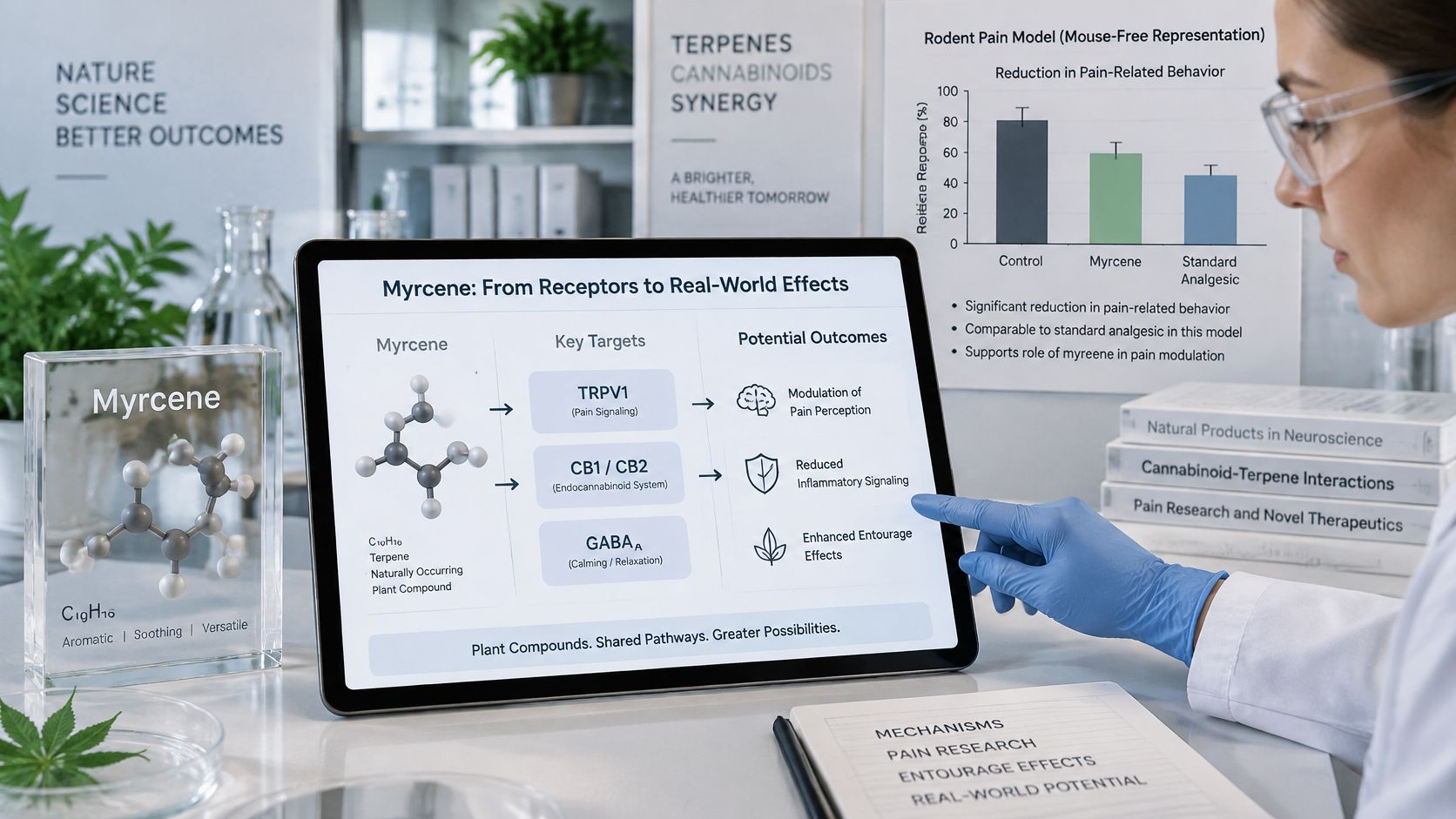
The preclinical picture runs through several pathways at once, as a review of myrcene's analgesic mechanisms describes. In rodent pain models, antinociceptive effects were partly reversed by naloxone and yohimbine, which points to endogenous opioid and noradrenergic signaling. Separate cellular work found that micromolar myrcene activated TRPV1 channels, producing a calcium influx that capsazepine blocked. Myrcene has also been associated with reduced prostaglandin E2-driven inflammatory sensitization. Promising mechanisms, all of them. None of them is a human outcome.
What the 2025 pain study added
In 2025, researchers reported that myrcene raised mechanical nociceptive thresholds in nerve-injured mice across intraperitoneal doses of 1 to 200 mg/kg, with greater potency in female than male mice, in a study published in the journal Pain, as UC San Diego's Center for Medicinal Cannabis Research summarizes. Two things follow. First, a sex difference in response gives anyone designing a trial a real variable to control. Second, an injected milligram-per-kilogram range in mice says nothing about a percentage in a cartridge.
The recorded walkthrough below covers the underlying science for teams that want the fuller picture.
Where the entourage claim stands
Product marketing often implies that adding myrcene reliably amplifies cannabinoid effects. The tested evidence is thinner. In a preclinical arthritis model, myrcene combined with CBD produced no significantly greater effect than myrcene alone, and cell studies that ran beta-myrcene, alone and alongside other common cannabis terpenoids, found no direct activation of CB1 or CB2 receptors and no change in THC signaling under the tested conditions. Additive or synergistic entourage effects remain unproven at the formulation level.
The discipline that follows is simple. Tag every claim you test with its evidence level, cell, animal or human, and keep it at that level in the copy. Before a blend page says a terpene "works with" a cannabinoid, run the isolate and the blend side by side in your own trial. When a spec sheet or sales sheet implies synergy, ask which model supports it. Our entourage effect explainer covers how those evidence levels are usually assigned.
Physical Properties That Shape Your Formula
Three values decide how myrcene behaves on your production floor. It's a volatile compound with the formula C10H16, it boils at 167 °C (332.6 °F) at one atmosphere, and its vapor pressure is 4.61 mmHg, according to PubChem's myrcene compound record. Read together, they describe a material that leaves an open container.
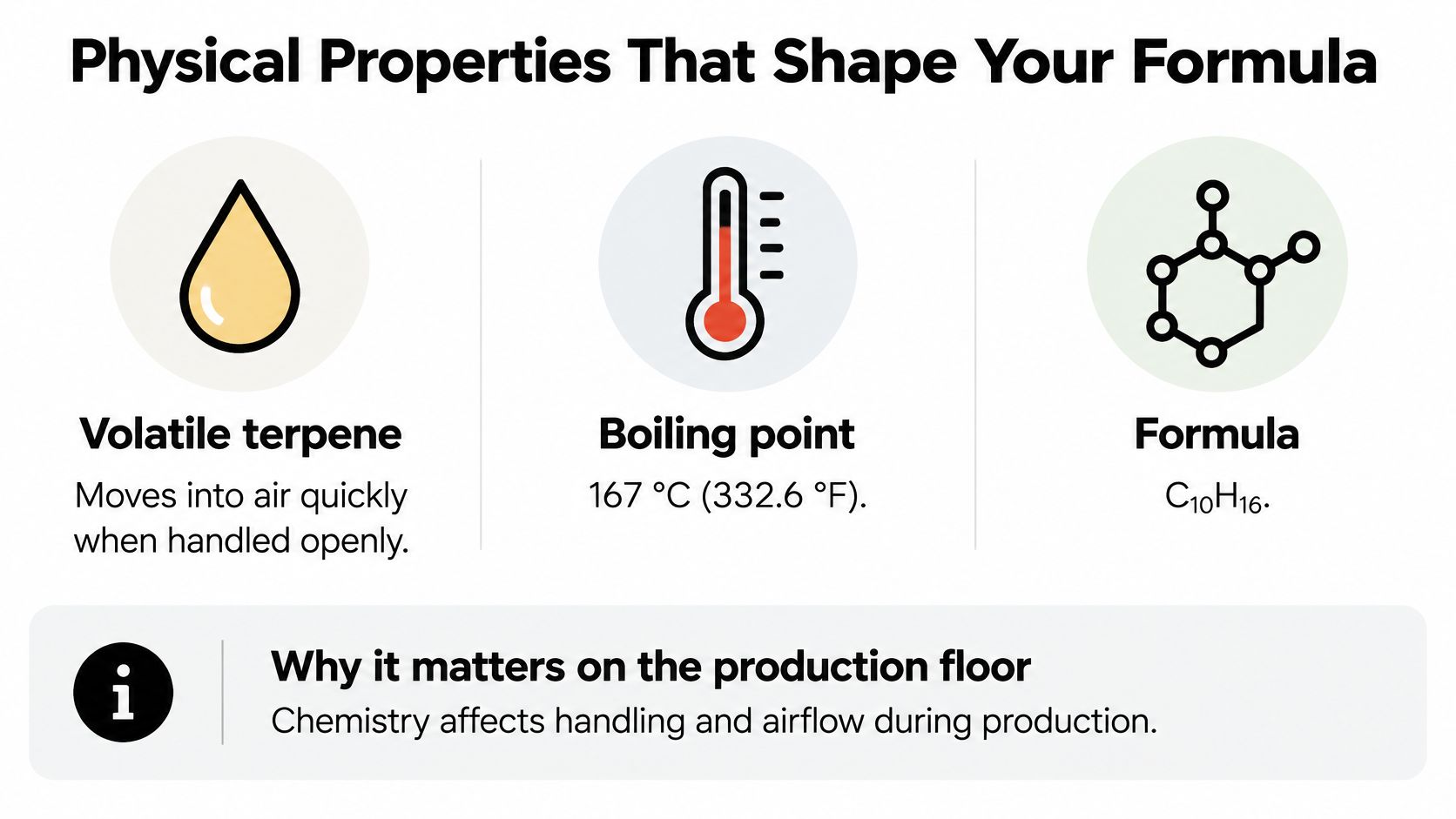
That's the practical consequence. A batch that smells right on the day you mix it can drift before it reaches a filling line, because the aroma has been migrating into the headspace of every container it touched. Closed-container storage, careful weighing and controlled blending into distillate or cartridge oil are what keep a spec stable.
A handling routine that matches the chemistry
- Weigh in a closed container. Tare, add, reseal. Don't weigh into an open beaker and walk away.
- Keep headspace small through transfers. Smaller containers, filled fuller, lose less to the air.
- Mix into distillate or oil promptly. Don't leave terpene sitting on top of a carrier while you set up the next step.
- Cap and store stock cool and dark. Light and heat both push degradation and aroma loss.
- Retest potency and aroma after mixing. The finished batch is the record that matters, not the pre-mix calculation.
Heat is the other lever. Hot processing steps drive aroma off, so keep them short and log the temperatures you ran. A short hot step with a recorded setpoint is repeatable. A long one that "felt fine" isn't.
These properties set storage and handling for every batch you run, not just the first pilot. Build them into the batch record and the routine survives staff changes.
How to Dose and Test Myrcene in Distillate and Carts
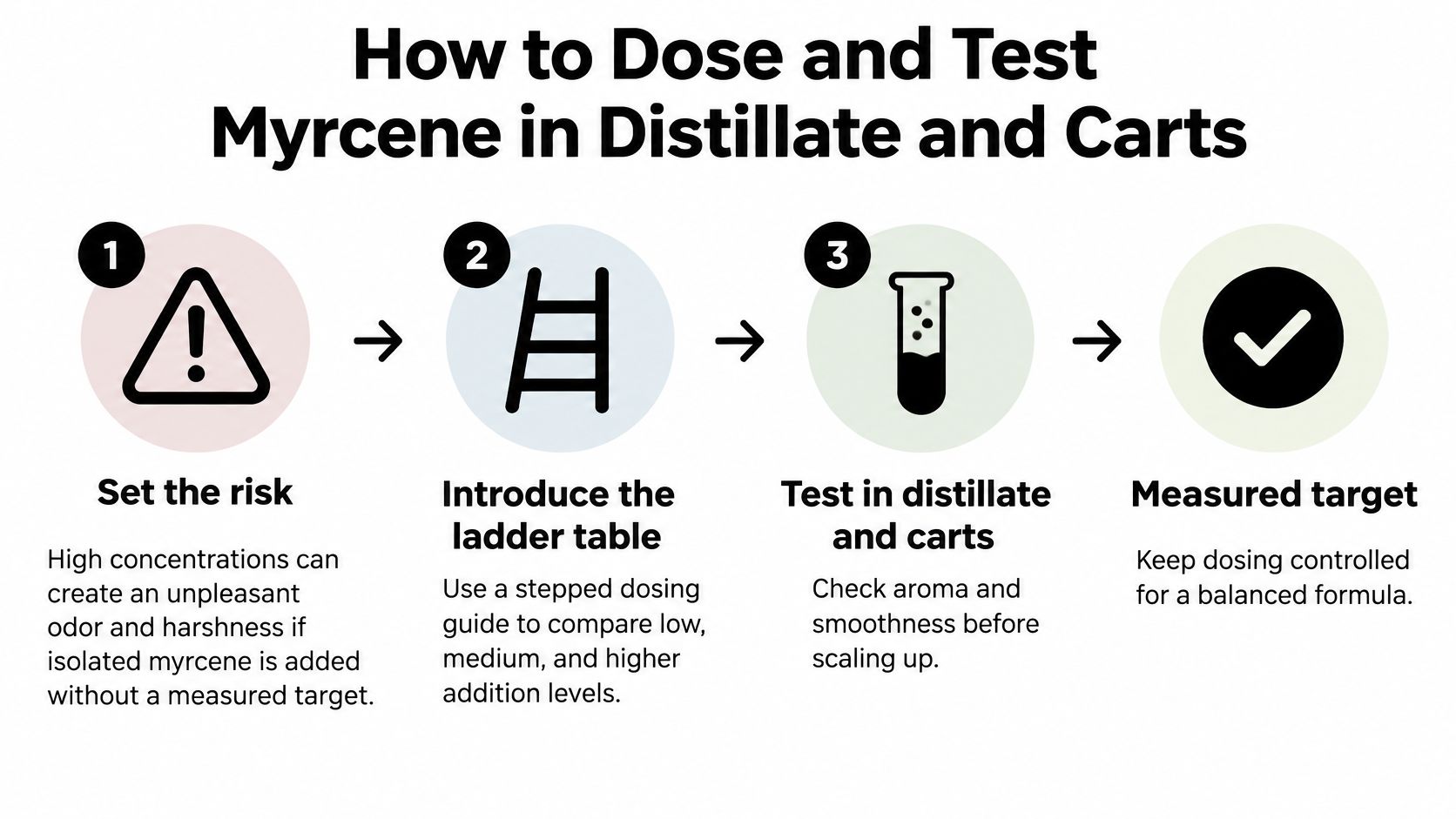
Myrcene is described in NOAA chemical-response data as having an unpleasant odor at high concentrations, and its molecular weight is 136.24, per the NOAA CAMEO chemical data sheet. That molecular weight is the figure to use when you convert between weight and volume on a batch sheet. The odor note is the risk warning.
Isolated myrcene added without a measured target turns a balanced formula harsh or overpowering in a hurry. The fix is a documented bench dilution, thorough mixing into the carrier, a recorded percentage, and a sensory check before anything gets scaled.
Starting shares by blend role
Use these as bench starting points, then confirm them with your own panel. They're not product specifications.
| Role in blend | Starting share | Sensory check |
|---|---|---|
| Accent note | 0.25% to 0.5% | Confirm the earthy edge does not dominate |
| Supporting note | 0.5% to 1% | Smell and taste again at 24 hours |
| Lead note | 1% to 2% | Watch for a harsh or overpowering finish |
The bench routine
- Write the target aroma profile first. Two or three descriptors, in order of prominence.
- Make a bench dilution in a small carrier sample. Never judge the neat isolate.
- Mix until uniform. Then mix a little more. Terpene sitting on the surface reads as harshness.
- Record the percentage and the lot number. Both, on the same sheet as the sensory notes.
- Check aroma again at 24 hours. Volatility means the first read isn't the final read.
- Scale only after the batch passes the sensory check. A pilot that fails at 50 grams will fail at 5 kilos.
Two formulation notes that change the numbers. Distillate holds little native aroma, so myrcene may need to rebuild the earthy base rather than sit on top of it. Cartridge blends also have to stay inside the viscosity and flow range your hardware requires, which limits how much carrier you can swap in to soften a note. Our guide to how much terpenes to add to distillate covers the arithmetic behind those adjustments.
Change one variable per trial. If you alter the percentage, the carrier and the mix time together, nobody on the team knows which change moved the aroma.
Compliance, Sourcing and Safety Documents to Request
A purchase order that says "myrcene" is not a specification. Match the identifiers below on every certificate of analysis before a batch is released, using the U.S. FDA food-substance database entry for beta-myrcene.
| Identifier | Value | Use in sourcing |
|---|---|---|
| CAS number | 123-35-3 | Confirms compound identity |
| FEMA number | 2762 | Compares flavor documentation |
| FEMA GRAS publication number | 3 | Traces the GRAS listing |
| JECFA flavor number | 1327 | Matches international flavor records |
The FDA database lists the technical effect as a "flavoring agent or adjuvant". That language describes flavor use and leaves inhalable finished products outside its scope, so keep the two categories separate in supplier review.
The regulatory split you have to ask about
U.S. rules treat naturally derived and synthetic myrcene differently, and the relevant listings have changed over time. A buyer cannot infer status from the word myrcene or from a flavor record alone; the FEMA flavor library entry for myrcene is useful for comparing flavor documentation, while your product category still decides what evidence is required. Ask the supplier to confirm in writing whether the lot is botanically derived or synthetic, which rule set it is sold under, and what market-specific guidance applies to the batch.
Ask what the safety sheet actually covers
Oral, topical and inhaled exposure cannot be assumed equivalent. Ask each supplier whether the safety documentation addresses inhalation or vape use at all. For any inhalable product, request concentration limits, thermal degradation data and inhalation toxicology before you commit to a run. Food and fragrance safety answer a different question from vape safety.
Send suppliers one packet request: source statement, certificate of analysis, the four identifiers above, safety sheet with route coverage, and written market guidance. Gold Coast Terpenes uses terpene information provided by SC Labs, publishes a Terpene Safety & Documents page for this paperwork, and keeps the standard regulatory line on product pages: statements there have not been evaluated by the Food and Drug Administration. The safety data sheet requirements guide shows what a complete packet looks like.
Request Samples Before You Scale Your Batch
The sequence that saves money is short and unglamorous. Run it in order, and run it before the purchase order goes out.
- Request the certificate of analysis and the safety documents listed in the section above.
- Source a bench-scale quantity and run the bench dilution at the accent, supporting and lead percentages.
- Confirm the aroma at 24 hours against the profile you wrote down first.
- Scale through the bulk program once the target profile holds. Orders above 64 oz carry discounts, and U.S. shipping is free over $100.
Gold Coast Terpenes supplies botanically derived terpenes and isolates, including myrcene, with myrcene variants priced from $27.00 to $220.00. The Pioneer Pack includes one bottle each of Beta Caryophyllene, Limonene, Myrcene, Linalool, Alpha Pinene and Terpinolene, so a single order covers six isolates for side-by-side trials in the same bench session. Profiles are grouped by attributes such as Relaxation, Inflammation, Pain and Focus/Energy, which gives your team a shortlist based on the effect the finished product needs.
Mouse data justified the trial. What myrcene does in your carrier, at your ratio, decides the batch.
Gold Coast Terpenes stocks botanically derived myrcene isolate and more than 50 strain profiles built for cartridges, distillate and concentrate work, all lab-verified and THC-free. Run the bench dilution on your own carrier, confirm the aroma against your target profile, then scale through the bulk and wholesale programs. Visit Gold Coast Terpenes to shop myrcene, blends and the Pioneer Pack.