
Drop by the mixing room on a Monday morning and the week's problems are usually sitting out in the open. A working bottle of blend, half full, cap turned but not sealed, parked where the afternoon sun lands on it. The batch you run Friday won't match the one you approved last month, and no amount of extra dosing will close the gap.
Most advice on how to store terpenes stops at three words: cool, dark, airtight. That's true and it's not enough. Monoterpenes and sesquiterpenes don't age at the same rate, a sealed bottle isn't a protected bottle, and "it still smells strong" is not evidence that the ratio is intact. What follows is the target, the routine, and the ranking of which molecules to protect first.
Storage Rules That Protect Terpene Quality
| Factor | Target condition | Why it matters |
|---|---|---|
| Temperature | Cool and steady at the supplier's specified temperature; refrigerate when the supplier specifies it | Heat accelerates both volatile loss and oxidation, and the damage accumulates over weeks |
| Light | Dark, opaque or amber packaging, away from windows and display lighting | Light drives monoterpene loss at room temperature, and faster still at warm temperatures |
| Oxygen | Tightly sealed, with minimal headspace | Oxygen pushes oxidation toward epoxides, alcohols, ketones and aldehydes |
| Container | Chemically compatible amber glass or UV-blocking packaging with a tight closure | Blocks light and limits oxygen transfer through the closure itself |
| Handling | No repeated warming and cooling | Temperature swings cause condensation inside the container and compositional drift |
The row that fails most often is light, and its damage is easy to miss. A 2012 study in Food Research International held four essential oils under three conditions: 23 °C in darkness, 23 °C under cool-white light, and 38 °C under cool-white light, with atmospheric oxygen present throughout. Rosemary oil lost monoterpenes fastest. α-terpinene fell below 10% of its starting level after three weeks at 38 °C under light, while the same three weeks at 23 °C in darkness left it stable. Pine oil followed the same pattern, with α-terpinene down to about 40% under the warm, lit condition against about 65% in the study's comparison condition.
Heat and light compound each other, so rank them together. Under both stressors a monoterpene degrades faster than it would under either one alone, and heat works the same way by itself: stability falls as storage temperature climbs. Compounds differ in volatility and oxidation sensitivity, so a single shelf life printed on a label can't be defended. A setpoint that protects the bulk of a blend can still leave its most fragile component exposed, which is why the target conditions have to be set against the molecules most likely to go first.
Audit this first: walk the storage area at midday and look at what the sun actually reaches. Windows, skylights, glass-front shelving and clear working bottles are the four failures I look for before anything else, and none of them show up on a temperature log.
A storage record needs temperature exposure, time at that temperature and light conditions alongside the manufacturing date. The manufacturing date tells you when the material was made. It says nothing about the afternoon the drum spent on a dock. The chemistry behind that loss is covered in our guide to terpene degradation.
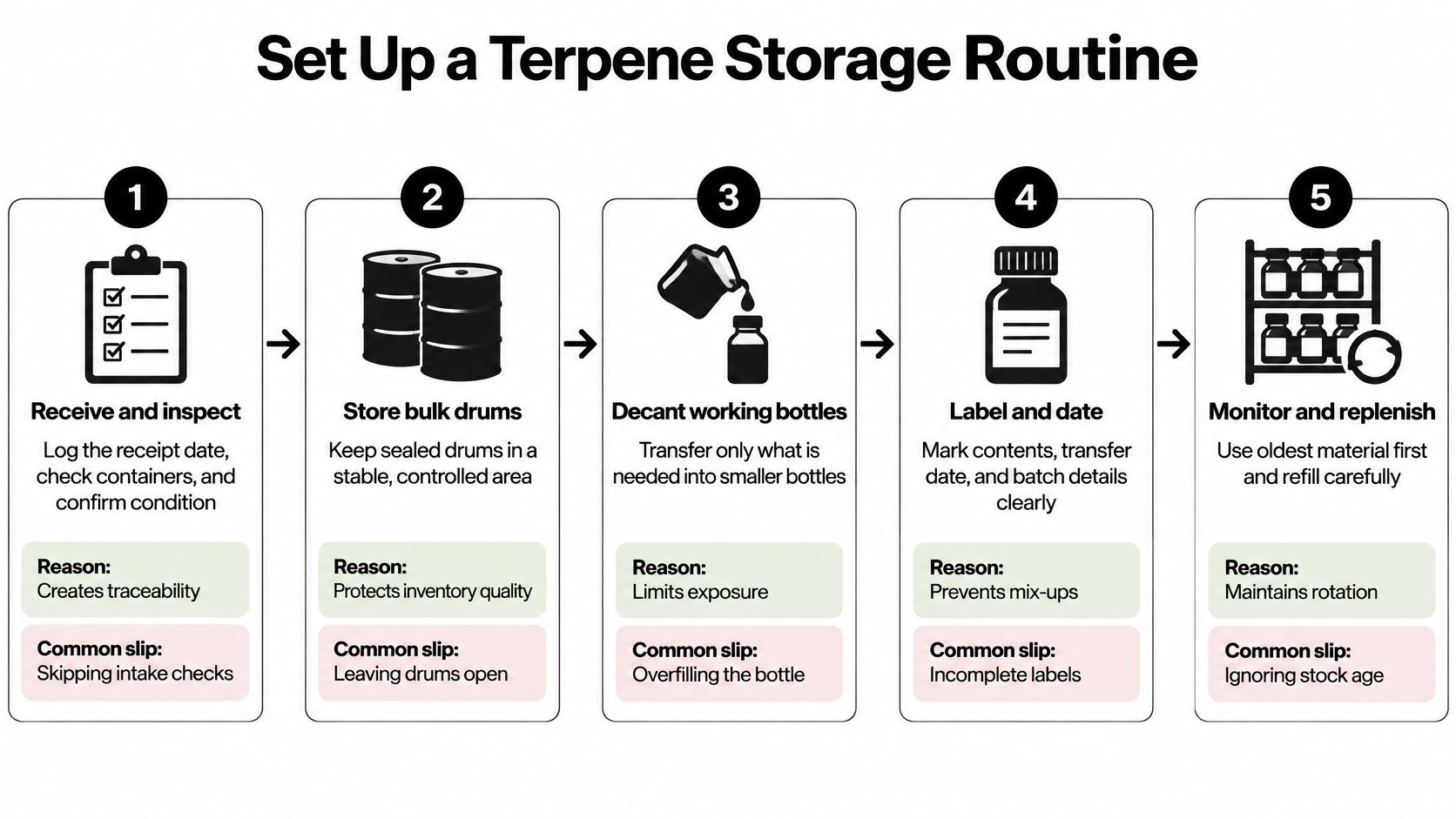
Set Up a Terpene Storage Routine
A documented routine beats a nominal shelf life every time, because it catches the handling failures a certificate of analysis can't. Run these steps in the order material moves through the building.
- Receive and inspect the same day. Log the receipt date, check seals and labels, and move containers into storage before the shift ends. A drum that sits on a loading dock through a warm afternoon has already had its worst temperature event.
- Match the container to the chemistry. Amber or opaque glass, or another UV-blocking package that's chemically compatible with terpenes, with a cap that seats flat. Clear plastic working bottles are the common single mistake, because they're cheap, unbreakable and completely transparent to light.
- Size the container to the volume. Bulk stays in sealed drums at the smallest practical headspace. Frequent-use material gets split into smaller working bottles so the reserve isn't reopened daily. A half-empty drum on the bench is an oxygen reactor with a lid on it.
- Label twice. Lot number, receipt date, opening date and storage location, on the bottle and in the batch log. Keep opened stock physically separate from unopened reserve so an analytical result traces back to one condition.
- Store cool, dark and steady, away from the work. Not beside the heat press, not under a skylight, not on the shelf above the mixing station. If the supplier specified refrigeration, refrigerate.
- Let it equilibrate, then dispense fast. Pull the container, let it reach room temperature while still sealed, then open it, measure only what the batch needs with clean dry tools, and reseal. Opening a cold bottle in a humid room puts condensation straight into the blend, and a cap left off during a long run does more damage than the dosing step.
- Rotate and record. First-expired, first-out. Note color, clarity, viscosity and aroma at every opening. Inert-gas blanketing suits high-value bulk, but only where it's technically and legally appropriate and validated for container compatibility and product safety.
Terpene information for our products comes from SC Labs, and the reference documents sit on our Terpene Safety & Documents page, so a batch log can point to a real specification instead of a memory. Rotation discipline gets more detail in our inventory management tips.
Healthy stock looks boring. Same color, same clarity, an aroma that lines up with the retained standard, no cloudiness and no viscosity shift. Temperature is where drift shows first, and the gap is not subtle. A 2023 review on terpene and essential-oil stability reports rosemary essential oil stored for 12 weeks at 38 °C reaching a peroxide value 8.2 times its starting level, against 4.2 times at room temperature. Parking the same oil in a warm spot roughly doubles its oxidation. That gap is what steps 4 and 7 exist to explain: when a lot drifts, the opening date, storage location and condition notes tell you whether the bottle or the room caused it.
Limiting Air Contact in Working Bottles
Say a cartridge operation runs three SKUs a week. The top-note working bottle gets pulled, dosed and set back down a dozen times a day. By week three it's half full, still in service because the nose test passes, and the batch it goes into no longer matches the approved standard. This is an air-contact problem, not a formulation problem.
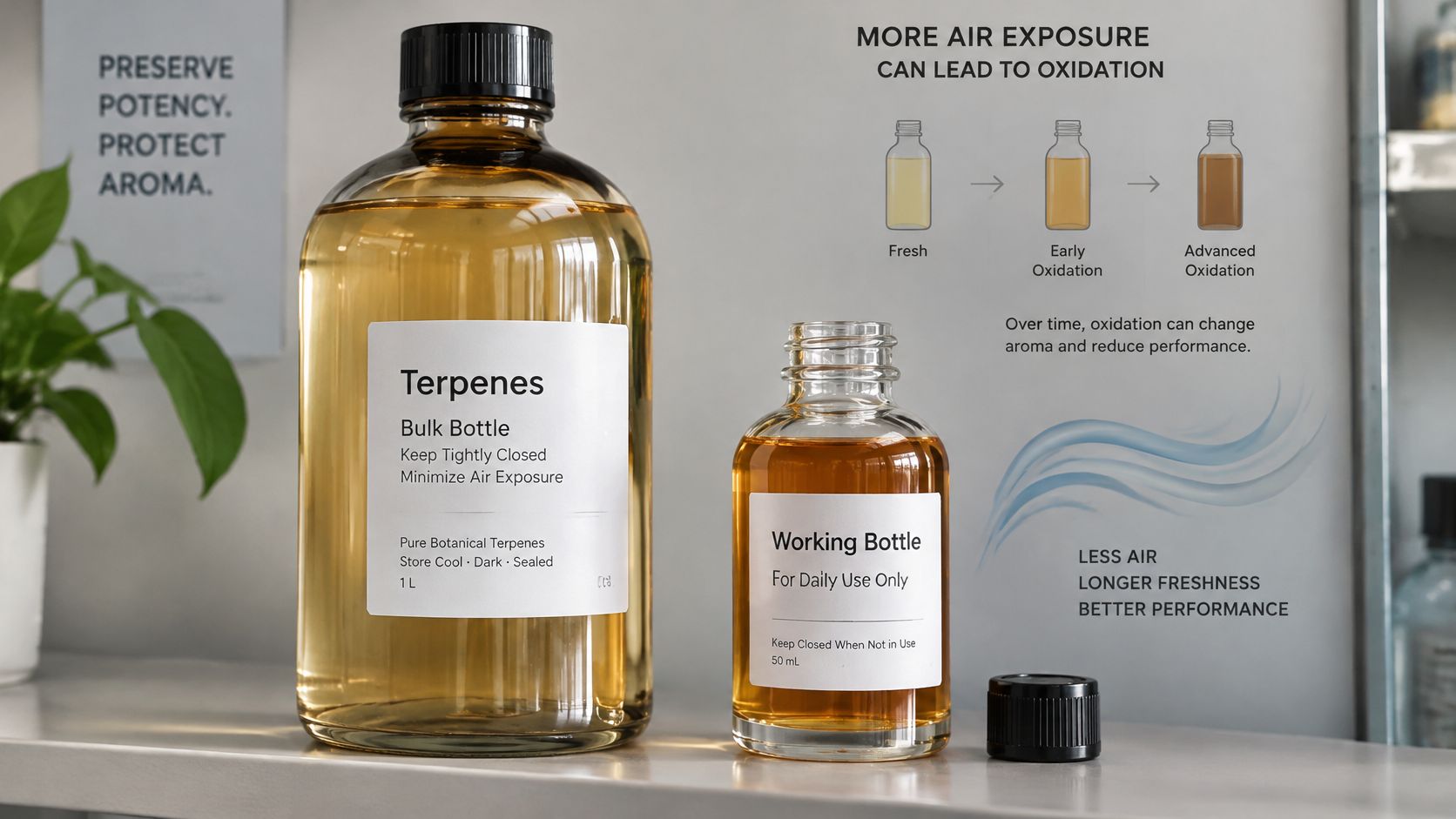
Terpenes oxidize, and the products of that reaction, including epoxides, alcohols, ketones and aldehydes, change aroma, flavor and chemical performance. Each opening draws fresh air into the headspace, and a half-full bottle carries more of it than a full one. A 2023 review in Polymer Bulletin shows what that exposure does over time. Marjoram essential oil stored in light for more than three months showed substantial compositional change, accumulation of oxidative compounds and loss of organoleptic quality. A Satureja montana oil changed under high temperature and air but stayed comparatively unchanged in an inert atmosphere.
The cap matters less than the air trapped under it. A 2025 storage study found oxidative degradation was a possible cause of terpene loss even in vacuum-sealed bags, where oxygen exposure and evaporation had already been reduced (PMC storage study). The working number is air exchanges across the life of the material: how often the bottle opens, how much headspace it carries, how long it sits between pulls. A blend built around faster-oxidizing components shows the drift sooner, which is why the same bottle routine holds for some materials and fails others.
The test that catches drift
A blend that still smells strong can still have lost its chemical integrity. Odor tells you the loudest compounds are present. It says nothing about whether the ratio survived intact.
For high-value stock, confirm with GC-MS against the retained standard, or track peroxide value as an oxidation marker, before the blend enters a batch. Run that check on the half-used working bottle as well as the sealed reserve. Drift accumulates in the bottle that gets opened, and that check is what stops a bad lot from becoming a bad production run.
The walkthrough below covers the handling side of the same problem.
Smaller working containers reduce repeated oxygen ingress into the main supply, and they make the drift visible earlier. Decant a week of material into a bottle sized for that week and keep the reserve sealed, and the bulk sees a fraction of the openings. Our guide to preventing oxidation in terpenes covers the container and closure choices that limit it.
Why Terpenes Age at Different Rates
| Terpene | Relative sensitivity | What the research shows |
|---|---|---|
| Limonene | High; unsaturated | Forms limonene-1,2-epoxide, carveol and limonene-1,2-diol during storage |
| Myrcene | High among monoterpenes | Monoterpenes generally decline faster than sesquiterpenes |
| α-terpinene | High | Temperature is the main driver of degradation; UV light accelerates it |
| β-pinene | Moderate to high under UV | One of the weaker performers under sustained UV exposure |
| α-pinene | Lower under UV | Held up far better under the same UV exposure |
| γ-terpinene | Lower when protected from light | Degrades more slowly when kept from light |
| Sesquiterpenes (group) | Lower than monoterpenes | Generally decline more slowly during storage |
The pinene rows show why a single rule fails. After 18 days under UV exposure, β-pinene kept 75% of its starting level while α-pinene held 94% (UV stability study). Same light, same duration, same family, very different losses.
Use the table to set priorities. The compounds near the top set the ceiling on how long a blend holds its intended ratio, and they're the ones worth spending packaging money on.
The molecule-specific behavior is what makes one universal rule useless. Monoterpenes such as myrcene and limonene generally decline faster than sesquiterpenes during storage, and limonene specifically forms limonene-1,2-epoxide, carveol and limonene-1,2-diol as it oxidizes (Molecules, 2025). Temperature drives α-terpinene degradation hardest, while light protection buys γ-terpinene more time. A six-month lavender study tells the same family-level story: terpene hydrocarbons decreased while oxygenated terpenes increased in some storage systems (Scientific Reports, 2023).
What the ranking changes in practice
A blend can shift in aroma while the bottle stays sealed, because the most volatile or unsaturated components convert or leave first. Three habits follow from that.
- Classify isolates by sensitivity when you build a formula, so the limonene and myrcene portions get smaller working bottles and tighter handling than the sesquiterpene fractions.
- Track blends by their most sensitive component. Total terpene volume can pass a receiving check after the ratio has already drifted.
- Separate sensory decline from safety-relevant oxidation. Flattened top notes are a quality problem. Accumulated oxidation products are a different problem, and a smell test won't distinguish them.
That last point is why a flavor match against a retained standard catches what a nose test misses. The chemistry behind it sits in our guide to terpene chemistry.
Cartridge makers and extractors buying bulk feel this most. Long formulation cycles keep one container in play for weeks, and the blend most likely to drift is the working bottle on the mixing bench, opened and resealed every shift while the sealed reserve waits.
Confirm Your Storage Plan and Request Samples
Four actions, in order, starting this week.
- Audit one storage area against the first table. Start with light and temperature, walk it at midday, and write down the readings. One area, not all of them.
- Open a batch log for every container. Lot number, receipt date, opening date, storage location, and a one-line appearance and aroma note at each opening. Add the analytical result when you pull one.
- Ask for documentation before you buy volume. Certificate of analysis, recommended storage conditions, and a clear statement of what the material is and is not cut with.
- Test the match, not just the smell. Take a small first order of one profile, split it between two working bottles, store one by the routine and one badly, then run a side-by-side flavor match against your retained standard at the end of the month. That comparison tells you more about your facility than any spec sheet.
If you want a specific profile to run that test against, 24k gold punch is one of the blends we supply. The Mixing Calculator and Terpenes 101 pages cover dosing ratios and the basics. When you are ready to talk through a first order, bulk pricing, or a custom blend, the team is at 929-356-6086.
Gold Coast Terpenes supplies terpene blends, strain-specific profiles, and isolates for cartridges, winterized distillate, and flavor work. The terpenes are extracted from fresh plants and are free of mixtures, chemicals, and additives, with no VG, PG, PEG, or MCT in the cartridge line, and every product is SC Lab-tested. Visit Gold Coast Terpenes to shop blends, pull the safety documents, or price a bulk order.