
You have a sample bottle on the bench, a target profile in your inbox, and a launch date that hasn't moved. You need bright lemon with a light sweet finish, the hardware is already locked, and someone on the call wants to know whether the concentrate is fine to inhale at that wattage. The spec sheet in your hand doesn't answer the question.
That gap is where most flavor work gets stuck. A concentrate can smell exactly right and still be the wrong choice: too heavy for the coil, unstable in the base, or carrying an ingredient nobody screened for inhalation.
So treat flavor as three linked decisions. Sensory match gets you the note. Loading level gets you the strength. Inhalation screening is what lets you ship it. Each one is testable on a bench, and none of them can be signed off from a label.
What Flavor Concentrates and Terpenes Each Do
A flavor concentrate is a dosed aroma ingredient. A manufacturer blends a small measured amount into a carrier, and it sets the taste and smell of the finished product. A terpene is a narrower thing: one family of aromatic molecules that plants produce, and the source of much of the character a profile carries. Limonene reads as citrus. Myrcene reads as earthy and ripe. Those molecules typically sit inside a concentrate rather than replacing it.
The kitchen version is the fastest way to place the four ingredient types. The base is the dish. The concentrate is the seasoning you weigh in. Terpenes are the individual spices inside that seasoning. Change the dish, change the seasoning, or dial a single spice, and you're making three different moves.
Here's how the types line up.
| Ingredient | What It Adds | What to Check on the Spec Sheet |
|---|---|---|
| Single isolate (e.g., limonene, myrcene) | One clear, traceable note | Purity and botanical origin |
| Terpene blend | Layered profile built to a target | Full composition and lot records |
| Flavor profile (e.g., blueberry, lemon, peach) | A ready-made flavor direction | Dilution guidance and intended use |
| Diluent or carrier (e.g., winterized distillate, MCT oil) | Body and carrying capacity | Compatibility with the terpene blend |
Two points matter on the buying side. Terpenes in this category are botanically derived, so they start from plant material, and that origin belongs in the ingredient record a buyer reviews. Concentrates also arrive far stronger than the finished product, so nothing here is a pour-from-the-bottle input. You build the product by blending and dosing.
Flavor is a product-design variable, not a finishing touch. In the 2023 National Youth Tobacco Survey, 89.4% of current youth e-cigarette users reported using a flavored e-cigarette in the preceding 30 days, and fruit was the most common category at 63.4%. Meanwhile the CDC Foundation's December 2023 sales brief relays the FDA's September 2024 statement that it had issued marketing denial orders for more than 20,000 flavored e-cigarette products since December 2023, while 23 devices and tobacco-flavored products had been authorized. A profile that sells is not automatically a profile you can market.
How Terpenes Build a Flavor Profile
A few dominant terpenes set the first impression. The minor ones fill in depth and finish. Give a new formulator that rule before they touch a scale, and most of the guesswork about where to start disappears.
The map below is the one worth pinning above the bench, because it shows how individual isolates line up against the notes they carry.
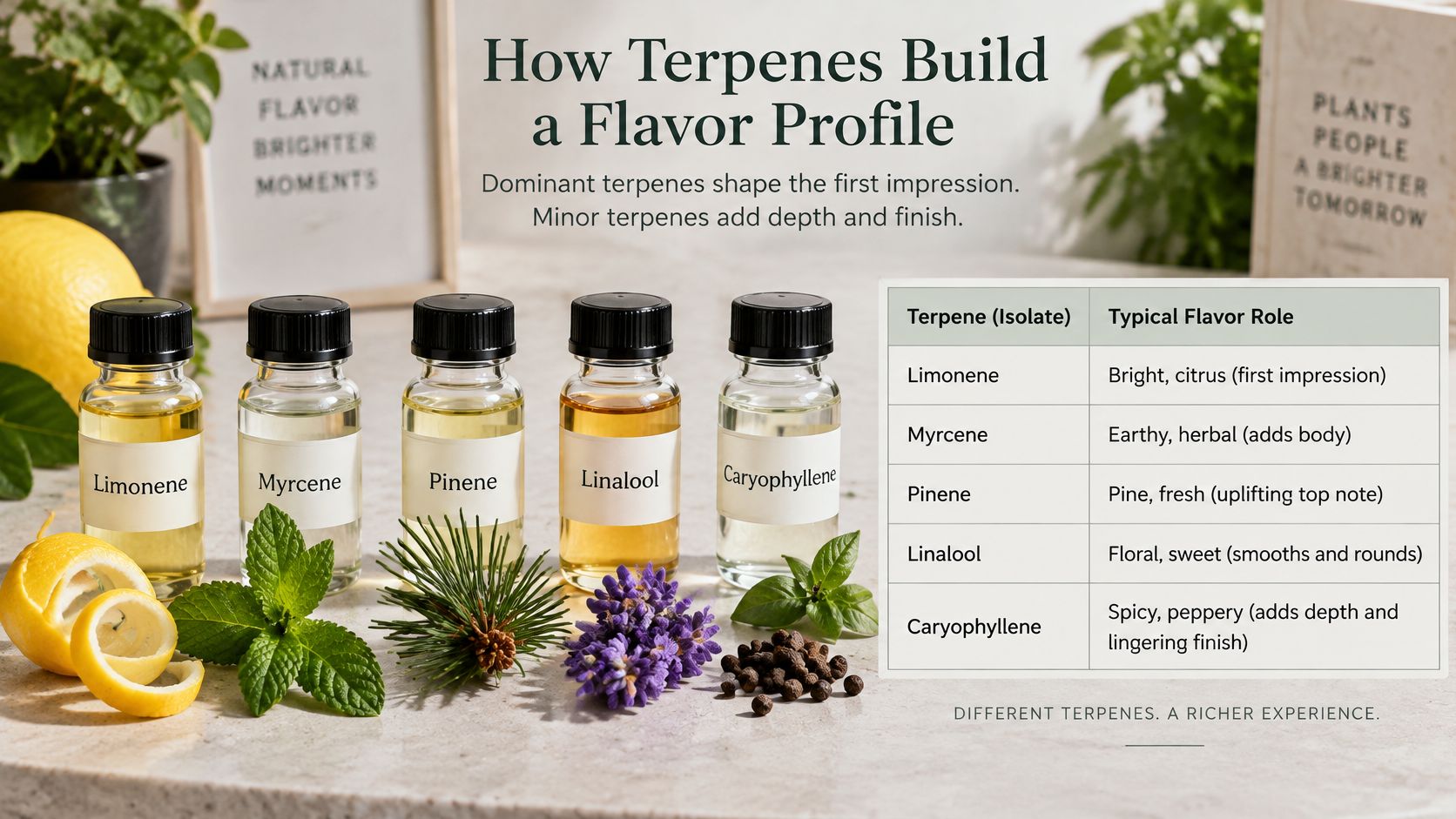
Layering works like a painter's palette. Two or three terpenes make the base, and one accent gives it brightness. A blueberry target rarely comes from a single compound. You get closer with a fruity base and a green, earthy layer underneath, which keeps the whole thing from reading like candy.
| Terpene | Typical Note | Common Use in a Blend |
|---|---|---|
| Limonene | Bright citrus, lemon, orange | Citrus top note or accent |
| Myrcene | Earthy, herbal, ripe fruit | Base layer for fruit profiles |
| Linalool | Floral, lavender-like, sweet | Floral lift in sweet or grape-style blends |
| Beta-caryophyllene | Peppery, spicy, woody | Warm depth and finish |
| Terpinolene | Fresh, piney, floral | Fresh, clean top note |
Shortlist from a terpene flavor chart before you open a bottle, then let the table above tell you which molecules are doing the work.
A single isolate usually tastes thinner than a blend, because one molecule has no depth behind it. What lands in the cart also depends on the carrier and the heat it sees at the coil, and both move the note. The chart gives you a starting point, not a result.
Here's the difference between a chart and a formula.
Confirm the match with a blind panel before you write a formula around it. Three tasters, coded samples, one question: does this hit the target? Note charts are guides, not guarantees, and tasting your own batch is the only thing that closes the loop.
How to Handle and Screen Concentrates Safely
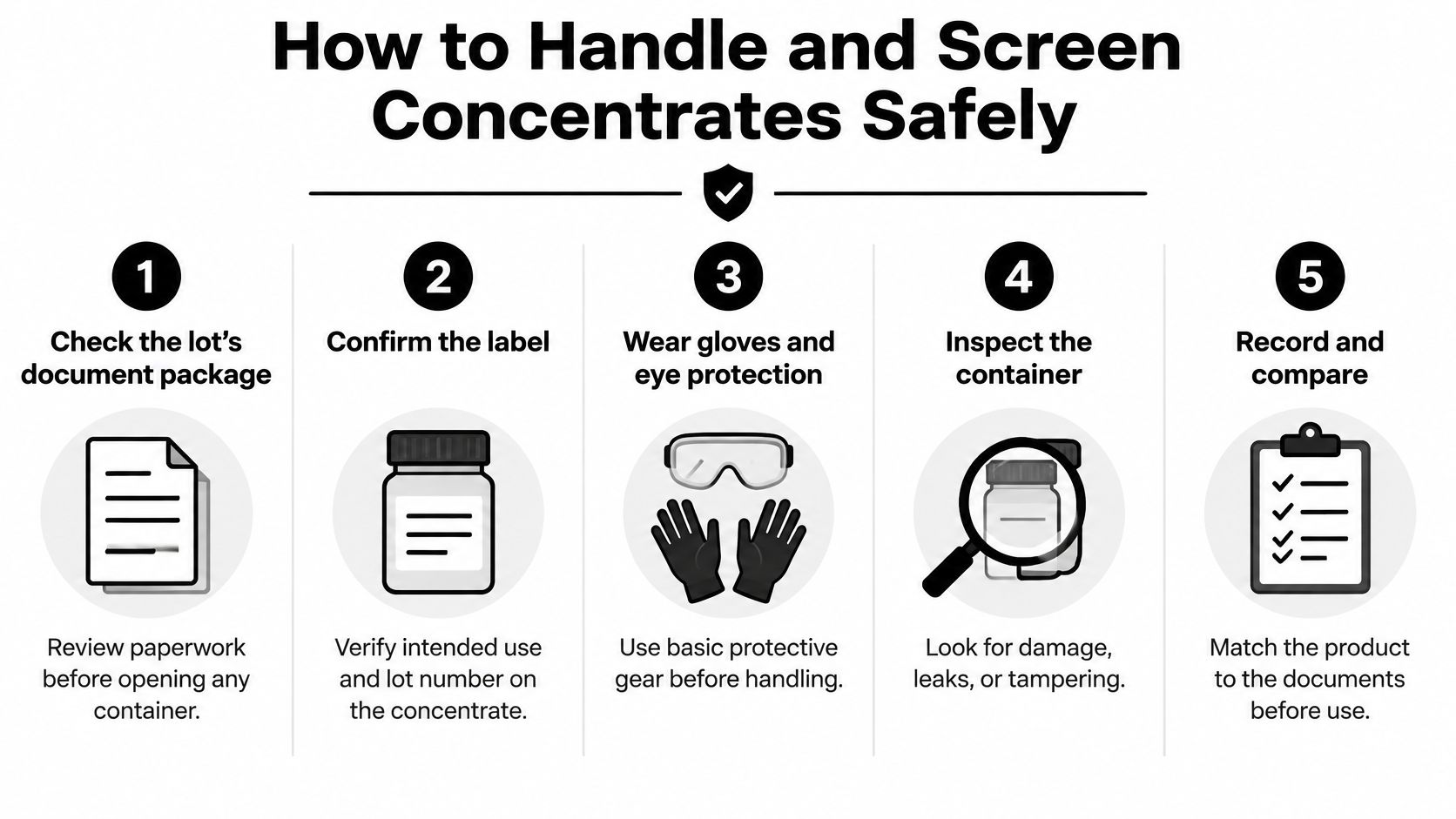
A concentrate can smell right at the bench and still fail in aerosol, so handling, loading level and inhalation screening stay linked from the first container. Run the steps in a fixed order before anything gets weighed, written tightly enough that a second person can repeat them without asking what you meant.
- Check the document package first. Lot certificate, composition and safety data before any container is opened.
- Confirm the label. Intended use and lot number, matched against the paperwork on the bench.
- Wear gloves and eye protection, and work in a ventilated area with the bench clear.
- Keep concentrates away from food and drink, and use dedicated tools that never travel to the kitchen.
- Weigh by mass, not volume. Record every addition on the batch sheet as you make it.
- Dilute to the recipe. Neat concentrate is many times stronger than the finished liquid.
- Screen for inhalation risk separately from food status. More on this below.
- Run aerosol testing on the intended hardware before anything scales.
- Clean spills with suitable absorbent and log the waste.
Step 7 is the one that gets skipped. The FDA's chemicals in tobacco products page notes that e-cigarettes may contain flavorings such as diacetyl and acetoin, and states that these substances can be safe to eat but harmful when inhaled. That reframes a whole purchasing habit: food-grade or GRAS status does not clear an ingredient for a cart, and a botanical label still needs the same review. If your team is still working through which materials belong in a cart at all, are terpenes safe to vape covers the ground rules.
The five-step graphic below condenses the routine. The paperwork side sits in steps 1 and 2: lot certificate, composition, safety data, intended use and lot number.
The instrument matters as much as the rule. Thermal degradation experiments on flavorants found that higher temperatures increased formaldehyde and acetaldehyde emissions from cinnamaldehyde and menthol and raised benzene formation, while the same flavorants produced higher benzoic-acid levels at lower temperatures. Temperature changes which reactions occur, not only how much forms. GC-MS or equivalent analysis of aerosol carbonyls, run at your operating power and puff duration, shows that on your own product instead of a supplier's.
How to Choose a Flavor and Set Its Loading
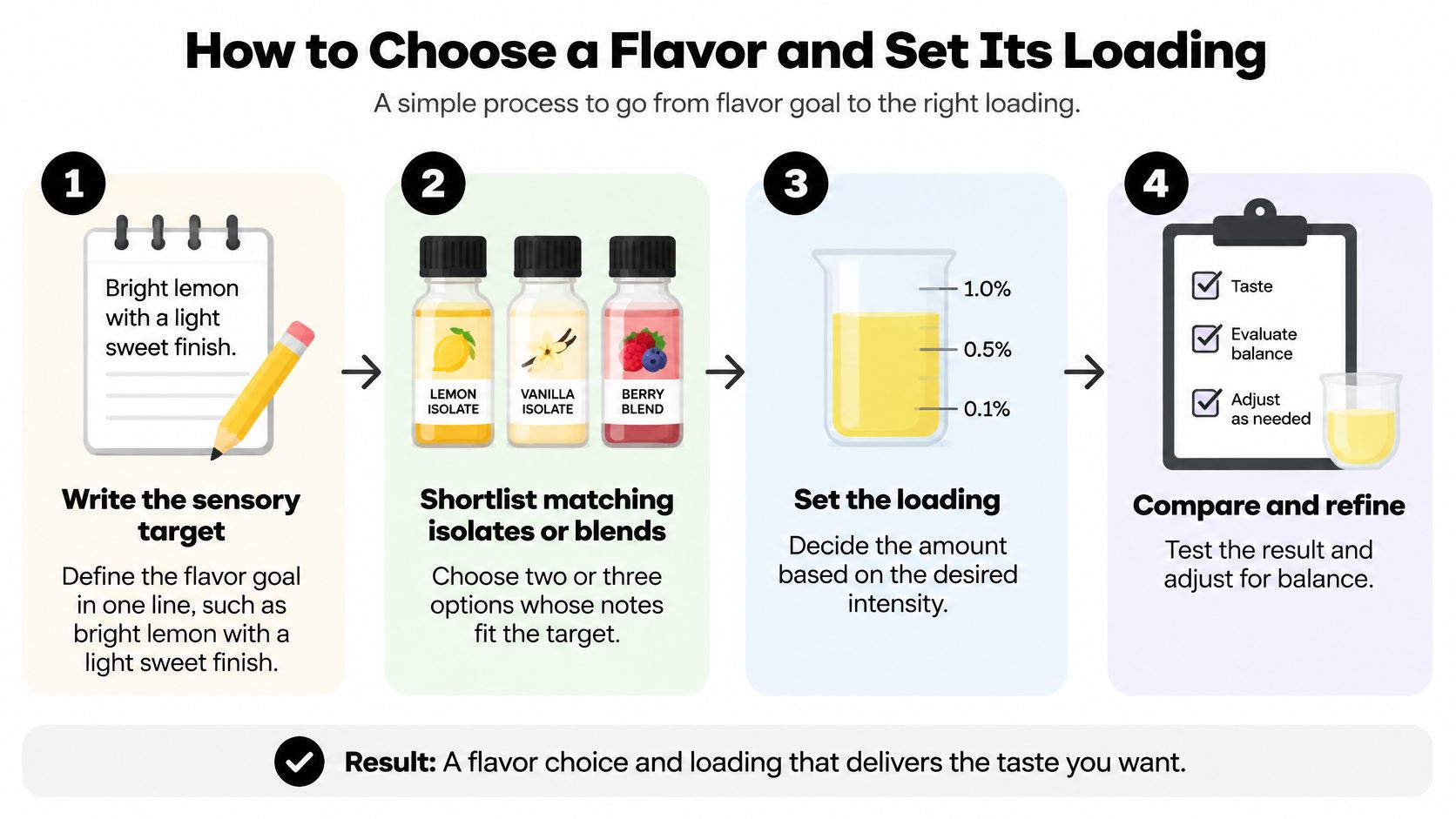
Choosing a flavor and setting its loading is a sequence, and the order matters more than the sophistication of the equipment. Treat it as three linked decisions: the sensory match, the loading level, and the inhalation screen that loading has to pass. A blend that tastes right at a level that fails screening is a data point, not a recipe.
- Write the sensory target in one line. Bright lemon with a light sweet finish beats a page of adjectives.
- Shortlist two or three isolates or blends whose notes point at that target.
- Start low. Dose at the bottom of the plausible range and work up.
- Calculate by mass. 3% of 1,000 g of distillate is 30 g of terpene blend. 5% is 50 g. Record the grams, not the percentage alone.
- Mix three small batches in steps of about 1% and label each with loading and date.
- Record color, viscosity and aroma for every batch on the same day, under the same light.
- Run a blind panel and pick the lowest loading that clearly hits the target.
- Send that loading to compatibility and aerosol testing before you scale it.
Set the loading by mass, never by feel
Starting low gives you room to find the target before the aldehyde load climbs. Measurements across flavored and unflavored e-liquids found that thermal decomposition of flavoring compounds was a major contributor to aldehyde formation, and that aldehyde production increased exponentially with flavoring concentration, in some cases reaching ninefold increases and exceeding occupational exposure standards. Screened at three loading points, the pattern looks like this:
| Test point | Loading by mass | Reported effect |
|---|---|---|
| Unflavored control | 0% | Baseline carbonyl level |
| Low screen | 7.5% | Carbonyl emissions increased |
| High screen | 15% | Increases reached as high as ninefold |
Doubling the loading more than doubles the carbonyl burden. That is why the panel's job is to find the lowest percentage that hits the target, and why the number it lands on goes straight to the emissions bench before it goes anywhere near production.
Why more concentrate rarely fixes a flat note
If a batch tastes flat, raising the percentage is the reflex and usually the wrong move. Pouring in more of the same blend lifts everything at once, including the parts the panel rejected. Adjust the note mix first: add a small amount of the accent isolate, or split the base between two blends that lean in different directions, and keep the total loading where the panel approved it. Every extra percent is also more material your aerosol screen has to clear, so a flat note fixed with a heavier pour often just trades a sensory problem for a compliance one.
The four steps below are the ones to draw on the whiteboard before the next batch.
One last check before you lock the recipe. Let the batch rest, then taste it again. Some notes round out and some go quiet, so the profile your panel approved on day one can drift by the time it ships. A flavor that wins the panel at a loading that fails screening goes back to the shortlist, not into production. If you're still working out the ratios, how much terpenes to add to distillate walks through the arithmetic.
Checking Compatibility With Distillate, Diluents and Hardware
A bench check comes before a device check, and neither one is optional.
Winterized distillate holds little native terpene content, so the profile has to be reintroduced. Mix at room temperature until the liquid is fully clear, then look at three things: haze, layering, and flow rate through the nozzle or syringe you'll fill with. A blend that separates overnight will separate in a cart too.
Mixing into distillate without haze
Haze usually means the blend isn't fully in solution. Layering means it won't be at that ratio. Slow, gentle mixing in a warm room solves more of these cases than extra agitation does. Cold distillate is the other common cause, so bring the base to room temperature before anything goes in.
| Base or System | What to Check | Main Risk |
|---|---|---|
| Winterized distillate | Viscosity and flow at room temperature | Thick, slow flow or separation |
| MCT oil diluent | Clarity and stability after mixing | Haze or layering over time |
| PG/VG e-liquid base | Full ingredient list and PG/VG ratio | Reactions with aldehyde flavorings and higher emissions |
| Disposable device | Heat output of the fixed coil | Emissions differ from bench results |
| Refillable cartridge | Coil resistance and power range | Burnt or off-tasting hits at high power |
Treat terpene loading as a measured variable. The emissions data behind the loading table shows carbonyl output climbing with the terpene share of the liquid, so the figure that matters is the percentage in the final mix, whether you're adding a botanical terpene blend or an isolate mix. The arithmetic has to run on the combined mass. Add 30 g of blend to 1,000 g of distillate and you have 30 g of blend per 1,030 g total, or about 2.9% by mass. That's the figure that belongs on the batch sheet.
Where the hardware changes the answer
The same concentrate behaves differently in a disposable, a refillable cart and a high-power rig. A study comparing flavor classes across power levels and PG/VG ratios found that flavored liquids generally produced more carbonyl emissions than unflavored controls, and that terpene-based flavors produced up to twice as much formaldehyde and up to eight times as much acrolein under some conditions, with emissions frequently exceeding short-term exposure limits.
That's why you screen the finished liquid in the finished device rather than the bulk blend alone. A profile that clears the taste panel has passed one of three checks; the loading still has to be verified against the combined mass, and the vapor data has to come from the coil that ships. When the base lot, the PG/VG ratio or the coil changes, your existing data stops describing the product. Retest it. If you're narrowing down hardware, this guide to choosing a vape cartridge for your formulation covers the practical side of the match.
Storage and Aging Controls That Protect a Recipe
Flavor intensity tells you almost nothing about stability. A batch that still smells strong after three months on a shelf can have converted a large share of its aldehyde notes into something else, and the label on the bottle won't show it.
Controls first, in the order that does the most work.
- Opaque containers. Light is the fastest-acting of the common degraders.
- Cool and dark. Room temperature is the facility default, and it isn't doing the concentrate any favors.
- Low headspace, low oxygen. Fill closer to the shoulder and purge where your process allows.
- Lot-specific dating. A blend's age at mixing shifts the finished result.
- Compatibility testing on the base, not only on the concentrate.
What the aging data actually shows
A 24-month naturalistic study of flavor chemical stability found flavor chemicals were least stable when stored at ambient temperature and exposed to light, and the researchers concluded that dark and colder storage improved flavor stability. The same work found that aldehyde flavorings such as benzaldehyde, cinnamaldehyde, citral, ethylvanillin and vanillin reacted with PG after mixing, with up to more than 40% converted into aldehyde-PG acetals, and 50% to 80% of those acetals carried into the vapor during testing.
That second finding matters to anyone working in a PG-containing base. The note you measured at mixing isn't the note in the cart.
There's a wider effect too. A separate 2025 study of terpene-containing emissions found that indoor aging increased ultrafine particles and highly oxygenated compounds, with terpene ozonolysis identified as the main driver of the particle-number increase.
A recipe is chemically equivalent after storage and repeated heating only when the lab data says so. Flavor intensity is not that data.
Set a re-test schedule and hold to it: at 3, 6 and 12 months, plus a re-test whenever the base lot, the blend lot or the storage conditions change.
Request Samples and Documents Before You Buy
A sample request is cheaper than a bad production run. Treat it as three linked checks: the panel has to pick the profile, the recipe has to hold at the chosen loading, and the aerosol screen has to stay clean.
Ask for the package you would expect for any ingredient that ends up in a cart:
- A certificate of analysis listing the full composition of each blend rather than a headline figure.
- A botanical origin statement, so the ingredient review has something to point at.
- Lot numbers and dates that match what ships.
- Contaminant and residual-solvent results where they apply.
- A complete ingredient statement covering every diluent, including the ones you would assume.
California's guidance on requirements for inhaled cannabis products makes a useful template even if you sell elsewhere. Added terpenes do not have to come from cannabis there, but they must be naturally occurring, consistent with the terpenes found in the product, and contributing to its natural flavor or aroma. A supplier who cannot give you composition and origin at lot level leaves you unable to support that kind of review.
Gold Coast Terpenes' terpenes for cartridges are SC Lab-tested and contain no VG, PG, PEG or MCT. Every strain is highly concentrated and needs proper dilution before use, so the loading work belongs before the order form.
To compare profiles without committing to a case, the 3ml Strain Picker Pack lets you select any three terpene profiles in 1.5ml or 3ml sizes; its listed uses are terpene testing, custom vape or tincture formulation, and comparing Indica vs. Sativa effects. For a fruit-forward target, pull a profile from the Elevated Strains line as a sample so the panel can score it beside single isolates. Order at full strength, run your own loadings, and let the aerosol results make the call.
Gold Coast Terpenes supplies 100% natural terpene blends, isolates and flavor-oriented profiles for cartridges, distillate and product formulation, with the lot documentation a formulation review can request. Run sensory, loading and aerosol screens on samples before a bulk commitment. Visit Gold Coast Terpenes to browse blends, ask for samples, or start a bulk or custom order.