
Most advice about the entourage effect starts with a conclusion: combine THC, CBD, and a terpene blend, and the whole will work better than any isolate. That conclusion is attractive for strain replication, full-spectrum extracts, and vape cartridge development, but it's too broad for a formulation lab.
The more useful answer to what is entourage effect is narrower. It's a hypothesis of compound interaction, not a universal clinical rule. Some combinations may alter a finished product's sensory profile or biological activity, while others may do nothing measurable. Recent reviews describe the evidence as contradictory, equivocal, and inconclusive, with insufficient support for a stable, predictable, clinically proven effect (2023 scoping review, 2024 technical review).
For formulators, that distinction changes the workflow. Instead of treating a terpene list as proof of synergy, you can define a target cannabinoid matrix, choose a lead terpene, control volatility, build matched controls, and test whether the finished blend changes aroma, vapor character, or panel response. The result is a more defensible strain-inspired terpene blend, whether you're developing an extract, replicating flavor, or formulating for vape cartridges.
The Marketing Version vs the Lab Version of Entourage
The marketing version says that a whole-plant extract naturally outperforms an isolate because every compound supports every other compound. Labels often compress that idea into phrases such as “full-spectrum synergy” or “the complete plant experience.” Those phrases may describe a product philosophy, but they don't establish that a particular cannabinoid-terpene combination produces a predictable result.
The laboratory version began elsewhere. The original entourage concept described interactions among endogenous compounds, not a blanket rule for every botanical mixture. In cannabis product development, the term later expanded to cannabinoids, terpenes, flavonoids, and extract matrices. That migration created a useful research question, but it also encouraged claims that went beyond the available data, a problem identified by reviews of the concept's scientific evolution (historical review).
Marketing Claims vs Lab Reality
| Claim on the Label | What the Lab Shows |
|---|---|
| Full-spectrum material always works better than an isolate | The evidence for a predictable cannabis entourage effect remains limited and inconsistent. |
| Adding terpenes automatically creates synergy | Terpenes may contribute through indirect pathways or matrix effects, but direct cannabinoid-receptor synergy isn't supported as a general mechanism. |
| A strain name predicts the product's activity | A strain label doesn't replace quantitative cannabinoid and terpene testing. |
| More compounds mean a stronger result | Compound count alone doesn't establish additive or synergistic activity. |
| A familiar aroma guarantees a familiar effect | Aroma, volatility, route, concentration, and cannabinoid context can all change the finished profile. |
A useful technical discussion of whether terpenes produce intoxication reinforces the need to separate sensory perception from pharmacological claims. A terpene can change flavor, aroma, and the perceived character of vapor without proving direct activity at CB1 or CB2.
Practical rule: Treat “entourage” as a testable formulation hypothesis. Don't use it as the sole justification for a label claim.
That framing doesn't make terpene work less valuable. It makes the work more precise. The commercial question isn't whether every compound must cooperate. It's which pairing, in which matrix and at which concentration, creates a repeatable result worth carrying into production.
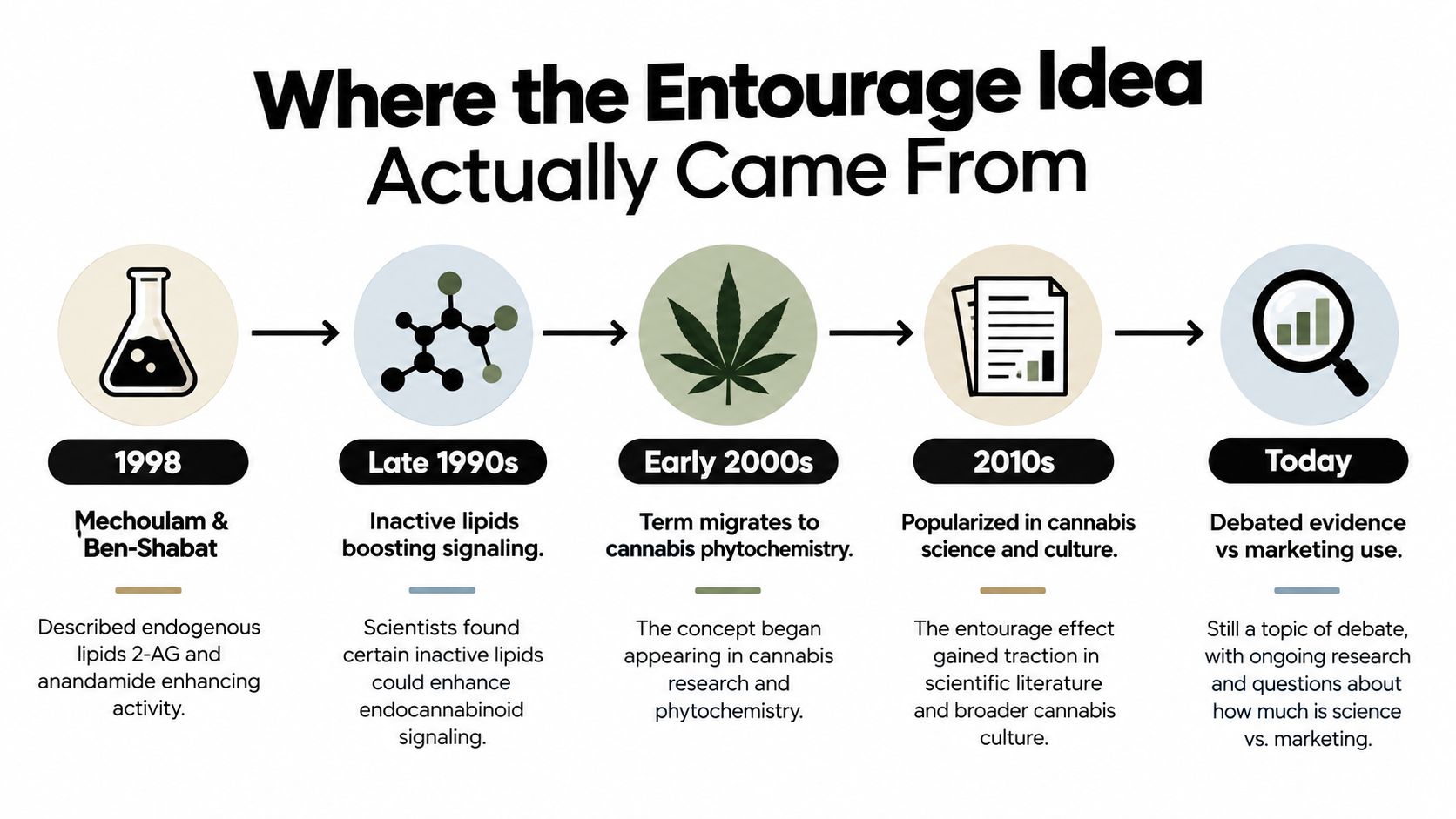
Where the Entourage Idea Actually Came From
The modern framework traces back to 1998, when Raphael Mechoulam and Shimon Ben-Shabat described an entourage effect in the endocannabinoid system (historical review). Their proposal concerned closely related molecules that were otherwise inactive but could increase the activity of the body's primary endocannabinoids, anandamide and 2-arachidonoylglycerol.
That origin matters because it changes how you interpret the phrase. The initial observation wasn't “every cannabis compound improves every other cannabis compound.” It was a more specific idea about endogenous signaling lipids and the way molecular context can influence activity.
How the term migrated into cannabis formulation
The transition from endogenous compounds to cannabis phytochemicals was conceptually appealing. Researchers and industry writers began applying the framework to THC, CBD, minor cannabinoids, terpenes, and other plant constituents. In that setting, “entourage” became shorthand for the possibility that a complex extract could behave differently from a purified molecule.
The phrase migrated faster than the mechanism was validated. Early endogenous evidence could support the possibility of context-dependent signaling, but it didn't automatically demonstrate that a terpene added to distillate would enhance a cannabinoid's effect in humans.
By 2020, a major review had traced the term's evolution and noted that it was frequently used to describe a positive contribution from added terpenes, while warning that the concept had been overstated in scientific and commercial settings (2020 review). In practical terms, the 1998 milestone still shapes full-spectrum marketing, strain narratives, and product labeling, but it should be understood as the starting point of a framework, not proof of every modern application.
The cleanest historical takeaway is simple:
- The original idea concerned endogenous molecules.
- Cannabis phytochemicals later adopted the language.
- Commercial usage broadened the claim.
- Modern reviews now ask which specific interactions can be demonstrated.
That chronology gives a formulator a better boundary. You can investigate synergy without assuming that the word itself validates a finished blend.
How Cannabinoids and Terpenes Are Proposed to Interact
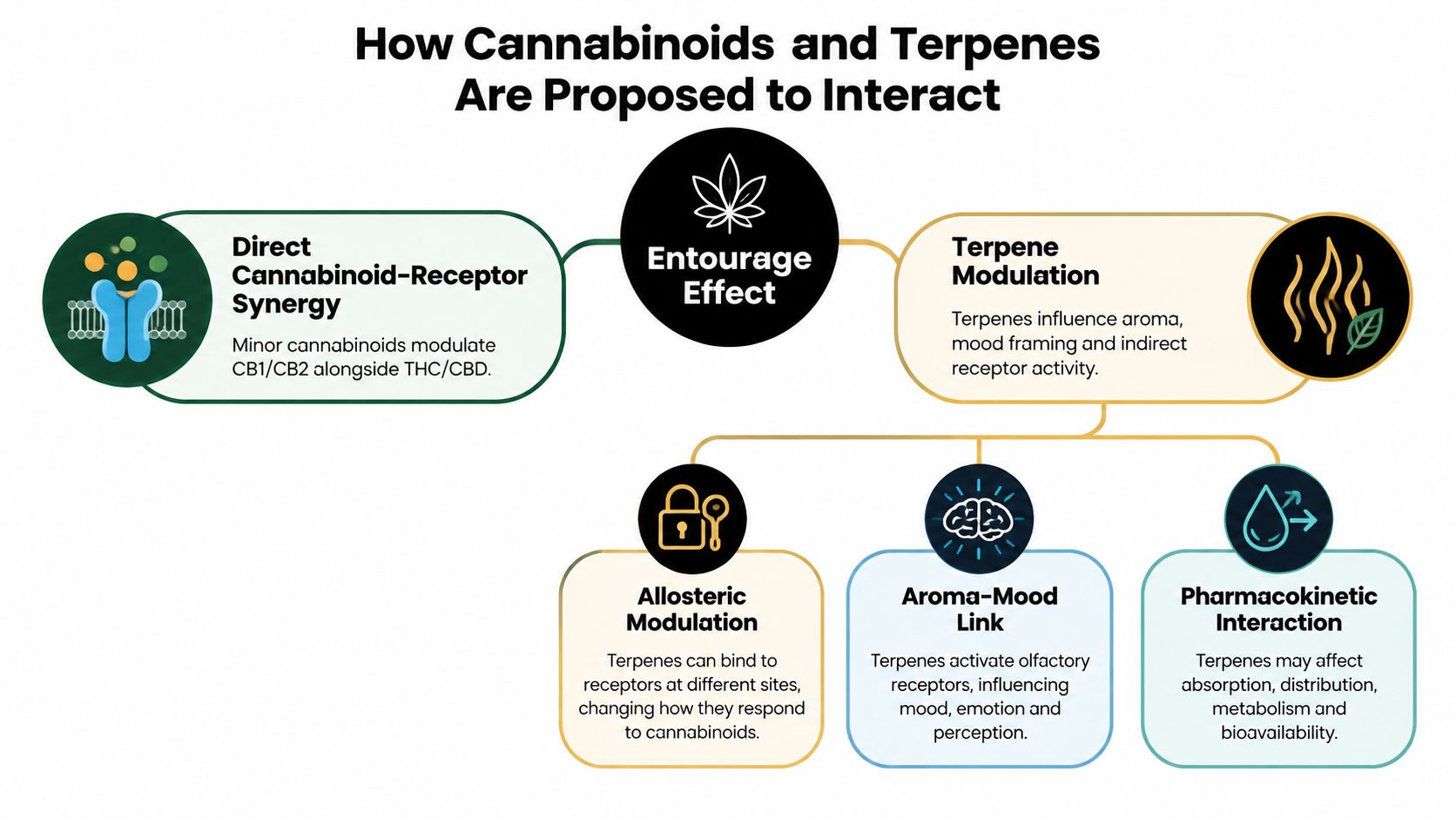
The proposed mechanism divides into two branches. The first is direct cannabinoid-receptor synergy, where cannabinoids interact at CB1 or CB2 through binding, receptor modulation, or related pharmacology. The second is indirect modulation, where terpenes and other compounds influence non-cannabinoid systems that may alter the overall response.
Direct CB1 and CB2 synergy sounds like the most straightforward explanation, but current reviews don't support it as a general rule. Evidence for a broad additive effect at classic cannabinoid receptors remains weak, and a controlled study of five common cannabis terpenes found that the compounds didn't produce cannabinoid-like effects at CB1 or CB2 or explain entourage activity through direct receptor agonism or modulation (controlled terpene study).
The indirect branch is more plausible, but not settled
Terpenes may still matter through other systems. Reviews identify plausible involvement across serotonergic, GABAergic, adenosine, and TRP-channel pathways, including targets such as 5-HT1A, GABA-related signaling, adenosine A2A, and TRPV1 or TRPA1 channels (2024 technical review). These pathways could help shape a product's broader profile without requiring a terpene to act like THC at CB1.
Examples commonly discussed in formulation research include:
- Linalool, associated with plausible GABAergic and serotonergic modulation.
- Beta-caryophyllene, relevant to non-classic cannabinoid signaling through CB2-related research.
- Myrcene, investigated for broader pharmacological and sensory contributions.
- Limonene, studied in combination contexts involving anxiety-related endpoints.
- Alpha-pinene, considered in relation to TRP channels and other non-cannabinoid targets.
These mechanisms remain incomplete in humans. A plausible receptor pathway doesn't prove that a selected terpene concentration will produce a reproducible finished-product effect.
Pharmacokinetic interaction adds another layer. A compound could influence absorption, distribution, metabolism, or tissue exposure, including possible effects on blood-brain barrier permeability. That possibility is useful for generating experiments, but it's not a permission slip to claim that a particular cartridge will alter cannabinoid delivery.
The formulation implication is important. If a blend changes user response, don't assume the cause is direct CB1 or CB2 overlap. Test the entire combination, including matrix, route, concentration, and volatility.
A cartridge lab can therefore separate two questions. Does the blend create a different sensory output? Does it create a measurable difference in a controlled response endpoint? Those questions may have different answers.
For a concise distinction between the ingredients and their roles, see this guide to the differences between cannabinoids and terpenes. It's a useful starting point before assigning a biological rationale to an aroma-driven formulation.
What the Latest Reviews Really Conclude About the Evidence
The current evidence doesn't support a single yes-or-no answer. It supports a narrower conclusion: some cannabinoid-terpene interactions are plausible, selected findings are promising, and the overall cannabis entourage effect remains unproven as a stable human phenomenon.
The 2023 scoping review described the literature as contradictory, equivocal, and inconclusive, with a lack of sound evidence supporting the claimed cannabis-related effect (2023 scoping review). A 2024 narrative scoping review reached a similar conclusion, stating that the hypothesis remains possible but isn't yet stable, predictable, or clinically proven. It also emphasized that current evidence is insufficient to establish clear clinical efficacy, safety, or regulation based on the hypothesis (2024 review).
Evidence tiers for common entourage claims
| Combination | Evidence Tier | Representative Finding | Formulator Takeaway |
|---|---|---|---|
| THC with CBD | Mixed human and preclinical evidence | Some repeated research interest exists, but current reviews don't establish a universal synergistic rule. | Test the finished ratio rather than assuming full-spectrum superiority. |
| CBD with limonene | Early clinical and model evidence | A 2024 clinical study reported that D-limonene mitigated anxiety when combined with THC, which the authors described as among the first clinical studies supporting the theory (Drexel study summary). | Treat it as a promising, combination-specific signal, not a universal claim. |
| CBD with linalool | Preclinical and mechanistic evidence | Plausible non-cannabinoid pathway involvement hasn't established predictable human outcomes. | Use it to design a testable aroma and modulation hypothesis. |
| Five common cannabis terpenes at CB1 and CB2 | Controlled preclinical evidence | The terpenes didn't show cannabinoid-like effects or explain activity through direct CB1 or CB2 mechanisms (controlled terpene study). | Don't describe terpene addition as direct receptor synergy without compound-specific evidence. |
| Whole-extract matrix effects | Incomplete evidence | Extract composition, route, concentration, and combination context may alter the observed signal. | Compare reintroduced blends with single-constituent and matrix controls. |
The methodological weaknesses are equally important. Reviews repeatedly point to limited human evidence, inconsistent source material, variable chemotype reporting, and experimental conditions that may not reflect product exposure. Results from cells or animals can identify a mechanism worth testing, but they can't establish a label-ready performance claim.
A COA can support what it measures, such as cannabinoid potency, terpene identity and concentration, and contaminant results. It can't, by itself, prove that one component enhances another in a human outcome. That distinction keeps a terpene profile for cannabis product formulation commercially useful without turning analytical data into an unsupported efficacy promise.
Translating Entourage Theory Into Formulation Decisions
A lab can use the hypothesis without pretending it's settled science. Start with the physical behavior of the blend, because vapor delivery and sensory perception are formulation variables before they become pharmacology.
Lighter monoterpenes such as limonene and myrcene evaporate relatively quickly and function as top notes. Heavier sesquiterpenes such as beta-caryophyllene are less volatile, persist longer, and can act as base-note anchors that make a blend feel fuller and more stable (terpene volatility chart). This top, mid, and base structure matters for flavor replication because the first puff, the middle of the vapor curve, and the lingering finish may not present the same compounds equally.
A controlled formulation sequence
Define the dominant cannabinoid profile. Decide whether the project is built around THC, CBD, CBG, or a broader extract. Record the actual cannabinoid composition instead of relying on a strain name.
Choose a lead terpene for the sensory target. Limonene, pinene, and terpinolene can establish bright or sharp top-note direction. A lead compound should be selected for aroma and blend behavior first, with any receptor rationale treated as a hypothesis.
Add one modulator at a controlled level. The supplied formulation brief identifies 0.25 to 0.5 percent of total weight as a test range for one modulator terpene. That range should be treated as an experimental parameter, not a universal minimum or a guaranteed active dose.
Build a matched control cartridge. Compare the full blend with a cartridge containing the same cannabinoid matrix and only the lead constituent. Hold hardware, fill process, and storage conditions constant.
Matrix changes the interpretation
Distillate, live resin, and full-spectrum extracts don't present the same chemical context. Reintroducing terpenes after winterization isn't equivalent to retaining them through harvest, extraction, cure, and storage. If two products carry the same named profile but use different matrices, the finished vapor can differ in volatility, mouthfeel, aroma persistence, and analytical composition.
That's why replicating flavor of a reference extract requires more than matching a headline terpene. Measure the reference, identify dominant and supporting compounds, then test the blend in the intended oil and hardware. A formulation resource on terpene effects can help frame the sensory and formulation questions, but your own controls must determine whether the blend is repeatable.
Bench standard: Every proposed synergy needs a control that removes one variable while preserving the rest of the formulation.
A Worked Example Developing a Cartridge Blend
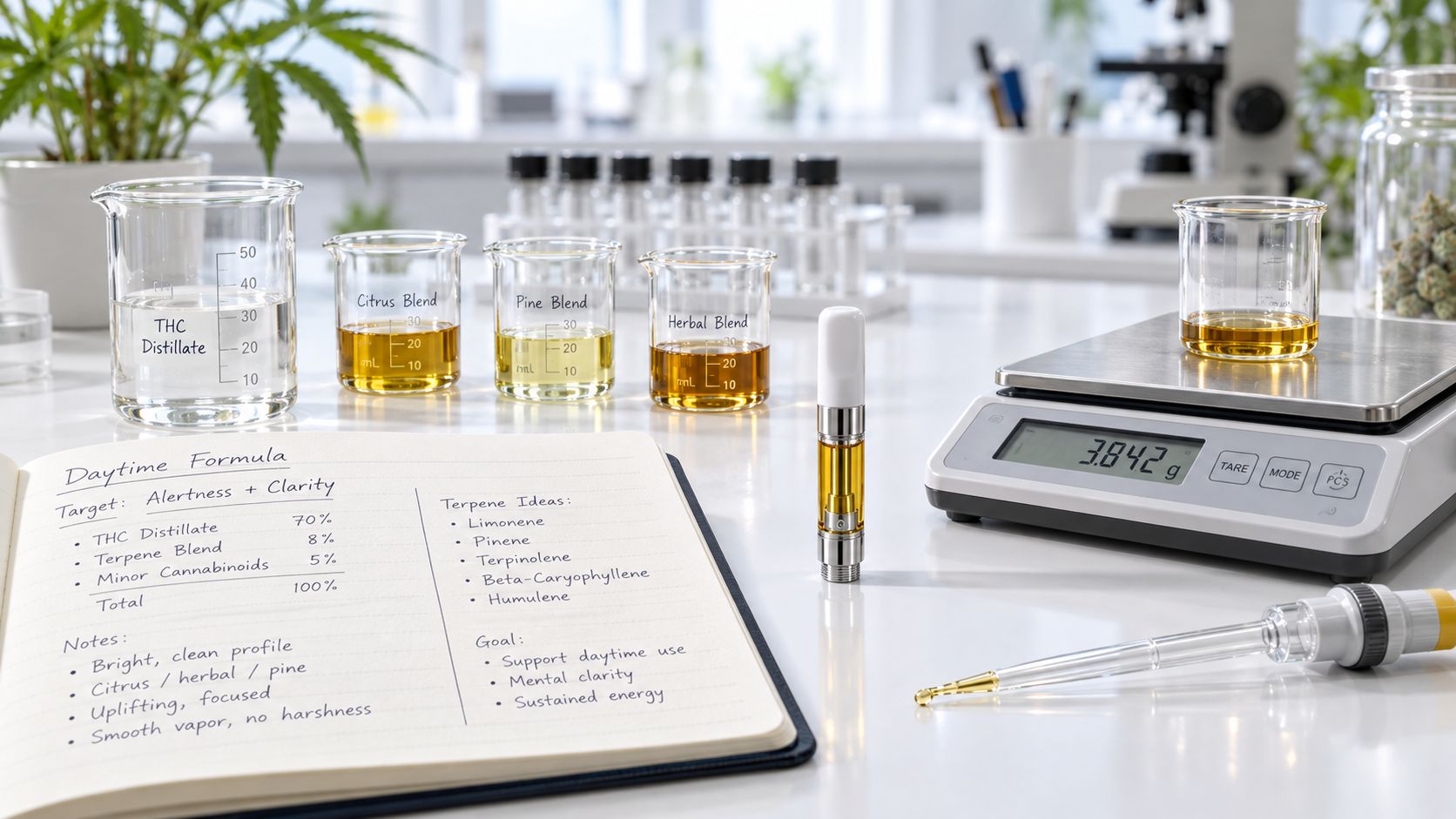
Consider a daytime distillate project designed for alertness and clarity rather than sedation. The development team selects a cannabinoid matrix containing 60 percent THC, 5 percent CBG, and 2 percent CBD. Those values define the starting composition for the example, not a general recommendation for every cartridge.
The terpene stack uses terpinolene as the lead, pinene as the modulator, humulene as a small base note, and supporting notes to close the sensory gap. Total terpene loading is 6 percent of fill weight, divided into 3.2 percent terpinolene, 1.8 percent pinene, 0.6 percent humulene, and 0.4 percent supporting notes.
Why the blend is structured this way
Terpinolene provides the main aromatic direction. Pinene sharpens the profile and gives the vapor a more defined mid-palate, while humulene supplies a less volatile base element that can keep the finish from collapsing into a single bright note. The “entourage” hypothesis enters as a test question: does the combined stack produce a different panel response from the lead terpene alone?
The control cartridge uses the same cannabinoid matrix, hardware, fill weight, and manufacturing process, but removes the modulator and base components. The panel receives blinded samples in a randomized order, with notes collected separately for first impression, mid-vapor character, aftertaste, harshness, and profile consistency.
No clinical conclusion comes from this panel. It can support an internal sensory decision, such as whether the full blend better matches a reference oil or whether the modulator introduces an unwanted note. The team can then decide whether the profile merits scale-up into a 510-thread production batch.
Use a validated process for mixing distillate with terpenes and document temperature, agitation, hold time, and filling conditions. The finished release package should include potency and residual-solvent targets, along with the broader safety panel required by the applicable market.
This example demonstrates disciplined hypothesis testing, not proof that terpinolene, pinene, or humulene creates a biological entourage effect. The blend earns production consideration by meeting sensory, analytical, process, and consistency requirements.
Safety, Labeling, and Scale-Up Considerations
An entourage hypothesis creates a labeling risk when teams treat a strain name as analytical evidence. A cartridge marketed under a familiar cultivar label may not reproduce the original chemotype unless the manufacturer has measured the reference and matched the relevant cannabinoid and terpene composition. Aroma resemblance can support a sensory description, but it doesn't verify biological equivalence.
Every production program should define a testing package before scale-up. That package may include:
- Cannabinoid potency: Verify the declared cannabinoid composition in the finished oil.
- Terpene composition: Confirm identity and concentration against the approved formulation.
- Residual solvents: Test the extract and any processing inputs under the applicable standard.
- Heavy metals: Include the finished matrix and hardware-relevant risk assessment where required.
- Batch records: Track lot numbers, source materials, blend date, mixing conditions, and fill results.
Why consistency breaks down
Natural terpene inputs can vary between lots. Botanical origin, extraction method, storage, oxidation, and supplier specifications can all change the composition that reaches the blending tank. A formulation that depends on a narrow ratio needs tighter incoming-material controls than one built around broad flavor direction.
Safety documentation also needs careful interpretation. Food-use or GRAS status for a common terpene doesn't automatically establish suitability for inhalation. Dermal and inhalation exposure are different use contexts, and allergen disclosure, regional restrictions, child-resistant packaging, and product-specific requirements still apply. Don't convert a food ingredient status into a cartridge safety conclusion without appropriate documentation.
Sourcing options for terpene inputs at scale
| Source Type | Reproducibility | Traceability | Typical Cost | Best Use Case |
|---|---|---|---|---|
| Botanical | Can vary with source and lot | Depends on supplier documentation | Must be evaluated by quote and specification | Authenticity-led profiles where natural variation is acceptable |
| Steam-distilled | Often suitable for repeatable aromatic inputs | Requires batch and origin records | Depends on yield, purity, and volume | Production blends requiring documented botanical input |
| Reconstituted | Can offer tight ratio control | Strong when individual components are documented | Depends on isolate and blending costs | Flavor replication and standardized high-volume programs |
For wholesale and bulk buyers, the practical decision is not which origin story sounds most authentic. It's which input gives the required reproducibility, traceability, and cost per kilogram while meeting the intended route and regulatory requirements. A strain-inspired profile is useful only when the supplier can help you reproduce it from batch to batch.
Practical FAQs and Next Steps for Formulators
How can a lab test for an entourage effect without a clinical trial?
You can't establish clinical efficacy through a sensory panel alone. You can, however, design a controlled internal experiment using a matched cannabinoid matrix, a lead-terpene control, a complete blend, consistent hardware, blinded samples, and predefined sensory endpoints.
If you're testing a biological endpoint, keep the language exploratory and document the exposure conditions. The goal is to identify a repeatable formulation difference that justifies further investigation, not to turn an internal screen into a medical claim.
Can isolates plus added terpenes reproduce a full-spectrum outcome?
They may reproduce some aroma and flavor characteristics, but the evidence doesn't establish that added terpenes recreate every effect of a full-spectrum extract. A full-spectrum matrix can contain compounds that an isolate-based reconstruction doesn't include, while a reconstituted blend offers tighter control over known inputs.
The right comparison is analytical and functional. Match the measured cannabinoid and terpene profile as closely as possible, then compare vapor behavior and controlled panel results.
Why can two cartridges with identical THC percentages feel different?
THC percentage is only one formulation variable. Terpene composition, minor cannabinoids, matrix, hardware, volatility, oxidation, and draw conditions can all affect the sensory and perceived character of a cartridge. Identical THC values don't prove identical chemical exposure or aroma delivery.
That's why product development should record the complete profile instead of using potency as a proxy for equivalence.
What minimum terpene loading should a lab target?
There isn't a scientifically established universal minimum that guarantees an entourage effect. Loading should be determined by the target sensory profile, oil compatibility, hardware performance, analytical limits, and applicable safety requirements.
Start with a controlled design, then test lower and higher levels around the selected operating point. Keep the lead terpene constant while changing one variable at a time, so the panel can distinguish concentration effects from blend effects.
Which tools should a formulator use next?
A terpene calculator can help estimate blend composition and organize trial batches, but it doesn't predict clinical outcomes. A strain-inspired blend catalog can provide starting profiles for flavor replication, while your laboratory testing determines whether those profiles suit the cannabinoid matrix, hardware, and market requirements.
Use both as R&D aids rather than finished answers. The defensible workflow is simple: specify, blend, control, test, document, and only then scale.
Gold Coast Terpenes offers natural terpene blends, isolated compounds, strain-inspired profiles, formulation education, safety documents, and a mixing calculator for cartridge and extract development. Visit Gold Coast Terpenes to compare starting profiles and build a controlled formulation workflow around your own analytical and sensory requirements.