
You're at the bench with a warm vessel of distillate, a terpene blend open beside the scale, and three different definitions of success competing for attention. Marketing wants a strain-inspired terpene blend that reads as energetic. Extraction has delivered a raw input with a sharp pinene character. Compliance wants inhalation safety documentation before the first cartridge is filled. The same dropper has to answer all three demands.
That's the practical problem with terpene effects. Aroma, perceived function, and inhalation behavior overlap, but they aren't the same variable. A blend can smell accurate and perform poorly in hardware. It can support a calm sensory direction while tasting flat. It can produce a convincing opening note while oxidizing into an off-profile before the product reaches the customer.
A Formulator's Dilemma at the Bench
The work rarely begins with a clean target. More often, the starting material already carries a fingerprint. A distillate may have a faint herbal finish, a winterized oil may feel too thin, or a botanical isolate may bring a volatile top note that dominates the entire batch. You're not designing in a vacuum. You're correcting, amplifying, or restraining what the extract is already doing.
That's why a formulator shouldn't treat “uplifting,” “relaxing,” or “strain accurate” as interchangeable instructions. A marketing descriptor is a direction. A sensory profile is a measurable design target. Hardware behavior is a manufacturing constraint. The blend has to satisfy all three without pretending that one terpene can solve every problem.
A practical starting point is to separate the brief into three questions:
- What should the product smell like cold? This determines the opening and the first impression when the cartridge is opened.
- What should it taste like during a draw? This determines how volatile top notes interact with mid and base notes after heating.
- What should the user perceive over time? This is a formulation intention, not a medical claim, and it should remain subordinate to sensory and safety validation.
The practical guide to using terpenes is useful here because the addition step is only one part of the job. The difficult decisions happen before the syringe enters the vessel, when you decide whether a missing note needs to be restored or whether an existing note needs to be reduced.
Bench rule: If aroma, intended function, and hardware compatibility are written as one sentence in the product brief, the brief is already too vague.
A strain-inspired terpene profile for vape cartridges should therefore be treated as a controlled compromise. The person holding the syringe needs to know which compounds create the opening, which ones carry the body, which ones persist through the finish, and which claims remain speculative. That perspective is more useful than a strain encyclopedia because it reflects the actual failure points in commercial formulation.
What Terpene Effects Actually Mean in a Cartridge
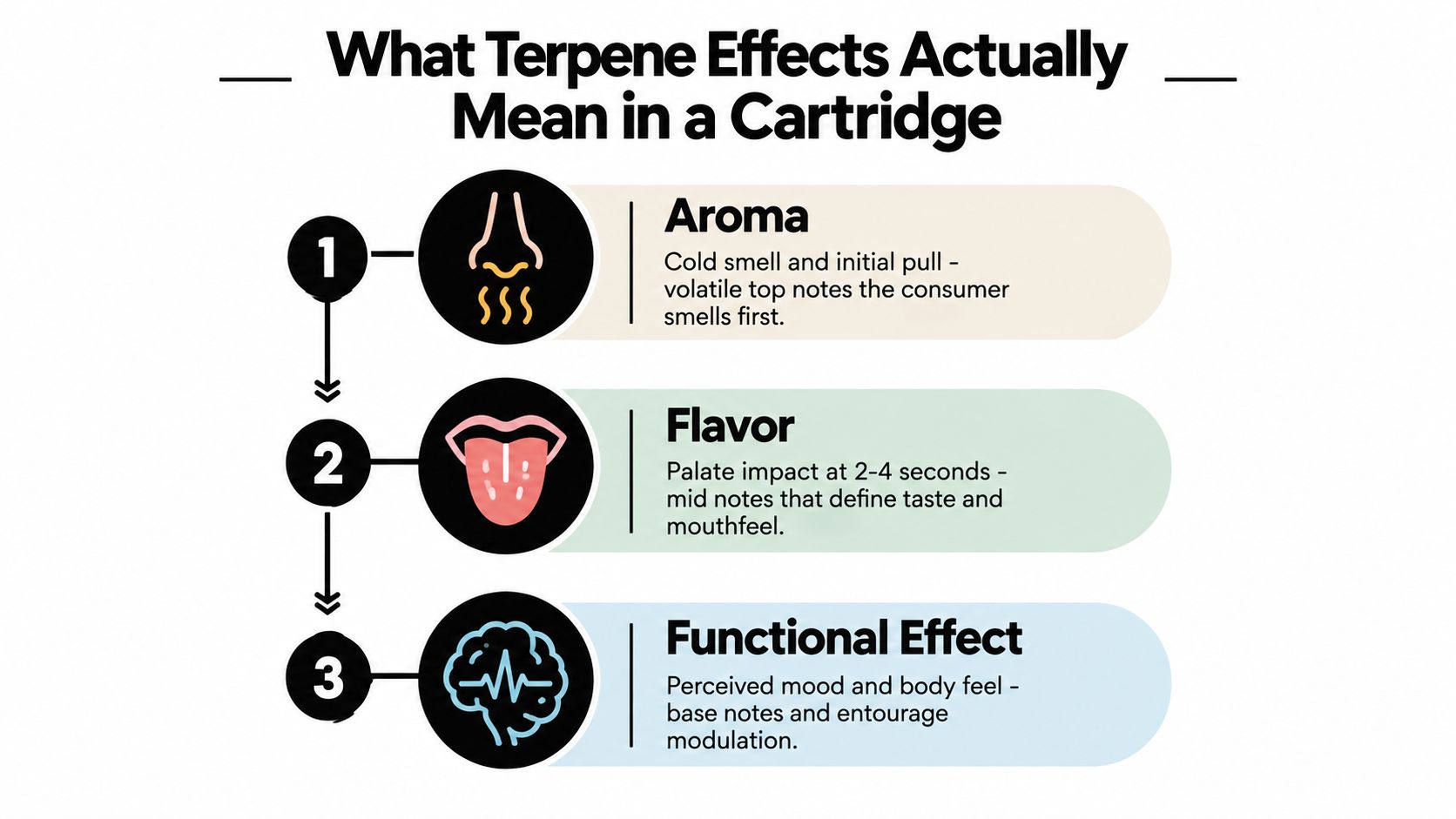
A cartridge gives you three separate design levers: aroma, flavor, and functional intent. Confusing them creates inaccurate expectations and poor blend decisions.
Aroma is the cold smell and the first impression during the initial pull. Volatile top notes such as limonene and pinene often lead this stage. They're bright and recognizable, but they can disappear quickly if the blend lacks a durable middle and base.
Flavor is the palate experience after the aerosol reaches the mouth and throat. The first few seconds expose whether the blend has enough body. A citrus opening may be attractive in a vial but taste thin if no mid notes connect it to the finish. A heavy base can provide persistence, yet too much can make the profile muddy or blunt.
Functional effect is the subjective direction the formulation is intended to support over minutes. “Focus,” “calm,” and “uplift” are useful internal targets, but they aren't clinical outcomes. The evidence for reliable human terpene effects remains limited, and recent reviews continue to call for larger human studies before specific effects can be mapped confidently to dose and identity (review of the human evidence gap).
Use the note pyramid as a formulation map
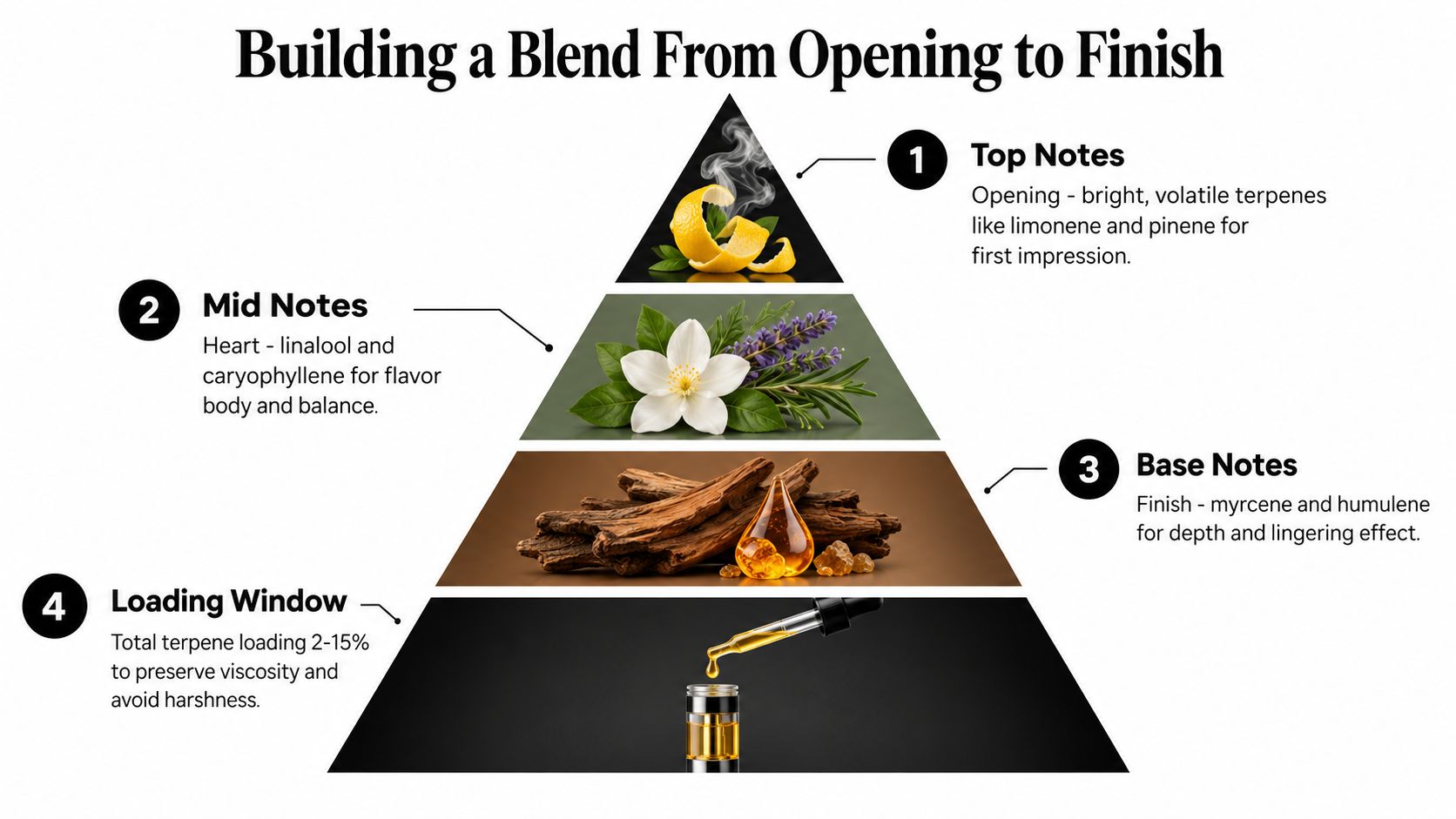
Top notes create recognition. Limonene and pinene can make a blend read as citrus-forward or pine-forward before the customer notices anything else. Middle notes such as linalool, terpinolene, ocimene, and supporting caryophyllene create continuity between the opening and the palate. Base notes such as myrcene, caryophyllene, and humulene contribute depth, persistence, and a more grounded finish.
The same profile can behave very differently at different total loads. A lower load may preserve a clean opening while leaving the finish understated. A higher load of the same ingredients can push top notes forward, increase sharpness, and change perceived balance even when the ratios remain similar. That's why a formulation guide for distillate should record both relative ratios and total addition by batch weight, not just the name of a profile.
This distinction also answers a common question about whether terpenes create a high. They can influence aroma, perception, and subjective direction, but a formulator shouldn't present those effects as equivalent to cannabinoid intoxication or as predictable clinical outcomes.
The Major Terpenes and Their Sensory Signatures
A working formulator usually reaches for a small group of recognizable archetypes. The objective isn't to assign a universal effect to each compound. It's to understand what each ingredient does to the blend's opening, palate behavior, persistence, and intended direction.
| Terpene | Dominant Aroma | Flavor Behavior | Note Position | Common Functional Signal |
|---|---|---|---|---|
| Myrcene | Earthy, musky, herbal, with a sweet fruit association | Full, soft, lingering, sometimes heavy | Base | Body and relaxation framing |
| Limonene | Bright citrus, lemon peel, orange rind | Sweet, sharp, lifting | Top | Uplift and alertness framing |
| Alpha-pinene and beta-pinene | Pine, resin, fresh herbs | Sharp, dry, clean | Top | Focus and clarity framing |
| Linalool | Floral, lavender, lightly sweet | Soft, rounded, calming | Mid | Calm and smoothing |
| Beta-caryophyllene | Black pepper, clove, warm spice | Dry, peppery, persistent | Base | Body balance and stress framing |
| Terpinolene | Herbal, floral, citrus, pine | Complex, volatile, sometimes sharp | Mid to top | Uplift or cerebral direction |
| Humulene | Woody, hoppy, earthy | Dry, bitter, anchoring | Base | Appetite modulation framing |
Myrcene is the body anchor. It fills space in a blend and helps prevent a citrus or pine profile from feeling hollow. It can also make a cartridge feel heavier in aroma and finish, so it's usually better treated as structural support than as a single-compound “sedative” switch.
Limonene supplies immediate brightness. It's effective when a profile needs a clear citrus identity, but it can become detergent-like or overly pointed when it carries too much of the blend. Pairing it with a soft middle note usually produces a more believable citrus profile.
Alpha-pinene and beta-pinene sharpen the opening and provide a fresh resin character. They're useful in focus-oriented formulation briefs, but that framing is hypothesis-grade rather than a clinically established result. Pinene also exposes imbalance quickly. A small excess can make a blend smell solvent-like or harsh.
Linalool rounds edges. It can soften a bright top note and make a dry base easier to tolerate. Its floral character is powerful, so it should support the profile rather than announce itself unless lavender is part of the target.
Beta-caryophyllene brings pepper and structure. It's the one terpene in this group with documented CB2 activity in experimental work, but that fact shouldn't be converted into a consumer medical promise. Sensory-wise, its value is more immediate. It extends the finish and gives citrus, fruit, and floral profiles a dry counterpoint.
Terpinolene is volatile and complex. It can connect citrus, herbal, floral, and pine impressions, but it's easy to overuse. Humulene sits lower in the pyramid, adding wood, hops, and bitterness. Appetite modulation is a formulation framing, not a validated product outcome.
For a citrus-pine profile, limonene can open the blend, alpha-pinene can sharpen the first read, beta-pinene can add herbal depth, and terpinolene can bridge the two. Linalool can prevent the middle from becoming abrasive. Caryophyllene supplies dry spice, while myrcene and humulene keep the finish grounded. The terpene flavor chart can help translate that structure into sensory language before you start weighing.
Mechanisms and Evidence Behind Effects
At the bench, receptor language earns its place only when it changes a formulation decision. A plausible pathway does not establish a predictable human result, so mechanism-based claims must stay separate from sensory observations and clinical outcomes.
The evidence remains mixed. A 2021 Scientific Reports study reported that selected cannabis terpenes showed pharmacological activity in vitro and could selectively enhance cannabinoid signaling across cannabinoid and non-cannabinoid targets, as shown in the receptor and assay findings. Separate work found that five tested terpenes did not directly change CB1 or CB2 binding or several tested cannabinoid effects, aside from a weak possible interaction involving beta-caryophyllene, as described in the counter-evidence. The practical conclusion is limited but useful: effects vary with terpene identity, assay design, concentration, combination, and context.
| Terpene | Proposed Mechanism | Evidence Strength | Realistic Functional Signal |
|---|---|---|---|
| Myrcene | Putative GABAergic and TRPV1 modulation | Mostly preclinical and mechanistic | Heavier, more grounded sensory direction |
| Limonene | Proposed serotonergic and adenosine signaling | Mostly preclinical, with limited human relevance | Bright, optimistic, alertness-oriented framing |
| Alpha-pinene | Proposed cholinesterase inhibition | Primarily preclinical | Cleaner, sharper profile |
| Linalool | Proposed GABA-A activity | Preclinical with sensory support from broader botanical use | Softer, calmer profile |
| Beta-caryophyllene | Selective CB2 agonism | Experimental receptor evidence | Peppery body balance, not a medical claim |
| Terpinolene | Proposed sedative GABA pathways | Limited and largely preclinical | Complex cerebral or relaxed direction |
| Humulene | Proposed inflammatory cascade activity | Mostly preclinical | Dry, grounded, appetite-related framing |
What the human signal actually tells us
The clearest human signal in the supplied evidence comes from a 2025 randomized, placebo-controlled sleep study of a CBD-terpene formulation. It reported a statistically significant 1.3% increase in combined slow-wave sleep plus REM sleep share versus placebo, with a 95% confidence interval of 0.1% to 2.5% and P = .03. Some participants averaged as much as 48 additional minutes per night over four weeks (the controlled sleep trial). The study found no effect on total sleep time, resting heart rate, or heart-rate variability.
That finding matters because it identifies a selective, measurable human signal rather than a broad sedative effect. It does not define a universal terpene ratio for cartridges, and it does not support general sleep claims on a product label.
Practical interpretation: Use mechanisms to choose direction. Use sensory testing, batch math, and controlled trials to choose dose. Keep clinical language out of consumer positioning unless the product and evidence support it.
A brain-focused terpene guide can assist internal education. Final decisions should come from measured blend behavior, inhalation testing, and the intended sensory result, not a receptor diagram alone.
Building a Blend From Opening to Finish
At the bench, a strain-inspired blend can smell correct in the vial and fail in the cartridge. Build the profile as a pyramid: set the finish first, establish the middle, then add the opening. This sequence gives better control over persistence and limits the chance that volatile top notes dominate before the rest of the profile is established.
For cartridges and distillate, calculate additions by total batch weight rather than drops or assumed volume. The formulation reference places finished terpene loading within 2% to 15% (batch-weight and loading guidance). In a 1 kilogram batch, a 5% target equals 50 grams of total terpene blend. Weigh each ingredient separately when building a custom profile, then document the actual contribution of every component.
Build the base first
Start with myrcene, humulene, and beta-caryophyllene when the target calls for body, dryness, or a lingering finish. A useful starting architecture is roughly 20% top notes, 30% mid notes, and 50% base notes. Treat that ratio as a design point, not a fixed recipe. The right balance depends on the distillate, the intended sensory result, and how the blend behaves after heating.
Add the base components only after the carrier is uniform and workable. If the material has undergone decarboxylation or another heat-sensitive preparation step, let the vessel return to the lowest practical mixing temperature before adding volatile compounds. Mix long enough for even dispersion, but avoid using heat to strip the molecules the blend depends on.
Add the bridge
Linalool, terpinolene, and ocimene connect the opening with the finish. Linalool can soften sharp edges, terpinolene can add complexity, and ocimene can lift an herbal or floral profile without reducing it to a single citrus note.
Mix slowly and inspect the blend before adding the tops. Look for incomplete dispersion, haze, or viscosity changes. Those observations can predict filling and draw problems later, but they do not replace a cartridge test.
Cap the opening last
Add limonene, alpha-pinene, and beta-pinene last, at the lowest practical temperature. Open vessels, warm processing, and extended agitation can reduce volatile top notes before the blend reaches the cartridge.
Evaluate the finished profile in the actual oil, not only in a neat vial. Dilution can shift the result toward citrus, resin, or musk. Gold Coast Terpenes' staged distillate blending guidance recommends staged replication and evaluation in both the oil and hardware, with a 5% to 7% starting point by total weight for many cannabis distillates. Use that range as a controlled starting point, then adjust according to the oil and device.
Run the verification sequence before scaling:
- Review the ingredient documentation. Confirm identity, lot information, and expected composition for every input.
- Check the blend at room temperature. Record the opening, body, and finish on a standardized strip or vial.
- Warm the sample modestly. Compare the warmed aroma with the cold profile.
- Fill a representative cartridge. Test draw behavior, leakage, flavor progression, and residue.
- Compare the final profile with the target. Change one layer at a time so the cause of each shift remains clear.
A short technical walkthrough can support the first scale-up.
Why Higher Terpene Loads Do Not Equal Stronger Effects
At the bench, a faint cold vial can tempt you to add more. That shortcut may amplify the unheated aroma while making the cartridge harsher, less faithful after heating, and less tolerant of hardware variation.
Common finished cannabinoid products are often formulated between 2% and 5% terpenes, with an upper limit of 15%, according to the supplied formulation guidance (cartridge loading reference). A distillate guide gives a 5% to 7% starting point for many profiles. These ranges are starting controls, not guarantees. Set a measured addition, test it in the actual oil and cartridge, then adjust only when the sensory target requires it.
A louder aroma also does not establish a stronger functional effect. The entourage model has limits: an interaction seen in a cell assay may not persist after dilution into distillate, passage through a heated coil, and aerosolization. The 2021 findings support measurable terpene and cannabinoid interaction under specific experimental conditions. The 2020 counter-study shows that broad receptor-potentiation claims fail in other assays. A working formulation should account for both findings rather than treating synergy as automatic.
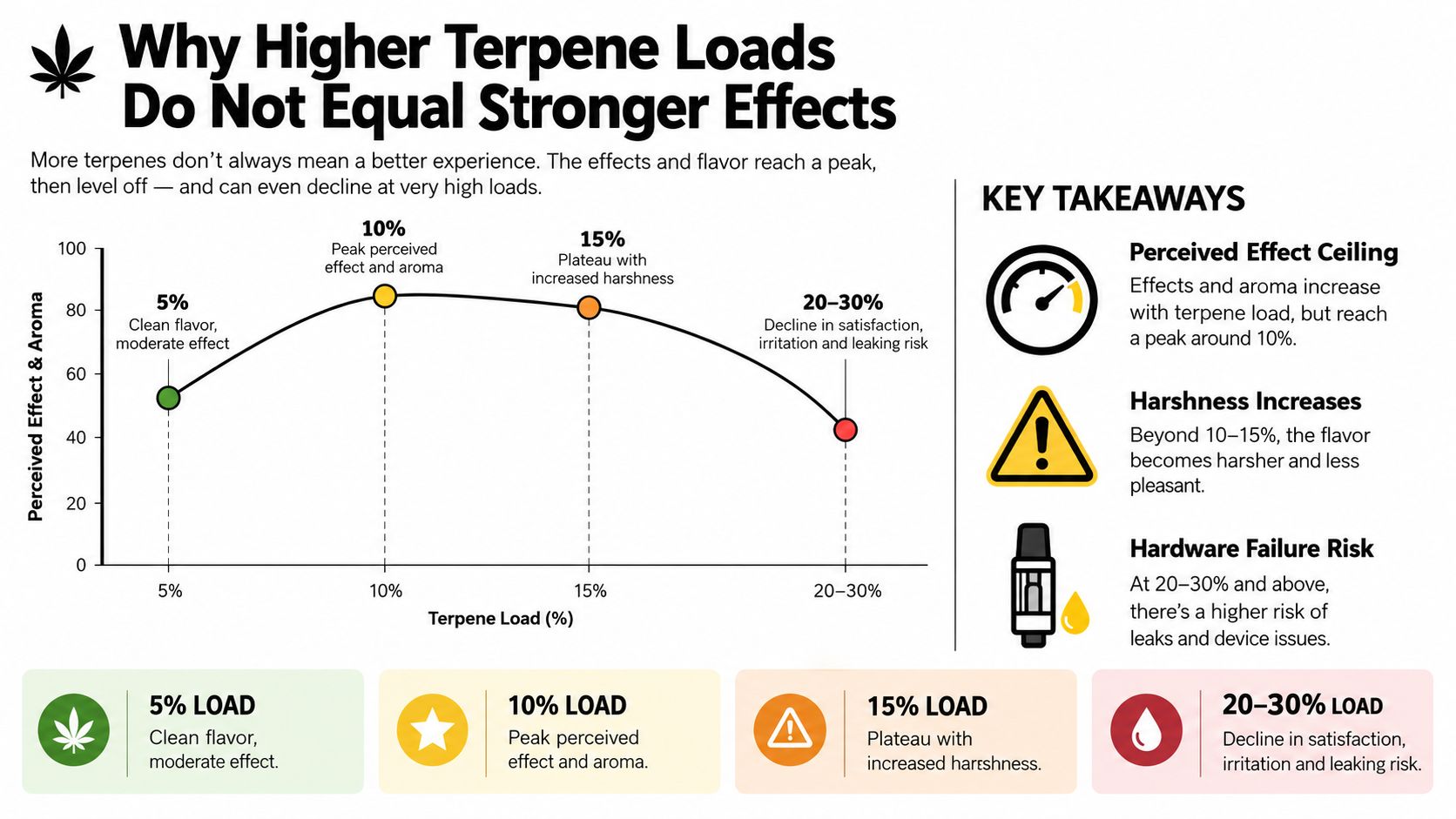
Higher loading also creates practical trade-offs. A sharp top note may irritate. A heavy base can make the draw feel dense. Oxidation products may push the flavor toward stale citrus, resin, or solvent-like notes. Judge the lowest load that delivers the intended profile through the selected hardware, rather than asking how much the oil can hold.
A restrained blend preserves sensory accuracy, leaves more control over irritation, and supports steadier cartridge performance.
Safety, Oxidation, and Storage for Finished Blends
A blend can smell precise in the vial and still change after storage, heating, and aerosolization. Inhalation safety therefore changes the formulation brief. Monoterpene oxidation products may increase sensory and pulmonary irritation, so current standards work emphasizes documenting acute and chronic inhalation toxicity for terpene-containing vape ingredients (vape ingredient safety standards discussion).
Control the main exposure points before filling: heat, light, oxygen in the headspace, and reactive contaminants. Residual acids or metals in distillate can accelerate unwanted chemistry. Use a sealed amber vessel, minimize headspace, and maintain controlled stock conditions.
| Parameter | Target | Reason |
|---|---|---|
| Stock container | Amber glass or another compatible light-resistant container | Limits light exposure and helps protect aroma |
| Headspace | Minimized, with inert gas where validated by the quality system | Reduces oxygen contact during storage |
| Stock temperature | 2°C to 8°C | Slows evaporation and oxidation during storage |
| Finished hardware | Sealed and protected from light and heat | Reduces changes after filling |
| High-power cartridge load | Consider 3% to 7% terpene content where appropriate | Limits aerosolized terpene exposure at higher operating intensity |
Treat coil temperature as a hardware-specific measurement. The setting printed on a battery does not establish the temperature at the oil interface. Ceramic and wick systems can produce different thermal profiles under the same electrical conditions. Validate the complete cartridge and battery combination, then record the operating ceiling in the product specification.
Pull a batch instead of patching it
Color shift, unexpected thinning or thickening, separation, and a new aroma all warrant investigation against release records. Do not correct an oxidized batch by adding fresh top notes. That may hide the defect briefly while leaving the underlying chemistry and inhalation profile unresolved.
Evidence discipline applies to finished-product decisions as well. A controlled human sleep study found a statistically significant signal for a terpene-containing formulation, but not across every measured outcome, including total sleep time, resting heart rate, or heart-rate variability. A blend can meet its aroma target and still fail stability review. Release decisions should assess both.
Gold Coast Terpenes offers strain-specific blends, isolated compounds, formulation resources, safety documents, and a mixing calculator for teams developing cartridges and distillate products. Compare a strain-inspired blend with the current oil, calculate the addition by batch weight, and review formulation options at Gold Coast Terpenes.