
A fresh distillate cart comes off the filling station with the cannabinoid potency you expected, but the aroma is wrong. The fruity top note is faint, the herbal body feels hollow, and the exhale has a slightly plastic edge. The first instinct is often to blame the hardware or the source oil. In practice, the missing variable is frequently the terpene package, especially an underrepresented myrcene terpene fraction.
Myrcene isn't merely a relaxation-associated aroma compound. For formulators, it's a volatile monoterpene, a base-note anchor, an early GC signal, and a heat-sensitive ingredient that can change the behavior of a finished vape. Its abundance in cannabis and its industrial history explain why it appears so often in strain replication and product profiling. Its volatility explains why the first fill and the final fill don't always smell identical.
Why Myrcene Matters More Than You Think in Formulation
A distillate can leave processing with a clean cannabinoid profile and still fail sensory review. Decarboxylation, winterization, and short-path distillation remove or redistribute volatile compounds, and myrcene is especially vulnerable to evaporative loss and entrainment. The result isn't always an obviously weak product. More often, the blend loses its rounded herbal body while brighter notes become sharp, thin, or disconnected.
Peer-reviewed cannabis chemistry reviews describe β-myrcene as one of the most abundant monoterpenes found across major plant species, including hops and cannabis. In commercial cannabis datasets, myrcene commonly represents more than 20% of the total terpene fraction on average, while some cultivars reach about 40% to 65% of the terpene profile and roughly 0.1% to 0.5% of dried-flower weight. Especially aromatic cultivars can reach about 1% to 2% by dried-flower weight, according to the review in peer-reviewed cannabis terpene research.
The missing layer in strain replication
Classic analyses found β-myrcene at 29.4% to 65.8% of steam-distilled cannabis essential oil in tested fiber and drug strains, a historical result documented in the same review. That prevalence helps explain why myrcene often becomes the dominant signal behind products marketed around earthy, herbal, or relaxing aroma architecture. It also explains why a blend can sound “close” on paper yet fail when evaluated from the cartridge.
A practical formulation review should therefore ask three questions:
- What survived extraction? Compare the incoming oil's terpene profile with the intended reference profile.
- What will evaporate first? Myrcene can leave during open handling, warm blending, vacuum work, and filling.
- What will the consumer smell after heating? A room-temperature vial profile doesn't fully predict vapor-phase behavior.
The industrial history matters too. A major review framed β-myrcene as a “natural base chemical” for fragrance, flavor, and synthesis research, showing that its importance predates the modern cannabis market. Storage research also reports that around 31% of total terpene content can be lost within one week of harvest and 55% by three months under standard storage conditions, as summarized in the industrial myrcene review.
Practical rule: Treat myrcene as a process variable, not a decorative flavor additive. If you don't track where it enters and leaves the workflow, sensory drift is almost guaranteed.
The rest of the formulation problem follows from that point. Dosing has to preserve the intended base without clouding the oil. Blending has to balance myrcene against brighter and spicier partners. Testing has to distinguish a stable profile from one that only smells correct immediately after filling.
The Chemical and Sensory Profile of Myrcene
Myrcene is an acyclic monoterpene with a 7-methyl-3-methylene-1,6-octadiene skeleton. That structure gives it several properties formulators care about: high volatility, compatibility with many aromatic compounds, and a sensory profile that can shift noticeably with concentration and blend context.
At lower inclusion levels, myrcene typically reads as earthy, musky, and herbal. As the fraction becomes more prominent, the profile can develop clove-like, resinous, or tropical-fruit undertones. Those descriptors aren't interchangeable. Earthiness gives a blend depth, musk fills the middle of the exhale, and the tropical nuance can help a fruit-forward profile avoid tasting like a simple citrus top note.
Oxidation also changes perception. Myrcene contains conjugated dienes that can form oxygenated derivatives during storage and handling. Trace myrcene-derived alcohols, including geraniol- and linalool-related aromatic contributions, can influence the final impression even when they aren't the dominant compounds in the starting material. For a practical primer on how structure, volatility, and aroma interact, see this terpene chemistry guide.
Why temperature changes the result
Myrcene's reported boiling point is about 166°C to 168°C, or 331°F to 334°F (technical reference on myrcene uses). A cartridge wick or ceramic element can operate in a thermal environment that reaches well beyond that range, depending on power, airflow, oil delivery, coil construction, and duty cycle. The boiling point doesn't mean every molecule instantly vaporizes at that temperature, but it does signal that myrcene is among the first major aroma compounds to express in thermal applications.
That creates two formulation realities. First, myrcene is easy to lose before filling. Second, the aroma that reaches the user can be disproportionately shaped by early vaporization and subsequent thermal chemistry.
| Property | Value | Formulation Implication |
|---|---|---|
| Chemical class | Acyclic monoterpene | Volatile and useful for rapid aroma expression |
| Sensory profile | Earthy, musky, herbal | Provides body and depth beneath brighter notes |
| Reported boiling point | About 166°C to 168°C | Requires disciplined heat control during processing |
| Analytical behavior | Early-eluting volatile terpene | Needs consistent GC handling and sealed sample preparation |
GC analysis makes myrcene both useful and troublesome. It separates from close monoterpene neighbors such as α-pinene in short retention windows. One rapid GC-MS workflow reported a separation window of about 4.2 to 6.1 minutes (rapid GC-MS workflow). That early signal helps identify profile drift, but it also makes sample handling important. A vial opened repeatedly or warmed unnecessarily may underreport the fraction you're trying to control.
How Myrcene Functions as a Base Note in a Blend
A well-built terpene profile behaves like a fragrance pyramid. Top notes arrive first, mid notes define the character, and base notes hold the blend together after the brighter compounds fade. Myrcene belongs primarily to the base or mid-to-base layer. Its earthy, musky, herbal character anchors citrus, pine, floral, and fruit notes without requiring the blend to become heavy.
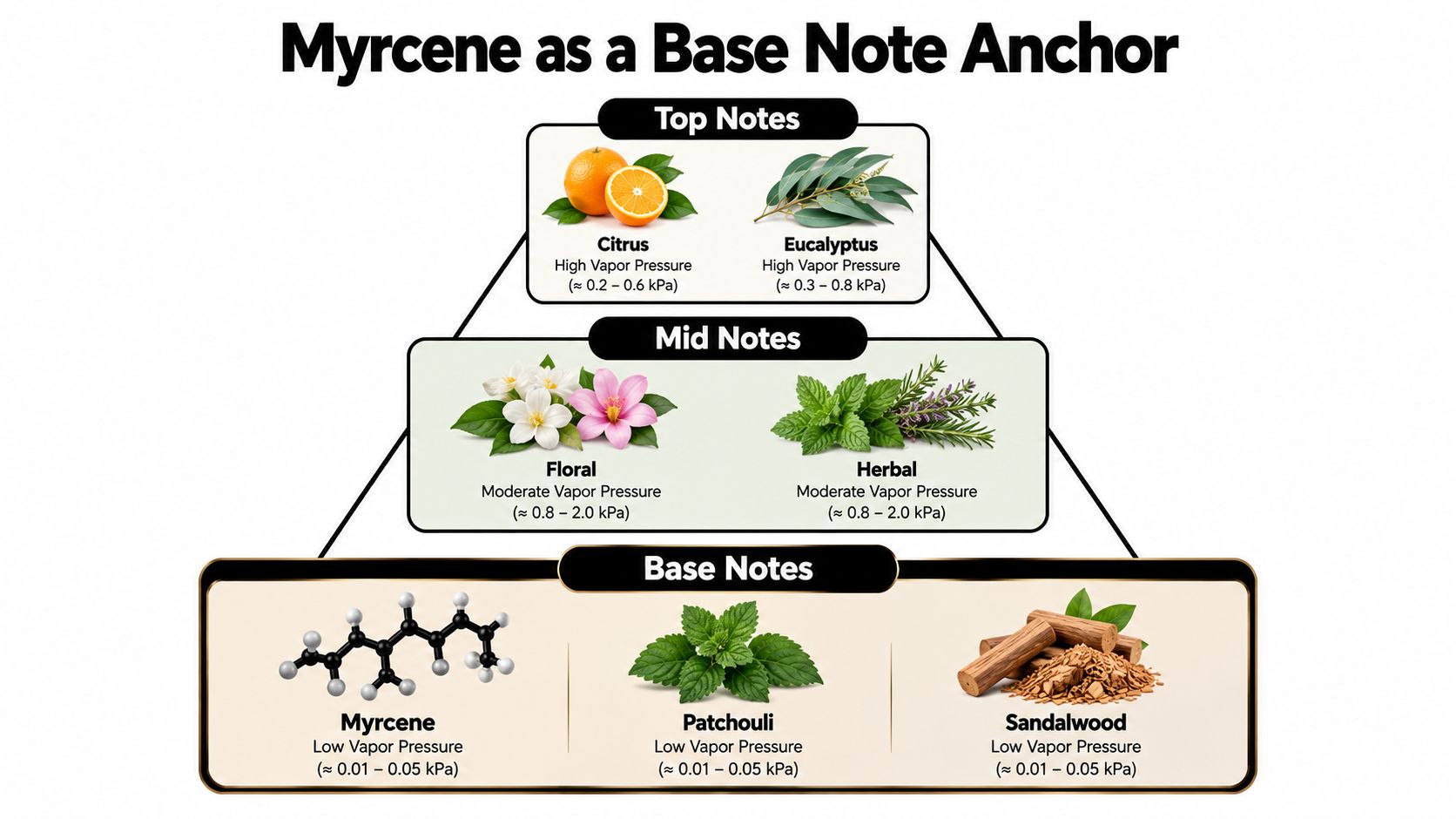
Limonene and α-pinene usually create the first impression because their brightness cuts through quickly. Myrcene helps the profile remain recognizable after those top notes recede. Independent formulation guidance describes it as a base or mid-to-base note that anchors a blend's body and extends aromatic persistence after brighter notes fade (myrcene and limonene formulation comparison).
Building the note architecture
For a 5% total terpene load, a practical starting architecture may place myrcene at 1.5% to 2.5% of the formulation, with the remainder distributed across top and mid notes. Those values are formulation examples, not universal targets. The correct level depends on the reference flower, the distillate matrix, the hardware, and whether the goal is a faithful replication or a deliberately brighter interpretation.
Myrcene also buffers harsher high-boiling sesquiterpenes such as β-caryophyllene and humulene. That doesn't mean it removes irritation or makes a cartridge medically safer. It means the sensory transition can feel less angular when the blend has a coherent base. Winterized distillate often needs more deliberate reconstruction because much of the original plant matrix has been removed. A less refined or crude base may already carry heavier waxes, residual aromatics, and color bodies that change how the same myrcene dose reads.
The Elevated Strains Apple Fritter profile is one example of a catalog profile that can be evaluated through this kind of note architecture, rather than judged by a single dominant terpene.
A base note isn't simply the last smell left in the vial. It determines whether the entire blend feels connected from first draw to finish.
Typical Dosing and Compatibility With Distillate and Cartridges
Dosing starts with a distinction that many batch sheets blur: total terpene load is not the same as myrcene share. Finished cartridges commonly use a total terpene load of 5% to 12% by weight, while myrcene may account for 1.5% to 3.5% of total mass or 20% to 35% of the terpene blend. These formulation ranges are supplied as practical benchmarks in the product brief, not as a guarantee for every oil or device.
| Format | Total Terpene Load | Myrcene % of Total Mass | Myrcene % of Terpene Blend |
|---|---|---|---|
| Distillate formulation | 5% to 12% | 1.5% to 3.5% | 20% to 35% |
| Finished vape cartridge | 5% to 12% | 1.5% to 3.5% | 20% to 35% |
| Concentrate blend | 5% to 12% | 1.5% to 3.5% | 20% to 35% |
For a 95:5 THC-to-terpene blend at a 10 g batch scale, the arithmetic is direct:
- Distillate: 9.5 g.
- Total terpene blend: 0.5 g.
- Myrcene fraction: 0.15 g to 0.175 g when myrcene represents 30% to 35% of the terpene blend.
The calculation is useful because it exposes how small handling losses can affect the final profile. If the myrcene is weighed into an open vessel, warmed aggressively, or added before the distillate is ready, the scale may record the intended amount while the finished cartridge contains less.
What underdosing and overdosing look like
Underdosing produces a profile that smells flat, thin, or disconnected from the reference. Overdosing can create excessive musk, suppress fruit and citrus detail, and contribute to distillate cloudiness. It can also complicate HHC crystallization, since the solvent balance and matrix behavior change with the terpene package.
Myrcene influences viscosity and therefore wick behavior. A thinner blend may wick readily but increase leak risk in hardware that isn't designed for the resulting fluidity. A thicker blend can starve the coil and generate inconsistent vapor. Ceramic and wick systems respond differently, so the batch should be evaluated in the actual cartridge rather than only in a beaker.
Botanically derived terpene blends often contain supporting compounds that make the profile feel broader. Isolated myrcene gives cleaner control over the variable but can sound stark when used without complementary top and mid notes. Isolated myrcene also shouldn't be treated as automatically approved for inhalation just because myrcene is used as a flavoring ingredient in food. The regulatory status of a material depends on the route, concentration, matrix, and jurisdiction. Review the distillate terpene dosing guide alongside your applicable inhalation-product requirements before approving a batch.
Blending Myrcene With Other Terpenes and Cannabinoids
Myrcene rarely works alone in a commercial profile. Its main partners are limonene, α-pinene, β-caryophyllene, and linalool, and each changes the way the base is perceived.
| Terpene | Note Position | Boiling Point (°C) | Blend Behavior With Myrcene |
|---|---|---|---|
| Limonene | Top | Not specified in verified data | Adds citrus brightness and prevents an earthy base from becoming dense |
| α-Pinene | Top | Not specified in verified data | Adds sharp, fresh lift and can counterbalance a heavy myrcene impression |
| β-Caryophyllene | Mid to base | Not specified in verified data | Adds peppery depth and can make the profile warmer |
| Linalool | Mid | Not specified in verified data | Adds floral softness and rounds herbal edges |
| Myrcene | Mid to base | About 166°C to 168°C | Anchors the blend and carries earthy, musky body |
Choosing the direction of the blend
Lead with myrcene when the reference profile depends on damp-herbal, resinous, tropical, or full-bodied character. Support it with limonene when the oil needs a recognizable opening note, or with α-pinene when the blend needs a sharper forest-like lift. Suppress myrcene when the target is deliberately citrus-forward, bright, or clean and the base would obscure that identity.
The commonly discussed 3:1:0.5 THC-to-myrcene-to-caryophyllene relationship can be used as a conceptual starting point for evaluating an entourage-style profile, but it isn't a validated universal ratio. A pinene-dominant blend may also mute the sensory signature that people associate with a myrcene-forward profile. That is a sensory interaction, not evidence of a predictable pharmacological outcome.
CBG and CBN introduce another formulation layer. Myrcene has been discussed in connection with cannabinoid transport and blood-brain barrier permeability, including a 2011 mechanism paper, but that mechanistic discussion shouldn't be converted into a human effect claim. For product work, the useful question is whether the cannabinoid combination changes viscosity, crystallization, aroma release, or consumer-perceived balance. The terpene entourage guide can provide background, but your own finished-product testing must decide whether the combination works.
| Formulation objective | Myrcene strategy | Supporting direction |
|---|---|---|
| Replicate earthy flower | Lead | Add restrained citrus or pine top notes |
| Build a fruit-forward cart | Support | Use myrcene as body beneath limonene |
| Create a bright daytime profile | Suppress | Let limonene or pinene carry the opening |
| Add warm herbal depth | Lead or support | Pair with caryophyllene or linalool |
Practical Blending Workflow for Distillate and Carts
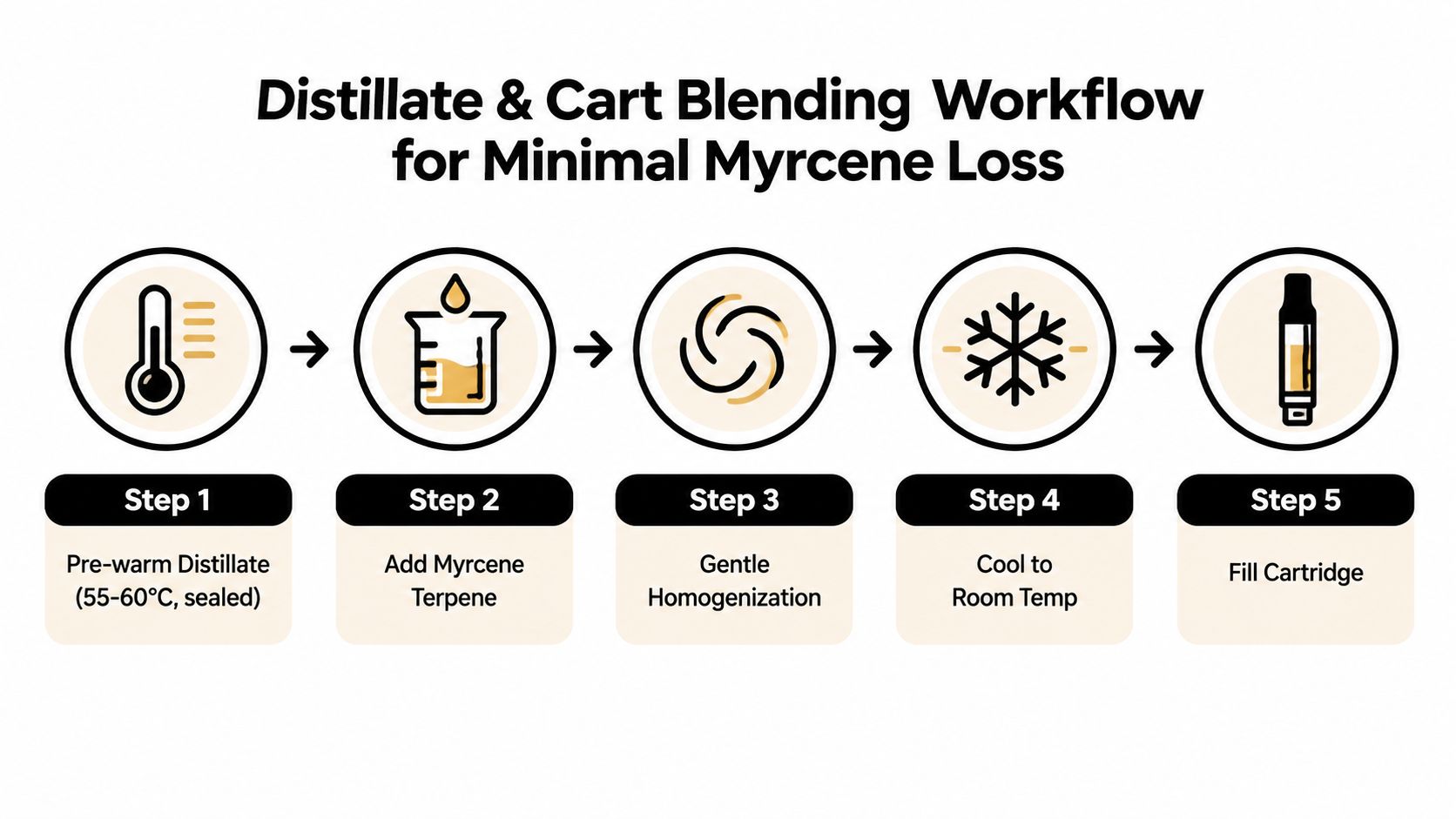
The most reliable workflow controls exposure time, temperature, and headspace. Myrcene doesn't need aggressive processing to disperse through distillate. It needs controlled contact and a sealed vessel.
A disciplined production sequence
- Pre-warm the distillate in a sealed vessel at 55°C to 60°C. Keep the vessel below 65°C, where myrcene can volatilize aggressively. The aim is to reduce viscosity, not to heat the oil until it becomes easy to evaporate.
- Prepare the terpene phase separately. Weigh the myrcene and supporting terpenes into an amber vial, pre-mix them, and add the blend as a single bolus. Drip-by-drip addition extends exposure time and makes the batch harder to homogenize consistently.
- Homogenize gently at 50°C for 90 to 120 seconds. Use a magnetic hot plate with the container sealed by a PTFE-lined cap. Avoid creating unnecessary splashing or a large vapor headspace.
- Pull vacuum only when necessary. If bubble removal requires vacuum, keep the material below 40°C. Vacuum and heat together can strip the most volatile components rapidly.
- Verify before filling. Confirm final potency and terpene percentage by GC. A visual inspection can't tell you whether myrcene was lost while the oil remained clear.
- Fill at 45°C to 50°C. Cap cartridges immediately and store finished units cold to slow aroma change and preserve the intended composition.
A practical loss account should include 8% to 15% myrcene attrition from raw input to finished cart under a standard workflow. That figure belongs in the mass-balance discussion, not as a reason to add an unverified excess. Establish your own process loss through paired pre-fill and post-fill GC results, then adjust the batch record only after the hardware and handling conditions are stable.
The following video can supplement operator training, but it shouldn't replace written batch instructions or release testing.
Safety, Heat Stability, and Testing Considerations
“Myrcene is safe” is too broad to guide an inhalation formulation. Food-use safety at typical dietary exposure levels doesn't answer what happens when the same molecule enters a heated vapor matrix at a concentrated product-use level. Independent summaries describe β-myrcene as acceptable as a flavoring ingredient at typical dietary exposure, while also noting high-dose animal findings and an IARC Group 2B classification, possibly carcinogenic to humans (PubChem beta-myrcene record).
A 2025 cannabis concentrate vaping study found that myrcene can break down into gas-phase byproducts, including isoprene and aldehydes. In a 95:5 THC-to-myrcene mixture, adding myrcene increased isoprene emissions fivefold, while a 90:10 mixture produced an increase of more than sixfold, according to the 2025 Frontiers in Toxicology study. Those findings don't establish the risk of every cartridge, but they do establish that heat chemistry deserves direct measurement.
Release testing should answer specific questions
Ceramic and wick systems can run in different thermal ranges, commonly around 180°C to 220°C depending on device conditions. Metal tanks may add catalytic surfaces that change degradation behavior. GRAS language for food ingredients doesn't automatically establish suitability for inhalation, so a supplier's food-use documentation isn't a complete inhalation safety file.
| Parameter | Target Threshold | Rationale |
|---|---|---|
| Enantiomeric purity | Verify by GC-MS or a suitable validated method | Confirms identity and composition of the incoming terpene |
| Residual solvents | Panel overlaps with the distillate COA | Prevents gaps between terpene and cannabinoid testing |
| Peroxide value | Below 10 meq/kg | Controls oxidation in the terpene input |
| Accelerated stability | 30 days at 40°C | Exposes aroma drift, oxidation, and compatibility problems |
| Thermal emissions | Characterize under intended device conditions | Links formulation chemistry to actual vapor behavior |
Treat safety as a control problem. The practical release decision depends on raw-material identity, oxidation state, processing exposure, cartridge compatibility, and emissions data, not on a single reassuring label. The terpene degradation guide is useful background, but each manufacturer still needs a product-specific testing plan.
Putting It All Together for Your Next SKU
A myrcene-forward SKU should begin with a locked target, not a vague sensory description. For a 95:5 distillate ratio, a starting target of 3% to 6% myrcene can be used when the reference profile calls for a substantial earthy base. Treat that range as a development window. The final target should come from GC data, sensory review, hardware testing, and stability results.
Select hardware for the intended thermal window, verify terpene solubility in the distillate matrix, and choose a top-note partner that survives the coil without overwhelming the base. Limonene or α-pinene can provide the opening, while myrcene supplies the body. β-Caryophyllene or linalool can fill the mid-to-base structure, but every addition changes viscosity, aroma persistence, and the cartridge's vapor response.
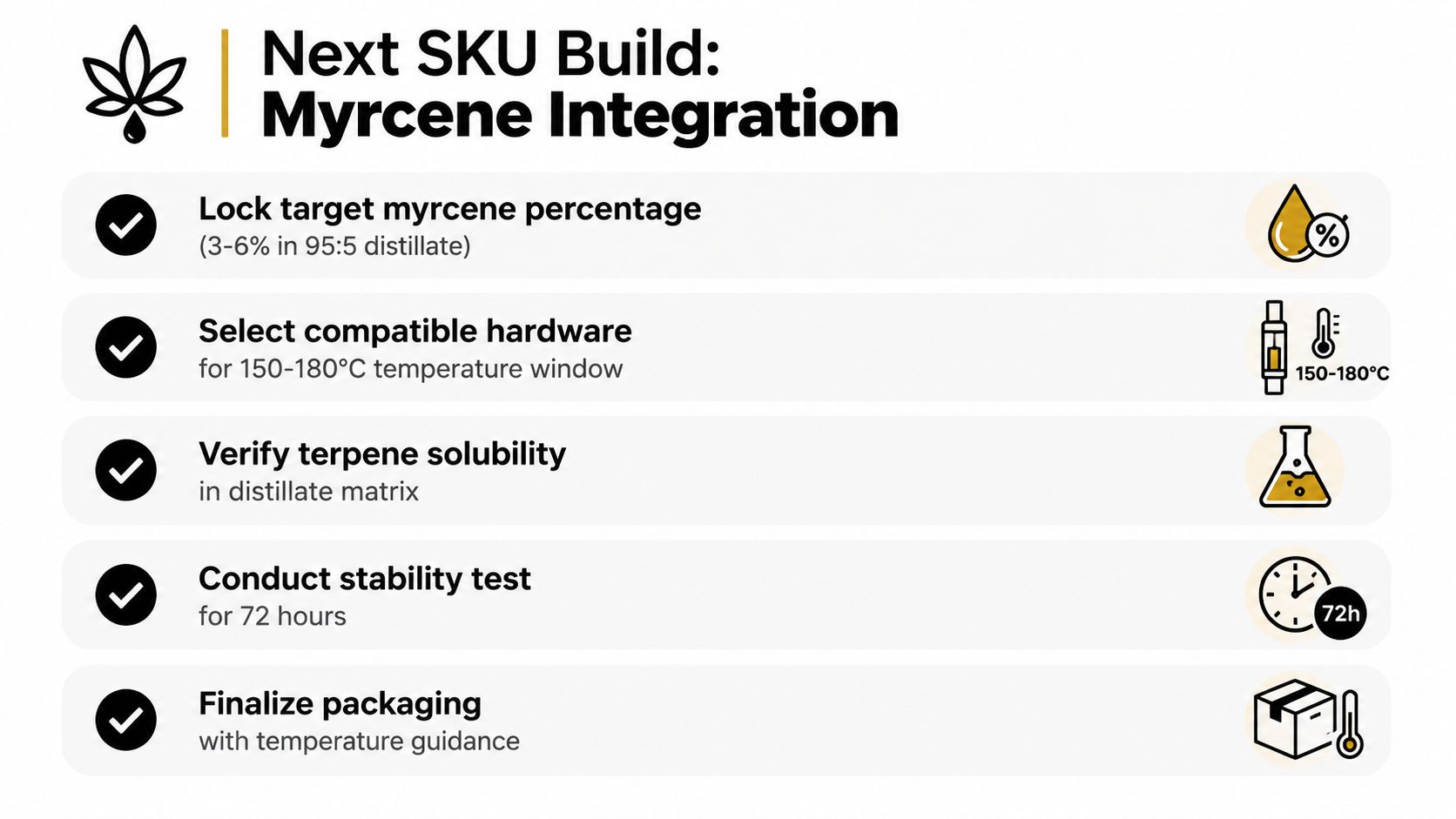
A practical launch checklist
- Lock the target: Record the intended myrcene percentage and the acceptable GC tolerance.
- Match the hardware: Confirm that the cartridge supports the viscosity and temperature window required by the blend.
- Verify the matrix: Check solubility, cloudiness, crystallization behavior, and fill consistency.
- Run stability work: Include the specified 72-hour bench check and a longer accelerated program before launch.
- Align documentation: Match terpene COAs, cannabinoid COAs, residual-solvent results, packaging, and label language.
- Control claims: Review terms such as “myrcene-rich” or “relax” for regulatory suitability rather than treating them as harmless descriptors.
- Pull post-launch samples: Schedule a 30-day stability pull and compare it with the release profile.
The commercial outcome is measurable in operational terms: repeat fills should deliver comparable aroma, vapor smoothness, session behavior, and shelf persistence. A myrcene-forward cart lives or dies on whether the second production run behaves like the first, not on how compelling the initial vial smells.
Gold Coast Terpenes supplies isolated compounds, strain-specific blends, formulation resources, and terpene tools for teams developing cartridges, concentrates, and distillate products. Visit Gold Coast Terpenes to evaluate myrcene and supporting profiles for your next batch, then pair any selected blend with your own GC, hardware, and stability validation before release.