
A bottle of limonene-heavy blend comes off the shelf and the citrus smells thinner than it did in March. The cap was on the whole time. Nobody left it near a heater on purpose. The batch sat in a warm room for a few months, and that was enough.
Teams blame the hardware first, or the distillate, or the supplier. The change usually starts in the bottle, and it starts unevenly. One terpene in a blend can lose ground while its neighbor in the same container barely moves, which is why a single shelf-life number so rarely matches what your cartridges taste like.
This guide treats terpene oxidation as a per-molecule and per-batch question. You'll see what the reaction is, which compounds go first, how to store a blend so it holds, how to catch a weak lot before it reaches a filling line, and which documents to ask for before you place a bulk order.
What Terpene Oxidation Is in Plain Terms
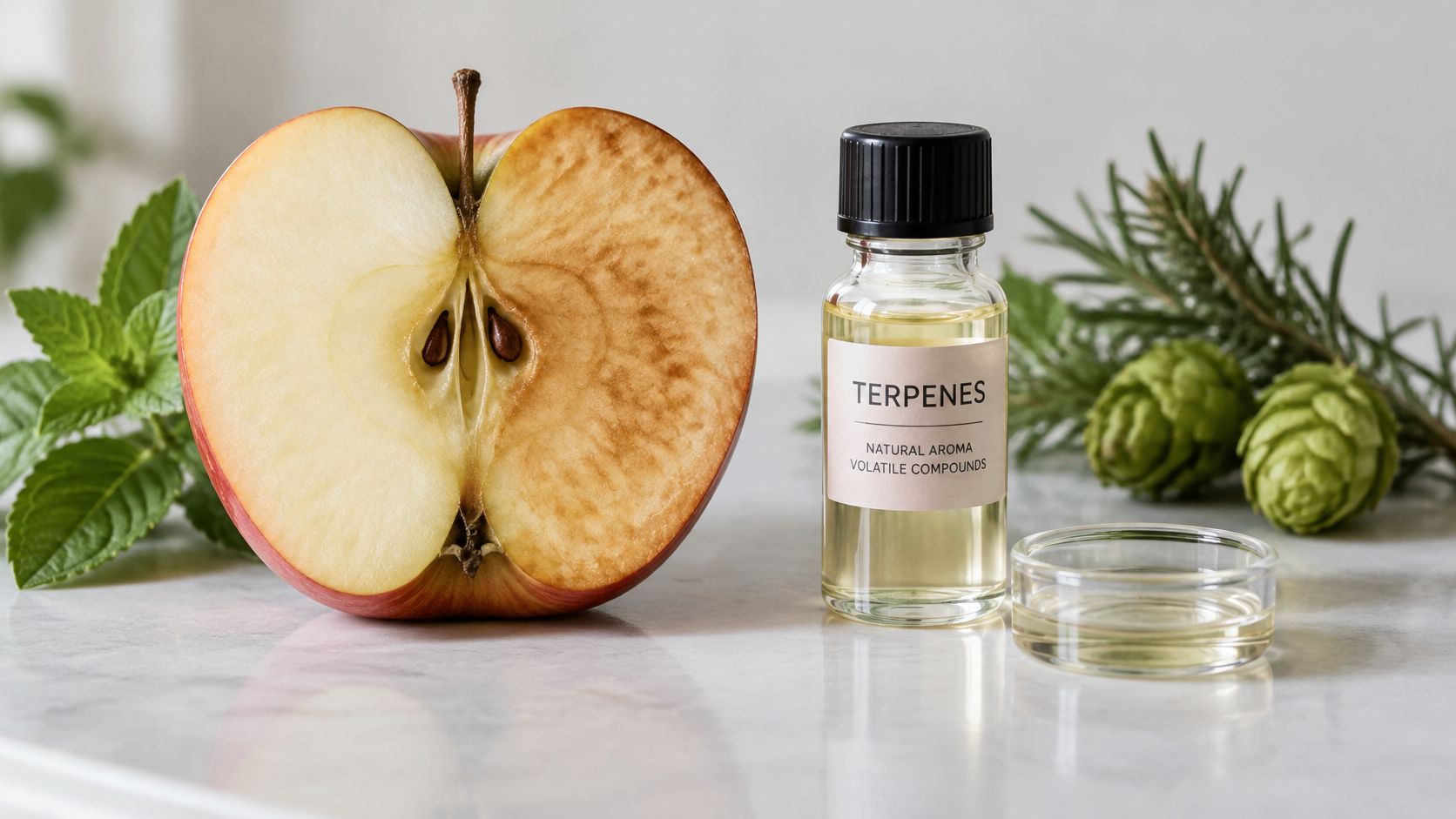
A cut apple browns because air reaches the exposed surface. Terpenes change for a related reason. A controlled study of limonene oxidation lays out the mechanism plainly: oxygen reacts with unsaturated carbon-carbon bonds, and heat, light, oxygen left in the container, and oxidants such as hydrogen peroxide all push that reaction along faster.
Your blend is full of those bonds. Botanically derived terpenes like limonene, myrcene, and pinene are small hydrocarbon molecules with one or more double bonds, and those bonds are the spots where oxygen attaches. Once it does, the original compound is gone and a new one takes its place.
The same study shows how far the reaction can run. Under controlled biocatalytic conditions, 99.3% of limonene converted, with roughly 64% forming 1,2-epoxide and 35.3% forming diepoxide. Oxidant loading decided the outcome: a twofold peroxide excess didn't fully oxidize limonene after four hours, while a fourfold excess reached complete conversion after three hours and then moved slowly toward the diepoxide.
Your stockroom isn't that lab test
Keep the number in proportion. That experiment pushed limonene with excess oxidant on purpose. A sealed bottle on a shelf reacts far more slowly, over weeks and months, at whatever rate the available oxygen, light, and temperature allow. You can't stop the chemistry. You can delay the start and slow the pace, and that's what a storage procedure is for.
Two of the four accelerators sit inside your control: how much oxygen the container holds and how warm it gets. Light exposure and peroxide contamination come next, and each has a practical fix.
Why one blend changes in two directions
A blend isn't one substance. It's a mixture, and every molecule in it has its own reaction rate. Some terpenes fall apart quickly once oxygen is present while others hold on far longer, so the mix you measured on day one isn't the mix you pour on day 200. That's how a cart can taste flat and harsh at the same time, with the bright note gone and something sharp left behind.
Oxidation needs a reactive bond and oxygen. Heat and light only decide how quickly the two get together.
Which Terpenes Break Down Fastest and Why
| Terpene | Chemical class | Relative sensitivity | What to watch |
|---|---|---|---|
| Myrcene | Monoterpene | Higher | Breaks down faster than heavier terpenes; watch for harsher, staler notes |
| Limonene | Monoterpene | Higher | Citrus top note fades; epoxide and other oxygenated products can form |
| Terpinolene | Monoterpene | Higher | Fresh, floral-herbal character flattens over time |
| Alpha-pinene | Monoterpene | Moderate to higher | Sharp pine note softens or turns harsh |
| Linalool | Monoterpene alcohol | Moderate | Floral note softens; oxidized products can form |
| Beta-caryophyllene | Sesquiterpene | Moderate | Spicy note shifts; generally slower to change than monoterpenes |
| Geranyl acetate and isobornyl acetate | Oxygenated terpenes | Lower in the tested study | Held up well under the study's stress conditions |
These ratings are planning guidance built from molecular structure. They are not measurements of any specific lot on your bench.
Why structure sets the pace
Two things decide how fast a terpene reacts: how many double bonds it carries and where they sit. An exposed double bond near the end of a chain is an easy target. One tucked inside a ring and shielded by neighboring groups is harder for oxygen to reach. That's why two compounds that smell equally fresh can behave nothing alike in a bottle.
The gap is measurable. In one set of measurements at 298 K, reported in an atmospheric chemistry product study, limonene reacted with ozone at about 2.1 × 10⁻¹⁶ cm³ molecule⁻¹ s⁻¹, alpha-pinene at 8.4 × 10⁻¹⁷, delta-3-carene at 3.7 × 10⁻¹⁷, and beta-pinene at 1.5 × 10⁻¹⁷. That's more than a tenfold spread across compounds a buyer would happily swap for one another on smell alone.
Some molecules go quietly
Sensitivity runs the other way for certain materials. A stability study of terpene standards found that several oxygenated terpenes, including cis- and trans-rose oxide, isobornyl acetate, citronellyl acetate, geranyl acetate, and phenylethyl alcohol, showed good stability under the stress conditions tested. A blend built on those materials needs less protection than a limonene-heavy one, and it can carry a longer documented shelf life without argument.
Sort your blends into three groups
- Higher sensitivity, the limonene, myrcene and terpinolene end: tight oxygen and light control, smaller container sizes, and a quarterly re-test.
- Moderate, the linalool, alpha-pinene and beta-caryophyllene middle: the same controls, reviewed on a six-month cycle.
- Lower sensitivity, oxygenated esters and similar: standard cool, dark, sealed storage with an annual check.
Set that frequency when a blend is approved, not after a complaint lands. A cart formula that leans on limonene and myrcene earns tighter oxygen and light control and more frequent analysis than one built around geranyl acetate. The difference belongs in your written spec sheet, where a buyer and a filling technician both can see it.
The category tells you where to look. Only a test on the blend you buy tells you what it does.
Storage Conditions That Speed Up or Slow Down Oxidation
| Factor | Why it matters | Control to use |
|---|---|---|
| Oxygen and headspace | Oxygen drives the reaction with double bonds, and a half-empty container holds much more air | Fill containers close to full, use smaller sizes, and reseal right after each draw |
| Heat | Heat speeds the reaction, and repeated warm-cool cycles add stress | Store in a cool, steady room away from heaters, windows, and vehicles |
| Light | Light can drive reactions in unsaturated compounds | Use amber or opaque containers and keep them in a dark cabinet |
| Peroxides and oxidants | Hydrogen peroxide and similar oxidants accelerate the reaction | Ask suppliers for peroxide or oxidation data and keep tools clean and dry |
| Time in storage | Longer holds give slow changes more time to build | Log receipt and open dates and use the oldest lots first |
| Repeated opening | Each opening adds fresh air and moisture | Pre-portion into single-use containers where practical |
| Metal contact | Some metal surfaces can catalyze oxidation | Use glass or food-grade, inert containers and tools |
The two controls that pay off most
Headspace is the one many teams ignore. A bottle that's half full isn't half protected, it's half air, and that air is in direct contact with the liquid every time the bottle moves. Buy the size you'll empty in a few weeks rather than the size that's cheapest per ounce, and reseal the moment you finish a draw.
Temperature is the second. A cool room with a steady reading beats a cold room with a door that opens all day. Keep stock out of vehicles, off window ledges, and away from any wall a heater sits against.
Practical rule: if you can't hold a container at a steady cool temperature, pick the smallest container your batch will finish quickly.
Where the edge cases bite
Refrigeration works well for long holds, with one habit attached: let the container come to room temperature before you open it. Open it cold and moisture condenses on the surface, and now you've added water to a reaction you were trying to slow.
Inert gas is a real tool, not a marketing line, but results differ by compound. In one storage trial, nitrogen-modified packaging preserved β-myrcene and increased α-humulene while decreasing limonene relative to atmospheric storage. Test the blanket on your own blend before it goes into a written procedure.
For light, amber or opaque glass and a closed cabinet handle it. For metal, use glass or food-grade inert containers and tools rather than bare metal scoops and funnels. Our guide to how to store terpenes walks through container choices in more detail.
Run first in, first out with dated labels on every container. Copy the table above into your own storage procedure, with your room, your container sizes, and your test intervals written in.
How Oxidation Changes Aroma and Cartridge Performance
Aroma doesn't leave all at once. The light, reactive top notes go first, which is why citrus and sharp pine are the earliest casualties. What stays behind reads flatter, sometimes sharper, and occasionally carries a note nobody ordered. Color can follow, and some blends darken as oxygenated products build up.
The change doesn't stay in the bottle. Terpenes for cartridges are added to winterized distillate oils to give the finished product a distinct flavor, so a terpene that has already moved on carries that change straight into the cart. Our breakdown of terpenes in cartridge performance covers how much of the finished sensory result rests on that step.
The dosing trap
Here's where a flavor problem turns into a math problem. Say a lot tests about 10% lower in parent limonene than its baseline. A 3% load of that lot now delivers roughly 10% less limonene than the formula intends. Raising the load to about 3.3% restores the target amount, but the ratio of terpenes to each other shifts and the cost per batch climbs. Test the adjusted mix in a pilot batch before you scale it.
That's why a partly oxidized lot can't be fixed by adding more. You end up paying extra to deliver a formula that no longer matches the approved spec, and flavor drifts from batch to batch while the paperwork says nothing changed.
- Fading top notes: the citrus or pine opening is weaker than the reference sample.
- A flat or harsh finish: the back end turns dull or slightly chemical.
- Darker color: the liquid no longer matches the retained sample.
- Inconsistent flavor between lots: two containers at the same dose taste different.
- Carts that drift: the same dose produces a different experience than last quarter.
What heating adds
Smell and taste are useful checks and poor early warnings. Long before a nose picks up an off-note, the analytical picture has already shifted, which is the whole case for scheduled testing.
Heating during use also creates products of its own, separate from anything that happened in storage. That's a second pathway with its own controls, and it's worth keeping straight in your head before you rewrite a spec.
Where U.S. food-flavoring rules apply, natural flavoring substances must be used at the minimum quantity needed for the intended technical or physical effect, under good manufacturing practice, as 21 CFR 172.510 sets out. Treat any recommended dose as a starting point and confirm it through pilot batches and sensory testing for each product format.
How to Check a Batch for Oxidation Before Production
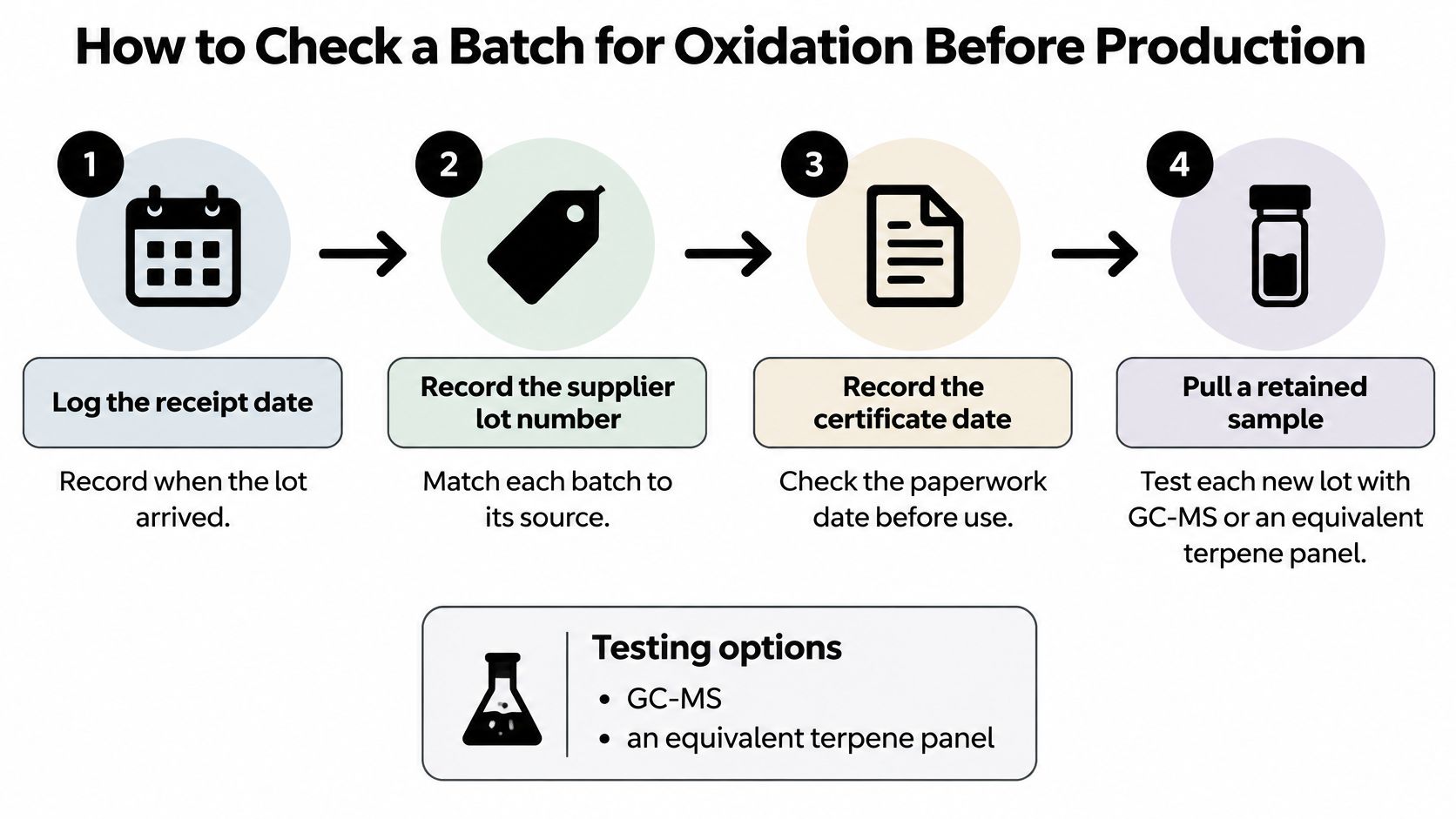
A batch check is a paper trail plus a measurement. Run these seven steps on every new lot and on every open container that stays in rotation.
- Log the receipt date, supplier lot number, and certificate date. A lot without a date is a lot you can't age.
- Pull a retained sample from each new lot. Run GC-MS or an equivalent terpene panel to set a baseline. Terpene information for our products is provided by SC Labs, so you have a comparison point from the start.
- Compare color and smell with a stored reference sample. Record what differs. Write it down rather than debating it at the filling bench.
- Request or run peroxide testing where a method is available.
- Store retained samples the way you store production stock. A reference sample kept in a fridge proves nothing about a bottle kept on a shelf.
- Re-test open containers at intervals you set in advance, such as every quarter.
- Compare each result with the baseline. Falling parent terpenes or rising oxygenated products mean hold, reformulate, or discard. Our guide to testing terpenes covers the panel side in more depth.
| Test and marker | Reference point | Action if it moves |
|---|---|---|
| GC-MS parent terpenes | Stored baseline level | Falling levels: hold or reformulate |
| GC-MS oxygenated products such as epoxides | Stored baseline level | Rising levels: hold or discard |
| Peroxide testing | Lot certificate or first retained sample | Rising peroxides: pull from production |
| Color and smell against reference | Stored reference sample | Darker color or off-notes: re-test before use |
| Discard limit | Agreed by the team in advance | Lot past the limit: stop and reorder |
Separating storage change from heat-generated change
Thermal-reaction work detected numerous products from alpha-pinene and terpinolene across roughly 100 to 300 °C, with outcomes affected by air intake and temperature, as a study of terpene thermal degradation reports. That means a blend can look clean on receipt and still generate new products during aerosolization, while an older lot may arrive carrying hydroperoxides nobody measured.
Run a stored sample and a heated, aerosolized sample side by side. The first tells you what storage did. The second tells you what your device does. They need different controls, and lowering storage temperature alone won't fix a problem created in the coil.
Limit to state plainly: inhalation effects are not fully characterized. These tests are quality checks, not health tests. Take compliance questions to a qualified advisor.
Worked Example of a Stale Limonene Batch
Here's a hypothetical worth walking through, because it's the shape of most real complaints.
A 30 mL bottle of a limonene-heavy blend is opened weekly and lives on a shelf near a sunny window for six months. By the end it's about half empty. Carts filled from it taste flatter than last quarter's run, and the team's first instinct is the hardware.
Four checks, in this order, settle it.
Look at the headspace. Half empty means a large volume of air sitting above the liquid, refreshed every time the cap comes off.
Check the storage spot. Window light plus afternoon warmth is two of the four accelerators in one place.
Compare the certificate date with the open date. A certificate describes the lot on the day it was tested, not the day it was opened, and those can be months apart.
Run a GC-MS comparison against the retained baseline sample. Numbers end the argument faster than a smell test.
The result comes back clear. Limonene is down against the baseline and the oxygenated peaks are up. That pattern points at the blend, not the coil, and the hardware gets cleared.
The fix has four parts. Pull the remaining stock from production. Rebuild the dose with fresh material rather than topping up the old bottle. Transfer the remainder into smaller amber bottles filled close to full and label each with its open date. Then write a discard rule: any lot that falls below an agreed limit comes out of use, no exceptions for a busy week.
The lasting lesson is about the reference point. Compare current results with the baseline sample, not with someone's memory of how the batch used to smell. Memory is unreliable after six months, and a baseline in the cabinet isn't.
Confirm Oxidation Controls Before You Order
Shelf life is a per-batch question, so the paperwork has to be per-batch too. A supplier's documents tell you whether oxidation was managed before the material ever reached your dock. Four requests cover it:
- A current certificate with a visible date: an undated certificate can't be matched to your lot.
- Written storage and container recommendations: "keep it cool and dark" is a slogan, not a procedure.
- Stability or oxidation data for the specific blend, not for its chemical category. A limonene-heavy profile and a pinene-heavy profile age differently, and category-level data won't show that.
- Retained-sample testing for the lot you would buy.
Four yes-or-no answers get you a decision. Is the certificate dated? Are the storage and container steps written down? Does the stability data describe this blend rather than its category? Can you get a retained sample?
Then run the checks yourself
Documents describe intent; your bench describes reality. Run the same arrival checks on a test quantity, and keep your results next to the supplier's paperwork. If the two disagree, you've learned it before a pallet ships. Once a batch passes, confirm the dose through a pilot run and sensory testing before you scale production.
Our terpenes for sale range is extracted from fresh plants with no mixtures, chemicals, or additives, and the Terpene Safety & Documents page on our site holds the paperwork buyers usually ask for. If you want help converting a tested profile into a dosing ratio, the Mixing Calculator does the arithmetic so your team doesn't rebuild it in a spreadsheet.
A blend that passes your checks is worth locking in with written specs, a storage procedure, and a test schedule. That combination keeps flavor consistent from lot to lot, and it costs less than reformulating after a customer notices the drift.
Gold Coast Terpenes supplies botanically derived blends and isolates built for cartridge, distillate, and flavor work, with SC Lab-tested documentation so you can set a baseline on arrival rather than guessing. Browse Gold Coast Terpenes to compare profiles, or ask about the bulk programs for larger orders.