
The popular shortcut for a flavor spray for weed is to count drops until the oil smells right. That shortcut collapses once the oil sits in a heated cartridge. Gold Coast Terpenes supplies lab-verified, THC-free terpene blends for cartridge and distillate formulation, and those blends are SC Lab-tested and made without VG, PG, PEG, or MCT. A botanical or food-grade mark only tells you where an ingredient came from. It doesn't tell you what happens when that ingredient is aerosolized.
Why Flavor Sprays Need Inhalation-Specific Safety Checks
The 2019 lung-injury outbreak showed that a diluent can be the hazard, not a trace contaminant. The ingredient list must identify every carrier. By November 13, 2019, the U.S. Centers for Disease Control and Prevention had recorded 2,172 cases of vaping-product-use-associated lung injury and 42 deaths across 49 states and the District of Columbia. Vitamin E acetate was identified in many linked THC products, according to the FDA summary of vaping-associated lung injuries. It functioned as an oil-like diluent, making ingredient identity a formulation concern.
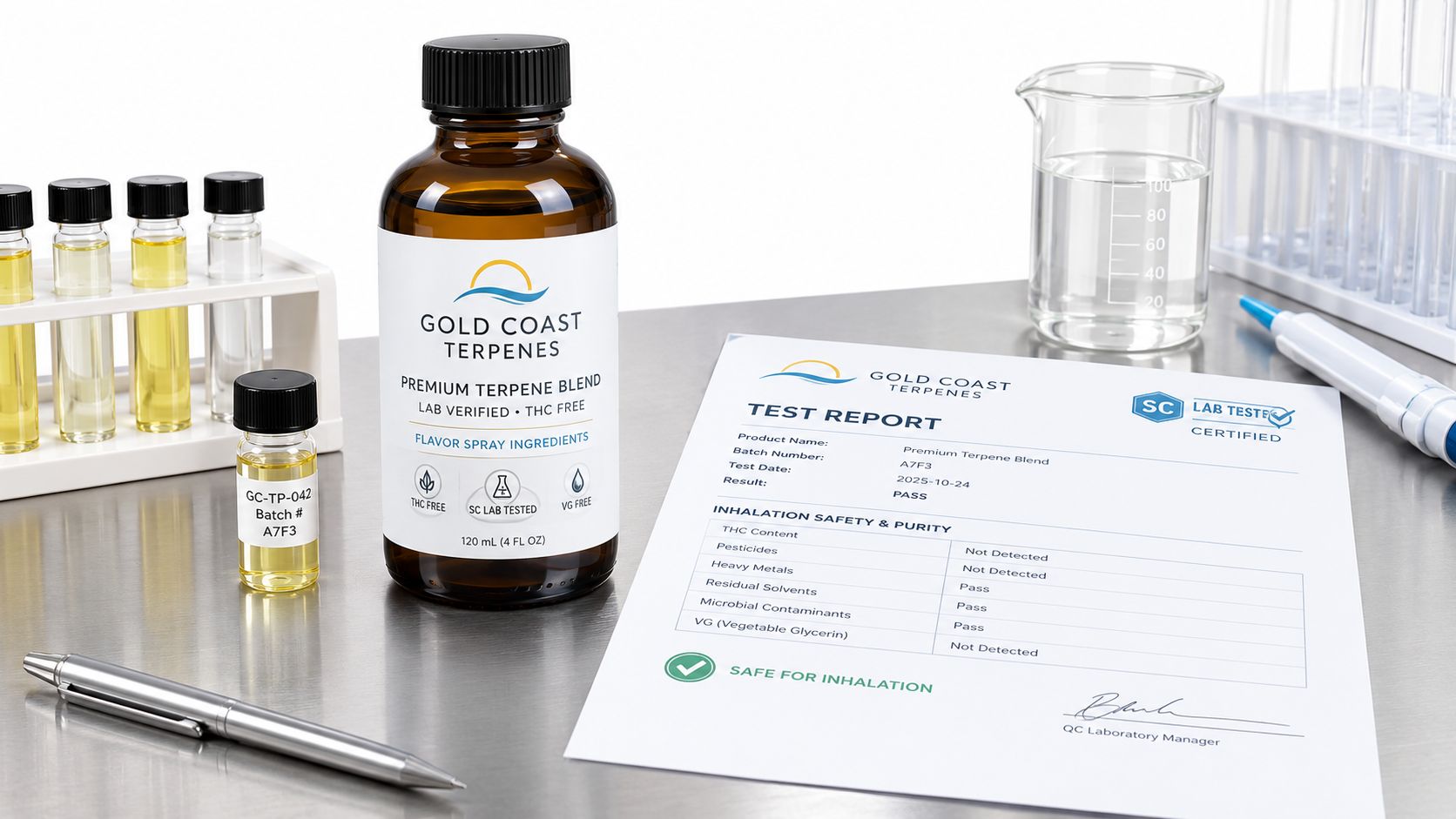
What changed on the spec sheet
For cartridge formulation, aroma selection also requires an inhalation specification. The VapeSAFER flavor reference memo says suitability depends on molecular structure, dose, and validated toxicology. It flags acetoin, benzoic acid, cinnamon aldehyde, diacetyl, MCT, PEG, and vitamin E acetate as compounds of concern.
Practical rule: Leave any carrier or diluent out of the formula unless inhalation-specific data covers your device and operating temperature.
Use three checks to assess the documentation for a blend:
- Ingredient disclosure: The file names each component, its purity specification, and its role. “Natural blend” does not identify what is in the formula.
- Inhalation-specific testing: Check that the data addresses heated aerosol, rather than relying only on food-use or topical references.
- Batch-level verification: Confirm identity and contaminants for the lot being weighed. A catalog sample from last year does not verify the current batch.
Before weighing any blend, request a batch file listing every component, its purity, and its inhalation test data. If any field is blank, hold the formula and request the missing documentation. For a closer look at the evidence and questions to ask, see whether terpenes are safe to vape.
How to Choose Between Botanical and Cannabis-Derived Terpenes
Choose a source your team can document, reproduce, and match to a defined aroma. A strong strain story still needs a batch file, a repeatable specification, and a sensory check against the target. Botanical blends and cannabis-derived material can both build a cartridge profile, with distinct sourcing and consistency trade-offs.
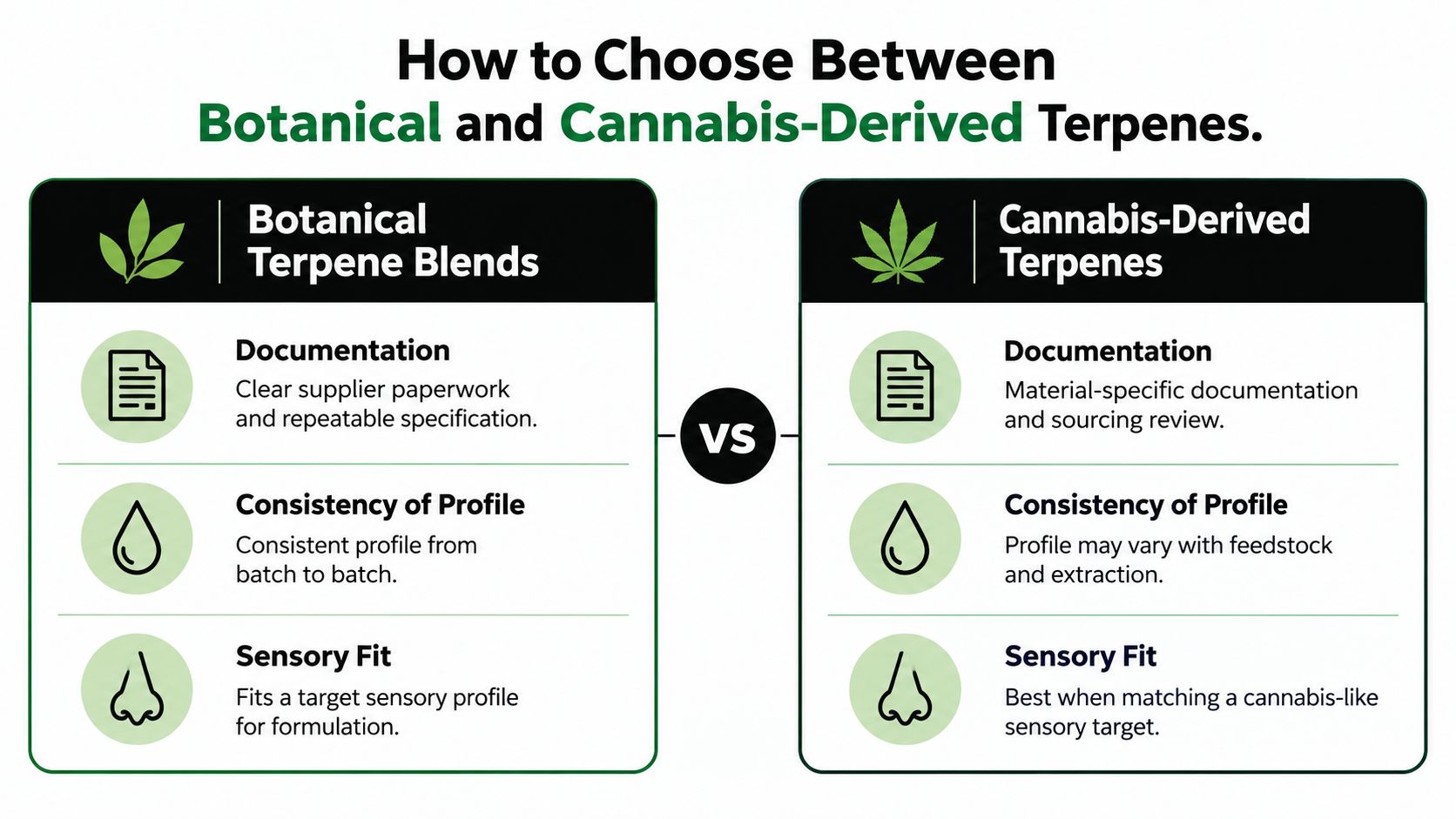
Note roles before you pick a source
A single high-impact terpene rarely carries a full flavor. Build the blend in three layers, then check the result against a reference aroma.
Top notes hit first and fade fastest. Limonene-style citrus sets the first impression in a short puff. Middle notes carry the aroma's body through the session, often providing floral, herbal, or fruit character. Base notes linger. Myrcene and beta-caryophyllene can anchor the finish after the brighter notes fade.
A top-note-heavy blend can smell loud on the first puff and thin by the third. A blend weighted toward base notes can seem heavy and miss the reference oil. Compare samples at consistent puff conditions to check whether the profile holds through use.
How the two sources compare
| Criterion | Botanically Derived Blends | Cannabis-Derived Material |
|---|---|---|
| Documentation | Supplier paperwork and a repeatable specification are usually easier to lock | Each lot needs a material-specific sourcing review |
| Consistency of profile | The same formula can be rebuilt batch to batch | Feedstock and extraction can shift the profile |
| Sensory fit | Can be built to a target aroma, including fruit and dessert directions | Can fit closely when the target is a cannabis-like aroma |
Gold Coast Terpenes describes its blends as 100% natural and lists more than 50 classic and contemporary profiles. Isolates including Limonene, Myrcene, and Beta-Caryophyllene let a formulator adjust one note without rebuilding the blend. The Elevated Strains line includes fruit and dessert profiles, such as Apple Fritter. Compare the sourcing trade-offs using this guide to cannabis-derived and botanically derived terpenes. For either source, retain the lot specification and compare a retained sample with the approved aroma target before release.
This walk-through shows a blend assembled from separate notes rather than from a strain name alone.
Aroma matching does not establish a pharmacological effect
A strain-style name describes a sensory profile. In a study of 19 participants, inhaled alpha-pinene at doses at or above levels naturally found in cannabis did not mitigate THC-related memory impairment or significantly change other acute THC effects (PubMed record of the alpha-pinene inhalation study). Aroma can change while cannabinoid effects remain unchanged. Describe the blend as a flavor match in product copy, and keep effect claims out of the listing.
How Much Flavor Spray to Add Per Batch
The first decision is the terpene mass fraction, because it affects viscosity, flavor intensity, aerosol output, and inhalation exposure. Weigh each addition. Drop volume varies with viscosity, temperature, and nozzle wear, so a five-drop addition to a thick oil can differ measurably from five drops in a thin oil. Record the mass every time.
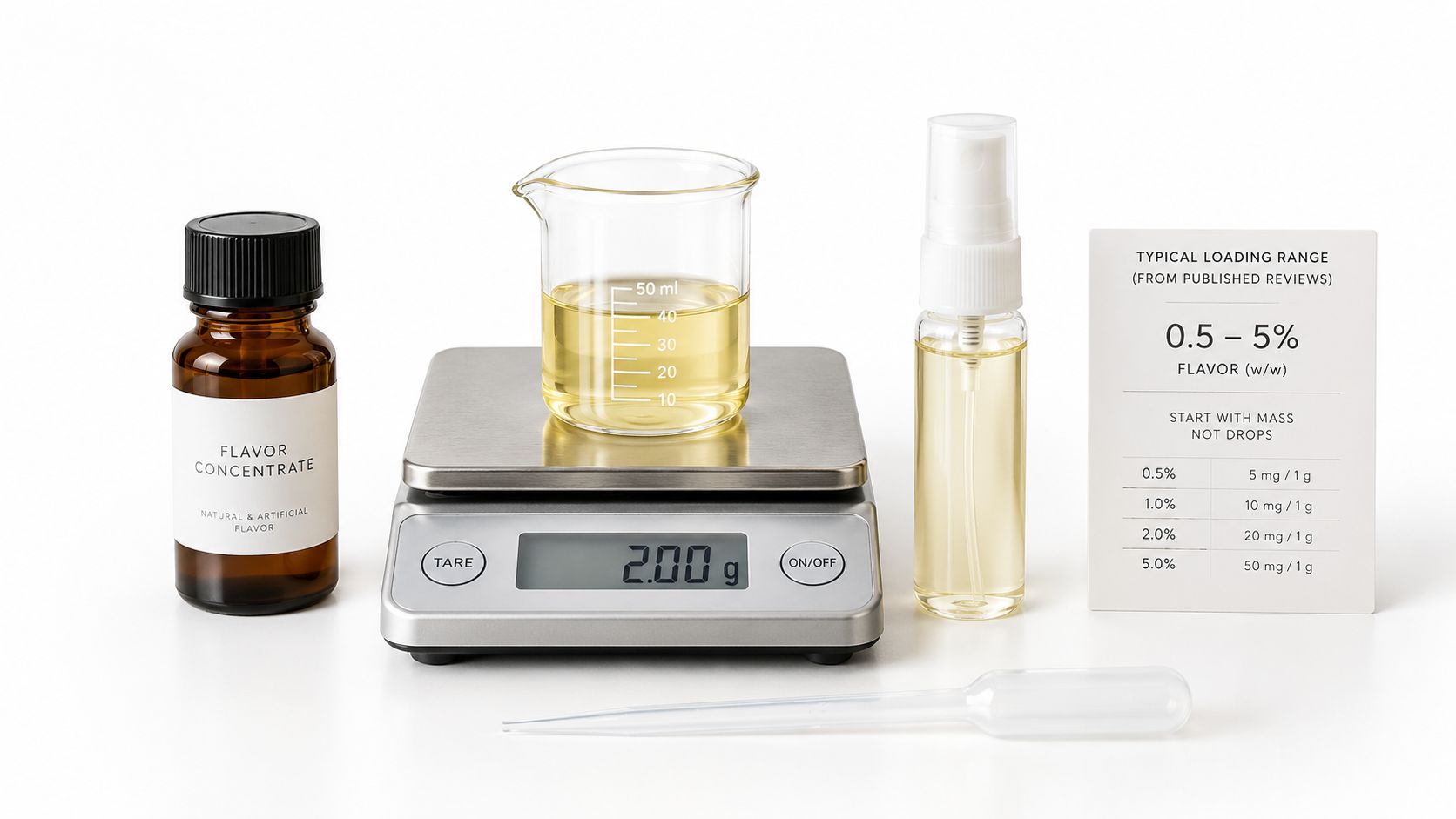
A documented bench start, not a house rule
Published reviews report that commercial cannabis cartridges may contain roughly 10–20% terpenes by weight, producing aerosol concentrations around 2,500–5,000 ppm. These levels are orders of magnitude above many inhalation-toxicology studies where irritation and inflammatory effects have been observed below 100 ppm (review of terpene levels in cannabis vape aerosols). Use aerosol testing to check the exposure implications of each loading rather than relying on aroma intensity as a proxy.
A 2025 Frontiers in Toxicology study used a 9:1 THC-to-terpene ratio as a practical solvent-free cannabis-concentrate vaping formulation, selected to balance distillate viscosity with vaporization performance (Frontiers in Toxicology concentrate vaping study). Treat it as a starting point for a bench trial, then verify performance in the target hardware. It is not a universal fill rate.
Bracket two loadings and measure both
A California-linked study tested THC distillate at 0%, 7.5%, and 15% terpene mixture by weight, providing a low-to-high bracket for comparing viscosity, flavor intensity, aerosol output, and carbonyls (California report on terpene effects in distillate). The appropriate loading depends on the terpene mix, distillate, cartridge, and coil.
- Fix the hardware. Use the same atomizer, voltage, puff length, and airflow for each sample. Record settings, since applied power affects thermal breakdown.
- Weigh a low point and a high point. Convert each target percentage into grams on a calibrated scale. Use a calculator to convert the targets into batch weights, and confirm its mass basis matches the batch. The same bracket can be tested across profiles, including the Strains range, when the calculator uses that same mass basis.
- Score four outputs. Measure viscosity, leakage after a defined hold, sensory intensity against the reference oil, and aerosol chemistry. Reject a louder sample when carbonyls or unexpected volatiles exceed the threshold in your validated method, even if its flavor score is higher.
For the calculation from a target percentage to a weighed distillate addition, see this guide on how much terpene to add to distillate.
How to Spread Flavor Spray Evenly and Verify It
Even flavor comes from a fixed spray mass, a closed vessel, and a multi-point assay. Looking at the oil, or smelling the beaker, doesn't tell you whether one pocket is rich and the rest is lean.
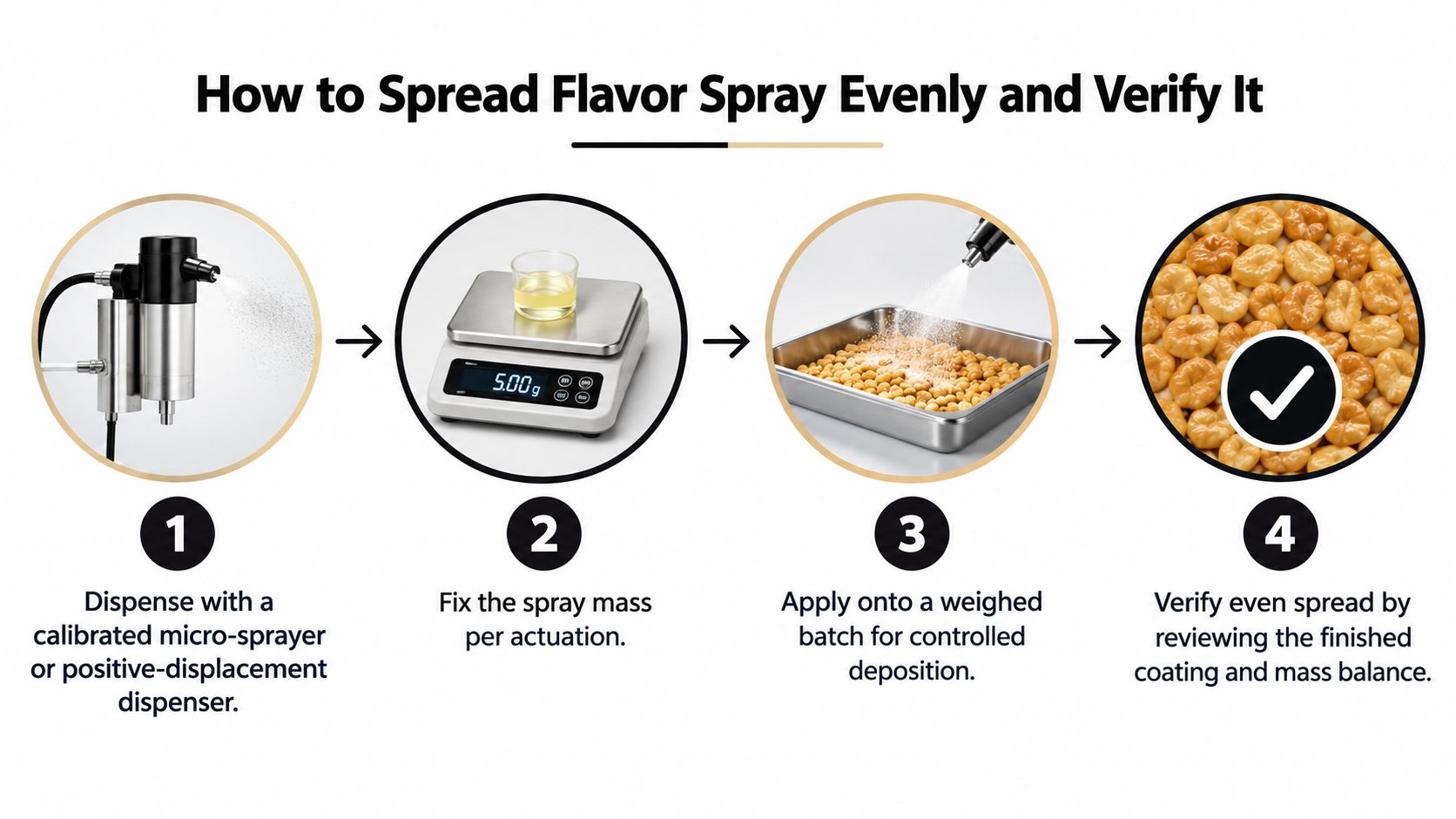
Controlled deposition in order
Use a calibrated micro-sprayer or a positive-displacement dispenser. Fix the spray mass per actuation on the scale, then apply onto a weighed substrate or into a measured oil aliquot inside a closed vessel. Open pouring loses the light fractions before they ever reach the oil.
Record the variables that decide whether you get a uniform layer or local high-concentration pockets.
- Nozzle type and droplet size: A coarse droplet sits on viscous oil instead of dispersing.
- Spray distance: Too close floods one spot. Too far lets volatiles leave before they land.
- Temperature and relative humidity: Both change viscosity and how fast the spray flashes off.
- Mixing time: Short mixing leaves streaks that a single sniff will miss.
Hold a defined equilibration period, then pull samples from several points and assay them by validated GC-FID or GC-MS. Set an internal relative-deviation limit and reject the batch when points fall outside it. Appearance and aroma are not release criteria.
What usually goes wrong
Nozzles clog when the oil is too thick for the orifice. Open handling lets terpenes evaporate, so the weighed addition isn't the addition that remains. Phase separation shows up after a rest, not during mixing. Drop-count dosing misses the target mass. Oxidation and heat then shift the flavor even when the first assay looked even.
Research has identified more than 100 terpenes and natural extracts in cannabis vape materials, and one study reported four abundant thermal products representing 18–30% of the aerosol gas phase under tested conditions (study of terpenes and thermal products in vape aerosols). Vaporization can also change the relative composition versus the liquid you filled. That is why the identity check has to cover both the liquid and the aerosol, on the hardware you will ship.
Gold Coast Terpenes' lab-verified blends give you a documented reference identity for that GC-MS check. You compare the finished oil to the blend's known fingerprint instead of to a handwritten strain name.
How to Store Blends So Flavor Stays Accurate
A blend that meets its target on day one can drift during storage, so set the hold conditions and retest schedule before filling. Flavor accuracy depends on time, container, light, and the actual formulation.
In one cannabis-oil study, terpene levels fell by approximately 40.70% and 23.07% in two MCT-based preparations after 90 days. Corresponding olive-oil preparations declined by approximately 61.27% and 44.70%. Significant losses appeared after 15 or 30 days, depending on the preparation. Terpenoid concentrations dropped rapidly under every tested storage condition, while olive-oil extracts held at 4°C performed best among those evaluated (cannabis-oil terpene stability study).
Set the hold before you set the blend
Schedule the first retest before production begins. For a new oil class, assay at intervals that can reveal early changes, rather than waiting for a later endpoint.
- Define a hold limit. If your formulation shows a meaningful terpene loss by day 15 or day 30, retest at that interval and set a documented acceptance limit.
- Cut light and headspace. Use light-protected, tightly closed containers. Compare assay results from containers filled and sealed under your intended production conditions.
- Repeat the aerosol test. Run the stored blend through the production coil and compare its aerosol profile with the liquid assay. A liquid result alone cannot verify performance after heating.
Treat any in-house diluent as a stability variable and run the same timed assay you use for the blend. In the cited study, MCT and olive-oil preparations lost terpenes at different rates, so test your own carrier rather than assuming those results transfer.
The blend ratio is a starting specification. The retained ratio after your real hold is the specification you can ship.
Set the first retest at day 15, use amber glass with a tight cap, and hold at 4°C. The guide to storing terpenes outlines a practical setup; validate it against your own blend with timed assays.
Frequently Asked Questions and Your Next Step
Is a natural or food-grade label enough to inhale a flavor spray?
Require a batch-specific certificate of analysis, full ingredient disclosure, and an inhalation test file. A food-use or THC-free label does not replace any of those checks. Gold Coast Terpenes identifies its blends as SC Lab-tested and THC-free, and lists VG, PG, PEG, and MCT as excluded ingredients. Match each claim to documentation for the product and lot you plan to use.
What documents should a supplier provide?
Request a certificate of analysis tied to the lot, a complete ingredient list, and documentation stating whether the formula is intended for inhalation. Check that the certificate identifies the tested batch and that the ingredient disclosure matches the product specification. Safety documents are available with the education tools, so match the paperwork to the batch you weighed.
Do bulk orders include shipping relief or a volume break?
The catalog lists free U.S. shipping on orders over $100 and discounts on orders above 64 oz. Wholesale and bulk programs are also available. Review the catalog terms on the order page before placing an order.
Where should a new formulator start?
Use Terpenes 101 to define the aroma notes you need, then enter the target percentage in the Mixing Calculator to convert it to grams. Compare the calculator result with your batch record after weighing, and document the actual addition before evaluating the blend. Gold Coast Terpenes provides both tools for cartridge and distillate formulation.
Before moving to production, check that the lot paperwork, ingredient list, and inhalation documentation all match the material in your batch record. Pull the certificate of analysis for the lot you plan to weigh before you mix the first bracketed batch.
Gold Coast Terpenes supplies natural terpene blends, strain-inspired profiles, and isolates for vape cartridge and distillate formulators. Its product information includes specifications for evaluation and batch records. Review the profiles and safety files at Gold Coast Terpenes.