
The usual advice for replicating the terpenes in Blue Dream is to copy a short strain chart. Gold Coast Terpenes supplies botanically derived, THC-free blends, but choosing a named blend is only the starting point: a production specification still needs measurable aroma targets, composition limits, and finished-device validation.
Blue Dream is a target sensory identity, not a universal chemical recipe. For cartridge developers, the useful question isn't whether a blend contains myrcene and pinene. It's whether the finished product retains the intended sweet, pine-forward character through manufacturing, storage, and use.
Why the Blue Dream Terpene Profile Matters in Formulation
A Blue Dream terpene profile for cannabis product formulation matters because the cultivar name alone doesn't define the input you're buying or the flavor you'll release. Developers need to translate that name into an approved sensory reference and a measurable ingredient specification.
Blue Dream emerged during California's medical-cannabis era and is associated with Blueberry and Haze lineages. That history explains the recognizable market identity, but it doesn't establish a standardized formulation. The commercial task is to preserve recognizability while controlling differences between incoming ingredients and finished batches.
For distillate, the distinction is particularly important. A blend intended to rebuild aroma in a relatively neutral carrier has a different job from a blend used to adjust an extract that already contains native terpenes. Copying the same addition rate across both can obscure the intended profile rather than improve it.
Specify the product, not just the cultivar
A useful purchasing specification separates:
- Sensory identity: The approved balance of pine brightness, sweet-earthy body, and supporting depth.
- Chemical identity: Named compounds, analytical methods, and agreed release limits.
- Application performance: Compatibility with the intended carrier, hardware, and manufacturing process.
- Documentation: Ingredient origin, batch traceability, contaminant results, and labeling information.
Practical rule: A strain name belongs on the product concept. Acceptance criteria belong on the purchase specification.
This approach also makes supplier conversations more productive. Instead of asking for something more authentic, a developer can identify whether the sample needs less sharpness, more body, or a different supporting note, then test that adjustment without changing every formulation variable.
The Primary Terpenes Detected in Blue Dream
Recurring Blue Dream markers include beta-myrcene, alpha-pinene, beta-pinene, and beta-caryophyllene, with supporting compounds contributing additional complexity. A short ingredient list is useful for orientation, but it isn't a complete reconstruction of the cultivar.
A peer-reviewed GC×GC-TOFMS investigation detected 62 terpenes and terpenoids, with monoterpenes representing 49.72% of measured relative abundance; alpha-pinene measured 20.38%, while the combined beta-myrcene/beta-pinene grouping accounted for 25.50%, as summarized in the Blue Dream analytical chemistry reference. Those are relative analytical abundances, not finished-cartridge addition rates.
Blue Dream Terpene Reference by Compound
The flower medians below come from a separate dataset. Aroma descriptors and formulation roles are practical sensory shorthand, not claims that an isolated compound reproduces the whole cultivar.
| Compound | Aroma Descriptor | Median Concentration | Formulation Role |
|---|---|---|---|
| Beta-myrcene | Sweet, earthy, musky | 0.40% | |
| Core body and sweet-earthy continuity | |||
| Alpha-pinene | Bright pine | 0.33% | Opening definition |
| Beta-caryophyllene | Peppery, woody | 0.23% | Supporting depth and finish |
| Beta-pinene | Pine-like, green | 0.15% | Adjustment of pine character |
| Alpha-humulene | Woody, herbal | 0.09% | Drier supporting structure |
| Linalool | Floral | 0.07% | Softening accent |
| Limonene | Citrus | 0.06% | Brightness adjustment |
All median concentrations are reported in the Blue Dream flower-testing dataset. They are medians, not acceptable concentration bands, and they should never be read as a supplier blend formula.
The distinction between datasets matters. A grouped analytical signal cannot establish the separate contribution of each compound within that group. Likewise, a relative-abundance result cannot be substituted directly for a flower mass percentage.
For purchasing, request individually reported compounds wherever possible. For development, use the table to identify likely aroma markers, then establish their working limits in the actual product rather than filling gaps with unsupported strain-chart ranges.
Top, Mid, and Base Note Roles in a Blue Dream Blend
A Blue Dream blend does not need one fixed ratio to read as Blue Dream. Use the note pyramid to define a sensory target, then set acceptable ranges around it. Pinene-family compounds can shape the opening, myrcene and supporting accents can carry the middle, and caryophyllene with humulene can support the finish. These are sensory working categories, not rigid chemical partitions or guarantees about evaporation order.
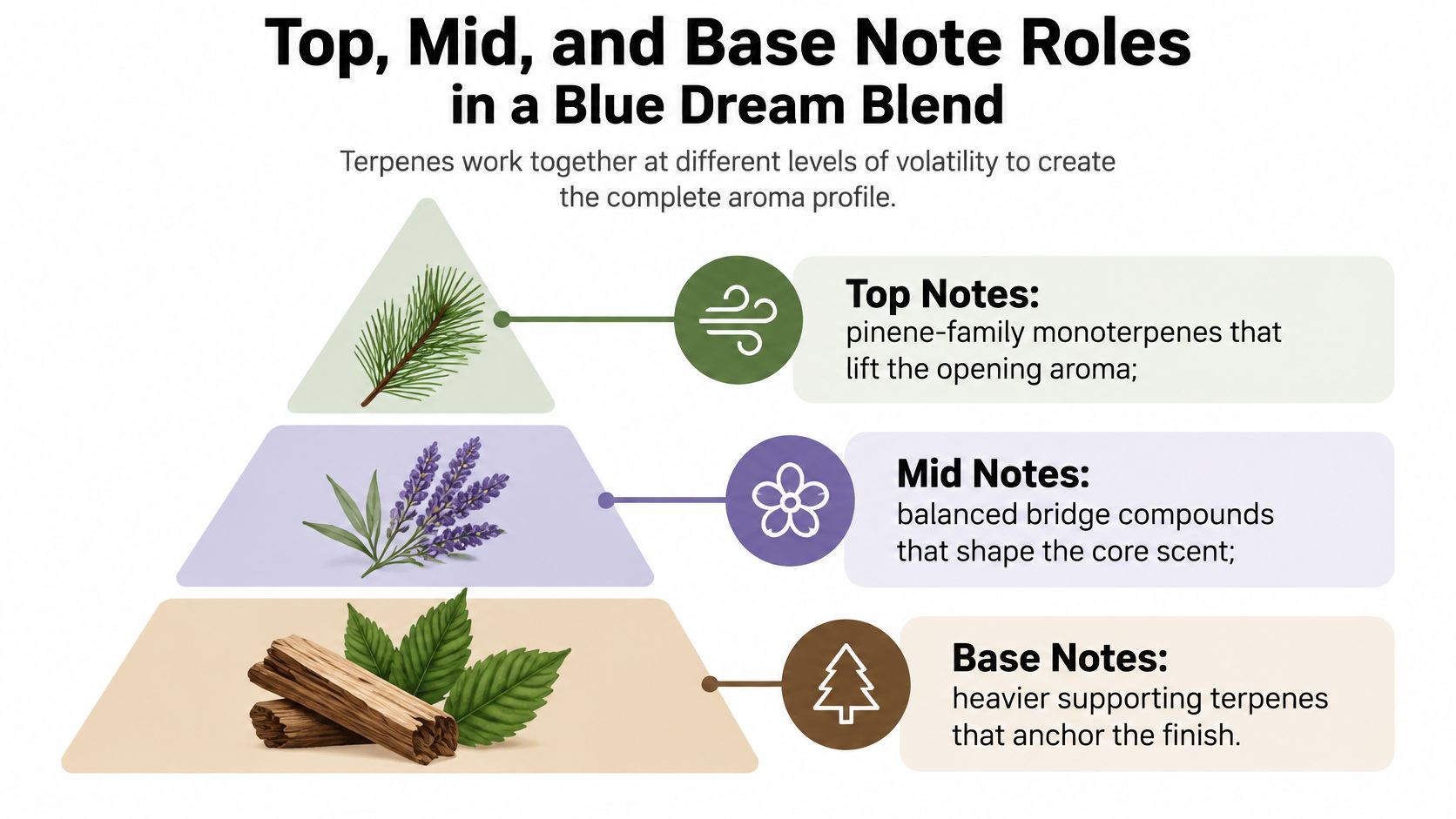
Set the balance by sensory target
For the opening, establish an acceptable pine-forward range in the finished formulation. If the first impression is too sharp, check the pine fraction before adding sweetness. Extra sweet material may soften the impression while obscuring the intended identity.
The middle should connect that opening to the finish. Myrcene-associated sweet, earthy, and musky notes can provide body, while supporting accents alter the overall impression. Assess berry character across the blend rather than attributing it to myrcene alone.
Keep the finish supportive. Caryophyllene and humulene can add dry, woody, peppery depth; if those notes dominate, the transition from opening to finish may feel disconnected. Judge balance in the carrier first, then through the device under controlled operating conditions. Bottle headspace is useful for screening, not for release decisions.
Storage matters, too. A fresh sample cannot show whether the balance holds over time, so include stored samples in sensory checks before approving the target range.
A fruit-forward extension can be a deliberate brand choice. Record it as a sensory variant, rather than presenting a stronger berry impression as a more chemically authentic Blue Dream.
How Much Blue Dream Profiles Vary Across Batches
A Blue Dream label does not guarantee a fixed terpene recipe. Formulate to a defined sensory target, then set analytical limits around qualified material. That keeps batch decisions tied to the intended aroma rather than a single reference chart.
In the cited flower dataset, beta-myrcene was the leading terpene in 68% of samples, alpha-pinene in 24%, and beta-caryophyllene in 6.6%. Terpinolene and limonene led 0.8% and 0.4%, respectively. These figures show how often each compound ranked first, not its concentration range within samples.
A broader commercial cannabis chemistry analysis grouped Blue Dream mainly in a high-myrcene–pinene cluster. That pattern can inform a target, but does not establish a universal ratio.
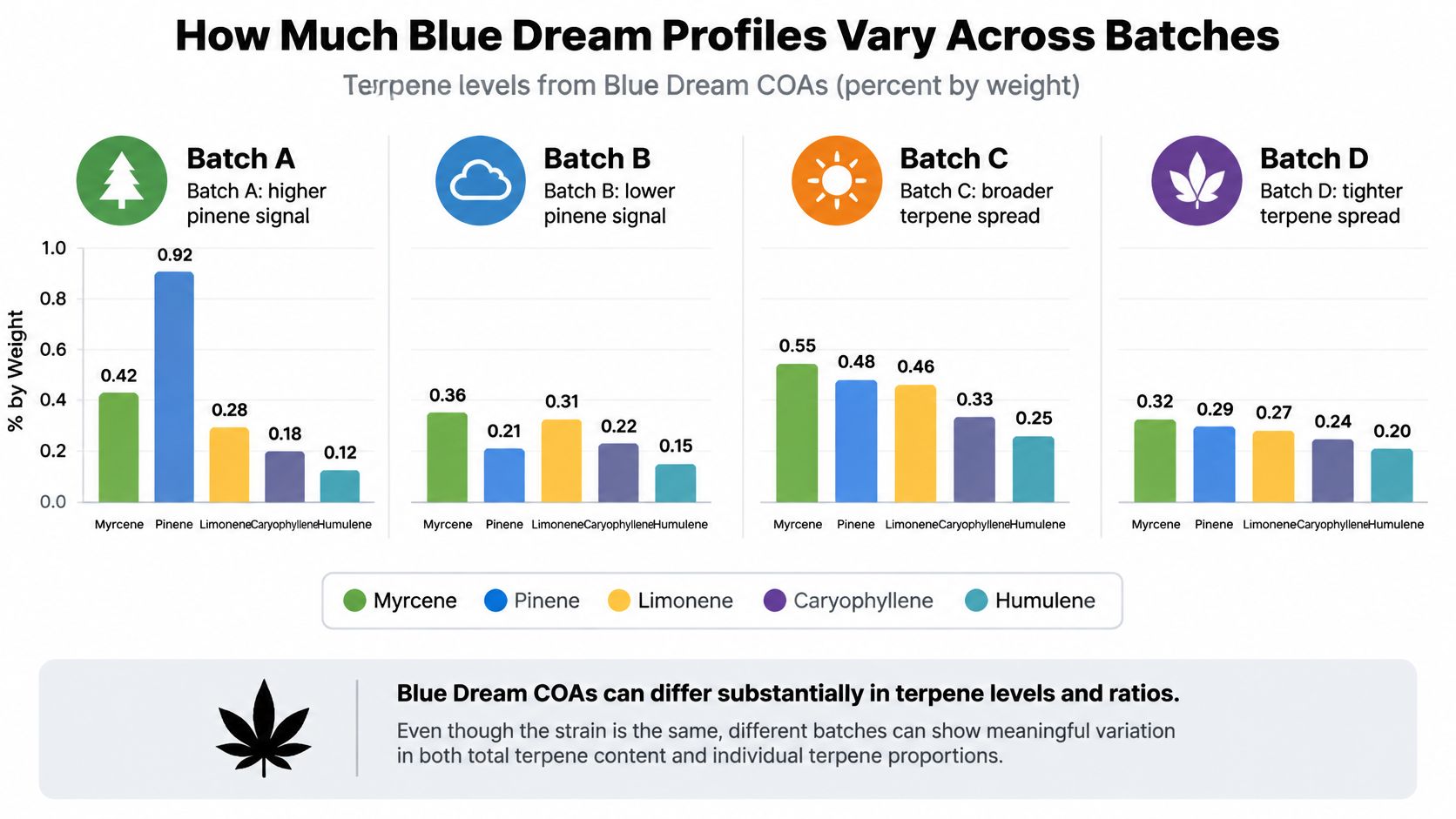
The illustration is conceptual. It does not provide measured results for the batches shown.
Set specifications using retained reference material and qualified pilot batches. Genetics, cultivation, harvest timing, drying, storage, and analytical methods can shift reported composition. Compare certificates of analysis only after confirming equivalent units, compound panels, and identification methods. A guide to testing for terpenes can help structure the laboratory discussion.
Define a lower limit where a marker no longer supports the target, and an upper limit where it disrupts the approved balance. Set supporting-compound limits too, so minor components cannot pull the blend away from its intended identity. Release ranges should cover batches that meet the sensory and analytical specification, not every profile reported under the cultivar name.
Botanical Versus Cannabis-Derived Terpenes for Blue Dream Blends
Choose botanical or cannabis-derived inputs according to the product's sourcing claim, desired aroma, documentation requirements, and ability to manage variation. Neither origin label is a substitute for batch-level analysis or finished-product testing.
A botanical blend offers a route to rebuilding selected aroma markers without depending on a particular cannabis harvest. A cannabis-derived fraction offers a route to carrying more of a source extract's character, but the developer still needs to qualify its composition and consistency.
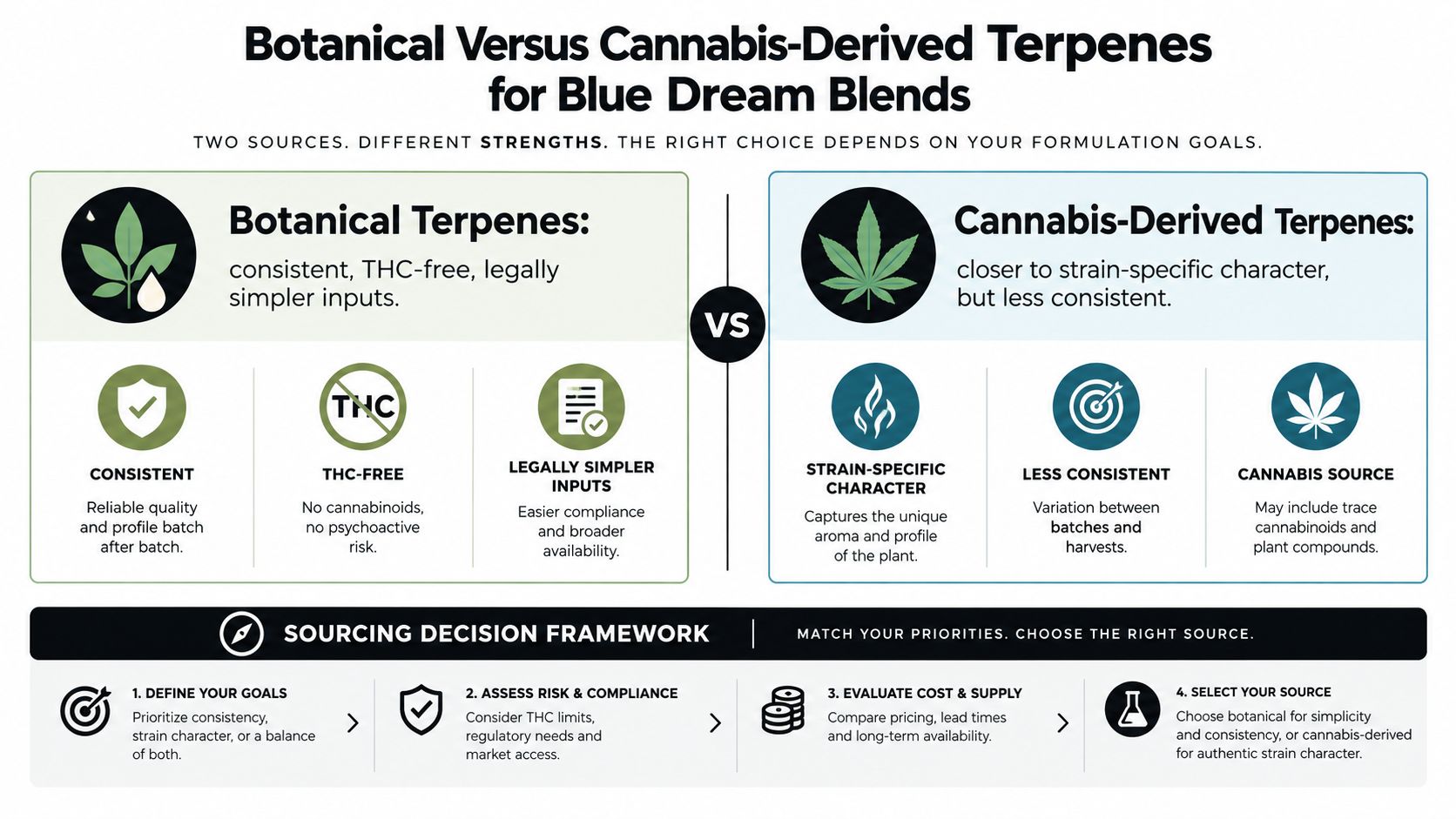
Compare the purchasing requirements
| Decision | Botanical input | Cannabis-derived input |
|---|---|---|
| Flavor matching | Qualify the reconstructed sensory target | Qualify the retained source character |
| Repeat orders | Require composition limits and change control | Require batch comparability and change control |
| Origin labeling | Document botanical sources | Document cannabis origin and applicable handling |
| Scale-up | Confirm capacity and lead times | Confirm source continuity and lead times |
| Cost evaluation | Compare qualified finished-product cost | Include qualification and adjustment requirements |
Botanical, naturally derived, and nature-identical are not interchangeable purchasing descriptions. Require the supplier to explain ingredient origin and manufacturing terminology rather than relying on a natural label.
THC-free status also needs appropriate analytical documentation. It doesn't establish that every finished formulation, marketing claim, or shipment is permitted in every jurisdiction.
The botanical versus cannabis-derived terpene comparison provides a useful starting point for this sourcing discussion. For supplier selection, ask for current COAs, test scope, safety documentation, traceability, minimum order quantities, and written bulk quotations.
Don't assume a lower ingredient price means a lower production cost. Include the work required to qualify, adjust, document, and release the finished SKU, then choose the sourcing model your team can control.
Building a Blue Dream Strain-Inspired Terpene Blend
Blue Dream is a sensory target, not a fixed chemical recipe. Build a Blue Dream strain-inspired terpene blend around an approved reference and application-specific limits, allowing for acceptable variation in compound ratios. A flower analysis can guide characterization, but it does not directly specify a recipe for a different carrier or product format.
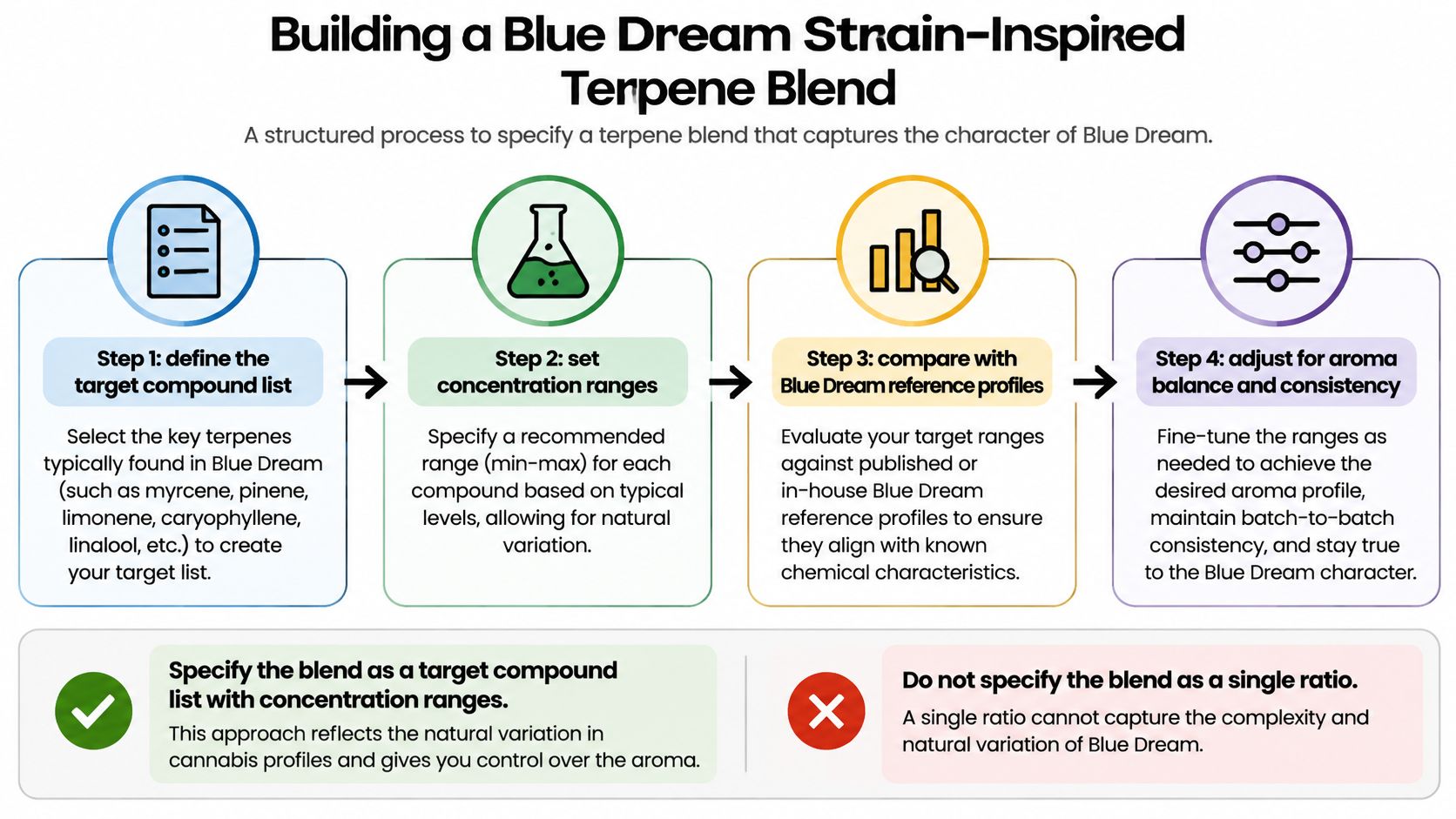
Define the sensory target, then tune
Keep a retained sample as the reference. Describe its opening, body, and finish, and identify departures the team will reject. Those boundaries let formulators adjust ratios without treating one batch's profile as the only acceptable composition.
Use the earlier monoterpene result as a characterization point, not a required blend balance. Select supporting compounds by sensory contribution; don't assign the uncharacterized remainder a prescribed sesquiterpene fraction.
Before making pilots, establish the carrier's native terpene content. Then keep carrier, hardware, and evaluation method consistent across trials. Record each addition and distinguish mass percentage from volume percentage, including any density conversion. Pair the formula and ingredient lots with analytical results and sensory assessments.
A Mixing Calculator can translate target amounts into additions, but the target and calculation basis remain formulation decisions. Check its assumptions before using calculated volumes in a mass-based specification.
The Elevated Strains catalog page can serve as a separate flavor reference. It does not establish Blue Dream composition or show that the product will perform interchangeably.
Before scale-up, document ingredient origin, additions, native contributions, and approved sensory language. This keeps the target reproducible while allowing qualified batches to vary within the sensory limits.
Terpene Loading for Vape Cartridges and Distillate
Higher terpene loading doesn't automatically improve aerosol performance. Set loading through flavor, physical-performance, and emissions testing, using the lowest concentration that meets the qualified product requirements.
A University of California study tested distillates containing 0%, 7.5%, and 15% terpene mixtures and found no statistically significant difference in average aerosol mass per puff across those concentrations, according to its terpene loading and aerosol-performance report. Those experimental levels are comparisons, not recommended production doses.
A peer-reviewed review of cannabis-vaping chemistry describes cartridge formulations containing roughly 10–20 wt% terpenes and estimated aerosol concentrations of approximately 2,500–5,000 ppm, compared with environmental inhalation studies generally below 100 ppm. The same review discusses industry guidance describing naturally occurring cannabis concentrations around 1–5% and suggesting a finished-product ceiling of 10%; this is not a universal safe limit or globally harmonized standard.
Separate the qualification questions
- Flavor: Does the product meet the reference without excessive intensity?
- Physical performance: Does it fill, wick, and resist leakage in the selected hardware?
- Electrical conditions: How do power and operating settings affect the result?
- Emissions: What does the actual formulation produce under the intended test conditions?
- Contaminants: Have the ingredients and product been screened against the applicable specification?
Release criterion: Food-grade documentation alone doesn't establish suitability for inhalation.
Avoid PG, VG, PEG, MCT, and unverified diluents where the product specification excludes them. Document total terpene concentration, not merely the addition rate, because native material remains part of the finished exposure.
Use the distillate terpene-addition guide for workflow context, then qualify the actual formulation and device rather than adopting a generic loading number.
Protecting Pinene-Rich Top Notes During Storage
Blue Dream is a sensory target, not a fixed recipe, so protect the pine-forward impression through process control rather than assuming every blend will age alike. Minimize unnecessary exposure to light, heat, and oxygen during blending, filling, and storage. Qualify the finished package, since the incoming blend alone cannot show how the product will hold up.
A study of cannabis terpenes and extracts reported compound-specific changes under UV and heat exposure. Sabinene and beta-pinene degraded more under UV, while alpha-pinene degradation was primarily time-dependent. Under the study's conditions, 94% of initial alpha-pinene remained after 18 days. Those results describe the tested conditions, not a shelf-life guarantee for a commercial cartridge. See the terpene stability investigation.
A practical stability check starts with representative finished-product samples. Use the intended carrier, container, closure, headspace, and temperature conditions. Compare chemical results with the approved sensory reference, and review aroma, appearance, and device behavior together.
Build handling controls into the process: close containers promptly, limit open transfers, and document heating and holding conditions. Check light protection and closure performance, then retain traceable samples from ingredient receipt through finished production. If the aroma shifts, investigate blending, transfer, filling, packaging, and storage before blaming the supplier's original composition.
The terpene storage guide can inform handling procedures. Product-specific evidence must support release and shelf-life decisions.
Adding more top notes at manufacture can make a fresh blend excessively sharp without fixing the cause of later aroma loss. Identify the exposure or packaging weakness first.
Quick Reference for Blue Dream Formulation
For replicating flavor of Blue Dream for vape cartridges, use a sensory reference plus a controlled analytical specification. The working formula should describe your qualified product, not claim to represent every flower sample sold under the name.
| Development decision | Working reference | Release check |
|---|---|---|
| Opening character | Pine-family markers | Matches the approved brightness |
| Core character | Sweet-earthy body | Retains continuity in the carrier |
| Supporting finish | Woody, peppery depth | Supports without dominating |
| Composition limits | Qualified pilot results | Meets individual release bands |
| Loading | Application testing | Meets sensory, physical, and emissions requirements |
| Stability | Finished-package studies | Retains the approved profile |
| Labeling | Documented ingredient origin | Matches applicable market requirements |
Prepare a useful supplier request
Send the supplier the intended carrier, hardware, target aroma description, exclusions, and documentation requirements. Include the reference you want matched and identify whether it represents flower aroma, an existing cartridge, or a deliberately modified brand profile.
Request samples before a production commitment. Ask for the current minimum order, available ordering formats, lead time, and bulk quotation rather than assuming published terms apply to your project.
Keep the comparison fair: evaluate candidate blends in the same carrier and device, using the same processing and assessment procedure. Record why a sample passes or fails so the purchasing decision can be repeated when personnel or ingredient lots change.
The next useful deliverable is a pilot specification, not another strain chart. Pull the supplier's current Blue Dream information, verify the Mixing Calculator's measurement basis, and prepare a documented sample evaluation before approving a manufacturing batch.
Frequently Asked Questions About Blue Dream Terpenes
Can a botanical Blue Dream blend match flower aroma?
A botanical blend can be developed toward selected flower-aroma markers, but matching those markers doesn't establish complete chemical equivalence. Evaluate the candidate in the intended product, because an aroma match doesn't guarantee reproduction of the whole-flower experience.
What should cartridge brands ask about minimum orders and bulk pricing?
Request the current minimum order, sample options, lead time, and written quotation for the required format. Include documentation and change-control requirements so competing offers cover the same purchasing specification.
What if a COA doesn't match a canonical strain chart?
Check analytical units, methods, and the individual compound results before concluding that the ingredient is unsuitable. Compare it against the approved product specification and sensory reference rather than an unsupported universal ratio.
Can terpene percentages predict focused or relaxing effects?
No, percentages alone don't establish those outcomes. The peer-reviewed six-cultivar chemistry study supports chemical characterization, not a guarantee that a named terpene causes a particular human experience.
Which documents should be reviewed before formulation?
Review the batch COA, ingredient-origin statement, safety documentation, applicable contaminant testing, and recommended handling information. Educational resources such as Terpenes 101 can support onboarding, but they don't replace formulation-specific qualification or a market-specific compliance review.
Gold Coast Terpenes offers strain-inspired blends and isolated compounds for developing Blue Dream-style aroma in distillate and cartridge formulations. Visit Gold Coast Terpenes to discuss your reference profile, request current documentation and ordering terms, and select a sample for evaluation in your intended carrier and hardware.