
Buying a Purple Punch strain profile by name is the fastest way to miss the target. Gold Coast Terpenes, a Redondo Beach, CA supplier, makes 100% botanically derived terpene blends, not cannabis-derived, and a terpene profile for Purple Punch should be ordered the same way it's built, against a measured COA. A name is a flavor brief. A ratio is a specification.
What Is the Target Terpene Profile for Purple Punch?
The working target is caryophyllene-led, not grape-led. Gold Coast Terpenes is a supplier of 100% natural, lab-verified, THC-free terpene blends with 50+ profiles, and strain-specific work starts from measured targets rather than names. One usable reference is the delta-8 Purple Punch vape COA with 4.266% total terpenes, led by trans-beta-caryophyllene at 2.35%.
| Terpene | Role | Share of total terpenes | Ratio to caryophyllene (=100) |
|---|---|---|---|
| Beta-caryophyllene | Base (structural anchor) | 55.1% | 100 |
| Limonene | Top (citrus lift) | 16.2% | 29.5 |
| Alpha-humulene | Base (support) | 6.0% | 10.9 |
| Myrcene | Mid (controlled input) | 4.4% | 7.9 |
| Linalool | Mid (floral accent) | 3.6% | 6.6 |
| Alpha-pinene | Top (fresh lift) | 3.6% | 6.5 |
What Each Note Does in the Blend
Beta-caryophyllene is the base. It's the warm, peppery backbone that holds the blend together after the top notes flash off. Without that anchor, a Purple Punch cartridge reads as sweet vapor with no structure underneath.
Limonene and alpha-pinene are top notes. Limonene at 0.693% in the reference COA adds citrus brightness that buyers associate with the fruit side of the profile. Alpha-pinene at 0.153% adds a fresher lift at the first draw. Both read fast and fade fast, so they can't carry the blend alone.
Alpha-humulene supports the base at 0.255%. It sits under caryophyllene rather than competing with it. Myrcene at 0.186% and linalool at 0.154% are mid notes that need restraint. Push myrcene and the blend drifts earthy. Push linalool and it drifts floral. Neither drift matches the dessert-fruit brief most brands write for Purple Punch.
Build from the anchor down. A formulator who starts with limonene usually overshoots brightness, then tries to fix it by adding more terpenes overall.
How to Read the Ratio Table
The ratio column is the practical part. Set caryophyllene to 100 and every other terpene scales from there, so a formulator can rebuild the same proportions at a different total loading. That's what separates a strain-inspired terpene blend from a name on a purchase order.
The limit matters. That COA describes a finished vape formulation, not raw flower, so its ratios are a design reference for flavor direction, not a guarantee for every Purple Punch batch. For comparison on the fruit-forward side, the 24k gold punch profile in the Strains range is a separate blend. It isn't a Purple Punch clone, and it shouldn't be labeled as one.
Why Does the Purple Punch Name Not Predict Its Terpenes?
A Purple Punch name can cover very different terpene profiles. One flower sample reported 6.3284% total terpenoids, led by limonene at 34.531 mg/g and myrcene at 9.074 mg/g. A concentrate sample reported 6.1983% total terpenes, led by beta-caryophyllene at 2.1551% and limonene at 1.1578%, according to the independent Purple Punch COA showing batch-level terpene variation.
The totals are close, but the leading terpene changes. A cartridge built around the flower sample would read limonene-forward; one built around the concentrate sample would read caryophyllene-forward. For a cartridge brand, the strain name is a flavor brief, not a usable chemical specification. A purchase order based on the name alone leaves the delivered profile to the supplier's available batch.
Why Batches Diverge
- Phenotype: Different cuts of the same cross can express different terpene profiles.
- Cultivation and curing: Growing conditions and cure handling affect volatile retention before extraction.
- Extraction and concentration: Flower, distillate, and live resin can retain terpenes in different proportions through processing.
The variation extends beyond Purple Punch. Research analyzing commercial cannabis samples found that strain labels did not consistently correspond to cannabinoid and terpene chemistry. The label names a marketing lineage, and the COA is the batch's chemistry record.
What Lineage Actually Tells a Formulator
Lineage helps set an aroma direction, not a batch specification. Purple Punch is generally described as a California-bred, indica-dominant hybrid created by Supernova Gardens from Larry OG and Granddaddy Purple. Its development is placed around 2012-2013, with wider visibility after late-2010s seed releases, according to the Purple Punch lineage history covering Larry OG and Granddaddy Purple.
Larry OG supplies an OG Kush-family reference, while Granddaddy Purple suggests the sweet, purple-fruit side that product teams may translate into grape and dessert notes. That heritage can guide a flavor brief, but it cannot set a milligram value for a particular lot. If a measured batch reads faint on fruit, Gold Coast Terpenes' strain formulation approach offers a documented way to emphasize fruit and dessert notes rather than relying on the strain name.
Set the target before ordering. Request a lot COA for each batch, specify acceptable ranges for caryophyllene, limonene and myrcene, and include the sensory goal in the purchase order. Gold Coast Terpenes' SC Lab-tested lot documentation can serve as a comparison point: assess the delivered batch against the written target, then test the blend under cartridge heat before placing an order.
How to Build a Purple Punch Terpene Blend Step by Step
Build to a written target, not to a memory of flower. The sequence below turns the reference ratio into a repeatable formulation guide for a distillate or live resin cartridge.
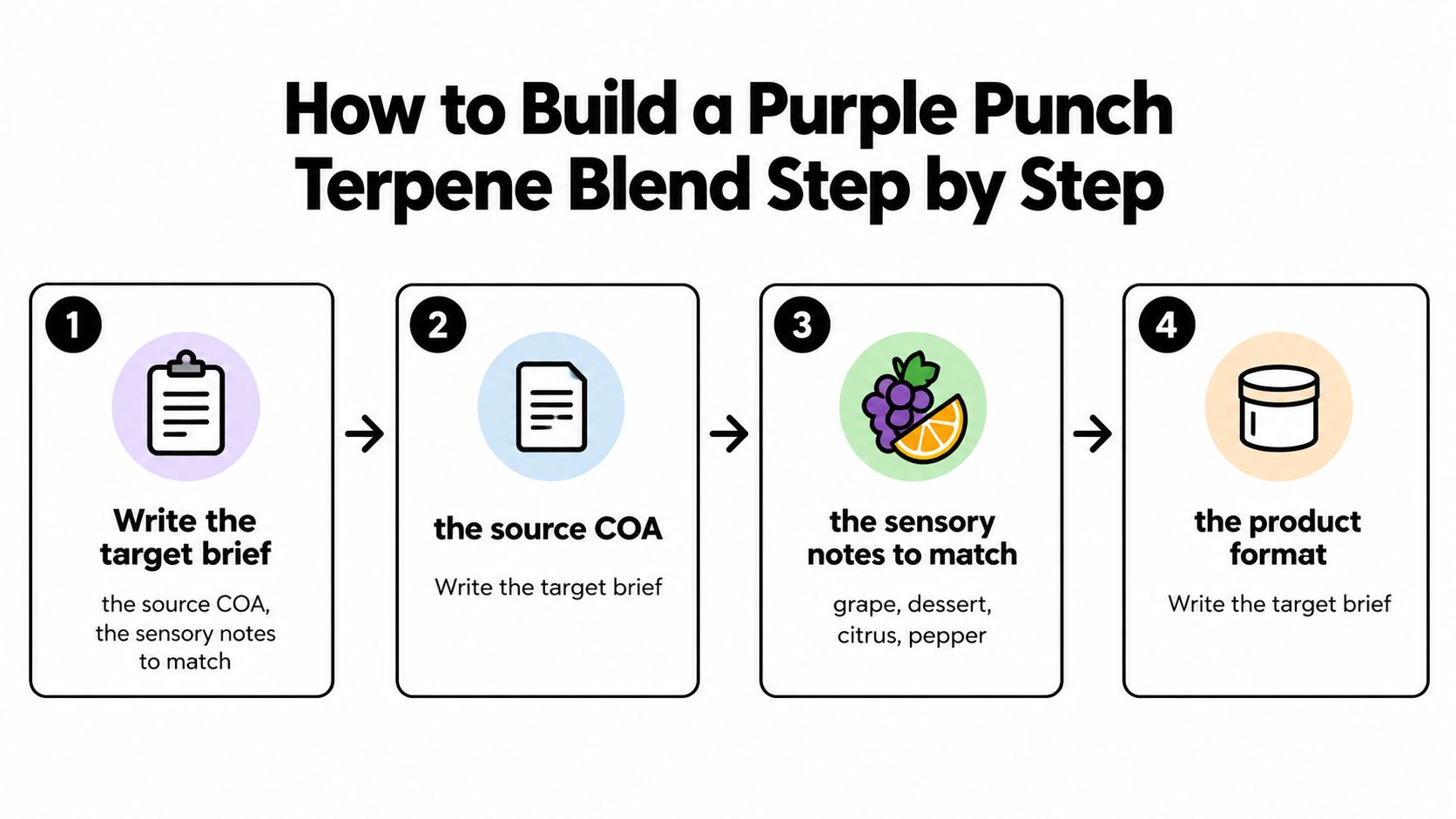
- Write the target brief. Record the source COA, the sensory notes to match (grape, dessert, citrus, pepper) and the format, such as a distillate cart or live resin cart. The brief exists because memory drifts between bench sessions. The common slip is skipping the format, since distillate and live resin carry the same blend differently.
- Set beta-caryophyllene as 100. Every other component scales from the anchor, which keeps proportions stable if the batch size changes. The common slip is building from limonene first and overshooting brightness, then burying the error under more total terpenes.
- Scale the supporting terpenes. Add limonene near 29.5 per 100 caryophyllene, alpha-humulene near 10.9, myrcene near 7.9, and linalool and alpha-pinene near 6.5 to 6.6. These ratios come from the reference COA cited earlier. The common slip is letting linalool climb because it smells pleasant in the jar. In a heated cart it pushes the profile floral.
- Blend a small trial lot and record every weight. A trial lot costs little and exposes ratio errors before production oil is committed. Unrecorded adjustments can't be reproduced, and an unreproducible blend has no value to a brand.
- Run GC-FID against the target. Compare the measured result with the written profile inside a defined tolerance band. Sensory checks alone miss quiet ratio drift. The dominant compound can change between batches, so analytical confirmation isn't optional decoration.
- Dilute to the planned cart loading and test in hardware. Smell and draw the oil in the actual cartridge, not only in the jar. Jar aroma rewards top notes that hardware may strip or distort. The common slip is approving a blend that was never heated.
- Scale with the Mixing Calculator. Gold Coast Terpenes offers a Mixing Calculator for checking total percentages when a trial recipe moves to production volume. Pairs well with the method in the distillate and terpene mixing procedure, which covers incorporation order and handling.
- Lock the recipe and document the lot. Record the lot number and COA, then repeat the GC check on each production lot. A locked recipe without lot verification is just an intention.
Adjusting One Anchor Without Rebuilding
Isolates change the economics of correction. Gold Coast Terpenes supplies isolates including Limonene, Myrcene and Beta-Caryophyllene, so a formulator can move one anchor a small amount without discarding the whole blend. That matters in replicating flavor of a specific batch, where the gap between target and trial is usually one terpene, not six. Background on top, mid and base roles sits in the Terpenes 101 material on the supplier site for team members who are new to blend architecture.
Bench rule: Change one variable per trial. A formulator who moves the ratio and the loading in the same test learns nothing about either one.
How Much Purple Punch Blend Should a Cartridge Carry?
Keep myrcene at its target ratio and set loading from hardware first. More blend isn't more flavor. Past a hardware-dependent point, more blend is more harshness and less of the grape note the brand paid to build.
Why Myrcene Sets the Ceiling
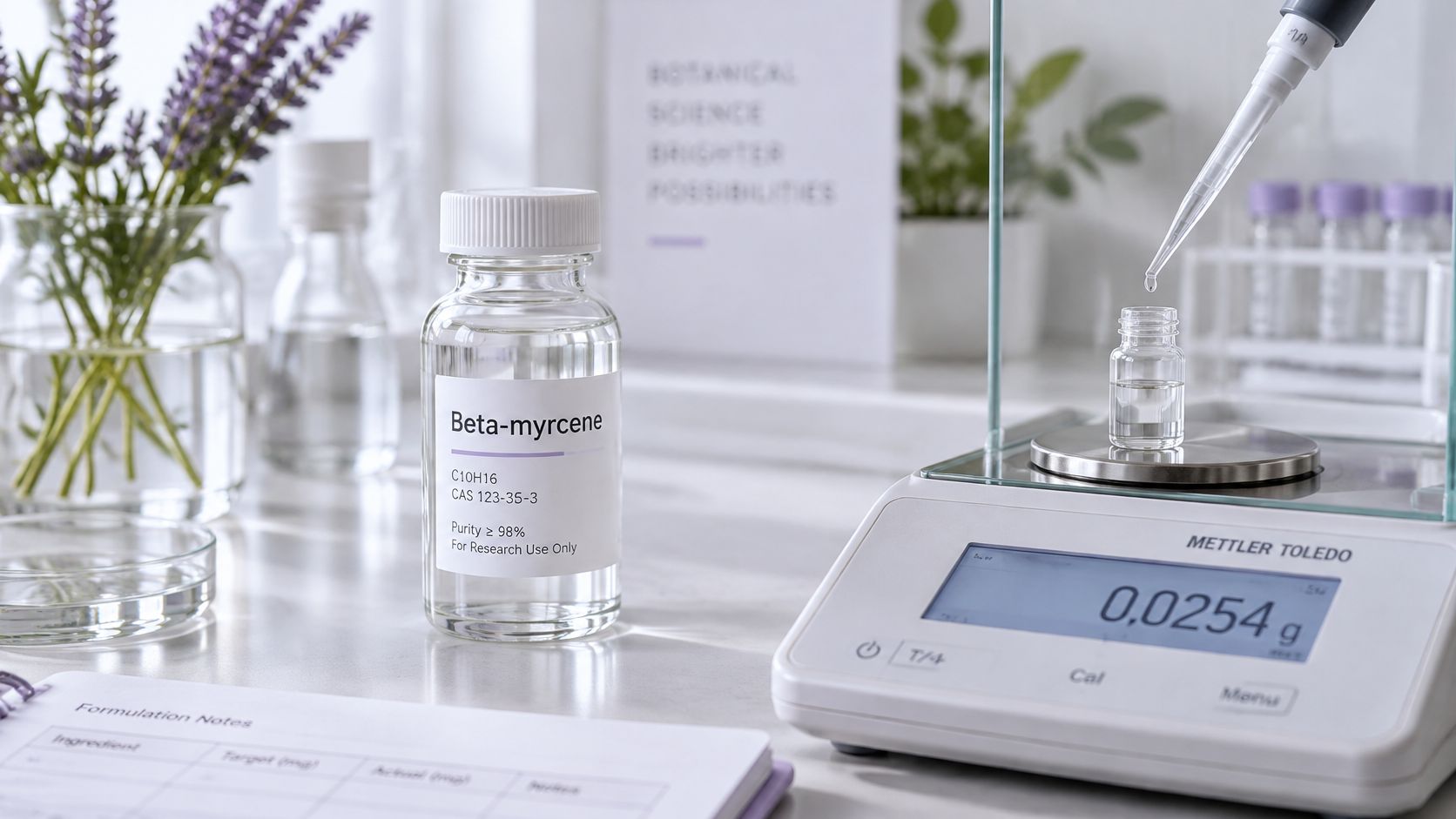
Research on beta-myrcene as a variable affecting aerosol chemistry in vaporization treats myrcene as a controlled formulation input, not a free flavor booster. In a simplified distillate model tested at 370 °C, increasing beta-myrcene levels were associated with reaction products linked to lowered aerosolization temperatures. That finding doesn't establish a consumer effect. It establishes a manufacturing caution. A Purple Punch replication should preserve its measured myrcene contribution instead of assuming a higher percentage improves performance for distillate.
Loading and Ratio Are Separate Variables
Loading means the terpene percentage of the finished oil. Ratio means the proportions inside that percentage. Confusing the two is the most common cartridge error. A team that wants more grape character often raises loading, which raises everything, including the peppery base and the harsh fraction, while the delicate top notes get masked rather than amplified.
The cleaner sequence is fixed ratio, variable loading. Set the candidate loadings from oil viscosity and hardware flow first. Then fill test carts at two or three loadings with the ratio held constant. Compare aroma persistence, harshness and flow side by side. The loading that wins in the jar frequently loses in the coil.
- Viscosity at fill temperature: The oil must fill cleanly and wick without flooding or dry hits.
- Aroma after heating: The grape and citrus top should still read after the coil, not just before it.
- Flavor stability at the next test point: A blend that fades between fill day and the follow-up check isn't ready to scale.
Carrier Disclosure Still Applies
Gold Coast Terpenes describes its terpenes as free of VG, PG, PEG and MCT. That describes the terpene input. The finished formula still needs its own declared carrier position, and compatibility with the chosen hardware still needs testing. A brand shouldn't let a clean input claim substitute for a finished-oil specification.
Does a Purple Punch Blend Hold Its Flavor at Vape Power?
A Purple Punch flavor brief is not approved by tasting the blend cold. The cartridge has to keep its intended profile after heating, so test the actual blend in the target hardware before placing an order.
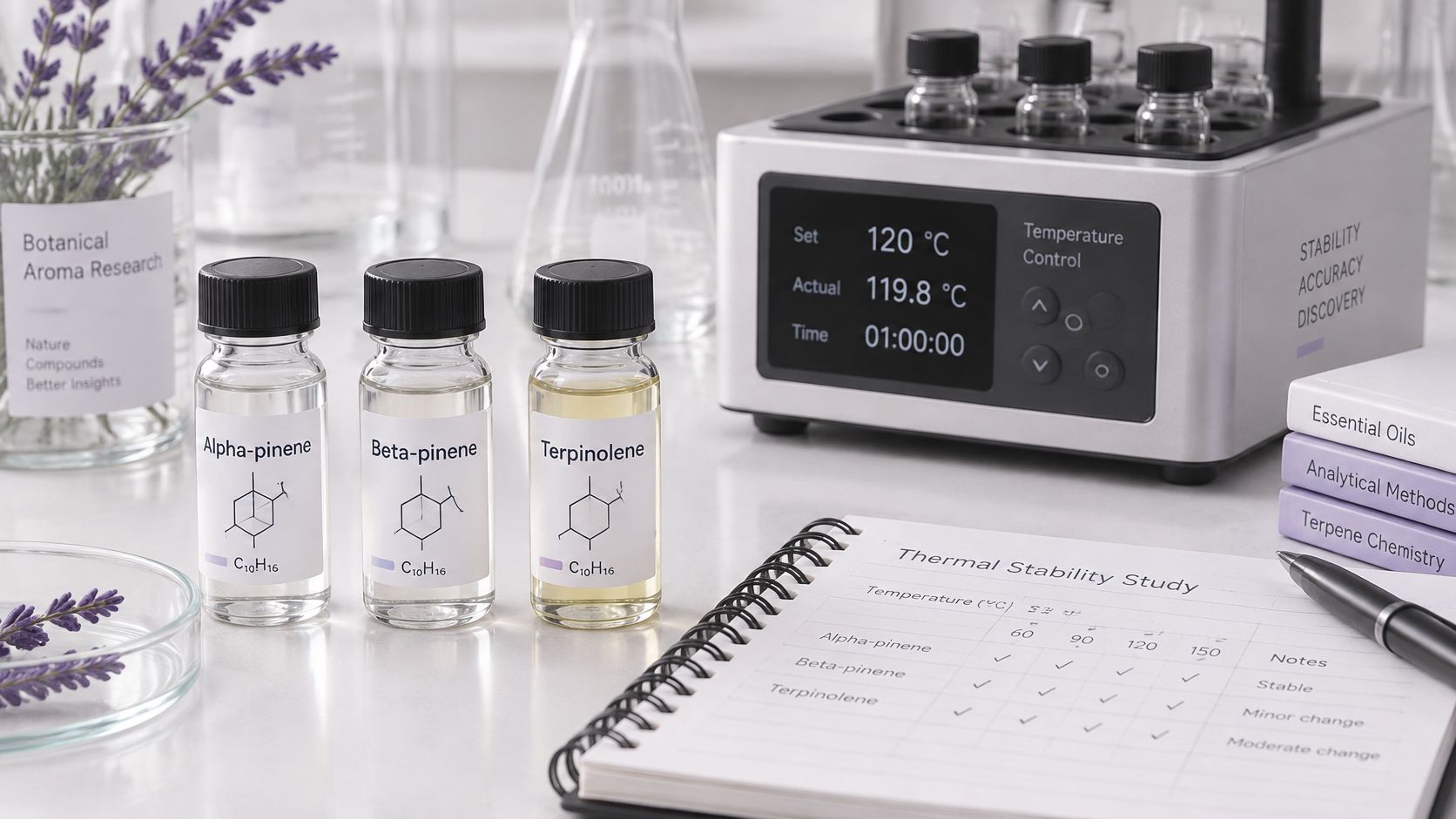
Research on thermal oxidation of myrcene and limonene under simulated vaping conditions found oxidation across alpha-pinene, beta-pinene, terpinolene, myrcene and limonene from 100 °C to 200 °C, including at the lower end of typical vaping temperatures. A separate study found that the relative levels of four terpene-derived products were highly correlated with applied e-cigarette power. Device power changes the chemistry, so it belongs in the test plan.
The Five Stage Test
| Stage | Condition | What it catches | Pass signal |
|---|---|---|---|
| Unheated blend | Room temperature, GC-FID | Mixing error or ratio drift | Within tolerance of the target profile |
| Low power | Lower end of typical vape range | Early oxidation | Top notes intact, no stale note |
| Mid power | Mid-range device setting | Ratio shift under heat | Limonene to caryophyllene ratio held |
| High power | Upper device setting | Thermal breakdown products | No new peaks absent from target profile; ratios within tolerance |
| After storage | Planned shelf conditions | Slow flavor drift | Sensory match to the fresh sample |
Use the unheated blend's GC-FID result as the baseline. Then test the filled cartridge at each planned power setting, compare its aroma with the fresh sample, and repeat the sensory check after storage. The guide to selecting an optimal vaping temperature range can help identify which device settings to test first.
The demonstration below shows cartridge hardware in operation, the conditions the blend must withstand.
Read the failure signals separately. If limonene fades, the fruit impression can collapse first. A stale or harsh note that appears only at higher power points to a heat-related change, not a ratio error. New chromatogram peaks absent from the target profile indicate that heating has changed the approved blend.
Approve only power levels that pass both chemical and sensory checks. Record the passing level in the product specification for any blend sold for vape cartridges. A strain name alone cannot establish that result.
What Is the Difference Between Botanical and Cannabis-Derived Terpenes?
Purple Punch works better as a flavor brief than as a fixed terpene specification. The strain name does not establish a consistent ratio, so the blend should start with a measured target from the relevant COA. Source then determines how the blend is described and documented, while the target ratio remains tied to the formulation.
A botanical blend uses terpenes sourced from non-cannabis plants. A cannabis-derived blend uses terpenes isolated from cannabis. For a practical comparison of their sourcing trade-offs, see this comparison of cannabis-derived and botanical terpene sourcing.
Gold Coast Terpenes, based in Redondo Beach, California, makes 100% botanically derived terpene blends rather than cannabis-derived blends. Its blends are THC-free and SC Lab-tested. The supplier lists 50+ profiles, giving formulation teams options to assess against a measured target.
Three Labels a Buyer Will See
- Botanical: Terpenes sourced from non-cannabis plants and blended to a target profile.
- Cannabis-derived: Terpenes isolated from cannabis material, with sourcing tied to that input.
- Nature-identical: Molecules chemically matching natural terpenes but potentially produced through other routes. Treat the label as a source claim and confirm what it means with the supplier.
What the Choice Changes in Practice
For a Purple Punch-style product for cannabis product formulation, source affects label wording, compliance files, and how buyers describe the product to retailers. Source changes the label and paperwork, while the target ratio is set by the measured flavor profile. A source story is not a flavor specification; a blend can have traceable paperwork and still miss the intended aroma.
Set the ratio first, then confirm the source wording on the lot COA. Ask suppliers to identify the source category for each isolate, and reject blends whose labels cannot be traced to a named source. Gold Coast Terpenes offers Limonene, Myrcene and Beta-Caryophyllene as botanical isolates, allowing a formulator to keep the source category consistent while adjusting a recipe.
A source label says where the molecules came from. The COA identifies what is in the bottle.
Confirm the Batch Before You Order Purple Punch Terpenes
Order documentation before volume. A Purple Punch-style order should pass six checks, and any single red flag should pause the purchase.
| Check | What to request | Red flag |
|---|---|---|
| Batch documentation | Lot COA with GC terpene results for each lot | One COA reused across lots |
| Source wording | Plain statement of origin, such as 100% natural | Vague origin claims |
| Lab testing | Named lab results, THC-free confirmation | No named lab |
| Carrier | Full list of diluents, including whether VG, PG, PEG or MCT are present | Undisclosed carriers |
| Volume terms | MOQ, bulk program and discount tiers | MOQ not stated |
| Trial quantity | A sample lot to run the build steps | Full order required before any trial |
Batch documentation comes first because the ratio drift covered earlier makes a reused certificate worthless. The guide to reading a certificate of analysis before purchasing explains which fields matter. Source wording comes next. Gold Coast Terpenes describes its blends as 100% natural, and any supplier should offer an equally plain statement.
Lab testing requires a named lab. Gold Coast Terpenes blends are SC Lab-tested and THC-free, and a supplier who names no lab should be questioned directly. Carriers require a full list, since Gold Coast Terpenes lists its terpenes as free of VG, PG, PEG and MCT and other suppliers should state their position just as clearly.
Volume terms should be explicit before sampling, including MOQ and bulk tiers. Gold Coast Terpenes offers free U.S. shipping over $100 and discounts on orders above 64 oz, which belong in the cost model from the start. Finally, request a trial lot. Order one trial lot of the Purple Punch-style blend, run the build and heat-test steps, and scale only after both pass.
Frequently Asked Questions About Purple Punch Terpene Blends
How Should a GC-FID Chromatogram Be Read?
Check the compound names, retention times, and peak areas. GC-FID results typically report each terpene as a share of the measured total. Confirm whether the report lists normalized percentages or raw peak areas before comparing it with a target ratio. A chromatogram shows measured composition, not how the blend will taste in a cartridge.
How Should a Target Ratio Tolerance Be Set?
Set a tolerance for each major terpene before blending, based on the intended flavor direction and the precision of the available measurements. Keep minor compounds in a separate range; small shifts there may affect nuance without changing the blend's main character. Agree on the measurement method and rounding rules with the lab, so a passing result means the same thing to the formulator and supplier.
Can the Reference Ratio Predict Cartridge Flavor?
Only partly. A COA ratio gives a starting point, while heat, hardware, and formulation can change the perceived balance. Test the blend in the intended cartridge at operating power, then adjust the flavor brief if grape, dessert, citrus, or pepper notes become unbalanced.
Gold Coast Terpenes supplies THC-free, SC Lab-tested botanical blends, strain-specific profiles, and isolates including Beta-Caryophyllene, Limonene, and Myrcene for cartridge and distillate formulation. A product team can compare a trial lot with its target COA and heat-test it before committing to production volume. Visit Gold Coast Terpenes to review its profiles, isolates, and formulation resources.