
Strain-specific terpenes are formulated blends that recreate the dominant terpene ratio of a named cannabis cultivar using measured isolates, designed to deliver a consistent sensory and functional profile batch after batch. In one analysis of six strains, researchers detected 146 distinct terpenes and terpenoids, confirming that a cannabis aroma is a complex chemical fingerprint, not one universal scent.
A familiar problem follows a product from the bench to the market. The label names a cultivar, the oil passes potency testing, and the finished cartridge still doesn't smell or taste like the reference flower. The issue usually isn't the cultivar name. It's that the name was treated as the specification.
For formulators, the useful definition is narrower. A strain-specific terpene blend is a measured reconstruction of a cultivar's dominant volatile pattern. It uses isolated compounds in controlled ratios so a manufacturer can reproduce a recognizable aroma and flavor in distillate, concentrate, or a vape cartridge without relying on the variability of fresh flower.
What Strain-Specific Terpenes Actually Are
A strain name can identify a commercial concept, but it doesn't automatically identify a chemical composition. Genotype, flowering stage, drying, storage, and cultivation environment can all shift the relative abundance of volatile compounds. The product name may remain unchanged while the profile on the chromatogram moves.
That distinction matters because strain-specific terpenes aren't a flavor graphic on a jar. They're a formulation input. The target is a repeatable ratio of compounds such as β-myrcene, limonene, β-caryophyllene, linalool, and pinene, selected to approximate the dominant fingerprint associated with a named cultivar.
A peer-reviewed analysis of six strains found 146 distinct terpenes and terpenoids across the samples. That level of chemical diversity explains why two products carrying the same broad strain name can express different citrus, pine, floral, peppery, herbal, or earthy characteristics. A separate study of 140 medicinal cannabis samples sold in Germany found that nine terpenes explained 86% of the variation in terpene profiles, which gives formulators a practical starting framework without implying that minor compounds are irrelevant. The analytical reference on strain-level terpene variation is useful when defining a target profile.
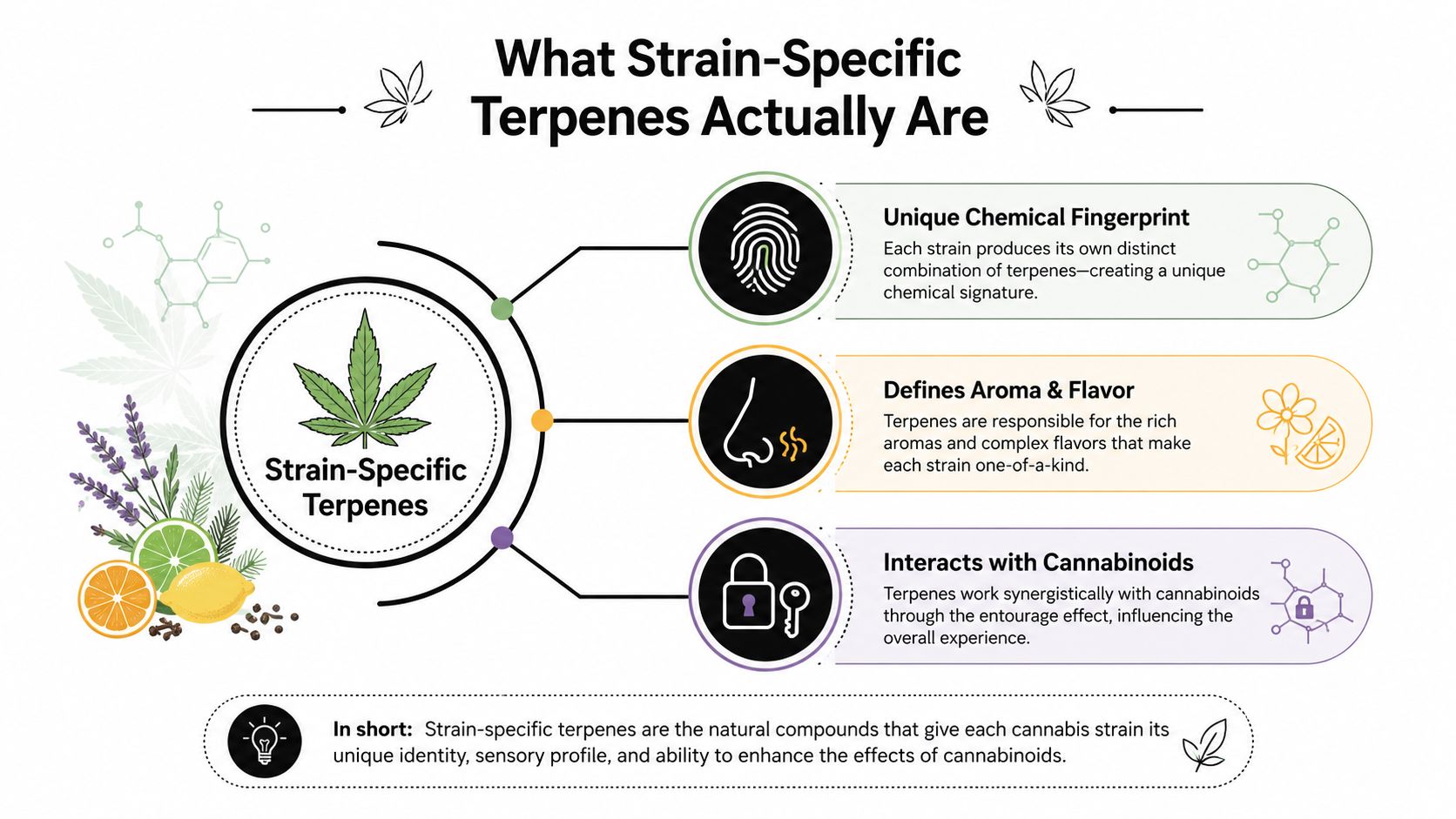
From fingerprint to production input
The practical workflow is straightforward:
- Select a reference. Use a representative flower COA, a retained aromatic standard, or a validated supplier profile.
- Identify the dominant compounds. Rank the terpenes by relative abundance and sensory contribution.
- Build the ratio. Combine measured isolates into a strain-inspired terpene blend.
- Dose into the base. Add the blend to distillate or concentrate at a controlled load.
- Verify the result. Compare the finished lot's aroma, viscosity, stability, and analytical profile against the internal specification.
A terpene fundamentals guide can help standardize terminology across purchasing, extraction, and quality teams. The key point is that the blend becomes the operational definition of the profile. The cultivar name provides context, while the ratio, lot documentation, and finished-product testing provide control.
Practical rule: Treat the strain name as a reference label. Treat the terpene ratio and COA as the specification.
Strain-Specific Profiles vs Isolates and Generic Blends
The buying decision usually comes down to three options: purchase individual isolates, use a generic flavor blend, or source a documented strain-specific profile. Each can work, but they solve different manufacturing problems.
Single isolates are the most flexible. A formulator can add limonene to brighten a blend, increase β-caryophyllene for peppery depth, or reduce an overly floral linalool note. Isolates are useful for rebalancing an existing profile and for custom development work. They also create the most labor, because every component must be weighed, recorded, mixed, and verified.
Generic or fruit-named blends are faster and often easier to buy, but the name may describe a sensory direction rather than a cultivar fingerprint. A blend labeled citrus, berry, or tropical can be appropriate for a flavor-led SKU, yet it may fail a strain-replication brief because its ratio isn't tied to a documented reference.
True strain-specific profiles sit between those extremes. They provide a defined composition associated with a named cultivar while avoiding the full bench work of building every blend from scratch. Their value is strongest when a brand needs the same sensory identity across repeated distillate or cartridge runs.
| Option | Best use | Main strength | Main limitation |
|---|---|---|---|
| Single isolates | Custom development and rebalancing | Maximum control over individual compounds | More weighing, documentation, and verification |
| Generic blends | Flavor-first products | Fast sensory direction | May not reproduce a named cultivar |
| Strain-specific profiles | Replicating flavor of a cultivar for vape cartridges | Better repeatability around a defined target | Still requires incoming-lot and finished-product QC |
The cost question isn't only the price per bottle. In-house blending also consumes formulation time, requires traceable batch records, and creates more opportunities for weighing or transcription errors. For a high-volume SKU, a ready profile can be more efficient. For a new flavor architecture, isolates let the formulator explore before locking the production blend.
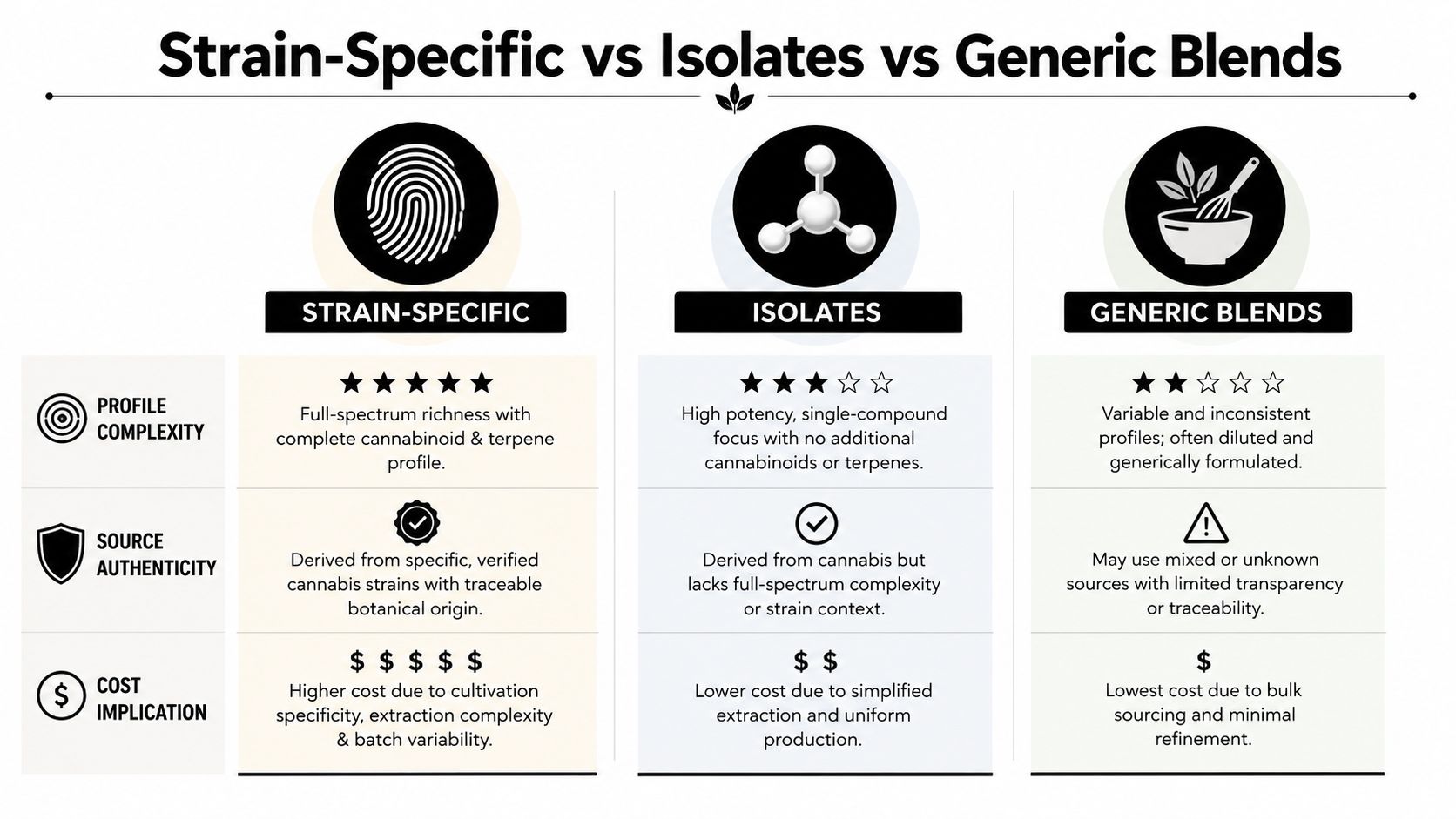
A concise visual comparison can also help align brand and technical teams:
The distinction between a cultivar reconstruction and a flavor additive is also covered in this comparison of strain-specific terpenes and terpene-enhanced flavors. Use the category that matches the brief. Don't buy a generic fruit profile and expect the COA to support cultivar fidelity.
The Dominant Compounds That Drive a Strain Profile
A 2024 classification study identified a practical nine-terpene framework for separating cannabis profiles. β-myrcene, β-caryophyllene, limonene, linalool, α-humulene, α-pinene, β-pinene, terpinolene, and fenchol explained 86% of the variation across the analyzed samples. The published classification study provides the quantitative basis for using these compounds as a formulation screen.
The compounds don't contribute equally to perception. A dominant terpene establishes the profile's center of gravity, while secondary compounds determine whether the blend feels sharp, rounded, floral, resinous, or persistent.
- β-Myrcene contributes herbal, musky, and earthy character. It can give a blend a softer body, but excessive use can flatten brighter top notes.
- β-Caryophyllene brings pepper, spice, and dry woody depth. It often anchors a profile that needs persistence rather than an immediate citrus burst.
- Limonene supplies citrus peel and a bright, high-impact opening. It functions well as a top note, but it can dominate quickly if the supporting mid and base notes are weak.
- Linalool adds floral softness and helps bridge bright compounds into a smoother aromatic body.
- α-Humulene contributes woody, earthy, and hop-like nuance, often reinforcing a dry rather than sweet direction.
- α-Pinene provides pine, rosemary, and a crisp resinous lift.
- β-Pinene supports the pine and herbal structure, usually with a subtler profile than α-pinene.
- Terpinolene creates a complex sweet, floral, herbal, and fresh character. It can make a blend feel more lifted and layered.
- Fenchol adds camphoraceous, woody, and earthy detail, especially useful in small supporting roles.
Ratios matter more than a shopping list
A formula containing all nine compounds isn't automatically strain-specific. The identity comes from their relative proportions and from the way minor constituents support the dominant pattern. A myrcene and caryophyllene-led blend will read broader, earthier, and more peppered than a terpinolene and pinene-led blend, even when both contain the same ingredient list.
Historical research also found measurable terpene variation among progenies from 16 cannabis plants, with recurring dominant compounds including β-myrcene, α-pinene, limonene, and β-caryophyllene. In later characterization work, one strain yielded 49 identified terpenes, including 15 monoterpenes and 34 sesquiterpenes. The horticultural research record shows why a practical framework should guide reconstruction, not replace analytical testing.
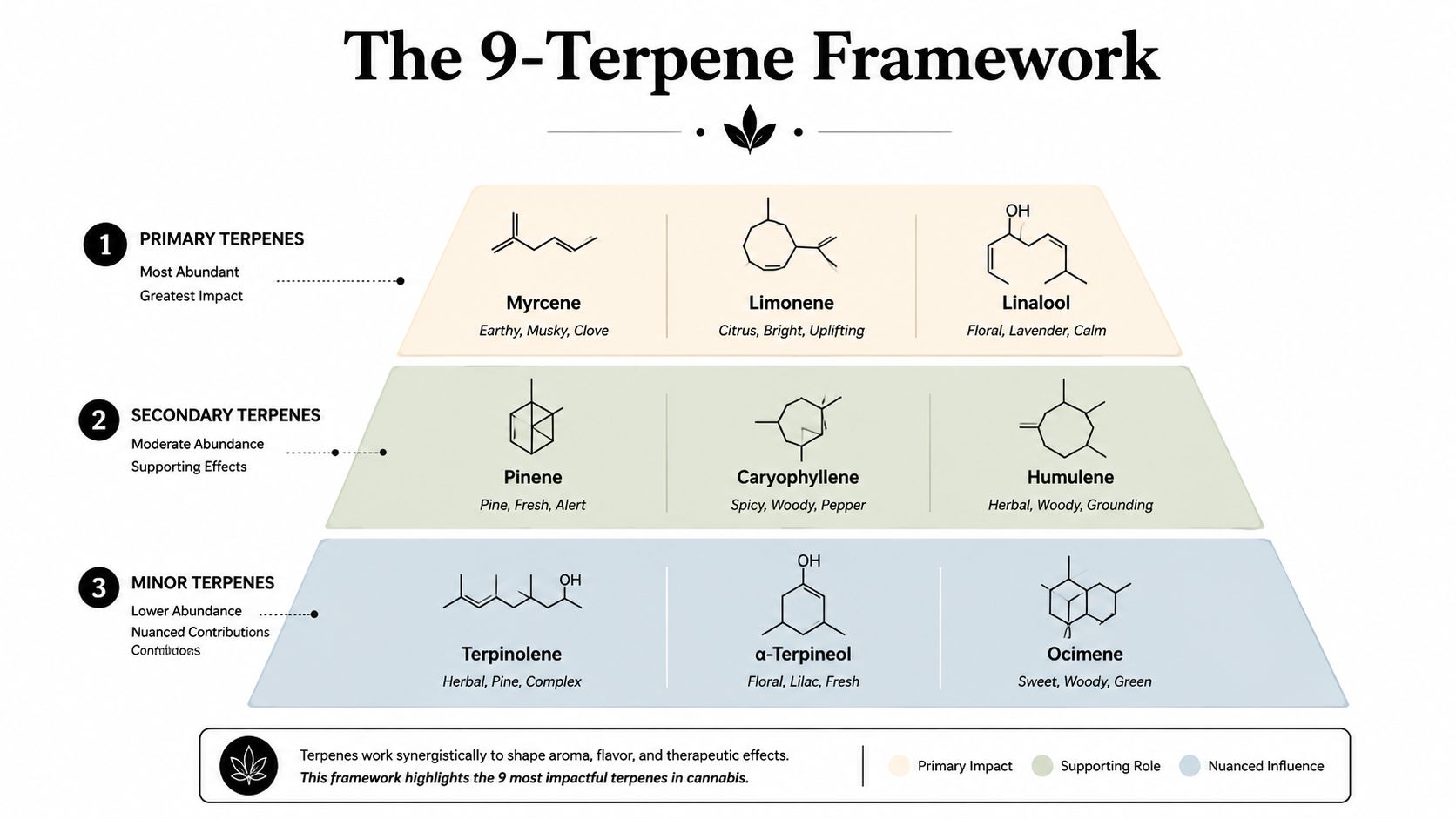
Reading a Real Strain Profile Like a Formulator
A lab report gives you abundance. Your nose evaluates structure. The fastest way to connect both is to read the profile through top, mid, and base notes, then ask which layer is carrying the product after dilution and heat exposure.
Consider a representative strain-inspired terpene blend led by limonene and α-pinene, supported by linalool, and anchored with β-myrcene and β-caryophyllene. This isn't a claim about one cultivar's universal COA. It's a practical model for translating a target fingerprint into a sensory architecture.
| Note Layer | Common Compounds | Sensory Role | Approximate Share |
|---|---|---|---|
| Top | Limonene, α-pinene, β-pinene | First impression, citrus brightness, pine lift | Defined by the target COA |
| Mid | Linalool, terpinolene | Floral bridge, sweetness, aromatic complexity | Defined by the target COA |
| Base | β-myrcene, β-caryophyllene, α-humulene, fenchol | Body, spice, earth, persistence | Defined by the target COA |
Commercial blend architecture commonly assigns limonene and pinene to the top, linalool to the mid, and myrcene with β-caryophyllene to the base or mid-base layer. A practical guide to note structure in vape formulation uses this same functional approach.
Diagnose the sensory miss
If the finished oil smells bright in the bottle but loses that character in the cartridge, the top-note fraction may be too volatile for the hardware cycle. If it tastes thin, the issue may be an underbuilt mid or base rather than a need for more total terpene. If it lands harsh, increasing the whole blend is usually the wrong correction. First isolate whether the problem is a sharp monoterpene, an unbalanced carrier, or inadequate homogenization.
A useful bench record includes the target ratio, total terpene load, base distillate identity, mixing temperature, mixing time, hardware, fill date, and sensory result after conditioning. The lab report interpretation resource can help teams read reported compounds without confusing a dominant peak with the complete sensory experience.
The best formulation decision often involves cutting one component rather than boosting five others. Strain replication rewards restraint. You're trying to preserve the relationship among compounds, not produce the loudest aroma possible.
Dosing Strain-Specific Terpenes in Vapes and Distillate
Dosing starts with the base, not the blend. Distillate viscosity, cannabinoid purity, hardware geometry, wicking behavior, and the volatility of the selected compounds all affect the final result. A strain-specific ratio can be analytically correct and still perform poorly if the total load doesn't suit the oil or cartridge.
Industry formulation guidance commonly places total terpene load for vape cartridges between 5% and 15% by weight, with 6% to 10% described as a balanced working target. Vape terpene selection guidance also notes that volatile monoterpenes may be reduced by 10% to 15% when heat-cycle stability is a priority.
For standard-viscosity distillate at 90% or higher purity, one formulation guide gives 7.5% terpene incorporation as a starting point. The same guidance places lower-viscosity inputs at 5% and high-viscosity liquid diamonds at 10%. The distillate starting-point guide is useful as a benchmark, not a substitute for hardware validation.
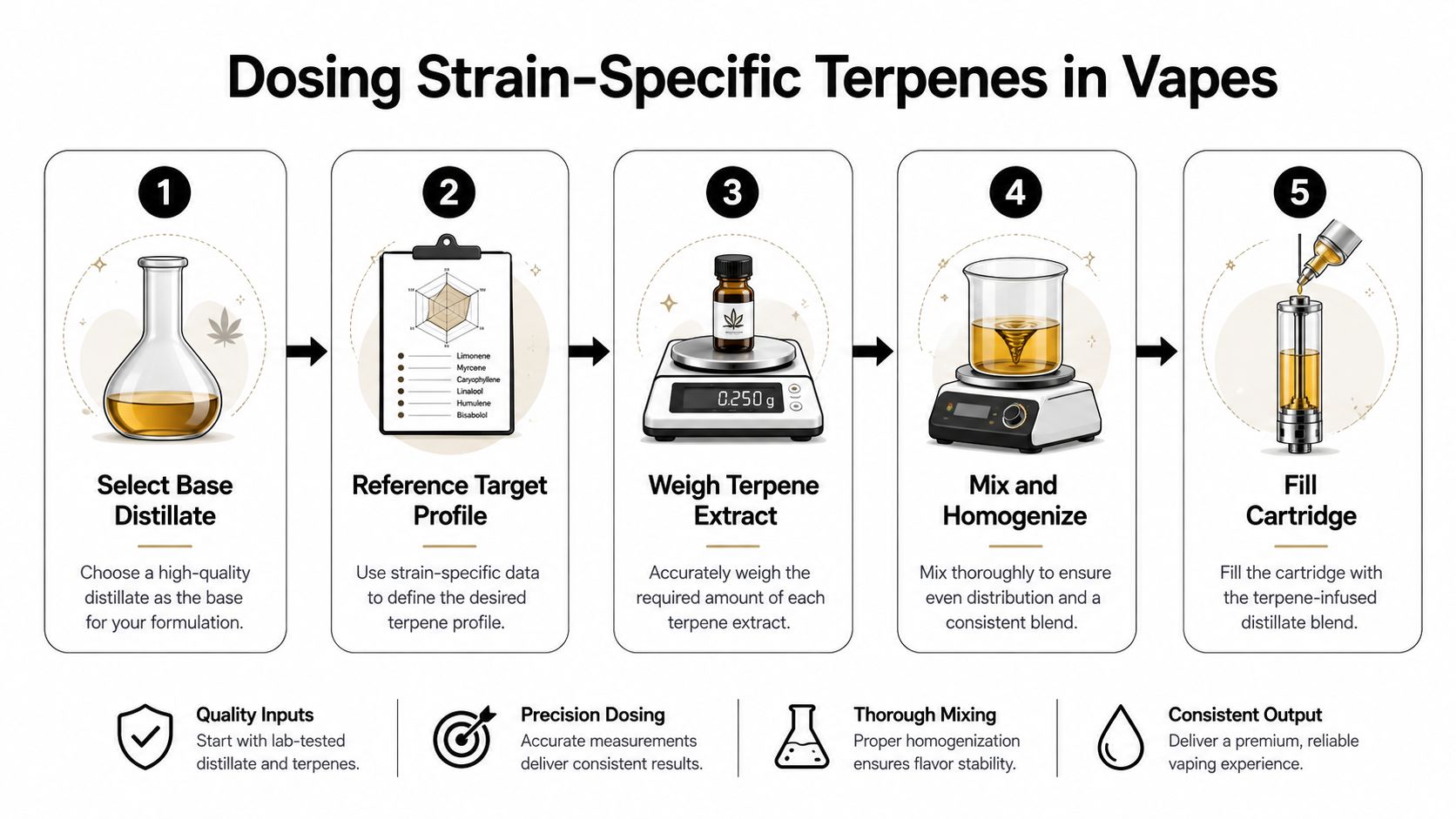
A repeatable bench sequence
- Characterize the base. Record viscosity, cannabinoid potency, color, prior terpene load, and any processing history.
- Set the target profile. Convert the reference COA into a working ratio, then decide whether heat-sensitive monoterpenes need moderation.
- Calculate by total batch weight. Weigh the terpene blend and base separately. Don't dose by volume when the specification is weight-based.
- Warm and mix carefully. One cannabis formulation guide recommends warming distillate to about 100 to 120°F, then adding the blend and mixing for at least 5 to 10 minutes. Its vape application guidance gives a starting range of 5% to 7% by total weight for many cannabis distillates.
- Check homogeneity and fill behavior. Inspect the mixture, verify the cartridge draw and leakage behavior, and retain samples for post-fill comparison.
The starting number is only the beginning. Adjust one variable at a time, especially total load and the ratio of volatile top notes. A small sensory correction is easier to troubleshoot than a large change that alters viscosity, aroma intensity, and cartridge performance simultaneously.
Freshness, Storage, and Oxidation Risk
A strain-specific blend is a volatile ingredient, so its specification must include time and storage, not just composition. Drying, oxygen exposure, heat, and repeated container opening can change the aromatic signature before the blend reaches the production tank.
Independent analytical guidance reports that individual terpene concentrations can range roughly from 0.1% to 1.5% of dry weight and may drop by more than half after three months of storage. The analytical storage reference connects those losses to the practical need for freshness controls.
What to put in the incoming-material specification
- Lot identity: Match the bottle, COA, purchase order, and retained sample.
- Production and retest dates: Don't accept an undated blend for a profile-sensitive SKU.
- Chromatographic composition: Require the reported terpene list and relative values, not only a flavor name.
- Storage statement: Document the supplier's recommended temperature, light exposure, and container conditions.
- Appearance and odor check: Compare the incoming lot against an approved reference before releasing it to production.
Sesquiterpenes and monoterpenes don't behave identically, so a blend can shift in balance even when the total aroma remains noticeable. Keep containers tightly closed, minimize headspace exposure where the packaging system allows it, and avoid warming the full inventory when only a small production portion is needed.
Batch-control rule: A retained sample is valuable only if you compare it against a defined sensory and analytical target.
Don't solve a stale blend by adding fresh isolates to the tank without documenting the correction. That may restore intensity while creating a new ratio that no longer matches the approved strain profile.
Why a Strain Name Is Not a Chemical Guarantee
A cultivar name can stay constant while its terpene fingerprint shifts between lots. Research published in 2025 found significant differences in monoterpene and sesquiterpene content across Cannabis accessions, with composition also changing across the plant life cycle and between indoor and outdoor cultivation. The accession and environment research supports a practical purchasing rule: verify the chemistry instead of accepting the name as a specification.
Flowering stage affects the result because volatile production is not static. Genotype establishes part of the biosynthetic potential, while cultivation conditions and harvest timing influence which compounds dominate the harvested material. Drying and storage add further variation before the material reaches a formulation line.
A strain name is therefore a reproducible chemical fingerprint only when the ratio is measured, documented, and controlled. Flower-derived proportions are a starting reference, not a guarantee that the same balance will appear in a cart or distillate. Processing, dilution, and the selected terpene source can change the finished profile even when the label remains unchanged.
Build from evidence, not cultivar artwork
For strain replication, rank the evidence this way:
- Current chromatographic data from the reference material
- A documented supplier blend with a defined target ratio
- Sensory comparison against an approved retained sample
- The commercial strain name
The name still supports product positioning and customer recognition, but it should not control release decisions. A vendor chromatogram, lot history, and deviation procedure provide better control over repeatability than cultivar artwork. If the target is flower-derived, compare dominant compounds and their relative proportions, then confirm the rebuilt blend against the retained reference.
Functional language requires the same restraint. Terpene profiles can shape aroma and perceived experience, but recent evidence does not establish predictable human effects from a volatile fingerprint or support routine therapeutic use. A 2025 evidence discussion on terpene receptor activity and clinical limitations supports keeping formulation claims sensory and product-focused rather than medical.
Sourcing and Standardizing Strain-Specific Terpenes
Write the purchase specification before choosing the supplier. Require the named profile, ingredient identity, lot number, chromatographic results, safety documentation, storage conditions, and a clear tolerance range for the dominant compounds. Then define your own acceptance checks for aroma, appearance, viscosity impact, mixing behavior, and cartridge performance.
Buy a finished strain-specific profile when speed, repeatability, and production simplicity matter. Blend from isolates when you need to create a new target, correct a documented imbalance, or maintain direct control over each component. In either case, retain an approved reference and compare every incoming lot against it.
A terpene sourcing guide can support supplier evaluation, but your internal specification remains the final control document. Reject profiles that provide only a cultivar name without composition, lot traceability, or usable safety paperwork.
Gold Coast Terpenes offers strain-specific profiles, isolated compounds, formulation resources, and tools for teams developing cartridges and distillate products. Review the available profiles and technical resources at Gold Coast Terpenes, then use your approved terpene ratio and incoming-lot checks to build a repeatable production standard.