
Around 30,000 new products enter global markets each year, while widely cited industry summaries report that roughly 95% fail to achieve meaningful commercial success (CustomCy product-development statistics). A terpene-infused cartridge can look simple on a batch sheet, yet its success depends on several variables arriving at the same result: accurate flavor, controlled viscosity, reliable wicking, stable storage, and repeatable production.
That's why new product formulation for cartridges should be treated as a controlled development program, not a last-minute blending exercise. The right strain-inspired terpene blend has to work with the oil and the hardware, not merely smell impressive in a glass vial.
Why Most New Product Formulations Fail Before Launch
A cartridge can fail before a customer ever evaluates its flavor. The blend may separate during storage, move too quickly through the wick, produce inconsistent vapor, or taste harsh after the volatile top notes have changed. These failures usually begin when a team treats a bench sample as proof that the SKU is production-ready.
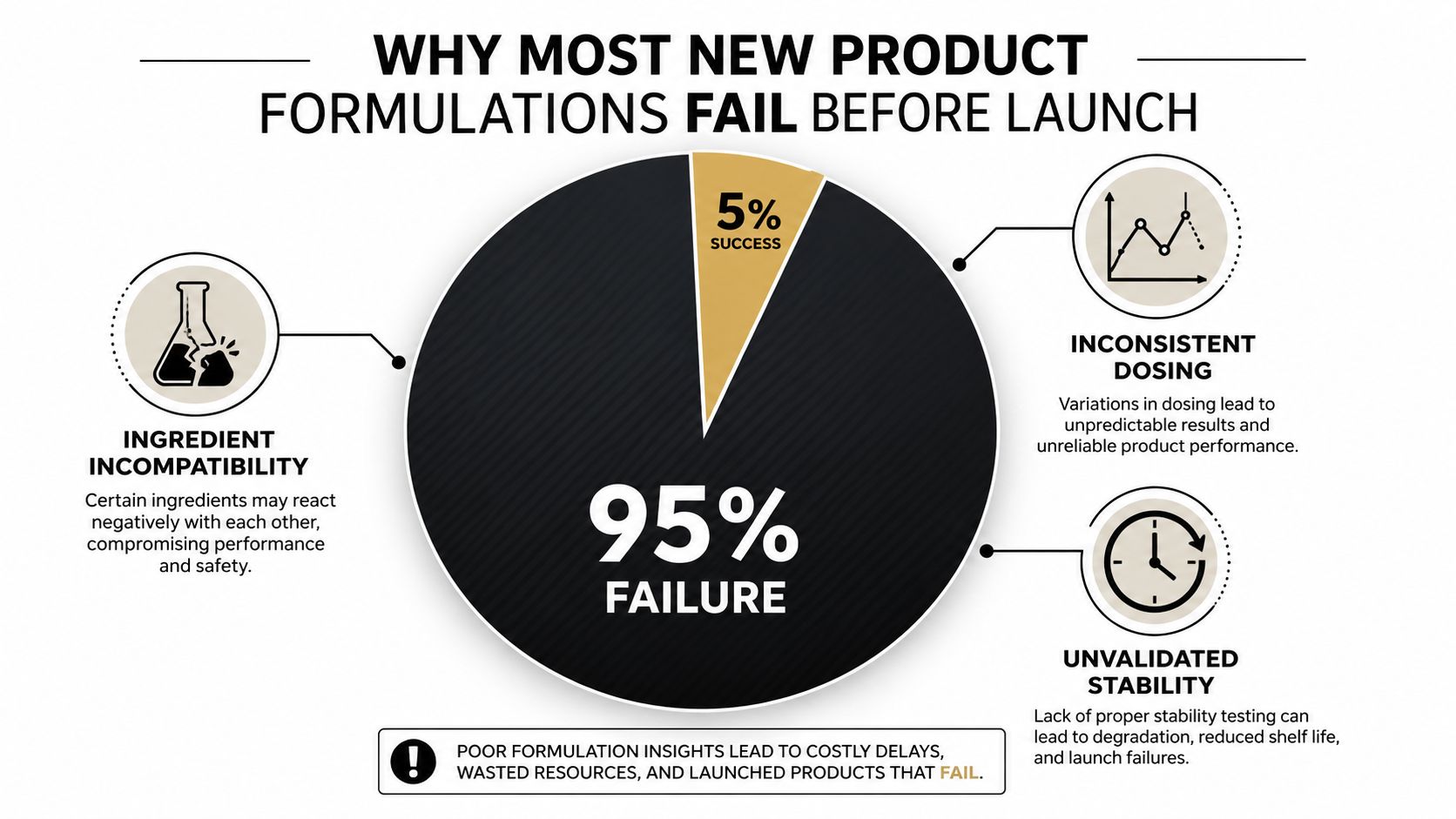
Around 30,000 new products are introduced globally each year, and roughly 95% fail to achieve meaningful commercial success, according to widely cited industry summaries (CustomCy product-development statistics). The same source indicates that only about 40% of developed products reach the market, which means many concepts are stopped during development rather than after launch. For cartridge manufacturers, that distinction matters. A disciplined development program can identify an incompatible oil, unstable aroma system, or unsuitable cartridge before those problems become inventory.
The bench sample is only the first gate
A strong process separates the work into decisions with defined evidence:
- Discovery: Define the target flavor, aroma intensity, user experience, oil type, hardware, and commercial constraints.
- Prototype: Build a small number of strain-inspired terpene blends and test them in the intended oil.
- Development: Confirm mixing behavior, viscosity, fill performance, and early sensory quality.
- Validation: Hold filled cartridges under controlled conditions and inspect sensory and physical performance.
- Launch approval: Release the SKU only when the formula, process, and hardware perform together.
A PDMA global study of 651 companies in 37 countries found that the best-performing firms achieved an average new-product success rate of 76%, compared with 51% for other companies (StudioRed product-development statistics). The lesson isn't that a particular gate guarantees success. It's that process design changes how quickly teams find weak concepts and how reliably they scale strong ones.
Practical rule: Don't approve a cartridge formula because it tastes good in a vial. Approve it after the oil, terpene system, cartridge, fill process, and storage conditions have been tested as one product.
Terpene volatility, oil viscosity, and wick behavior make cannabis formulation less forgiving than generic product-development advice suggests. A team that copies a flavor ratio without checking the extract's refinement level or the cartridge's feed system is accepting avoidable risk. Stage-gate formulation protects the launch by forcing those interactions into the development conversation early.
Selecting Terpene Profiles and Isolates for Target Effects
Flavor accuracy starts with architecture. Instead of adding compounds until the blend smells familiar, map the target profile across top, mid, and base notes. Top notes create the first aromatic impression, mid notes provide the recognizable body of the profile, and base notes add persistence and depth.
For a strain-inspired terpene blend, begin with a reference sample or a clearly defined sensory brief. Record the dominant citrus, floral, pine, spice, fruit, or earth impressions, then decide whether the objective is close replication or a deliberate variation. A Blue Dream-inspired profile may need a brighter fruit-forward opening, while an OG Kush-inspired direction may call for heavier, more resinous depth. Those names should guide the sensory target, not replace analytical and hardware testing.
Build the profile by function
Use isolates when you need control over a specific sensory feature. Limonene can lift the opening with citrus character. Linalool can soften the middle with floral nuance. Caryophyllene can anchor the profile with spice and persistence. Myrcene may contribute body, but a formulator should evaluate the complete blend rather than assume that adding more of any single compound will improve the result.
The terpene flavor chart provides a useful reference for note position, boiling point, and starting usage ranges.
| Terpene | Note Position | Boiling Point (°C) | Distillate Usage Rate |
|---|---|---|---|
| Limonene | Top note | 176°C | 0.5%–2.5% |
| Linalool | Mid note | 198°C | 0.2%–1.5% |
| Caryophyllene | Base note | 266°C | 1.0%–3.0% |
The chart's ranges are starting points for distillate development, not automatic formulas. Boiling point also doesn't predict the entire consumer experience. Mixing conditions, cartridge heating, oil chemistry, and storage can all change which notes remain prominent by the time the product is used.
Separate flavor replication from experience design
“Replicating flavor of” a target strain and designing a cartridge for a particular experience are related but separate tasks. First, match the sensory identity. Then adjust the blend's balance to support the intended direction, such as relax, uplift, or focus, without making medical claims or treating terpene composition as a therapeutic guarantee.
A practical workflow is to build one reference blend, one brighter interpretation, and one deeper interpretation. Keep the total terpene load controlled while changing the relationship between top, mid, and base notes. This approach makes sensory decisions traceable and prevents the common mistake of increasing the total blend just because the first prototype lacks character.
Dosing Terpenes Across Oil Types and Cartridge Hardware
A single terpene percentage won't work across every oil and cartridge. The usable range depends on oil viscosity, refinement level, terpene volatility, wick material, reservoir geometry, and heating behavior. A blend that performs well in a ceramic cartridge can leak or feed too aggressively through a cotton-wick system.
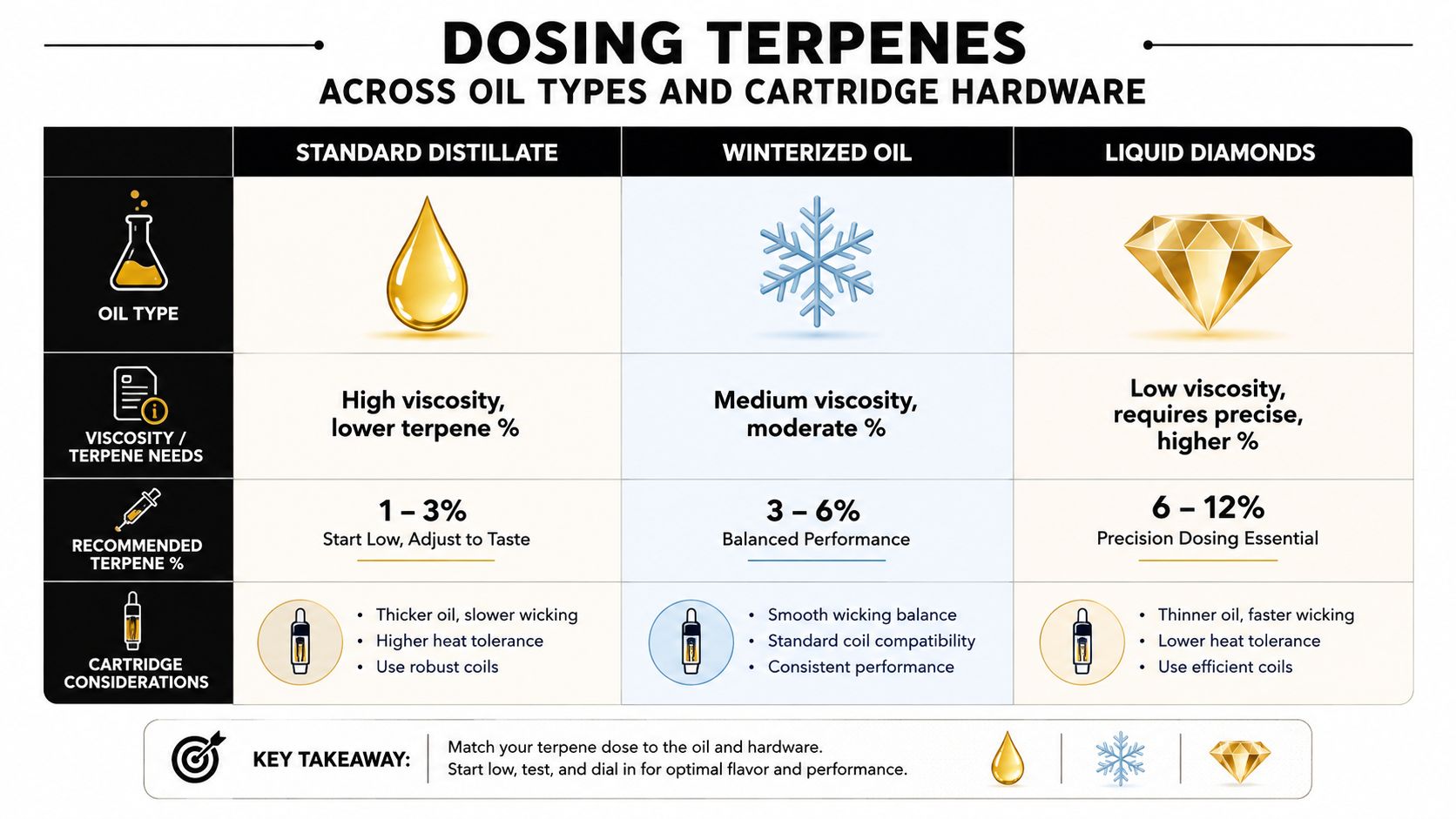
For cannabis product formulation, begin by identifying the oil category and hardware combination. One formulation guide gives 5%–7% terpenes by total weight as a practical starting point for cannabis distillate, with the possibility of increasing up to 10% for highly refined or winterized extracts when processing has removed substantial aroma (Gold Coast Terpenes distillate guide). A separate cartridge-focused guide lists approximately 10% for liquid diamonds, 7.5% for standard distillate, and 5% for low-viscosity oils, while also identifying 5%–8% by weight as an industry sweet spot for distillate vape carts (Terpene Belt Farms vape formulation guide).
Hardware changes the decision
Independent vape-performance guidance places many vape oils around 4%–7% terpene content by weight, but its hardware-specific recommendations vary to 8%–12% for ceramic cartridges, 5%–8% for cotton-wick cartridges, and 5%–10% for disposables (Sorting Robotics cartridge-performance guidance). These ranges overlap, but they shouldn't be treated as interchangeable. Ceramic, cotton-wick, and disposable systems can have materially different feed and heating characteristics.
| Formulation variable | What a higher terpene load may do | What to monitor |
|---|---|---|
| Refined or winterized oil | Restore aroma and reduce apparent viscosity | Separation, leakage, flavor sharpness |
| Standard distillate | Increase aromatic impact and improve flow | Wicking rate, harshness, reservoir seepage |
| Low-viscosity oil | Add flavor without needing much thinning | Flooding, leaks, weak vapor control |
| Ceramic hardware | Support a broader working window in some designs | Coil temperature and over-delivery |
| Cotton-wick hardware | Require tighter control of flow | Dry hits, saturation, feed consistency |
| Disposables | Depend heavily on the integrated heating system | Battery behavior and end-of-life taste |
Use a terpene calculator to convert the selected percentage into a mass-based addition, then verify the calculation against the actual batch weight. Don't copy a competitor's ratio without matching the oil and hardware. Over-terping can create harshness, leaks, or unstable wicking. Under-terping can leave a cartridge flat and indistinct.
For a practical starting point, test a controlled low, middle, and high level within the applicable range, then select based on flavor, viscosity, and cartridge performance together. The best ratio is the one that survives the complete product system.
Mixing Workflow and Temperature Control for Stable Blends
Temperature control is a formulation variable, not a convenience. Excessive heat can strip the volatile top notes that define a profile, while insufficient agitation can leave localized terpene-rich pockets that fill inconsistently and taste different from cartridge to cartridge.
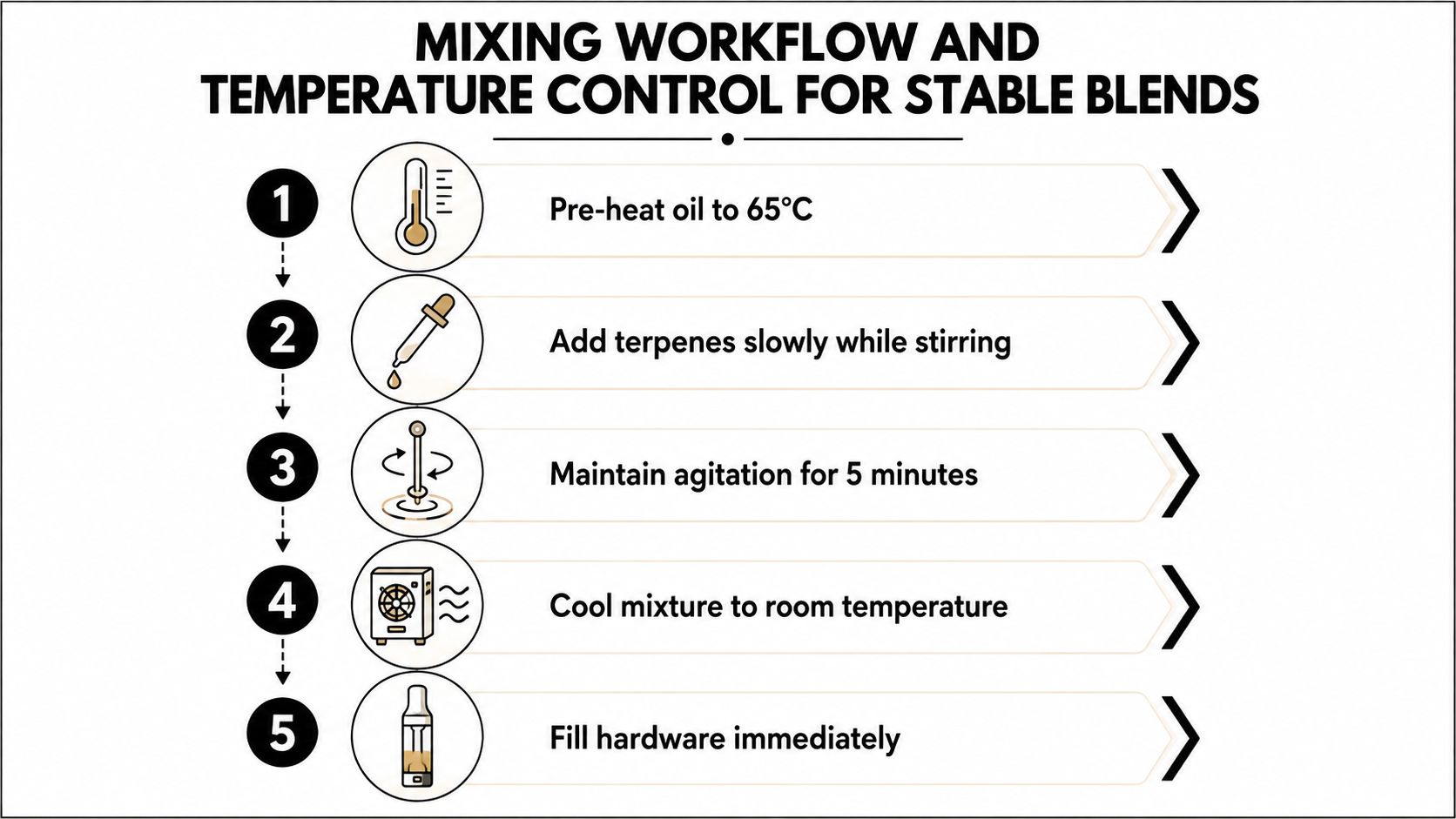
A formulation guide recommends warming the oil to approximately 100–120°F, or 40–50°C, and blending for 5–10 minutes to reduce separation risk (Gold Coast Terpenes mixing guidance). The supplied production workflow visual specifies 65°C as its preheating step, so the batch record should identify which validated temperature window applies to the specific oil and process rather than allowing operators to choose by feel.
A repeatable order of operations
- Measure the oil and terpene blend by weight. Record lot numbers, starting temperature, and target ratio before heating.
- Warm the oil gradually. Use controlled heating and avoid holding the batch at a raised temperature longer than necessary.
- Add terpenes slowly while agitating. A slow addition gives the mixer time to distribute the lower-viscosity terpene phase through the oil.
- Maintain consistent mixing. For small batches, a magnetic stirrer may work if the vessel geometry creates adequate circulation. Larger batches usually need an overhead mixer selected for viscosity and vessel size.
- Cool and fill under controlled conditions. Inspect the blend for haze, streaking, or visible separation before transferring it to hardware.
The terpene temperature chart can support decisions about handling sensitive aromatic materials. Container geometry matters as much as mixer speed. A vessel that creates a central vortex but leaves material on the walls may look active while producing a poorly homogenized blend.
Batch-room check: A uniform appearance is encouraging, but it isn't proof of uniform composition. Pull samples from different points in the vessel and compare aroma, clarity, and fill behavior before approving the batch.
Some teams add the terpene system in two stages. That can help preserve a delicate top-note fraction, but only if the process is documented and validated. It shouldn't become an informal workaround for weak mixing. The same order, temperature limits, agitation time, and cooling procedure must be used whenever the SKU is reproduced.
For additional process context, review this cartridge formulation video alongside your own equipment qualification and batch records.
Stability Testing and Shelf-Life Validation Protocols
A cartridge that tastes excellent on fill day can change during storage. Terpenes may migrate, the oil may separate, the color may shift, or the wick may deliver a different volume after the formulation has spent time in contact with the cartridge components.
Stability testing should answer one commercial question: will the product still perform as specified when it reaches the customer? That requires more than looking at a retained vial. Test the filled cartridge because the reservoir, seal, wick, heating element, and oil interact throughout storage.
Define the checkpoints before filling
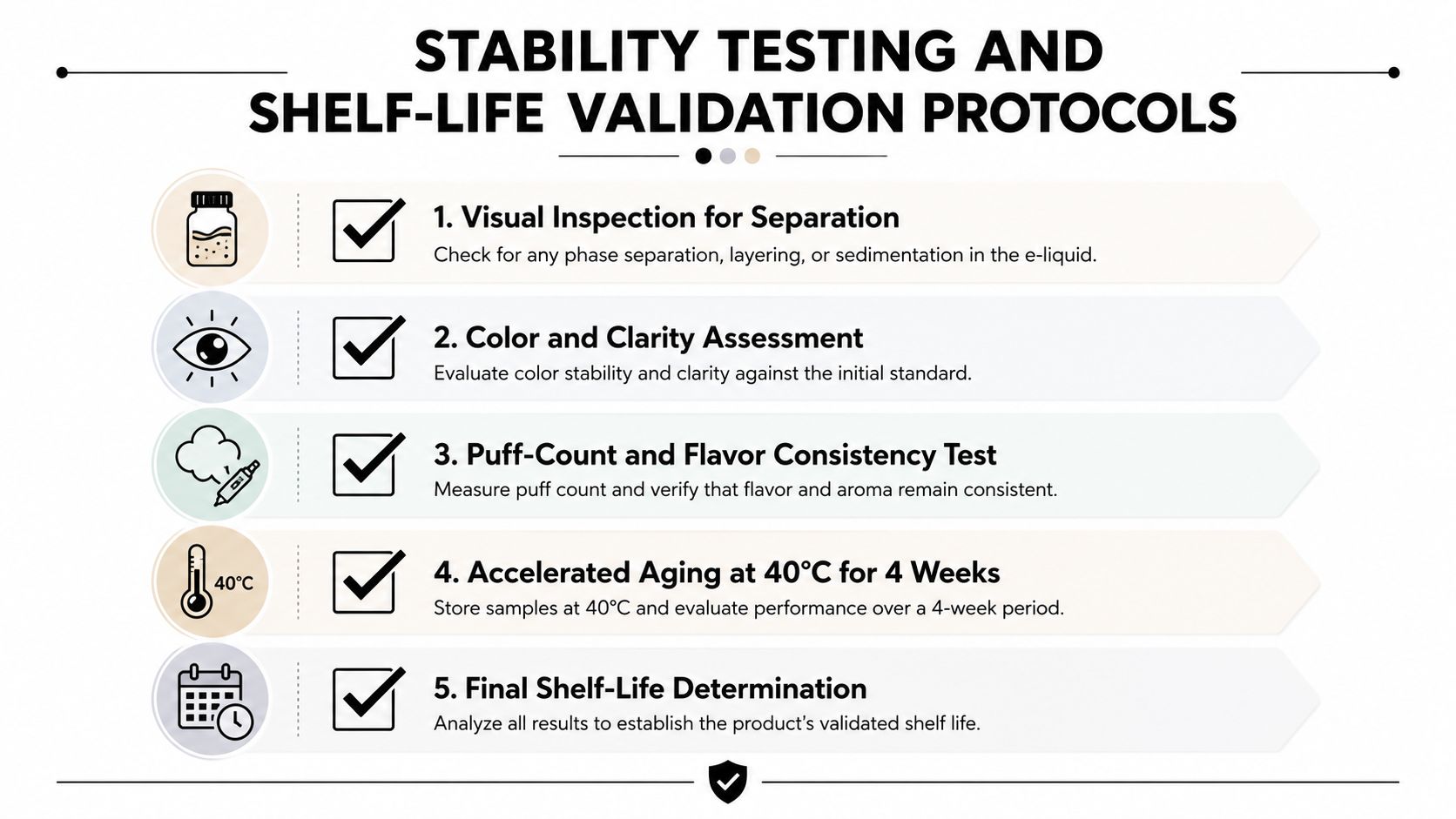
Create a written inspection sheet with measurable observations and clear go or no-go criteria. Useful checkpoints include:
- Visual condition: Check for separation, layering, precipitation, bubbles, leaks, and seal changes.
- Color and clarity: Compare samples against the approved reference under consistent lighting.
- Sensory profile: Evaluate aroma and vapor flavor for top-note loss, harshness, bitterness, or off-notes.
- Wicking behavior: Check draw consistency, dry-hit tendency, flooding, and end-of-reservoir performance.
- Physical properties: Record viscosity or flow behavior using the same method each time.
The supplied stability protocol calls for accelerated aging at 40°C for 4 weeks. That condition can provide an accelerated screen, but it doesn't replace real-time storage observations or market-specific requirements. A shortened launch schedule may justify prioritizing the highest-risk oil and hardware combinations first. It doesn't justify skipping filled-cartridge testing.
A stage-gate review should stop the SKU when evidence shows separation, unacceptable sensory drift, leakage, or inconsistent delivery. Teams should document the failure mode, change one meaningful variable at a time, and repeat the relevant test rather than subtly adjusting the formula until it appears acceptable.
The terpene degradation guide can help formulators think about aromatic loss as a process and storage issue, not merely a flavor preference. Light exposure, headspace, heat history, and packaging all deserve attention in the test plan.
Go/no-go standard: If the cartridge needs an explanation to excuse a change in flavor or flow, it hasn't met the product specification.
Regulatory Considerations and Clean-Label Formulation Trade-Offs
Clean-label positioning can simplify the consumer message while complicating the technical work. Solvent-free, VG-free, PG-free, PEG-free, and MCT-free expectations limit the diluents available for viscosity adjustment, so the formulator has less room to correct a poor oil or unsuitable hardware after the fact.
That constraint makes ingredient selection and documentation inseparable. A terpene-derived diluent may help adjust flow, but it still needs compatibility testing, accurate labeling, supplier documentation, and review against the requirements of the market where the product will be sold. Marketing language must describe what the formula contains and what testing supports. It shouldn't imply medical outcomes.
The recurring formulation bottlenecks identified in recent formulation coverage include solubility, viscosity, and aggregation, especially as teams pursue concentrated, waterless, or more sustainable systems (Formly Pro formulation trends). Reducing solvent load can improve positioning, yet it may also make the blend harder to homogenize and more sensitive to temperature or hardware differences.
Use a documented release package that includes raw-material specifications, lot traceability, blend calculations, batch records, cartridge compatibility results, and laboratory testing from SC Labs or an equivalent qualified laboratory where appropriate. Regulatory review should happen before production, not after a finished label and sales plan have locked the team into unsupported claims.
For formulators building a new product formulation for vape cartridges, the commercial advantage comes from preserving sensory quality while controlling technical and compliance risk. Gold Coast Terpenes supplies natural, THC-free terpene blends, strain-specific profiles, isolates, formulation resources, and lab-tested materials designed for cartridge and concentrate development, including options free of VG, PG, PEG, and MCT.
Visit Gold Coast Terpenes to compare strain-specific profiles, isolated compounds, and formulation resources for your next cartridge program. Use the available blending tools and product documentation to move from a target terpene profile to a controlled, testable production batch.