
The most repeated advice on limonene vs myrcene is a mood match. Limonene for a bright, citrus-forward daytime cart. Myrcene for a heavier evening one. It's easy to repeat and it formulates badly, because it treats two aroma compounds as effect switches and skips everything that happens between the drum and the cartridge.
A formulation lead has a narrower question. Which of the two leads the batch, at what percentage by weight, and how do I prove that each lot delivers it? Those answers depend on boiling point, on vapor pressure, on what the certificate of analysis says, and on the temperature you filled at. Two blends with the same nominal name can leave the same filling line and smell different three weeks later.
The table below is the spec sheet I'd hand a new formulation tech on day one. What follows it is the part that decides the outcome: processing checks, the arithmetic, and the lot verification that let you claim a limonene or a myrcene profile and defend it.
Limonene and Myrcene Side by Side
Limonene and myrcene share the same molecular formula, C10H16, and the same molecular weight, about 136.24 g/mol. On a formula sheet, equal weight percentages of the two look identical. In a tank they are not identical. One is a ring structure, the other an open chain, and their boiling points sit roughly 9 °C apart. That gap means myrcene is generally expected to lose more material than limonene during a warm fill, so the compound you weighed is not always the compound the finished cart delivers.
| Property | Limonene | Myrcene |
|---|---|---|
| Molecular formula | C10H16 | C10H16 |
| Molecular weight | about 136.24 g/mol | about 136.24 g/mol |
| Structure | Cyclic | Acyclic |
| Boiling point | about 176 °C | about 167 to 168 °C |
| Typical aroma | Citrus peel, orange | Earthy, herbal, resinous |
| Water solubility | Low | Practically insoluble |
| Reported odor threshold | about 38 ppb | about 13 ppb |
Two rows should drive the first decision. The boiling point row tells you myrcene leaves a warm oil faster, so a hotter filling line strips more of it. The odor threshold row tells you that loss reaches the nose before it reaches a lab report. Reported thresholds put myrcene at about 13 ppb against limonene at about 38 ppb, meaning myrcene can be detected at roughly one-third the airborne concentration limonene needs, according to the PubChem compound record for beta-myrcene. A blend can hit its target on paper and still smell thin in the cart.
Treat every figure in that table as a reference point rather than a specification. Your supplier's lot data, your carrier, and your fill temperature will move the numbers. In a pilot batch the row to check first is boiling point. If the fill runs hot, myrcene will read weaker than the formula predicted. That is a processing error, not a bad drum of terpene.
Both compounds are available as botanically derived isolates, which is what makes this comparison actionable. You can weigh each one separately, test each one separately, and adjust one without disturbing the other.
Aroma Profiles and How Blends Vary
A citrus build and an herbal build start in different places. Limonene reads as orange and lemon peel, bright and forward, the first note a nose finds in a lemon dessert. Myrcene reads lower and damper, closer to hops and thyme than to fruit, with a resinous tail that lingers. Put a few fresh peels next to a handful of dried herbs and the split is obvious:
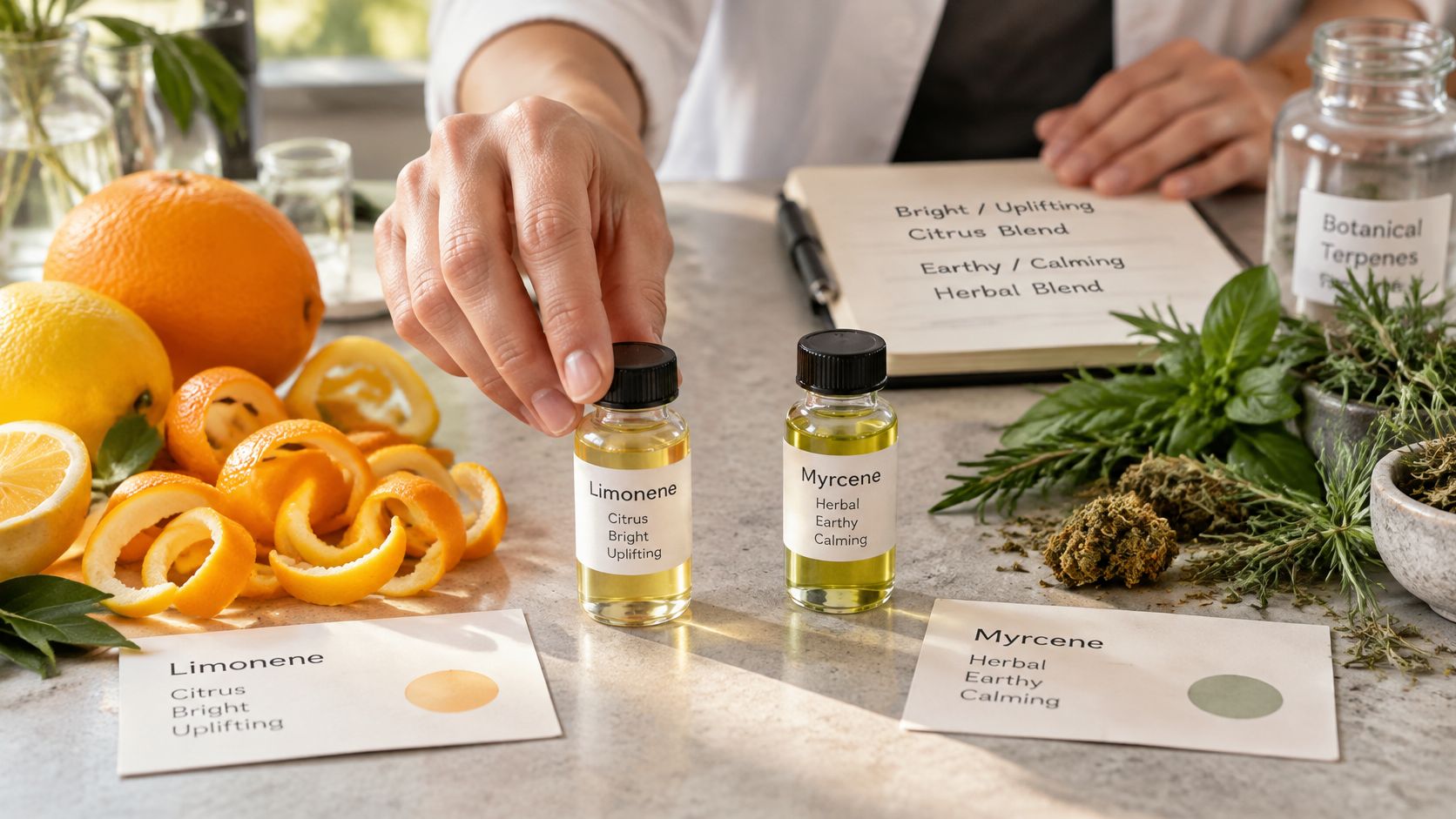
Formulators rarely want either one alone. Limonene lifts a fruit build and keeps it from going flat. Myrcene adds weight underneath, which is why a citrus cart with a small myrcene share smells rounder than the same cart built on limonene only. Our terpene flavors run from blueberry, lemon and strawberry through to grape and peach, and most of those builds use both compounds at different ratios rather than one at a time.
A label doesn't lock a ratio. In a validated GC-MS analysis of two cannabis-flower cultivars, beta-myrcene was the dominant measured terpene at 5.85 to 8.62 mg/g of dried plant material against limonene at 0.91 to 1.33 mg/g, roughly 4.4 to 9.5 times higher, per the published GC-MS cultivar analysis. The same source reports a separate analytical study of three varieties where limonene reached 1.44 to 1.61 mg/g in one indoor-grown variety and stayed below 0.15 and below 0.09 mg/g in the other two, a spread of more than tenfold. Source material, cultivar and growing environment move the ratio by an order of magnitude before anything reaches your drum.
Set the target before you set the dose. Describe the aroma you want in words, then choose the percentages that hit it. Starting from "I want 60 percent myrcene" and working backwards is how blends end up off-brief.
A flavor brief that survives a production run has four lines:
- Target aroma descriptors. Three to five plain words, such as bright lemon peel with a resinous base.
- Lead terpene. The compound carrying the dominant note, plus the percentage you want from it.
- Support terpene. The compound rounding the edges, plus its percentage.
- Tested weight percentages. The measured figure per lot, not the blend name on the invoice.
Heat, Volatility, and Storage Rules for Myrcene
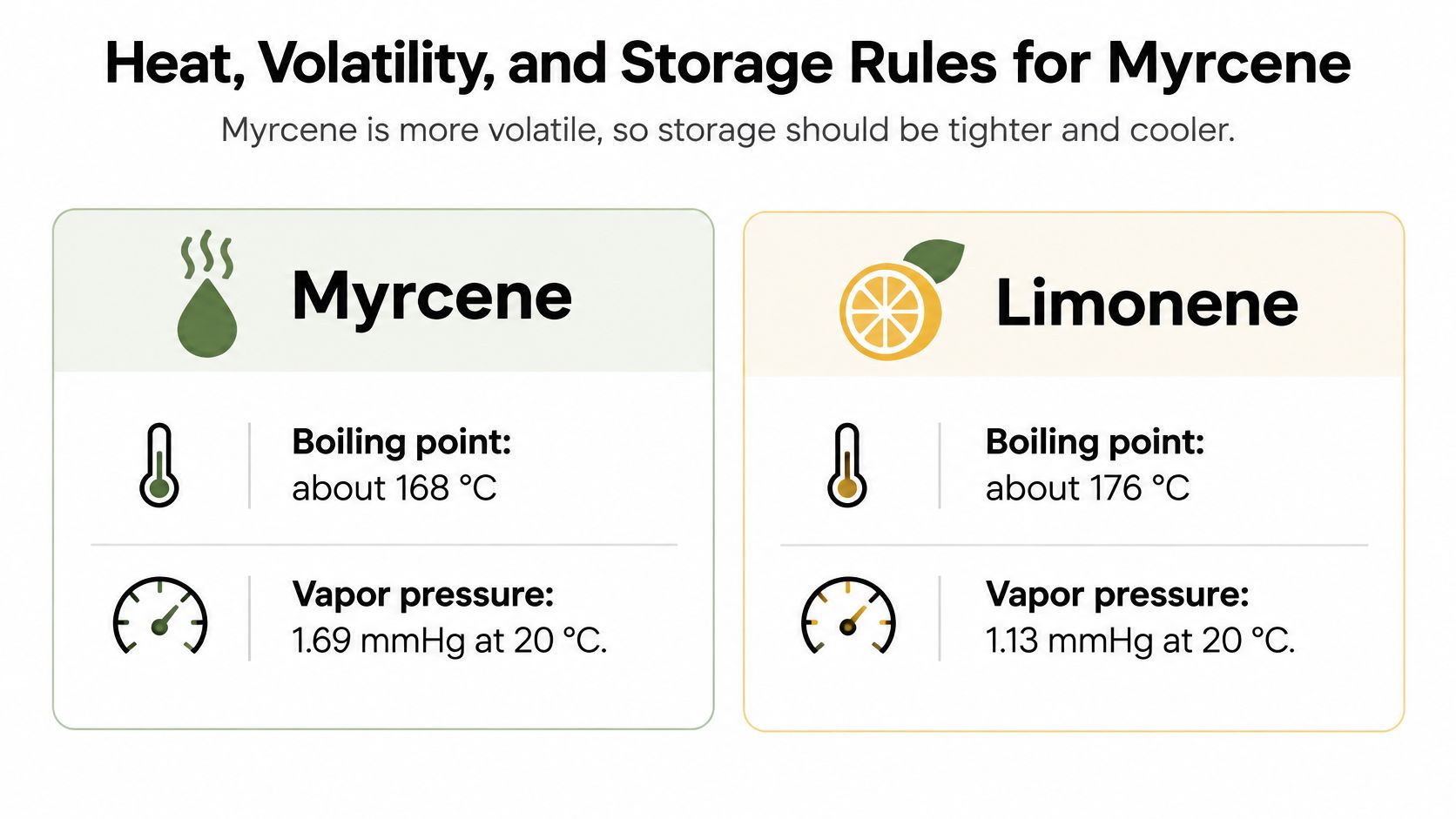
Myrcene leaves the bottle first. Its boiling point is approximately 168 °C with a vapor pressure of 1.69 mmHg at 20 °C, against limonene at approximately 176 °C and 1.13 mmHg, per the published vapor pressure data for both terpenes. Those two panels belong on the wall above the filling bench:
| Temperature | Limonene vapor pressure | Myrcene vapor pressure |
|---|---|---|
| 20 °C | 1.13 mmHg | 1.69 mmHg |
| 49 °C | 6.12 mmHg | 8.72 mmHg |
| 130 °C | 188 mmHg | 243 mmHg |
The middle row is the one that matters on a production floor. At 49 °C, myrcene sits at 8.72 mmHg against limonene at 6.12 mmHg, and at 130 °C the figures widen to about 243 and 188 mmHg. Evaporation tracks vapor pressure, so myrcene leaves an exposed oil phase faster during warm filling, open mixing, or a lid that doesn't seal. The handling rules follow directly: tighter container closure, shorter open handling, and lower thermal exposure for myrcene-heavy blends. Limonene retains somewhat better under identical conditions, which is one reason a citrus profile holds its top note longer than an earthy one in the same packaging.
What heat does beyond simple loss
Losing aroma is the mild outcome. Heating pure terpenes during vaporization can generate degradation products, including methacrolein and, at the highest temperatures tested, benzene, according to the transparency report on terpene thermal degradation. That finding doesn't make either compound hazardous at every device temperature, and detecting a degradation product under extreme conditions doesn't quantify exposure in a given cartridge. It does mean the choice between limonene and myrcene can't rest on aroma alone. Terpene loading, coil temperature, residence time, oxygen exposure and cartridge design belong in the same conversation as flavor.
Process control beats ingredient identity. Lower total terpene loading, a device that holds its temperature, no repeated dry hits, and batch testing do more for the finished product than picking a terpene by name.
Storage rules for a myrcene-heavy blend
A published technical review lists myrcene as practically insoluble in water, soluble in alcohol and several organic solvents, and capable of spontaneous polymerization at room temperature whether or not air is excluded, per the technical review of myrcene handling and stability. That last property catches people out. A drum that sat open in a warm room doesn't only smell weaker. It can thicken, and thick myrcene doses badly.
- Sealed compatible containers. Close the drum between weighings, not at the end of the shift.
- Minimal headspace. Decant into the smallest container that holds the batch.
- Light and heat limits. Store away from windows and warm equipment, and never park a drum beside the filling line.
- Shelf-life checks. Evaluate odor, color and viscosity across the supplier's stated shelf life, and do it before aged material enters a finished blend.
For water-based systems, myrcene needs a suitable carrier or a validated dispersion. Adding it straight to an aqueous formula separates. For oil-based work, our diluent is Proprietary MCT Oil, which holds the terpene in a single phase from mixing through filling.
A three-step pilot check
- Weigh each terpene by percentage before filling. Record the target and the actual on the same sheet.
- Fill at a controlled temperature and reseal immediately. Note the fill temperature alongside the batch number.
- Compare aroma after mixing and after a set hold period. Log both readings before anyone scales the formula.
The terpene storage guide covers container and temperature practice in more detail.
Verifying Each Lot Before You Blend
A blend name is a promise. A certificate of analysis is evidence. Every point of flavor drift between two lots of the same product starts in that gap.
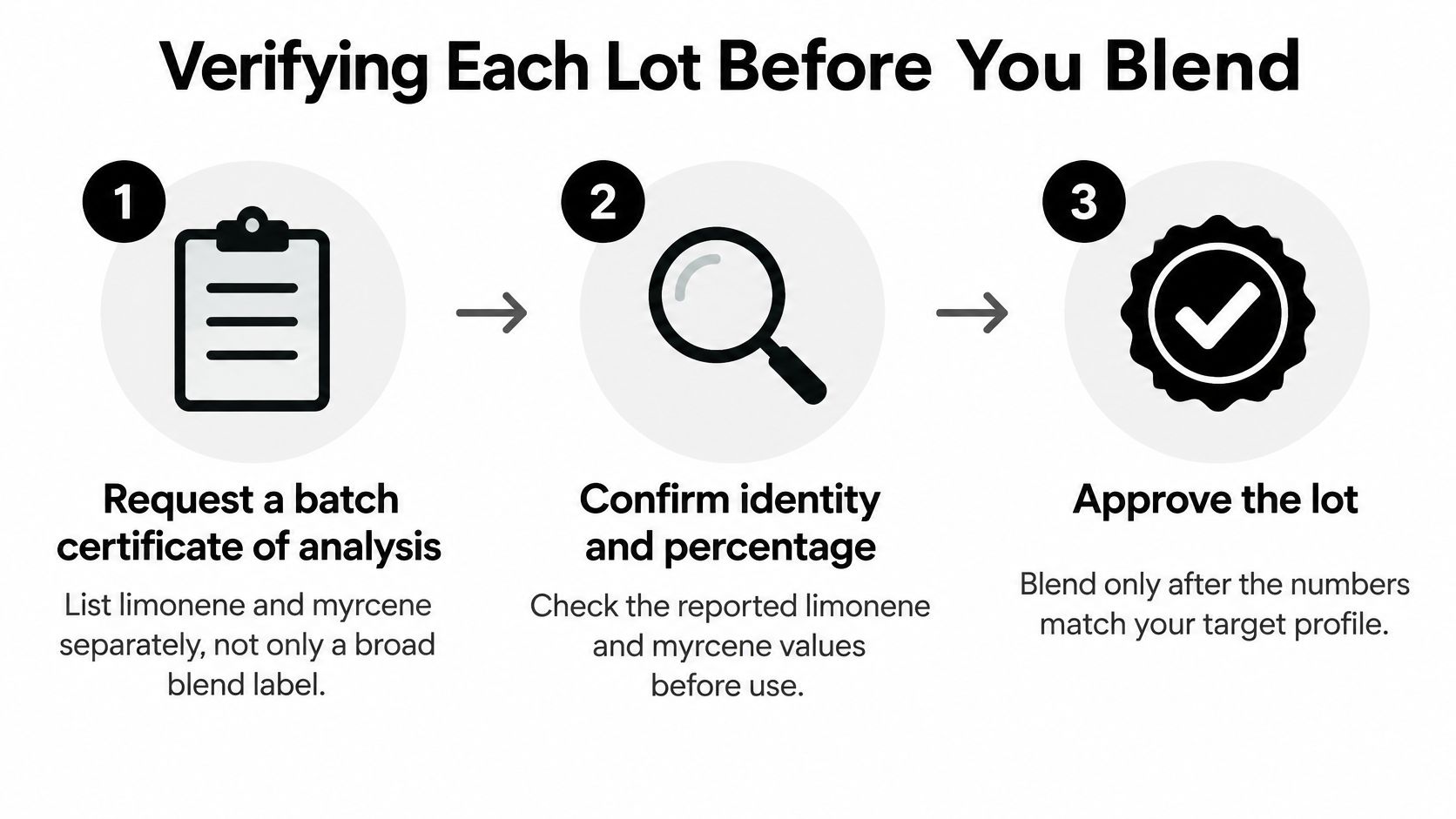
Run every incoming lot through the same six steps:
- Request a batch certificate of analysis that lists limonene and myrcene separately. A broad "terpene blend" line can't tell you how much of either you're adding. A validated method that analyzed 18 abundant terpene compounds by selected-ion monitoring with internal standards found beta-myrcene and beta-caryophyllene dominant in the samples tested, followed by alpha-humulene, limonene and alpha-bisabolol, per the GC-MS analysis of cannabis essential oil. Those are five separate numbers that a blend label collapses into one.
- Confirm identity and percentage by weight for each compound. Identity without a percentage tells you what's in the drum, not how much of it will reach the cart.
- Check that the method is validated and uses matched calibration standards. Myrcene can go missing at this stage. In a validated headspace GC/MS terpene method, the largest overall extraction area came at 120 °C, but highly volatile terpenes such as myrcene showed lower measured levels at higher temperatures, attributed to degradation or loss, and a 30-minute incubation at 100 °C was reported as effective, per the validated HS-GC/MS terpene method. Read a low myrcene result as a question about the vial, not an automatic fact about the plant.
- Compare the results with the target percentage in your brief. In the same source, observed myrcene concentrations ran from 0.7 to 17,400 μg/g against 1.3 to 300 μg/g for limonene across the leaves and inflorescences examined, which is why a "typical ratio" has no analytical basis. Your brief, not a textbook figure, is the benchmark.
- Recalculate additions from the measured percentages, not the nominal name. A lot at 92 percent purity needs more grams than a lot at 96.5 percent to hit the same profile.
- Log lot numbers next to each batch record. When a customer complaint arrives three months later, the lot number is the only thing that lets you trace it.
A passing lot looks unremarkable on paper: compound levels listed individually, a stated method, calibration detail, and results that land inside the brief. Terpene information for our products comes from SC Labs, so the numbers we quote trace back to a named lab. The certificate of analysis guide walks through what the document should contain before you approve anything.
Calculating Doses From Measured Lot Data
Measured purity changes the weight you scoop. Here's the arithmetic on a worked example.
Say you're building 1,000 g of oil-based distillate at a 2 percent total terpene load. That's 20 g of terpene. A 2:1 limonene to myrcene split gives you 13.3 g of limonene and 6.7 g of myrcene as the target actives. Now divide each target by the measured purity on the lot certificate. If the limonene isolate tests at 96.5 percent and the myrcene isolate tests at 92.0 percent, you weigh about 13.8 g of limonene (13.3 divided by 0.965) and about 7.2 g of myrcene (6.7 divided by 0.920). Roughly a gram of extra material across the batch, which is enough to shift a citrus profile toward the herbal side if you skip the correction.
- Set the total load. Pick the percentage by weight and convert it to grams for the batch size.
- Split it by the target ratio. Two parts limonene to one part myrcene is a reasonable first pilot.
- Divide each amount by the measured purity from the certificate. Lower purity means a larger addition.
- Weigh each addition and record it against the lot number. The batch record should show both the target and the actual weight.
A lot with lower measured purity needs a bigger addition to hit the same profile. That's the whole argument for dosing from certificate data rather than a blend name, and it's why two production runs using the same nominal material can land in different places.
Between 1 and 3 percent total terpene by weight is a pilot starting point, not a rule. The pilot results set the final ratio, and the ratio you keep is the one that held its aroma after a warm fill and a hold period. Run the calculation again whenever a new lot arrives, even if the certificate looks familiar. The mixing ratios calculator handles the repeat arithmetic once your targets are set.
Recalculate on receipt, not on reorder. Purity moves between lots, and a formula that ignores it drifts quietly until a customer notices.
Sourcing and Compliance Checks for Botanically Derived Terpenes
Regulators treat synthetically derived and botanically derived flavoring substances differently, so the source of your isolate matters as much as the molecule itself. For a reference point, the FDA food substance database entry for d-limonene lists the compound as a flavoring agent or adjuvant and references 21 CFR 182.60 and FEMA number 2633.
Neither record authorizes terpene use in every product category or jurisdiction. The intended application, the source documentation, the specifications and your local rules all shape what you can legally sell, so verify before purchase rather than after.
The supplier checklist
- A current certificate of analysis. Batch specific, with limonene and myrcene reported separately.
- Identity and purity data. Compound name, CAS number, and percentage by weight.
- Safety documentation. Available on request, and current.
- Clear botanical source information. Which plant, which part, which process.
- Lot numbers and a stated shelf life. So storage and rotation are manageable.
Botanical sourcing gets claimed far more often than it gets documented. Ask for the paperwork.
Our terpenes are extracted from fresh plants and are free of mixtures, chemicals and additives, and that claim should come with documents you can file, not a word on a label. If a supplier cannot produce a batch certificate that matches the lot on your invoice, treat the material as untested and price the risk accordingly.
Compare cost per gram of tested material
Sticker price misleads here. Myrcene runs from $27.00 through $220.00 across its variants, so the same compound name can land at very different unit costs depending on pack size and grade. Divide the price by the grams of documented terpene in the container, then weigh that figure against the cost of a failed batch. A cheaper drum that forces a reformulation and a re-test costs more than the difference.
Confirm your local rules and your target product category before any purchase. The botanically derived terpenes guide covers sourcing documentation in more depth.
Choosing the Lead Terpene and Running Your Pilot
Start with the sensory target, not the terpene name. The table maps four common goals to a lead compound, the reason it fits, and the first thing to check in a pilot.
| Product goal | Lead terpene | Why it fits | First pilot check |
|---|---|---|---|
| Citrus-forward cart or edible | Limonene | Reads as orange and lemon peel | Confirm limonene percentage by lot before setting the dose |
| Earthy, herbal or resinous cart | Myrcene | Builds a herbal and resinous base | Check aroma after warm fill and reseal |
| Balanced citrus and herbal blend | Both, added by weight | Keeps each note audible | Run a two-ratio pilot and compare side by side |
| Fruit or dessert flavor build | Limonene with a flavor isolate | Carries lemon or fruit top notes | Confirm the flavor holds after heat exposure |
Myrcene can take over a blend. It is a strong, low note that reads at small percentages, so a shift of a point or two in its share moves the whole profile from bright citrus to damp and resinous. If your brief leans citrus, treat myrcene as a seasoning and dose it last. If the brief leans earthy, build myrcene first and add only enough limonene to keep the top from closing.
The functional target points the same direction. Strains carrying more than 0.5% myrcene tend toward a sedative profile, while those under that line lean energizing, and the attribute groupings follow the same split: myrcene anchors the Relax set while limonene sits in Uplift. Popular isolates in the range include Alpha Pinene, Beta Caryophyllene, Limonene, Linalool, Myrcene and Terpinolene, so a lead-terpene decision rarely means a two-ingredient formula. Limonene and myrcene carry the front and back of a build, and the rest fill in texture.
The pilot sequence
- Pick the lead terpene from the sensory target. Not from a mood label.
- Confirm each lot's measured percentages. Correct the weights using the certificate arithmetic.
- Run two or three ratios. Two parts to one, then one to one, is enough to hear the difference.
- Check aroma after a warm fill and a hold period. The ratio that survives both is the one to scale.
- Move to bulk only after the held sample passes. Then lock the formula to specific lot numbers.
What published evidence supports is narrower than most label copy suggests. A recent review found no direct human data validating myrcene's anxiolytic or antidepressant effects, and a randomized crossover study of 20 adults found vaporized limonene alone did not differ from placebo, per the review of terpene and cannabinoid interaction studies. Choose a lead terpene because it hits the aroma brief and survives your process. Effect language doesn't belong on a formulation decision.
Three ways to move from decision to batch:
- Shop the isolates and blends. Compare the botanically derived limonene and myrcene isolates against the profile blends built around them.
- Pilot with the Pioneer Pack. It ships one bottle each of Beta Caryophyllene, Limonene, Myrcene, Linalool, Alpha Pinene and Terpinolene, so a two-ratio pilot runs off a single order.
- Scale through bulk or wholesale. Once the held sample passes, contact Gold Coast Terpenes about bulk or wholesale pricing at your batch size.
Limonene and myrcene look interchangeable on a formula sheet and behave nothing alike in a tank, which is why they sell as separate botanically derived isolates backed by SC Labs testing rather than one vague citrus-herbal blend. Whether you are building a citrus-forward cart, an earthy concentrate, or a ratio between the two, shop Gold Coast Terpenes for isolates, blends, packs and diluents, then move to bulk once the pilot ratio holds.