
What makes a flavor concentrate natural? Regulators answer that question with paperwork. In the United States, the claim rests on where the flavoring constituents come from and whether flavoring is their significant function in the finished product. In the European Union, Regulation (EC) No 1334/2008 requires at least 95% by weight of the flavoring component to come from the source named on the label.
Buyers usually expect one certificate to settle the matter. What they work with is a stack of records: a specification sheet, a certificate of analysis, an ingredient statement, and for some markets a source breakdown by weight. Each record describes where the material came from and what it does in the product. None of them grades the concentrate as better or safer.
Natural, in other words, is a legal status with documents behind it. Learning which records each claim requires is the work that protects a blend before a purchase order goes out.
What Natural Flavor Concentrates Are
A natural flavor concentrate is a small-volume flavoring whose flavoring constituents come from permitted botanical, dairy, or fermentation sources, and whose significant job in the finished product is flavor rather than nutrition. You buy it by the gram and dose it at a few percent of batch weight. That small volume sets the entire aroma of what you make.
Tomato paste is the closest everyday comparison. Fresh tomatoes are mostly water, so cooking that water off leaves a spoonful of paste carrying the flavor of a whole bowl. A concentrate does the same with aroma. The source material, whether citrus peel, spice, fruit or leaf, is processed until the flavor-bearing fraction is dense enough that a small dose defines the batch.
A mixture, not a molecule
A concentrate isn't one chemical. It's a blend of volatile and semi-volatile compounds, and its character comes from their ratios and how they release in your matrix. Change the crop, change the extraction route, and you get a materially different product carrying the same name.
| Type | How It Is Made | Typical Use |
|---|---|---|
| Essential oil | Steam distillation or cold pressing of plant material | Citrus and herb flavors |
| Oleoresin | Solvent extraction of spices and dried herbs | Spice blends and savory flavors |
| Extract | Solvent or alcohol extraction of fruit or plant material | Fruit and beverage flavors |
| Essence | Volatile flavor dissolved in an alcohol carrier | Liquid flavorings |
| Distillate | Heat-based separation of volatile fractions | Light, clean flavor carriers |
Settle that table with your supplier before anything else. A citrus essential oil and a citrus distillate can both be sold as natural flavor and behave nothing alike in a cartridge or a beverage, and one may carry a carrier the other doesn't.
The category is commercially mature. Grand View Research valued the global natural flavors market at USD 6.4 billion in 2023, which tells you the supply base is deep and the material classes are well established.
Because a small dose sets the flavor, the form, the botanical source and any carrier all have to be known before you commit. A spec sheet reading only "natural flavor" leaves all three unanswered.
How Natural Flavor Concentrates Differ From Terpene Blends
Both materials start in plants and both get dosed for aroma. They're built differently, and that difference decides which one belongs in your product.
| Attribute | Natural Flavor Concentrate | Botanically Derived Terpene Blend |
|---|---|---|
| Source | Whole botanical material processed by oil, oleoresin, extract or distillate routes | Botanically derived terpenes recombined by ratio |
| Composition | Dozens or hundreds of constituents from the source | Defined terpenes such as limonene, myrcene and beta-caryophyllene at set ratios |
| Batch consistency | Shifts with crop, extraction route and lot | Easier to repeat when ratios are fixed |
| Regulatory framing | Food flavor rules based on source and function | Depends on the intended market and use route |
| Typical use | Complex, natural-tasting flavors | Matching a target profile in distillate or carts |
Where the two materials part company
Consistency decides most purchases. A concentrate keeps whatever the harvest and the extraction gave it. FDA technical material notes that two concentrates from different crops, extraction methods or production lots can differ substantially, because the material is a complex mixture rather than a standardized chemical. A blend assembled from defined terpenes at fixed ratios doesn't share that weakness. It's reproducible on purpose, which matters when a SKU ships monthly and customers notice drift.
A concentrate works like a photograph of a single harvest: accurate, and different every season. A blend works like a recipe, written so it can be cooked the same way twice.
Documentation splits along the same line. With a concentrate, the file has to prove identity: botanical source, extraction route, a chromatographic fingerprint, marker-compound ranges, residual solvents and oxidation indicators. With a blend, it has to prove the recipe and the origin of each component. The word on the label can be identical. What the paperwork behind it must show is not.
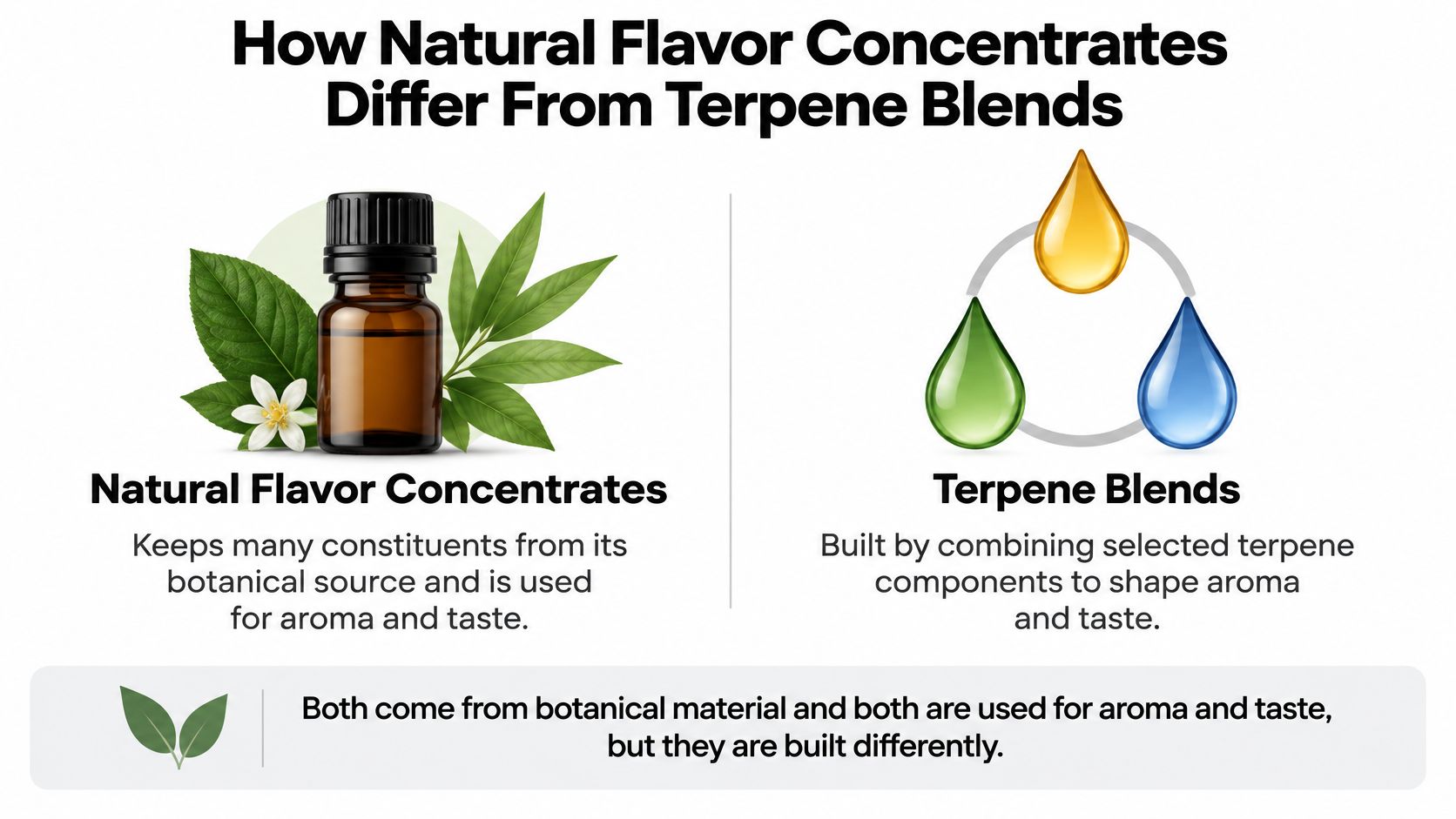
Pick the material by what the SKU has to do. A core cartridge flavor that reorders every month belongs on a fixed-ratio blend. A limited run built around a layered fruit or spice character is where a concentrate earns its extra testing. The sourcing question underneath that choice, what "botanically derived" means on paper, is covered in our comparison of cannabis-derived and botanically derived terpenes.
Buying test: if the goal is an exact, repeatable profile, start with a blend; if the goal is a complex source-driven flavor, start with a concentrate and budget for more lot testing.
The rest of the tradeoff is arithmetic. A concentrate can cost more per usable unit of flavor, may have a shorter shelf life, and usually brings a heavier compliance file than many synthetic alternatives. A fixed-ratio blend is simpler to price, stock and reorder. Whichever route you choose, the label claim stands or falls on the records the supplier can produce for it.
Why a Natural Claim Depends on Source, Function and Market
On a spec sheet, "natural" reads like a grade. As a regulatory term it works as a sourcing and function claim: it records where the flavoring constituents came from and what job the ingredient does in the product, and each market writes that description differently. The word carries real commercial weight. Natural flavors made up nearly 22.2% of the clean-label ingredients market in 2024, according to Research and Markets data reported by Ingredients Insight.
The US rule is about origin and purpose
FDA food-labeling rules define a natural flavor as an essential oil, oleoresin, essence, extractive, distillate or similar preparation whose flavoring constituents come from plant materials such as spices, fruits, vegetables, herbs, bark, buds, roots or leaves. The same rule requires that the ingredient's significant function be flavoring rather than nutrition.
Both halves matter. A botanical extract added for color, or to support a nutrient claim, fails the definition no matter how cleanly it was produced. Supplier documentation should name the botanical source and the intended flavoring function instead of leaning on marketing language.
The definition has a long tail. A USDA National Organic Program policy memo on natural flavors traces US oversight of flavor labeling to the Pure Food and Drug Act of 1906, which pushed manufacturers toward greater ingredient disclosure and helped establish the regulatory split between natural and synthetic flavor descriptions.
Where the rules diverge
The European Union approaches the same word from a different angle. A named botanical on the label triggers a minimum share by weight from that source, and "natural flavouring substance" is reserved for components built exclusively from natural flavoring substances. A blend that tastes of mango doesn't clear either bar.
| Market | Rule for a Natural Claim | Record to Hold |
|---|---|---|
| United States | Source must be a permitted natural material and flavoring must be the significant function | Ingredient statement and certificate of analysis showing the botanical source |
| European Union | A named source on the label requires a minimum share by weight from that source, and the "natural flavouring substance" term allows only natural flavoring substances | Source breakdown by weight and batch-level records |
Two markets, two different files, one habit that covers both: treat "natural" as a paperwork claim that only exists if the records are on file. Before a purchase order goes out, ask which definition applies in your selling market and which documents prove the ingredient meets it. Our guide to botanically derived terpenes shows how that sourcing and specification work looks for one ingredient class. Terpene statements on our product pages have not been evaluated by the Food and Drug Administration.
Supplier Documents to Require Before Approving a Blend
A natural claim is a file claim. The label word only stands if the records show the source material, the processing route, the full formula and the route of use. The market rules set the label bar; at approval, your job is to make the supplier hand over proof for each part of that bar.
Ask the percentage by weight from the named botanical source and what fills the remaining share, including carriers, diluents and processing aids. A mango-named material that smells like mango still needs a source breakdown, because aroma alone does not establish the claim.
Before you approve a concentrate for a new SKU, request:
- Certificate of analysis: constituent percentages, residual solvents, heavy metals, pesticides where relevant, microbial limits, and storage conditions.
- Botanical source and processing route: steam distillation, solvent extraction, cold pressing or heat-based separation, named specifically rather than described as "natural processing."
- Full ingredient list: every carrier and diluent, not just the flavor declaration.
- Sensory specification: the target aroma and the acceptable range from lot to lot.
- Stability data: behavior under light, heat, oxygen, and contact with your packaging.
- Market and route file: the label records required for the destination market, plus route-specific safety documents when the material is headed for cartridges.
Lot discipline: each lot needs its own certificate, the certificate ties to the ingredient statement, and the ingredient statement ties to the batch record of the finished blend.
That chain is what tells you where a problem started. When a batch tastes off, trace it to a specific lot number before blaming the process, the equipment or the operator. Retest the lot first.
All our ingredients are lab tested, and terpene information for our products is provided by SC Labs, so the technical file travels with the material. Our safety documentation requirements set out what accompanies each lot; ask us for those records before you approve a blend, not after the first production run.
How to Blend a Concentrate Into Distillate or Carts
A repeatable blend comes down to eight moves, and each one exists because skipping it causes a specific failure.
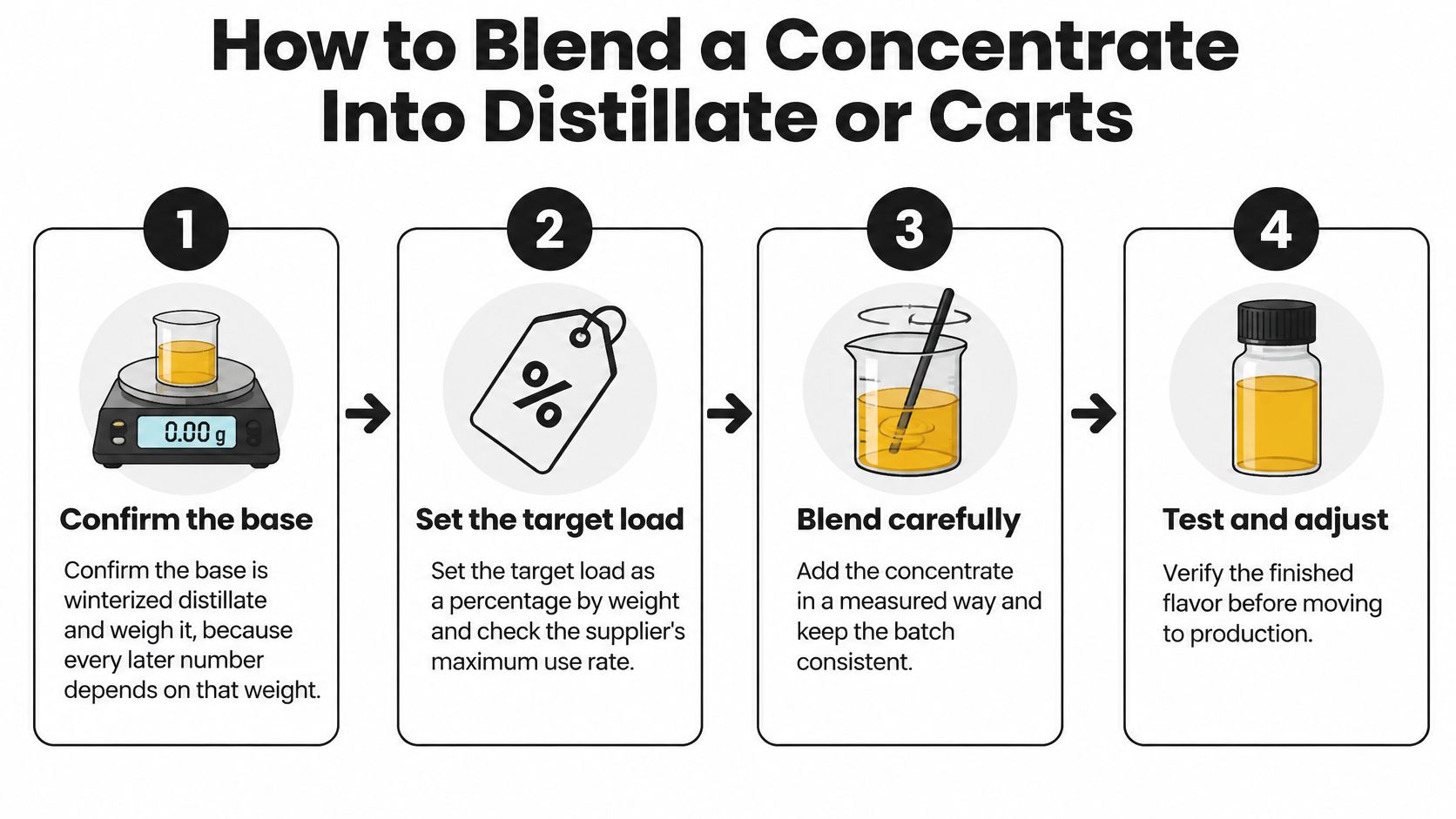
Confirm and weigh the base. Check that the base is winterized distillate, then weigh it on a calibrated scale. Every later number is a percentage of that weight, so a bad base weight spoils everything downstream.
Set the load by weight. Choose the target, typically a low single-digit percentage, and check the supplier's documented maximum use level first. That maximum is the ceiling the material was assessed at, not a suggestion.
Do the math in grams before you open the container. A 1,000 g batch at a 3% load takes 30 g of concentrate. Write the figure on the batch sheet, because bench arithmetic is where batches drift.
Warm the base gently. Heat it only until it pours. Push it hotter and you drive off the light volatiles that carry the top notes, and nothing added later puts them back.
Add slowly on a fine-reading scale. Use a scale that reads to 0.01 g and add the concentrate in a steady stream while the base moves. A half-gram slip on a small charge is a visible shift in the finished aroma.
Mix to uniform. Stir until there are no streaks, layers or haze. If a cloudiness won't clear, stop and identify it before filling anything.
Rest, then evaluate. Let the batch sit so the flavor equilibrates in the matrix, compare it against the target, then check again after a set interval. Some profiles bloom in the first day and others fade.
Log the run. Record base and concentrate lot numbers, weights, temperatures, mix times and sensory notes. That log is the only thing that lets you repeat a good batch or explain a bad one.
Dose check: calculate the final concentration of every intentionally added component and compare it against the supplier's documented maximum use level. Where the same constituent shows up in two ingredients, add them together.
Dilution also reframes the safety question. FDA technical material notes that natural flavor complexes may sit at comparatively higher levels within a compounded flavor while individual chemically defined constituents in the finished compounded flavor are typically present below 1%. Your 3% load is a finished-product figure, so the exposure that matters is in the cart, not in the neat concentrate.
A good blend looks like this: even aroma across the batch, no separation after resting, and a second evaluation that still matches the target. If the second check drifts, you have a stability question rather than a dosing one. Our walkthrough on how to mix distillate with terpenes covers the mechanics in more detail.
Worked Examples and Costly Mistakes
Most rework at this stage traces back to two small slips: a misread charge weight and a replacement lot nobody checked. Take the first. Say a batch is 500 g of distillate at a 4% load. That calls for 20 g of concentrate, and a 2 g scale error on that charge is a 10% miss, enough to move the flavor from a background note to a foreground one. Weigh the charge into a tared beaker on a 0.01 g scale and confirm the reading before it goes in.
The second slip is harder to see. A replacement lot of the same concentrate arrives, you run the identical 4% load, and the batch smells thinner and sharper than the standard. The instinct is to blame the process. Pull both certificates of analysis instead, compare where each marker compound sits inside its certified range, and check the oxidation indicators side by side. Retest the drifted lot before you touch the method.
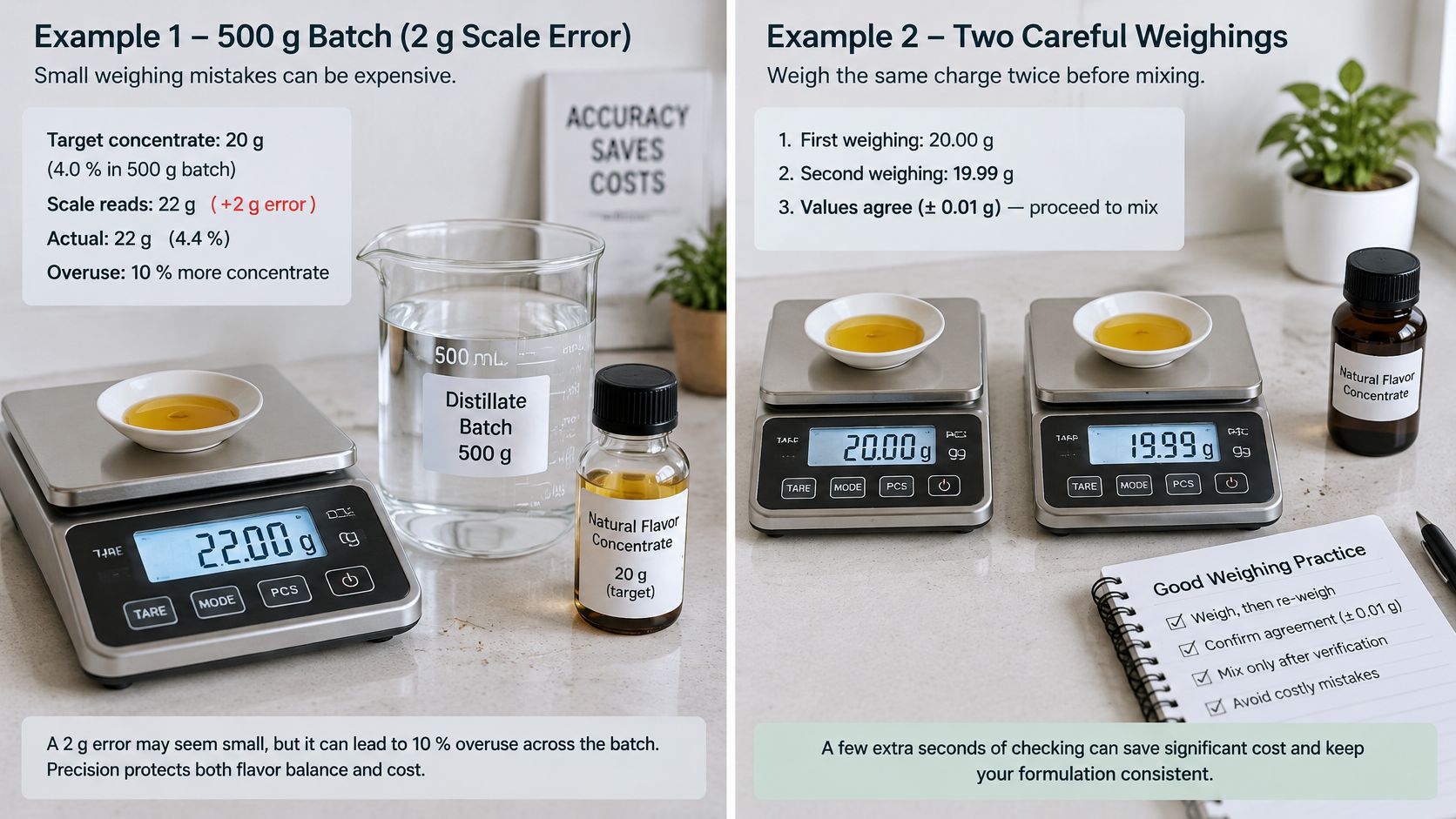
A drifted lot is a lot problem until you prove it's a process problem.
Ranked by how much damage they do
Approving a blend on paperwork written for a different route of use. A material assessed for a food product does not carry that assessment into a cartridge. Match the supplier's stated intended use to the product you're filling, and treat any gap between the two as a stop.
Skipping the oxidation check. An oxidized concentrate smells sharp or flat before it looks any different. Keep a retained sample of the approved lot and smell it beside the new one at every delivery.
Not knowing the carrier. An undisclosed carrier can separate in your matrix or add a note you never designed. Demand the full ingredient statement, not the flavor declaration alone.
Overloading to chase a stronger aroma. Past the supplier's maximum you're outside the assessed use level, and the usual result is a harsher top note rather than a bigger one. Dose to spec, then adjust elsewhere.
Filling with no sensory check against the target. Hold every batch against a reference standard and record the result, even when the run looks identical to the last one.
Storing in reactive packaging or a warm, bright room. The profile can shift within weeks. Use low-sorption containers, keep headspace minimal, and store cool and dark.
Notice how the six split. The first three let a compromised material into the batch; the last three let a good material drift or ship unchecked. Work the list top down, because rejecting a delivery costs an hour at the bench while reworking a filled run costs the whole batch.
Request Samples, Test and Contact Gold Coast Terpenes
A bench trial costs a sample. A failed production run costs a batch. Work the checklist in this order.
- Shortlist two or three materials that fit the target profile, mixing concentrates and blends if the brief allows either.
- Request a sample and the lot documents from the checklist, including the source breakdown for any market that requires one. For a material sold as natural, that paperwork is the claim: without it, the word on the label is decoration.
- Test each in a small distillate batch at the planned load, following the eight steps above.
- Compare aroma and separation after a set storage period, not minutes after mixing.
- Confirm the documents match the target market before anyone scales up.
Keep a test log with each lot number, weight and sensory result. When a second lot arrives, that log is what lets your team compare the two side by side instead of relying on memory.
Our isolates and terpene profiles let you choose by preference, and the diluent options listed on the site are Proprietary MCT Oil and PÜR TERP. If you're building a fruit-forward profile, 24k gold punch is one blend worth testing against your target before you commit to a full run.
Gold Coast Terpenes supplies terpene blends extracted from fresh plants, strain-specific profiles and isolates for cartridges, concentrates and product formulation, and we can send the technical records and lot documentation you need before a blend is approved. Request samples, run them against your target on the bench, then come back to us for a bulk order or the wholesale program once the numbers hold up. Visit Gold Coast Terpenes and tell us what you're building.