
A strain name is the weakest spec sheet in the room. Blue Bacio can travel across cuts, grows and batches, so start with a sensory brief: layers, ratio limits, COA fields. Gold Coast Terpenes carries strain profiles and isolates; write the target before you buy terpenes or scale.
What Should a Blue Bacio Blend Taste Like?
A Blue Bacio blend should taste like candied sherbet and bright fruit over denser sweet cream, dessert depth, gas and spice. The target is two layers in tension: a bright top that reads as sherbet and a heavier base that reads as gelato.
The OA Seeds Blue Bacio listing describes Grounded Genetics crossing Original Blue Sherbert, used as the female, with a reversed Bacio Gelato pollen donor, and the cultivar was originally released in 2021. That parentage is your formulation map before you touch a scale. The Blue Sherbert side tells you where the fruit and sherbet character comes from, and the Bacio Gelato side tells you where the cream, gas and spice belong.
Blue Bacio Target Terpene Map by Layer
| Layer | Sensory direction | Starting terpene candidates | Source of direction |
|---|---|---|---|
| Top | Candied sherbet, berry, tropical fruit | Limonene | Blue Sherbert parent, reported fruit and sherbet traits |
| Mid | Fruit body, soft sweetness, floral lift | Myrcene, alpha-pinene | Breeder and seller descriptions, no quantified terpene data |
| Base | Sweet cream, dessert depth, gas, spice | Beta-caryophyllene, alpha-humulene | Bacio Gelato parent, reported dense sweet-cream and gas traits |
Top notes hit the nose first and fade first, so they carry the sherbet snap but can't hold the profile alone. Mid notes give the fruit its body and keep the blend from reading thin or sharply citrus. Base notes anchor the finish, persist longest in the aroma, and carry the cream, gas and spice contrast. If a first pass smells flat, adjust the layer that went quiet before you touch the one already working.
Run each candidate through the terpene flavor chart as a check against its assigned layer.
I would treat every cell in the table as a starting hypothesis until a batch COA and a blind sensory panel confirm it.
Build the contrast, not just the fruit. If the base disappears, you've made a generic sherbet blend, not a Blue Bacio direction.
Bright candy fruit without darker gelato depth misses half the genetics, and heavy cream without sherbet lift misses the other half. Hold both sides and the profile earns the name.
Why a Blue Bacio Name Cannot Set Your Ratios
A Blue Bacio name can't set your ratios because commercial records describe at least two different lineages under that name. The African Smoke Grounded Genetics listing reports Original Blue Sherbert × reversed Bacio Gelato, while an Umamii live rosin listing identifies Blue Cookies × Gelato 33.
Two Commercial Blue Bacio Lines Compared
| Attribute | Grounded Genetics line | Umamii live rosin line |
|---|---|---|
| Lineage | Original Blue Sherbert × reversed Bacio Gelato | Blue Cookies × Gelato 33 |
| Product type | Feminized seed and flower cultivar | Live rosin extract |
| Named dominant terpenes | Beta-myrcene, limonene, beta-caryophyllene (no percentages in breeder data) | Beta-caryophyllene and limonene |
| Evidence type | Breeder and seed-retailer descriptions | Single product listing with extraction data |
If you formulate from the name alone, you can blend two chemistries and call the error a house style. A seed cultivar and a live rosin also answer different questions, one about potential flower expression and one about a specific extracted batch.
Breeder listings name myrcene, limonene and beta-caryophyllene, but naming isn't measuring. Without individual percentages, you don't know concentration, dominance or batch consistency, and you can't defend a ratio in a spec sheet.
Every Blue Bacio brief should carry five verification fields before anyone mixes:
- Breeder or extractor: Name which commercial line you're following.
- Phenotype: Record the selection, not just the cultivar name.
- Batch COA: Tie the target to one tested lot.
- Cannabinoid profile: Keep potency claims separate from flavor targets.
- Quantitative terpene panel: Require individual values, not a dominant list.
That list turns a marketing reference into a formulation target you can reproduce, audit and revise.
Which Potency and Cycle Numbers Are Safe to Plan Against
Treat reported Blue Bacio numbers as scale and timing references. The House of Seeds Blue Bacio listing places expected THC at about 20% to 25%; broader seed catalogs stretch the floor lower and keep flower inside the same late-window range.
Reported Blue Bacio Potency and Cycle Values
| Metric | Reported value | Named source and evidence type | How to use it in a brief |
|---|---|---|---|
| THC, seed listing | 20% to 25% | House of Seeds retail listing | Context only, not a batch specification |
| THC, broader seed listing | 15% to 25% | Broader seed catalog range | Shows phenotype spread |
| Flowering time, general | 8 to 9 weeks (8.5 to 9 weeks in one catalog) | Seed catalog timing | Sets harvest timing for source flower |
| Flowering time, Grounded Genetics line | 56 to 65 days | Grounded Genetics retailer listing | Cross-check against breeder timing |
| THC, Umamii live rosin | 76.6% | Umamii live rosin product listing | Concentrate reference only |
| Total terpenes, Umamii live rosin | 8.51% | Umamii live rosin product listing | Scale benchmark, not a strain specification |
The THC spread is a warning about phenotype, cultivation, harvest timing and test method. It does not tell you whether sherbet, cream or gas leads the aroma.
Flowering time matters for source planning because resin maturity at harvest shapes the volatile input an extractor receives. The rosin figures sit at concentrate scale, so use them to benchmark an extracted reference and keep them away from flower or distillate targets.
Planning rule: A THC match does not prove a flavor match, and a total terpene figure does not prove which terpene dominates.
Set terpene load from your target profile, hardware and carrier. Confirm it with a quantitative panel on the finished blend, not with a cultivar range copied from a seed page.
Which Gold Coast Terpenes Profiles and Isolates Fit Best?
Three isolates map cleanly onto the brief: Limonene for top, Myrcene for mid and Beta-Caryophyllene for base. Build that skeleton first, then pull in strain profiles only as directional references. The attribute lists support the split: Limonene sits on the UPLIFT side while Myrcene and Beta-Caryophyllene sit on RELAX, which is the lift-over-depth shape a sherbet and gelato cross needs.
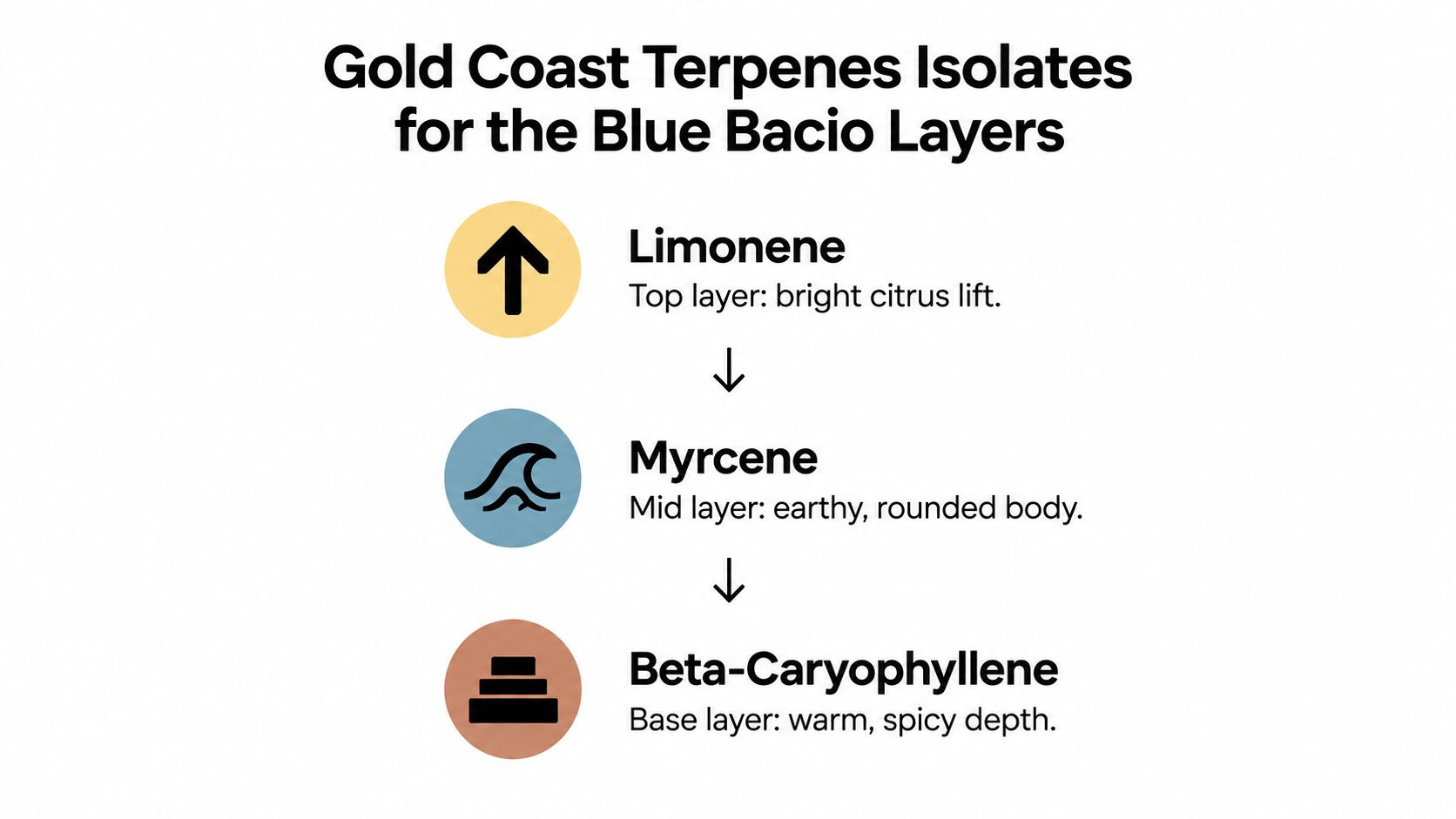
Limonene brightens the sherbet and fruit lift. Myrcene adds fruit body and rounds the middle so the top doesn't read sharp. Beta-Caryophyllene supplies spice and gas depth, which keeps the finish from collapsing into plain sweetness. The guide on how to use terpene isolates walks through this layer by layer approach.
Among profiles, Rainbow Sherbet is the closest reference for the top to mid transition. Pink Lemonade, with lemon, strawberry and sweet notes, can sharpen fruit edges in small trials. Blue Dream works only as a blueberry leaning accent, since a larger share pulls the brief away from gelato depth. At $40, the 3ml Strain Picker Pack lets you select any three profiles from the catalog, which makes it a cheap way to run those references side by side.
Elevated Strains are made by the Master Terpologists, who boost rare and exotic terpenes to bring out fruity nuances. That suits a fruit edge brief, but the result still has to pass your target panel.
Catalogs rotate, and new strains are added each month. Check current listings before naming a Blue Bacio match in product copy, and remember every profile ships concentrated and needs proper dilution before it reaches a blend. I would build the isolate skeleton first, then add one profile only where the panel finds a gap.
How to Build a Strain-Inspired Terpene Blend Step by Step
Build a Blue Bacio blend in six measured steps, from a written target to a lab checked finish. Skip the written target and every later adjustment becomes opinion.
The process sequence below keeps formulation for distillate and cartridges tied to weight, records and retesting.
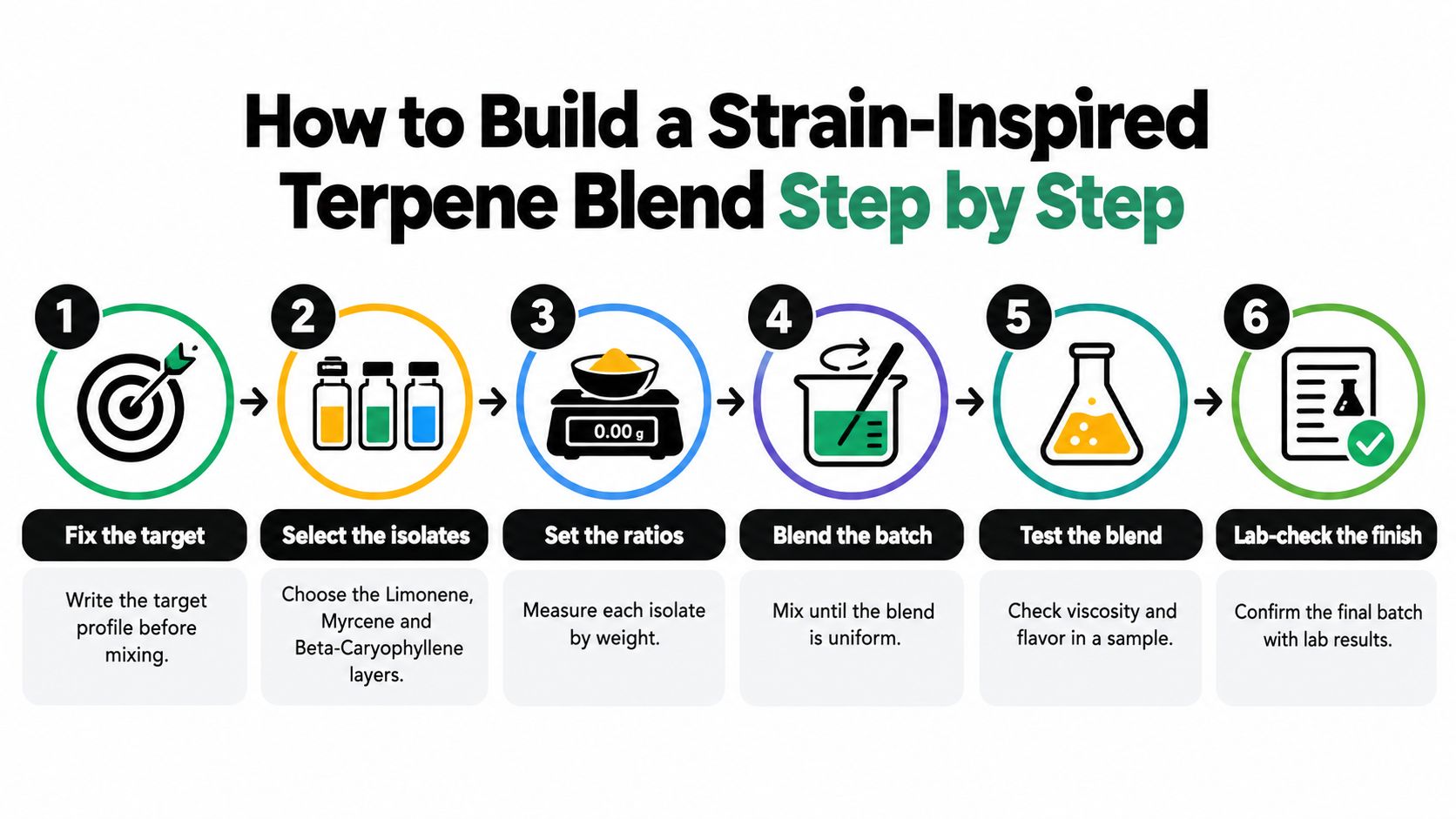
Fix the target. Write the layer map and, if a reference COA exists, copy its individual terpene values into the brief. The common slip is starting from aroma memory, which drifts between sessions and can't be handed to another formulator.
Set the total load. The Certified Stoners Umamii Blue Bacio live rosin listing reports 76.6% THC and 8.51% total terpenes, so 1.000 g at 8.51% w/w contains approximately 85.1 mg total terpenes. Use that math as a scale benchmark, then set the load your product, carrier and hardware can support.
Split the load by layer. For example, an illustrative 40/35/25 top, mid and base split gives sherbet lift without starving the finish. Treat that split as a first trial, not a claim about the cultivar, and adjust it only after sensory testing.
Choose the ingredients. Use Limonene, Myrcene and Beta-Caryophyllene isolates as the core, or start from a Gold Coast Terpenes strain profile when speed matters more than layer control. Don't add all top note material at once, because a loud opening can mask a weak base until the blend rests.
Watch the mixing sequence before you convert the trial into a production batch.
Blend and record. Note lot, time, temperature and container for every addition. Use the Mixing Calculator to convert percentages into grams, because volume guesses compound error when you scale a small trial.
Test and correct. Rest the blend, run a sensory panel, then run a terpene panel and adjust in 0.5% steps. Terpene percentage alone can't predict viscosity, flavor stability or aerosol performance after dilution, so those checks stay separate.
A passing blend lets the panel identify each layer without a harsh lead note. The panel result sits inside your tolerance, the records reproduce the batch, and the next correction changes one layer for a stated reason.
How Extraction and Storage Shift the Finished Flavor
Extraction and storage decide how much target flavor survives, so document both beside the terpene ingredients. A correct ingredient list can still produce a dull finished product if heat, oxygen or poor storage strips the volatile fraction.
Process Variables That Shift the Finished Flavor
| Stage | Variable | Effect on the finished flavor | Control to record |
|---|---|---|---|
| Harvest | Maturity and resin state | Changes the volatile fraction available to extract | Harvest date and lot number |
| Extraction | Method and temperature | Determines how much of the light top fraction survives | Method name and process temperature |
| Processing | Time and oxygen exposure | Oxidation alters aroma and can flatten top notes | Processing time and headspace exposure |
| Storage | Temperature and formulation | Stability depends on both across long holding periods | Storage temperature log |
| Additives | Tocopherol acetate | Antioxidant addition is not a guaranteed stability fix | Confirm by stability panel, do not assume |
The Thieme stability study abstract monitored beta-caryophyllene and alpha-humulene over eight months and found stability depended on formulation and storage conditions. In those tested preparations, tocopherol acetate did not improve overall stability, and refrigeration was reported as detrimental to long term THC stability.
Process choice carries similar weight. Gentler preparation methods tend to hold more of the limonene and pinene top fraction and show fewer signs of oxidation. Treat any single process comparison as a starting point, because it doesn't prove a gentle method performs the same way on your matrix.
Dense, resin covered flower also doesn't guarantee identical input. Harvest maturity, drying and storage change what an extractor receives, so two lots under one name can start from different sensory baselines.
For each distillate lot, record solvent, temperature, processing time, oxygen exposure and storage conditions. Without that chain, you can't tell whether a flavor miss came from the blend or the process.
How Does a Blue Bacio Blend Perform in Vape Cartridges?
A Blue Bacio blend for vape cartridges must pass three tests before you call it matched, viscosity, flavor after heating and aerosol clarity. A blend that smells right in a vial can still fail in hardware.
The cartridge setup below frames those checks as hardware tests, not just aroma checks.
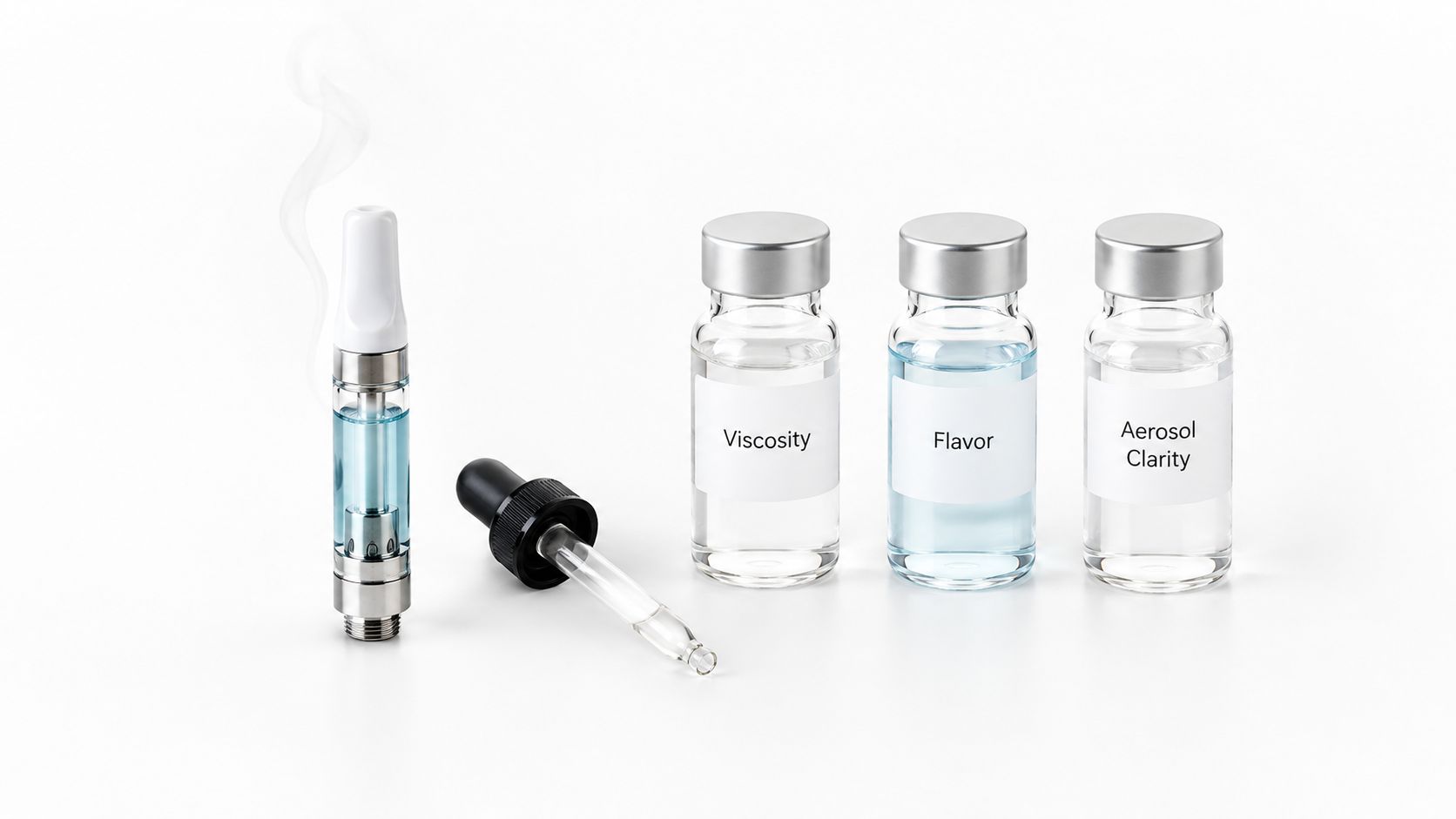
Terpene load changes viscosity and flow, so raise it in small steps and measure at each stage. Too little can read thin and mute the sherbet top, while too much can create harshness, leakage risk or poor wicking in a given device.
Gold Coast Terpenes blends are free of VG, PG, PEG and MCT, so carrier choice stays with your brand. Validate that carrier against the blend and hardware together, since compatibility in a mixing vessel doesn't prove clean performance through a coil.
Heat separates the layers. Volatile limonene leaves the aerosol early, while the caryophyllene base remains longer, so a bright first draw can fade into spice if the top share is fragile. Test the same fill at two or three heating settings and score each layer separately.
A Practical Cartridge Test Sequence
- Viscosity: Check flow at room temperature before filling.
- Resting flavor: Score sealed samples at day one, day seven and day thirty.
- Aerosol: Confirm a clean draw, consistent vapor and no unusual residue.
- Heat range: Repeat sensory scoring at each intended power setting.
A cartridge that's sweet on day one and dull after a week usually points to top note loss, oxidation or an overheavy base. Change one variable at a time, refill, and retest before touching the next.
Verify the Batch and Trial Before You Scale
A Blue Bacio blend is ready to scale only after a verified reference, a passing cartridge trial and a labeling check. The six gates below keep flavor matching, compliance and purchasing in the same file.
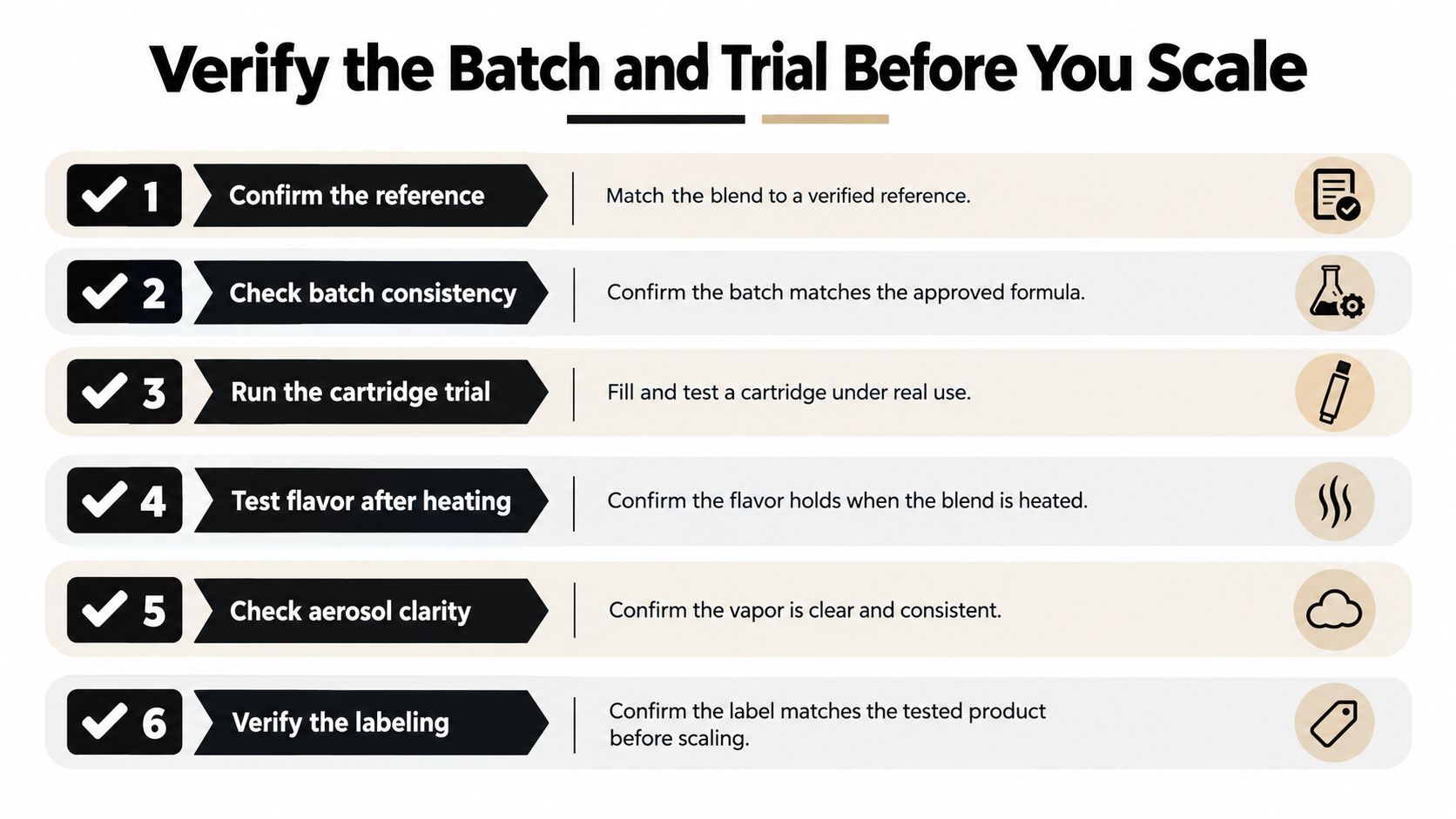
- Confirm the reference. State whether the brief follows Grounded Genetics or the Umamii Blue Cookies × Gelato 33 rosin, plus breeder and phenotype.
- Pull the batch COA. Use the COA certificate of analysis guide and check limonene, myrcene, beta-caryophyllene, linalool and alpha-pinene against layer targets.
- Record labeling basis. For each Gold Coast Terpenes ingredient, record whether it's botanically derived, cannabis derived or nature identical, and confirm THC free status for your file.
- Run a small trial. The 3ml Strain Picker Pack lets customers select any three different terpene profiles from the catalog in 1.5ml or 3ml sizes for side by side comparison.
- Scale after passing. Wholesale pricing is available on strain orders totaling over 64oz, so lock the formula before bulk math drives decisions.
- Dilute and document. All strains are highly concentrated and need to be properly diluted before use, so record the working percentage for every batch.
Frequently Asked Questions
Does Blue Bacio have one standard terpene profile? No. Gold Coast Terpenes formulators should treat it as a sensory reference and verify the specific batch COA, because two commercial lineages use the name.
Can a blend match a Blue Bacio batch exactly? It can match measured layer targets closely, but exact identity needs the original batch's individual terpene values. Gold Coast Terpenes isolates help you adjust those layers deliberately.
Which isolates should I start with? Start with Limonene, Myrcene and Beta-Caryophyllene for top, mid and base control. Gold Coast Terpenes profiles can then fill a panel verified gap.
Are Gold Coast Terpenes blends botanical or cannabis derived? Record the basis for each ingredient before labeling, whether botanically derived, cannabis derived or nature identical. Gold Coast Terpenes product documentation belongs in your compliance file.
How should finished blends be stored? Store them under documented conditions and track stability with repeat panels. Gold Coast Terpenes ingredients still need your lot level storage log.
Build your Blue Bacio direction from measured layers, verified COAs and cartridge tests, then source Limonene, Myrcene, Beta-Caryophyllene and sherbet leaning profiles with documented labeling basis. Visit Gold Coast Terpenes to compare isolates, profiles and picker packs for your next formulation trial.