
Mai Tai is generally a hybrid, not a fixed indica or sativa, and the answer depends on lineage: Clearwater Genetics' Sunset Sherbet × Purple Punch or the widely circulated Maui Wowie × Tutti Frutti. For Gold Coast Terpenes and cartridge developers using its formulation resources, even a reported 50/50 to 60/40 indica-to-sativa classification isn't a substitute for measured terpene composition.
The counterintuitive part is that choosing the correct strain name still doesn't specify the flavor you're buying. A production brief needs a reference lot, a quantified aroma profile, and acceptance criteria for the finished cartridge, not just a category on a supplier spreadsheet.
Mai Tai Is a Hybrid, Not a Fixed Indica or Sativa
Mai Tai hybrid, followed by breeder or lineage, is the defensible classification. The modern Clearwater version and the older Maui Wowie cross shouldn't be treated as interchangeable raw-material specifications.
Beard Bros Pharms' Mai Tai guide identifies Sunset Sherbet × Purple Punch as the commonly documented Clearwater lineage, describes classifications around 50/50 to 60/40 indica to sativa, and notes that a commercial listing calls the Maui Wowie × Tutti Frutti version sativa with potency near 30% THC. It also documents the alternate spelling Mai Thai, another reason to verify provenance rather than match names alone.
Documented Mai Tai lineages, classifications and reported chemistry
| Lineage or sample | Reported source | Reported classification | Reported dominant terpenes | Reported THC |
|---|---|---|---|---|
| Clearwater version, Sunset Sherbet × Purple Punch | Clearwater Genetics listings summarized in strain guides | Balanced hybrid, about 50/50 to 60/40 indica to sativa by phenotype | Limonene appears in available records | 18%–26% common; 26%–32% in some listings |
| Maui Wowie × Tutti Frutti | Older widely circulated lineage; Leafly | Hybrid; one commercial listing says sativa | Limonene, followed by caryophyllene and pinene | Near 30% in one listing |
| Unspecified-lineage sample | Sample range summarized by JointCommerce | Lineage and category not established for this sample | Limonene at 0.42% | 18.7%–25.3% |
The potency ranges and unspecified-lineage sample in the table come from JointCommerce's Clearwater Mai Tai guide, which reports 18%–26%, higher listings of 26%–32%, and a separate 18.7%–25.3% THC range with 0.42% limonene. These are reported observations, not release specifications for your product.
Leafly's Mai Tai entry identifies the Maui Waui × Tutti Frutti lineage as a hybrid and lists limonene, caryophyllene, and pinene as its leading terpenes. Notice the boundary: a terpene ranking doesn't supply the proportions needed to reproduce it.
What belongs on the formulation brief
Record the breeder, lineage, reference-lot identifier, cannabinoid certificate, and terpene chromatogram as separate fields. Don't let purchasing replace missing chemistry with a familiar strain category.
Use the indica-versus-sativa terpene guide to distinguish category language from formulation language.
Practical rule: Approve the name for identity, the chromatogram for composition, and the finished-cartridge comparison for flavor. None replaces the others.
Why Indica and Sativa Labels Cannot Set Product Claims
Two spice jars marked warm can taste nothing alike because the label describes a family, not the chemicals inside. Indica, sativa, and hybrid labels have the same specification problem, so they can't establish a Mai Tai product's physiological claims.
The comparison is useful when reviewing a marketing brief.
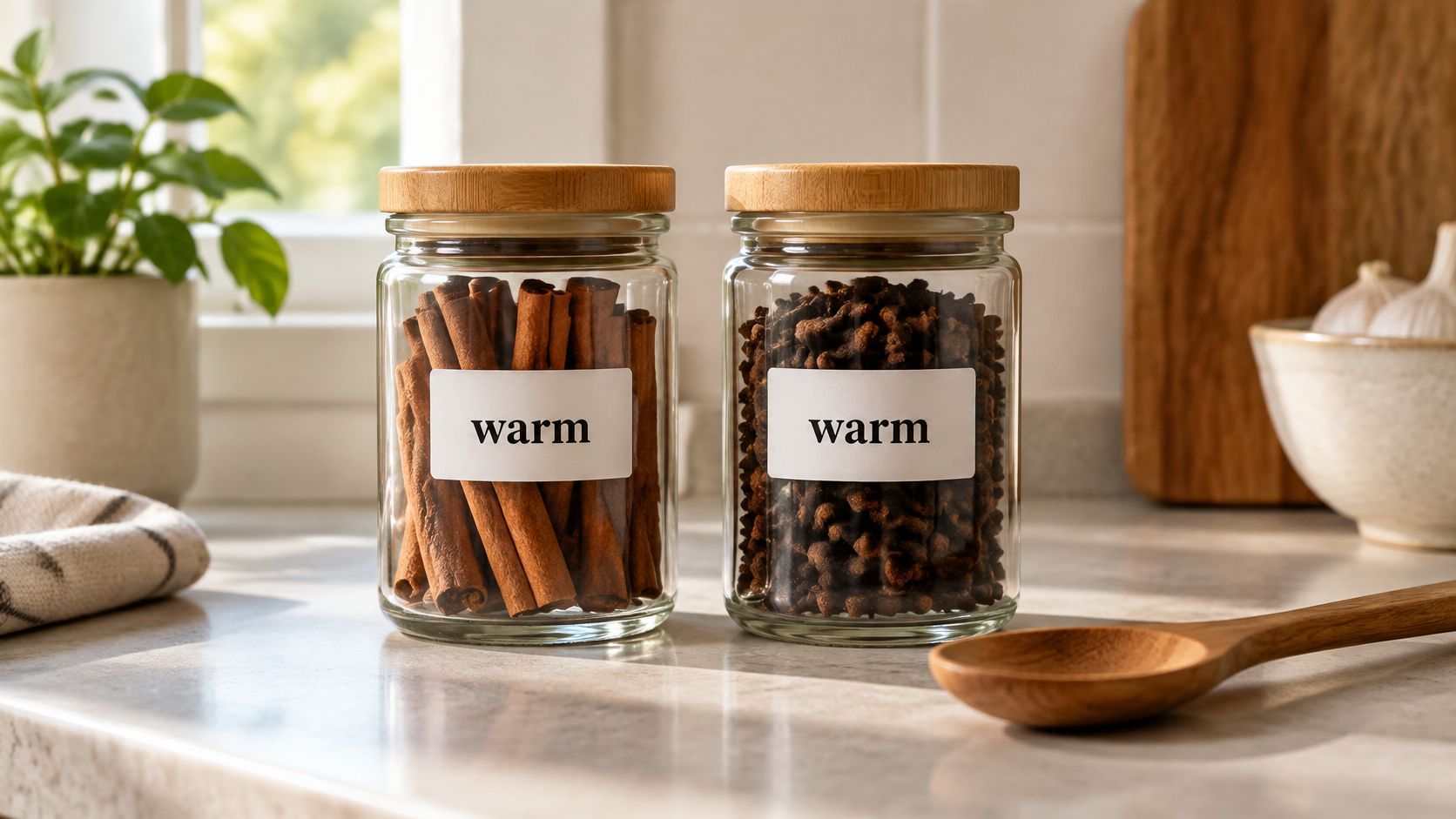
A six-state analysis published in PLOS ONE found that commercial indica, sativa, and hybrid labels didn't reliably distinguish cannabinoid or terpene profiles. A genomic analysis of cannabis labeling likewise challenges the use of these categories as reliable genetic identifiers.
That makes indica-style relaxing Mai Tai a poor product-development claim. It joins an uncertain category to an expected response without establishing that the finished formulation delivers that response.
Replace effect language with a measurable specification
A more defensible description is Mai Tai-inspired blend with bright citrus and tropical fruit aroma, built from quantified limonene, myrcene, and beta-caryophyllene. Use that wording only when the composition and sensory results support it.
Don't turn a myrcene threshold into a guaranteed sedation or energy switch. Concentration belongs in the analytical specification; a physiological promise requires evidence that goes beyond a category or isolated terpene percentage.
For Gold Coast Terpenes formulation work, the replacement brief should contain:
- Cannabinoid composition: THC and CBD results from the actual carrier lot.
- Terpene composition: Named compounds, mass percentages, and acceptable production tolerances.
- Sensory target: Defined top, mid, and base notes with an approved reference.
- Claim boundaries: Aroma and taste descriptions separated from pharmacological claims.
Marketing can describe citrus, tropical fruit, resin, and pepper when evaluators consistently identify them. It shouldn't translate those observations into an unsupported promise of stimulation or sedation.
Top, Mid and Base Notes in a Mai Tai Terpene Profile
Top, mid, and base notes are a sensory map, not fixed chemical compartments. Top notes establish the opening, mid notes carry body, and base notes contribute persistence through the finish.
Use this hierarchy to organize the bench brief before adjusting individual compounds.
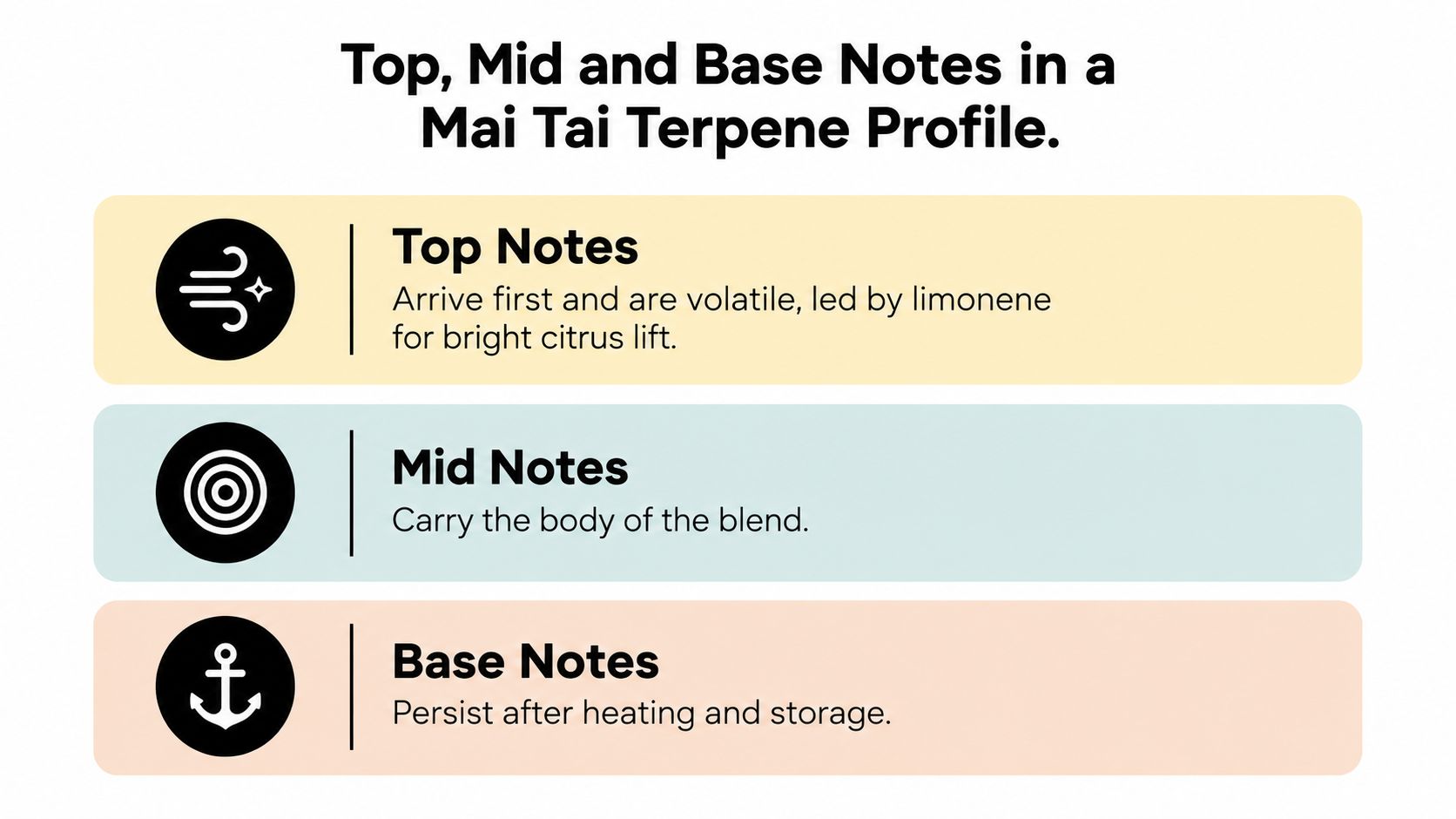
Terpene roles in a Mai Tai profile
| Tier | Terpene | Volatility | Sensory character | Formulation job |
|---|---|---|---|---|
| Top | Limonene | Volatile monoterpene | Bright citrus opening | Sets the first impression |
| Top | Alpha-pinene | Volatile monoterpene | Fresh pine and lift | Adds clarity to the opening |
| Mid | Myrcene | Volatile monoterpene | Resinous, herbal body | Bridges top and base |
| Base | Beta-caryophyllene | Less volatile sesquiterpene | Peppery, woody | Contributes persistence after heating and aging |
| Base | Alpha-humulene | Less volatile sesquiterpene | Woody, hoppy | Adds structural depth |
The Gold Coast Terpenes guide to terpenes for dabs supports separating citrus opening, resinous body, and heavier structural notes when developing a formulation. The important distinction is that myrcene can function sensorially as a mid note while remaining a volatile monoterpene.
Balance the opening against the finish
Excessive reliance on monoterpenes can produce a convincing initial fruit impression that becomes less recognizable after storage or thermal exposure. Increasing heavier compounds may improve persistence, but an overly woody or peppery finish can bury the tropical target.
Don't correct every weak fruit impression by adding more limonene. First determine whether the problem is insufficient citrus, a missing bridge between citrus and resin, or a base that masks the opening.
Use the terpene flavor chart to describe adjustments consistently across purchasing, formulation, and sensory teams. Terms such as bright citrus, fresh pine, resinous herbal body, and woody finish are more actionable than stronger or smoother.
The following video provides additional terpene context.
Record mass percentages, clarity, phase behavior, viscosity, and aroma after equilibration for every iteration. An attractive aroma immediately after mixing doesn't establish that the carrier and finished hardware will preserve it.
The opening should identify the profile, the middle should connect its parts, and the finish should leave the intended character rather than simply the heaviest ingredient.
Strain-Inspired Terpene Blends for Mai Tai Vape Cartridges and Distillate
A Mai Tai strain-inspired terpene blend should target bright citrus and tropical fruit, a connected fruit-resin middle, and a controlled heavier finish. The following allocations are hypothetical bench examples, not measured Mai Tai recipes or validated stability claims.
Starting terpene blends for Mai Tai formulations
| Blend | Top (%) | Mid (%) | Base (%) | Best fit |
|---|---|---|---|---|
| A, bright citrus-tropical | Limonene 40, alpha-pinene 10 | Myrcene 20 | Beta-caryophyllene 30 | Cartridge trial prioritizing a strong opening |
| B, fruit-forward, heavier base | Limonene 30, alpha-pinene 5 | Myrcene 20, linalool 10 | Beta-caryophyllene 35 | Cartridge trial targeting a longer finish |
| C, base-heavy | Limonene 15 | Myrcene 15, linalool 10 | Beta-caryophyllene 40, alpha-humulene 20 | Distillate storage comparison |
Every percentage describes the terpene fraction only, not the complete cartridge formulation. Each hypothetical row totals the complete terpene blend, which must then be diluted appropriately into its intended carrier.
These ingredients illustrate the sensory direction, not a requirement to reproduce a cocktail or add food ingredients.
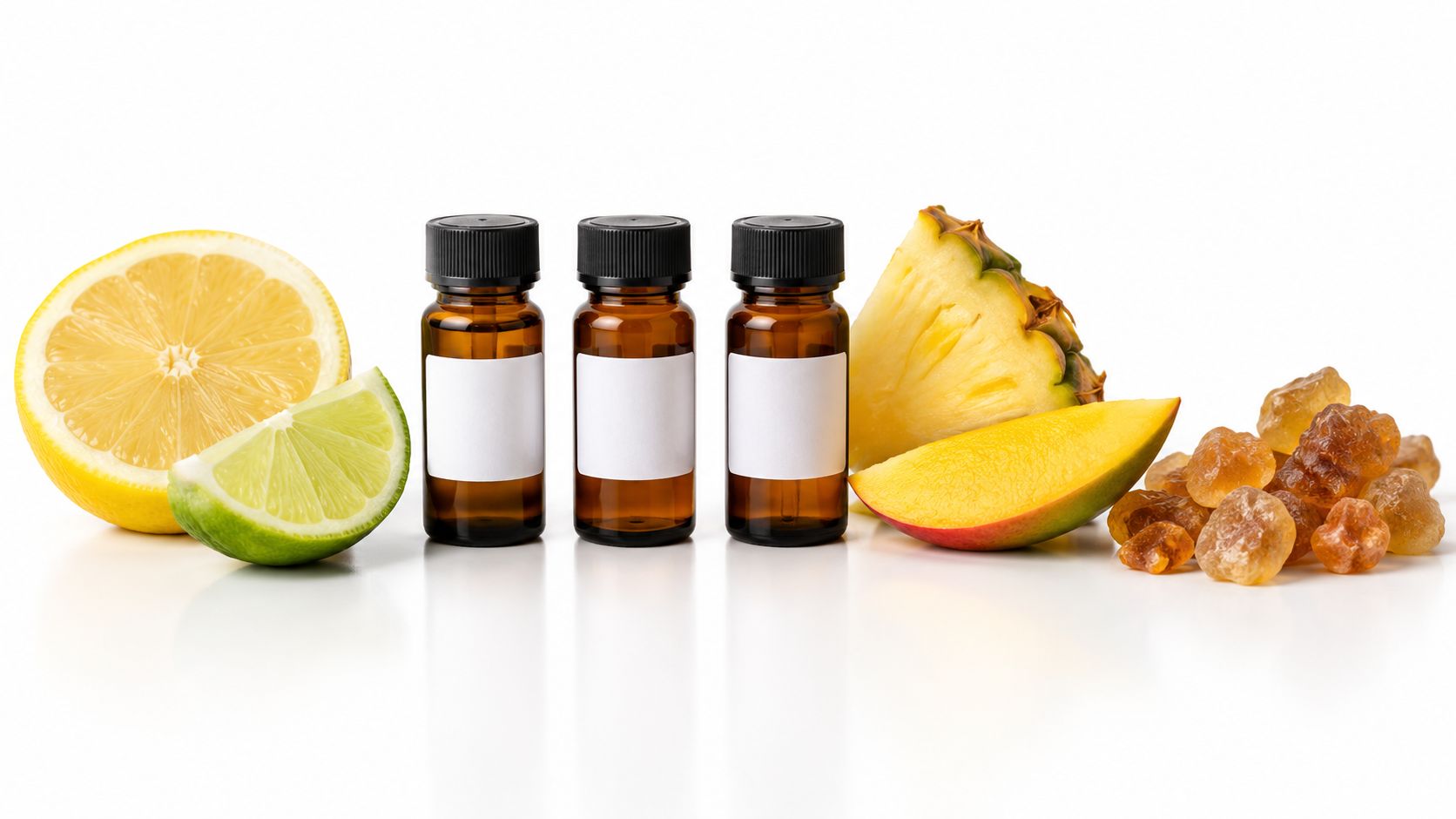
FindMySeeds' Mai Tai record associates the Sunset Sherbert × Purple Punch lineage with tree-fruit, tropical, and mango notes, with limonene appearing in its terpene records. That supports a sensory direction, but it doesn't establish the ratios in the hypothetical blends.
Choose the experiment by the product constraint
Blend A asks whether a pronounced opening improves recognition in the intended cartridge. Its trade-off is greater dependence on volatile components, so don't assume a strong initial impression means better shelf performance.
Blend B tests whether additional middle and base character produces a more connected finish. Linalool is an experimental rounding component here, not proof that your reference flower contains the same proportion.
Blend C deliberately emphasizes the base to test persistence in distillate. It may remain recognizable longer, or it may become too woody and lose the desired tropical identity. Base-heavy doesn't mean stability-validated.
Separate flavor inspiration from replication
Gold Coast Terpenes offers individual isolates for ratio adjustment, concentrated strain profiles that require dilution, and Elevated Strains, with the linked Apple Fritter page providing a fruit-profile catalog reference rather than a Mai Tai substitute. Its premium-profile approach selectively enhances rare and exotic terpenes for fruit and dessert nuances.
For handling fundamentals, use the guide to using terpenes. The site's Terpenes 101 and Mixing Calculator can support preparation and ratio math, but neither replaces a reference chromatogram.
A small set of major terpenes can approximate a broad citrus-resin direction. It may miss the minor compounds that distinguish a particular flower lot, so approve a replica only after analytical and sensory comparison.
How to Replicate a Mai Tai Flavor Profile Step by Step
Replicating flavor requires a defined reference, controlled mixing, and testing in the finished cartridge system. A bottle-aroma match alone isn't an approval criterion.
Keep the reference definition and starting blend tied to the same development record.
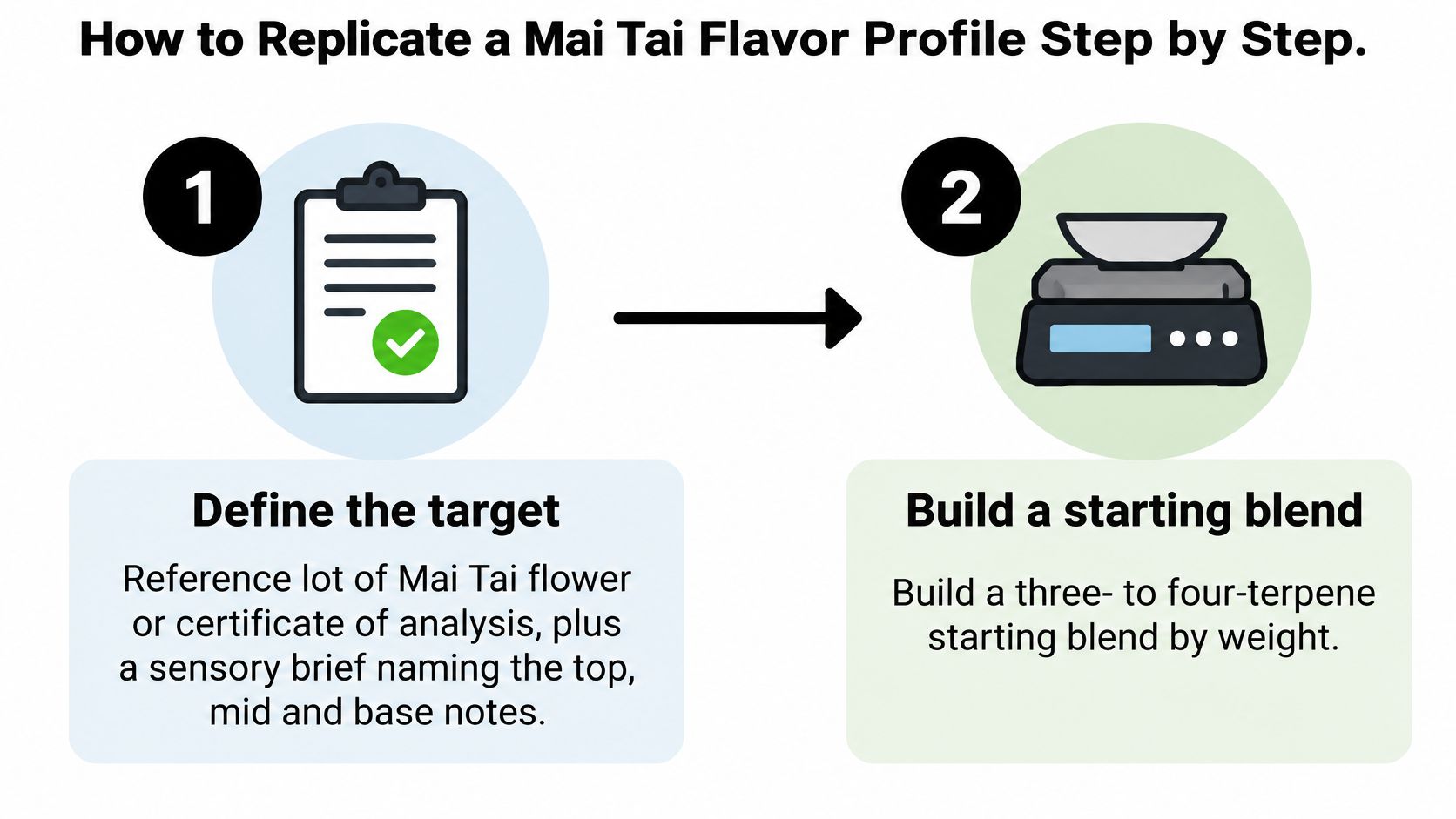
Define the target before weighing ingredients. Obtain a reference lot and its certificate of analysis, then write a sensory brief identifying the desired opening, body, and finish so the team evaluates the same target. If the certificate lacks a terpene panel, obtain appropriate analytical testing rather than estimating ratios from the strain name.
Build a restrained starting blend by mass. Begin with a small set of compounds that explain the reference's main sensory features, recording each ingredient's lot identifier and mass percentage so later adjustments remain traceable. Use a suitable calibrated balance and closed, compatible mixing vessels rather than counting drops.
Dilute into the actual carrier before evaluation. Gold Coast Terpenes' strain products are highly concentrated and require proper dilution before use, so neat-material evaluation cannot establish finished-product flavor. Set the loading through the product's technical documentation, intended application, and qualified safety review rather than borrowing an unrelated recipe.
Prepare a matched baseline. Retain the original formulation in the same carrier and prepare a carrier-only control when useful, because you need to distinguish a blend adjustment from changes caused by the carrier. Keep preparation, container, fill conditions, and storage exposure consistent.
Challenge the formulation in its intended hardware. Entour's terpene-selection guide recommends heat-cycling between 20°C and 40°C, checking terpene retention, cannabinoid degradation, and metal leaching, and considering a 10%–15% reduction in highly volatile monoterpenes with compensation from more stable sesquiterpenes. Treat that thermal range as a development screen, not a complete simulation of aerosol-generation temperatures or a finished safety qualification.
Adjust the volatile fraction only when results justify it. If thermal exposure weakens the opening, trial the relative monoterpene reduction described in the guide and compensate with beta-caryophyllene, while keeping the unchanged blend for comparison. Record whether the adjustment is relative to each ingredient or the combined fraction, because those interpretations produce different formulas.
Confirm chemistry and sensory performance before scaling. Compare flavor, aerosol output, viscosity, clarity, and phase behavior, then use GC-MS and a qualified blind sensory comparison against the reference lot to determine whether the revision actually improves the match. Conduct inhalation-related evaluation only within an appropriately reviewed testing program, not by treating a pleasant aroma as evidence of suitability.
Make the approval repeatable
Create a release record that links the approved formula to supplier lots, analytical results, hardware, carrier, and sensory decisions. Record rejected iterations too, including why they failed.
Scale-up gate: Don't approve a formula because the fresh sample smells right. Approve the defined formulation in the defined carrier and hardware after the relevant analytical, stability, and sensory checks.
Botanical Sourcing and Pre-Buy Checklist for Mai Tai Terpenes
Gold Coast Terpenes uses botanically derived terpenes rather than cannabis-derived inputs, and its blends are lab-verified and THC-free. Source identity, however, is separate from proof that a formulation matches Mai Tai or is suitable for a particular finished application.
Botanical, cannabis-derived and nature-identical terpenes compared
| Criterion | Botanically derived | Cannabis-derived | Nature-identical |
|---|---|---|---|
| Source | Plant material other than cannabis | Extracted from cannabis flower or biomass | Made to match a natural molecule |
| Label used | Botanical | Cannabis-derived | Nature-identical |
| THC content | THC-free for Gold Coast Terpenes blends | Establish from the lot certificate | Not inherent to the terpene molecule; verify the supplied material |
| Batch matching to a Mai Tai reference | Reproducible through specified ratios and acceptance testing | Establish separately for each harvest and batch | Reproducible through specified ratios and acceptance testing |
| Compliance check | Confirm rules for each market | May fall under cannabis product rules | Confirm rules for each market |
Botanical describes origin. Nature-identical describes molecular correspondence to a natural compound. Those aren't interchangeable claims, and neither establishes a complete sensory match by itself.
Cannabis-derived sourcing can preserve a plant-associated mixture, but purchasing still needs to control harvest-to-harvest differences. Rebuilding from specified components gives a formulator more direct control of ratios, while potentially missing trace constituents present in the reference extract.
Choose documentation before choosing a supplier
The best terpene supplier for a vape brand is the one whose documentation, lot control, and application support fit the product's requirements. Don't rank suppliers solely by catalog size, a recognizable strain name, or an unqualified purity statement.
A Dalhousie University summary of cannabis-labeling work explains why samples carrying the same strain name can differ substantially in genetic and chemical identity. For procurement, that means the approved reference and supplied blend need measurable acceptance criteria.
Use the terpene purchasing guide to organize supplier qualification, then require the following before placing a production order:
- Lot-level composition: Obtain a certificate for each isolate or blend with terpene percentages, test methods, and relevant quality results. Confirm that the certificate corresponds to the material being shipped.
- Reference chemistry: Obtain GC-MS information for the selected Mai Tai lot, including how unidentified or unquantified peaks are handled.
- Written commercial terms: Confirm the minimum order quantity, sample terms, bulk terms, lead time, and replacement-lot process in writing. Don't assume a sample size establishes the production MOQ.
- Label review: Review Mai Tai-inspired versus Mai Tai wording, botanical-origin statements, ingredient declarations, and cannabinoid claims in every intended market.
- Application review: Confirm the ingredient documentation supports the intended use. A general purity result doesn't establish inhalation safety or hardware compatibility.
Keep sampling and production procurement separate
For small comparisons, the 3ml Strain Picker Pack allows selection of any three profiles in 1.5ml or 3ml sizes. Its listed uses include terpene testing, custom vape or tincture formulation, and comparing indica-versus-sativa effects, but that last category isn't validation of a physiological claim.
Bulk ordering permits multiple strains in one order, which can support parallel profile evaluations. Confirm custom Mai Tai variant terms separately rather than assuming that multi-strain ordering includes custom blending.
Have local counsel review market-specific treatment of botanical, cannabis-derived, and nature-identical inputs before launch. Gold Coast Terpenes' THC-free sourcing claim doesn't replace the finished manufacturer's responsibility for ingredient permissions, labeling, and release testing.
Before committing to scale, complete the hardware heat-cycle comparison, analytical checks, and reference-based sensory approval. Purchasing should buy the approved specification, not merely reorder the same name.
Common Questions About Formulating Mai Tai Terpene Profiles
Is Mai Tai indica or sativa for cannabis product formulation?
Mai Tai is generally a hybrid, with classification tied to the specific lineage. Neither the Clearwater Sunset Sherbet × Purple Punch version nor the Maui Wowie × Tutti Frutti name supplies a complete formulation specification.
Which Mai Tai lineage should a formulator reference?
Choose the lineage represented by your approved flower or extract reference and identify its breeder in the development brief. Match that lot’s chemistry and sensory character rather than combining unrelated strain-page descriptions.
Can a terpene blend recreate Mai Tai flavor for vape cartridges?
A strain-inspired blend can approximate the target aroma and taste. GC-MS, blind sensory comparison, and finished-hardware testing determine how closely the formulation matches and whether it remains consistent.
Are botanical terpenes different from cannabis-derived terpenes?
Yes, their sourcing differs, even when individual compounds share the same chemical identity. Gold Coast Terpenes uses botanical sourcing; cannabis-derived inputs introduce separate provenance, labeling, and compliance questions.
What should a brand confirm before ordering test quantities?
Confirm the selected sample format, lot documentation, and intended evaluation carrier before ordering. Obtain written minimums and bulk terms separately so a successful bench trial can transfer into production purchasing without assumptions.
Gold Coast Terpenes offers botanical terpene blends, isolates, and formulation resources for developing a measured Mai Tai-inspired profile. Visit Gold Coast Terpenes to select bench-testing components, review dilution resources, and discuss sampling or bulk requirements against your reference-lot specification.