
The popular advice is to choose a strain-specific terpene blend by starting with “indica,” “sativa,” or a familiar cultivar name. That approach is convenient for marketing, but it's weak formulation science. The best strain specific terpenes are selected by measured chemical markers, volatility behavior, target format, and hardware performance.
A commercial blend has to do more than smell similar in a bottle. It must reproduce the intended aroma after dilution, survive processing, remain compatible with the extract and cartridge, and deliver a consistent sensory profile from the first unit to the last. A terpene panel gives you a better starting point than a strain name, especially when you're developing a strain-inspired terpene blend, replicating flavor of a benchmark oil, or formulating for vape cartridges.
| Formulation profile | Dominant markers to investigate | Commercial strength | Main limitation |
|---|---|---|---|
| OG-style | Limonene, linalool, terpinolene, alpha-terpineol | Complex citrus, floral, herbal direction | Can become sharp if top notes dominate |
| Kush-style | Myrcene, alpha-pinene, guaiol, beta-eudesmol | Dense, earthy, woody foundation | Heavy base character can flatten bright notes |
| Blue Dream-style | Myrcene, limonene, caryophyllene | Familiar fruit and herbal balance | Requires careful top-to-base control |
| Forbidden Fruit-style | Limonene, myrcene, caryophyllene | Strong fruit-forward identity | Citrus volatility can outpace the body |
| 24K Gold Punch-style | Limonene, myrcene, caryophyllene, floral support | Flexible fruit, citrus, and spice platform | Needs hardware screening for sensory intensity |
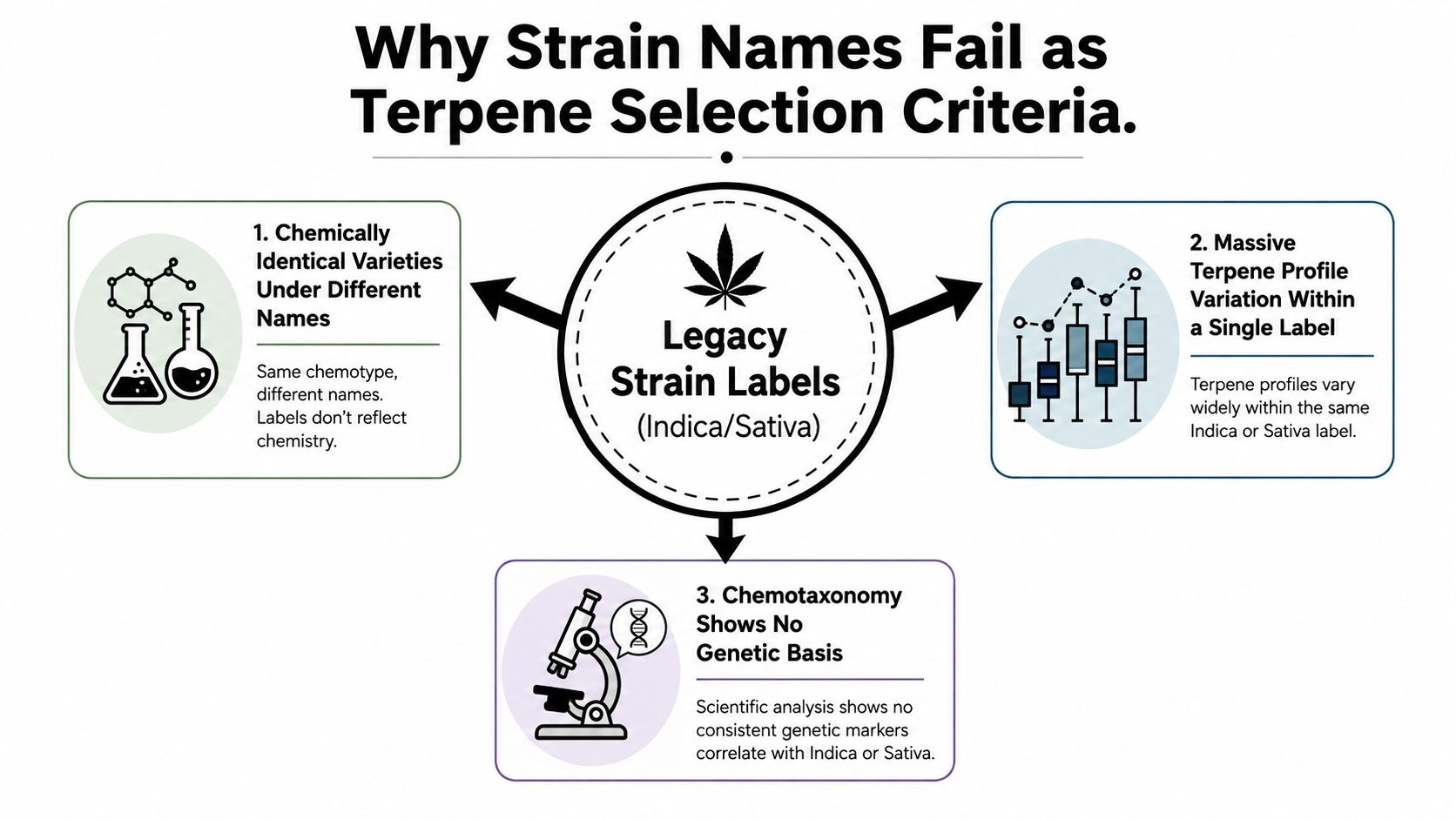
Why Strain Names Fail as Terpene Selection Criteria
Strain names are convenient marketing shorthand, not reliable purchasing specifications. A 2025 analysis of 140 cannabis flowers from the German market identified 38 different terpenes and found no meaningful terpene-profile differences between samples labeled hybrid, indica, or sativa. The researchers instead grouped the cultivars into six chemical clusters according to measured composition (the 2025 analysis of cannabis terpene profiles).
The commercial risk is specification drift. Two suppliers can sell an “OG” profile with different proportions of limonene, myrcene, linalool, and heavier woody compounds. A purchase order that names only “OG Kush” leaves the supplier too much room to define the finished blend, including its aroma balance and performance after dilution.
Use chemistry as the purchasing specification
Specify the dominant-marker terpenes, acceptable ranges, botanical origin, purity documentation, and intended application. Keep the cultivar name for consumer-facing communication, but define the blend through measurable chemical targets.
The chemistry-first approach also fits broader chemotaxonomic research. Cannabis samples show a continuum of composition rather than cleanly separated chemotypes, with different marker tendencies reported in OG- and Kush-type samples. The findings support using measured markers instead of the indica or sativa label as the technical identity.
A strain name remains useful as a sensory shorthand. For commercial replication, test the reference flower or oil, record its terpene panel, identify the compounds that dominate its character, and set those compounds as benchmark targets. Include tolerances so another formulator can reproduce the profile without relying on interpretation.
Practical rule: Treat the strain name as the brief. Treat the terpene panel as the formula target.
The strain-specific terpene and flavor comparison guide helps distinguish a true strain-inspired profile from a terpene-enhanced flavor or a non-cannabis flavor system.
Understanding Volatility Layers in Terpene Profiles
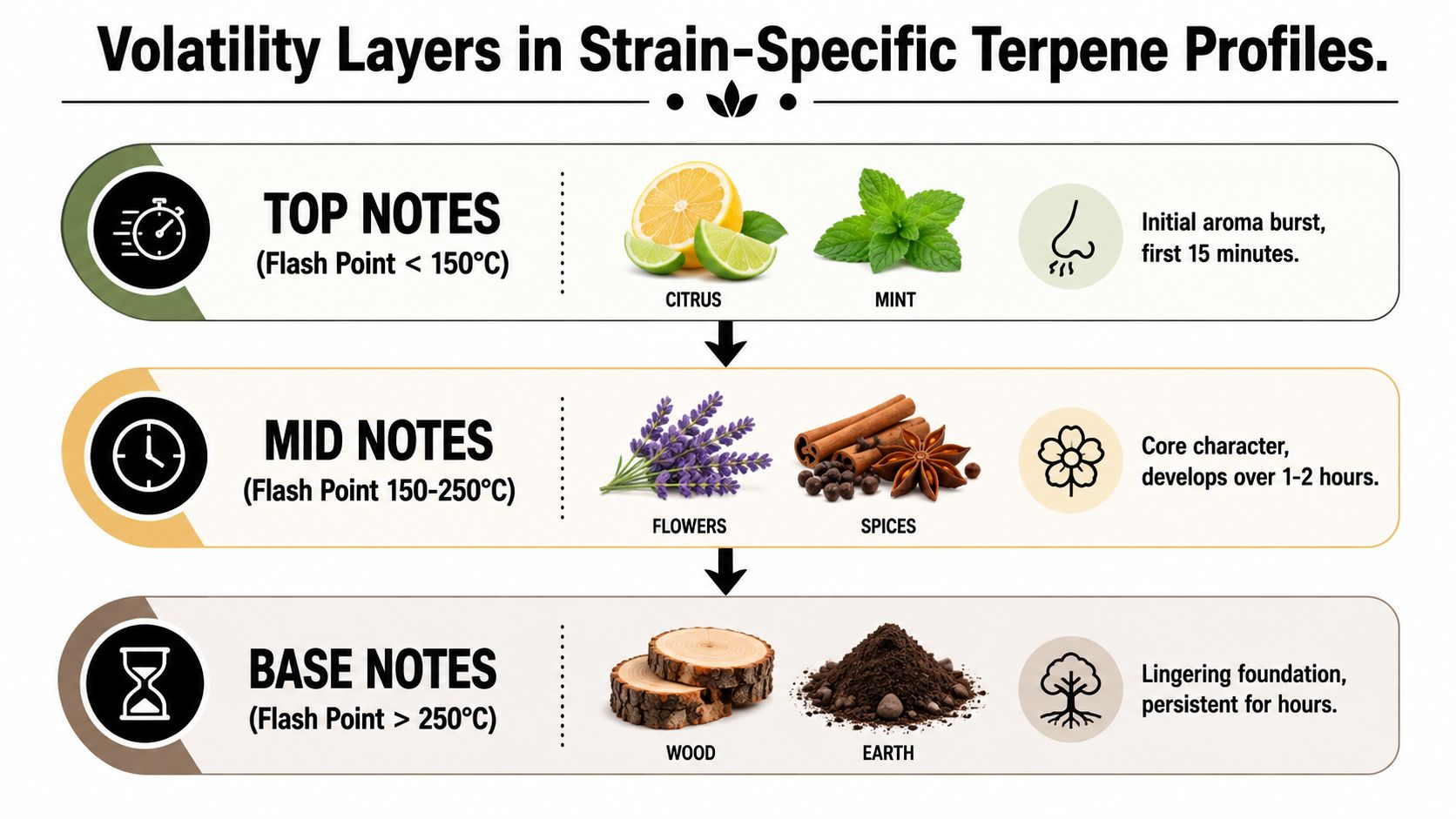
A strain profile isn't a flat list of ingredients. Each compound contributes at a different point in the sensory timeline. Professional cannabis product formulation commonly organizes terpenes into top, mid, and base notes, allowing a formulator to design the opening aroma, central character, and lingering finish (volatility-layer guidance for terpene formulation).
Top notes are the first impression. Bright citrus, mint, and other fast-moving aromatic materials can make a cartridge appear vivid immediately after filling. Limonene is often important in this layer, but a blend built almost entirely around quick top notes can lose definition during storage or feel thin after repeated use.
Mid notes provide the profile's recognizable body. Floral, herbal, and spicy materials help connect the initial burst to the longer finish. Linalool, beta-caryophyllene, and related compounds can support this middle structure, depending on the reference profile and the desired sensory direction.
Base notes are the slowest-moving foundation. Woody, earthy, and heavier aromatic materials give a blend persistence and depth. Myrcene can contribute substantial body in some profiles, while alpha-humulene, guaiol, and beta-eudesmol may help create a darker, more persistent character when the reference chemistry supports them.
Design for the entire cartridge experience
A formulation can smell accurate at filling and still fail in use. If the blend has too much volatile material and too little body, the first inhalation may be impressive while later units or later sessions seem muted. If the base is excessive, the profile may remain stable but lose the brightness that made the reference recognizable.
Hardware changes the result. Wick design, reservoir geometry, airflow, coil temperature, and the viscosity of the cannabinoid base all influence how the aroma is delivered. A low-temperature device may preserve delicate top notes, while a hotter system can make a citrus-heavy blend taste aggressive or overcooked.
Use the volatility model as a screening tool. Compare the blend immediately after integration, after storage, and after repeated device use. The objective isn't a strong aroma. It's a stable opening, identifiable middle, and durable finish.
The following video provides a visual introduction to terpene temperature behavior and can help teams align sensory testing with processing conditions.
Comparing High-Demand Strain Profiles for Commercial Use
Popular strain names are weak formulation specifications. A commercial profile should be matched by dominant markers, volatility behavior, base-material compatibility, and hardware performance. The practical questions are whether the blend retains its identity in refined distillate, remains comfortable in the selected cartridge, and carries enough mid and base structure for storage and repeated heating.
The comparison below is a development starting point, not a replacement for a reference COA or device test. Marker names identify compounds to investigate. Final ratios should come from the actual benchmark, analytical results, and sensory evaluation.
| Strain Profile | Dominant Markers | Best Application | Volatility Balance | Hardware Compatibility |
|---|---|---|---|---|
| OG Kush | Limonene, linalool, terpinolene, alpha-terpineol | Premium distillate, concentrate, and cartridge profiles | Bright opening with floral and herbal depth | Broad compatibility, provided citrus intensity is screened |
| Blue Dream | Myrcene, limonene, caryophyllene | High-volume cartridge and flavor extension lines | Balanced fruit, herbal body, and spice | Generally adaptable, but viscosity and intensity still require testing |
| Forbidden Fruit | Limonene, myrcene, caryophyllene | Fruit-forward cartridges and concentrates | Strong top note supported by earthy body | Works best when the hardware does not exaggerate bright notes |
| 24K Gold Punch | Limonene, myrcene, caryophyllene, floral support | Distillate, disposable, and flavor-led SKU development | Citrus-led profile with rounded mid and base notes | Screen for taste strength across low and high heat |
| Kush-style custom blend | Myrcene, alpha-pinene, guaiol, beta-eudesmol | Darker cartridges, concentrates, and proprietary house profiles | Base-heavy, woody, and persistent | Better suited to hardware that can deliver heavier aromatic material cleanly |
OG-style and Kush-style products should not share a generic high-myrcene formula. Chemotaxonomic analysis found OG-type samples associated with alpha-terpineol, fenchol, limonene, camphene, terpinolene, and linalool. Kush-type samples showed stronger association with trans-ocimene, guaiol, beta-eudesmol, myrcene, and alpha-pinene, as described in the OG and Kush marker analysis. A bright OG reconstruction can therefore lose its reference character when its marker core is replaced by a broadly earthy, myrcene-heavy base.
Match the profile to the base material
Distillate often contains little of the original aromatic identity. A strain-inspired blend must restore recognizable structure without masking the base or creating instability. Highly refined extract can accept a more expressive profile, but the blend still needs compatibility with viscosity and crystallization behavior.
Use a controlled development sequence:
- Screen the reference: Record aroma at the reference material's normal use concentration, not only from the neat blend.
- Build the marker core: Start with the compounds that define the profile, then add supporting materials in measured increments.
- Check the device: Evaluate first and later draws in the actual cartridge hardware.
- Review sensory longevity: Compare fresh and stored samples before approval, rather than relying on a same-day result.
The commercial strain terpene profile review can help organize candidate profile concepts before a formal bench trial. Use it for direction, then confirm the chosen marker balance against the reference COA, finished oil, and device output.
Formulation Rates and Integration Protocols
Terpene selection and terpene loading are separate decisions. A chemically accurate blend can still fail if the inclusion rate overwhelms the distillate, creates an unpleasantly sharp opening, or changes the oil's behavior in the cartridge.
For most cannabis distillates, a common starting range is 3% to 8% total terpenes by weight. Highly refined or winterized extracts may require up to 10% to restore aroma lost during processing, according to this distillate terpene formulation guide. Cartridge guidance varies by source and formulation, with reported working ranges of 4% to 10% by volume or 5% to 15% by weight, depending on hardware, base viscosity, and sensory intensity (vape cartridge terpene guidance).
Connecticut vape-product data illustrates why loading should be validated rather than copied from an old formula. Average total terpene concentration moved from 11.222% in 2018 to 3.301% in 2023, then to 4.286% in 2024 (Connecticut vape product terpene data). Those figures don't establish a universal target. They show that commercial formulations can occupy very different loading levels.
A controlled integration workflow
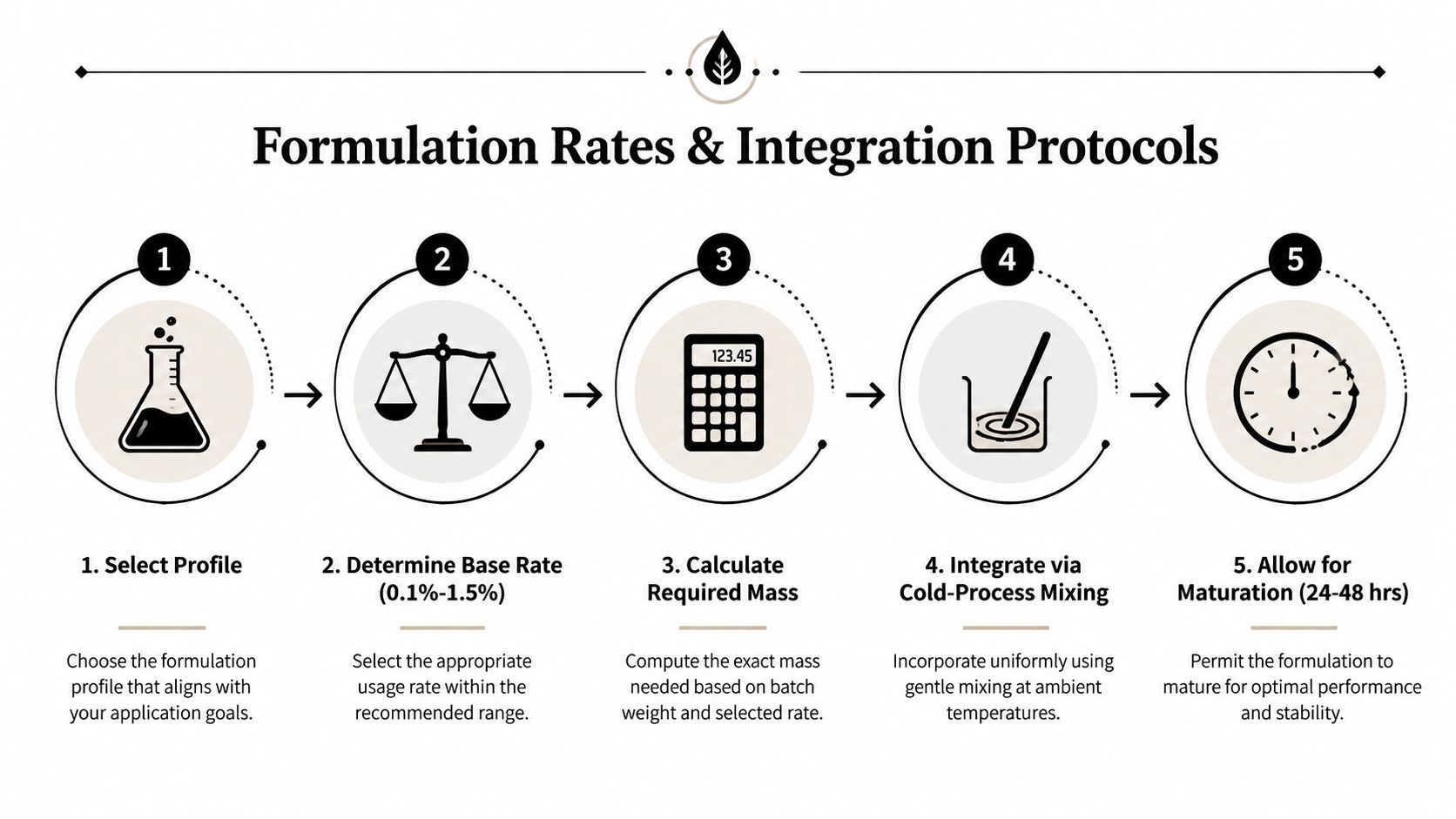
Use a weight-based calculation:
Required terpene mass = extract mass × desired terpene percentage
For example, a formulator working with an extract mass should express the target as a decimal before calculating. Keep the calculation in the batch record, and weigh the terpene blend rather than relying on approximate volume measurements.
A formulation guide places vape-cartridge terpene integration at 5% to 10% by weight and 120 to 150°F, or 49 to 65°C, while also warning that the extract should be fully decarboxylated to reduce cannabinoid crystallization risk during cartridge production (integration temperature and decarboxylation guidance).
Use gentle mixing and avoid unnecessary heat exposure. Terpenes are volatile, so an open vessel, prolonged heating, or aggressive agitation can change the finished ratio before filling. After mixing, inspect clarity, viscosity, and homogeneity, then run the blend through the intended cartridge hardware.
Formulation checkpoint: If a weak aroma leads you to keep increasing the terpene load, first verify the reference panel, mixing loss, hardware temperature, and storage conditions. More terpene isn't a substitute for a better blend.
Lab Verification and Purity Standards for sourcing
“Strain-specific” should refer to a reproducible chemical profile, not an appealing aroma or legacy category. Before approving a supplier, confirm the blend's composition, test method, batch identity, and absence of materials that the formulation does not permit.
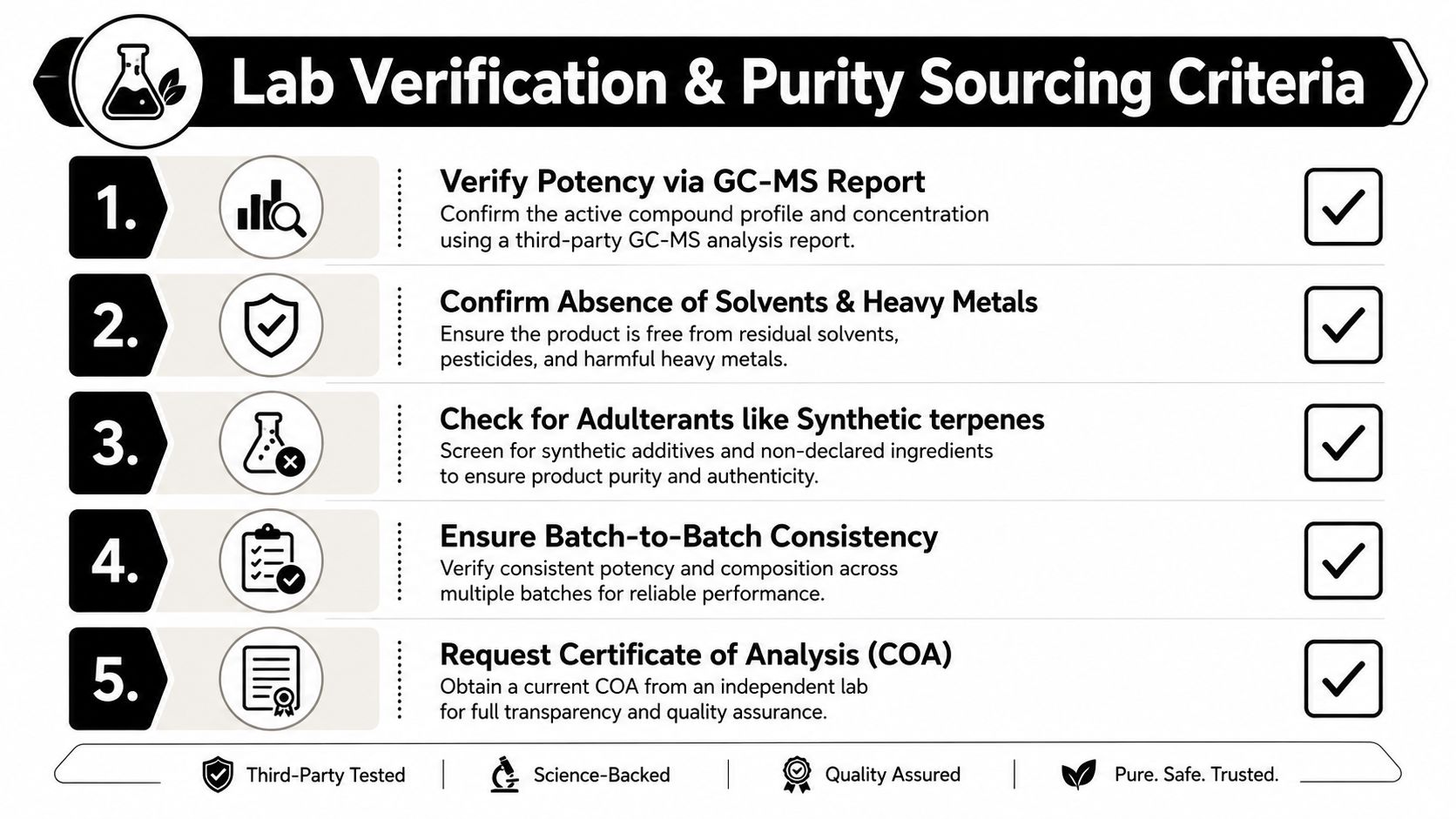
Request a current certificate of analysis tied to the supplied lot. Review the full analyte list rather than accepting a general purity statement. The COA should identify the dominant markers clearly enough to compare them with the target profile, and it should include contaminant testing relevant to the supply chain and finished product, including residual solvents and heavy metals.
What to request from a supplier
- GC-MS potency data: Verify that the reported marker compounds are present and that their relative composition supports the strain profile being sold.
- Contaminant documentation: Request solvent and heavy-metal results appropriate to the materials, process, and intended product.
- Adulteration screening: Ask whether the blend contains synthetic terpenes, undisclosed flavor materials, or other undeclared additives.
- Batch records: Compare records between lots and investigate meaningful changes in dominant markers or total composition.
- Material disclosure: Confirm that the blend contains no VG, PG, PEG, or MCT cutting agents when the specification calls for neat terpenes.
Botanical sourcing needs its own written specification. A buyer requesting 100% natural terpenes should receive documentation identifying the botanical source and explaining whether the product uses isolated compounds, compounded materials, or both. “Natural” and “strain-specific” describe different attributes, so the supplier should define each term.
THC-free material can simplify development for brands managing jurisdictional requirements or keeping terpene products separate from cannabinoid content. It still requires local compliance review, but it gives manufacturing a clearer raw-material boundary.
Keep a purchasing file that connects the COA with the lot number, packaging, production date, and internal approval record. The terpene quality standards guide provides a practical framework for checking purity claims before the blend enters production.
Benchmarking Custom Blends Using Dominant Markers
Perfect strain replication is often the wrong commercial target. Cannabis chemistry shifts with genetics, cultivation, harvest, curing, extraction, and storage, so a single canonical profile may not exist. A more reliable method identifies the three to five dominant markers that make a reference recognizable, then builds a proprietary blend around their relationships.
The OG and Kush comparison shows the value of this approach. OG samples tended to contain more alpha-terpineol, fenchol, limonene, camphene, terpinolene, and linalool. Kush samples leaned toward trans-ocimene, guaiol, beta-eudesmol, myrcene, and alpha-pinene. These groups provide a defensible starting point when the finished product must resemble a reference without copying one flower lot exactly.
Build a marker specification
Start with the reference material and sort its composition into three working categories:
- Identity markers: Compounds that make the profile immediately recognizable.
- Support markers: Materials that connect dominant notes and prevent a one-dimensional result.
- Stability markers: Mid or base materials that help the aroma persist through processing and use.
This classification prevents one terpene from standing in for an entire strain. Production-environment measurements have also shown beta-myrcene and limonene dominating terpene emissions across indoor cultivation and processing rooms. Beta-myrcene ranged from 25 ppb to 3,200 ppb and represented 39% to 78% of total emissions, while limonene ranged from 12 ppb to 3,075 ppb and represented 17% to 53% (the production-environment terpene emissions study). The other 20 terpenes each accounted for less than 5% in practically all samples.
Dominant-marker benchmarking sets direction, but a single-compound shortcut removes the character customers recognize. Supporting markers preserve nuance. Write the specification with the marker identity, target relationship, acceptable sensory range, and observed hardware result. Record the dominant-to-supporting balance, rather than only listing compounds, so reformulation has a clear reference point.
Use that specification to create controlled variations. An OG-inspired cartridge can retain its limonene and floral-marker identity while adjusting the base for a particular device. A Kush-inspired concentrate can preserve myrcene and woody markers while reducing heaviness for a cleaner finish. The product stays recognizable because the chemistry is matched deliberately, rather than assumed from an indica or sativa label.
Frequently Asked Questions About Strain Specific Terpene Formulation
Can one dominant terpene define a strain profile?
Usually not. A dominant marker shapes the opening aroma, while supporting compounds and volatility layers determine how the profile develops and persists. Myrcene or limonene may dominate production measurements, but neither serves as a universal shorthand for every strain.
Should cartridge loading match distillate loading?
Set the rate from the hardware, base viscosity, and target sensory result. Distillate formulations commonly start at 3% to 8% by weight, while cartridge guidance includes 5% to 10% by weight. Screen the finished blend in the actual device before approving production. Loading that works in a bulk distillate can produce leakage, muted flavor, or an overly sharp top note in a cartridge.
What causes flavor fade in stored cartridges?
Volatile top notes, headspace exposure, heat, permeation, weak closure, and hardware interaction can shift the aroma over time. Compare fresh and stored units, then adjust the top, mid, and base layers rather than raising total terpene content. A blend that tastes correct on day one can still fail after storage.
How can a supplier's strain profile be verified?
Request the COA and GC-MS marker data. Confirm botanical sourcing, screen for cutting agents and adulterants, and compare the blend with a retained reference sample. A strain name and flavor description alone cannot support a reproducible specification.
Gold Coast Terpenes provides strain specific blends, isolated compounds, formulation guides, and a terpene calculator for distillate, concentrate, and cartridge development. Review its technical resources, request documentation, and bench-test each blend against the target hardware before ordering.