
A supplier sends a revised SDS while your terpene room is busy preparing a new cartridge run. The old PDF sits in a shared folder, the current file is buried in an email thread, and nobody can say which version the production team used for the last batch. During an audit, that small filing problem becomes a larger question: can you prove which hazard information governed receiving, storage, blending, labeling, training, and distribution?
That's the operational reality of safety data sheet management for cannabis formulators and extractors. A terpene profile for distillate, a limonene isolate, a carrier, and a cleaning agent all need controlled information that workers can retrieve and use. The same discipline that protects a vape cartridge workflow also supports strain-inspired terpene blend development, flavor replication, and commercially defensible product launches.
Why Safety Data Sheet Management Matters for Formulators and Extractors
An SDS folder looks organized until someone needs the right document during a spill, receiving inspection, or customer review. In extraction facilities, the failure usually isn't dramatic. A technician finds a PDF, but it belongs to an older blend. A brand owner receives an SDS for a similar product, but not the exact formulation. A supervisor can access the file from a desktop, while the operator working on the floor can't open the shared drive.
That's why SDS management is a lifecycle control system, not simple file storage. The workflow begins with product identification and supplier sourcing, then continues through hazard classification, review, publication, revision, controlled distribution, and archival. The importance of safety data sheets becomes clearest when one document supports several connected activities, including receiving, handling, storage, spill response, worker training, customer communication, and audit evidence.
The compliance obligation follows the product lifecycle
In the European Union, SDS management is anchored in REACH Article 31, with the required format standardized into 16 sections under Annex II. Regulation (EU) 2020/878 modernized SDS content and aligned it with later GHS revisions, so an old document can remain readable while still failing to reflect current requirements. EU guidance also identifies SDS obligations for dangerous substances or mixtures, persistent, bioaccumulative and toxic substances, and candidate substances of very high concern. EU SDS guidance explains why the document must remain connected to changing hazard information.
REACH Article 36 also requires relevant parties to retain information needed to carry out their duties, including SDS records, for at least 10 years after they last manufactured, imported, supplied, or used the substance or mixture. That retention period turns archiving into regulatory traceability, not an afterthought. In the United States, OSHA records rules can treat an SDS as an employee exposure record, with exposure records retained for 30 years in applicable circumstances. OSHA SDS recordkeeping guidance shows why superseded documents may matter long after a product leaves active production.
What this means for terpene operations
A formulator developing a strain-inspired terpene blend needs accurate product identity and handling data, but an SDS doesn't replace sensory testing, a certificate of analysis, or a workplace risk assessment. It serves a different purpose. The SDS communicates supplier-provided hazard, handling, storage, emergency, and protective information, while the facility's procedures address how the material is used.
A defensible program has four visible traits:
- Complete inventory: Every blend, isolate, diluent, carrier, and relevant cleaning chemical has an owner and a current document.
- Controlled versions: The active SDS is obvious, while prior versions remain traceable according to the applicable retention policy.
- Floor access: Workers can retrieve the current document without depending on one administrator's inbox.
- Change evidence: Reviews record what changed, who approved it, and where the revised SDS was distributed.
For formulators working with Gold Coast Terpenes blends, isolates, or diluents, consistency matters because the same ingredient information can influence purchasing, batch documentation, label review, customer support, and launch readiness. The sensory profile may drive the product concept, but disciplined document control keeps the formulation process auditable.
Understanding the 16 Section SDS Format and What to Verify First
The 16-section format is useful because it gives a production team a predictable way to locate information. OSHA's Appendix D states that sections 1 through 11 and section 16 are mandatory, while other sections follow the standardized structure. Section 16 must include the date of preparation or last revision, making currency visible rather than implied. OSHA Appendix D is the right reference for U.S. teams checking the required structure.
Start with identity, not hazard language. Section 1 should match the exact product name, supplier, contact information, and intended use in your inventory. If your purchasing system calls an item “Citrus Blend,” but the supplier SDS identifies a different trade name or grade, stop and reconcile the records before publication. Similar names are not adequate product control.
Read the sections that affect daily formulation work
For terpene handling, sections 2, 8, and 16 deserve an intentional first review.
- Section 2, hazard identification: Confirm classification, signal word, hazard statements, pictograms, and precautionary statements. Compare these details with the workplace label and container identity.
- Section 8, exposure controls and personal protection: Check listed exposure limits where available, engineering controls, ventilation expectations, and recommended protective equipment. Don't convert this section into a universal PPE rule without considering the task and facility controls.
- Section 16, other information: Verify the preparation or revision date, revision notes, and supporting information. This is the quickest document-control checkpoint.
Section 3 helps confirm composition and ingredient identity. Section 7 supports storage and handling decisions. Sections 4, 5, and 6 guide first aid, firefighting, and accidental release procedures. Section 9 can help the team understand physical and chemical properties relevant to storage and process conditions, while sections 10 through 15 support reactivity, toxicological, ecological, disposal, transport, and regulatory reviews.
A certificate of analysis serves a separate function from an SDS. Use COA and certificate documentation to support identity and quality review, but don't treat a COA as a substitute for hazard communication.
Use a mismatch check before approval
Look for contradictions between the product label, inventory record, SDS sections, and formulation documentation. A blend name that differs between sections 1 and 3, a revision date that doesn't match the controlled record, or protective guidance that conflicts with the site procedure should trigger review.
The video below provides another visual reference for the structured SDS workflow.
Don't use an SDS to make medical claims about a terpene profile or finished cannabis product. Use it for hazards, handling, emergency response, and protective measures. Product performance and flavor accuracy require separate technical validation.
Building a Reliable SDS Creation and Inventory Workflow
The most reliable programs begin with a master chemical inventory, not a pile of downloaded PDFs. List every material that enters the facility, including terpene blends, isolated compounds such as Limonene or Myrcene, diluents, carriers, extraction inputs, and cleaning agents. Include materials used infrequently. The chemical that appears once a month is still a control problem if nobody knows where its SDS lives.
Create one inventory record per distinct product identity. Capture the supplier, manufacturer where available, product name, internal SKU, grade or formulation identifier, storage location, jurisdiction, hazard classification, SDS revision date, source location, and responsible owner. If two products have similar names but different suppliers or grades, keep them separate until the technical owner confirms equivalence.
Build the record before writing or publishing
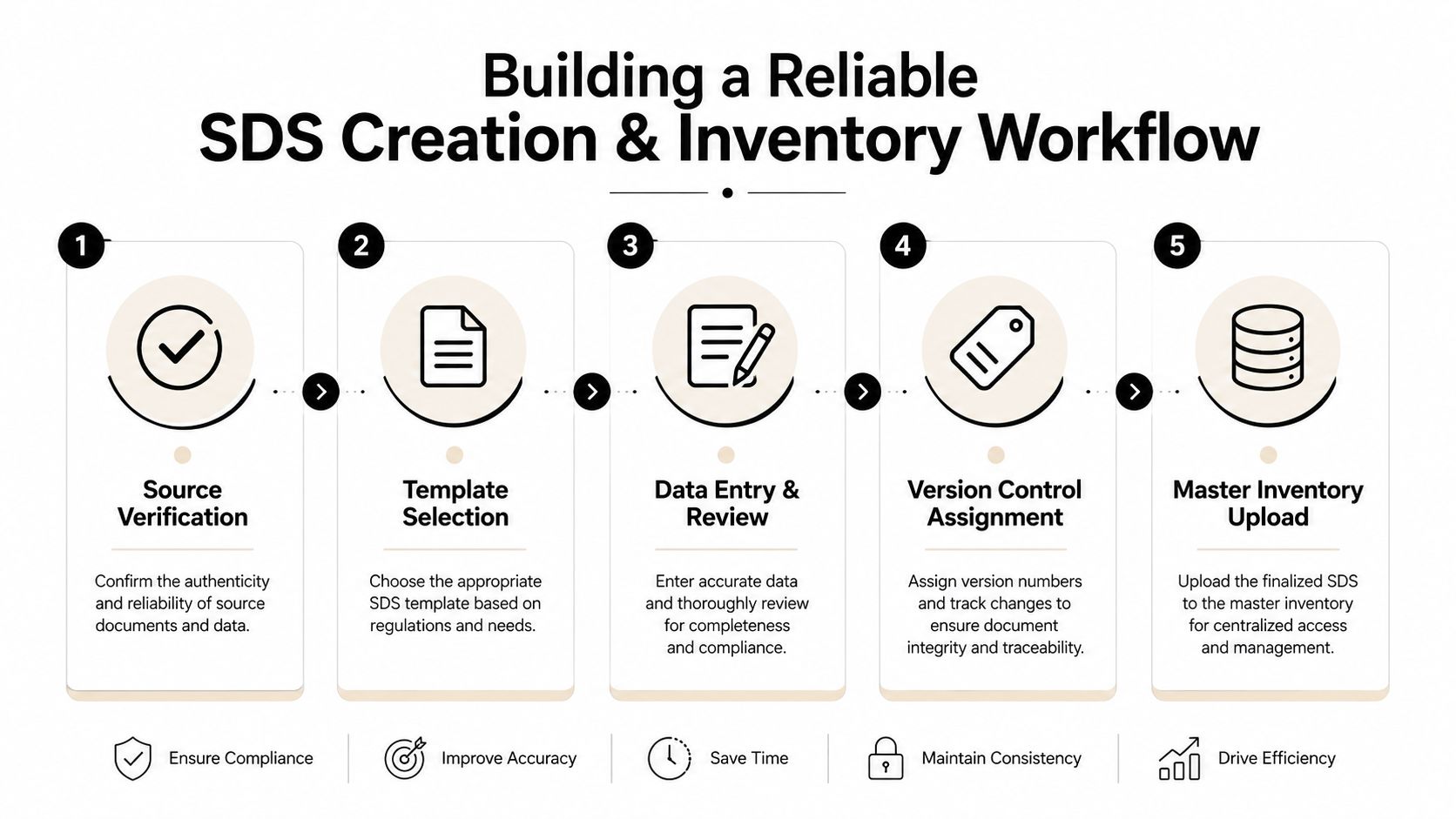
A practical intake sequence looks like this:
- Verify the source: Obtain the current SDS from the supplier or manufacturer and confirm the product identifier. Don't build a record from an unlabeled attachment or an old internal copy.
- Standardize naming: Keep the supplier's exact identity alongside your internal name. This prevents purchasing, production, and customer service from searching under incompatible terms.
- Review critical fields: Check sections 1, 2, 3, 8, 9, and 16 before the item becomes active. These fields connect identity, composition, hazards, controls, physical properties, and revision status.
- Assign ownership: Name the person or function responsible for review, approval, and update monitoring. “Operations” isn't an owner unless a specific role is accountable.
- Link the item to the right rules: Record the jurisdictions where the material is manufactured, supplied, stored, or used. A document suitable for one market may not satisfy another market's requirements.
Industry guidance identifies outdated classifications, incomplete sections, inconsistent label and SDS content, and manual entry from disconnected files as recurring SDS authoring problems. Common SDS authoring mistakes also reports that a 2025 survey found 67% of organizations used spreadsheets and 33% relied on shared folders, illustrating how often teams begin with tools that weren't designed for controlled chemical documentation.
Keep formulation launches tied to inventory control
A new terpene profile for vape cartridges shouldn't reach production planning until its SDS record exists, its identity is resolved, and the applicable reviewer has approved it. The same gate applies when a formulator substitutes an isolate, changes a carrier, introduces a diluent, or adjusts a blend for distillate.
The inventory management resource can support broader stock-control thinking, but SDS inventory needs its own document fields and approval status. Don't assume that a purchasing inventory, a batch sheet, and an SDS library are interchangeable. They should connect, while each retains the information its users need.
A spreadsheet can work during a small, stable setup if one person controls edits, files use consistent naming, and the team performs deliberate reconciliation. It stops working when duplicate records appear, links break, revisions arrive through separate channels, or nobody can prove which file was active at a historical point. Purpose-built software earns its place when the inventory needs searchable relationships between products, locations, documents, versions, users, and approvals.
Practical rule: If an operator can't identify the exact product record behind an SDS, the document isn't controlled yet.
Keeping SDS Documents Current and Audit Ready
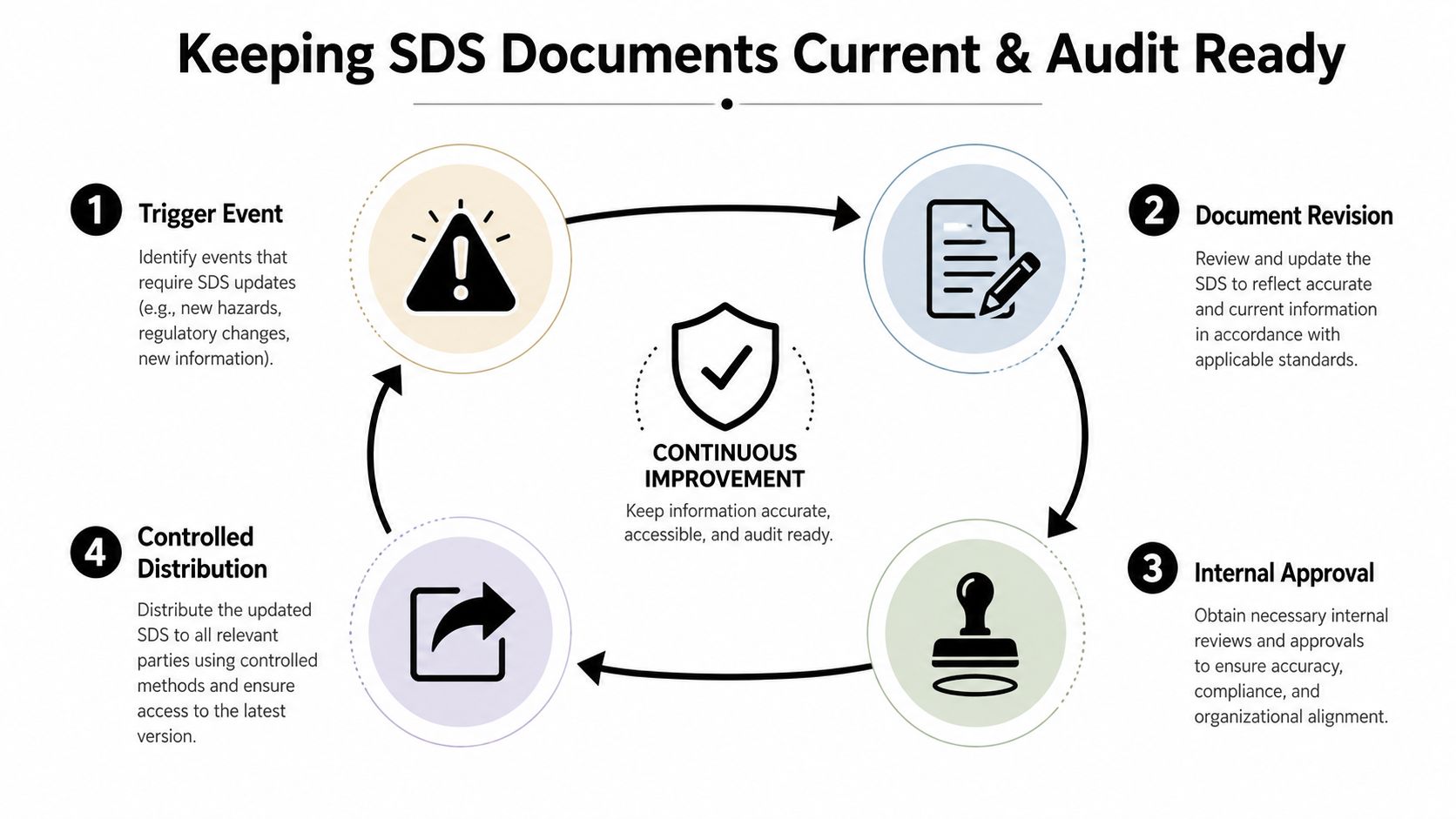
Publication is only the midpoint. The difficult work starts when a supplier revises a classification, a new hazard or protective measure becomes available, a formulation changes, or a jurisdiction updates its requirements. Revision control must show more than a new filename. It should show the trigger, the comparison, the technical review, the approval, the distribution, and the disposition of the prior version.
Under OSHA 29 CFR 1910.1200, when a manufacturer, importer, or employer preparing an SDS learns significant new hazard information or new protective measures, the SDS must be updated within three months, and affected labels must be revised within six months. OSHA 29 CFR 1910.1200 gives the underlying rule. These deadlines make an email inbox a poor change-management system because messages don't reliably connect a trigger to every affected document, label, location, and customer.
Treat every revision as a controlled event
A useful revision record answers five questions:
- What triggered the review? Supplier notice, formulation change, new hazard information, regulatory amendment, authorization outcome, restriction, or internal discrepancy.
- What changed? Classification, composition, exposure control, emergency measure, transport information, language, or revision notes.
- Who reviewed it? Identify the technical and compliance reviewers, not just the person who uploaded the file.
- Where was it distributed? Production, receiving, storage, training materials, customer portals, downstream users, and affected labels.
- What happened to the old version? Mark it superseded, restrict routine access, and retain it when historical traceability requires it.
In the EU, REACH Article 36 requires relevant information, including SDS records, to be retained for at least 10 years after the last manufacture, import, supply, or use. The long retention window means a current library and a historical archive serve different purposes. Don't delete superseded documents just because the active folder looks cleaner.
Monitor changes instead of relying on calendar reviews
A calendar review can catch neglected records, but it won't replace event monitoring. Teams should watch supplier communications and regulatory updates affecting GHS alignment, OSHA's Hazard Communication Standard, European REACH requirements, and Canada's Hazardous Products Regulations. Canada's transition period for amended HPR requirements ended on December 14, 2025, OSHA's updated HCS includes staggered SDS and label deadlines into 2026, and UNECE published GHS Rev. 11 in 2025, according to this 2025 SDS regulatory update guide.
Section 16 is the quick audit checkpoint because it should show the preparation or last revision date. A date alone doesn't prove the document is correct, but a missing or unexplained date is an immediate control weakness. UK guidance also describes section 16 as the place to verify that an SDS is the latest version and suitable for use. UK SDS section guidance supports using revision details as a practical workflow check.
Tie reviews to formulation events. A new SKU, supplier change, altered blend, revised isolate specification, new market, or changed storage method should create a documented SDS review rather than waiting for the next routine meeting.
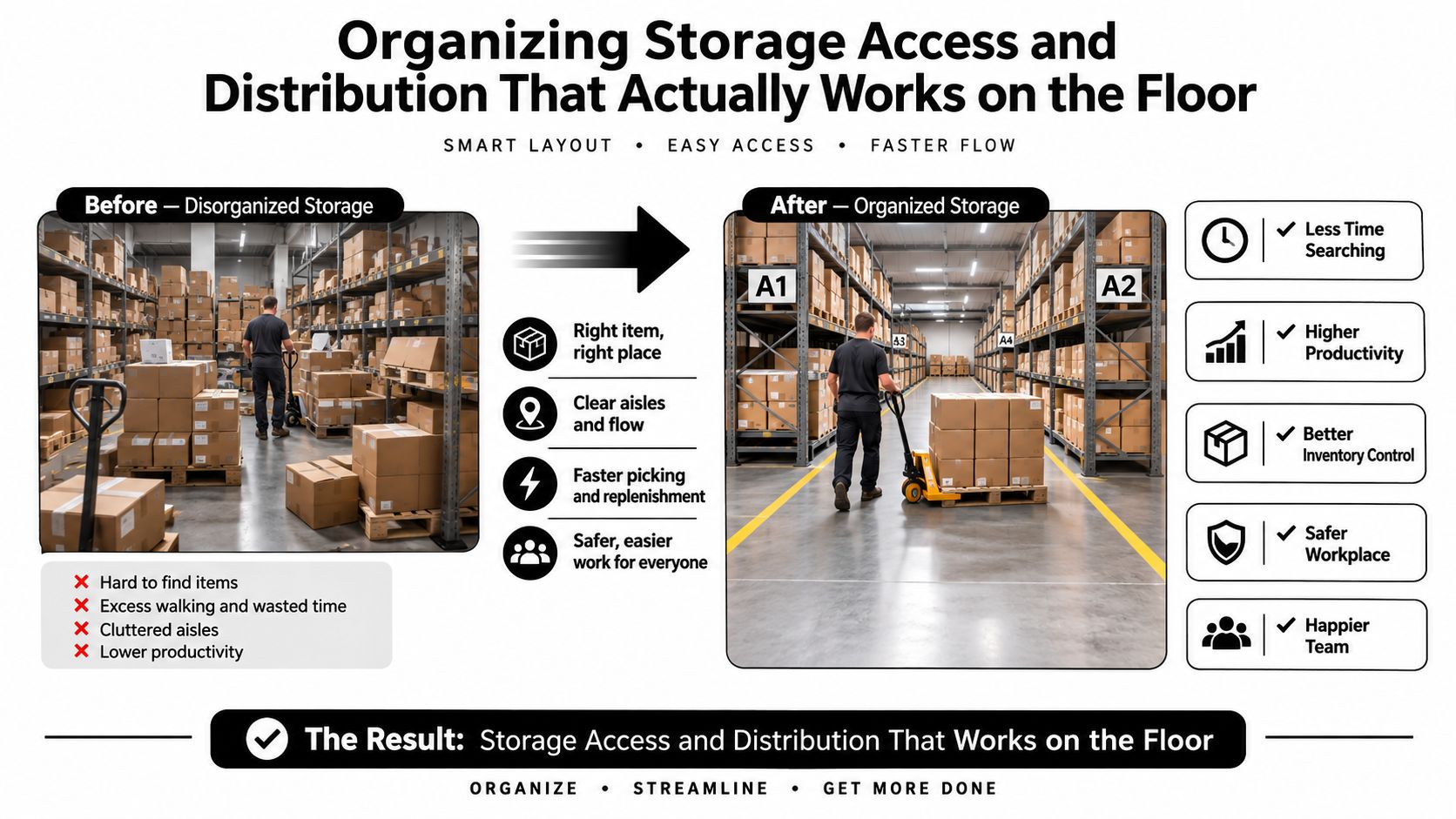
Organizing Storage Access and Distribution That Actually Works on the Floor
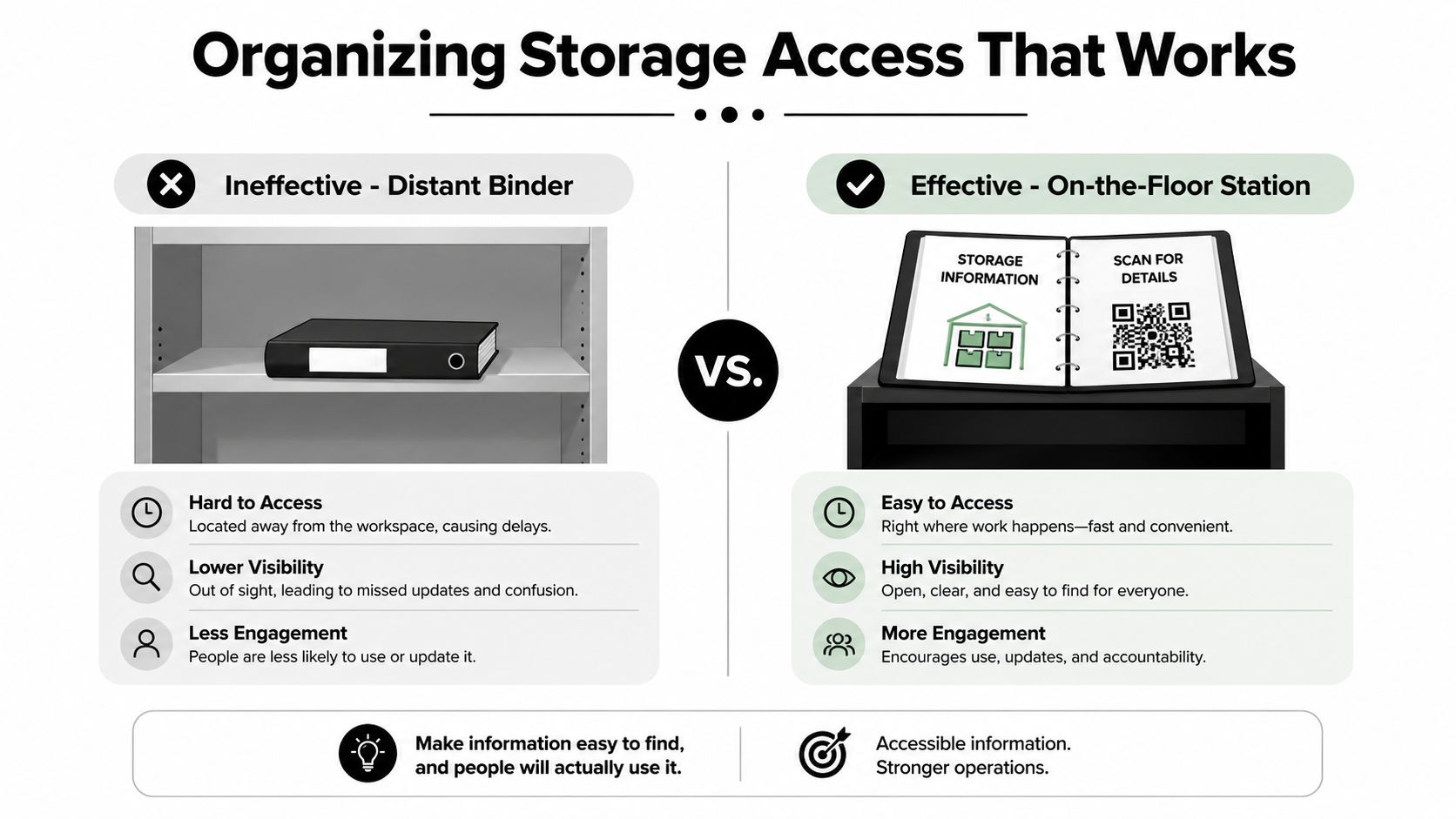
A document is useful only when the right person can retrieve it at the point of work. A production technician shouldn't need to remember which shared folder contains the current SDS, and a customer service representative shouldn't send a file from a personal desktop without checking its status. Access design is part of compliance, not an IT convenience.
Spreadsheets and shared folders remain common because they're familiar and inexpensive to start. The weakness is structural. A spreadsheet can list an SDS, but it may not control the document itself. A shared folder can store several PDFs, but it may not make the active version obvious, record approval, restrict edits, or show who received an update.
Compare the practical trade-offs
| Method | What it handles reasonably well | Where it fails under pressure |
|---|---|---|
| Spreadsheet index | Simple product lists and assigned owners | Broken links, duplicate names, weak revision history |
| Shared folder | Basic PDF storage and team access | Multiple active copies, uncontrolled edits, unclear distribution |
| Paper binder | Familiar fallback at a fixed workstation | Slow updates, poor search, difficult multilingual control |
| Dedicated SDS platform | Inventory relationships, version control, permissions, alerts, reporting | Requires setup, governance, training, and ongoing ownership |
A 2026 survey found 67% of organizations used spreadsheets, 33% used shared folders, and 0% used dedicated SDS management software. The survey's SDS management findings frame the gap clearly: many organizations have storage, but not a defensible system for version control, access, and audit readiness.
Design access around real floor conditions
Put the current SDS library where receiving, blending, storage, and spill-response teams can reach it. Mobile access helps when workers move between rooms or locations. Offline capability matters when connectivity is unreliable, but downloaded files need clear status controls so an old local copy doesn't become the unofficial active version.
Use permissions deliberately:
- Operators: View current SDSs and emergency information without edit access.
- Supervisors: Confirm location assignments, initiate reviews, and report discrepancies.
- Technical reviewers: Compare revisions, approve changes, and document rationale.
- Administrators: Manage records, permissions, backups, and audit exports.
- Customer-facing staff: Distribute approved external documents only.
Support the languages required for the markets and workforce you serve. Keep customer distribution controlled, especially when a downstream user needs the SDS for a specific blend, isolate, or diluent. Link the approved document to the exact product identity, not merely to a broad category such as “terpenes.”
Floor access should also connect to incident procedures. A worker handling a spill needs the current SDS alongside the site's containment and response instructions. Keep spill containment procedures accessible from the same operational environment, while preserving the distinction between supplier hazard information and facility-specific response steps.
Gold Coast Terpenes offers product safety documents that can be connected to formulation resources and product records, giving teams a practical source for reviewing documents associated with terpene products. Use any supplier document within a controlled internal workflow, with your own inventory ownership, approval, access, and retention rules.
Practical Next Steps for Compliant and Scalable SDS Management
Begin with a retrieval test on the floor. Ask receiving to find the current SDS for a terpene blend, production to locate an isolate document, and a supervisor to show the revision history without administrator access. Record search time, locations checked, and whether each person selected the same active version. A failed test exposes a workflow problem, not merely a filing problem.
Prioritize corrections in this order:
- Close inventory gaps: List every blend, isolate, carrier, diluent, extraction input, and cleaning chemical.
- Resolve identity: Match internal names, supplier names, SKUs, grades, and intended jurisdiction.
- Assign owners: Name people responsible for sourcing, review, approval, distribution, and archival.
- Control revisions: Record triggers, changes, reviewers, approval dates, active status, and superseded files.
- Improve access: Place current documents at receiving, production, storage, and emergency-response points, including mobile or offline access where needed.
- Test distribution: Confirm workers, customers, and downstream users receive the document for the exact product.
- Gate product changes: Require SDS review for new vape cartridge SKUs, distillate formulations, strain-inspired terpene blends, and supplier substitutions.
Treat the workflow as document control across the product lifecycle. Spreadsheets can establish ownership and inventory, but they often fail when revisions, permissions, and floor access need one dependable record. Software can reduce those gaps only after product identities, approval rules, and change responsibilities are defined.
Accurate records also support formulation work. A controlled inventory helps teams replicate a reference flavor, adjust top, mid, and base notes, or use a terpene calculator without guessing. For formulation education, consult Terpenes 101, then apply the same approved product records during development.
Before launch, request technical review when composition, use case, destination market, or supplier hazard classification changes. SDS control does not replace process safety or sensory validation. It gives both disciplines a reliable product record.
Gold Coast Terpenes provides terpene blends, isolated compounds, diluents, and product safety documents that can connect with controlled inventory and formulation workflows. Review the documents for each material before sourcing components for vape cartridges, distillate, or cannabis product formulation.