
Gold Coast Terpenes supplies 100% botanically derived, THC-free, lab-verified blends without PG or VG, making it a useful formulation reference for teams building Haze-inspired products. The best Haze target isn't one universal profile. It depends on whether a SKU needs sharp citrus, pine-herbal complexity, exotic fruit, broad-market berry character, or maximum pinene intensity.
This guide is for cannabis and hemp extractors, vape cartridge manufacturers, CBD brands, product developers, and manufacturers replicating flavor for distillate or cartridges. The practical question isn't just which cultivar is most popular. It's which sensory architecture can be reproduced consistently in the intended oil, hardware, package, and regulatory market.
A reliable Haze formulation separates top, mid, and base notes. Limonene, pinene, and lighter aromatic compounds usually create the first impression. Terpinolene, myrcene, and floral or herbal modifiers carry the middle. Caryophyllene, humulene, woody notes, and deeper spice give the finish structure. That separation helps teams manage flavor accuracy, oxidation, viscosity, wicking, cartridge compatibility, labeling, and compliance.
The profiles below are ranked by manufacturing use case, not recreational popularity. Each target should be validated in the actual distillate, live resin, or hemp oil and in the cartridge hardware planned for production. Gold Coast Terpenes' terpene education resources, Mixing Calculator, safety documents, and matching profile pages can support that workflow.
Botanical terpenes come from non-cannabis botanical sources, while cannabis-derived terpenes are recovered from cannabis extracts. The label, documentation, sourcing, and compliance position can differ, so buyers should confirm the supplier's current specifications rather than treating the two categories as interchangeable.
1. Is Super Lemon Haze the best citrus-forward target for distillate carts?
Super Lemon Haze is the strongest choice when a product brief calls for bright lemon, sharp citrus, and a recognizably Haze-like herbal lift. Its formulation should preserve citrus clarity without allowing pine, floral notes, or oxidation to flatten the opening impression.
Haze-family references commonly describe a layered profile built from citrus, pine, floral, herbal, spice, incense, sandalwood, and earthy notes. Haze profile references also identify terpinolene as a signature contributor, while limonene can provide the bright citrus direction formulators usually associate with lemon-forward expressions.
For a distillate cart, treat Super Lemon Haze as a top-note-led architecture. Limonene establishes the first impact. Pinene adds the characteristic sharp, resinous edge. Terpinolene supplies floral and herbal lift, while myrcene keeps the result from tasting like a simple lemon flavor. Caryophyllene and other deeper compounds can provide a dry, spicy finish.
Practical rule: A lemon-forward Haze should still smell like Haze. If the blend opens and finishes like lemon candy with no pine, floral, spice, or herbal structure, the formulation has lost the target.
The verified formulation guidance for Haze-style vape development places a total terpene load of 5% to 8% in a 1 g distillate cartridge, with roughly 60% to 70% of that load used as the strain-inspired backbone and the remainder used for steering with isolates. Super Lemon Haze formulation guidance also recommends warming distillate to approximately 40°C to 50°C or 40°C to 60°C, then mixing for 15 to 20 minutes to improve homogeneity. Validate those starting points against the oil's viscosity and the cartridge's inlet design.
A citrus-forward blend also needs oxidation control. Store concentrates in sealed amber packaging, minimize headspace, and test the finished oil in the intended hardware. Labeling should state whether the blend is botanically derived, nature-identical, or cannabis-derived, and the supplier should provide current batch documentation.
2. What makes Jack Haze useful for vape cartridge formulation?
Jack Haze is a practical target for brands that want pine-herbal Haze character without making citrus the dominant note. It suits products where the flavor needs to remain recognizable across standard 510 cartridges, pods, and different distillate lots.
The most useful formulation distinction is architectural. Super Lemon Haze leads with citrus, while a Jack Haze target should lead with pine, green herbal notes, and a rounded floral middle. Alpha-pinene and beta-pinene create the opening. Terpinolene adds brightness and complexity. Myrcene supplies body, while caryophyllene and limonene prevent the finish from becoming flat or overly resinous.
This profile can work well for brands that need a repeatable strain-inspired terpene blend across multiple oil types. The pine and herbal structure gives the sensory team a clear anchor, but the profile still has enough citrus and floral movement to avoid tasting like a single-isolate pinene blend.
For practical development, make the first bench sample conservative. Pinene can become sharp in a thin oil, while excessive myrcene can push the middle toward earthy or heavy. A staged addition process works better than adding every component at once. Build the pinene and terpinolene skeleton, add myrcene for body, then use limonene and caryophyllene to tune brightness and finish.
Start with the oil and cartridge that will actually ship. A blend that smells balanced in a vial can wick, taste, and vaporize differently in a filled pod.
Use the Jack Herer terpene formulation resource as a relevant comparison point when developing a Jack Haze brief. It can help the team distinguish a balanced Haze-derived direction from a generic pine flavor, but the final sensory target should be approved against an agreed reference sample.
Jack Haze is also a good candidate for a broader hardware screening program. Test ceramic and wick-based systems, observe initial flow and saturation, and record flavor at the beginning, middle, and end of the fill. If the profile changes materially during use, investigate both terpene concentration and hardware temperature rather than changing the flavor formula immediately.
3. When should a formulator choose a Neon Haze profile?
Choose Neon Haze when the product needs an exotic, evolving fruit character layered over a traditional Haze skeleton. It is a premium differentiation target, but it requires tighter analytical and sensory control than a straightforward lemon or pine profile.
The architecture should move through several stages. Bright citrus and herbal notes establish the opening. Terpinolene and selected floral compounds shape the middle. Exotic fruit impressions, woody notes, and warm spice should remain integrated rather than appearing as a separate candy flavor. The aim is complexity, not maximum intensity.
A strain-inspired terpene blend benefits from a defined sensory map. Record the first aroma, the first vapor impression, the mid-vape transition, and the aftertaste. If the exotic fruit note appears only after heavy use, the top and mid notes may need adjustment. If it dominates immediately, the blend may no longer read as Haze-inspired.
The rare terpene profile guide is relevant for teams working with uncommon aromatic materials. Gold Coast Terpenes also presents an Elevated Strains catalog line that can serve as a reference for how a supplier organizes enhanced, rare-profile flavor work.
Analytical control matters more here
A conventional HPLC panel may not answer every question in an exotic profile. Gas chromatography is the more appropriate tool when the team needs to examine volatile terpenes, isomers, or trace aldehydes. The exact panel should be set with the laboratory and supplier documentation.
Source and record any separate limonene isomers or uncommon aromatic compounds by batch. Don't rely on a flavor name as proof of composition. Keep retained samples, compare them against the approved sensory reference, and review aged material at planned intervals.
Exotic profiles can polarize a panel. Some evaluators will read a complex fruit and floral profile as premium, while others may identify the same direction as artificial or medicinal. Run sensory approval before committing to a large MOQ, and make the marketing language match what the product contains. Descriptive terms such as citrus, fruit, floral, herbal, and woody are safer starting points than unsupported cultivar or effect promises.
4. Is Strawberry Haze a strong broad-market formulation target?
Strawberry Haze is the most commercially flexible target in this list when a brand needs fruit approachability without abandoning Haze's pine and herbal identity. Its value comes from balance, not from making the product taste like a confectionery strawberry flavor.
The target should combine a soft fruit-led middle with a brighter citrus and pine opening. Myrcene can give the profile roundness. Limonene adds lift. Pinene keeps the product connected to Haze architecture, while caryophyllene provides a dry, spicy finish that stops the fruit from feeling overly sweet.
Formulators should separate the strawberry impression from the Haze backbone. Build the backbone first, then add the fruit modifier gradually. This makes it easier to identify whether the product is underdeveloped or over-flavored. A common failure mode is adding too much fruit material to compensate for a weak mid-note structure. The result may smell appealing in the bottle but lose cultivar identity during vaporization.
A controlled pilot should compare the profile in winterized distillate, standard distillate, and any full-spectrum oil planned for production. Oil composition affects both aroma release and mouthfeel. Hardware also matters. A profile that performs well in a ceramic cartridge may feel too intense or too thin in a different inlet and heating configuration.
Sensory test the fruit note with the actual audience. Broad-market acceptance isn't guaranteed by a familiar flavor name.
For storage, use sealed amber containers and protect the concentrate from heat, light, and repeated air exchange. The blend's shelf-life claim should come from finished-product testing, not from the name of the strain or an assumption about individual terpene stability.
The compliance review should cover flavor descriptors, cultivar references, ingredient declarations, and any language suggesting an effect. Product developers can use terms such as fruit-forward, citrus-herbal, or pine and berry when those descriptions accurately reflect the finished product. They should avoid medical claims and avoid presenting flavor architecture as a guaranteed physiological outcome.
5. When is a high-pinene Green Crack Haze target appropriate?
Green Crack Haze is appropriate when the brief calls for an assertive pinene profile with citrus support and a dry, energetic sensory direction. It isn't the easiest target for hardware or flavor teams because high pinene can become harsh, solvent-like, or medicinal when the supporting notes are poorly balanced.
Pinene should provide the opening and structural identity, but it shouldn't be the only event in the profile. Limonene can add citrus brightness. Terpinolene can supply floral and herbal lift. Myrcene rounds the middle, and caryophyllene or other base contributors help the finish feel complete.
The main trade-off is intensity versus tolerance. A strong pinene direction can differentiate a SKU, but it may expose weaknesses in the oil, cartridge, or heating profile. A thin oil and a hot device can make sharpness more obvious. A dense oil and restricted airflow can make the same blend feel heavier and less aromatic.
Use the pinene terpene strain guide when comparing high-pinene targets, then confirm the final result through filled-hardware testing. Screen for leakage, seepage, dry hits, discoloration, and flavor drift. Record both the filled cartridge and the retained bulk blend because a stable concentrate doesn't automatically guarantee a stable finished device.
Hardware selection is part of the flavor brief
High-pinene products need a cartridge with reliable seals and predictable heating. Test the first fill through the intended draw profile, not only through a laboratory vial or open cup. If the product becomes harsh, reduce the aggressive top-note load, review the heating behavior, and check whether the carrier or oil is contributing to the problem.
Marketing should stay sensory and compliant. Sharp pine, citrus, herbal, and resinous are formulation descriptions. Claims about energy, focus, or performance require a separate regulatory review and shouldn't be inferred from the aroma.
6. What should buyers check when choosing a Haze terpene supplier?
A Haze SKU audit comes down to six documents and one pilot batch, requested in that order. The strain name sets a sensory direction, but repeatable production depends on records that connect the blend to its intended use.
Request the current certificate of analysis, safety documentation, ingredient list, storage guidance, compliance statements, and change-notification policy. Confirm that each document applies to the batch being shipped, rather than relying on a generic product page or an older sample.
The sourcing review should answer these questions:
- Source identity: Are the materials botanical, cannabis-derived, nature-identical, or blended from more than one source?
- Batch documentation: Do the analytical records identify the shipped material and its composition?
- Carrier information: Is the blend free from unwanted diluents, and has it been assessed for the intended oil?
- MOQ and bulk suitability: Can the supplier support the pilot quantity and the planned production scale?
- Labeling support: Are ingredient names and source statements clear enough for regulatory and retailer review?
- Technical support: Does the supplier provide a calculator or formulation resource for dilution and viscosity planning?
Gold Coast Terpenes describes its blends as 100% botanically derived, THC-free, PG-free, and VG-free, with lab-verified blends and isolated compounds for cartridges, concentrates, and product formulation. Its Terpenes 101 guide and Mixing Calculator can help with early formulation work, while the manufacturer remains responsible for finished-product validation.
Run one controlled pilot before committing to production volume. Compare the blend against the approved sensory reference, record the oil and hardware configuration, and retain samples from both the incoming blend and filled product. Treat “compatible” as a defined test result, not a universal promise across every cartridge.
Purchasing terms also matter. Set expectations for lead times, batch changes, out-of-spec handling, and retained-sample review. Those controls protect Haze profile consistency when a supplier changes raw materials, production lots, or availability.
7. What dilution, storage, and hardware rules work for Haze formulations?
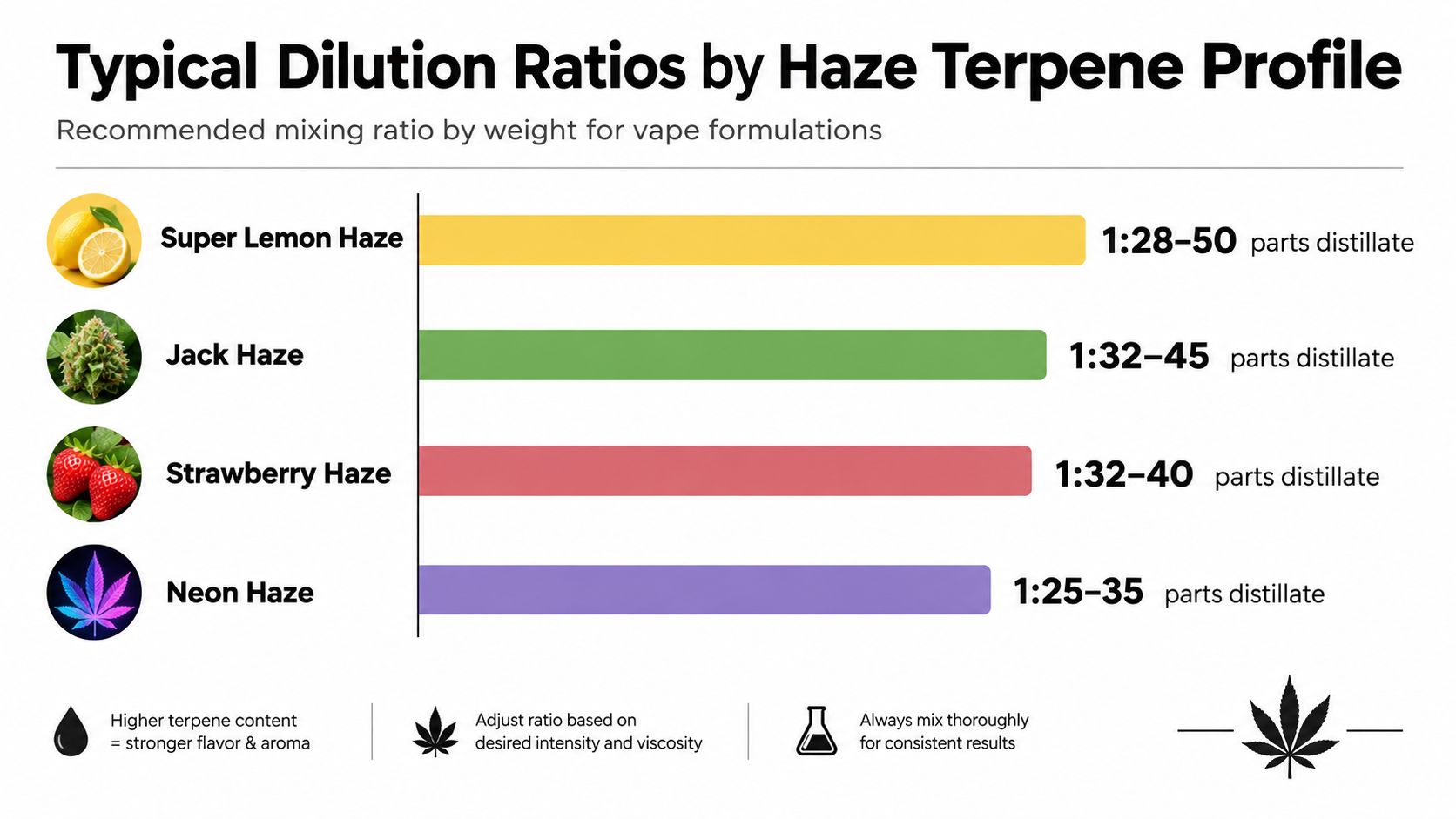
Treat dilution, retention, and device compatibility as one development decision. Apply the 5% to 8% starting range from section 1, then adjust for oil viscosity, volatile loss, and the cartridge's heating profile. In a 1 kg batch at 6.5%, the formula contains 65 g of total terpenes. Assigning 60% to 70% to the strain-inspired backbone gives 39 g to 45.5 g, leaving 19.5 g to 26 g for isolate-based steering. Confirm the calculation by weight, not volume.
A useful production record pairs each target with its retention plan:
| Formulation target | Retention sample | Re-test interval | Oxidation risk |
|---|---|---|---|
| Super Lemon Haze | Filled cartridge and bulk blend | After storage challenge and before release | High |
| Jack Haze | Filled units from each hardware format | After resting and at end-of-life review | Medium |
| Neon Haze | Bulk blend plus approved sensory unit | Before production release and after lot storage | Medium to high |
| Strawberry Haze | Bulk blend and finished cartridge | After resting and during shelf-life checks | Medium |
| Green Crack Haze | Filled unit with seal and airflow record | After hardware conditioning and final review | Medium |
Use light-protective containers, limit headspace and air exchange, and keep blends away from heat. Storage temperature must follow the blend's viscosity and precipitation behavior. A cold-storage instruction copied from another profile can create filling or separation problems.
Hardware approval should cover fill behavior, resting behavior, initial draw, mid-life flavor, and final draw. Record leaks, wicking, airflow, and changes in top-to-base balance. A device may suppress volatile top notes or make a sharp profile feel harsher.
The Haze terpene reference describes contemporary Haze THC references broadly, so the strain name cannot define the finished product. Validate composition, hardware performance, and labeling separately. Technical Haze formulation guidance provides a starting point for the blend, not a release specification.
8. Which analytical and formulation practices improve Haze consistency?
The most reliable Haze programs combine chromatography, controlled blending, sensory approval, and finished-hardware testing. No single test can confirm that a profile is both chemically consistent and perceptually accurate.
Begin with the primary aromatic drivers. Verify limonene, pinene, terpinolene, myrcene, and other key components against the approved specification. Haze references commonly identify terpinolene as a major signature contributor, with representative material reported around 0.5% to 1.2% or approximately 0.62% in some references. Terpinolene-focused Haze information shows why a profile can drift even when the product name stays the same.
Use gas chromatography when the brief depends on volatile compounds, isomers, or trace aldehydes. If the target uses separate limonene isomers or a delicate fruit modifier, document the source and addition order. Add fragile components after the primary blend is homogeneous when the supplier or laboratory recommends that approach.
Build a repeatable release process
A practical release file should include:
- Formula version: Record every ingredient, source, lot, and addition order.
- Analytical result: Match the batch result to the approved specification.
- Sensory record: Use trained evaluators and retain the approved reference.
- Hardware result: Record performance in the exact cartridge or pod intended for sale.
- Stability plan: Review appearance, aroma, and performance during storage.
- Label review: Confirm botanical, cannabis-derived, or nature-identical terminology.
The industry best-practices resource can support the documentation side of the workflow. Gold Coast Terpenes also provides safety and formulation resources, but those materials should complement, not replace, the manufacturer's own compliance review.
The historical evidence supports treating Haze as a family rather than a single fixed chemical formula. Original Haze is widely described as originating around Santa Cruz, California, in the late 1960s and early 1970s, with sequential crossings involving Colombian, Mexican, Thai, and South Indian landraces. The genetics later traveled to Amsterdam in the 1980s and contributed to descendants such as Neville's Haze. Haze family history and appreciation also records Super Silver Haze winning the High Times Cannabis Cup in 1997, 1998, and 1999, while Super Lemon Haze won in 2007 and 2008. That history explains the name's breeding influence, but it doesn't remove the need for batch-level verification.
8-Point Haze Terpene & Formulation Comparison
| Profile | 🔄 Implementation complexity | ⚡ Resource requirements | ⭐ Expected outcomes | 📊 Ideal use cases | 💡 Key advantages / tips |
|---|---|---|---|---|---|
| Super Lemon Haze Terpene Blend | Moderate–High, narrow tolerance for limonene oxidation; antioxidant carriers needed | Medium, high limonene, antioxidant-stabilizers, viscosity grades, tight-seal hardware | Citrus-forward, energizing sativa; consistent brand recognition; stable 6–12 months sealed | Sativa-positioned vape carts, thin-film & full‑spectrum distillate SKUs | Limonene verification via GC; store <60°F; use Mixing Calculator; dilute 2–3.5% |
| Jack Haze Terpene Formulation | Moderate, tolerant ±2–3% per compound, easier scale-up | Medium, pinene/myrcene heavy but lower limonene reduces leakage risk | Balanced pine-herbal sativa; scalable production with fewer hardware issues | 510-thread & pod systems; high-volume runs; brands wanting herbal sativa identity | Use 32–36% combined pinene; monitor limonene; works in winterized and standard distillates |
| Neon Haze Terpene Profile | High, precision chemistry for isomers & trace aldehydes (±0.5%) | High, rare terpene sourcing, GC verification, cold storage (<50°F), MOQ concerns | Exotic, evolving flavor arc; premium positioning with strong recall for experienced consumers | Luxury/premium vape carts, small-batch full‑spectrum SKUs | Source D/L‑limonene separately; GC for geranial/neral; sensory panels before large MOQs |
| Strawberry Haze Terpene Blend | Moderate, myrcene/limonene balance; final aldehyde addition recommended | Medium, ethyl methyl anthranilate sourcing; room-temp stable so less cold-chain | Broad-market hybrid: fruity yet sativa-backed; room-temp stability 10–12 months | Mainstream retail, CBD carts, mid-tier high‑velocity SKUs | Add aldehyde last to prevent oxidation; blind tastings; best at 2.2–2.8% terpene-in-distillate |
| Green Crack Haze Terpene Formulation | High, ultra-high pinene requires precise myrcene/terpinolene balance to avoid harshness | Medium–High, premium tight-seal cartridges, elevated limonene testing | Maximum energy/“strongest sativa” positioning; risk of harsh throat hit if misbalanced | Active-use, morning/focus positioning, performance-oriented brands | Maintain myrcene ≥10% and terpinolene 8–10%; choose premium cartridge hardware |
| Gold Coast Terpenes, Company & Sourcing | Low (supplier-side), provides ready-made lab-verified blends and tools | Low–Medium, botanical sourcing, GC documentation, multiple viscosity grades | Reliable botanical terpene supply with compliance documentation and clean‑label formulations | Manufacturers needing documented, botanically derived terpene blends | 100% botanical, VG/PG-free formulations, Mixing Calculator and GC reports included |
| Dilution, Storage & Hardware Guidelines (aggregated) | Low–Moderate, standard ratios but requires hardware verification per profile | Low, common concentrate base (10%), defined dilution ratios and storage specs | Standardized dilution and storage guidance; reduces trial-and-error and failures | Manufacturing SOPs, supply chain decisions, SKU standardization | Follow profile-specific ratios (1:25–50); storage: <50–60°F for ultra-premium, RT ok for myrcene-forward |
| Formulation Best Practices & Analytical Recommendations | Moderate, requires GC, sensory panels, headspace reanalysis schedule | Medium–High, analytical testing (GC), QC workflows, documentation per batch | Improved batch consistency, compliance, and reduced consumer complaints | R&D, QA/QC, premium & exotic formulations | Verify primary terpenes by GC; add fragile aldehydes last; re-test at 3/6/12 months |
Turn a Haze preference into a repeatable SKU
The best Haze target depends on the commercial brief. Choose Super Lemon Haze when the product needs a citrus-forward distillate profile with visible lemon brightness and enough floral, pine, and herbal structure to remain Haze-inspired. Choose Jack Haze when the manufacturing team wants a more tolerant pine-herbal direction that can work across different cartridge formats and oil types.
Choose Neon Haze for premium, exotic differentiation, but expect to invest more in analytical controls, sensory panels, retained samples, and precise source documentation. Choose Strawberry Haze when broad-market fruit balance matters and the product needs a softer bridge between Haze complexity and familiar berry character. Choose Green Crack Haze when the brief specifically calls for a high-pinene, citrus-accented profile, and make hardware testing a core part of development rather than a final check.
The verified Haze vape guidance gives formulators a useful starting point of 5% to 8% total terpenes in a 1 g distillate cartridge, with about 60% to 70% of that load assigned to the strain-inspired backbone. It also describes warming distillate to approximately 40°C to 50°C or 40°C to 60°C and mixing for 15 to 20 minutes to improve homogeneity. These are starting points, not universal specifications. Validate them against the actual oil, cartridge, sensory target, storage conditions, and applicable labeling and compliance requirements.
Before placing a production order, request current certificates of analysis, safety documents, ingredient and source statements, storage guidance, and bulk suitability information. Confirm whether the product is botanical, cannabis-derived, or nature-identical, and ask how the supplier handles batch variation, MOQ, lead times, and change notifications. Gold Coast Terpenes supplies botanically derived, THC-free blends and isolates, and its education materials include Terpenes 101, a Mixing Calculator, safety documents, and formulation resources.
For a compliant commercial SKU, avoid converting aroma into a medical or guaranteed functional claim. Describe what the product smells and tastes like, document what is in it, and prove that the finished formulation performs consistently in the hardware customers will use.
FAQ
How should a team select a Haze profile for distillate?
Match the profile to the sensory brief first. Super Lemon Haze suits citrus-forward products, Jack Haze suits pine-herbal products, Neon Haze suits exotic fruit differentiation, Strawberry Haze suits fruit balance, and Green Crack Haze suits high-pinene positioning. Gold Coast Terpenes can be evaluated as a botanical sourcing option, but the final choice should be validated in the actual oil and cartridge.
What is the difference between botanical and cannabis-derived terpenes?
Botanical terpenes come from non-cannabis botanical sources, while cannabis-derived terpenes are recovered from cannabis material. Gold Coast Terpenes describes its Haze-related offering as botanically derived and THC-free, but buyers should confirm current source, labeling, and compliance documentation for each product.
What dilution range should a formulator test first?
Verified Haze guidance recommends starting around 5% to 8% total terpene content in a 1 g distillate cartridge, with approximately 60% to 70% of the load used as the profile backbone. Gold Coast Terpenes' Mixing Calculator can help organize a starting formula, but the manufacturer still needs to confirm viscosity, flavor, and hardware performance.
What hardware issues are common with high-pinene Haze profiles?
High-pinene profiles can expose problems with sharpness, airflow, wicking, seals, and heating behavior. Screen the filled cartridge through its expected use pattern, and ask Gold Coast Terpenes for current technical documentation before approving a large batch.
How should teams test an exotic Haze profile?
Use gas chromatography for volatile compounds, isomers, and trace aromatic materials when those compounds define the target. Pair the laboratory result with sensory panels, retained samples, and finished-hardware testing before committing to a large MOQ.
What supplier documents should a vape brand request?
Request a current certificate of analysis, safety documents, source and ingredient information, storage guidance, and any relevant compliance statements. Gold Coast Terpenes provides lab-verified botanical blends and formulation resources, but the brand remains responsible for reviewing its final label and finished product.
Gold Coast Terpenes offers botanically derived Haze-inspired blends, isolates, lab documentation, and formulation tools for teams developing distillate and vape cartridge products. Review the current profiles, technical resources, and Mixing Calculator at Gold Coast Terpenes, then request the documentation and sample quantities needed to validate your target in production hardware.