
The most popular advice for a Lime Sherbet Punch strain-inspired terpene blend is also the easiest way to ruin a vape cartridge: increase limonene until the oil smells aggressively citrusy. That approach usually produces a sharp opening note, a thin flavor body, and a harsher finish under repeated coil heat. Gold Coast Terpenes supplies 100% botanically derived terpene blends, rather than cannabis-derived blends, which gives formulators a practical starting point for building a controlled citrus-cream profile.
For vape manufacturers, the target isn't a loud lime aroma in the bottle. It's a flavor that stays recognizable from the first draw through the end of the cartridge, while the distillate remains compatible with the selected hardware. The profile works best when bright citrus sits above a rounded sherbet center and a restrained, warm base. This is a strain-inspired terpene blend for vape cartridges, not a recipe for reproducing a particular flower lot exactly.
Why High Limonene Fails in Lime Sherbet Punch Strain Vape Carts
High limonene doesn't automatically create a better lime flavor. It can make the opening feel sharp and solvent-like, especially when the formulation lacks mid and base notes to soften the citrus impression during heating.
The lime character needs structure. Limonene can provide brightness, but valencene can help broaden the citrus impression, while floral, sweet, and spicy components give the profile somewhere to go after the first inhale. A useful overview of limonene effects on cannabis experience can help teams separate sensory discussion from claims about finished product effects. For a formulation team, the relevant question is simpler: does the blend remain balanced after aerosolization?
The problem with a one-note citrus system
A limonene-heavy blend may smell convincing in a vial and fail in a cartridge. The most volatile portion arrives first, leaving the sherbet character underdeveloped. As the oil is heated repeatedly, the consumer may experience a progressively thinner flavor, with citrus intensity replacing the creamy and candy-like finish that gives this profile commercial identity.
This is why a high-limonene strain reference should be treated as a comparison tool, not as a command to maximize one isolate. A strong prototype starts with the desired sensory arc, then assigns each note a role in that arc.
Practical rule: If the lime note dominates the aroma before the distillate is heated, reduce the top-note emphasis before changing hardware.
What works better
Build the blend around citrus brightness, a soft fruit bridge, and a restrained grounding note. The goal isn't to hide limonene. It's to stop limonene from carrying the entire flavor.
For commercial development, evaluate the blend in the actual oil and cartridge format. Test the first draw, the middle of the fill, and the final portion of the cartridge. A flavor that smells excellent in a sample jar but becomes acrid in the device isn't ready for production.
What Lineage Markers Define the Lime Sherbet Punch Strain Profile
Lime Sherbet Punch is generally described as a modern hybrid emerging from the Sherb and Punch family lines. These lineages became prominent for dessert-like aromas, strong resin production, and colorful presentation. A neutral Lime Sherbet Punch lineage guide identifies the Sherb side with Sunset Sherbet, a Cookies-family descendant, and the Punch side with Purple Punch. It also notes that the cultivar has no universally recognized breeder of record.
That uncertainty matters to formulators. A strain name may represent a sensory family rather than one chemically fixed reference standard. Replication should therefore focus on the repeatable flavor markers, not on an assumption that every batch carries the same terpene distribution.
Translating family traits into formulation targets
The Sherb influence suggests a profile built around lime zest, sweet cream, and confectionery softness. The Punch influence adds a darker fruit impression and a warmer finish. In a cartridge, those impressions need to be represented by a layered blend rather than a single dominant compound.
Limonene is the obvious lime marker, but it shouldn't stand alone. Valencene can support a fuller citrus impression, while linalool can create a floral bridge between sharp citrus and sweet cream. Beta-caryophyllene can add dry spice and warmth, and myrcene may help connect the heavier portion of the profile without turning it muddy.
The purpose of a strain terpene profile guide is to help formulators compare these roles across related flavor families. A catalog example such as Elevated Strains can also be reviewed as a separate flavor reference, but it shouldn't be treated as a Lime Sherbet Punch standard.
Authenticity is a sensory decision
A technically accurate blend doesn't need to reproduce every compound found in a flower sample. It needs to preserve the profile's recognizable movement: bright lime first, sweet and creamy in the center, then fruit, spice, or herb at the finish.
That approach is more reliable than chasing a strain label. It also gives brands a clearer way to approve batches, because sensory acceptance can be tied to a defined flavor architecture rather than an unverified breeder history.
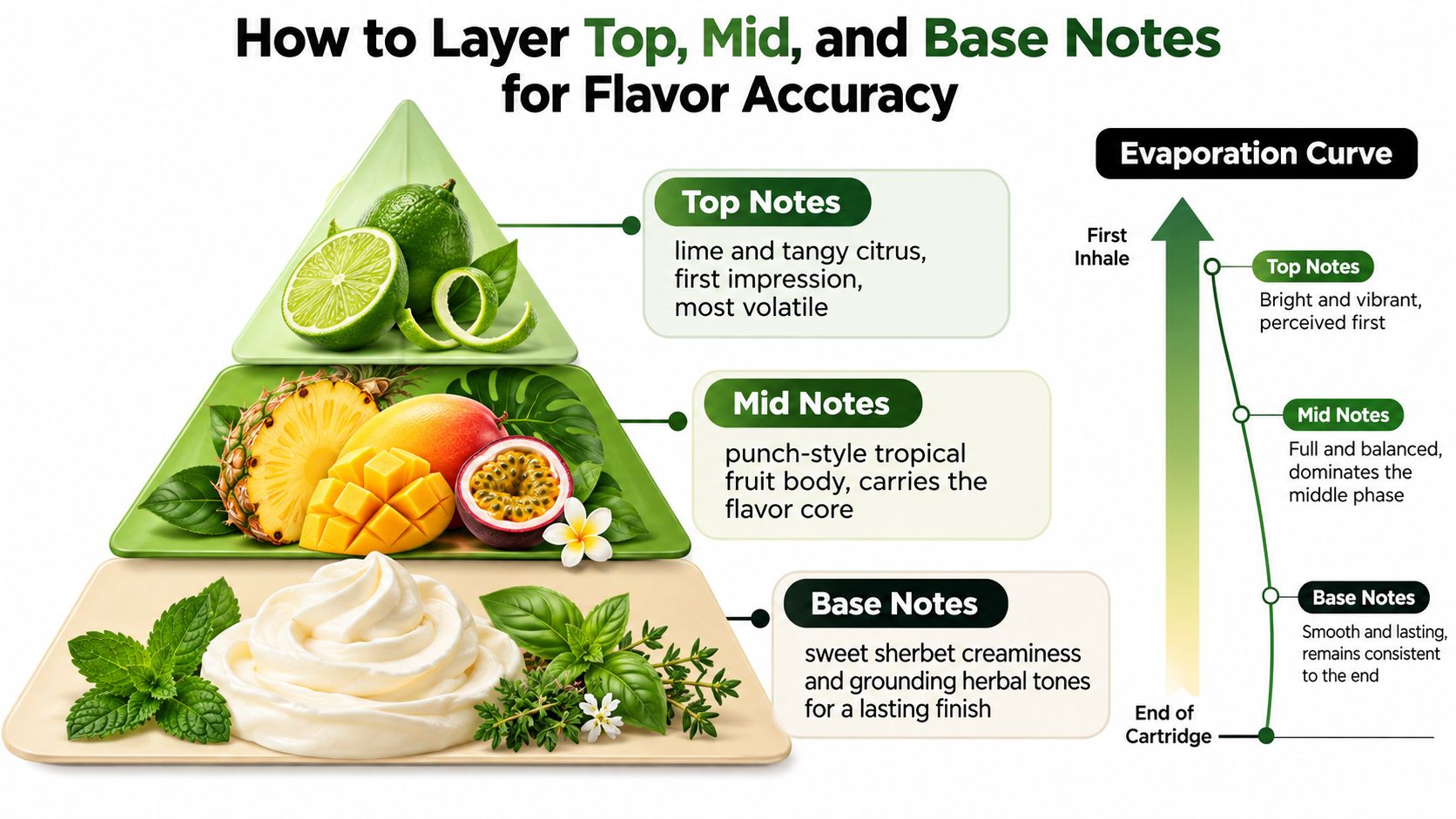
How to Layer Top, Mid, and Base Notes for Flavor Accuracy
A successful formulation guide for Lime Sherbet Punch flavor uses three layers. Top notes create the first impression, mid notes carry the identity of the blend, and base notes keep the finish from disappearing after the citrus peak.
The available strain data describes limonene as a frequent lead compound and cites sampled Lime Sherbet material with typical limonene levels of 0.5% to 1.5%. That range describes sampled material, not a universal cartridge recipe, and it shouldn't be copied directly into a distillate formula. Finished oil needs to be evaluated for aroma, taste, heat exposure, and hardware behavior.
Top notes establish the lime impression
Limonene supplies the recognizable citrus lift. Valencene can help make the citrus feel broader and less like a single sharp peel note. Use the top layer to create recognition, but keep it subordinate to the full flavor arc.
A common failure is adjusting only the top layer when the blend feels weak. If the cartridge lacks creaminess, increasing limonene usually makes the problem more obvious. Add structure to the middle and base before increasing the citrus component.
Mid notes carry the flavor core
Linalool can bridge citrus with floral and soft dessert impressions. A controlled mid layer gives the blend continuity between the initial lime strike and the heavier finish. The profile begins to feel like sherbet rather than lime flavoring.
The terpene flavor chart is useful when comparing individual isolate characteristics during bench work. Keep changes small, document each iteration, and evaluate the blend after it has rested in the target distillate. A pleasant concentrate aroma isn't enough evidence for a production decision.
Base notes control the finish
Beta-caryophyllene can provide peppery warmth, while myrcene can add a softer, more earthy body. These notes should ground the flavor without turning the cartridge woody or heavy. A small amount of base character can make the lime feel more natural, but too much can obscure the creamy center.
The best citrus cartridges don't taste like citrus at every stage. They taste like a complete flavor that happens to open with citrus.
Botanical and cannabis-derived sources can both be evaluated for sensory fit, regulatory needs, and supply consistency. The source decision belongs in the product specification, alongside the target oil, device, label language, and certificate-of-analysis requirements.
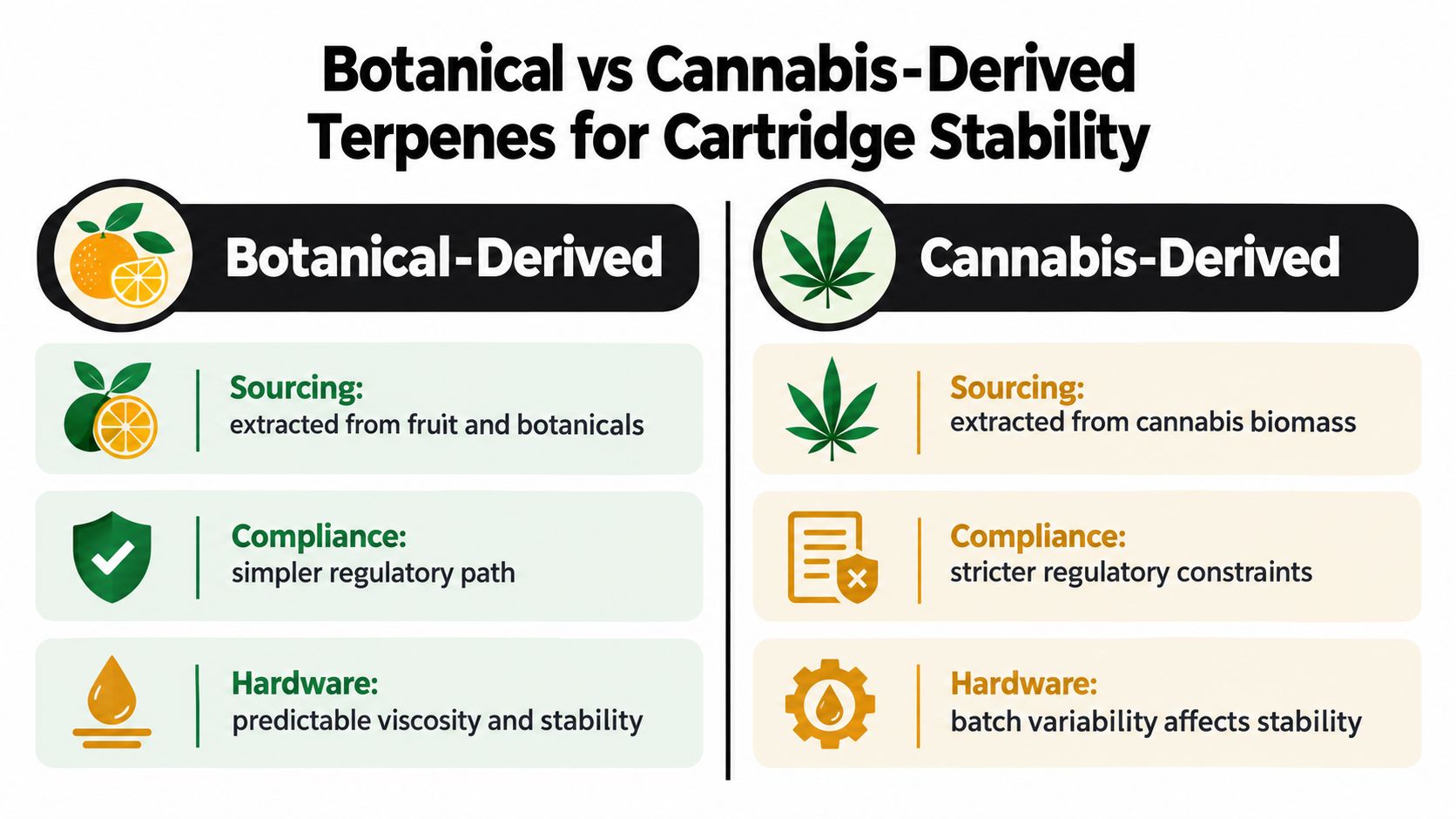
Botanical vs Cannabis-Derived Terpenes for Cartridge Stability
Botanical-derived and cannabis-derived terpenes should be compared by documentation, batch consistency, formulation behavior, and regulatory requirements. Neither source automatically creates a more authentic cartridge, and neither removes the need for finished-product testing.
Botanical sourcing can simplify separation between the terpene blend and cannabis extract in a manufacturing record. It may also make supply planning easier when a brand needs the same flavor direction across products or jurisdictions. Cannabis-derived material can provide a closer match to a specific extract, but the available profile may vary with cultivar, harvest, processing, and batch.
A practical supplier comparison
| Evaluation point | Botanical-derived blend | Cannabis-derived blend |
|---|---|---|
| Flavor consistency | Review the supplier's blend specification and lot documentation | Compare every lot against the approved sensory reference |
| Regulatory file | Confirm source, ingredients, testing, and label requirements | Confirm source, cannabinoid implications, and jurisdictional requirements |
| Hardware work | Validate viscosity, clarity, and draw behavior in the selected cartridge | Validate the same properties because source alone doesn't predict performance |
| Replication strategy | Build the profile from defined aroma roles | Use the extract's native profile or supplement it carefully |
| Scale planning | Confirm continuity of raw materials and documentation | Confirm biomass and extraction continuity |
What to request before buying
A serious supplier should provide a current certificate of analysis, ingredient information, safety documentation, and clear guidance for intended use. Formulators should also ask whether the blend contains carriers or thinning agents and whether the label language should say botanical-derived, cannabis-derived, or another permitted designation.
A blend marketed as natural still needs a complete review. Check the ingredient statement, contaminant testing, and compatibility with the intended oil. Avoid assuming that botanical sourcing alone proves cartridge stability, and avoid assuming that cannabis-derived sourcing guarantees strain fidelity.
For brands comparing the best terpene suppliers for vape brands, the useful question isn't who has the longest catalog. It's who can support repeatable flavor development, documentation, responsive technical communication, and a realistic production workflow.
What Dilution Ratios Work Best for Winterized Distillate
There is no universal dilution ratio that can be declared safe or correct for every winterized distillate, cartridge, and heating system. Start with a controlled bench range specified by the supplier, then validate sensory strength, viscosity, leakage, draw resistance, and stability in the actual device.
A reliable terpenes for distillate formulation workflow begins with compatibility rather than flavor intensity. Confirm that the distillate is fully prepared, free of unwanted solids, and at a workable temperature before adding the blend. Avoid high heat, because excessive thermal exposure can flatten delicate top notes and distort the flavor you're trying to reproduce.
A controlled mixing sequence
Record the batch identity. Document the distillate lot, terpene lot, target fill, device, and starting observations.
Warm only as needed. Use gentle, controlled warming that improves mixing without exposing the blend to unnecessary heat.
Add gradually. Introduce the terpene blend in portions while stirring slowly. High-shear mixing can add air and make sensory evaluation less reliable.
Inspect the oil. Look for clouding, separation, unexpected viscosity changes, or persistent bubbles before filling hardware.
Rest and retest. Allow the blend to equilibrate under a documented condition, then assess aroma and vapor in the target cartridge.
The guide to how much terpene to add to distillate can support the initial calculation, but the final specification still belongs to the manufacturer. Use a terpene calculator to scale the selected pilot formula, and verify the result by mass rather than relying only on a nominal volume assumption.
Standard distillate dilution parameters
| Parameter | Target metric | Tolerance range |
|---|---|---|
| Terpene loading | Supplier-supported pilot level | Defined by internal sensory and hardware testing |
| Mixing temperature | Lowest workable temperature | Narrow validated operating window |
| Agitation | Uniform incorporation without aeration | Adjusted to oil viscosity and vessel geometry |
| Rest period | Documented equilibration before approval | Set by sensory and stability observations |
| Fill condition | Clear, homogeneous oil | No visible separation, clouding, or sediment |
Store terpene blends in tightly closed, appropriately labeled containers with minimal headspace and limited light exposure. Any storage program should be confirmed against the supplier's safety documentation and the manufacturer's stability requirements.
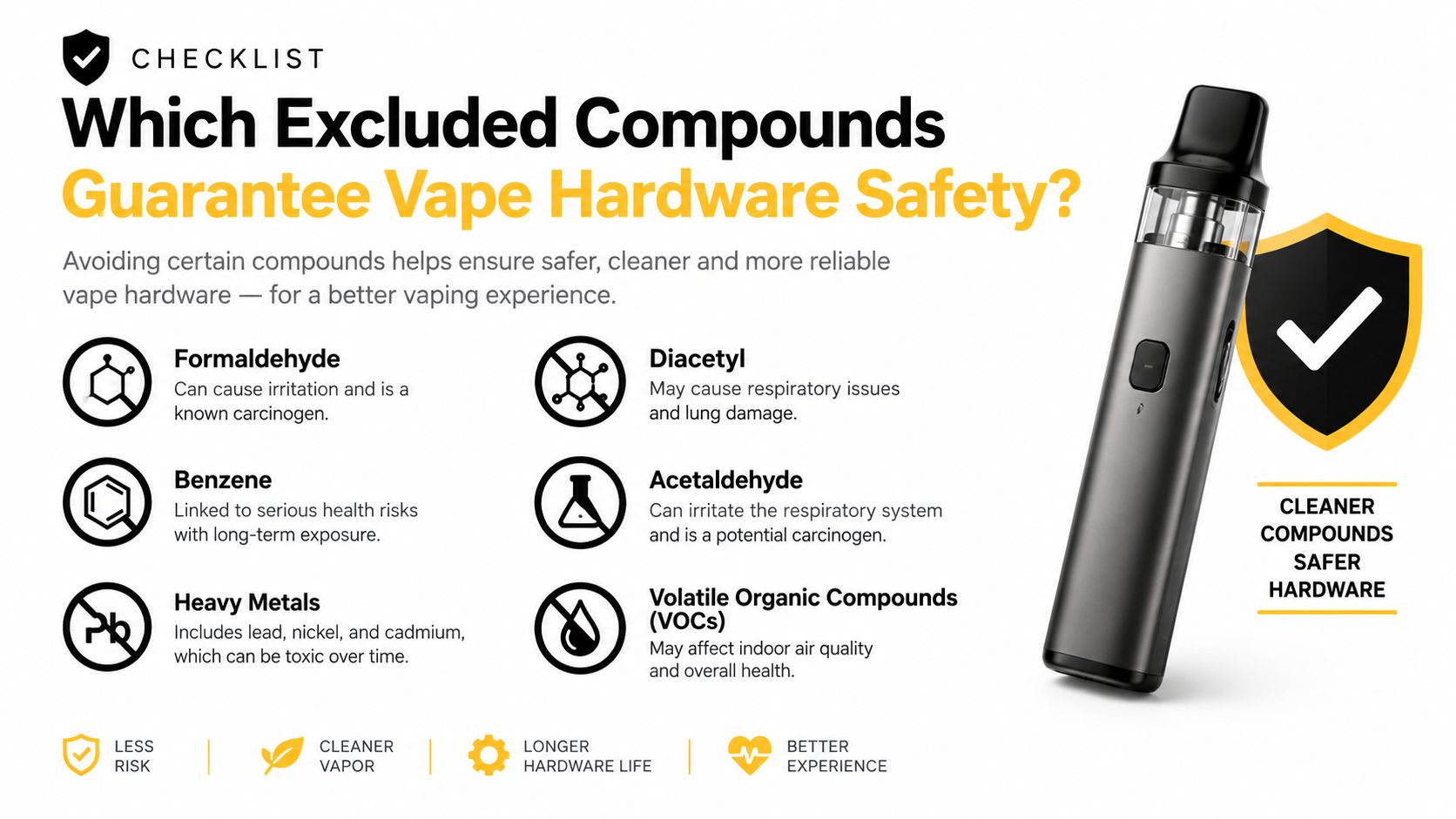
Which Excluded Compounds Guarantee Vape Hardware Safety
No excluded-compound list can guarantee hardware safety on its own. It can, however, help a formulation team identify what a blend does not intentionally contain and direct the additional compatibility testing needed for the finished oil and cartridge.
A product safety declaration for a Lime Sherbet Punch proprietary terpene blend lists MCT, propylene glycol, peppermint oil, citral diethyl acetal, methyl cinnamate, and pulegone among compounds not intentionally added. That declaration is useful as a screening document, especially when a brand's specification excludes common carriers, cooling agents, or particular flavor chemicals.
Read exclusions as part of a wider file
MCT, propylene glycol, and other carriers can materially change an oil's viscosity and device behavior. Peppermint oil can redirect the sensory profile away from lime sherbet, while compounds such as citral diethyl acetal, methyl cinnamate, and pulegone deserve attention in ingredient review and regulatory screening.
The correct process is to compare the declaration with the finished formulation. The distillate, terpene blend, hardware, packaging, and processing conditions all contribute to the final result. A clean terpene document doesn't replace pesticide, heavy-metal, microbial, residual-solvent, or finished-product testing where those tests apply.
Troubleshoot the actual failure
Clouding can indicate incompatibility, precipitation, contamination, or temperature-related behavior. Harshness can come from excessive top-note loading, thermal stress, an unsuitable device setting, or an issue in the extract itself. Clogging can result from particulates, unsuitable viscosity, crystallization, or filling conditions.
Don't solve those problems by adding an unapproved thinner. Identify the failure, isolate the variable, and repeat the test with documented controls. That process protects both flavor accuracy and compliance.
Frequently Asked Questions About Lime Sherbet Punch Formulation
How can formulators stop limonene from tasting like cleaning solvent in a high-heat pod?
Reduce the dominance of the top note and build a citrus-cream structure with mid and base components. Validate the result in the target pod, because a blend that smells rounded at room temperature can become sharp after repeated heating.
Can a botanical blend reproduce the entourage effect with minor cannabinoids?
A terpene blend can reproduce selected aroma and flavor characteristics, but it shouldn't be presented as reproducing the full chemical or experiential behavior of a cannabis extract. Pairing a botanical blend with minor cannabinoids requires separate formulation, analytical, regulatory, and product-performance review.
What minimum order quantity should a manufacturer expect?
Minimum order quantities vary by supplier, blend, packaging format, and whether the buyer needs a custom profile. Ask for the current commercial terms directly, then compare the minimum against pilot volume, production volume, shelf-life planning, and expected reorder timing.
How should bulk terpenes be stored to reduce oxidation?
Keep containers tightly closed, protected from light, and handled according to the supplier's safety documentation. Limit unnecessary opening and record storage conditions, lot numbers, and any changes in aroma, color, or clarity before production use.
How should a team choose a terpene supplier?
Choose based on documentation, ingredient transparency, lot consistency, technical support, and the supplier's ability to meet the intended scale. For strain-specific flavor work, request a sample, define the sensory reference, and approve the blend in the actual distillate and cartridge rather than relying on the bottle aroma alone.
Gold Coast Terpenes offers botanical-derived strain profiles, isolated compounds, formulation education, and tools that can support Lime Sherbet Punch flavor development for distillate and cartridge products. Review the available Gold Coast Terpenes resources, request the documentation for the blend you're evaluating, and validate the final formula in your chosen hardware before moving to production.