
Gold Coast Terpenes, a Redondo Beach, California supplier, produces 100% botanically derived terpene blends rather than cannabis-derived extracts. For a vape brand evaluating Apple Fritter strain yield, that distinction matters because high flower weight doesn't guarantee recoverable oil, strong wash performance, or a flavor that survives distillation.
The useful commercial question isn't just how many grams a cultivar produces. It's how much extraction-grade biomass, resin, and recognizable aroma you can procure consistently, then how accurately you can rebuild the profile in distillate. That requires separating flower yield from oil recovery and treating terpene formulation as part of the manufacturing plan, not as a last-minute flavor correction.
Why Flower Weight Does Not Equal Extraction Value
High flower yield doesn't automatically create high extraction value. For distillate and cartridges, the more useful metrics are recoverable oil, resin integrity, contaminant results, terpene retention, and sensory consistency across lots. Gold Coast Terpenes helps address the flavor side of that equation with botanically derived blends when natural extraction doesn't deliver a repeatable Apple Fritter profile.
A cultivation team may report an impressive harvest, but an extractor still needs to know what portion of that biomass is suitable for the intended process. Dense flowers can carry substantial resin while also presenting moisture-management and handling risks. A visually heavy batch may produce a disappointing sensory result if the aroma has degraded before extraction or if the selected phenotype contains less useful resin than expected.
For a brand owner, procurement should therefore connect three measurements:
- Biomass output, measured by the cultivation environment and phenotype.
- Process recovery, determined by the extraction method, material condition, and resin characteristics.
- Finished-product flavor, assessed after distillation, dilution, filling, and storage.
The first measure is easy to market because it appears on a cultivation sheet. The second and third determine whether the material supports a profitable SKU.
Commercial rule: Buy Apple Fritter biomass against a defined extraction specification, not a breeder's maximum yield claim.
Apple Fritter is generally treated as a high-potency, moderately high-yield hybrid rather than a pure biomass maximizer. Its compact flowering window, commonly described as about 8 to 10 weeks, helps explain why independent profiles often place it below the largest commercial-yield cultivars, even when breeder listings publish higher estimates. Herb's Apple Fritter profile illustrates how published yield figures can vary by source and cultivation conditions.
A distillate manufacturer should also avoid assuming that natural Apple Fritter oil will retain the complete sensory signature consumers associate with the cultivar. Distillation can reduce or rearrange volatile expression, and different cuts can present different balances of spice, citrus, earth, floral sweetness, and fruit. A strain-inspired terpene blend can provide a controlled correction, but only after the extracted oil has been characterized.
For technical background on how distillate changes the starting material, the distillate processing guide is a useful reference. The practical takeaway is straightforward: flower grams are an input, while usable oil and repeatable flavor are commercial outputs.
Analyzing the True Apple Fritter Strain Yield Range
Apple Fritter strain yield is not a reliable procurement forecast by itself. Published estimates vary with lighting, climate, canopy structure, phenotype selection, and reporting methods. For an extraction buyer, the more useful question is how much consistent, resin-bearing biomass the crop can provide, not which listing shows the largest flower weight.
One seed-bank listing reports up to 650 g/m² indoors and up to 1,000 g per plant outdoors. An independent cultivation profile gives a more conservative 400 to 500 g/m² indoors and 600 to 900 g per plant outdoors. These figures describe different environments, genetics, and definitions of a successful harvest. The Barney's Farm Apple Fritter listing represents the higher published range, while an independent Apple Fritter cultivation profile supports the lower indoor benchmark.
What the published range actually tells procurement teams
| Environment | Conservative estimate | Optimized estimate |
|---|---|---|
| Indoor | 400 to 500 g/m², independent strain data | Up to 650 g/m², seed-bank listing |
| Outdoor | 500 to 900 g/plant, independent strain data | Up to 1,000 g/plant, seed-bank listing |
The table has value only when its growing conditions remain attached to each figure. Indoor grams per square meter cannot be compared directly with outdoor grams per plant. An even indoor canopy may perform differently from one large outdoor plant, and a selected cut may produce a different result from a mixed seed population.
For production planning, focus on canopy utilization, veg duration, training, climate, and phenotype. An uneven canopy leaves usable light unproductive, while excessive density can create moisture and handling problems late in flower. Outdoor cultivation adds rain exposure, harvest-timing pressure, and plant-size variability.
Some references place Apple Fritter nearer to 400 to 550 g/m² indoors, while other claims run higher. Cannaconnection's Apple Fritter guide connects stronger indoor outcomes with controlled light distribution, late-flower temperature, and humidity management. For context on cultivars bred specifically for output, see the guide to high-yield cannabis strains.
Flower weight still does not predict wash yield or flavor accuracy. A heavy crop with diluted resin, poor handling, or a terpene profile that shifts between lots can generate less valuable oil than a lighter, more consistent crop. A buyer reviewing the Elevated Strains Apple Fritter profile should validate natural oil against the intended sensory target before approving a formulation. The cultivar name indicates direction, not guaranteed extraction performance.
Why breeder maximums create financial risk
Maximum claims can describe favorable conditions rather than a repeatable baseline. Procurement models need lot-level records covering cut identity, cultivation environment, harvest timing, dry biomass, intake moisture, and available cannabinoid or terpene testing. Without those records, a high yield claim can inflate expected oil supply while hiding inconsistent resin quality. Evaluate the crop by extraction-grade biomass value, then confirm whether precise terpene formulation is needed for consistent cartridge flavor.
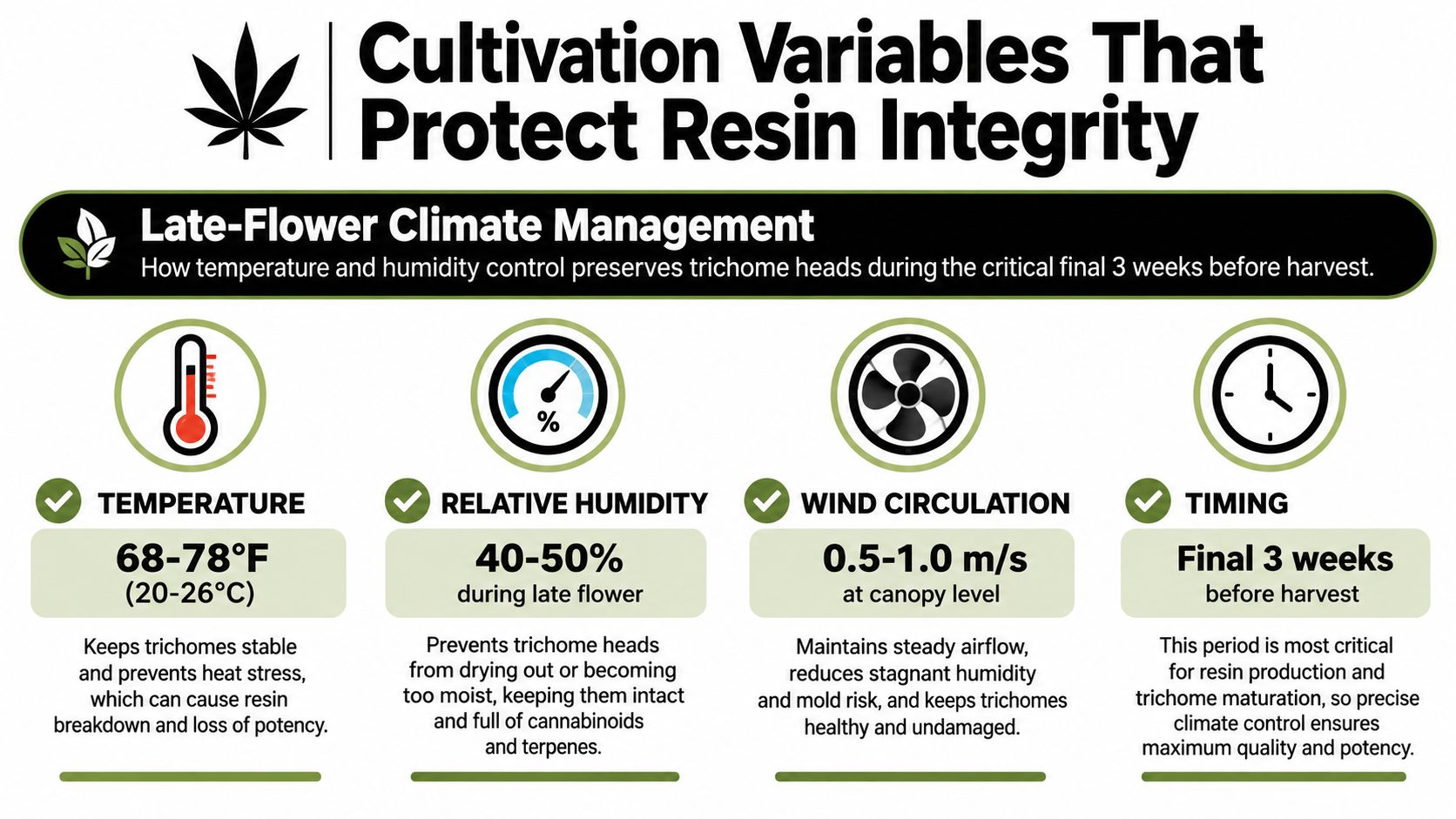
Cultivation Variables That Protect Resin Integrity
Late-flower climate control protects the resin that extraction teams buy. Apple Fritter's dense flowers need consistent airflow and moisture management through the final weeks. Trapped humidity can reduce resin quality before the biomass reaches the lab, while rough handling can remove or damage trichome heads after cultivation is complete.
Lighting must suit the cultivar's structure. For dense-flowering hybrids, cultivators commonly discuss high flower-stage PPFD, but intensity alone does not create extraction-grade biomass. PPFD distribution should remain even across the productive canopy, with temperature, humidity, irrigation, and airflow controlled together. Excess intensity can increase plant stress or uneven development when the rest of the room is not configured to match it.
Audit the final weeks, not only the harvest weight
A supplier audit should cover the conditions that affect resin retention:
- Canopy light: Confirm that PPFD reaches the productive canopy evenly instead of concentrating intensity on the uppermost flowers.
- Air movement: Check circulation through and beneath dense flowers. Still pockets can retain moisture even when room-level readings look acceptable.
- Humidity stability: Review sustained control across late flower, not a favorable single reading taken during a room check.
- Flower structure: Inspect compact flowers for internal moisture, bruising, and damaged resin. Dense structure can hide problems that visual inspection misses.
- Harvest handling: Ask how the crop is cooled, dried, packaged, and transported. Compression, heat, and rough movement can compromise trichome heads after the grow has performed well.
The trichome integrity guide offers useful background for assessing the resin structures that influence extraction potential and aroma preservation. Procurement teams do not need to impose one universal grow recipe. They need evidence that a supplier can maintain suitable conditions through late flower and post-harvest handling.
Supplier audit question: Can the grower show how late-flower temperature, humidity, airflow, and harvest handling were controlled for the specific lot being offered?
A high-yield batch with degraded aroma may still suit a broad distillate product, but it is a weaker candidate for a strain-specific cartridge. For accurate Apple Fritter flavor replication, test both the incoming biomass and resulting oil, then compare the sensory profile with a controlled terpene reference.
Evaluating Wash Yield Versus Visual Frostiness
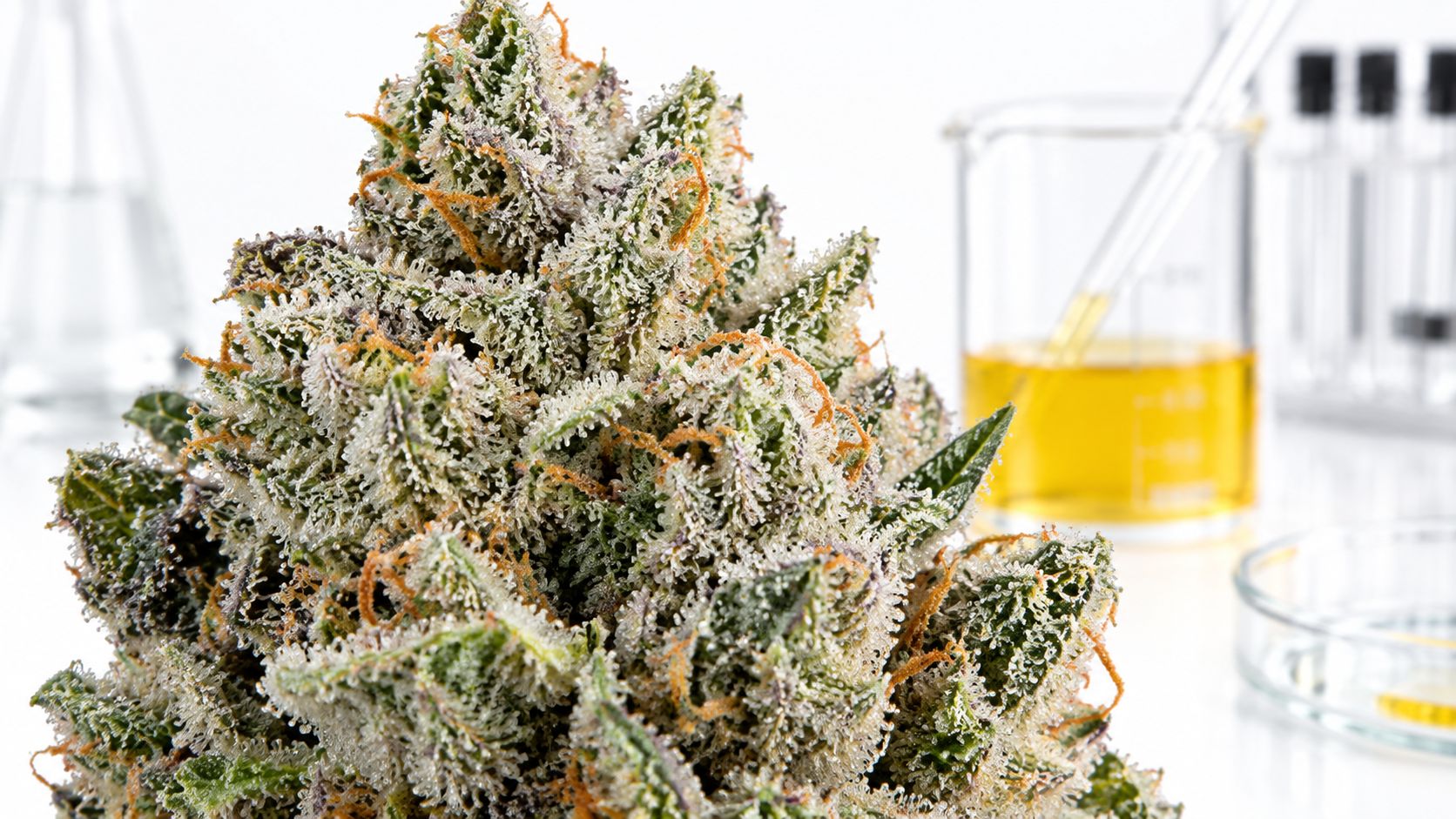
Frosty flowers are worth testing, but frost alone doesn't prove strong wash yield or finished-extract performance. Apple Fritter's visible trichome coverage can support an extraction hypothesis, yet the selected cut still needs process testing for resin behavior, recovery, and flavor retention.
A trichome-heavy appearance tells you that the flower has visible glandular structures. It doesn't tell you how those trichomes separate, whether the resin melts cleanly, how much oil the process recovers, or whether the resulting extract carries the expected Apple Fritter character. Weedmaps' Apple Fritter reference makes the important distinction that visual frostiness should prompt testing rather than serve as proof of hash performance.
Screen the cut for process value
A useful screening program compares phenotypes under the same process conditions. Keep the material history consistent, record recovered oil, assess the physical behavior of the resin, and compare the aroma before and after downstream processing. The objective is not to reward the prettiest flower. It's to identify the cut that delivers a repeatable combination of recovery and usable flavor.
For a vape manufacturer, the finished oil also needs to pass a sensory review after dilution. A raw extract can smell rich and expressive, then lose its recognizable profile during distillation or become dominated by one heavy note after formulation. That outcome doesn't necessarily mean the biomass was poor. It may mean the oil needs a carefully designed strain-inspired terpene blend rather than an aggressive attempt to recreate every natural volatile.
Extraction-grade frost is a test result, not a visual category.
A practical comparison should include:
- Starting biomass quality, including handling, moisture condition, and visible trichome integrity.
- Recovered oil, measured using the same process and comparable input condition.
- Aroma architecture, including spice, citrus, earth, floral, pine, and fruit impressions.
- Cartridge behavior, such as clarity, viscosity, fill consistency, and sensory stability under the brand's validated formulation conditions.
The video below can help teams align cultivation observations with laboratory and extraction discussions.
If natural wash performance varies between cuts, standardization becomes a formulation problem as much as a cultivation problem. That's where botanical components can help a brand preserve a recognizable profile across lots, provided the final product remains compliant with the applicable jurisdiction and the formulation is validated for the intended hardware.
Rebuilding the Terpene Hierarchy for Vape Cartridges
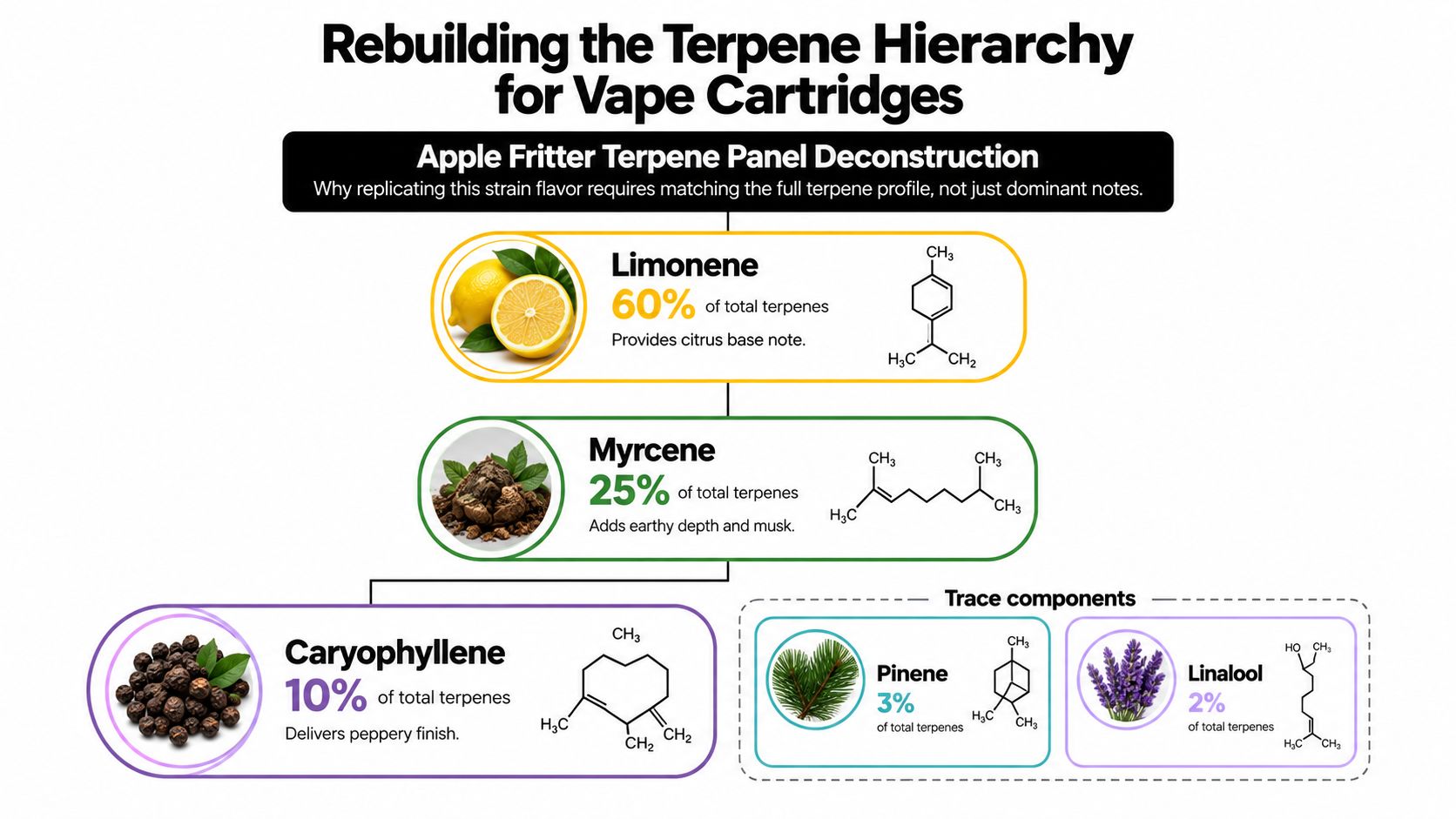
Accurate Apple Fritter flavor replication requires the full terpene hierarchy, not just a sweet apple label. The profile is commonly described as caryophyllene-led, with limonene and humulene often following, while some cuts show more myrcene. A separate Apple Fritter strain review reports a measured panel led by caryophyllene at well above half a percent, with limonene and humulene next and myrcene notably low.
That hierarchy creates a formulation challenge. The product name suggests fruit and dessert, but caryophyllene can bring warm spice, pepper, and a gassy bite that dominate the first impression. Limonene supplies citrus brightness, while other minor components help create the creamy, floral, dough-like character that makes the profile feel complete rather than just citrus-forward.
Assign each component a sensory job
A practical formulation map separates the profile into functional layers:
- Top notes: Limonene contributes citrus lift and helps the opening read as bright and fruit-oriented. Alpha-pinene can add a fresh, sharp lift when the blend needs more definition.
- Middle notes: Bisabolol can support creamy-sweet floral and dough-like impressions. Myrcene, when present in the selected cut, can add earthy and musky depth.
- Base notes: Caryophyllene creates warm spice, pepper, and gassy bite. Humulene can reinforce a dry, woody, earthy direction rather than a candy-like fruit note.
A strain reference from Blimburn Seeds assigns caryophyllene to warm spice and gassy bite, bisabolol to creamy-sweet floral doughiness, and alpha-pinene to fresh pine lift. Those assignments are more useful for cartridge development than treating “apple” as a single ingredient.
Gold Coast Terpenes can be used as one botanical formulation option when a brand needs a repeatable strain-inspired direction for distillate. The company also offers isolated compounds such as limonene, myrcene, and beta-caryophyllene, allowing a formulator to adjust the opening, body, or finish rather than adding an undifferentiated flavor concentrate.
The critical comparison is between natural-extract dependence and controlled reconstruction. Natural extraction can produce an authentic lot-specific profile, but it may vary with phenotype, harvest, storage, and processing. A botanical blend can improve batch-to-batch consistency, but an overly simple blend may flatten the profile or exaggerate the wrong note.
Formulation principle: Match the dominant sensory relationship, not merely the dominant laboratory peak.
For vape cartridges, evaluate the blend in the actual distillate matrix and hardware. Check whether the citrus top note disappears, whether caryophyllene becomes harsh or overly dry, and whether the creamy middle survives filling and storage. The distillate terpene guide offers a starting point for that work, but the final ratio should come from bench testing, sensory review, and compliance documentation.
Commercial Formulation and Sourcing Questions
Commercial Apple Fritter formulation should start with documentation, a repeatable blend strategy, and a controlled dilution workflow. Gold Coast Terpenes supplies lab-verified, THC-free, botanically derived components designed for cartridges, concentrates, and product development, but each manufacturer still needs to validate its own finished formula, hardware, and regulatory requirements.
How should a brand choose a terpene supplier?
Look for clear botanical versus cannabis-derived labeling, batch documentation, safety data, consistent naming, and support for the intended product type. A supplier should also explain whether a profile is a complete blend, an isolate, or a custom formulation, because those choices affect sensory control and label review.
The best terpene suppliers for vape brands aren't selected by flavor names alone. Evaluate whether the vendor can support repeat purchasing, provide the documentation your quality team needs, and communicate practical ordering terms such as minimum order quantities, bulk formats, and custom-blend requirements.
Are botanical terpenes suitable for an Apple Fritter profile?
Botanical terpenes can provide the compounds used to build a strain-inspired profile without relying on cannabis-derived input. The choice between botanical and cannabis-derived terpenes depends on jurisdiction, brand positioning, documentation, supply consistency, and the sensory target.
For cannabis product formulation, don't assume that a botanical blend will taste identical to a particular live resin lot. Use it to reproduce the intended aromatic structure, then compare it with a retained natural reference and adjust the balance of citrus, spice, floral sweetness, earth, and pine.
How should formulators approach dilution?
Start with a small, documented bench batch of winterized distillate and a controlled terpene addition. Use a terpene calculator to record the target ratio, isolate contributions, lot numbers, mixing order, and sensory observations, then validate the formula in the intended cartridge system.
The calculator is a recordkeeping and ratio tool, not a substitute for compatibility testing. Viscosity, fill behavior, leakage risk, flavor intensity, and hardware performance must be assessed by the manufacturer under its established quality process.
What should a buyer ask about minimum order quantities?
Ask for the MOQ for stock profiles and the separate MOQ for custom blends. Confirm whether the same profile can be reproduced across future lots, what documents accompany each shipment, and how the supplier manages specification changes.
Gold Coast Terpenes supports strain-specific profiles and isolated compounds, so a buyer can evaluate whether a ready-made direction or a more adjustable blend better fits the Apple Fritter SKU. The commercial decision should reflect forecasted production and validation capacity, not just the lowest initial order size.
Can a frosty Apple Fritter cut replace terpene formulation?
Not reliably. Frostiness can justify extraction testing, but it doesn't establish wash recovery, distillate aroma retention, or repeatability across phenotypes. A brand that wants consistent cartridge flavor should characterize the natural oil and keep a validated botanical formulation route available for lot correction or profile standardization.
For product teams, the strongest sourcing model combines lot-level biomass testing, process-specific recovery data, and documented terpene formulation. That approach avoids paying for flower weight that doesn't translate into usable oil or a stable consumer-facing profile.
Gold Coast Terpenes offers strain-inspired botanical blends and isolated compounds for teams developing Apple Fritter-style distillate, concentrates, and vape cartridges. Review the available formulation options and supporting resources at Gold Coast Terpenes, then request the documentation and samples needed to validate flavor, hardware performance, and compliance before placing a production order.