
A historical Cherry Pie dataset puts humulene ahead of myrcene, a useful warning against treating a strain name as a recipe. For manufacturers evaluating Gold Coast Terpenes or another supplier, Cherry Pie strain terpenes for cannabis product formulation should start with a measurable flavor target, not a familiar label.
The practical question isn't whether a blend sounds like Cherry Pie on a product page. It's whether its compound ratios match your reference, its source supports your intended labeling, and its flavor survives your distillate matrix and production hardware.
What Does the Cherry Pie Terpene Profile Contain?
The terpene profile for Cherry Pie is a range, not a fixed formula. Historical laboratory records, nursery descriptions, and individual certificates of analysis can identify different dominant compounds without establishing a universal specification.
A dataset covering 84 flower laboratory records from 2012 to 2018 reports 2.6% median total terpenes by weight, with humulene at 0.68%, beta-caryophyllene at 0.52%, myrcene at 0.28%, and pinene at 0.21%. Smaller reported contributors include ocimene at 0.04% and bisabolol at 0.02%.
Reference terpene values for Cherry Pie by source
The historical values above and the 2026 Prime Cuts Nursery listing provide contrasting reference points.
| Source | Total terpenes | Beta-myrcene | Beta-caryophyllene | Alpha-pinene | Other leading compound |
|---|---|---|---|---|---|
| 84 flower records, 2012-2018, median | 2.6% | 0.28% | 0.52% | 0.21%, reported as pinene | Humulene 0.68% |
| Prime Cuts Nursery listing, 2026 | Not stated | 0.8-1.2% | 0.4-0.9% | 0.1-0.3% | Limonene 0.1-0.3% |
Don't silently convert a general pinene result into an alpha-pinene specification. The distinction matters when you're purchasing isolates or comparing laboratory methods.
The historical dataset also identifies Granddaddy Purple crossed with Durban Poison as the lineage. Its sweet, fruit-like, earthy, spicy, and herbal aromatic description is useful for setting a sensory target, but lineage doesn't establish the concentration of any individual compound.
Why the myrcene-forward description still appears
SC Labs' terpene classification overview identifies Cherry Pie as an example of a myrcene-dominant profile, with myrcene sometimes exceeding 50% of a sample's total terpene content. That describes a recognized chemotype, not a guarantee for every batch sold under the name.
For cultivation-side context, Botanist Seeds provides a home grower's guide to aromatic cultivars. Use that kind of resource to understand aroma vocabulary, not to set manufacturing tolerances.
Practical rule: Treat the strain name as a hypothesis. The target batch's COA establishes the chemical specification.
For purchasing, separate the reference profile from the acceptance specification. A reference tells your blending team where to begin; an acceptance specification tells quality control which incoming material can enter production.
Should Cherry Pie Blends Use Botanical or Cannabis-Derived Terpenes?
Three sourcing questions determine whether a terpene blend fits a Cherry Pie product: What plant material was used? Does the documented composition meet the flavor target? What source and content claims can the finished-product label support? The strain name is a starting hypothesis. Check each batch's documents before approving it.
Botanical terpenes come from plants other than cannabis, such as citrus or pine. Cannabis-derived terpenes come from cannabis flower or extract fractions. “Nature-identical” describes a different manufacturing or labeling claim, so verify the supplier's terminology and supporting records rather than treating these categories as interchangeable.
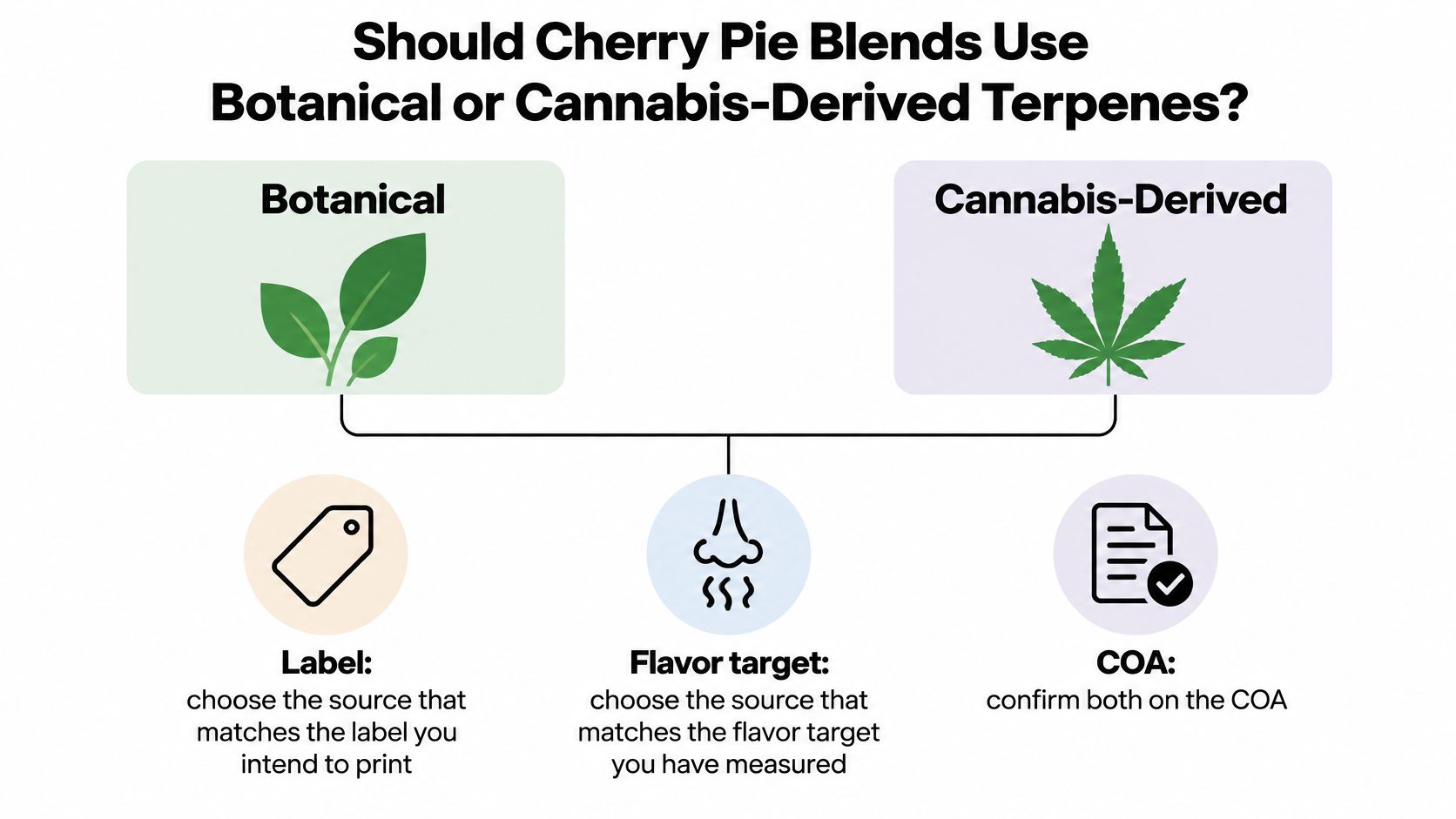
Botanical and cannabis-derived terpenes compared for Cherry Pie products
The botanical versus cannabis-derived terpene guide can help clarify source terminology. Treat it as background, then request batch-specific documents before turning a category description into a product claim.
| Factor | Botanical terpenes | Cannabis-derived terpenes |
|---|---|---|
| Source material | Plants other than cannabis, such as citrus or pine | Cannabis flower or extract fractions |
| Flavor match to Cherry Pie | Built from reference ratios; flower-native minor compounds may be absent | Can carry flower-native minor compounds; varies by source batch |
| Label term | Use botanical terminology only with supporting origin documentation | Use terminology that matches documented cannabis origin |
| THC content | Publisher describes its botanical blends as THC-free; verify the batch | Confirm on the COA and against applicable state rules |
| Carrier additives | Publisher states its blends exclude VG, PG, PEG, and MCT | Varies by supplier; check the specification sheet |
| Testing | Publisher states its blends are SC Lab-tested; request batch confirmation | Confirm the laboratory, scope, and report date |
A botanical blend gives the formulator a defined set of compounds to adjust against a reference profile. That can make composition easier to control, but it does not establish a complete match to flower, especially when the target includes minor compounds absent from the specification.
Cannabis-derived fractions may retain flower-native minor constituents. Their source does not guarantee a consistent profile, so compare each batch's COA with the material's acceptance limits before production.
Check the label before approving the material
- Origin documentation: Confirm the supplier's sourcing records support the intended botanical or cannabis-derived claim.
- THC status: Review analytical results and reporting limits against the rules for the finished product.
- Carrier declaration: Obtain a written specification; don't assume the product contains only terpenes.
- Compound coverage: Check whether the report measures the compounds relevant to your flavor target.
The Apple Fritter flavor page in the catalog is a flavor reference, not a Cherry Pie specification. Use the documentation for the actual material under review. If the batch COA, source declaration, and compound list do not support the intended product and label, hold the material for clarification rather than approving it.
How Do You Turn a Cherry Pie COA Into a Blend Ratio?
Divide each measured compound by the batch's total terpene concentration, then scale those normalized shares to your chosen finished-product load. Normalization separates the relative flavor recipe from the amount added to distillate.
The Cherry Pie certificate of analysis used for this calculation reports 0.763% total terpenes, comprising limonene at 0.249%, sabinene hydrate at 0.213%, terpinolene at 0.127%, beta-myrcene at 0.116%, and alpha-pinene at 0.058%. The calculations below derive from those reported values.
The conversion follows this sequence.
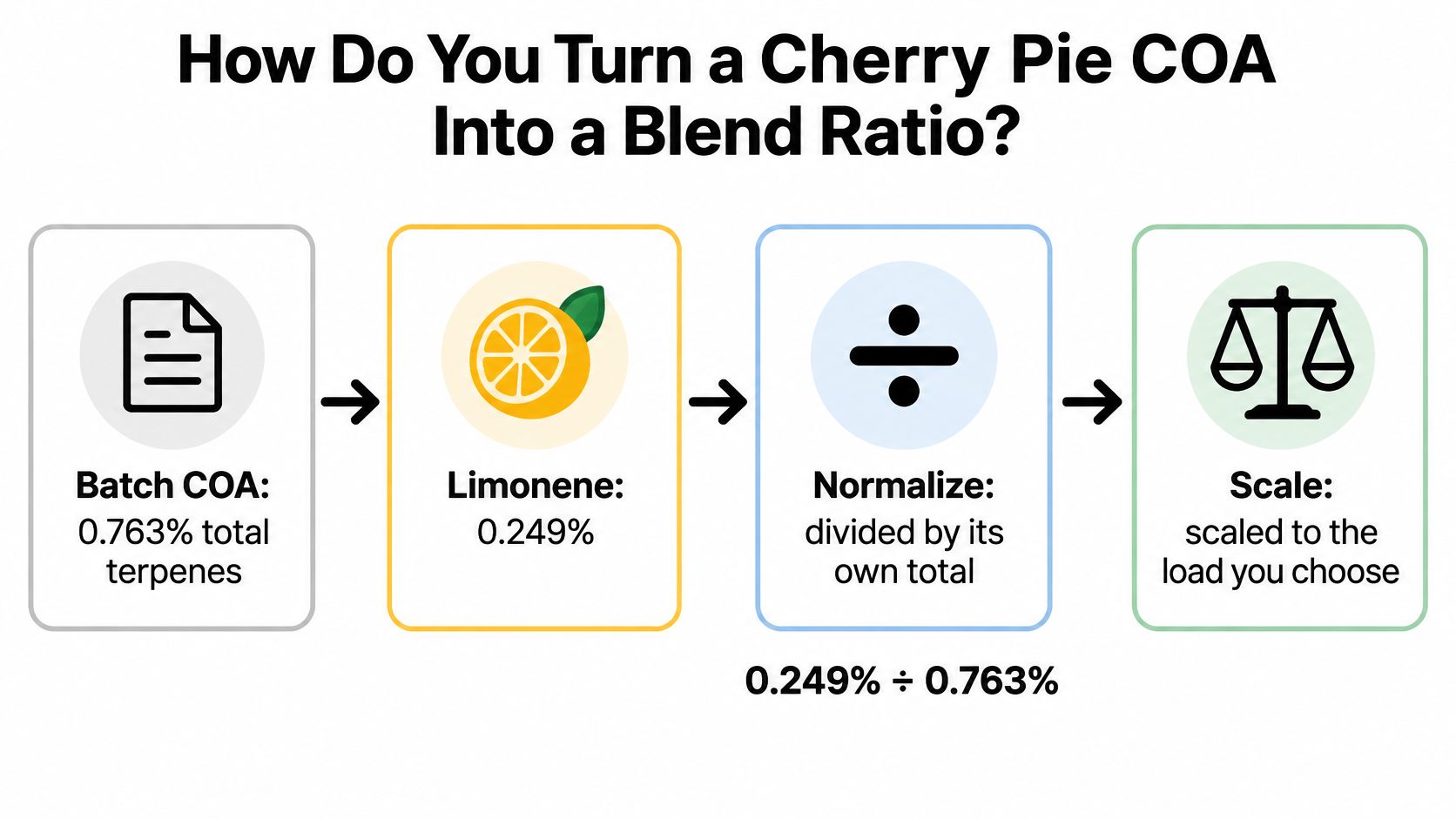
Calculate the relative composition first
Transcribe the measured values. Keep compound names and reporting units exactly as the laboratory presents them. Don't merge isomers or treat an unreported compound as a measured zero.
Confirm that the listed values sum to the reported total. They do in this example, which allows normalization against that total without an unexplained remainder.
Divide each compound value by the total. The result is its share of the terpene fraction, not its concentration in the finished cartridge.
Choose a finished-product loading assumption. The table uses 3% only as a worked arithmetic example, not as a safety limit or recommended operating level.
Convert the result to mass. Multiply each finished-product fraction by the intended finished batch mass, retaining unrounded values until the weighing calculation is complete.
Compare the normalized recipe with your target. This COA doesn't report the humulene or beta-caryophyllene values prominent in the historical reference, so it represents a different starting profile.
Worked COA conversion for a 3% terpene load
These are calculated values from the linked COA, rounded for display.
| Compound | COA weight % | Share of total terpenes | Amount in a 3% load |
|---|---|---|---|
| Limonene | 0.249% | 32.6% | 0.98% |
| Sabinene hydrate | 0.213% | 27.9% | 0.84% |
| Terpinolene | 0.127% | 16.6% | 0.50% |
| Beta-myrcene | 0.116% | 15.2% | 0.46% |
| Alpha-pinene | 0.058% | 7.6% | 0.23% |
For example, the calculated limonene contribution in a 1 kg finished batch is approximately 9.8 g, using the same COA and loading assumption. Rounded table entries won't necessarily add to the exact target, so use full-precision fractions in the production worksheet.
The mixing ratios calculator can help check scaling arithmetic. It can't determine whether the selected loading works in your matrix or hardware.
A normalized COA is a starting recipe, not a finished-product approval.
Write down whether your percentage means fraction of final product or addition relative to starting distillate. Those denominators aren't interchangeable, and a clear batch sheet prevents an avoidable weighing error.
Which Terpenes Go in the Top, Mid and Base Notes?
Top notes establish the first impression, mid notes connect the profile, and base notes provide a deeper finish. These are sensory formulation roles, not guarantees about which compounds remain unchanged during vaporization.
The top note is the first chord struck, the mid note is the melody, and the base is the bass line that lingers. That analogy helps organize bench trials without pretending aroma timing is a precise thermal model.
The hierarchy is useful when comparing successive blends.
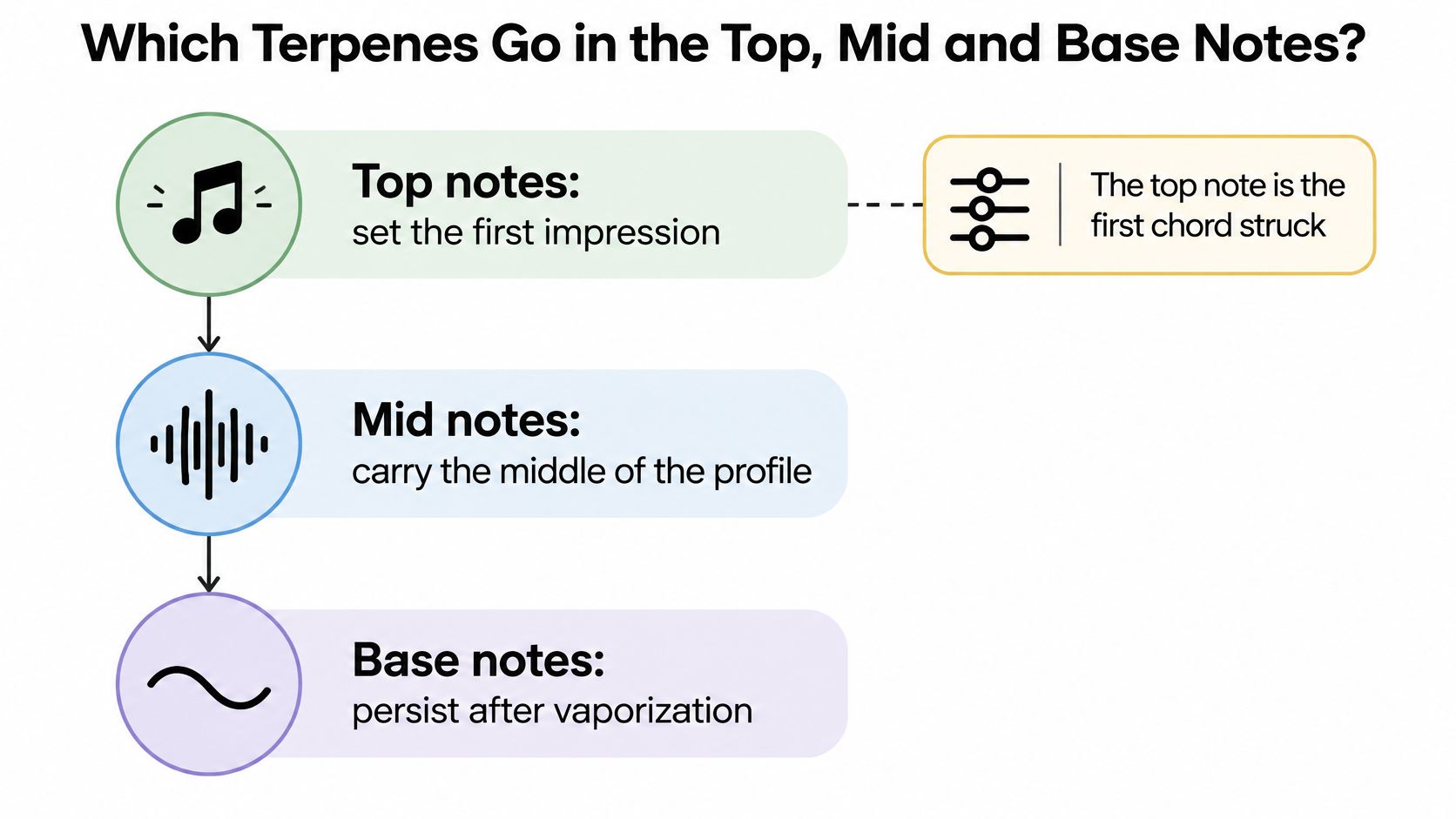
Assign roles against the actual reference
The terpene extract formulation guide describes limonene as a top-note component, linalool as a mid-note component, and myrcene plus beta-caryophyllene as base-note components. For a Cherry Pie strain-inspired terpene blend, that architecture separates immediate fruit-citrus brightness from floral connection and grounded depth.
- Top: Use limonene as the opening reference in the worked profile. Evaluate its balance against the rest of the blend rather than increasing it because the opening seems weak.
- Mid: Linalool is a possible floral bridge, but the worked COA doesn't report it. Treat sabinene hydrate's placement in the middle as a bench hypothesis to test, not an established replacement for linalool.
- Base: Evaluate myrcene for the deeper finish. Add beta-caryophyllene only when your intended reference or sensory specification calls for it, rather than inserting it automatically because another Cherry Pie dataset contains it.
- Top-to-mid adjustment: Evaluate terpinolene separately during sensory and heated testing. Its contribution shouldn't be inferred solely from its liquid-phase concentration.
Change a role, not everything at once
If the opening is too sharp, changing the total terpene load also changes the middle and finish. A more informative trial holds the other components steady while adjusting the opening fraction.
Likewise, adding a floral bridge changes the target. It may improve a commercially useful interpretation, but the resulting blend should be documented as strain-inspired, not presented as an exact reconstruction of the reference COA.
Roles establish order of impression, not dose.
Assign each compound a primary role in the bench worksheet, then adjust a single slot per trial. Record both the chemical change and the sensory result so the next formulator can reproduce the decision.
Why Does a Cherry Pie Blend Change When Heated?
Equal liquid-phase percentages don't guarantee equal delivered flavor. Heat can remove, transform, or deliver compounds at different rates, so matching the vial doesn't establish a match in the aerosol.
The image below illustrates aromatic materials, not a cartridge-testing method.
A cartridge formulation discussion summarizing a 2021 heating study reports testing 12 cannabis terpenes from 100°C to 500°C, with approximately 97-98% myrcene survival versus 11-28% terpinolene survival at the higher temperatures tested. Those results justify checking terpinolene retention, but they aren't a forecast for your cartridge.
Separate evaporation from chemical survival
Research on cannabis vaporization reports that at 180°C, approximate vaporization rates relative to THC were about 23 times for bisabolol, 380 times for beta-caryophyllene, 2,200 times for linalool, and more than 3,500 times for beta-myrcene. A compound can therefore survive a particular heat test yet leave the liquid quickly.
That distinction prevents a misleading conclusion that myrcene always “holds up” while terpinolene disappears. Chemical survival, evaporation, and aerosol delivery are different measurements.
The guide to terpene boiling points provides terminology for discussing volatility. Don't turn a boiling-point chart into a device operating specification.
Test the filled product
- Capture aerosol from production hardware. Use the operating power range and puff conditions you intend to validate.
- Compare the aerosol analysis with the pre-fill analysis for the same blend. Pair the chemistry with a controlled sensory assessment.
- Adjust only after identifying the loss. If the opening falls outside specification, evaluate a ratio change or alternative component, then repeat emissions and storage testing.
Don't automatically raise terpene loading to compensate for a weak opening. That can change both exposure and aerosol chemistry.
The video is an additional visual reference, not evidence for the thermal measurements above.
Which Aerosol Safety Variables Need Validation?
A Cherry Pie label is a hypothesis, not an emissions result. Test each batch at its intended terpene load, assess stability under planned storage conditions, then test the formulation in the final hardware. Ingredient identity alone cannot establish how the filled product performs when heated.
The relevant question is whether adding Cherry Pie terpenes to distillate changes aerosol chemistry at your target loading and device settings. A flavor match does not answer it.
Research on terpene-containing cannabis concentrate aerosols examined myrcene, linalool, limonene, and a commercial terpene mixture. The researchers reported volatile organic compounds, including benzene, methacrolein, and isoprene, and identified unresolved dose-response questions. The same research describes California regulators' summaries connecting higher terpene content with increased carbonyl emissions through terpene oxidation.
Variables that change Cherry Pie aerosol chemistry
Set acceptance criteria with your testing laboratory and compliance team before evaluating samples. Compare results with the same analytical method, target load, storage conditions, and device settings intended for production. The laboratory should define its reporting limits and applicable specifications; pass or fail each condition against those criteria rather than treating one favorable test as product-wide clearance.
| Variable | Why it matters | Evidence to request |
|---|---|---|
| Terpene loading | California regulators' summaries, described in the terpene aerosol research, link higher loads with increased carbonyl emissions | Aerosol emissions data at the target load |
| Oxygen exposure | Terpene oxidation contributes to carbonyl formation | Oxygen-exposure or headspace test record |
| Storage time | Volatile-component losses can shift the blend's balance | Stability data under planned storage conditions |
| Coil temperature and device power | Heating conditions affect delivery and degradation products | Aerosol testing across the intended power range |
| Hardware materials | Material compatibility depends on the assembled product | Material documentation and aerosol tests on final hardware |
| Batch COA | Establishes the measured compound list and total | Current batch COA with full reported analytes |
Keep ingredient approval separate from product approval
The terpene vaping safety resource can inform supplier discussions, but release decisions require evidence from the product itself. A purity claim does not characterize emissions from an assembled cartridge.
No universal loading limit follows from the cited research. Set product-specific acceptance criteria with the laboratory and compliance team, then require the formulation to meet them at the intended load. Follow with stability testing under planned storage conditions and aerosol testing in the final hardware. If any result falls outside specification, adjust the formulation or conditions and repeat the affected tests before release.
Release criterion: Approve the formulation that you tested, in the hardware that you tested.
The cited toxicology discussion describes California-funded 2025 work intended to build a reference dataset of natural flower flavor compounds for distinguishing authentic plant flavors from prohibited additives. Chemical authenticity and inhalation documentation address different questions, and both inform a defensible Cherry Pie claim.
Review the actual formulation, labeling, and sales jurisdiction before release. Botanical origin alone does not establish compliance or acceptable emissions.
What Should You Confirm Before Ordering Terpenes?
Treat the Cherry Pie name as a starting hypothesis, then qualify the specific batch against your target composition and intended label. Hold the order if the documentation does not support that target. Any difference from the reference should be reviewed at the bench before filling.
Purchase approval checklist
- Batch COA: Request the reported compound list and total. Compare the results with your normalized target.
- Laboratory confirmation: Obtain the batch-specific report behind any SC Lab-tested claim.
- THC and carrier statements: Request written specifications, including analytical reporting limits where relevant.
- Source declaration: Check that the documented origin supports the botanical or cannabis-derived wording you plan to use.
- Commercial terms: Confirm wholesale eligibility, bulk pricing, shipping, discounts, and quote validity before budgeting.
- Sample qualification: Test the material in your intended matrix and hardware before authorizing scale-up.
The available catalog reference does not establish a current Cherry Pie product-page URL or bulk-program page. Ask the supplier for the exact pages and order-specific documents. A similar listing is not evidence that it covers the material you intend to buy.
Compare suppliers on evidence access
| Buying criterion | What a useful response includes |
|---|---|
| Composition | A batch-linked analytical report, not only a generic example |
| Source disclosure | A written origin statement consistent with labeling |
| Manufacturing fit | Material that can be compared with your own GC results |
| Commercial clarity | Written MOQ, lead time, and quote validity |
| Change control | A clear process for notifying you about specification changes |
Choose the supplier whose records let your QC team reproduce the qualification decision. Check that the report, source declaration, and change-control process all refer to the material being quoted.
Botanical blends, cannabis-derived fractions, and internally assembled isolate blends can each be assessed against the same target. Their practical differences include source documentation and the work needed to verify the blend against your specification. Keep the evaluation focused on documented fit.
Request a sample with its batch COA and source declaration. Keep the purchase on technical hold until pre-fill chemistry, delivered flavor, and emissions results support the finished-product specification. Recheck the blend in the intended hardware: a batch COA describes the material, while testing the filled product addresses what happens when it is heated.
What Do Formulators Ask About Cherry Pie Terpene Blends?
Confirm the minimum order quantity, lead time, and sample terms for the specific material before scheduling production. Ask whether production orders will include a batch-specific COA.
What minimum order and lead time should a vape brand expect for a Cherry Pie blend?
Get the MOQ and lead time in writing. Confirm that sample terms and production-order terms are distinct, and ask whether the quoted material will have a batch-specific COA. Treat Cherry Pie as a profile to verify against that COA, not as proof of a fixed composition.
How much blend does a distillate batch need at the worked example’s loading?
Multiply the intended finished batch mass by the selected terpene fraction, then allocate that mass according to the normalized COA shares. For a fixed distillate mass, calculate against the final-product mass, not the starting oil mass.
How do I keep a Cherry Pie formulation consistent across different grower batches?
Compare the normalized limonene share in each batch’s COA with the worked example’s normalized limonene share. Record the difference against your acceptance specification, then adjust only if analytical and sensory results support a change. This measures a defined part of the profile, rather than relying on the Cherry Pie name to imply consistency.
What should the batch file contain before a Cherry Pie product ships?
Document the approved formula and weighing record, plus finished-product stability, production-hardware aerosol results, and release approval. Supplier COAs do not establish how the blend performs after heating in your device.
Gold Coast Terpenes supplies strain-specific blends and isolated compounds for cartridges, concentrates, and formulation work. Ask Gold Coast Terpenes for its current Cherry Pie documentation and sample terms. Confirm the material against your measured reference before scaling production.