
One reference batch sums to 2.66% for its five leading terpenes alone, above the roughly 2% total commonly reported for commercial cannabis flower. Gold Coast Terpenes, a Redondo Beach, CA supplier of 100% natural, THC-free terpene blends and isolates that are not cannabis-derived, uses reference data like that to set targets for an Ice Cream Cake terpene profile for cannabis product formulation. The name is a sensory target, not a chemical specification, and that's the distinction that determines whether a blend matches or misses.
Ice Cream Cake Terpene Profile at a Glance
There's no single fixed Ice Cream Cake terpene profile, so use mean laboratory values as a starting target and confirm them against the batch you're matching. Commercial batches vary with genetics, cultivation conditions, harvest timing, curing, storage, and testing methodology, and ranking can shift from lot to lot.
Gold Coast Terpenes, a supplier of 100% natural, THC-free terpene blends and isolates, uses reference profiles like this one to set formulation targets rather than treating a cultivar name as a spec. The mean values below come from laboratory certificate of analysis aggregation data. They support a combined description of citrus, sweet floral, peppery, earthy, and woody notes rather than one dominant aroma, as summarized in laboratory COA aggregation data for Ice Cream Cake.
Mean Reference Values
| Terpene | Mean concentration | Aroma descriptor |
|---|---|---|
| Limonene | 0.81% | Citrus |
| Beta-caryophyllene | 0.70% | Peppery spice |
| Farnesene | 0.46% | Green woody |
| Linalool | 0.38% | Floral lavender |
| Beta-myrcene | 0.31% | Earthy herbal |
| Humulene | 0.22% | Hops, woody |
| Alpha-bisabolol | 0.15% | Soft floral |
| Nerolidol | 0.13% | Floral woody |
| Beta-pinene | 0.12% | Pine |
| Alpha-pinene | 0.12% | Pine |
The five leaders, limonene, beta-caryophyllene, farnesene, linalool, and beta-myrcene, sum to 2.66% before minor constituents are added. That reads as terpene-rich against the broader flower benchmark, but it's not a cultivar-wide average because the figures come from analyzed product certificates. Don't copy the table into a product spec without a batch check.
Practical rule: Set a target range per compound, then verify the finished blend against the certificate for the specific batch you're replicating.
A German market study of 140 medicinal cannabis flower samples detected 38 terpenes, while nine compounds explained 86% of variation among profiles, according to the same aggregation source linked above. The lesson for formulators isn't to chase every compound. It's to lock the compounds that drive variation and document ranges.
Before you set ratios, review how a certificate is structured in the COA certificate of analysis guide. Confirm units, method, and detection limits there, because a mean table can't tell you whether a compound was absent or just below reporting limits in your reference batch.
Which Terpenes Lead and Which Set the Base
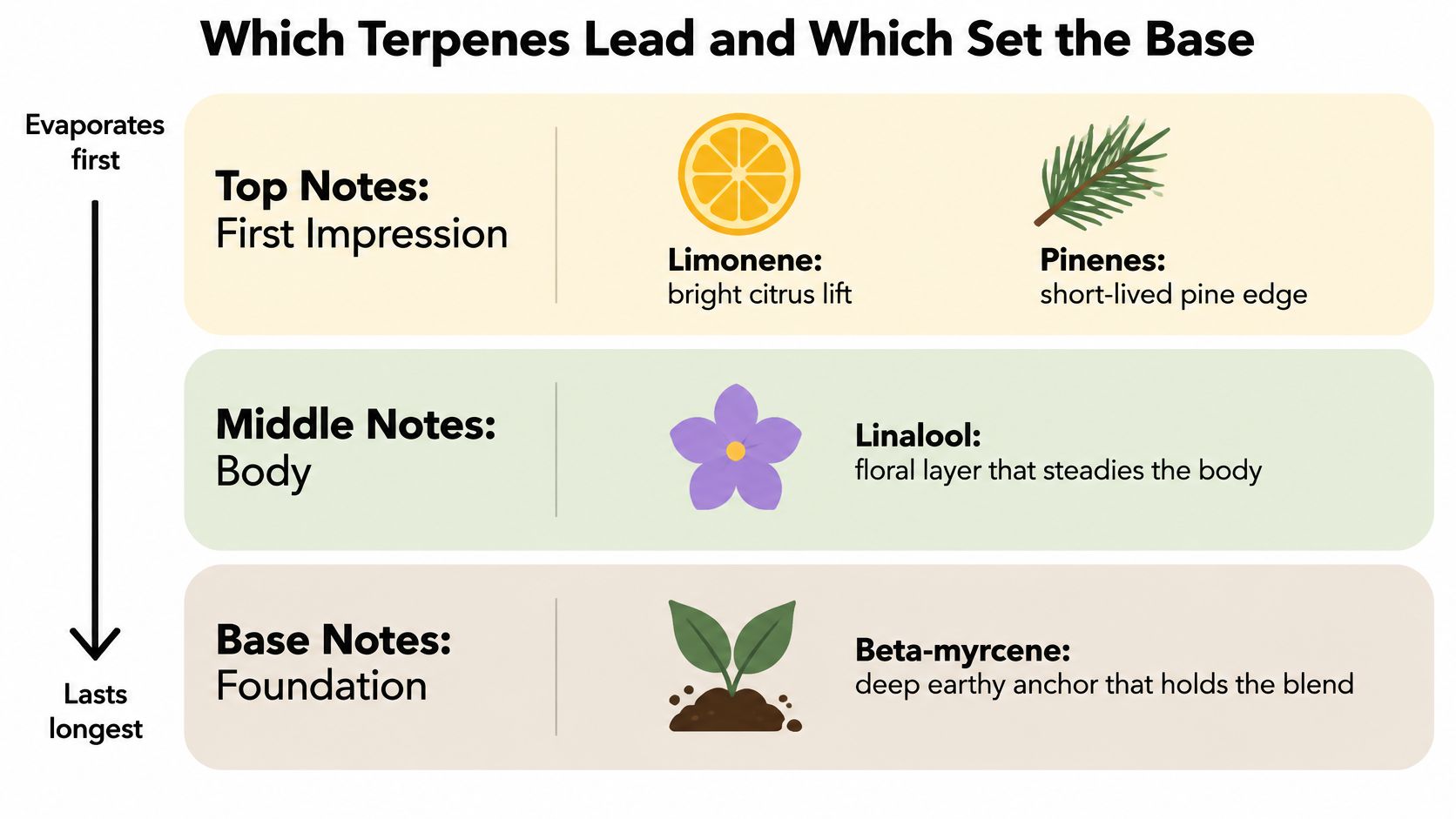
Limonene leads the top, linalool carries the floral middle, and beta-caryophyllene with beta-myrcene set the base. Roles describe function in the blend, not a fixed ranking, because reported rank order shifts between batches.
Top notes are the first impression and evaporate first. Limonene supplies bright citrus lift, while alpha-pinene and beta-pinene add a short-lived pine edge that keeps the opening from reading flat. If you overbuild the top, the blend smells like citrus cleaner instead of dessert.
The chart below maps the three tiers you'll balance when formulating.
Middle and Base Function
Middle notes carry body through the draw. Linalool provides the floral layer that prevents the profile from reading as only gas or spice, farnesene and nerolidol add green woody and floral woody depth, and alpha-bisabolol softens the finish. Published summaries identify beta-caryophyllene, limonene, and myrcene as major compounds, with linalool or humulene next depending on batch, in published Ice Cream Cake strain profile summaries.
Base notes last longest. Beta-caryophyllene gives dry, peppery spice, beta-myrcene adds heavier earthy herbal weight, and humulene adds hops and woody depth. Treat Ice Cream Cake as sensory architecture, dessert sweetness, floral lift, spice, and earthy depth, then adjust against batch data.
Worked Scaling Example
To reproduce the reference balance at a 2.0% total load, a formulator can scale the 2.66% reference sum proportionally for a starting test lot. That puts limonene near the top, caryophyllene as the spice base, farnesene and linalool in the middle, and myrcene as the earthy anchor, without claiming those scaled figures are a universal recipe.
For comparison work on note tiers, teams sometimes review other dessert-leaning profiles such as Elevated Strains alongside isolate data. Gold Coast Terpenes lists 37 Strains and 40 strains in its top-shelf range in its catalog framing, plus isolates for limonene, beta-caryophyllene, and beta-myrcene that let you adjust one tier at a time.
Why Batch Variation Makes a Strain Name Insufficient
A strain name can't specify your formula because the lead terpene, and sometimes the entire ranking, changes by batch. If you build on an assumed limonene signature, you'll miss batches where limonene isn't detected at all.
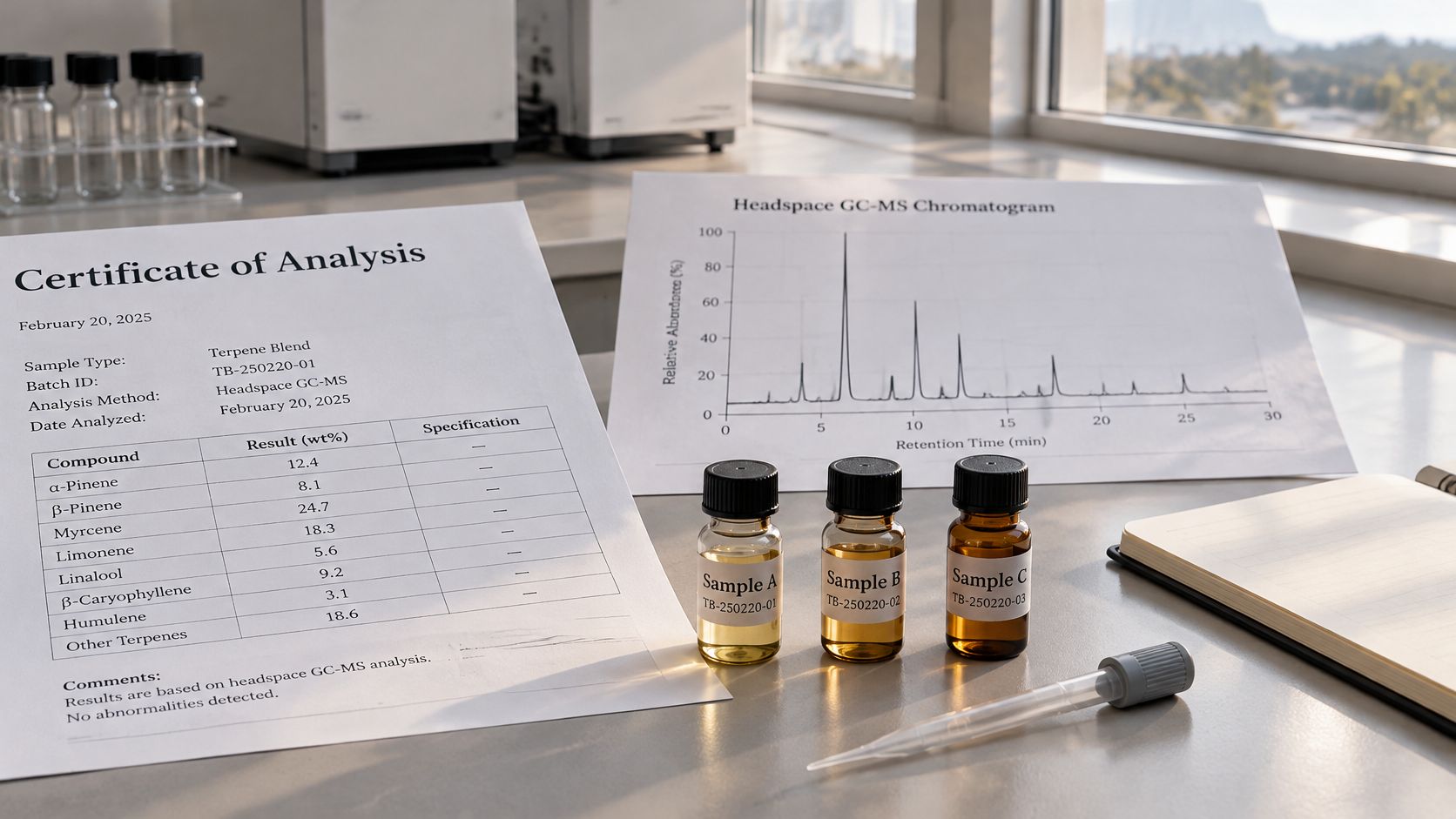
A live rosin certificate analyzed by headspace GC-MS on February 20, 2025 led with beta-myrcene at 1.899% by weight, followed by terpinolene at 0.735% and beta-caryophyllene at 0.575%, with terpineol at 0.247%, beta-pinene at 0.070%, and valencene at 0.022%, while limonene was not detected, as shown in the February 20, 2025 Ice Cream Cake live rosin COA. That's not a minor drift. It's a different anchor.
The laboratory record below is the type of document that should drive your replication, not the label on a jar.
What Moves the Profile
- Phenotype and genetics: Change which terpene leads and how the minor tail ranks.
- Cultivation conditions: Shift total terpene level and minor compound expression.
- Harvest timing: Alters ratios among myrcene, limonene, and caryophyllene.
- Curing and drying: Reduce volatile compounds that define the top note.
- Storage: Changes concentration with temperature and age, so retained samples drift.
- Testing method: Sets detection limits, compound lists, and whether a result reads as not detected.
Environmental influence is covered in the guide to terpene transformation and environmental factors. Use it when you write receiving specs, because percent and mg/g can't be compared directly without conversion and method context.
Specify analytical method, units, detection status, and batch identity on every purchase order. A number without those four fields isn't comparable.
Gold Coast Terpenes publishes SC Lab-tested results, which gives formulators a documented baseline for comparison. Set acceptable ranges per compound instead of one target value, and require a new review when the lead order changes. That rule protects you when a supplier's next lot looks like the myrcene-led rosin above rather than the limonene-led mean.
Minor Terpenes That Make the Profile Read as Dessert
A three-terpene shortcut of limonene, myrcene, and linalool captures the label but loses the dessert depth. The minor tail is what makes the blend read as cake, spice, and floral finish instead of a generic sweet citrus mix.
One representative flower certificate was caryophyllene-dominant, with trans-caryophyllene at 0.4092% (4.092 mg/g), linalool at 0.2674% (2.674 mg/g), limonene at 0.2476% (2.476 mg/g), and alpha-humulene at 0.1261% (1.261 mg/g), as reported in a representative Ice Cream Cake flower certificate. The same sample also contained trans-nerolidol, both pinenes, endo-fenchyl alcohol, beta-myrcene, camphene, alpha-bisabolol, and caryophyllene oxide.
Representative Flower Values
| Terpene | Concentration (%) | Concentration (mg/g) | Descriptor |
|---|---|---|---|
| trans-Caryophyllene | 0.4092% | 4.092 | Clove |
| Linalool | 0.2674% | 2.674 | Lavender |
| Limonene | 0.2476% | 2.476 | Orange |
| Alpha-humulene | 0.1261% | 1.261 | Hops |
| Trans-nerolidol | Present, value not listed | Present, value not listed | Floral woody |
| Beta-pinene | Present, value not listed | Present, value not listed | Pine |
| Alpha-pinene | Present, value not listed | Present, value not listed | Pine |
| Endo-fenchyl alcohol | Present, value not listed | Present, value not listed | Herbal |
| Beta-myrcene | Present, value not listed | Present, value not listed | Earthy herbal |
| Camphene | Present, value not listed | Present, value not listed | Woody herbal |
| Alpha-bisabolol | Present, value not listed | Present, value not listed | Soft floral |
| Caryophyllene oxide | Present, value not listed | Present, value not listed | Dry woody |
The reported descriptors, clove, lavender, orange, hops, and pine, show why caryophyllene, linalool, limonene, humulene, and pinene together create more realism than a simplified blend. Preserve the dominant to minor order and measure the full tail, including humulene, nerolidol, bisabolol, and the pinenes.
Flavor Matching Checklist
- Confirm the top note: Citrus and pine appear first without harshness.
- Confirm the spice base: Caryophyllene reads as dry pepper and clove, not heat.
- Confirm floral lift: Linalool and bisabolol soften the middle.
- Check the finish: Woody, hops, and earthy notes linger after citrus fades.
These are sensory design decisions. The available sources don't establish a validated strain-specific effect outcome, so keep product copy to aroma and flavor and don't let a terpene list imply a guaranteed experience.
Botanical vs Cannabis-Derived Terpenes for This Profile
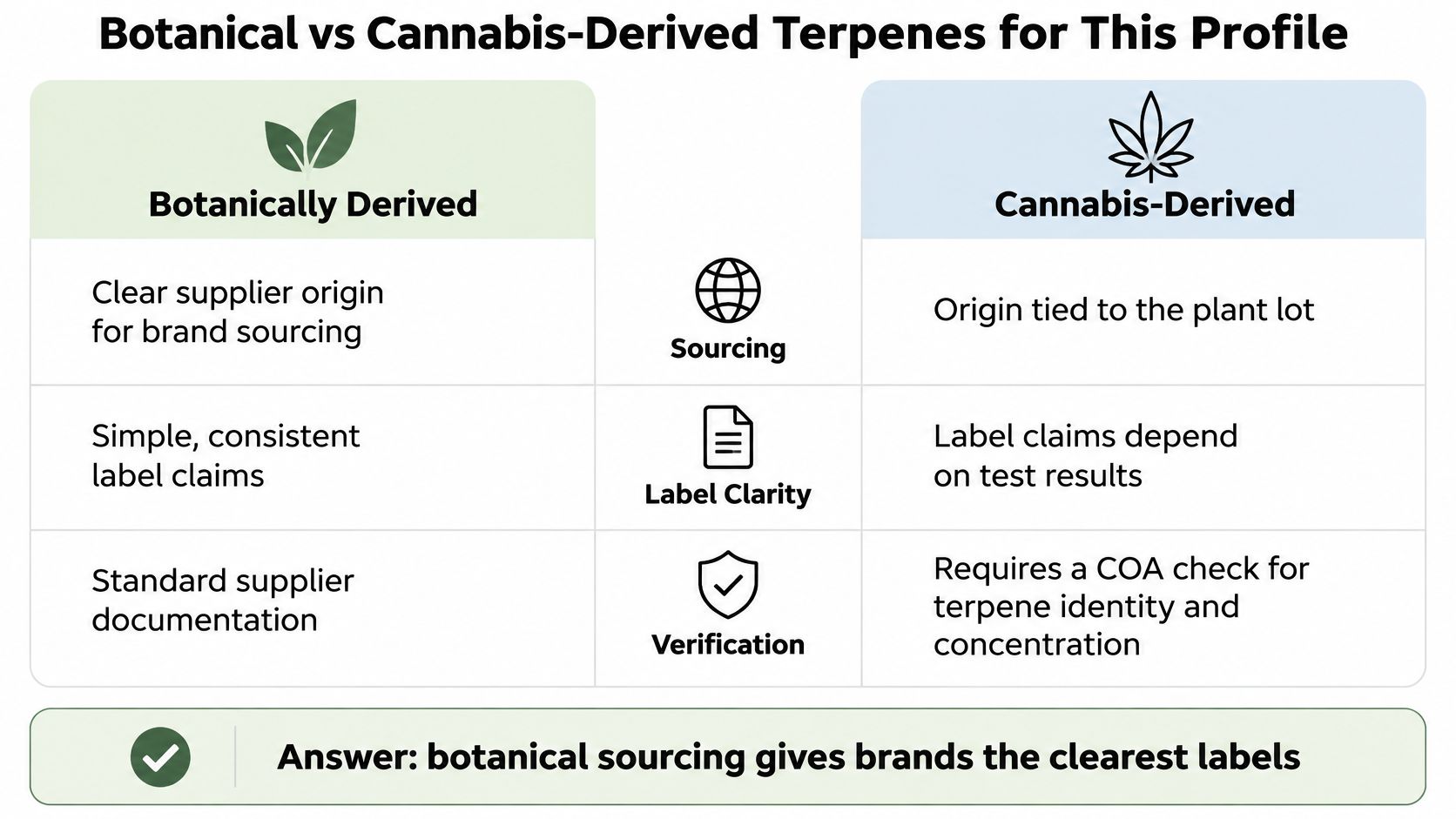
For most brands building a strain-inspired terpene blend, botanically derived terpenes give clearer sourcing and label language, while cannabis-derived material ties your claim to a specific plant lot and its COA. Match the category to the claim you intend to print, not to price per kilogram.
Gold Coast Terpenes sells 100% natural, THC-free, botanically derived terpene blends, not cannabis-derived material, so its labels can be checked against that standard. That distinction matters for brands selling across states, because botanical, cannabis-derived, and nature-identical aren't interchangeable terms and buyers have to read the exact claim on the certificate.
The comparison below separates sourcing from label verification before you commit to a category.
Category Comparison
| Attribute | Botanically derived | Cannabis-derived | Nature-identical |
|---|---|---|---|
| Source material | Plants other than cannabis | Cannabis biomass | Reproduced to match a natural compound |
| Label language to verify | Botanical or 100% natural | Cannabis-derived | Nature-identical |
| THC status | Gold Coast Terpenes lists THC-free blends | Depends on supplier COA | Verify on supplier COA |
| Diluent check | Confirm VG, PG, PEG, MCT status | Confirm diluent on COA | Confirm diluent on COA |
| Batch analysis | Lab-verified COA per batch | Lab-verified COA per batch | Lab-verified COA per batch |
Read the CDT vs BDT comparison before you approve label copy. Then confirm state rules for labeling language, the full diluent list, and whether each terpene lot is lab-verified. Nature-identical labeling needs the same scrutiny, because a compound can match a natural structure without sharing its source.
Decision rule: Choose the terpene category your label, compliance review, and supply chain can defend lot after lot.
Botanical sourcing doesn't excuse weak analytics. You still need compound identity, concentration, and batch documentation, especially when you're replicating flavor of Ice Cream Cake for vape cartridges where minor compounds shape the finish.
How to Build an Ice Cream Cake Blend for Vape Cartridges
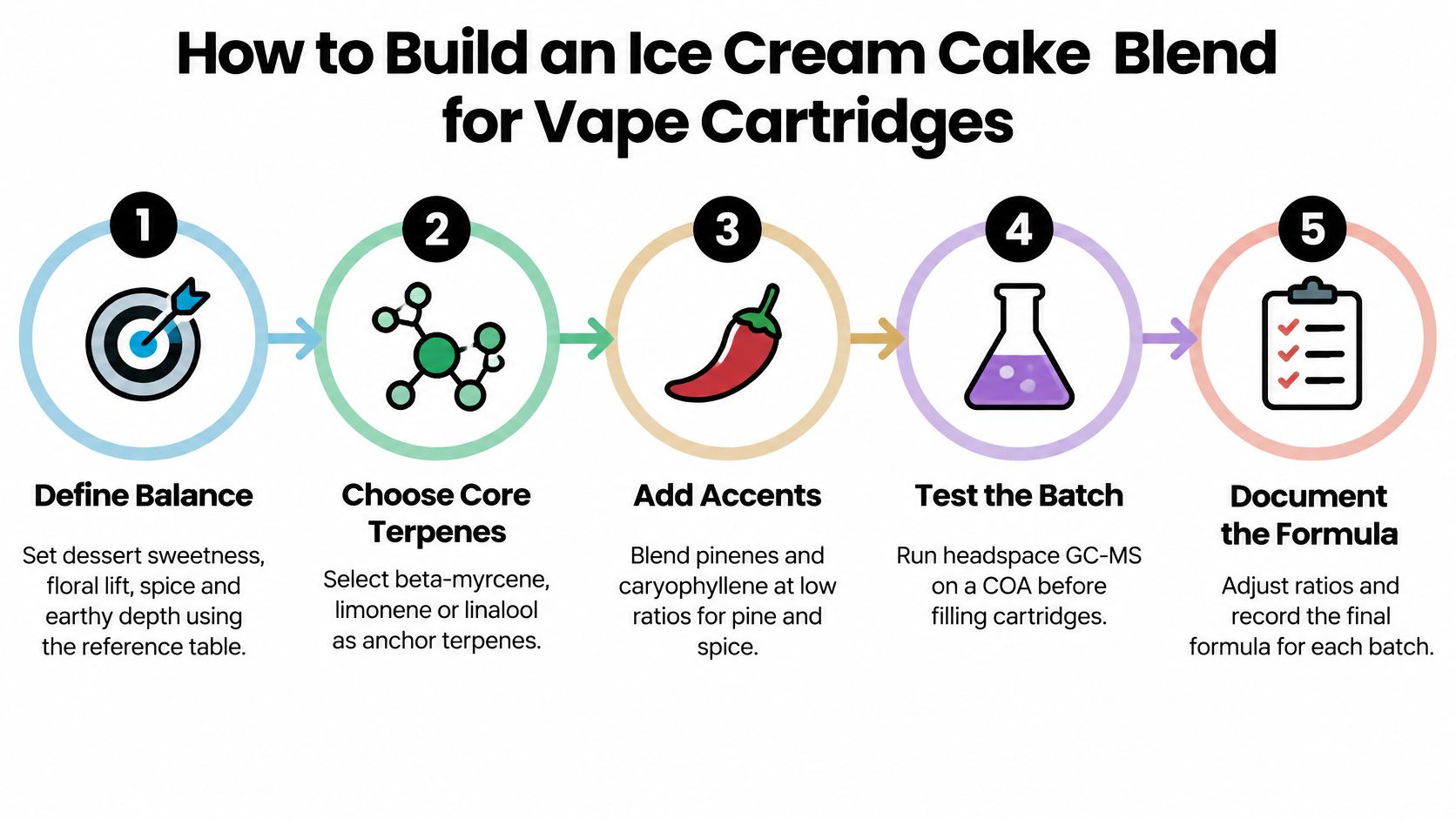
Build the blend from a defined sensory balance and a batch COA, then test the finished oil and its aerosol on target hardware. Don't assume a profile that smells right in oil behaves the same after heating.
The process flow below outlines the sequence from target setting to documentation.
Formulation Procedure
- Define the target balance: Set dessert sweetness, floral lift, spice, and earthy depth using the reference table as your starting point.
- Choose the anchor: Pick beta-myrcene, limonene, or beta-caryophyllene based on the COA you're matching, not habit.
- Set working loading: Record total terpene percentage against the cartridge spec and convert percentages to batch weights before mixing.
- Add minor compounds: Use linalool, humulene, nerolidol, and bisabolol at low ratios, and confirm diluent status.
- Mix small test lots: Compare sensory notes against the target reference and adjust one tier at a time.
- Analyze finished oil: Run the check on the blend for distillate, not the source flower, using a comparable method.
- Test aerosol behavior: Run the oil on target hardware at recorded voltage or temperature and log sensory and emissions results.
Cartridge testing summarized terpene levels from below 1% to 7% across twelve California cartridges, with approximately 60 terpene, terpenoid, flavor, and fragrance compounds across samples, in California research on terpene-containing cannabis aerosols. That range is a benchmark for variation, not a safe or optimal target. Treat loading as a process and emissions variable, especially with volatile limonene, myrcene, or terpinolene.
Gold Coast Terpenes specifies blends free of VG, PG, PEG, and MCT, which is the diluent standard to confirm in step four. Use the Mixing Calculator on goldcoastterpenes.com before step three, and review the guide on how to use terpenes for handling basics.
The video below gives a visual walkthrough to pair with your written batch record.
Batch Specification Fields
| Field | What to record | Why it matters |
|---|---|---|
| Total terpene loading | Percent of finished oil | Benchmark against the sub-1% to 7% cartridge range |
| Individual terpene levels | Percent and mg/g per compound | Reproduces the dominant to minor order |
| Analytical method | Method name, such as headspace GC-MS | Makes lots comparable |
| Detection limits | Reported LOQ values | Separates absent from not detected |
| Hardware and temperature | Coil type, voltage and temperature | Aerosol output depends on hardware |
| Aerosol test result | Sensory and emissions readout after heating | Confirms the profile survives aerosolization |
Confirm the Blend and Choose a Terpene Supplier
Confirm the finished blend against your reference profile first, then buy only from a supplier whose COA and label language support your claim. A cheap lot that forces a label rewrite isn't cheap.
Supplier Checklist
- Lab-verified COA per batch: Compound identity, concentration, method, and LOQ included.
- SC Lab testing: Documented third-party results you can file with the lot.
- THC-free status: Stated clearly for botanical blends and isolates.
- Diluent list: Free of VG, PG, PEG, and MCT where your spec requires it.
- Labeling language: Botanical, cannabis-derived, or nature-identical used accurately.
- MOQ and bulk pricing: Confirm current minimum order quantity before committing.
- Shipping terms: Lead time, restrictions, and bulk program details in writing.
Gold Coast Terpenes offers 50+ classic and contemporary strain-specific blends, including Blue Dream, OG Kush, Forbidden Fruit, and Green Crack, plus Limonene, Myrcene, and Beta-Caryophyllene isolates for building an anchor. Its published terms include free U.S. shipping on orders over $100, discounts on orders exceeding 64 oz, and wholesale and bulk programs. MOQ isn't stated in the material reviewed here, so ask Gold Coast Terpenes directly.
When comparing best terpene suppliers for vape brands, score documentation before flavor names. Run the Mixing Calculator, order a test quantity of anchor isolates, and send the finished blend for analytical comparison against the source COA. If the lead order or minor tail doesn't match, adjust the formula and retest rather than widening your spec to hide the miss.
Frequently Asked Questions About Ice Cream Cake Terpenes
What Minimum Order Quantity Should I Request
Ask Gold Coast Terpenes for its current MOQ before ordering, since a minimum isn't stated in the material covered here. Request the MOQ for anchor isolates separately from finished blends, because test lots and production lots have different needs.
How Should a Finished Blend Be Stored So the Profile Holds
Record storage temperature, container, and age for each lot, because storage changes concentration over time. Retest a retained sample against its original COA at set intervals and investigate drift before release.
Does Gold Coast Terpenes Publish Batch COAs
Gold Coast Terpenes publishes SC Lab-tested results that formulators can use as a documented baseline. Compare your finished oil COA against that baseline and your reference batch, and verify each supplier lot before production.
Can One Blend Serve Both Distillate and Cartridge Formulations
Only after you've tested it in each format. Sensory behavior in distillate and aerosol behavior in a cartridge differ, so run hardware testing and log results per format before using one spec for both.
How Do I Word a Flavor Claim Without Implying an Effect
Describe aroma and flavor only, such as citrus, peppery spice, floral lavender, or earthy woody notes. Keep relaxation, indica, and other effect language out of product copy, because terpene presence alone doesn't establish a validated outcome.
Gold Coast Terpenes supplies botanically derived, THC-free strain blends and Limonene, Myrcene, and Beta-Caryophyllene isolates you can use to build and test an Ice Cream Cake terpene profile for vape cartridges or distillate. Run your target ratios through the Mixing Calculator, request current MOQ and batch COAs, and order a test quantity before scaling. Visit Gold Coast Terpenes to review the catalog and start your formulation.