
Copying a single online percentage split and calling it a Sour Apple Fritter strain recipe is the fastest way to build an inconsistent cartridge. Gold Coast Terpenes, a Redondo Beach, CA supplier, makes 100% botanically derived terpene blends, not cannabis-derived, and that distinction matters because a botanical rebuild has to hit a measured sensory target, not borrow credibility from a cultivar name. Don't start with "what's the authentic profile?" Start with a batch, a COA, and a set of target windows you can defend in production.
Why Is a Strain Name Not a Formulation Spec for Sour Apple Fritter?
A strain name isn't a formulation spec because it doesn't fix the chemotype, ratio, or total terpene load. For a terpene profile for Sour Apple Fritter, the name only signals a sensory direction, tart green apple, baked sweetness, and peppery spice.
Gold Coast Terpenes, a Redondo Beach, CA supplier of 100% botanically derived, THC-free terpene blends free of VG, PG, PEG and MCT, frames this correctly for formulators. Its blends are inputs you dose and verify. They're not proof that any flower lot matches a published profile.
The reported lineage, Sour Apple crossed with Animal Cookies, gives you a flavor map, not numbers. It tells you to expect a bright fruit top over a denser Cookies-style body. It doesn't tell you how much limonene or beta-caryophyllene belongs in a cartridge.
Where the Published Numbers Conflict
Coverage in the JointCommerce Sour Apple Fritter strain guide notes one guide claiming THC commonly reaches 22–26% and total terpenes 1.5–2.0%, while other commercial summaries report Apple Fritter samples from 14.9–20.1% or 22–28% THC. That's not a rounding error. That's a different product under the same label.
The terpene leaders shift too. Reports variously rank myrcene, pinene, beta-caryophyllene, limonene, humulene, and linalool as dominant, and some cuts turn myrcene-forward. If you copy one profile, you're choosing one lot's chemistry and pretending it's universal.
Three variables drive most of the spread.
- Cut and phenotype: Different selections express different dominant compounds even from the same cross.
- Cultivation and cure: Harvest timing, drying, and storage change volatile retention before extraction ever begins.
- Extraction method: Distillate, live resin, and cured flower don't carry the same fractions into the finished oil.
Working rule: Specify the sensory target first, then verify each batch with cannabinoid and terpene data before any flavor recreation.
For comparing targets across cultivars, use the Gold Coast Terpenes strain terpene profiles archive as a reference library, not as batch evidence. I would treat any named reference profile the same way. It's a starting point for replicating flavor of Sour Apple Fritter, and the COA decides whether it fits your lot.
What Terpene Ranges Should a Sour Apple Fritter Blend Target?
A strain name is a sensory target, not a fixed terpene formula. Set the blend around batch-verified COA windows, then tune the ratios for the apple, citrus, and spice balance you want.
The Seennabis Apple Fritter strain review compiles results from 18 licensed Apple Fritter batches collected from 2023–2025. The reported averages are 0.71% beta-caryophyllene, 0.54% limonene, 0.48% myrcene, 0.25% linalool, and 0.18% ocimene by weight. The same source reports a separate profile with 1.39% total terpenes, including 0.62% beta-caryophyllene, 0.30% limonene, and 0.17% alpha-humulene.
Reported Sour Apple Fritter Terpene Concentrations by Source
The single-COA values below come from the reported Sour Apple Fritter COA.
| Compound | 18-batch average (2023–2025) | Single reported profile | Single COA |
|---|---|---|---|
| Beta-caryophyllene | 0.71% | 0.62% | 0.842% |
| Limonene | 0.54% | 0.30% | 0.416% |
| Myrcene | 0.48% | Not reported | Not reported |
| Linalool | 0.25% | Not reported | 0.299% |
| Ocimene | 0.18% | Not reported | Not reported |
| Alpha-humulene | Not reported | 0.17% | 0.243% |
| Alpha-pinene | Not reported | Not reported | 0.079% |
| Total terpenes | Not reported as a total | 1.39% | 1.843% |
“Not reported” does not mean absent. Use only measured values to set a marker target. Do not treat a blank as zero.
The Two Ratios That Matter Most
Compare limonene with beta-caryophyllene to define the balance between citrus lift and spice. In the 18-batch average, 0.54 ÷ 0.71 gives a ratio of about 0.76 to 1. In the single COA, 0.416 ÷ 0.842 gives about 0.49 to 1. The lower ratio puts more weight on beta-caryophyllene relative to limonene.
For a first pilot, set marker bands from the lowest and highest reported values, then center the blend on the batch data you have. The reported total-terpene values of 1.39% and 1.843% support a rough flower-equivalent reference window of 1.4% to 1.8%. Treat it as a starting point, not a cartridge target. Translate the profile into the oil matrix through sensory testing, since flower percentages do not directly predict perceived intensity in distillate.
Which Terpenes Form the Top, Mid and Base Notes?
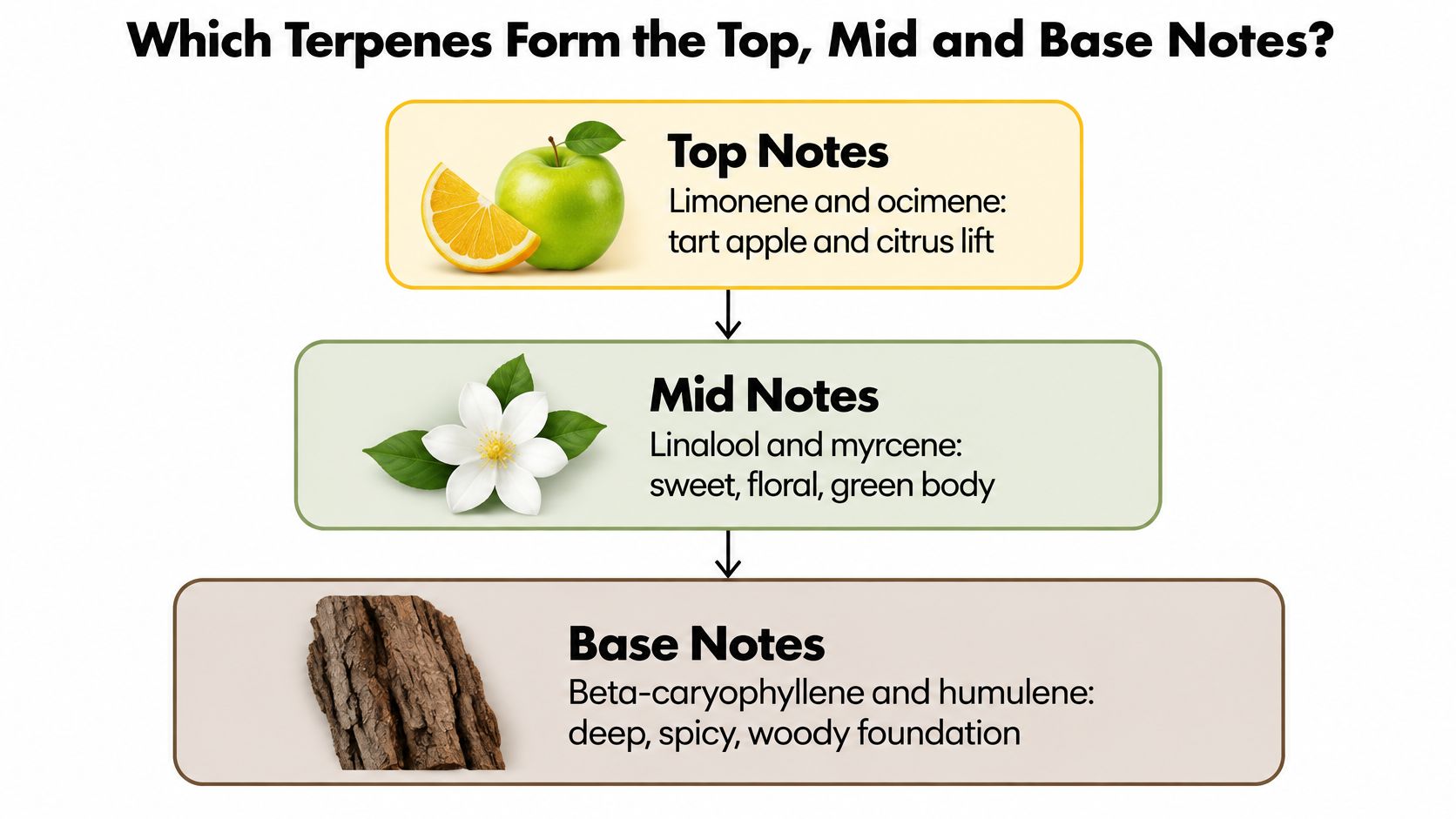
Top notes are limonene and ocimene for tart apple and citrus lift, mid notes are linalool and myrcene for sweet, floral, green body, and base notes are beta-caryophyllene and humulene for peppery, woody, pastry spice. Build in that order of perception, even if you blend base first.
Think of a baked apple pastry. Bright apple hits on the surface. Dough and sugar sit in the middle. Warm spice stays underneath after the first impression fades.
How Lineage Maps to Layers
The Nile Cannabis Apple Fritter strain review describes Apple Fritter as commonly attributed to a Sour Apple × Animal Cookies cross associated with Lumpy's Flowers in California. That gives formulators a practical map. Sour Apple supplies the tart direction, Animal Cookies supplies density.
In that framework, Sour Apple is associated with tart green-apple and fruit aromatics, while Animal Cookies contributes a denser Cookies-derived pastry, earth, spice, and resinous direction. So the target needs an acidic fruit top, a sweet baked body, and a peppery earthy base. A single apple note won't get you there.
- Top layer: Limonene drives citrus brightness, ocimene adds a lighter green lift.
- Mid layer: Linalool softens with floral sweetness, myrcene adds body and rounds the fruit.
- Base layer: Beta-caryophyllene brings pepper and warm spice, humulene adds dry woody depth.
Use the Gold Coast Terpenes terpene flavor chart to sanity-check each compound's sensory direction before you assign it to a layer. Don't assign by name recognition. Assign by what the compound does at your dose.
How Each Layer Fails
Too much limonene reads as generic citrus cleaner, not sour apple. It strips the pastry character and makes the blend interchangeable with any lemon-forward profile.
Too little beta-caryophyllene loses the baked finish. The top may smell correct on a blotter, but the exhale goes thin and sweet without spice to anchor it.
Pinene is the easiest mistake. Above trace levels it pushes the blend toward pine, which fights the dessert target. Keep it as a supporting edge, not a feature.
Volatile top notes also shift first in heated delivery. A blend that reads balanced at room temperature can lose its apple lift after heating, so judge the top layer after heating, not from the mixing vessel. Component sourcing for each layer is mapped in the formulation steps that follow.
How Do You Read a COA Before Matching the Profile?
Two Sour Apple Fritter batches can carry the same name and show different chemistry. Graswiese's Apple Fritter strain data reports two Illinois flower batches at approximately 25.1% and 21.3% THCA, with total terpene concentrations of 2.3% and 1.5% and delta-9-THC at 1.2% and 0.4%. Use the strain name as a sensory target; use the batch COA to set the measurable blend target.
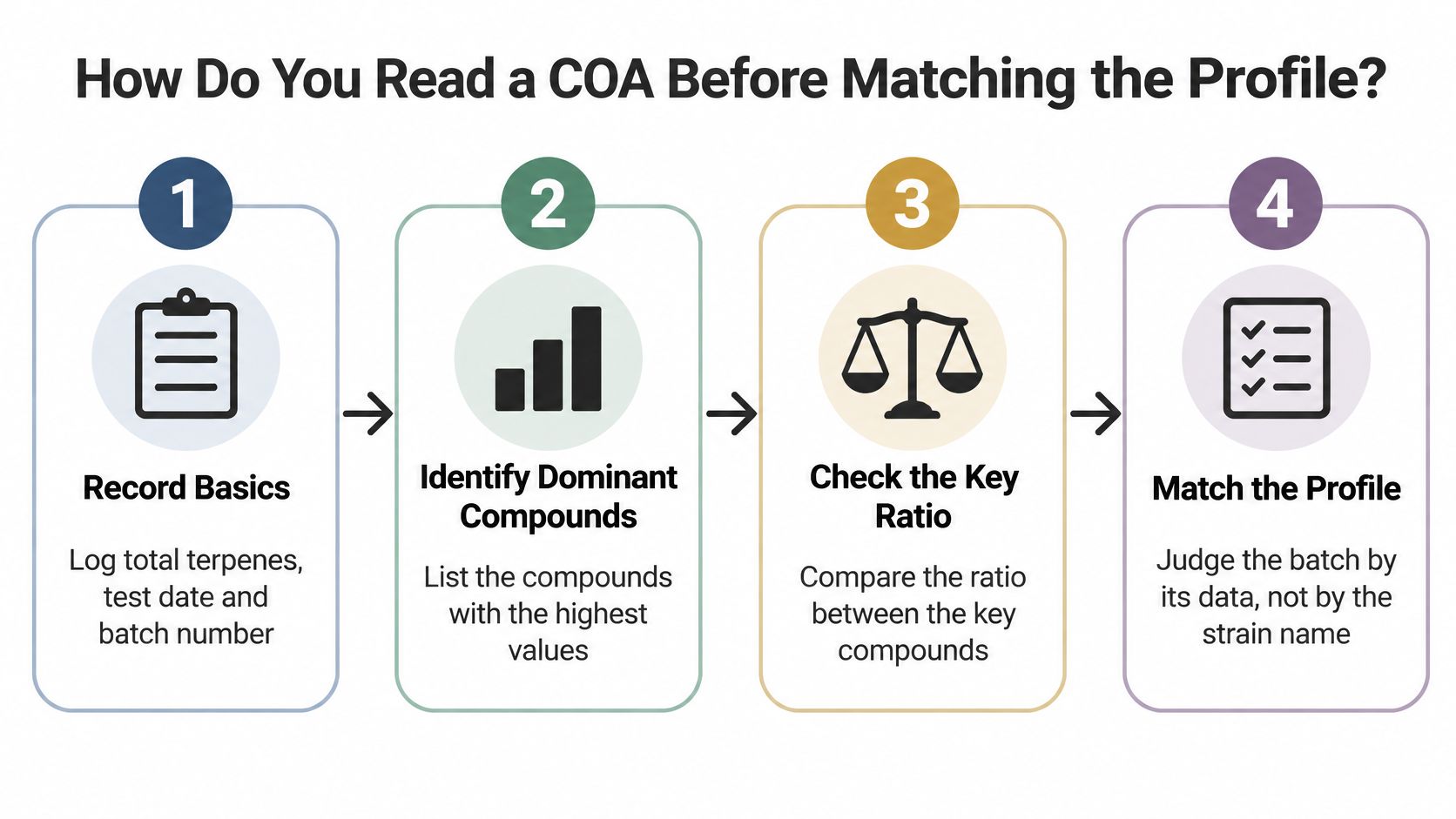
Six Step COA Reading Procedure
- Record the basics: Log total terpenes, test date, lab, and batch number before reviewing individual compounds.
- Rank the top five: List the highest compounds and compare them with the target bands.
- Calculate the key ratio: Divide limonene by beta-caryophyllene, then compare the result with the target balance established earlier.
- Check for myrcene dominance: A myrcene-forward batch puts more weight on the mid layer and may need a different top-note balance.
- Flag low-total batches: A lower total terpene percentage requires more input per gram to reach the same aroma, affecting cost and consistency.
- Make a lot decision: Accept, re-weight, or reject the batch, then record its COA number with the formulation.
One COA listed 1.843% total terpenes, including 0.842% beta-caryophyllene, 0.416% limonene, 0.299% linalool, 0.243% humulene, and 0.079% pinene, according to the reported Sour Apple Fritter COA data. Its limonene-to-beta-caryophyllene ratio falls below the 18-batch average described in the earlier section, so this batch has a more base-weighted profile.
The difference between 2.3% and 1.5% total terpenes is roughly 35%. Pricing and dosing from the higher-terpene lot could leave the lower-terpene lot short on aroma at the same input rate.
Use the COA certificate of analysis guide to standardize how your team records these fields. Consistent logging helps buyers assess a batch using the same criteria, rather than relying on total terpene percentage or one dominant compound alone.
A COA gives you a batch-specific starting point, not a finished blend specification. Distillate, live resin blends, and cartridge hardware can present the same compounds with different intensity, so confirm the profile in the intended matrix and hardware.
How Do You Formulate a Sour Apple Fritter Blend for Vape Cartridges?
A strain name is a sensory target, not a cartridge formula. Build from the selected batch's COA ranges, then adjust the blend in heated hardware. The batch target sets the proportions; the strain label does not.
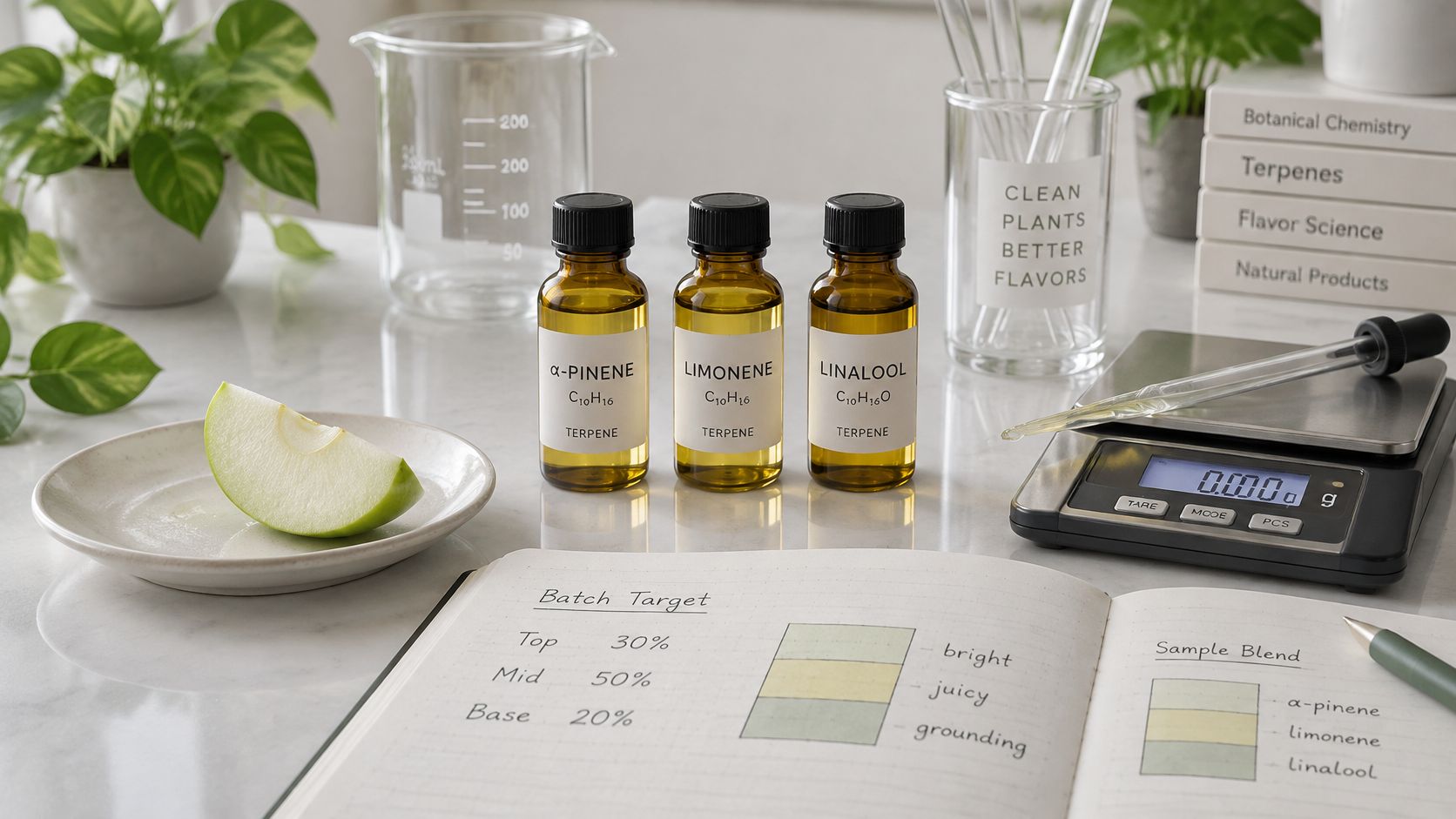
Eight Step Build Sequence
- Set target bands from the chosen batch COA: Establish the limonene-to-beta-caryophyllene ratio before weighing.
- Start with beta-caryophyllene as the base: Set its share to anchor the spicy finish.
- Add limonene for the top note: Keep it within the target ratio rather than chasing the strongest apple aroma in the vessel.
- Add linalool and myrcene for mid body: Use them to shape floral softness and sweetness without dulling the tart top note.
- Add pinene or ocimene only at trace levels: Use them for edge and lift, not as headline notes.
- Confirm carrier compatibility: Gold Coast Terpenes describes its blends as free of VG, PG, PEG, and MCT. Check compatibility against the oil and cartridge materials in the finished product.
- Dose in small increments: Evaluate the blend after heating on the intended hardware. Room-temperature aroma is not the final test.
- Check the arithmetic: Use the Gold Coast Terpenes Mixing Calculator to check dilution and ratio calculations before scaling a pilot.
Gold Coast Terpenes offers full strain profiles and isolated compounds for adjusting individual layers. A full profile provides a starting point; isolates let you re-weight a specific note without rebuilding the entire blend.
The Apple Fritter full profile can serve as a starting blend. Compare its COA with your target bands, then adjust where the batch profile differs.
Gold Coast Terpenes Matches for Each Blend Component
| Blend component | Role in the build | Gold Coast Terpenes match |
|---|---|---|
| Apple Fritter full profile | Starting base for the whole blend | Apple Fritter full profile |
| Beta-caryophyllene | Base layer, peppery and pastry spice | Beta-Caryophyllene isolate |
| Limonene | Top layer, tart citrus lift | Limonene isolate |
| Myrcene | Mid layer, body and sweetness | Myrcene isolate |
| Linalool | Mid layer, floral softness | Source separately; it is not in the isolate list summarized here |
| Alpha-humulene | Base layer, woody dryness | Source separately; it is not in the isolate list summarized here |
That sourcing gap affects how closely the blend can match its target. If linalool or humulene is part of the target bands, qualify a separate source and review its lot COA. Removing either changes the sensory target.
The video below offers bench context for handling and evaluating terpene inputs before blending them into oil.
Start a pilot at the center of the target bands, heat it, then change one layer at a time. If you alter limonene, myrcene, and total dose in the same trial, you cannot identify which change affected the flavor. Log each adjustment and judge it in the intended hardware. For distillate or cartridges, controlled, single-variable changes make the result easier to interpret.
Which Pre-Release Checks and Pilot Test Come Before You Buy?
A blend can match the intended flavor and still fail release checks. Confirm its origin, THC status, carrier ingredients, contaminant results, heated-emissions data, and label claims before ordering at scale. Then test it in a pilot on production-intent hardware.
The University of California study on effects of terpenes in aerosol systems reported that terpene-containing aerosol systems can increase carbonyl formation, with some conditions producing increases of up to ninefold. That finding makes heating conditions part of product validation. A favorable flavor result alone does not establish how the blend performs when heated.
Pre-Release Checks for a Terpene Blend in Cartridges
| Check | What to verify | Evidence to hold |
|---|---|---|
| Terpene origin | Label says botanical, nature-identical or cannabis-derived, matching the spec | Supplier statement and lot COA |
| THC content | Terpene blend tested THC-free | Third-party lab report |
| Carrier compatibility | No VG, PG, PEG or MCT in the terpene blend | Ingredient list for the lot |
| Contaminant screen | Solvent, pesticide and heavy-metal results within limits | Third-party COA |
| Heated emissions | Carbonyl formation checked at validated vape temperature | Heating test record |
| Label claims | No medical or effect claims on packaging | Label review against state rules |
Start with the origin documents. Botanical, nature-identical, and cannabis-derived describe different sources, so the supplier's records and the package wording must agree. A flavor match does not resolve an origin mismatch.
Gold Coast Terpenes offers blends described as THC-free and free of VG, PG, PEG, and MCT. Check that the documentation matches the exact lot received. A COA for another lot does not release the one intended for production.
Check the terpene blend's ingredients separately from the finished oil. Then confirm compatibility at the chosen dose with the finished oil and hardware. A clean ingredient list does not replace testing the cartridge formulation.
Pilot Test Before Scale
- Build a trial blend: Record every weight, lot number, and ratio so the pilot can be repeated exactly.
- Run a small pilot cartridge: Evaluate after heating at the validated temperature on production-intent hardware.
- Compare on the same hardware: Run your build against the published Apple Fritter profile so hardware differences don't create a false flavor difference.
Use Gold Coast Terpenes sensory evaluation methods to structure the comparison. Score top, mid, and base separately. One overall score can hide whether the apple lift or pastry finish is out of balance.
Buying rule: Buy the lot that passes the checks, not the one with the best name.
Before scaling, confirm the minimum order quantity and lead time for the production size. Gold Coast Terpenes offers wholesale and bulk programs, free U.S. shipping over $100, and discounts on orders exceeding 64 oz. Keep the production specification consistent with the pilot that passed.
Compare suppliers on lot-specific documentation, clear origin labeling, and support for heated testing on your hardware. Commercial terms matter after the technical file passes. Tie every label claim to records you hold, and remove medical, effect, or origin wording that the documentation cannot support. If a check fails, resolve the lot or label before filling cartridges.
Frequently Asked Questions About Sour Apple Fritter Terpene Blends
Does Gold Coast Terpenes Offer a Sour Apple Fritter Blend?
The Elevated Strains Apple Fritter profile is the closest catalog option for this sensory target. Treat it as a starting point, then compare its flavor against your target and the batch's COA windows before setting the formula.
What Minimum Order Should a Pilot Plan Assume?
Ask Gold Coast Terpenes to confirm the minimum order quantity and lead time for your planned pilot size. If the pilot passes on your hardware, its wholesale and bulk programs can support production orders.
Do These Terpenes Suit Distillate as Well as Cartridges?
Gold Coast Terpenes blends are THC-free and made without VG, PG, PEG, or MCT. They can be used in distillate and cartridge oils, but the finished product still needs carrier and heated testing.
Does a New Flower Batch Need a New Blend?
Check each new batch against the target COA windows. If the lot's terpene profile changes, re-weight the top notes to keep the apple character on target.
How Can a Brand Request a Lot-Specific COA?
Ask Gold Coast Terpenes for the COA tied to the specific lot you plan to order. Confirm that the document matches the product and lot before using it to set your blend.
{“@context”:”https://schema.org”,”@type”:”FAQPage”,”mainEntity”:[{“@type”:”Question”,”name”:”Does Gold Coast Terpenes offer a Sour Apple Fritter blend?”,”acceptedAnswer”:{“@type”:”Answer”,”text”:”The Elevated Strains Apple Fritter profile is the closest catalog option for this sensory target. Compare its flavor against your target and batch COA windows before setting the formula.”}},{“@type”:”Question”,”name”:”What minimum order should a pilot plan assume?”,”acceptedAnswer”:{“@type”:”Answer”,”text”:”Ask Gold Coast Terpenes to confirm the minimum order quantity and lead time for your planned pilot size. Its wholesale and bulk programs can support production orders if the pilot passes.”}},{“@type”:”Question”,”name”:”Do these terpenes suit distillate as well as cartridges?”,”acceptedAnswer”:{“@type”:”Answer”,”text”:”Gold Coast Terpenes blends are THC-free and made without VG, PG, PEG, or MCT. They can be used in distillate and cartridge oils, but the finished product still needs carrier and heated testing.”}},{“@type”:”Question”,”name”:”Does a new flower batch need a new blend?”,”acceptedAnswer”:{“@type”:”Answer”,”text”:”Check each new batch against the target COA windows. If the lot’s terpene profile changes, re-weight the top notes to keep the apple character on target.”}},{“@type”:”Question”,”name”:”How can a brand request a lot-specific COA?”,”acceptedAnswer”:{“@type”:”Answer”,”text”:”Ask Gold Coast Terpenes for the COA tied to the specific lot you plan to order. Confirm that the document matches the product and lot before using it to set your blend.”}}]}Build your Sour Apple Fritter target from COA windows, then source the profile and isolates needed to match them consistently. Visit Gold Coast Terpenes to review the Apple Fritter profile in the strain catalog, use the Mixing Calculator, and confirm bulk sizing for your next pilot.