
A Blue Pineapple cart can pass an initial flavor check and still miss the reference profile at every commercial touchpoint. The package promises ripe pineapple and berry, but the first aroma is muted, the inhale tastes like generic citrus, and the finish turns sharp after heating. That gap usually comes from treating the name as a fixed formula instead of identifying the genetic and chemical reference behind the batch.
For formulators, Blue Pineapple is better understood as a naming-confused family of crosses with a repeatable sensory direction, not one universal terpene recipe. The practical target is a cart that opens with bright fruit, carries a layered berry body, and finishes with clean pine, spice, or soft wood without allowing any single note to dominate. That's where a documented strain-inspired terpene blend earns its place in product development, alongside resources such as brand differentiation strategies for cannabis products and background reading on Colorado home grow Blue Lotus.
Why Blue Pineapple Flavor Accuracy Wins Shelf Space
A brand owner usually notices the problem after the first production run. The distillate is clear, the cartridge fills correctly, and the label looks strong. Yet the product tastes more like sweet lemon than pineapple berry, so the next batch gets adjusted by adding more citrus. That correction often makes the profile harsher and less recognizable rather than more accurate.
Flavor accuracy starts before the first puff. A credible Blue Pineapple-inspired cartridge needs three separate sensory checkpoints:
- Aroma on opening: The package should communicate fruit immediately, with enough brightness to suggest pineapple rather than a neutral botanical blend.
- Flavor on inhalation: The top note needs support from a fuller middle, otherwise limonene can read as thin citrus.
- Finish after heating: Pine, pepper, and soft wood should provide structure without leaving a burnt, solvent-like, or excessively dry impression.
This is a commercial issue because buyers compare the remembered experience of one SKU with the next. Flavor drift weakens confidence in the label, complicates reorders, and makes it harder for a brand to maintain a recognizable product family. The problem becomes more pronounced when different extractors use the same strain name but start with different genetics or terpene fractions.
Practical rule: Treat the name as a sensory brief, then verify the reference material before you choose the blend.
The reported Blue Pineapple profile is especially useful for replication because it combines a clear fruit direction with enough pine and spice to avoid tasting like candy flavoring. Independent guidance describes more than 30 volatile compounds and at least 15 detected terpenes, with reported limonene around 0.5% to 1.0% of total terpene content and pinene around 0.3% to 0.7% (independent Blue Pineapple terpene guide). Those figures support a layered approach rather than a single-molecule shortcut.
A successful formulation therefore isn't the loudest pineapple available. It's the blend that maintains recognizable fruit through filling, storage, and vaporization while preserving enough mid and base character to make the flavor feel like a cannabis-derived hybrid.
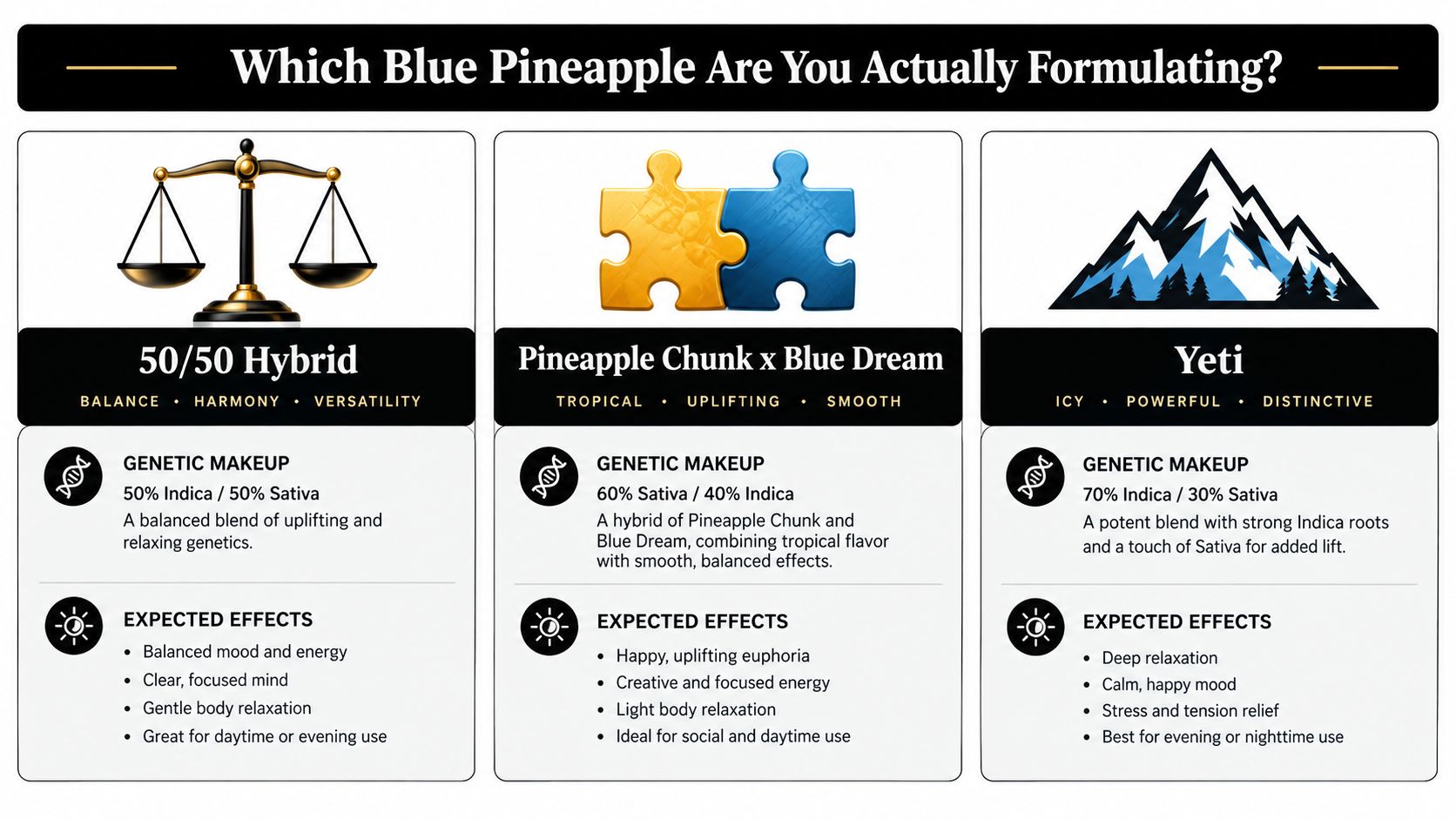
Which Blue Pineapple Are You Formulating
A production brief can fail before blending starts if “Blue Pineapple” is treated as one fixed strain. The name covers several genetic references. One widely circulated description identifies Blue Pineapple by Swamp Donkey Seeds as a deliberately bred, roughly 50/50 indica-sativa hybrid, while another describes Blue Pineapple as a cross of Pineapple Chunk and Blue Dream (lineage and potency reference).
The market uses the name for other combinations as well. Blue Pineapple by Yeti is described as Blazing Blue crossed with Pineapple Fields. Blue Pineapple Chunk is associated with Blue Dream and Pineapple Chunk, while Blueberry Pineapple is associated with Blueberry and Pineapple Diesel (market naming examples). Treat these as separate profile families. Parentage can shift the balance among berry sweetness, tropical fruit, citrus, pine, haze, earth, and spice.
Use a reference filter before blending
Separate the genetic claim, batch COA, and sensory result in the intake record. A familiar label is not source verification.
- Record the stated lineage. Capture the breeder, seed company, clone source, or supplier description exactly as provided.
- Check the cannabinoid panel. Confirm that potency fits the product brief rather than assigning strength from the strain name.
- Read the terpene panel. Note dominant compounds and their relative order. Do not force a limonene-forward batch into a heavy myrcene profile without a defined product reason.
- Keep a sensory reference. Retain a sealed sample or approved flavor standard. A photographed COA cannot show aroma, inhale, or finish.
- Assign a profile family. A Blue Dream-linked reference may need more berry and haze support. A Pineapple Fields-linked reference may suit a brighter tropical direction.
Purchasing requires the same discipline. A supplier's “Blue Pineapple terpenes” may represent one interpretation, while the flower or extract represents another. Before approving production volume, request the blend's dominant terpene architecture and confirm whether it is intended as a direct strain reference or a broader flavor interpretation. The guide to strain-specific terpenes supplies useful terminology for that review.
Deconstructing the Pineapple Berry Terpene Pyramid
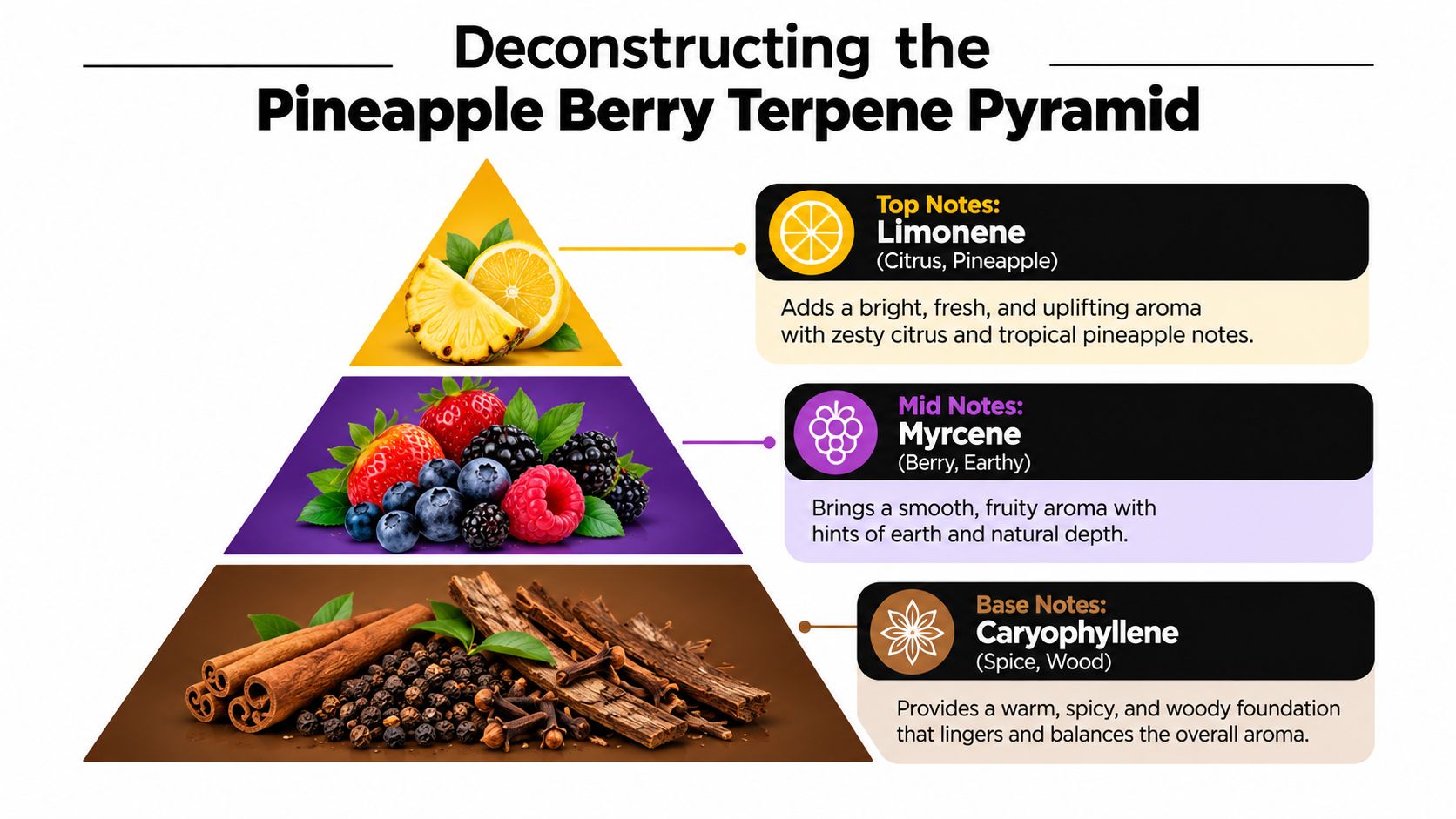
A cartridge can open with convincing pineapple and still finish flat. Blue Pineapple flavor behaves like a layered perfume: volatile top notes create the first impression, mid notes build the fruit, and heavier compounds keep the finish present after the brightest aromas fade. Build only the top and the cart smells impressive but tastes hollow. Overbuild the base and the fruit loses definition.
Independent analysis describes over 30 volatile compounds and at least 15 distinct terpenes in the profile (Blue Pineapple compound and terpene breakdown). That complexity does not require isolating every compound. It requires a layered formula, with one dominant ingredient kept from carrying the entire identity.
Top notes create the opening
Limonene supplies citrus lift that can read as pineapple when sweeter fruit notes support it. Reported Blue Pineapple limonene sits around 0.5% to 1.0% of total terpene content, while pinene is reported around 0.3% to 0.7% (profile data). Use limonene to announce the profile rather than dominate it. Excess can shift the result toward lemon peel, cleaner, or acidic candy.
Pinene adds fresh pine, green air, and a cleaner finish. It prevents the fruit from becoming syrupy and can restore freshness after cartridge processing softens the original aromatic edge.
Mid notes make the fruit believable
Myrcene supplies body, making pineapple feel ripe, soft, and rounded instead of sharp. In a berry-forward interpretation, it also connects sweet fruit with the earthy background common to cannabis profiles.
Caryophyllene contributes pepper, dry spice, and restrained wood. Use it as seasoning, not heat. Its function is to sharpen the fruit's outline so the blend does not collapse into a single sweet note.
Base notes preserve the finish
Minor volatiles carry blueberry sweetness and less obvious aromatic details. They may be difficult to identify individually, yet removing them can make the blend feel synthetic even when the primary ratios look correct. The terpene flavor chart helps map individual compounds to sensory roles during bench work.
A practical pyramid uses this structure:
- Top: limonene for citrus and pineapple brightness, supported by pinene for freshness.
- Middle: myrcene for ripe fruit volume, with berry-supporting minor notes.
- Base: caryophyllene for pepper and wood, plus heavier background notes that extend the finish.
Treat these as functional layers, not proof of one fixed strain formula. Winterization, evaporation, and high-temperature blending can strip or distort them at different rates. A blend that smells accurate in a cold vial may taste thin after entering a heated cartridge, so evaluate the finished hardware as well as the bench sample.
Expected Potency Context and Sensory Positioning
Blue Pineapple is commonly treated as a high-potency hybrid, with cannabinoid results varying by grower, phenotype, and laboratory. Reported examples place THC from the high teens into the mid-twenties, while CBD is generally minimal. Use those figures as context, not as a fixed promise attached to the name. The label may describe a family of related crosses rather than one standardized chemotype.
That uncertainty affects sensory positioning. A fruit-forward cartridge can taste approachable while still presenting as potent. The aromatic phase needs enough definition to stand beside a strong cannabinoid base, yet excessive loading creates a rough inhale and a louder, less credible fruit profile. Flavor should support the product's identity, not disguise its strength.
Distillate, live resin, and isolate-built profiles
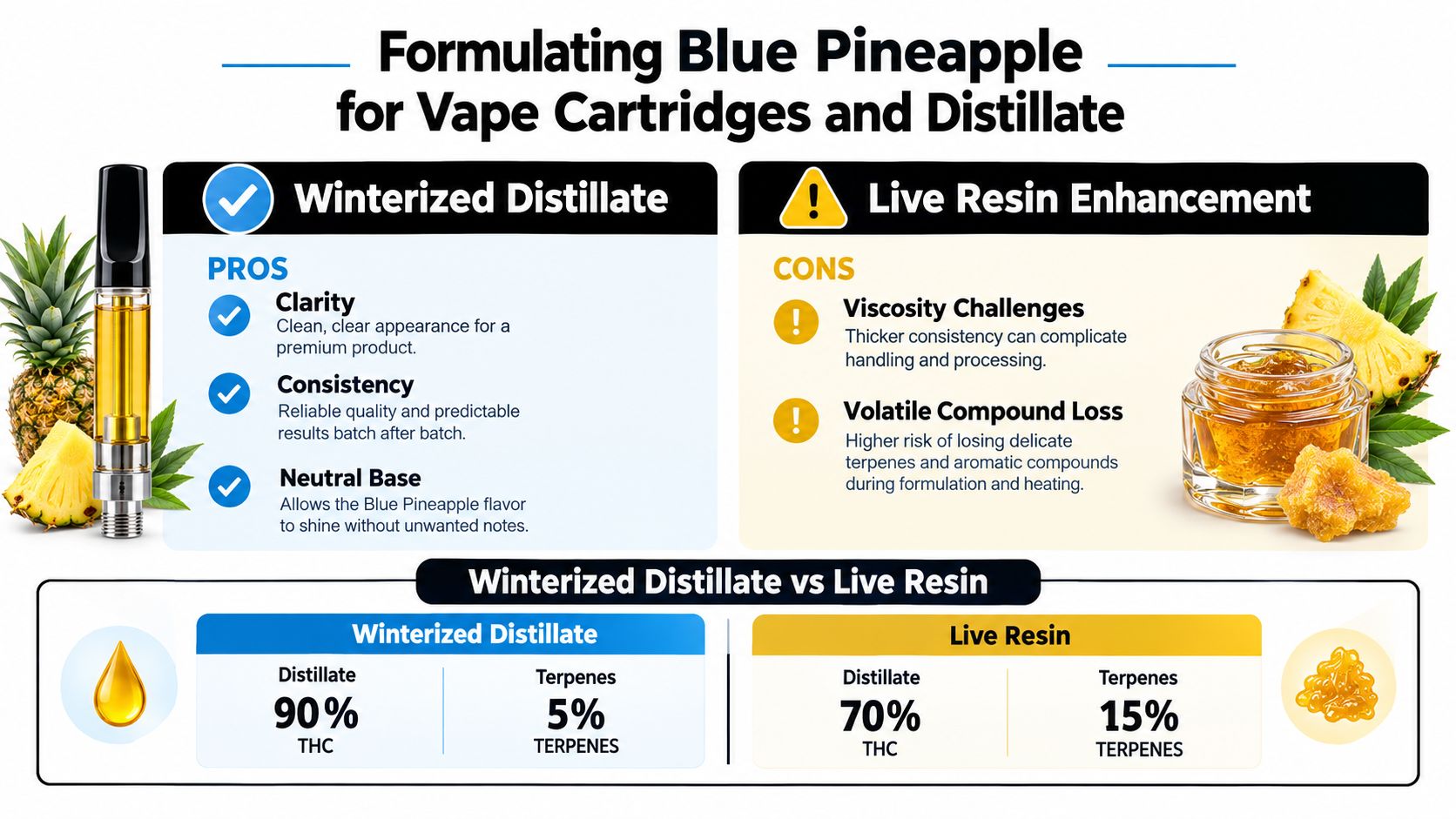
Winterized distillate provides a relatively neutral canvas. It gives the formulator control over the pineapple-berry direction, but the terpene blend must supply nearly all of the strain identity. Thin layering exposes the formula quickly, especially in a heated cartridge.
Live resin enhancement starts with more native aromatic character. Correction usually works better than replacement. A complete strain-inspired blend can bury desirable native notes, complicate viscosity control, and make the finished oil taste over-composed.
Isolate-based replication offers the tightest control over individual compounds. It also demands careful sensory review. A technically tidy blend can lack the small irregularities associated with flower-derived expression, so chasing analytical neatness alone can reduce realism.
Keep potency review separate from sensory review. The COA records the batch composition, while a controlled sensory evaluation method tests whether the finished oil still communicates the intended profile after processing and heating. Avoid medical positioning. Defensible commercial language includes fruit-forward, balanced, potent, citrus-led, berry-supported, and pine-finished, provided the tested product delivers those descriptors.
Formulating Blue Pineapple for Vape Cartridges and Distillate
The base determines how much work the terpene blend must do. Winterized distillate gives you clarity, consistency, and a neutral starting point, but the process can remove native aroma. Live resin retains more of the original extract character, although it introduces viscosity and volatile-retention concerns. An isolate-built formula gives maximum control, but it can sound more engineered if the minor aromatic layer is neglected.
Choose the base according to the target
| Base Type | Flavor Fidelity | Best Use Case |
|---|---|---|
| Winterized distillate | High control, but requires full aromatic reconstruction | Consistent branded SKUs and neutral oil systems |
| Live resin | Strong native identity, with more batch variation | Limited runs or products built around extract character |
| Isolate-built oil | Precise and repeatable when carefully layered | Formulas requiring tight control over individual notes |
Start by creating a small bench blend rather than correcting an entire production vessel. Keep the base constant, add the aromatic phase gradually, and evaluate the oil after it has equilibrated. The correct addition level depends on the base, target hardware, and applicable regulations, so the production team should validate viscosity, leakage, clogging, and vapor performance with the actual cartridge system.
Protect the top note
Winterization and high-temperature mixing are common points of flavor loss. Limonene and pinene provide much of the bright opening, so prolonged heat exposure can leave the finished oil tasting dull even when the blend was accurate at the start. Use the lowest practical incorporation temperature, minimize open-air handling, and add volatile components after the bulk oil has reached a workable processing condition.
For distillate, a limonene-forward top note with pinene-driven freshness gives the profile its recognizable lift. Myrcene and caryophyllene should create the fruit and spice body underneath, while minor constituents support the berry character. For live resin, taste the native extract first. The right intervention may be a targeted top-note correction rather than a complete reconstitution.
Viscosity is a hardware issue, not just a mixing issue. A formula that fills smoothly may still perform poorly if the oil wicks slowly, floods, or leaves residue around the heating element. Test the finished blend in the intended hardware and document both initial flavor and flavor after repeated heating.
Ratio Framework and Blending Tips for Accurate Replication
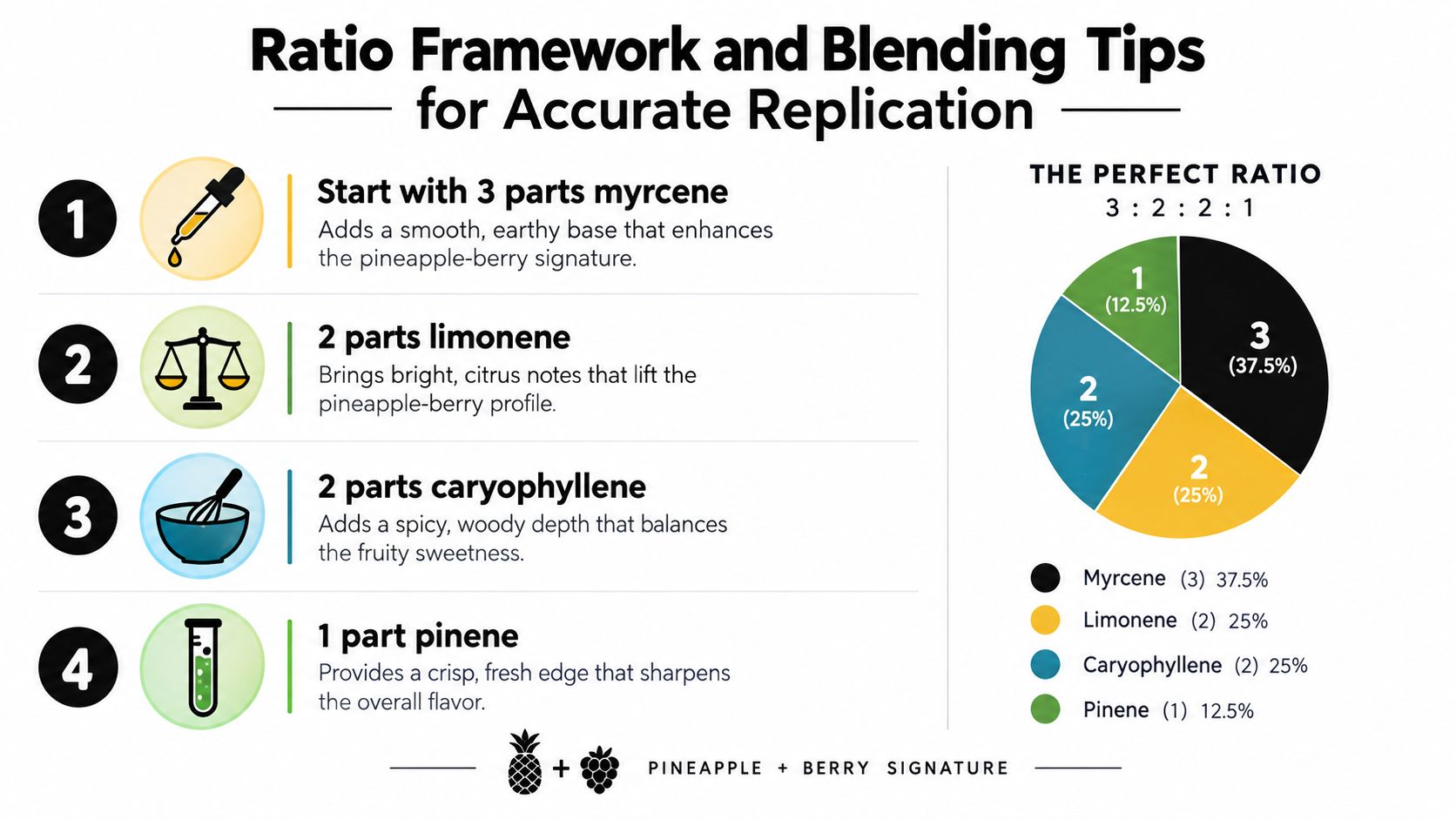
A ratio is a starting architecture, not a guaranteed finished formula. One independent strain-specific blending guide gives a concrete example for a fruit-forward profile using 3 parts myrcene, 2 parts caryophyllene, 1 part pinene, and 0.5 parts limonene (strain-specific terpene blending framework). That framework is useful because it demonstrates how a formulator can assign relative roles instead of adding ingredients by intuition alone.
Blue Pineapple needs a different sensory emphasis if the target is bright pineapple with berry depth. Limonene should receive more attention than it does in the cited starting architecture, while myrcene continues to provide roundness and caryophyllene keeps the finish structured. Pinene remains important, but it should lift the profile rather than turn it into a pine-dominant formula.
Blend in an order that protects the profile
- Build the body first. Combine the heavier structural components, led by myrcene and caryophyllene, so you can judge whether the base already feels too earthy, peppery, or dense.
- Add the bright layer carefully. Introduce limonene in a controlled increment and evaluate whether it reads as pineapple citrus or lemon.
- Lift with pinene. Add pinene after the fruit body is established. This makes it easier to stop before the finish becomes overly green or medicinal.
- Support the berry impression. Use suitable minor aromatic components or a strain-specific blend to fill the gap between sweet fruit and cannabis background. The aim is a layered berry impression, not artificial blueberry candy.
- Allow equilibration before judging. Evaluate the blend after thorough, gentle homogenization and again after it has contacted the intended oil base. Freshly mixed samples can misrepresent the final balance.
Use low heat and avoid aggressive, prolonged mixing when the aromatic phase is already uniform. Record the lot, base, blend version, addition sequence, processing temperature, hardware, and sensory result. That record matters more than a ratio written once in a notebook because it lets the team identify whether drift came from the terpene material, the extract, the process, or the cartridge.
For references, formulators can compare isolated compounds such as limonene, myrcene, and beta-caryophyllene with curated profiles such as Elevated Strains Apple Fritter, while keeping the Blue Pineapple target defined by its own COA and sensory standard.
Compliance Testing and Sourcing for Consistent Results
A sellable Blue Pineapple-inspired cartridge needs more than a convincing aroma. Confirm the terpene material is THC-free, review current COAs, and verify residual-solvent results before approving it for production. The formulation should also be screened for the diluents the brand has chosen to exclude, including VG, PG, PEG, and MCT, rather than relying on a supplier's flavor description.
Natural origin alone doesn't establish consistency. Ask for lot-specific documentation, ingredient identity, storage guidance, and evidence that the material performs in the intended hardware. Retain a reference sample and compare the finished oil over shelf life, because a blend can be accurate at filling and drift after heat, oxygen, and storage exposure.
A practical release checklist includes:
- Identity: Verify the COA matches the purchased terpene material and the declared formulation.
- Safety: Review residual solvents and any required contaminant panels.
- Process retention: Compare pre-blend and finished-product aroma where testing is available.
- Hardware performance: Check filling, wicking, leakage, clogging, and vapor consistency.
- Documentation: Keep the approved sensory standard, blend version, and batch records together.
For teams working with cannabinoid products that require documented testing, THC-free CBD with verified testing offers useful context on why laboratory verification matters. Gold Coast Terpenes supplies lab-verified, THC-free terpene blends, strain-specific profiles, and isolated compounds for cartridges, concentrates, and formulation work, with options described as free of VG, PG, PEG, and MCT.
Gold Coast Terpenes offers strain-specific blends, isolated compounds, formulation resources, and a terpene calculator for teams developing Blue Pineapple-style cartridges and distillate products. Visit Gold Coast Terpenes to compare profile options, review formulation tools, and source the aromatic components for your next validated bench blend.