
Limonene and ocimene create the bright opening in the Forbidden Guava profile, while beta-caryophyllene, myrcene, and linalool supply spice, body, musk, and floral softness. For vape formulation, that hierarchy matters more than the cultivar name alone because a fruit-forward formula can lose its identity when the citrus fraction overwhelms the heavier notes.
You've probably encountered the problem already. A blend smells convincing in a vial, but once it's mixed into distillate and pulled through cartridge hardware, the guava impression becomes generic citrus, the middle feels hollow, or the finish turns too peppery. Replicating the Forbidden Guava strain profile requires a structured approach to volatile hierarchy, terpene loading, oil compatibility, and sensory validation.
The Commercial Context of the Forbidden Guava Profile
Forbidden Guava is a useful commercial target because it sits between recognizable fruit brightness and a heavier, more strain-rooted foundation. It's generally described as an indica-dominant hybrid, with one major database listing an 86% indica and 14% sativa split and identifying the lineage as Stardawg crossed with Afghani. An independent listing reports the same parent pairing with an 85% indica and 15% sativa split, reinforcing its market position as strongly indica-leaning rather than balanced or purely indica. Those figures come from separate Forbidden Guava strain profiles and independent cultivar records.
That classification matters to formulators because the fruit notes don't stand alone. The commercial profile repeatedly combines tropical or grapefruit-like brightness with earthy, musky, spicy, and sometimes creamy undertones. One reference highlights high myrcene and linalool content, while another describes a broader ensemble led by limonene, ocimene, beta-caryophyllene, myrcene, and linalool. The resulting target is not “guava flavor.” It's a bright top layer held over a dense aromatic base.
Why the modern-market context matters
Forbidden Guava appears to be a relatively recent cultivar rather than a long-established heritage variety. A Nugs 420 catalog record places its earliest entry in 2013, reports flowering at about 60 days, and lists feminized seeds. More recent retail descriptions show the name circulating through flower, vape cartridges, and concentrate-oriented products in 2025 and 2026, including a live-resin cartridge reported near 79% THC and a separate product summary describing 25% to 30% THC with CBD below 1%. The cited catalog record also shows meaningful phenotype variation, with descriptions ranging from grapefruit, cherry, and lime to tropical berry, grapefruit, and creamy or spicy finishes.
That spread makes the profile commercially interesting and technically demanding. A brand trying to replicate it needs a stable sensory reference that can survive differences in biomass, extraction, distillation, and hardware. The opportunity is strongest for strain-inspired terpene blends for vape cartridges, where the product must deliver a recognizable fruit opening without losing the earthy and musky structure that makes the profile read as Forbidden Guava rather than a generic tropical cart.
A related passion-orange-guava profile can help teams compare how bright tropical notes change when the darker, spice-driven foundation is reduced.
Deconstructing the Terpene Hierarchy
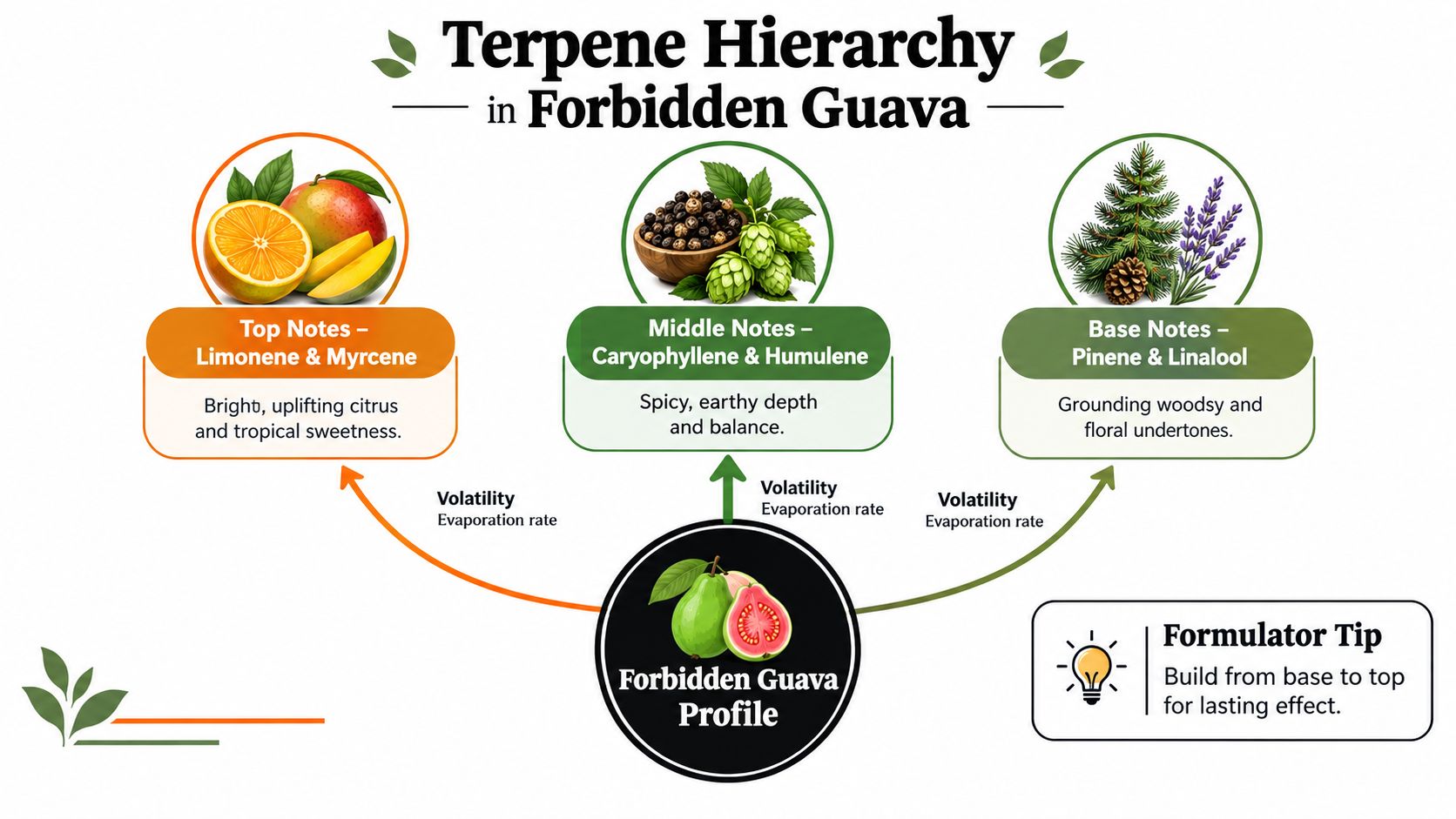
A useful formulation model treats aroma as a sequence rather than a list. Top notes appear first and tend to be more volatile. Middle notes give the vapor its transition and fullness. Base notes stay longer, providing the finish that keeps the profile from collapsing after the first impression.
For Forbidden Guava, the practical map begins with limonene and ocimene at the top, beta-caryophyllene and myrcene providing depth, and linalool bridging brightness with softness. This structure explains why adding more limonene often fails. Limonene can make the blend smell immediately attractive, but without enough body and foundation, the vapor becomes sharp, thin, or broadly citrus-like.
Top notes
Limonene supplies the obvious citrus lift. In this profile, it should suggest grapefruit peel, bright tropical fruit, and a clean opening rather than lemon candy or household citrus. Ocimene adds a fresher, lighter fruit dimension that keeps the top from feeling dense. Together, they create the first-pull signal that tells the palate it's dealing with a guava-adjacent tropical profile.
The top layer needs restraint. If it dominates the blend, the product may smell vivid during filling but taste one-dimensional in hardware. The issue isn't necessarily low flavor intensity. It's a missing transition into the middle.
Middle notes
Linalool is the bridge. Its floral character can soften the edge of citrus and help connect the fruit opening to the heavier finish. Myrcene contributes ripe fruit depth, musk, and body. Leafly specifically characterizes Forbidden Guava as high in myrcene and linalool, which supports using both compounds as structural elements rather than treating them as incidental accents.
Myrcene can also change the perceived weight of the vapor. Too little, and the blend feels angular. Too much, and the fruit can become muddy or overly musky. Linalool helps round that center, but excessive floral emphasis can pull the profile away from guava and toward lavender-like softness.
Base notes
Beta-caryophyllene gives the finish peppery, spicy, and grounding qualities. It's the main counterweight to limonene and ocimene. The goal isn't to make the exhale taste like black pepper. The goal is to make the tropical layer feel anchored and persistent.
The broader terpene profile reference is useful during bench work because it encourages teams to assess each compound by sensory function. For Forbidden Guava, build from the base upward, then tune the top. That method usually produces a more durable flavor arc than starting with a loud citrus fraction and trying to repair the finish afterward.
Practical rule: If the blend smells like guava in the vial but tastes like citrus water in the cartridge, rebuild the middle and base before increasing the top notes.
Formulation Benchmarks for Cartridges and Distillate
Commercial references give formulators a useful range for understanding how bold this profile may need to be. One live-resin cartridge listing reports 78.98% THC and 0.15% CBD, with myrcene, caryophyllene, and limonene described as dominant components. A separate disposable listing reports a finished blend containing 22% THCA, 60% Delta-8 THC, 3% THCP, 10% live-resin cannabis-derived terpenes, and 5% CBD. These are product-specific formulations, not universal specifications, but they show that Forbidden Guava-inspired flavor is being positioned in high-potency hardware with a substantial terpene fraction.
Translating the load into bench math
A 10% terpene load means the finished batch is divided into 90% cannabinoid oil and 10% terpene blend. For a 10 gram pilot, that corresponds to 9 grams of oil and 1 gram of terpenes. For a 100 gram batch, it corresponds to 90 grams of oil and 10 grams of terpenes. The arithmetic is straightforward, but the formulation decision isn't.
That benchmark may be appropriate for a bold disposable concept, yet a team shouldn't treat it as an automatic target for every cartridge. The finished sensory result depends on the base oil, terpene source, hardware, operating temperature, and the volatility of the top-note fraction. Use the guide to terpene additions for distillate to structure the calculation, then validate the actual oil in the intended device.
Why high potency changes the sensory problem
THC-rich oils can mute or reshape aromatic perception. A blend that smells open and expressive before incorporation may become compressed once dispersed through a dense cannabinoid base. That's why potency and flavor can't be evaluated separately. The oil needs enough aromatic structure to remain identifiable, but excess terpene addition can create an aggressive throat profile, alter viscosity, and change the way the cartridge wicks.
Start with a control and several deliberately separated bench variants. Keep the total formula documented, then compare:
- Opening impact: Does limonene and ocimene deliver tropical brightness without turning sharp?
- Mid-palate continuity: Do myrcene and linalool create a recognizable body?
- Finish quality: Does beta-caryophyllene add persistence without dominating the exhale?
- Hardware behavior: Does the oil wick and vaporize consistently in the intended cartridge?
- Rested performance: Does the flavor remain coherent after the oil has settled?
Viscosity and solubility
Terpenes need to disperse uniformly through the cannabinoid base. Thick oil can trap uneven concentration if the team adds the blend too quickly or mixes at an unsuitable temperature. Warm the base only enough to improve flow, add the terpene phase gradually, and stop mixing once the batch is visibly uniform.
Avoid solving viscosity problems with unrelated diluents when the goal is a precise strain-inspired profile. Cutting agents can soften aromatic definition and make the transition from bright fruit to spice and musk less distinct. The cartridge should be approved on the exact hardware platform intended for sale, not only from a beaker or vial.
Blending Strategies, Isolates vs. Pre-Made Profiles
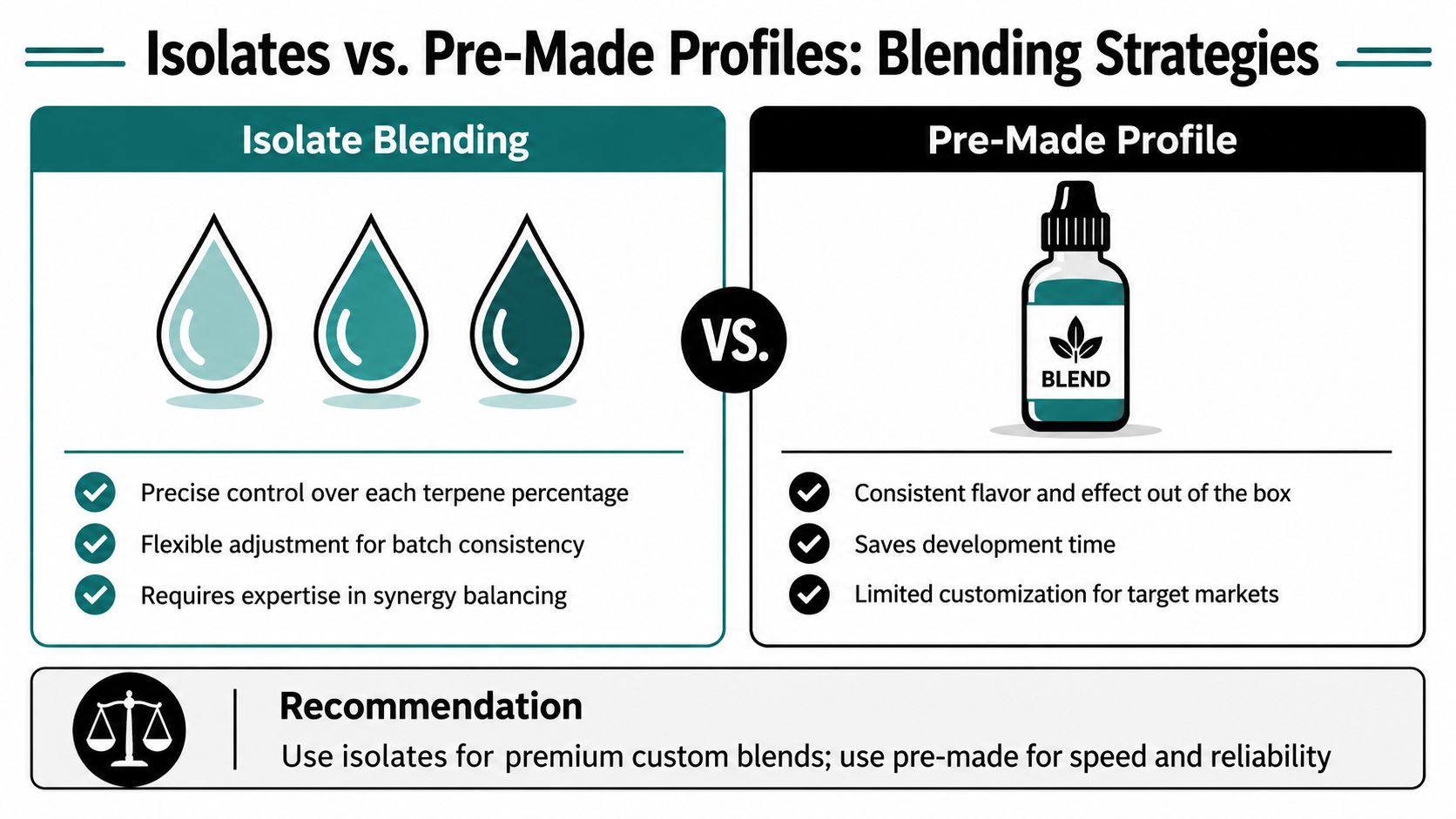
A Forbidden Guava-inspired cartridge can be built from individual terpenes or from a prepared profile. Isolate blending gives direct control over the ratio and dose of each component. A curated, pre-made profile shortens development and limits the variables in the first pilot. Choose based on the production requirement, oil base, and hardware platform rather than ingredient preference.
Isolate blending
Use isolates when the product needs a defined house interpretation or must be corrected for a specific distillate lot. Limonene can be adjusted against beta-caryophyllene, myrcene can be increased or reduced to set the body, and linalool can shape the floral transition. This control also helps when a new cartridge changes the apparent intensity of the same formula.
Ratio changes have trade-offs. More limonene can sharpen the opening while making the blend feel thinner. More beta-caryophyllene can extend the finish while pushing the pepper note forward. Isolate work therefore requires documented weighing, consistent batch records, and sensory checks at the intended dose.
Pre-made profile systems
A pre-made strain-inspired blend offers a faster starting point because its aromatic structure has already been assembled. It can move a manufacturer from concept to pilot with less screening of individual compounds. The Elevated Strains catalog shows a curated strain-profile format, although the linked product is a separate flavor, not a Forbidden Guava specification.
Customization is the main limitation. A prepared blend may be consistent from bottle to bottle, yet it leaves less room to adapt the profile to a particular oil, cartridge, or market preference. Treat it as a starting formula, then verify the finished product at the intended terpene dose.
| Production condition | More practical starting point | Reason |
|---|---|---|
| High customization requirement | Isolates | Each aromatic component can be adjusted independently |
| Limited sensory-development resources | Pre-made profile | The initial blend is already assembled |
| Multiple oil bases or hardware types | Isolates | The formula can be tuned to each platform |
| Fast pilot development | Pre-made profile | Fewer formulation decisions are required |
| Strong internal analytical capability | Isolates | The team can manage ratio and lot variation directly |
A practical compromise uses the pre-made profile as a sensory control, then applies isolates only to correct a defined weakness in the finished cartridge. This preserves development speed while retaining control over the Forbidden Guava flavor hierarchy.
Testing and Quality Assurance for Flavor Fidelity
A formula isn't finished when the blend looks uniform. It's finished when the oil performs consistently in the intended hardware and the sensory target survives production handling. Forbidden Guava is especially sensitive to balance because the profile depends on contrast, bright fruit against musk, spice, and floral softness.
Sensory verification
Use trained palates to evaluate the finished cartridge, not just the raw terpene blend. A sensory panel should assess the first draw, the developing middle, and the exhale. Record whether the product presents as grapefruit and tropical fruit, whether the body becomes creamy or musky, and whether the caryophyllene-led finish remains controlled.
Organoleptic testing can identify problems that a composition sheet won't reveal:
- Top-note loss: The blend no longer opens with clear citrus or tropical brightness.
- Middle collapse: Myrcene and linalool fail to provide enough body after heating.
- Base excess: Spice and musk overpower the fruit.
- Hardware distortion: The cartridge introduces a burnt, metallic, or otherwise off-target note.
- Storage change: The profile fades or shifts after the oil rests.
Use a retained control sample so the panel compares every pilot against the same reference. The control should be stored under the same conditions as the production sample and evaluated through the same hardware.
Analytical and contamination checks
Third-party laboratory testing should verify terpene concentration and screen for contaminants introduced through raw materials, mixing, filling, or hardware contact. The exact panel depends on the market and product category, but the principle is consistent. The final batch must match its specification and remain suitable for the intended application.
The quality assurance and testing resource can support the documentation side of that workflow. Maintain records for terpene lots, cannabinoid-oil lots, mixing conditions, fill date, cartridge type, and sensory observations. Small changes in terpene sourcing can alter aroma even when the written formula remains unchanged, so supplier and lot tracking matters.
Release checklist
Before approving a Forbidden Guava SKU, confirm:
- Input identity: Every terpene and oil lot has the required documentation.
- Formula accuracy: Weights, total terpene load, and batch size reconcile.
- Homogeneity: Samples from the batch present consistently.
- Hardware fit: The oil performs in the cartridge or disposable intended for release.
- Sensory match: The panel confirms top, middle, and base-note continuity.
- Laboratory results: Potency and contaminant testing meet the applicable specification.
- Record completeness: The batch can be reconstructed if a later lot tastes different.
Flavor fidelity is a quality-control result, not a marketing adjective.
Final Recommendations for Formulators
Treat Forbidden Guava as a commercial flavor architecture, not a fixed mythology exercise. The lineage is commonly presented as Stardawg crossed with Afghani, and independent databases place it at approximately 85% to 86% indica and 14% to 15% sativa, but the more useful development question is how that market identity translates into aromatic structure. The answer is a bright limonene and ocimene opening, a myrcene and linalool body, and a beta-caryophyllene-led foundation with earthy, musky, and spicy weight.
Begin with the commercial reference points, including the 78.98% THC and 0.15% CBD live-resin cartridge listing and the separate disposable listing built around a 10% terpene load. Treat those as benchmarks for understanding product positioning, not as universal formulas. Your oil base, cartridge, and target sensory intensity may require a different loading decision.
What works in practice
- Build from the base upward: Establish the spicy and musky foundation before increasing tropical brightness.
- Protect the middle: Use myrcene and linalool to prevent a citrus-heavy formula from feeling empty.
- Measure precisely: Small ratio changes can shift the balance between guava-like fruit and generic citrus.
- Test the finished device: A beaker sample can't predict every hardware outcome.
- Keep a sensory control: Compare each pilot with the same reference rather than relying on memory.
- Document every lot: Ingredient variability can create batch differences even when the formula is unchanged.
The strongest strain-inspired terpene blend for cannabis product formulation is the one that remains recognizable after mixing, filling, storage, and repeated heating. Use a terpene calculator for batch math, curated strain profiles for efficient starting points, and isolate adjustments when the cartridge needs a specific sensory correction.
Gold Coast Terpenes supplies natural terpene blends, strain-specific profiles, and isolated compounds for cartridges, concentrates, and formulation work. Visit Gold Coast Terpenes to compare profile options, use formulation resources, and source components for your next Forbidden Guava-inspired vape or distillate pilot.