
Your filling run looked clean, but the inspection tray now has suspended bubbles, a few foamy fills, and cartridges that changed after cooling. Before you reject the terpene blend or turn up the heater, separate the symptoms. A filling problem, a slow-flowing formula, and a leaking seal need different fixes.
For a production team asking “Why is my cart bubbling?”, the useful answer comes from controlled checks, not appearance alone. Keep the formulation fixed while you test the fill process, then evaluate botanically derived terpene loading and hardware fit as separate variables.
Bubble Patterns and What Each One Means
| Bubble pattern | Likely cause | First check |
|---|---|---|
| Small bubbles right after filling | Air introduced during dispensing | Review dispense path, needle position, and fill speed |
| Bubbles rise slowly and stay suspended | High viscosity or cold oil | Check oil temperature and allow settling time before judging |
| Bubbles grow or move after warming | Trapped gas expands as viscosity drops | Compare results after controlled thermal conditioning |
| Bubbles form at the coil during a draw | Boiling at the heater surface | Check power setting and wick-to-coil match |
| Bubbles with seepage or a loose seal | Seal or hardware defect | Quarantine the lot and run a leak test |
| Bubbles return after shipping | Tilt redistributed oil and exposed air pockets | Settle cartridges upright, then re-inspect |
| Thin, foamy, or discolored oil | Possible formulation or additive problem | Hold the batch and review the certificate of analysis |
Small bubbles spread throughout a fresh fill point first to the dispensing process. Check whether they appear as oil leaves the needle or only after capping, since that distinction helps narrow the investigation.
Slow, suspended bubbles call for a temperature check before a formula change. Bubbles that move after controlled warming can reflect existing trapped gas, not newly generated gas.
Separate reservoir symptoms from hardware faults
Bubbles at the operating coil belong in a hardware test, not a reservoir appearance check. Record where they form and whether liquid replenishment stays consistent during the test cycle.
For shipping-related changes, AO Vape's cartridge hardware guide explains that tilt can redistribute oil and expose trapped air pockets. It also distinguishes ordinary trapped air from bubbling accompanied by mouthpiece seepage or a loose seal.
Assign every flagged cartridge a symptom category before adjusting equipment. Photograph it against a consistent background and attach the image to the lot record.
A bubble pattern is a troubleshooting clue, not proof of quality. If oil looks unusually thin, foamy, or discolored, hold the batch and compare its certificate of analysis, ingredient weights, and fill records with the approved pilot.
How Viscosity and Heat Trap Air in Cartridges
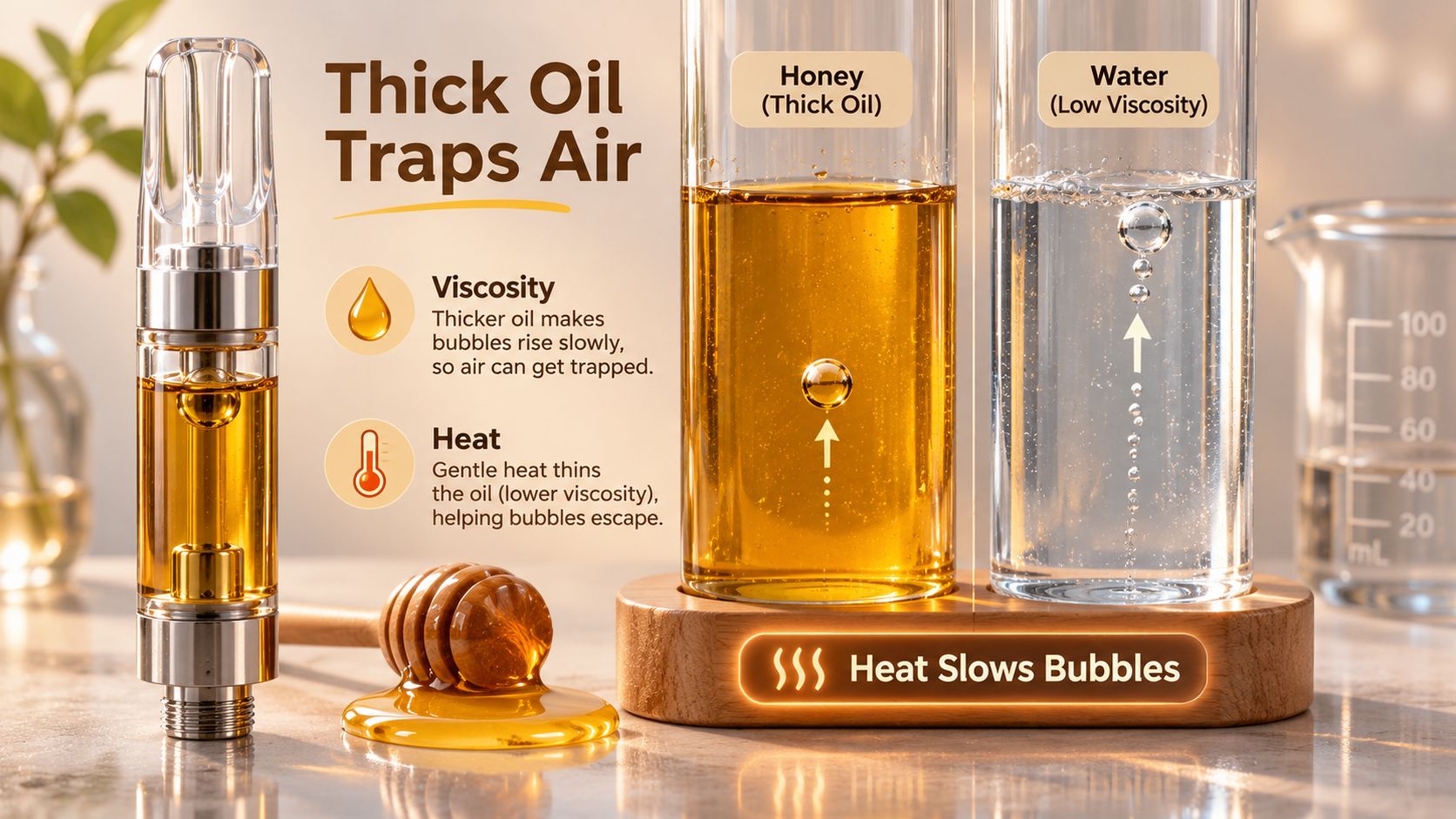
A bubble rises through honey much more slowly than it rises through water. The same basic resistance matters in cartridge filling: thick oil can hold air introduced during mixing, transfer, or dispensing long after the fill looks complete.
This diagram shows why bubble movement changes with viscosity and temperature.
For scale, a peer-reviewed study discussed in the CDC-hosted investigation document measured propylene glycol at 22.8 mPa·s and vegetable glycerin at 301.6 mPa·s, both at 37°C. These are reference liquids, not target specifications for your formula, but they show why the word liquid tells you little about flow resistance.
Temperature creates two different inspection problems. Warming lowers viscosity, allowing trapped bubbles to travel more freely while the gas can expand; cooling raises viscosity, slowing bubble escape and leaving pockets suspended.
Thick oil holds air, heat lets it move, and neither proves a defect by itself.
Test movement, not just appearance
Normal air displacement should be judged against an approved process baseline. Unusually large, persistent, or rapidly recurring bubbles deserve checks for excessive air entrainment, poor filling technique, imperfect sealing, or a mismatch between oil flow and hardware.
Don't treat more heat as the automatic answer. A formula that fills neatly while warm still needs to feed the wick and remain sealed under its intended storage and operating conditions.
For a blend that remains difficult to dispense, use the thick-distillate troubleshooting guide to organize the viscosity investigation before changing the botanically derived terpene ratio.
The accompanying video provides another visual reference for cartridge bubbling.
Run a temperature comparison using fixed conditions within your validated process range. Keep the cartridge, fill mass, blend, and observation schedule unchanged, then record bubble release time and final bubble position.
Use a temperature probe to confirm the oil's actual condition rather than relying only on the heater display. Compare results across two or three fixed test temperatures, and judge the batch against repeatable behavior rather than a single warm inspection.
Fill Settings That Keep Air Out of Cartridges
| Setting | Recommended range | Why it matters |
|---|---|---|
| Nitrogen pressure | 10–30 psi | Excess pressure can introduce air and contribute to terpene loss |
| Heater setpoint | 30–45°C | Warmer oil flows more easily, but excessive heat drives off terpenes |
| Charge speed | 10–14 | Slower charging reduces agitation and air capture |
| Dispense speed | 15–20 | Slower dispensing limits bubble capture and volatilization |
| Reservoir level | Keep above a minimum set in your SOP and record it | A nearly empty reservoir allows air ingestion |
| Dispense point | Along the cartridge wall | Avoids turbulence from dispensing above the oil surface |
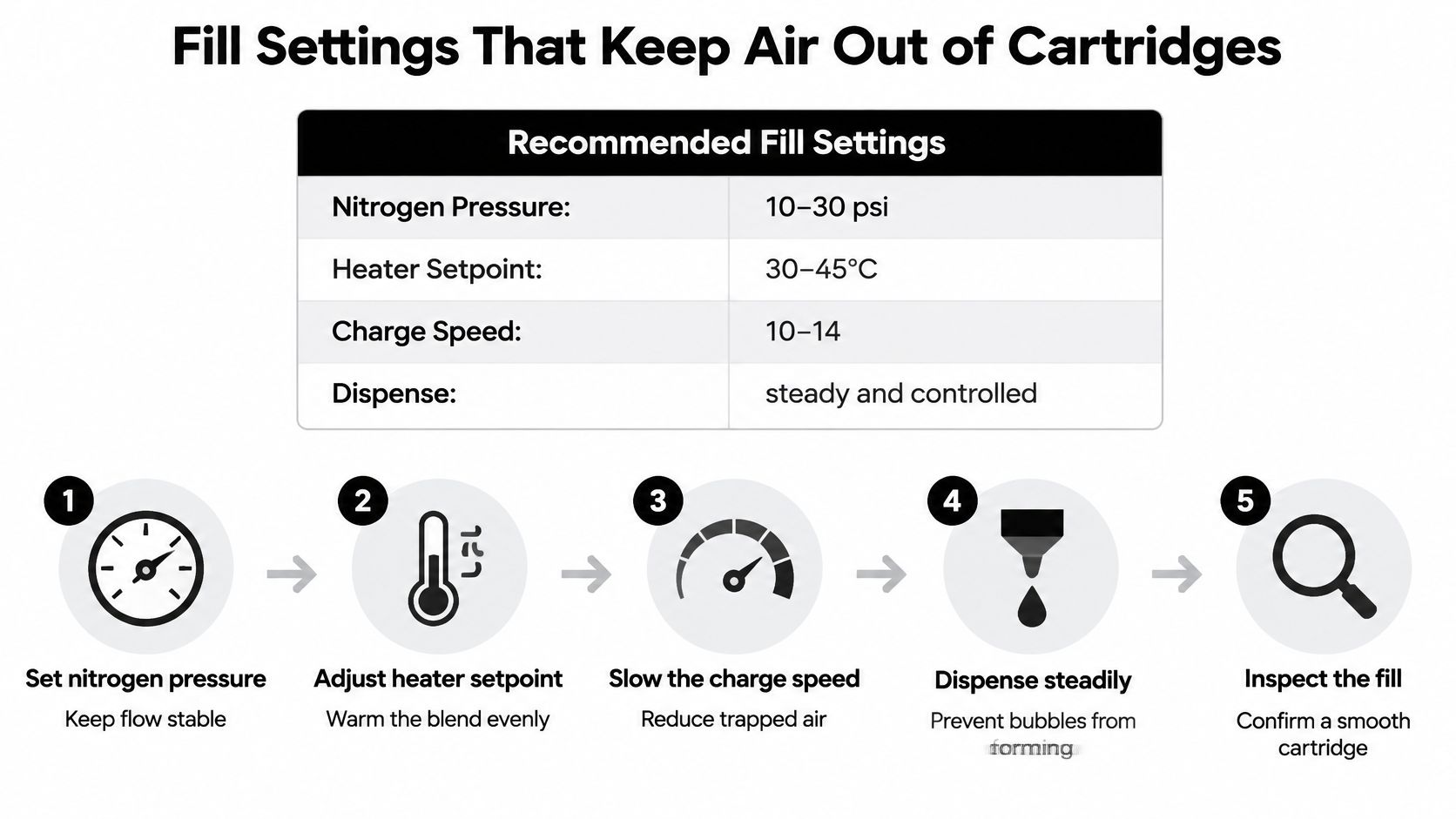
For a free-flowing formulation, the Vape-Jet troubleshooting guide recommends 10–30 psi nitrogen pressure, approximately 30–45°C heater setpoints, charge speed around 10–14, and dispense speed around 15–20. The speed values are equipment settings, not universal flow-rate units, so don't transfer them directly to an unrelated machine.
Set up the fill path before changing the blend
Seat the connection fully. Confirm that the syringe or valve connection is secure before dispensing. A partly seated connection can introduce air even when the blend itself is consistent.
Check the reservoir level. Refill before the supply approaches the point where the system can ingest gas. Mark the minimum operating level in the SOP so operators don't make different judgments.
Set pressure and temperature together. Start within the equipment maker's guidance for the formulation, then confirm stable delivery. Don't compensate for cold oil by increasing pressure alone.
Slow charging and dispensing. Reduce agitation while watching dose repeatability and cycle time. Faster throughput isn't useful if the inspection team must hold or rework the output.
Control the dispense point. The Urth & Fyre filling failure-mode guide recommends dispensing along the cartridge wall rather than above the oil surface to reduce turbulence and trapped air. Check needle position throughout the fill, not just at the start.
Record the complete setup. Include the cartridge, needle, pump, pressure, heater setting, measured oil temperature, and reservoir condition. Record the botanically derived terpene blend and loading with the same care.
This process graphic summarizes the main equipment controls.
Prove the settings on a pilot run
Higher nitrogen pressure may move a thick blend faster, but excessive pressure can introduce air while aggressive process conditions increase terpene loss. Raising heat at the same time makes it harder to identify which adjustment changed the result.
Use the cartridge filling machine guide when reviewing equipment fit, then run a small pilot with the actual production setup. Include cartridges from the beginning and end of the run so reservoir changes don't escape inspection.
Set the acceptable bubble-release window before approval. Establish it from the validated pilot rather than choosing a convenient waiting period after production starts.
The setup passes only when bubble release, fill consistency, sealing, and subsequent hardware checks meet that baseline. A smooth-looking fill at the nozzle is only an early process check.
Post-Fill Inspection Routine and Hold Rule
A cartridge can look stable at the dispense station and develop visible bubbles later. Release approval therefore needs a post-fill checkpoint and a conditioned checkpoint, not an operator's quick glance before the tray leaves the machine.
Vessel's cartridge bubbling guide identifies temperature changes and persistent bubbles in thicker oils as reasons to evaluate filling controls, including preheating, vacuum filling, degassing, and inspection. Use those controls within a documented process rather than applying them as unrecorded fixes.
Build a repeatable inspection record
Define approved temperature ranges for the blend, empty cartridges, filling equipment, and finished-goods storage. Record actual conditions for each lot, including any interruption that leaves material waiting in a heated reservoir.
Inspect after filling. Check each cartridge for bubble count, position, visible foam, and seepage. Use consistent lighting and orientation so inspectors can compare the production lot with the pilot reference.
Inspect after settling and conditioning. Keep cartridges upright at room temperature for the validated settling period, then run the approved storage-conditioning cycle and inspect again. Release the lot only when its inspection results match the pilot baseline.
The first checkpoint captures what the filling process produced. The conditioned checkpoint shows whether the finished package remains consistent after the expected temperature exposure.
Investigate drift before release
If results drift, review whether the approved preheating, vacuum-filling, or degassing process was followed. Don't introduce a new treatment on the production floor without recording and validating the change.
Treat seepage and loose seals as hardware or filling defects. A cartridge that loses oil isn't acceptable merely because its reservoir bubbles eventually disappear.
Keep the approved botanically derived terpene ratio fixed during this investigation unless the records show a weighing or mixing error. Otherwise, changing the formula can hide an equipment problem and invalidate the comparison.
Hold rule: Quarantine any lot where bubbles grow, return after conditioning, or appear with leakage, a color shift, or a viscosity change.
Before release, investigate fill pressure, sealing, formulation ratio, and storage exposure. Document the cause, corrective action, and repeat inspection result so the next shift doesn't have to diagnose the same fault again.
Terpene Loading Ratios and Flow Trade-Offs
| Loading | Evidence | Manufacturing action |
|---|---|---|
| 0% (base only) | Control condition in a UC Davis study | Use as the baseline for every comparison |
| 7.5% | Tested in the UC Davis study | Screen flow and fill behavior on the intended hardware |
| 15% | Tested in the study that reported increased carbonyl formation | Don't use as a default fix for thick or bubbly oil |
| Pilot-selected level | Your own pilot results | Record ratio, flow, and heating conditions in batch records |
The University of California, Davis study tested terpene additions of 0%, 7.5%, and 15% by mass in cannabinoid distillates and reported that adding the commercial terpene mixture increased carbonyl formation by up to ninefold under the tested conditions. That finding doesn't establish a universal production limit or mean the highest increase belongs to every formulation at the highest loading.
It does establish a practical reason not to solve every flow problem by adding more terpenes. A better-looking fill is not enough to approve a higher loading.
Compare flavor, flow, and heating performance
Start with the base-only control, then compare candidate botanically derived blends under fixed filling and hardware conditions. Screen the lowest loading that meets the intended flavor and wicking targets rather than working backward from the thinnest sample.
Weigh ingredients for mass-based trials. A volume-based recipe won't directly reproduce a mass percentage, and a calculator can't correct an unclear denominator.
Use the terpene-to-distillate dosing guide to structure the ratio calculation. Record whether the loading refers to the finished blend or an addition relative to the starting base.
For example, a higher-loading pilot may release bubbles sooner and still fail the broader approval process. Its flavor may no longer match the target, its hardware may leak, or its emissions performance may need further investigation.
Keep the comparison useful
- Hold the base constant. Use the same base lot when comparing candidate blends.
- Match the flavor target. Evaluate aroma and flavor alongside flow, not after selecting the easiest fill.
- Keep heating conditions fixed. A power change and a ratio change in the same trial leave the cause unclear.
- Retain the exact recipe. Record ingredient lot numbers, weights, mixing conditions, and inspection results.
Botanically derived sourcing doesn't remove the need for formulation validation. Before production use, request the current certificate of analysis and technical documentation for each blend, then confirm that the material received matches the approved pilot.
Hardware Fit and Coil Bubbles
Bubbles can form within milliseconds at the heated liquid surface through nucleate boiling, as described in the Scientific Reports study of atomizer bubble behavior. Local hot spots and poor liquid replenishment can intensify the effect, and bursting bubbles can throw droplets into the aerosol.
That's a different mechanism from air trapped during filling. A clear reservoir doesn't prove that the heater receives liquid evenly during operation.
Match liquid delivery to heating demand
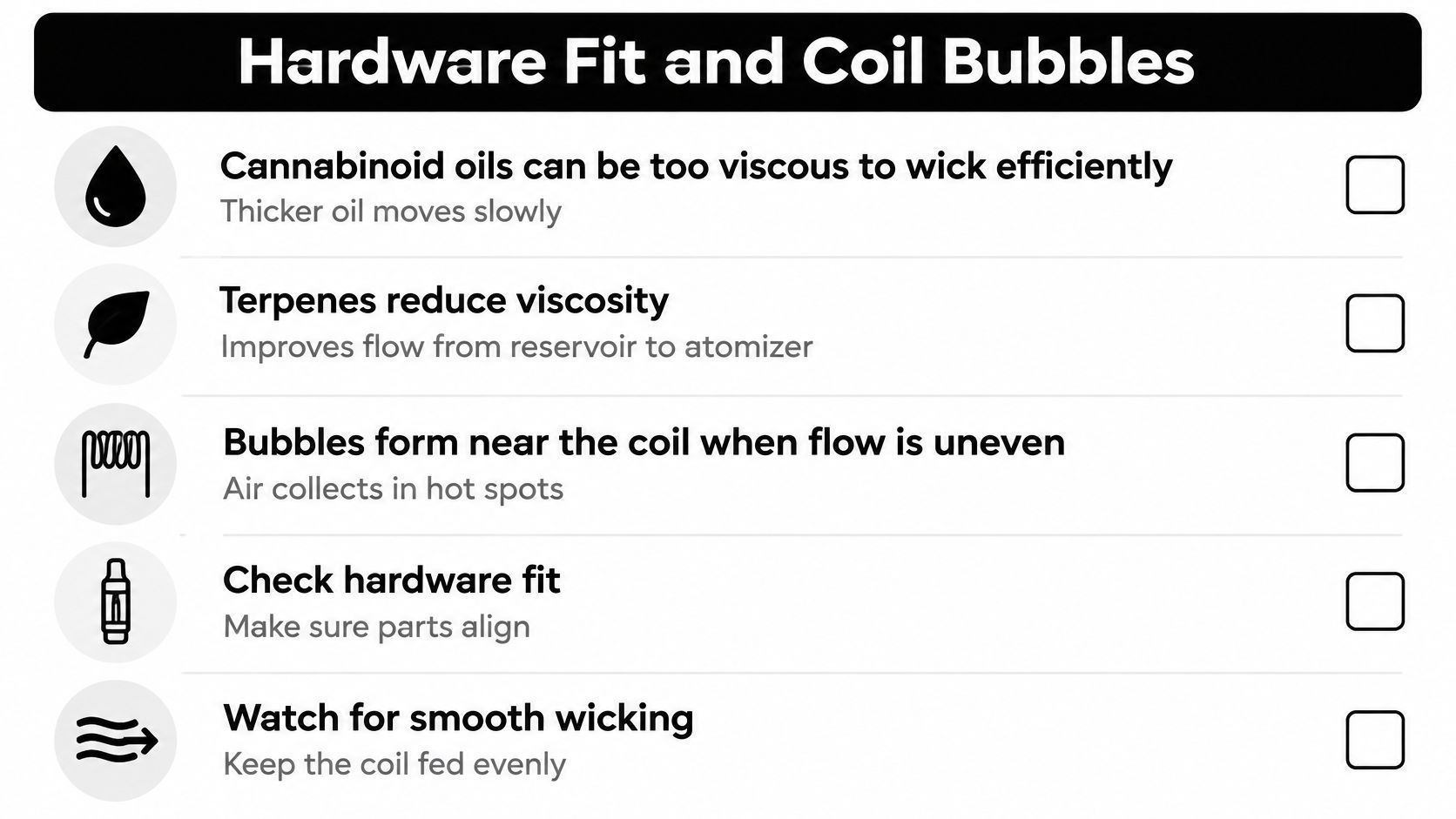
Viscous cannabinoid oils can feed a wick too slowly, while terpenes can reduce viscosity and improve delivery from reservoir to atomizer. The production task is to balance that flow with intake-hole size, wick design, coil geometry, and operating power.
Too little replenishment leaves the heater poorly supplied. Excessive flow can create a different failure mode, including flooding or leakage, so the easiest-flowing blend isn't automatically the best match.
Use this checklist to keep formulation and hardware decisions connected.
Run a pairing check for every new blend
- Confirm wick compatibility. Test whether the wick replenishes evenly with the actual production blend, not a substitute liquid.
- Set power conservatively. Evaluate the intended operating range and keep the test cycle fixed across samples.
- Inspect intake geometry. Check that inlet size and wick design suit the oil's flow at the intended conditions.
- Verify homogeneity. Confirm the blend is uniform before filling so cartridges don't receive different compositions.
- Leak-test finished units. Evaluate the sealed assembly, not just loose hardware or an uncapped fill.
- Compare coil behavior across lots. Record bubble location, replenishment, and visible flooding under the same test cycle.
The cartridge selection guide can help organize the hardware comparison. Keep a pairing record that connects each approved botanically derived blend to its cartridge specification and test conditions.
If a blend passes filling but fails coil testing, investigate liquid delivery and heating demand before changing the recipe. A fill-machine adjustment won't correct an unsuitable wick.
Don't add unapproved diluents to make the oil thinner. That changes the formula and hardware result together, leaving you without a clean explanation for either improvement or failure.
Verify Samples and Next Steps Before You Scale
Bubble size or disappearance cannot establish whether an ingredient is suitable for inhalation. Treat bubbling as a filling and performance check, not a safety test.
The FDA's vaping-illness information page documents the investigation context: the CDC reported 2,807 hospitalized EVALI cases or deaths by February 18, 2020, and a CDC-linked laboratory study detected vitamin E acetate in 48 of 51 patients, or 94%, and none of 99 healthy comparison individuals. These findings are a reason to verify ingredients and manufacturing controls, not a way to diagnose an individual cartridge by sight.
Additives and diluents can change gas retention, surface tension, and heating behavior. An unusually thin or foamy sample needs an ingredient and process review, even if the bubbles clear quickly.
Verify the sample before approving the supplier
Use documented ingredients appropriate for the intended application. Review composition, current analytical documents, and applicable compliance requirements. Don't assume flavor suitability establishes inhalation suitability.
Exclude unverified oils and additives. An undocumented processing aid can change the finished formula even when its purpose sounds minor.
Inspect finished units for leaks and contamination. Include packaging integrity and visible foreign material in the release checklist.
Use laboratory testing and validated controls. Appearance checks support quality control, but they don't replace analytical testing or product-specific evaluation.
Our botanically derived terpenes for carts are free from additives, VG, PG, PEG, and MCT, and our cartridge terpenes are SC Lab-tested. Ask for the current certificate of analysis when qualifying a sample; those credentials support ingredient review but don't replace validation of your finished formulation.
Make the sample trial match production
Request a sample of a botanically derived Gold Coast Terpenes blend and test it with your intended base, cartridge, needle, and filling equipment. Define the flavor target, ratio basis, bubble-release acceptance window, and hardware checks before mixing.
Keep a retained sample and a complete pilot record so purchasing can identify exactly what production approved. A supplier decision should connect ingredient documentation with repeatable fill and hardware performance, not just a preferred aroma.
For bulk planning, wholesale pricing is available on strain orders totaling over 64oz. Confirm the approved blend and production recipe before expanding the order so a purchasing change doesn't become an uncontrolled formulation change.
Gold Coast Terpenes offers botanically derived blends for manufacturers developing consistent flavor and cartridge formulations. Visit Gold Coast Terpenes to shop blends, request a sample for your fill-and-hardware pilot, or contact our team about bulk or custom orders.