
Your bench has two people filling carts with syringes, a scale, and a spreadsheet nobody trusts. The weights drift. A cart that reads 0.98 g at nine in the morning reads 1.02 g at two in the afternoon, and the oil hasn't changed. What changed is the room temperature, the oil temperature, and how tired the person holding the syringe is.
That's when most cart brands start shopping for a cartridge filling machine. It's also where the expensive mistakes begin, because the accuracy number on a spec sheet was almost certainly measured with a test fluid, not with your terpene-blended distillate at your fill temperature.
The equipment market has grown around that demand. The global cartridges filling lines market was valued at USD 470 million in 2024, per Intel Market Research. Plenty of machines to choose from, and the hard part isn't finding one. It's working out which ones will hold a dose with the oil you run.
Cartridge Filling Machine Types at a Glance
A cartridge filling machine measures a set amount of oil into each cartridge, then hands the cartridge off to capping or sealing. That is the whole job. Everything that separates one machine from another sits inside that sentence: how the dose is measured, how fast it repeats, what fill sizes the tooling supports, and how much of the work a person still does by hand.
Output is the first number buyers compare, and it spans two orders of magnitude. Alibaba's pharmaceutical cartridge filling machine listings show a platform rated at up to 36,000 cartridges per hour (about 600 a minute) for regulated aseptic work, alongside mid-scale systems listed at 2,400 per hour (40 a minute) and 5,400 per hour (90 a minute), with one listing claiming up to 9,500 per hour. Those are different categories wearing the same product name.
Cartridge filling machine types by stated output and fill range
| Machine type | Stated output | Fill range | Best fit |
|---|---|---|---|
| Manual or hand fill | Set by operator pace, one cart at a time | Set by the syringe you load | Prototypes and very small runs |
| Mid-scale system | 2,400 per hour (40 per minute) | Set by the pump and nozzle fitted | Small test batches |
| Benchtop volumetric filler | 1,500 to 3,000 per hour | 0.1 to 5 mL | Mid-scale cart runs |
| High-precision programmable filler | About 300 per hour | 0.1 to 3 mL in 0.1 mL steps | Small, exact fills |
| Industrial line | 5,400 to 9,500 per hour | Set by the multi-head tooling and valve | High-volume production |
Two columns carry the decision. Stated output tells you how many shifts you need to cover a day's orders. Fill range tells you whether the machine can hit your cart at all, and a unit built for 0.1 to 5 mL is a different tool than one built for 0.1 to 3 mL in fine steps.
Treat every number in that table as a starting point, not a result. Stated rates are usually measured with a test fluid that flows easier than a terpene-blended distillate at your fill temperature, so the machine you shortlist should be the one you verify against your own oil in a sample run.
The split into speed tiers and precision tiers is older than the vape industry. Until 1864, the U.S. government filled cartridge cases by hand, a process congressional testimony calls dangerous, with accidental explosions causing deaths and property damage. A mechanized filler ordered after a serious incident was delivered on August 18, 1865, and the government record of that program credits it with six slide-loads per minute plus more uniform charges than hand filling. Speed and consistency arrived as a package, and buyers have wanted both ever since.
Read the machine category against your hardware before anything else. If you are still deciding between 510-thread and all-in-one formats, start with the best vape cartridge options for your line so the fill range you shortlist matches what you will fill.
How Each Machine Type Doses Oil
Every filler answers one question. How do you move a fixed amount of thick oil into a small opening, the same way, ten thousand times? The dosing method is the answer, and each method fails differently when your formulation pushes back.
Three industrial cartridge filling machines, each built around a different dosing approach.
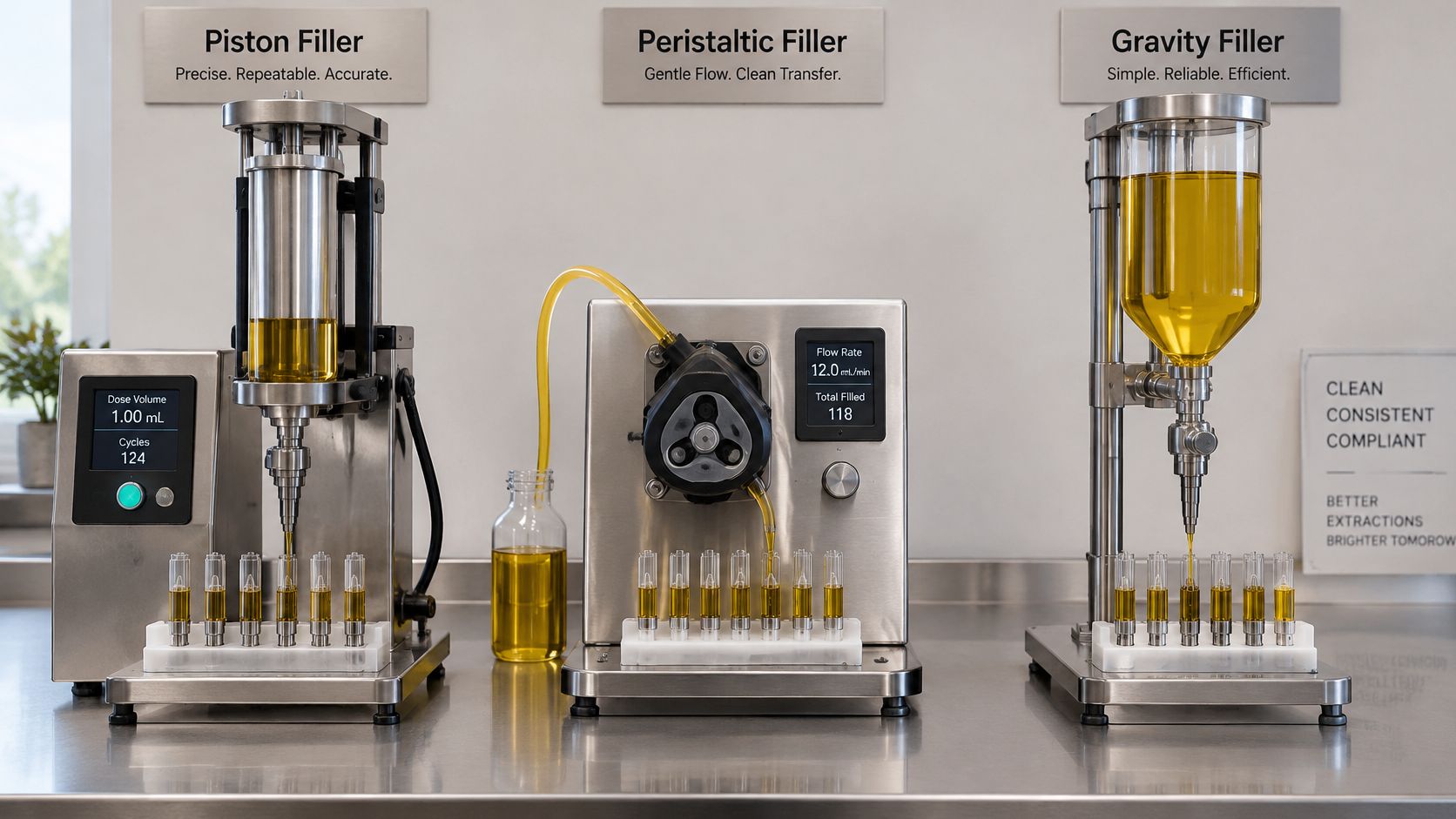
Piston and positive displacement. Think of a syringe. A rod strokes a fixed distance, so volume per stroke is set by mechanics rather than by pressure or time. Thick distillate doesn't change the stroke length, which is why piston fillers hold weight as the reservoir empties and the oil shifts viscosity.
Time pressure. Think of squeezing a ketchup bottle for a count of three. Air pressure pushes oil through a valve for a timed window, so the dose depends on how easily the oil flows. Colder reservoir, less oil in the window. It performs well when temperature is locked and the blend is consistent, and it drifts when either one moves.
That looks like in motion, including the hardware changeover side of the job.
Peristaltic. A roller squeezes flexible tubing in pulses, so the oil never touches a pump body. That's a genuine advantage with aggressive terpene blends. The trade-offs are tubing wear and pulse ripple, and at half-milliliter fills the ripple shows up in your weights.
Weight based. The machine fills, weighs, and corrects. It doesn't assume the dose, it checks the result, which is what you want when you need a defensible record for every cart.
Now the example that separates these methods. Say the reservoir runs a few degrees cooler than it did an hour ago. That thickens the oil enough to slow flow through a fixed nozzle. A time-pressure filler running a fixed timer will underfill every cart after that drop, and the operator will blame the scale. The fix isn't a longer timer. It's a heated reservoir, an insulated feed path, and a locked set point, so the oil arrives at the same viscosity on every cycle.
Decision rule: match the dosing method to the coolest point of your oil's temperature band, not the average. If your blend has to run cool to protect the terpenes, choose a method that doesn't depend on flow speed.
Key Features That Keep Every Fill Consistent
Brochure accuracy is a claim made under someone else's conditions. Line consistency is a set of features you can point to on the machine and prove in a batch record. These eight decide whether cart one and cart five thousand weigh the same.
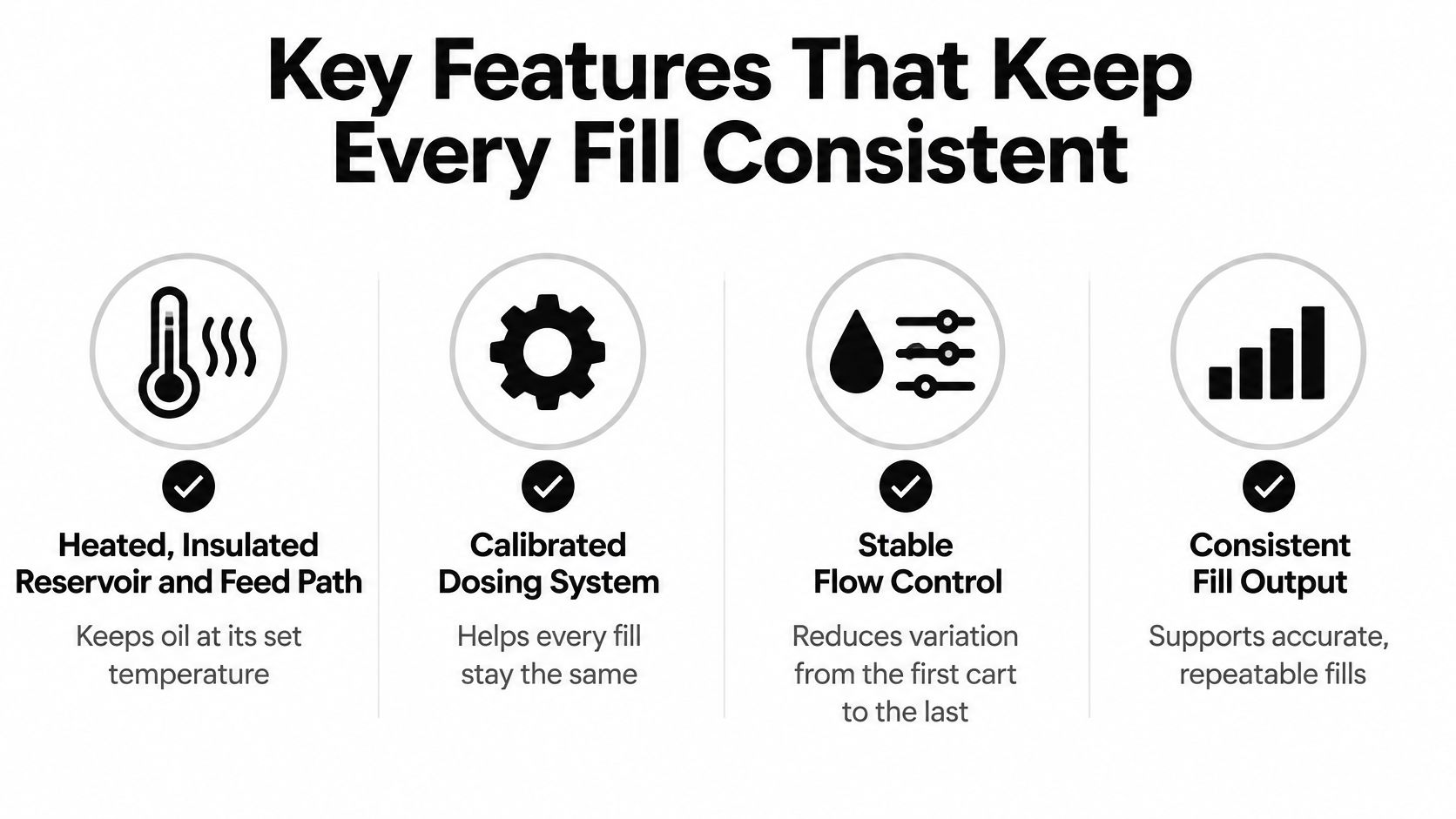
- A heated, insulated reservoir and feed path. Ask where the temperature sensor sits and what band the machine holds. A probe in the tank tells you nothing about the oil arriving at the nozzle.
- Calibrated temperature sensors writing to a recipe. Ask for the band in degrees that the recipe enforces, not the band the heater can reach.
- Nozzle anti-drip or suck-back programming. Ask whether it's programmable per recipe or fixed at the factory. Stringing shows up as light carts and dirty hardware.
- Inline checkweighing. Ask how often it weighs and what happens to the number. Weighing with no downstream action is a printout, not a control.
- No-cartridge and no-fill detection. Ask whether it senses the tray or the individual cart. A machine that dispenses into an empty pocket coats your jig in oil.
- Automatic reject handling. Ask where the reject goes and who empties it. If the answer is "an operator pulls it out", it will find its way back into a tray eventually.
- Recipe storage and data logs. Ask what a batch record contains. You want the set point, the allowable band, and the run count, not just a completion timestamp.
- Tool-free access for cleaning. Ask how long a full strip and clean takes and which cleaning chemicals each part tolerates. Changeover time is capacity.
Run the drift math once and the stakes get obvious. A 1 mL fill with 2% drift loses 0.02 mL per cart, which is 200 mL across 10,000 carts. On a terpene-rich blend, that's real money leaving the building in rejects and overfills.
A machine with all eight features is not accurate by default. The features don't make drift disappear. They turn it into something detected, flagged, and segregated, which is the only version of accuracy you can defend to a buyer or an auditor.
Matching Accuracy to Your Formulation Viscosity
A spec sheet can be accurate and still miss your oil. One volumetric cartridge-filling platform quotes a 0.1 to 5 mL range, 1,500 to 3,000 cartridges per hour, and a stated ±2.5% accuracy under controlled heating and backpressure, while a high-precision unit fills 0.1 to 3 mL in 0.1 mL programmable steps at about 300 cartridges per hour with ±2% volume performance, per ATG Pharma's cartridge filling platform summary. Neither figure was measured on your formulation.
Higher throughput usually means more aggressive material handling. Smaller fills amplify every disturbance: pump pulsation, nozzle drip, trapped air, and temperature variation. A pump that is accurate at 2 mL can drift noticeably at 0.3 mL, and the cause is often the physics of pushing a tiny volume through a narrow path.
The Five Step Qualification Run
- Run the complete formulation at the fill temperature you'll use in production. A base oil or test fluid will not expose the same behavior.
- Fill carts at the start, middle, and end of the batch and weigh every one in the sample. A single startup sample hides the drift that matters.
- Calculate mean bias, the average fill minus your target.
- Calculate the coefficient of variation, the standard deviation shown as a percent of the mean.
- Compare both numbers against limits you set yourself, not limits copied from a brochure.
Work the example once. Target is 1.00 g and the batch average is 0.98 g, so bias is minus 2%. If the standard deviation is 0.01 g, the coefficient of variation is about 1%. Read those two numbers separately, because they point to different fixes. A tight spread with a consistent offset is a set point problem you can correct in the recipe. A wide spread is a machine, handling, or formulation problem, and recipe tweaking will not close it.
Temperature is the variable most likely to move both numbers. Viscosity of CBD- and THC-rich extracts drops substantially across roughly 45 to 130 °C, and about 49 to 65 °C (120 to 150 °F) is the practical window many operations settle into, according to an industry summary of chemical-engineering data on vape filling. Thinner oil fills more easily; go too thin and you trade filling problems for leakage and post-fill migration.
If terpene ratio is part of the recipe, do the blend arithmetic in the mixing calculator, then measure the finished oil at each candidate fill temperature rather than borrowing a published curve. The number that matters is the viscosity of your heated blend at the nozzle, not the viscosity of a similar oil on a chart.
A fill that passes on a fresh reservoir can drift by the end of a long run. Test at all three stages, or you're qualifying the first twenty minutes of a four-hour shift.
Hardware Materials That Can Affect Product Safety
The common assumption is that a better filler makes a safer cart. It doesn't. A filler controls dose. The materials in the oil path, and the cartridge itself, decide what else travels into the cart along with the oil.
Independent testing has detected chromium, copper, nickel, and smaller amounts of lead, manganese, and tin in cannabis oils and vapor, with cartridge heating components identified as a likely source, per NORML's analysis of steel heating mechanisms in THC vape cartridges. Metal didn't appear because someone was careless on the line. It appeared because a material was in contact with the product under heat, and nobody qualified it.
List the wetted parts on a filler and the list gets long fast: needles and nozzles, seals and gaskets, tubing, the reservoir, fittings, any heated block, and the cleaning chemicals that touch all of them. Each one is a material decision with a certificate behind it or nothing behind it.
Here's the checklist I'd take to a supplier meeting:
- A material certificate for every wetted part, naming the stainless grade and the elastomer type, not just "food grade".
- A written list of compatible cleaning chemicals, with contact time and temperature limits for each part.
- A change-control rule stating that any part swap, including a like-for-like seal, triggers a re-test with your formulation.
- A sampling plan for filled carts after storage and after activation, because leachables can appear later, not on day one.
- Aerosol or heat testing where the final product is vaporized, using the hardware you ship.
The trap to avoid: automation is repeatable. If the wrong material touches the oil, the machine repeats that problem on every cart in the run, with far better consistency than a person ever managed.
Cartridge metal, adhesives, and wick materials count in this assessment too, not only the filler. The question worth asking isn't just how accurate the machine is. It's what the oil touches on its way through, and how each of those contacts was qualified. Our guide to preventing contamination in cartridge production covers the handling side of the same problem.
Calibration Records That Prove Consistent Fills
Calibration is what turns a fill weight into evidence. Without it, you have an opinion about a batch. With it, you have a number, a tolerance, and a date that show the measurement itself could be trusted on the day you ran it.
The federal rule is short and specific. Measurement equipment used to control a filling process must be calibrated at suitable intervals under a written program that specifies accuracy and precision limits, schedules, and corrective action when those limits are missed, per the eCFR text of 21 CFR Part 211. That covers balances, dosing pumps, gauges, and temperature sensors used to set or verify fill quantity.
Three parts make the program real. Limits for each instrument, written in the units you check it in. A schedule that survives a busy week. A corrective action that names who removes the instrument from service and what happens to product made since the last passing check.
Say a fill balance is checked against a 1.000 g reference weight and reads 0.990 g against a ±0.005 g limit. The balance fails. It comes off the line, gets repaired, and every batch since the last passing check gets reviewed. That last step is the one teams skip, and it's the only one that protects anyone.
Calibration record fields and what each proves
| Record field | What it shows | Example entry |
|---|---|---|
| Instrument ID | Which balance, pump or sensor was checked | Fill balance 2 |
| Reference value | The known weight or temperature used | 1.000 g |
| Reading | What the instrument reported | 0.990 g |
| Acceptance limit | The allowed tolerance from the written program | ±0.005 g |
| Pass or fail | Whether the reading was within limit | Fail |
| Corrective action | What was done to the instrument | Removed and repaired |
| Batches affected | Which batches ran since the last passing check | Batches 14 to 16 |
Records also separate causes, which is where they earn their keep. If the balance checks out and the carts still come up short, the problem is the formulation or the pump, not the scale. That single distinction can save a week of chasing the wrong variable. If your measurement habits need tightening before you get to this stage, start with precision measurement techniques for cartridge filling.
A rhythm that works in practice: a reference weight check with the balance before the first batch each day, a weekly check of every temperature sensor against a known reading, and a full calibration at the interval your written program sets.
Choose Your Machine and Test a Sample Batch
Five steps turn everything above into a purchase you won't regret.
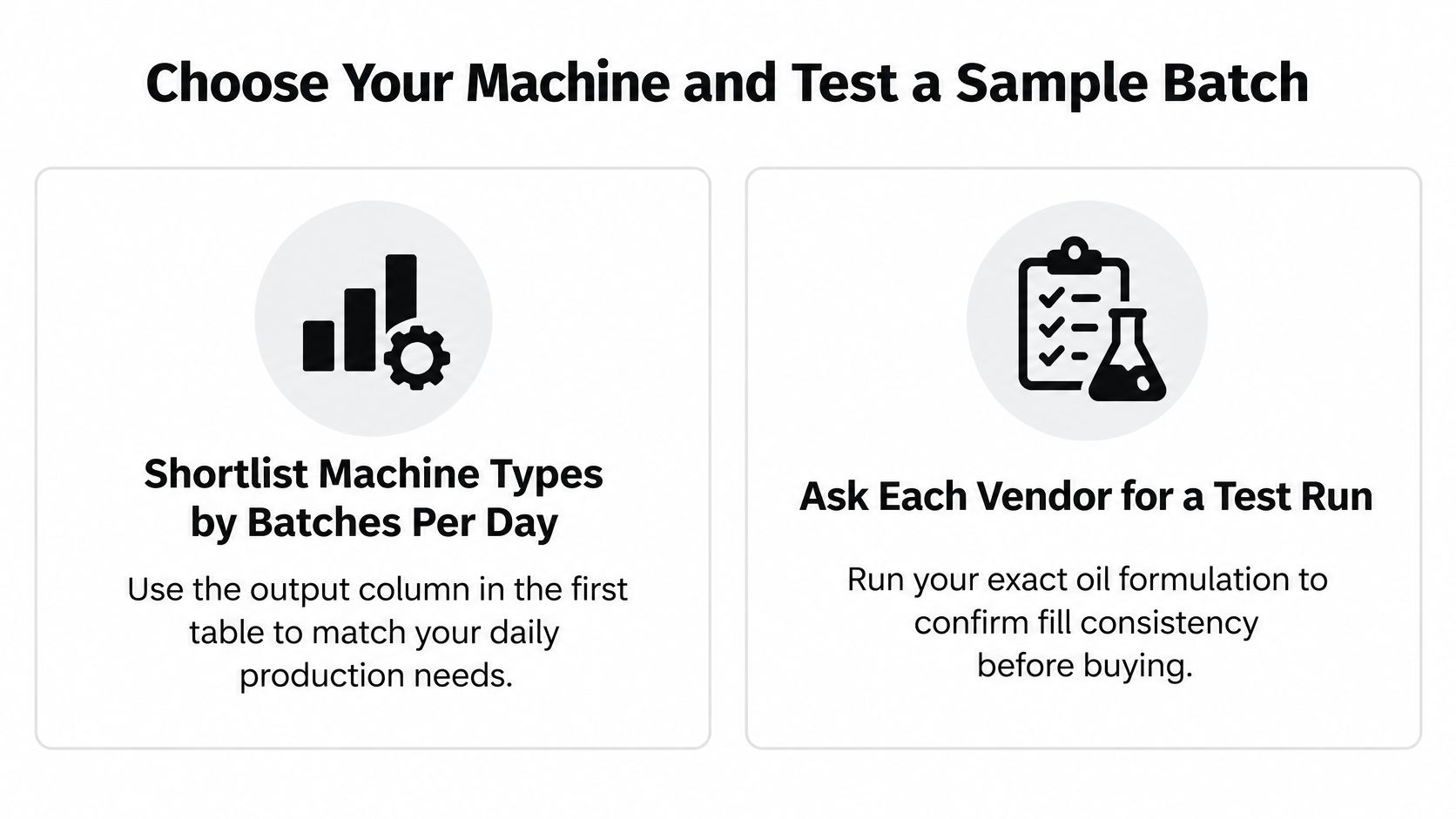
- Shortlist by batches per day. Take your daily cart count and divide it by the output column in the first table, then add the time you'll spend capping and cleaning. If you land near the top of a machine's range today, size for next year's volume instead.
- Ask every vendor for a test run on your oil. Your formulation, your fill temperature, your cart size and fill volume. A demo with clear test fluid answers a different question than the one you're asking. A pump that meters a thin fluid cleanly can still smear a thick winterized distillate, so the fluid in the reservoir has to match what you'll sell.
- Run a three-stage batch and sample it properly. Written in-process procedures should define how samples are selected and tested for every batch. FDA 21 CFR 211.110 requires controls that monitor process output and validate steps that could create variability. For a terpene-infused blend, document fill weight, oil uniformity, and terpene distribution, not just the volume the machine says it dispensed.
- Review hardware certificates and cleaning compatibility before you sign. Take the materials checklist into the vendor meeting and don't accept "food grade" as an answer. Ask which metals and elastomers sit in the fluid path and whether the seals tolerate your cleaning solvent, because those are the parts your oil touches for thousands of cycles.
- Set reject limits and calibration records before production starts. Writing the acceptance criteria after the first bad batch is how brands end up arguing with a buyer about which side of a tolerance they were on.
Everything on that list depends on one thing you control: the oil going into the reservoir. Our terpenes for cartridges are SC Lab-tested and legal worldwide, and they're free from additives, VG, PG, PEG, and MCT, so a qualification run on our blends behaves like the production batch it stands in for. The 3ml Strain Picker Pack lets you select any three different terpene profiles from the catalog in 1.5 ml or 3 ml sizes, which means three formulations can run side by side on the same machine on the same afternoon.
If you're about to qualify a new cartridge filling machine, test it with the oil you sell. Gold Coast Terpenes supplies 100% natural terpene blends built for cartridges, so your fill run measures your formulation rather than a stand-in. Browse the curated packs or use the 3ml Strain Picker Pack to line up three profiles for side-by-side testing, and talk to the team about bulk terpenes when the trial batch turns into a production run. Start at Gold Coast Terpenes and build the batch you'll be qualifying on.