
Live resin is a cannabis concentrate made from fresh-frozen plant material, extracted before the flower is ever dried or cured, and the word live describes that starting material rather than the potency or the quality. Concentrates sold under that name commonly contain approximately 40-95% THC, so the label on the jar tells you where the plant started, not what the oil will do inside a cartridge.
The same 2024 scientific review that reports that potency range also flags microbial contamination, pesticides and other toxins as key concerns for vaporized cannabis products (Wiley review of cannabis concentrate risks). Put those two facts side by side and the buying question shifts. You stop asking whether a product is live and start asking what's in the batch, and who signed the lab report.
Treat live resin as a preservation strategy rather than a quality badge and the rest of the decisions get easier. A product team has two honest paths here. Buy a verified extract that earns the name, or rebuild its aroma on purpose with botanically derived terpene blends in winterized distillate. Both work. They need different paperwork.
What Is Live Resin?
Live resin is a cannabis concentrate made from plant material frozen shortly after harvest, before any drying or curing, then extracted, usually with closed-loop hydrocarbon solvents.
The logic behind that sequence is simple. Drying and curing are good for flower and expensive for aroma. Light, heat and air all promote chemical degradation, and monoterpenes suffer most because they're more volatile than larger terpene molecules (peer-reviewed research on cannabis storage and phytocannabinoid stability). Freezing fresh biomass limits that loss before extraction, which is why producers chase the notes you'd recognize from a living plant: citrus, pine, fruit, earth.
The concept map below keeps the definition straight before we get into the trade-offs.
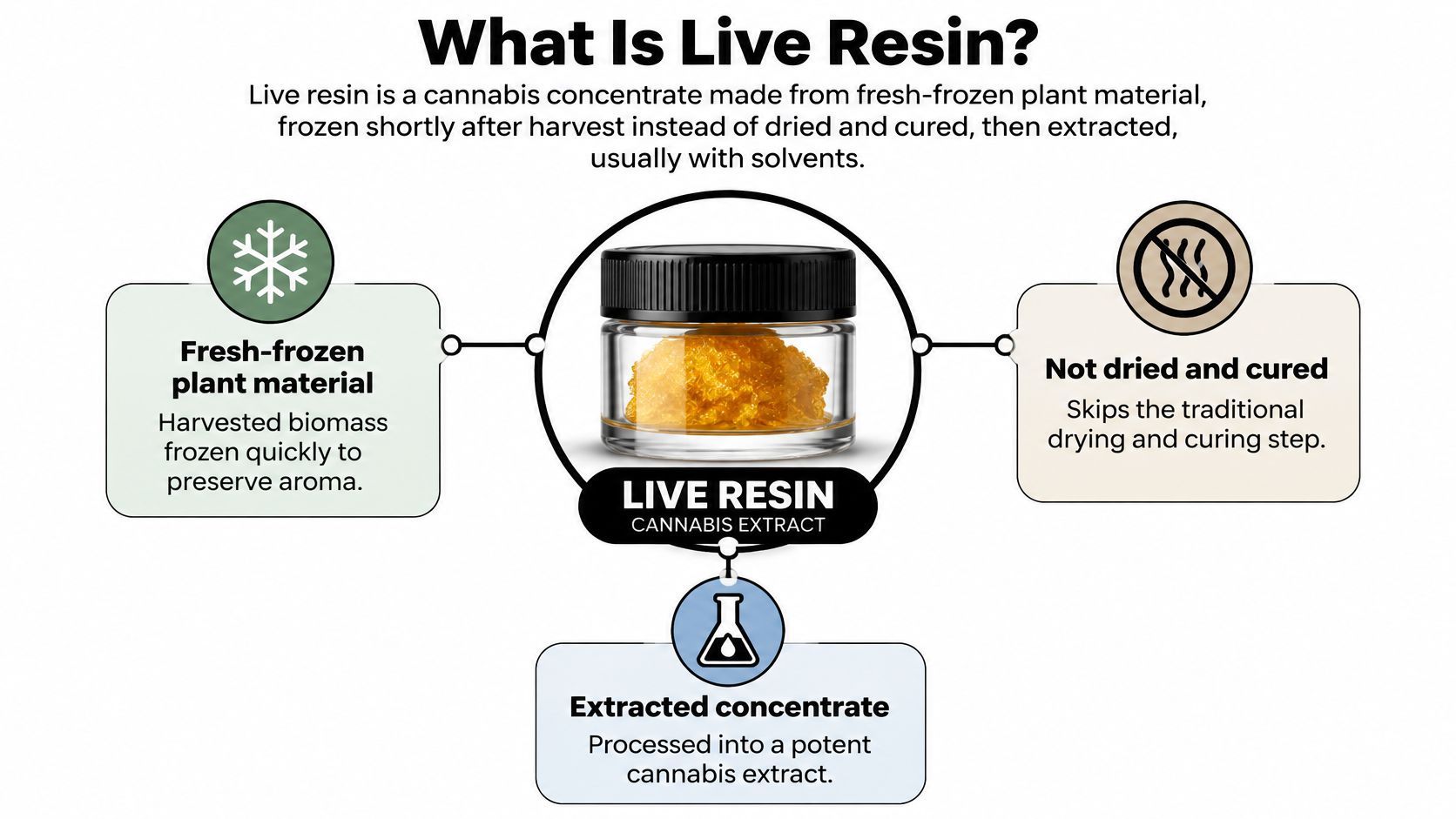
What live does not describe matters just as much. It isn't a texture, since the same extract can be sold as sauce, badder, sugar or another consistency depending on how it's finished. It isn't a fixed terpene percentage. And it isn't a quality guarantee, because the freeze happens before extraction and testing, not after.
For buyers, live resin is a licensed cannabis concentrate, so the compliance work starts with the first purchase order rather than the first fill run. Batch records, chain of custody and a lot-specific certificate of analysis belong in the deal from day one.
How Live Resin Is Made in Licensed Facilities
A licensed live resin run is short, cold and tightly controlled. Every stage exists to protect one thing: the volatile fraction you paid to freeze. Here are the five stages worth auditing on a supplier visit.
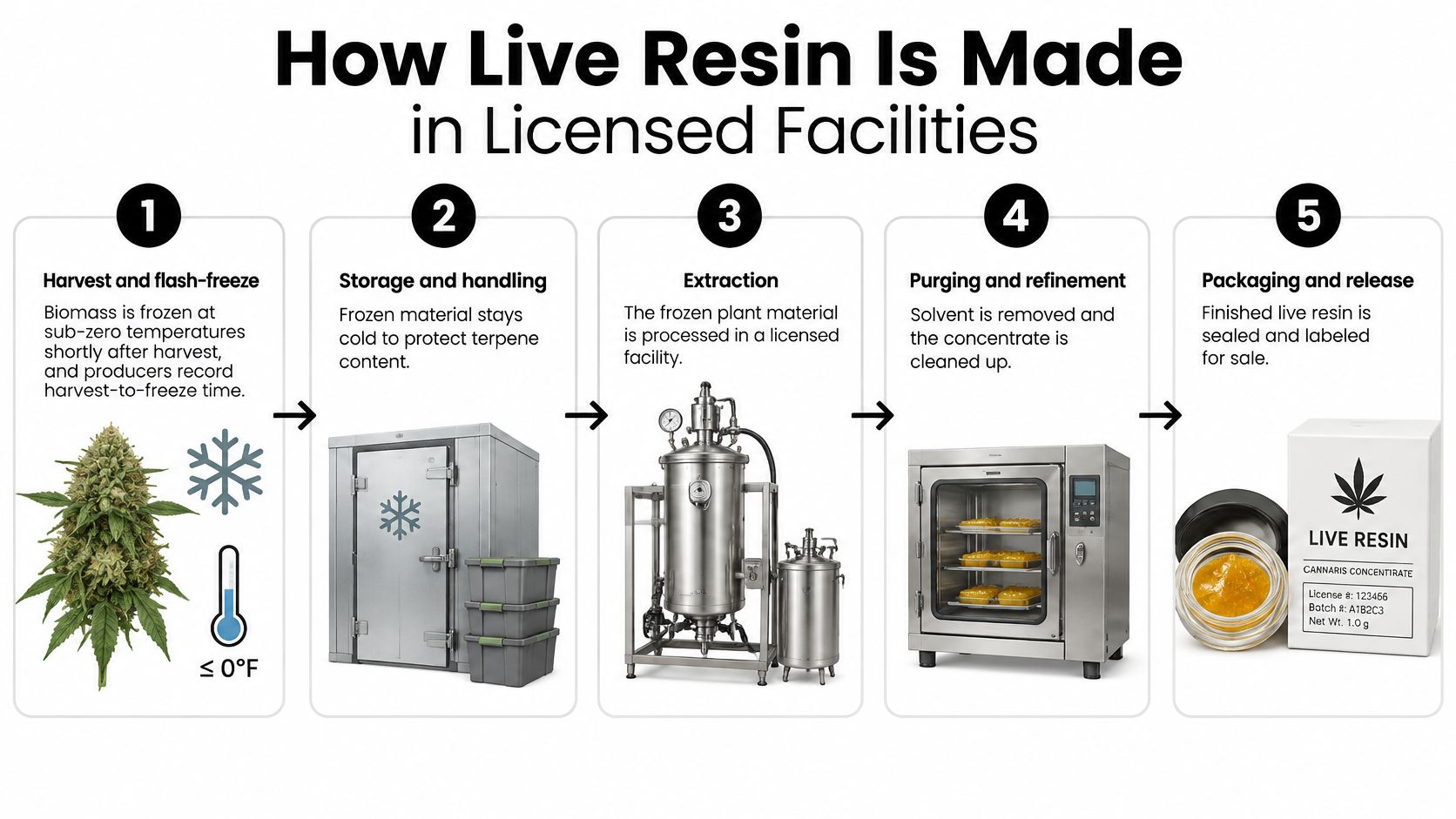
Harvest and flash-freeze. Biomass goes sub-zero shortly after cutting. Serious producers log harvest-to-freeze time in hours, because every hour at room temperature spends monoterpenes. Immediate freezing reduces molecular mobility and volatilization in the trichome resin (Cannabis Business Times guidance on fresh-freezing cannabis).
Cold extraction. A closed-loop hydrocarbon system running butane, propane or a blend strips cannabinoids and the volatile aroma fraction while the material stays cold. Temperature control at this step limits both evaporation and oxidation.
Solvent recovery. Solvent comes off under controlled vacuum and gentle heat. Done correctly, residual solvents test below limits. Rushed, you either leave solvent behind or boil off the compounds you froze the plant to protect.
Finishing and texture. Controlled precipitation, whipping or mild warming sets the final consistency, from sauce to badder to sugar. This is a formulation decision, not a marketing one, because texture changes how the oil loads and flows through a cartridge.
Batch testing. A certificate of analysis should cover cannabinoid potency, terpene composition, residual solvents, pesticides, heavy metals and microbial contaminants. Ask for the specific lot you're buying rather than a representative sample from six months ago.
Flammable solvents under pressure make this licensed-facility work with no exceptions for garage setups. Hydrocarbon extraction is hazardous outside regulated facilities because of flammability and pressure risks, and it shouldn't be attempted by consumers or unlicensed manufacturers.
If you're weighing extraction routes for a new SKU, our breakdown of solvent extraction methods puts hydrocarbon, ethanol and CO2 side by side on cost, selectivity and aroma retention.
This walkthrough shows the hardware and the sequence in motion.
The buyer takeaway is blunt. The process, not the name on the jar, determines what reaches your cartridge. Two brands can both print live resin and ship oils with very different terpene loads, solvent profiles and shelf behavior.
Live Resin Compared With Distillate and Other Extracts
The comparison between live resin and distillate is compositional before it's commercial. Starting material and processing decide what the oil can smell like and how much formulation work lands on your bench afterward.
| Extract | Starting material | Process | Terpene content | Aroma character | Typical manufacturing use |
|---|---|---|---|---|---|
| Live resin | Fresh-frozen biomass | Closed-loop hydrocarbon extraction | High; native volatiles retained | Strong, cultivar-specific, fresh | Aroma-forward cartridges and concentrates |
| Live rosin | Fresh-frozen biomass | Solventless heat and pressure | High but fragile; heat and pressure destroy it quickly | True-to-plant, delicate | Premium solventless SKUs |
| Cured resin | Dried and cured flower | Hydrocarbon extraction | Moderate; reduced by drying | Warmer, cured notes | Classic concentrate lines |
| Distillate | Refined crude oil | Heat and vacuum distillation | Low native; stripped with the volatiles | Neutral; needs added terpenes | Cannabinoid base for carts, edibles, tinctures |
Three decision notes sit behind those rows. Distillation deliberately separates and concentrates cannabinoids using heat and vacuum, so much of the original volatile fraction leaves with the process, and producers reintroduce terpenes afterward from cannabis or botanical sources (Phytogrammes guide to live resin extraction). That reintroduction step is where a formulator gains control and where label honesty gets tested.
Live resin takes the opposite route. It co-extracts cannabinoids and volatiles from frozen biomass before any extensive thermal processing, which can produce stronger, more cultivar-specific aroma. Retention still depends on extraction temperature, oxygen exposure, solvent recovery, packaging and storage, so the advantage is conditional rather than automatic.
A botanically derived blend added to distillate reproduces selected aroma notes with tight batch-to-batch consistency. It is not analytically identical to a verified live-resin extract unless the full volatile profile and minor constituents are matched, and no supplier should claim otherwise.
Live rosin trades solvent use for premium pricing and delicate handling, which makes it a strong flagship SKU and a poor volume play.
Working rule: shortlist the extract type with the table, then verify any candidate with a batch COA. The label narrows the field; the lab report picks the winner.
For a deeper head-to-head on the two formats most cartridge teams debate, read is live resin better than distillate.
What Shapes Live Resin Aroma and Terpene Profile
A live resin lot works like a relay team: every handoff can drop the baton, and the customer smells only what made it to the finish. In one peer-reviewed cannabis study, adding external terpene material at 1.18% of flower weight was the minimum needed to hold a flower's initial terpene content after six weeks under the tested packaging method (cannabis postharvest and terpene stability research). Aromatics leak, so packaging is part of the formula.
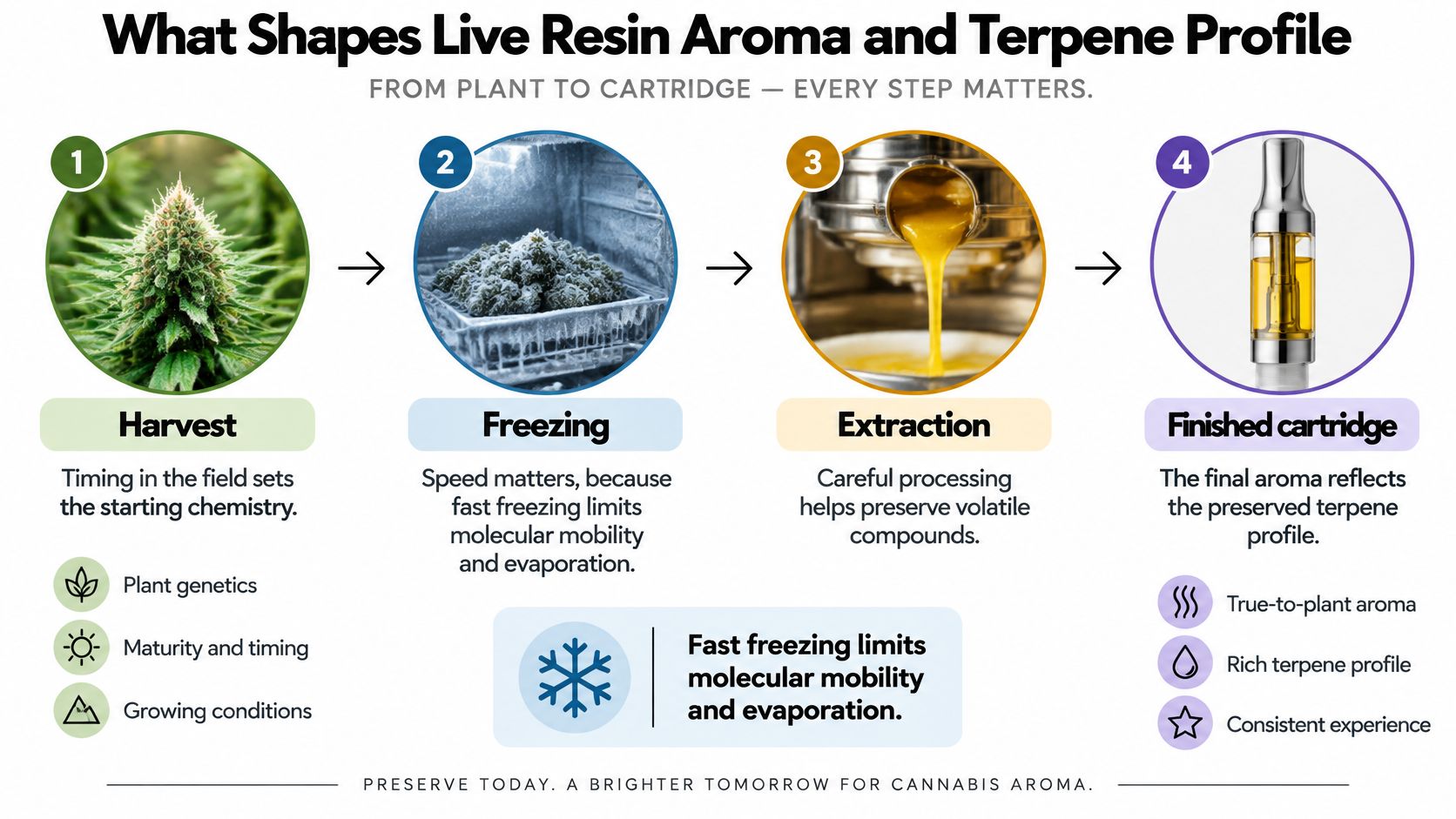
The staged view below tracks those handoffs in order, from field to finished cartridge.
The Chain From Harvest to Cartridge
Harvest timing sets the starting chemistry. Cut early and the profile leans lighter and greener; cut late and heavier notes dominate. Nothing downstream repairs a field decision.
Freezing speed decides how much of that chemistry survives the first 24 hours. Fast freezing limits molecular mobility and evaporation in the trichome resin; slow freezing gives the lighter monoterpenes time to leave before extraction begins.
Storage conditions keep spending the budget. Light, heat, oxygen and a weak package each take a share, and individual terpenes do not fade at the same rate, so two jars from the same batch can drift apart.
Extraction conditions choose which notes make it through. Temperature, oxygen exposure and solvent recovery change the balance, which is why two operators running the same biomass can fill different-smelling oils.
Product life continues after filling. Packaging barrier, shelf time and cartridge heating keep reshaping the profile in the package and in the device.
| Condition | Typical effect on terpenes | Formulator check |
|---|---|---|
| Warm storage | Faster loss of volatile top notes and flatter aroma | Set a room-temperature shelf-life panel |
| Cold storage | Slower aroma drift when the package stays sealed | Specify cold-chain handling before filling |
| Extended shelf time | Gradual thinning of cultivar character | Compare retained terpenes lot by lot |
| Light exposure | Uneven fade across individual terpenes | Require an opaque or barrier package |
| Added terpene material | Can help hold target aroma when dose and packaging are designed together | Confirm with a post-packaging panel |
Live raises the starting fidelity. Handling decides the ending.
That is why batch comparison beats strain names. When you source, specify cold-chain requirements, packaging barrier and a shelf-life terpene panel, then compare measured composition lot by lot instead of trusting a cultivar name printed in the same font every year.
Formulating With Live Resin Character in Distillate and Carts
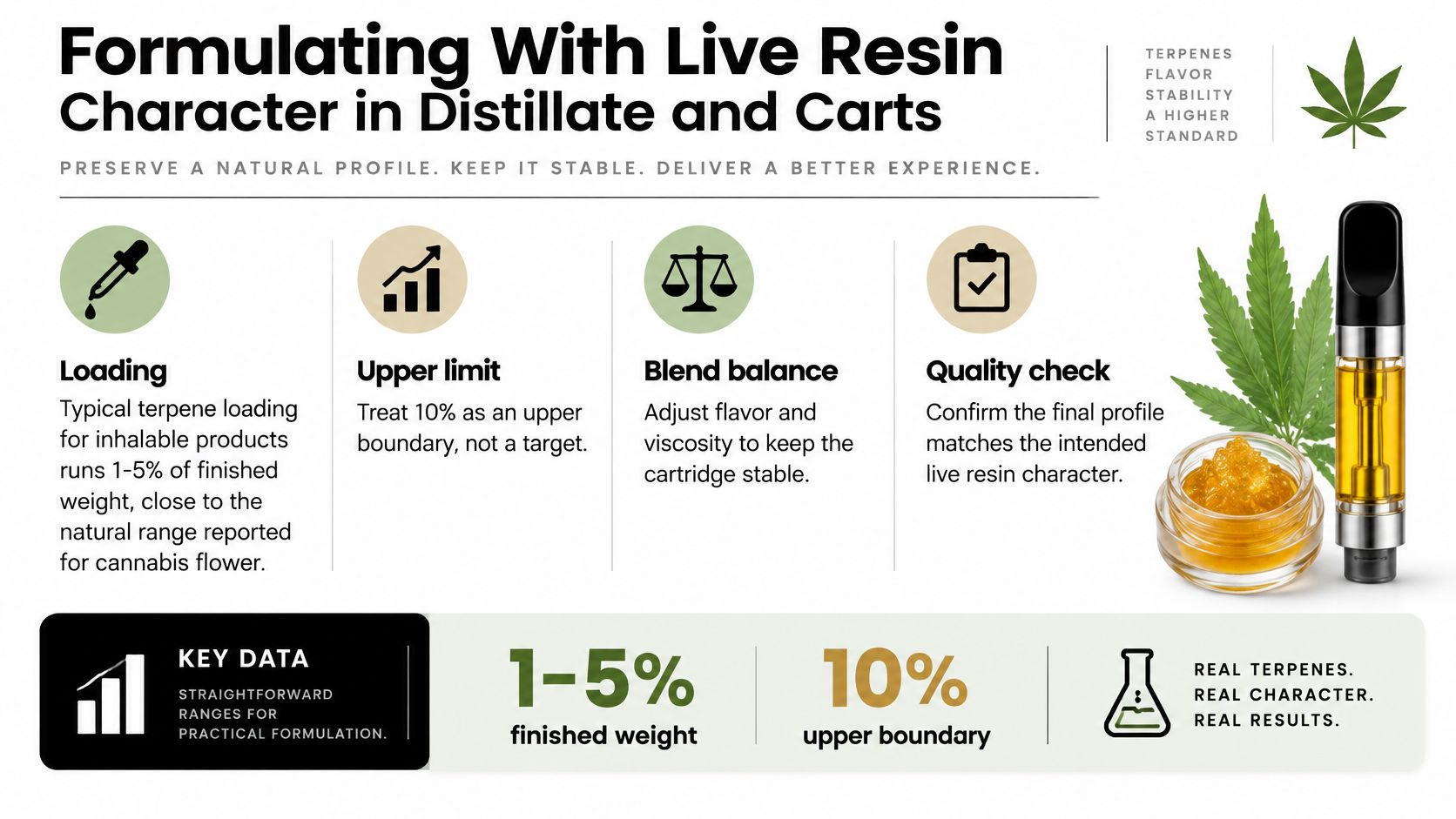
Start with the loading range. A practical terpene load for an inhalable product is 1% to 5% of the finished weight. NCIA guidance on e-liquids and vape formulation identifies 10% as an upper limit for the final product and keeps the safety and local-rule confirmation with the manufacturer. Treat the ceiling as a boundary, not a target.
A Mixing Workflow That Scales
- Start low. Begin a distillate trial at a 1-2% terpene load so you can smell and measure the direction before committing a full batch.
- Mix into winterized oil. Add the blend to fully winterized distillate and homogenize until the oil is uniform. Cold, cloudy or separated oil means the blend isn't fully dispersed.
- Fill a sample cartridge. Evaluate aroma and hardware performance together. Viscosity, wicking and clogging show up at fill, not on the certificate.
- Adjust in small steps. Move in increments of about 0.25% to 0.5% rather than adding a large amount at once. Overshooting is easy; walking flavor back is not.
- Record everything. Log every ratio, lot number and mix temperature so batch four tastes like batch one.
Small steps matter because a cartridge is a small closed system. A tenth of a percent change in load can move both throat feel and viscosity enough to change how a device performs across a week of use.
Matching a Blend to a Reference Extract
Aroma comparison gets you close. Measured composition gets you paid. Ask for a terpene panel on the reference live resin extract and on your candidate blend, then compare the top five compounds by percentage, not just the headline notes. Live resin earns its character by preserving what the fresh plant held, so the honest benchmark for a rebuilt blend is the same thing: a measured profile, not a name.
Batch-to-batch consistency is the third test. Three consecutive lots of the same blend should land inside a tight range, or your flavor will drift with every production run.
Practical note: strain names are marketing shorthand. Compound percentages are the specification.
Botanically derived, THC-free blends give you a controllable way to rebuild live resin character in distillate, carts and concentrates. Blends formulated from fresh-plant-extracted terpenes, tested by an independent lab and free of additives, let you match a reference profile compound by compound rather than guessing at it. Our guide to using terpenes in distillate and cartridge formulations covers dilution ratios and handling for the same workflow.
What Live Resin Does Not Guarantee
Fresh-Frozen Does Not Mean Clean
Myth one sounds like common sense, which is why it spreads: fresh-frozen must mean clean. Freezing describes the input, not the finished product. Microbial, pesticide and residual-solvent risk is controlled by extraction hygiene, solvent recovery and independent testing. Cold temperatures do none of that work on their own.
Replace the myth with three questions you can answer with documents.
| Quality question | What to verify | Document to request |
|---|---|---|
| Fresh-frozen input | Harvest-to-freeze time and cold chain | Batch record or process SOP |
| Solvent removal | Residual solvents within limits | Batch COA |
| Contaminant safety | Pesticides, heavy metals, microbes | COA with detection limits |
| True terpene profile | Native versus added terpenes, batch percentage | Lot-specific terpene panel |
If a supplier can't produce those four documents for the lot they're shipping, the freeze date is trivia.
More Terpenes Is Not a Quality Score
Myth two is subtler. A higher terpene number feels like a better product, but the perceived profile depends on the whole chain: harvest timing, freezing speed, storage duration, extraction conditions, solvent recovery, oxidation and cartridge heating (TribeTokes guide to live resin). Preserving more native chemistry can also preserve plant compounds you didn't want in an inhalable oil.
That leaves a real question for formulators: should a live resin extract be used as-is, or should its profile be adjusted analytically? Both are legitimate. What isn't legitimate is calling a rebuilt blend a live resin extract without saying so. Verify whether a product is a full extract or a blend with reintroduced terpenes, compare lot-specific panels batch by batch, and evaluate the aerosol after filling, because the inhaled output can differ from the oil in the jar. Potency belongs on the label, not in the purchase decision.
Source Live Resin Character With Confidence
Two branches, one checklist. Choose a true live resin extract when a SKU needs native, full-profile aroma and you can verify cold chain, residual solvents and terpene panels lot by lot. Choose botanically derived blends in distillate when you need batch consistency, THC-free formulation and tighter flavor control at scale.
Either way, require lot-specific COAs showing terpene purity and any carrier or process solvents, SDS documents that address inhalation exposure, ingredient lists and composition ranges (NCIA safe vaping white paper). State rules raise the bar further. Nevada asks for a natural-declaration statement, confirmation that acetone, toluene and methanol aren't added or used, solvent disclosure and ingredient-range SOPs, and it caps terpenes at no more than 10% of the final product with the percentage written into submitted SOPs (Nevada Cannabis Compliance Board terpene guidance). Supplier documentation is a purchasing criterion.
The COA guide from Gold Coast Terpenes walks through what a usable certificate contains. Its terpenes for cartridges are added to winterized distillate oils, SC Lab-tested and legal worldwide, which makes them practical for teams rebuilding a live resin profile without a cannabis-derived supply chain.
Live resin character doesn't have to come from a frozen harvest to be consistent, compliant and repeatable in production. Gold Coast Terpenes supplies botanically derived, THC-free blends and isolates built for distillate, cartridges and concentrates, all SC Lab-tested, alongside programs for distributors, shops and independent reps, affiliates, and manufacturers and brands. Browse the strain profiles, blends and isolates, review the wholesale, bulk and affiliate programs, or reach the team through Gold Coast Terpenes.