
An order lands for a thousand cartridges, and the only spec attached is a name: Super Lemon Haze. No terpene percentages, no certificate, no target ratio. Somewhere there's a lab sheet from the last supplier, and nobody is sure it matches what the previous lot tasted like.
That's the situation this guide answers. Super Lemon Haze is a label on a bottle, not a chemical formula. Formulators who hit a consistent lemon-citrus flavor treat the name that way: they build a range from batch data, set a sensory target, and check every lot against a certificate. Do that and the same name produces the same flavor across runs. Skip it and you'll be re-flavoring by feel every quarter.
What Super Lemon Haze Tastes Like to a Formulator
The target is specific. Bright lemon peel up front, a piney floral lift underneath, and a peppery finish that stops the whole thing from reading like candy. If your blend is flat lemon on the front and nothing behind it, you've missed the back half of the profile.
The quickest way to hold that target in your head is a bottle of blend next to the genuine article:
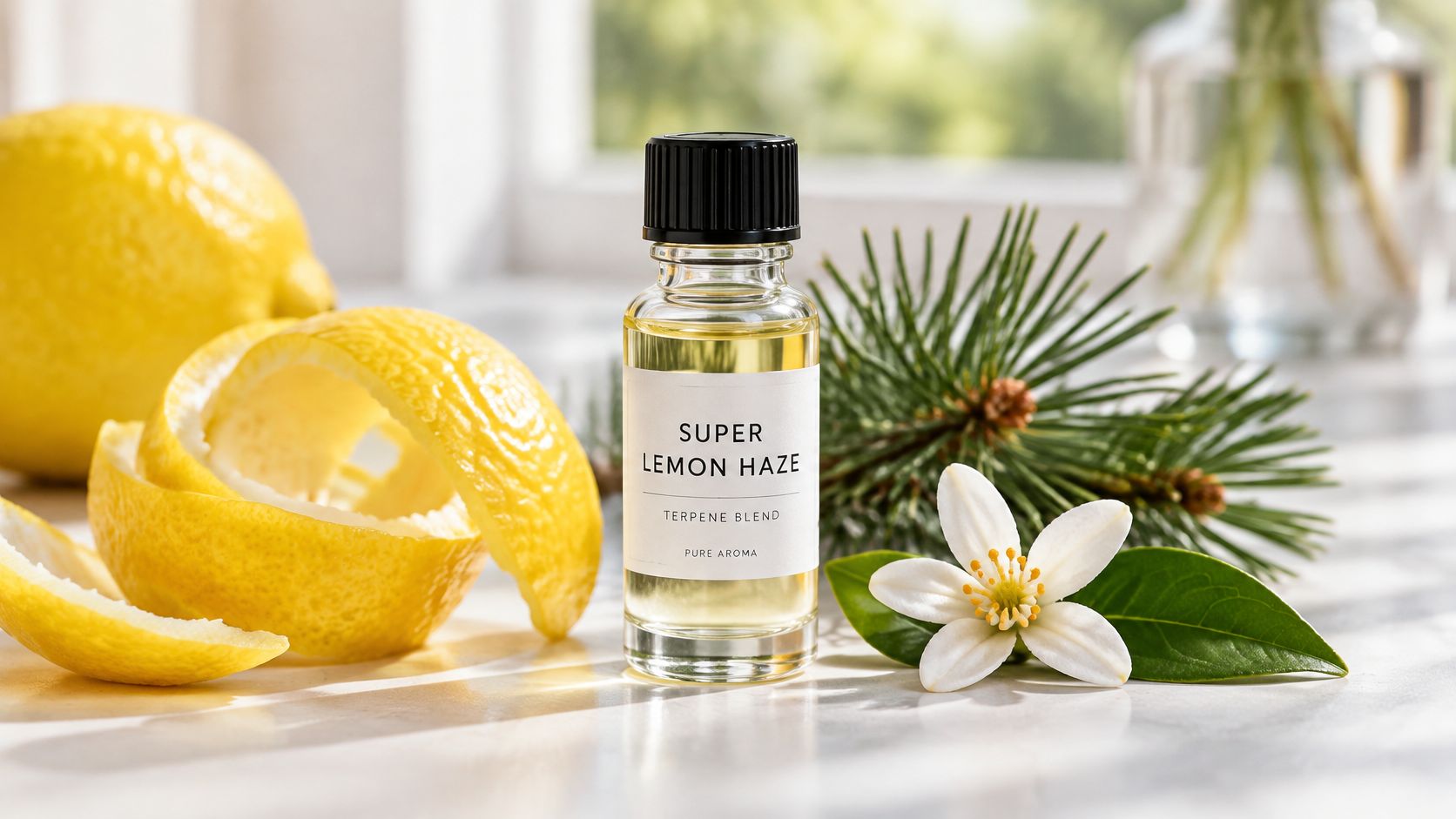
Treat the strain name as a recipe title and the terpene ratios as the ingredient list. Two kitchens can both print "lemon cake" and produce different cakes. The name became a citrus-Haze reference point when Green House Seed Company in Amsterdam crossed Lemon Skunk with Super Silver Haze and took consecutive first place wins at the High Times Cannabis Cup in 2008 and 2009 (High Times). The award fixed the reputation. It never fixed a chemical standard, and the same commercial name can represent different terpene ratios.
Four compounds shape the sensory target. Terpinolene carries the pine and floral lift that makes a profile read as Haze rather than as lemon. Limonene supplies the sharp peel brightness. Beta-caryophyllene adds peppery, woody depth. Myrcene rounds it out with earthy-fruity weight.
The blends you buy for this work are botanically derived, built from plant sources, so your supply doesn't hinge on one harvest or one region.
Judge flavor in the finished base. A blend that tastes right in winterized distillate can read sharper or thinner once it sits in a cartridge next to a wick and a coil, so keep the tasting step in the format you ship.
Practical rule: put one line on the spec sheet. Lemon lead, pine-floral edge, peppery finish. Then attach the certificate that shows whether a candidate blend hits it.
Target Terpenes and Reference Ranges for Super Lemon Haze
A buyer's first question is which terpene leads. The honest answer is that it changes with the lot, and you still need a table to argue with, so here's the one to put in front of a supplier.
Super Lemon Haze terpenes: roles and reference shares
| Terpene | Aroma role | Share in tested sample |
|---|---|---|
| Terpinolene | Pine, floral, herbal lift; lead terpene in published profiles | 0.55% to 0.65% across several tested products, not reported on the reference certificate |
| Beta-caryophyllene | Peppery, woody depth | 0.999% |
| Limonene | Sharp lemon peel brightness | 0.651% |
| Myrcene | Earthy, fruity rounding | 0.305% |
| Alpha-pinene | Fresh pine lift | 0.187% |
| Linalool | Soft floral note | 0.158% |
| Beta-pinene | Dry pine edge | 0.094% |
Read those shares as reference points from one sample, not as fixed cultivar specifications. Published profiles disagree in useful ways. Leafly identifies terpinolene as the most abundant terpene in the cultivar, while tested products have shown limonene leading at 1.02% to 1.12% with terpinolene at 0.55% to 0.65% (Leafly's Super Lemon Haze profile). Both statements are true of different samples sold under the same name.
Three starting directions
- Terpinolene-led, for the truest Haze edge. Start here once a certificate confirms terpinolene for your material, because that note is what separates this profile from a generic lemon blend.
- Limonene-heavier, for brighter peel. Useful when the citrus has to cut through a strong base or a heavy diluent and the front note needs to arrive fast.
- Balanced with caryophyllene, for depth. The peppery weight holds flavor in a cartridge where the light top notes fade first.
Limonene does the obvious work, and the lemon terpene profile breakdown is worth reading before you decide how much weight it should carry. Push either direction too far and the profile breaks predictably. Excess limonene drifts toward generic lemon candy, which reads as a flavor house product rather than a Haze. Too little terpinolene strips out the pine-floral complexity, and what's left is lemon without the lift. Which direction you pick depends on the base: winterized distillate carries lemon notes well, while a small cartridge fill on a hot coil loses top notes first and rewards extra caryophyllene.
Treat every row as a starting range and confirm it against the batch certificate before you scale. A supplier who can't send that certificate is asking you to buy a name.
Why Batch Data Beats the Strain Name
A strain name isn't a standard, and treating it like one is how batches drift. The chemistry is blunt about it. A 2020 study of plants from 32 cannabis seed sources found substantial terpene variation both between plants labeled as the same cultivar and among different cultivar groups. Its first two principal components explained 26.4% and 19.7% of the observed terpene variation, so a large share of the difference comes from genetics rather than from the label. Related commercial-cannabis research cited in the same paper found individual terpenes rarely above 0.5% by weight and most commonly below 0.2%, with total terpene content averaging about 2% (the 2020 cannabis terpene variation study).
Only five compounds showed up in every plant examined: myrcene, alpha-pinene, limonene, beta-caryophyllene and alpha-humulene. Terpinolene was not among them. That single detail matters for purchasing. A spec that requires terpinolene in every incoming lot will fail on a normal batch unless your supplier is blending to your target rather than selling you single-source material.
A name is a search term. A certificate is a specification.
Write the spec as a band, not a number
Say one lot shows limonene at 0.8% and the next at 1.1%. Both can sit inside the cultivar's sensory family, but dose them at the same rate and the finished flavor won't match, because the second reads brighter and pushes the pine edge back. The blend has to absorb that swing so the finished product doesn't show it.
The high end is real too. A Leafly review published in 2024 noted one plant reaching more than 3.5% terpenes by weight (Leafly Super Lemon Haze reviews), well above the 2% commercial average and the reason a maximum matters as much as a minimum.
So build the sheet with a floor and a ceiling for each lead terpene, and set the sensory target from that band. Then check incoming lots against it. Our strain terpene profiles show how the same approach applies across other names you may be matching. What you're buying is a range you can hold, not a number somebody typed once.
Reading a Real Super Lemon Haze Certificate
Here's a tested sample to read against your own target.
Terpene results from one Super Lemon Haze sample
| Terpene | Percent by weight | Milligrams per gram |
|---|---|---|
| trans-Caryophyllene | 0.999% | 9.986 |
| (R)-(+)-Limonene | 0.651% | 6.508 |
| beta-Myrcene | 0.305% | 3.051 |
| alpha-Pinene | 0.187% | 1.865 |
| Linalool | 0.158% | 1.582 |
| beta-Pinene | 0.094% | 0.939 |
| Total terpenes | 2.394% | 23.94 |
Start with the units. Milligrams per gram divided by ten gives percent, which is why limonene at 6.508 mg/g is 0.651%. When terpenoid testing is requested, the licensed laboratory must analyze at least 0.5 grams of the representative sample and report each result on the certificate both as a percentage and as milligrams per gram by weight or milligrams per milliliter by volume (California DCC regulations). The two columns must agree on every row, and the percent column here adds up to exactly the 2.394% total, which is a fast way to catch a mis-transcribed sheet.
Mark anything outside your range first. Go row by row against the band you set and flag what falls outside it. A sample sitting well above your limonene ceiling will read sweet and thin no matter how carefully you dose it, and no amount of caryophyllene rescues that.
Match the two leading rows next. On this certificate, trans-caryophyllene at 9.986 mg/g and (R)-(+)-limonene at 6.508 mg/g account for about 69% of the 2.394% total (this Super Lemon Haze certificate). Get those two into the right relationship and the profile is recognizable even when the smaller notes are off.
Read the total before you dose. A light sample needs a higher addition rate to reach the same intensity, and a rich one can be dosed lower. Dosing without checking the total is how a blend ends up either mute or harsh.
Myrcene, alpha-pinene, linalool and beta-pinene carry supporting character. Miss one and the core flavor barely moves. Miss caryophyllene or limonene and it changes completely. And remember that one certificate is one tested sample, not a universal formula, so use it as a matching benchmark. Our COA guide covers what a complete sheet should contain.
Check any certificate in four steps
Confirm the sample date so you know how old the material is. Confirm the named terpenes match the rows you care about. Confirm the units and that the percent column sums to the total. Then decide which rows to match first, which is almost always the two at the top.
How to Build a Super Lemon Haze Blend
Building the blend is the easy part. Keeping it consistent across lots is where the work sits, so work in this order.
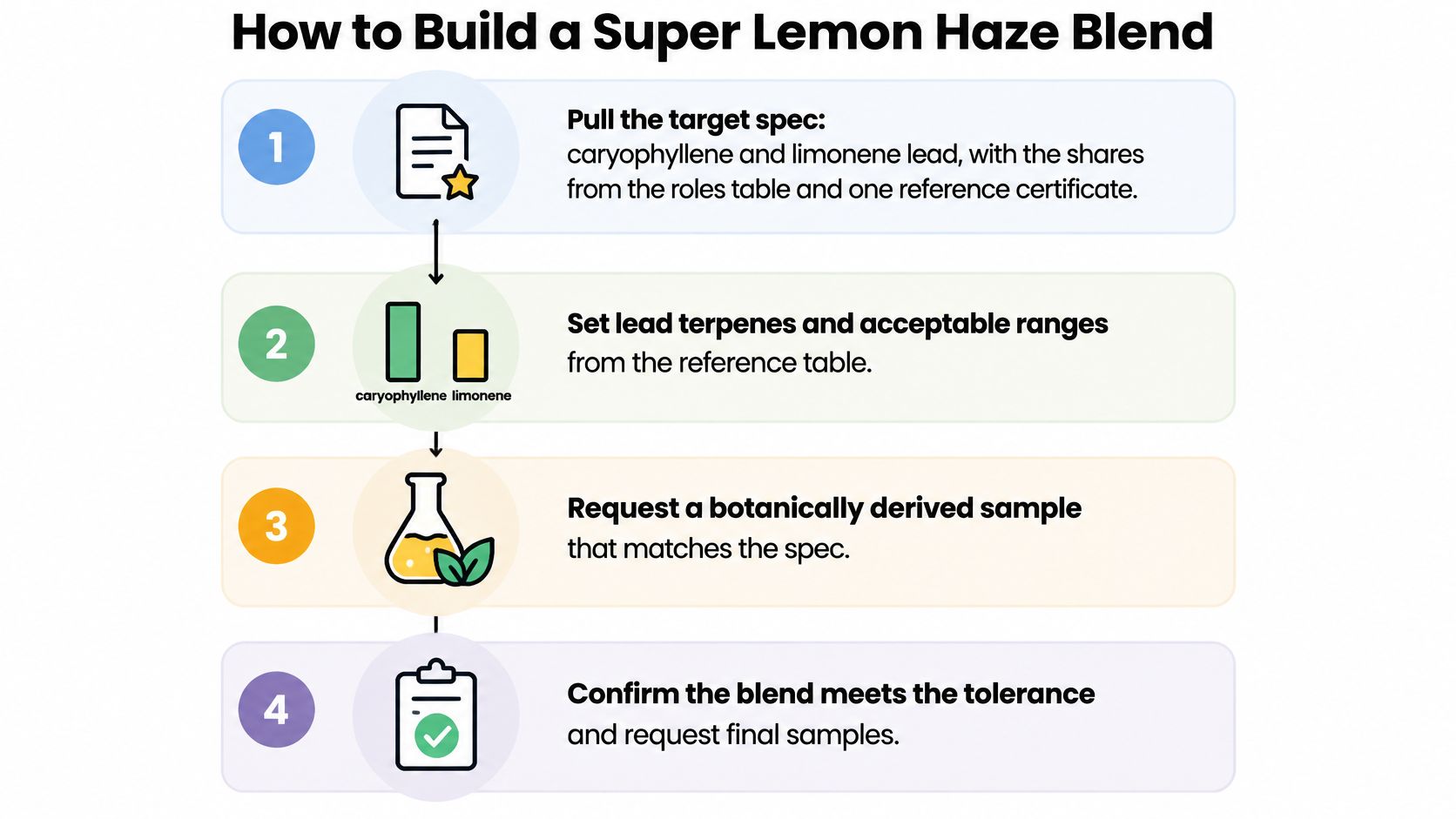
Pull the target spec. Start with the roles table and one reference certificate so you know which terpenes must lead. On the current reference, caryophyllene and limonene lead, and terpinolene stays open until a certificate confirms it for your lot.
Source botanically derived components for each row. Terpinolene, limonene, caryophyllene, myrcene, pinene and linalool cover the profile. Ask for third-party data with the material. Our terpene information is provided by SC Labs, and yours should come from a lab you can name to a buyer.
Build a 100 g working batch. A ratio worth testing: 40 g terpinolene-rich component, 25 g limonene, 15 g beta-caryophyllene, 10 g myrcene, 5 g alpha-pinene and 5 g linalool. If your certificate shows caryophyllene leading, move weight from terpinolene to caryophyllene in small steps instead of reformulating from scratch.
Dose into winterized distillate at 2% to 4% by weight of the finished oil. Step up in 0.5% increments and taste at each step. Excess terpene flattens the base and turns the lemon sharp, so the right rate is the one where the citrus lifts without dominating.
Mix in a clean vessel at room temperature, then let it rest. Fresh blends taste sharper than they settle, so a sample pulled ten minutes after mixing isn't the flavor you're shipping.
Test the finished product after sealing and storage. Monoterpenes such as terpinolene and limonene are volatile, so processing temperature, headspace, sealing and storage time can change the finished profile even when the blend itself was accurate (Journal of Cannabis Research). Hold a filled sample at the temperature your product will meet and retest it.
Log the lot, the addition rate and the total weight. Without those three numbers you can't tell later whether a flavor shift came from the blend or from storage, and you can't reconcile a label with a certificate.
Most small runs go wrong at the mixing step. Terpenes added to a cold, viscous oil and stirred for thirty seconds don't distribute evenly, and the first filled units carry hot spots that later units don't. Warm the oil enough to flow, add slowly, and stir until the blend is uniform. The guide to mixing terpene strains walks through the sequence in more detail, and this short walkthrough is worth five minutes before your next batch.
The blend works when a clear lemon lift keeps its pine-floral edge through the storage test. If it does, you have a spec you can buy against. If the lemon fades and the pepper takes over, your caryophyllene is high relative to limonene and the fix is a small weight shift, not a new supplier.
Labeling Tolerance and Batch Records
Say your label declares 1.0% limonene. Under the California regulation, that claim isn't treated as inaccurate as long as the certificate-of-analysis percentage lands within plus or minus 10.0% of the declared figure, so a result anywhere from 0.9% to 1.1% supports the label (California DCC testing laboratory program). The state requires cannabis goods to be tested before sale, including for accurate cannabinoid and terpene amounts, and inhaled-product labels must list all ingredients. That makes the certificate a labeling document, not a marketing one.
Audit trail: lot, rate, weight, result. Four fields, one page.
What the batch sheet needs
Record the blend lot so you can trace back to the supplier's certificate. Record the addition rate as a percentage of finished weight. Record the total formula weight or volume for the run. Record the finished-product test result so the declared profile can be reconciled with the certificate at any time. Add the fill date and the storage condition if your product ships in more than one format.
Records earn their keep when a lot drifts. If the finished result lands outside the tolerance, the logged addition rate tells you whether the blend or the storage caused it. Without that number you're guessing, and guessing usually means reformulating a blend that was fine.
Rules differ by state and country, so check local requirements with your own compliance advisor before scaling. A one-page batch sheet that links each lot to its certificate will satisfy most of them and costs you an afternoon to set up.
One more thing belongs on that sheet: whether the format is heated at all. A 2025 study found that adding a commercial terpene mixture to delta-8- and delta-10-THC distillates at 7.5% and 15% by mass increased carbonyl emissions by as much as ninefold, and related 2025 work found that heating common cannabis terpenes, limonene and myrcene among them, generated degradation products such as methacrolein, isoprene, benzene, aldehydes and acids (ACS ES&T Air). Ask suppliers for oxidation and storage data for any heated format, and don't promise a safety benefit from terpenes.
Request Samples and Start Your Blend
The fastest way to know whether a blend matches your target is to run it in your own base. A certificate tells you what's in the bottle. Only your distillate tells you what it tastes like.
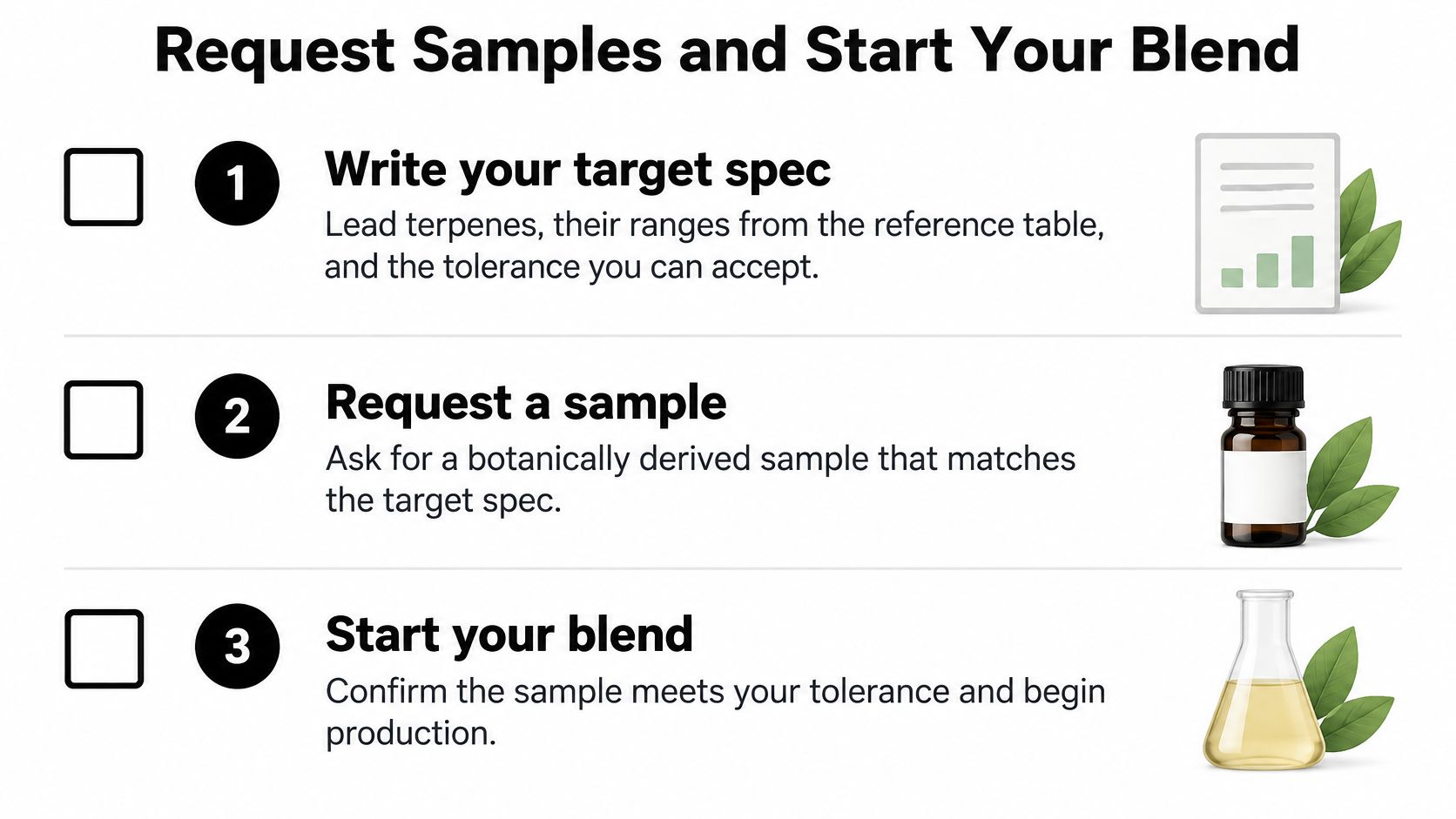
Write your target spec. Lead terpenes, their ranges from the reference table, and the tolerance you can accept on the label.
Pick a strain profile or isolate set that fits the spec. A botanically derived blend gets you close to the citrus-Haze character in one component. Isolates like Limonene, Terpinolene and Beta-Caryophyllene let you push individual rows into range if the blend falls short. Run whatever you choose in your base before committing to a run.
Ask for the lab certificate for the lot you're considering and check that the named terpenes and the total match your spec, row by row.
Plan the scale-up. Once the blend passes in your base, move to volume through the bulk program: orders over $100 ship free in the U.S., and orders above 64 oz carry a discount.
Gold Coast Terpenes offers botanically derived blends with terpene information provided by SC Labs. The material is extracted from fresh plants and is free of mixtures, chemicals and additives, and the terpenes for cartridges are SC Lab-tested and legal worldwide. The catalog covers more than 50 Indica, Sativa and Hybrid profiles, with new strains added each month, so a near-match to your spec is usually already on the shelf.
Gold Coast Terpenes supplies botanically derived strain profiles and isolates that let you build a Super Lemon Haze spec around your own batch data instead of a fixed recipe. When you're ready to buy terpenes for a production run, shop the strain profiles, packs and isolates at Gold Coast Terpenes.