
Most formulators misunderstand what qualifies as a botanical extract versus a botanical ingredient, and that mistake shows up fast in label claims, batch consistency, and flavor drift. In cannabis work, the distinction matters even more because the extract you choose can preserve delicate aroma notes, or flatten them before they ever reach a cartridge.
Botanical extracts sit inside a much larger industrial system than many assume. Recent market estimates put the category anywhere from about USD 6.91 billion to USD 12.5 billion in the mid-2020s, depending on methodology, with projections reaching USD 16.34 billion by 2034 at 10.15% CAGR in one report and USD 22.061 billion by 2036 at 5.3% CAGR in another, which shows that this is a major supply chain, not a niche herbal corner Fortune Business Insights. For cannabis formulators, that scale matters because it affects sourcing discipline, traceability, and whether a supplier can support repeatable production.
Defining Botanical Extracts for Formulation Work
A botanical extract is the concentrated result of pulling soluble compounds from leaves, roots, flowers, bark, seeds, or fruits with a solvent, then reducing that material into a dry, liquid, or semisolid form. That definition matters in formulation work because the extract you choose determines whether you keep a strain-like terpene profile intact or lose the top notes before the oil ever reaches a cartridge.
Why the definition changes your formulation math
The technical language around extracts exists for a reason, because concentration changes how the material behaves in a formula. USP guidance for dietary supplements describes botanical extracts as solid or semisolid preparations made by percolation, filtration, and concentration, and notes they're typically 4 to 10 times as strong as the original botanical USP guidance. In practical terms, the usage rate is tied to how much of the original plant chemistry survived extraction and how much was concentrated into the finished material.
Practical rule: if you do not know the extract form, the solvent history, and the ratio, you do not really know what you are dosing.
That distinction is where many teams lose control of flavor accuracy. A botanical ingredient can be raw plant material, a preparation, or an extract, but those categories do not behave the same way in a stable flavor system. Essential oils add another layer because they are highly volatile and often act very differently in distillate, carrier oils, and heated devices. If you are working with a terpene-rich input, the difference between a true extract and a broader botanical ingredient affects both the sensory result and the compliance story.
Why multicomponent chemistry matters in cannabis
Botanical extracts are complex, multicomponent mixtures, not single molecules, and that complexity creates both opportunity and risk. For strain-inspired blending, the useful part is that a single extract can carry top, mid, and base notes together. The trade-off is that the extraction process has to preserve those notes in the first place. A warm, aggressive process may give you more yield, but it can strip the bright terpenes that make the profile recognizable in a cartridge.
The classification also affects how you talk about the ingredient internally and on the spec sheet. A supplier description that stops at “botanical extract” does not tell you whether you are dealing with a terpene-forward fraction, a heavier aromatic concentrate, or a more generalized plant extract. For formulators, that means a key question is what was extracted, how was it concentrated, and how consistent is it from lot to lot. If that answer is vague, batch-to-batch flavor accuracy usually is too.
For teams working with high-terpene inputs, the distinction between extract types becomes operational, not academic. A material such as a high-terpene extract, or HTE, is handled differently from a broad botanical extract because the target is aroma retention, not just overall recovery. A useful reference point is this overview of what HTE means in practice, especially if you are comparing terpene-rich fractions against more conventional botanical inputs.
Core Extraction Methods and Their Impact on Terpenes
Extraction method is the first major decision that determines whether a botanical behaves like a precision flavor tool or a blunt plant slurry. Solvent choice, temperature, agitation, and post-processing all shape what survives, what degrades, and what stays compatible with vape cartridges or distillate.
Solvent, CO2, steam, and hydrodistillation
Solvent extraction gives formulators the most flexibility when the goal is to recover a broad range of phytochemicals, but it only performs well when the solvent is selective and the process is controlled. Technical guidance stresses that solvents should be selective, low-viscosity, recoverable, and nonreactive, because those traits support cleaner recovery and easier downstream handling standardized extraction guidance. For terpene work, that matters because a harsh solvent system can pull in unwanted material that muddies flavor and makes the finished oil harder to clean up.
CO2 extraction is often chosen when formulators want cleaner fractions and tighter control over the output. Steam distillation and hydrodistillation can isolate volatile compounds, but heat exposure becomes a problem when the profile depends on fragile top notes. If the goal is to preserve a strain-inspired aroma, a process that runs too hot or too long can push the profile toward cooked, flattened, or generic.
What works in cartridge and flavor systems
The process should start with the target use, not the method label. A cartridge-ready extract needs a profile that stays soluble, dispersible, and stable in the finished oil, while also holding onto the notes consumers expect. A stronger-yield extraction that loses delicate volatiles may look efficient on paper, then fail in sensory testing because the top note is gone.
Practical takeaway: choose the least aggressive method that still gives you the target chemistry, then verify it with sensory and analytical data.
Post-processing carries as much weight as the extraction step itself. Heat stability, solubility, dispersibility, and particle-size distribution decide whether the extract behaves cleanly in a finished blend. In production, those traits usually matter more than headline yield, especially in vape cartridges where flavor clarity and wicking behavior both matter. The same principle applies in distillate work, where a little extra residue or instability can show up fast in the final sensory profile.
For teams that want a deeper process walk-through, the internal guide on solvent extraction methods is a useful companion reference. The right extraction method changes more than yield, it changes whether the resulting terpene structure still reads like the intended cultivar in a finished cartridge.
Types of Botanical Extracts Used in Cannabis Formulation
The extract type matters as much as the source plant. A tincture, essential oil, absolute, resin, or isolate may all sound like botanical inputs, but they behave very differently once they hit a carrier system, a winterized oil, or a heated device.
| Botanical Extract Types Comparison | Potency | Stability | Solubility | Best For |
|---|---|---|---|---|
| Tincture | Moderate | Good in some systems, variable in others | Often mixed | Broad botanical flavor support |
| Essential oil | High for volatiles | Sensitive to heat and oxidation | Variable | Top-note aroma and accenting |
| Absolute | Concentrated | Often more stable than volatile oils | Can be challenging | Rich, perfumery-style flavor builds |
| Resin | Broad-spectrum | Can be less predictable | System-dependent | Fuller strain-inspired profiles |
| Isolate | Very high for one compound | Strong if protected properly | Usually easier to dose | Tight correction of a single note |
Matching extract type to product format
Tinctures can be practical when a formulation benefits from a broader plant signature, but they may not be the cleanest fit for all cartridge systems. Essential oils deliver vivid aroma, yet they're usually the most vulnerable to heat and oxidation, which can be a problem in high-temperature filling and consumer use. Absolutes and resins can give you deeper sensory bodies, but they need careful compatibility work because not every carrier system handles them gracefully.
Isolates solve a different problem. They're useful when a brand wants to correct or sharpen a single note, but they won't recreate a full terpene profile on their own. That's why they're better as building blocks than as the whole formula.
Choosing for stability, not just scent
The wrong extract type usually shows up as one of three failures, separation, flavor drift, or a product that tests fine on paper but performs badly in storage. A profile that smells beautiful in the lab can still separate in distillate if its solubility doesn't match the oil system. That's why formulation work has to balance potency, stability, and compatibility, not chase one property in isolation.
For a practical comparison against oil-based finished inputs, the internal reference on what is a distillate helps frame where botanical extracts fit in a cartridge or concentrate build. In production, the smartest choice is the one that survives filling, storage, and heat exposure without losing the intended sensory structure.
Standardization and Quality Control Protocols
Two lots of the same botanical can behave like different ingredients if extraction conditions shift. Standardization is not paperwork, it is the control system that keeps terpene profile accuracy intact when a process moves from bench trials to repeat production.
What to verify before a blend ever reaches the tank
Extraction efficiency changes with plant-part selection, particle size, pH, temperature, solvent-to-sample ratio, time, and agitation. If those variables drift, the recovered phytochemicals drift with them, and the finished material can look compliant on a COA while still giving a different sensory result in use.
A useful incoming quality program checks more than potency. It should verify drug-to-extract ratio, extraction solvent, extraction mode, temperature, pressure, and chemical marker concentrations, because those controls are what make batch-to-batch consistency possible. If a supplier cannot explain those fields clearly, the buyer is left to absorb process variability downstream.
A clean COA is not enough if the extraction method changed and the profile moved with it.
Practical red flags during supplier review
Generic documentation is usually where the trouble starts. If every batch is described in broad terms without solvent history, marker profile, or traceability, the issue is often in the process rather than the paperwork. The NIH botanical background guidance also makes the category problem clear, because ingredients, tinctures, extracts, essential oils, and dry extracts are not equivalent in strength or use NIH botanical background.
For production teams, the better protection is an incoming specification that ties the extract to a defined use case. If the target is a strain-inspired cartridge profile, ask whether the extract was standardized for aroma retention or concentrated for yield. Those are different goals, and the supplier should be able to say which one the material was built for.
A focused QC workflow should include:
- Certificate of Analysis review: Confirm the lot identity, marker targets, and pass or fail limits before release.
- Batch traceability: Tie each drum or container to a specific extraction run.
- Analytical fingerprinting: Compare the terpene profile against a retained reference sample.
- Residue screening: Check for solvent carryover when the extraction route uses solvents.
- Micro and contaminant testing: Protect the finished product from avoidable failures.
- Moisture and handling checks: Confirm the extract will stay stable in storage and filling.
For a more detailed production checklist, the internal resource on quality control testing fits directly into this workflow. Standardization is what keeps a flavor target from turning into a moving target.
Stability and Storage Best Practices
Terpene-rich extracts don't fail all at once. They usually drift first, with small losses in brightness, then a flatter aroma, then a finished product that no longer matches the original profile. Heat, light, oxygen, and container choice all play a part in that decline.
Protect the profile before filling starts
Storage starts with the raw extract, not the finished cart. Keep terpene-sensitive materials away from unnecessary heat and long exposure to light, and reduce the number of times the container is opened during production. Each handling event increases the chance of oxygen uptake, and oxidation changes how the blend smells and performs.
Container material matters too. Reactive or poorly sealed packaging can work against you even if the formula itself is sound. I've seen profile loss happen because a blend sat in the wrong vessel during staging, then entered the line already compromised.
What production floors should control
Warehouse storage and production staging need different rules. Warehouse lots need consistent conditions and traceable rotation. On the floor, operators need clear limits on how long terpene-rich materials sit uncapped, warm, or exposed to ambient light.
The most useful internal rule is simple, use the least amount of time, heat, and air necessary to move the material from storage to filling. That keeps volatile notes closer to the source profile and reduces the chance that the finished product smells “off” before it ever reaches packaging.
If a blend smells different after staging, the storage system already changed the formula.
For strain replication work, this matters because the top notes are usually the first to shift. Once those are gone, the profile can still be technically recognizable, but it won't be accurate. In cartridges and concentrates, that's the difference between a deliberate sensory build and a generic botanical note.
Regulatory and Safety Considerations for Formulators
A botanical extract can work in a bench sample and still be a poor commercial fit if the category definition, residue profile, or documentation does not match the target market. Cosmetics, supplements, and cannabis products do not treat botanical materials the same way, so the label language has to match the actual ingredient form.
Classification drives compliance decisions
Botanical ingredients, tinctures, extracts, essential oils, and dry extracts are not equivalent in strength or use, as noted in NIH botanical background. That matters because a product claim built around one category can become misleading if the material you use behaves like another. For formulation teams, the safer move is to document exactly what the extract is, not what the marketing team hopes it sounds like.
Extraction method also changes compliance risk. If the process uses solvents, residue control becomes part of release decisions. If the process concentrates volatile compounds, stability and storage records matter just as much, because a degraded profile can still pass a basic identity check while failing sensory consistency.
What to demand from suppliers
Use suppliers who can speak clearly about extraction mode, solvent history, and analytical markers. You want documentation that lets you connect the ingredient back to the process that made it. That matters most when a product line depends on repeatable aroma rather than generic botanical presence.
The ultimate test is whether the supplier can support your label claim, your testing program, and your batch record simultaneously. If one of those is missing, the product may still be usable, but the compliance burden shifts back to the formulator.
For cannabis formulations, I would choose a slightly less dramatic profile that is well documented over a flashier ingredient with vague provenance. A clean compliance trail is part of formulation performance, not separate from it.
Practical Formulation Tips for Terpene Blending
A strong terpene formula starts with structure, not enthusiasm. You need the right extract type, a realistic concentration target, and a blend order that respects volatility, solubility, and the final device or concentrate format.
Build from base notes upward
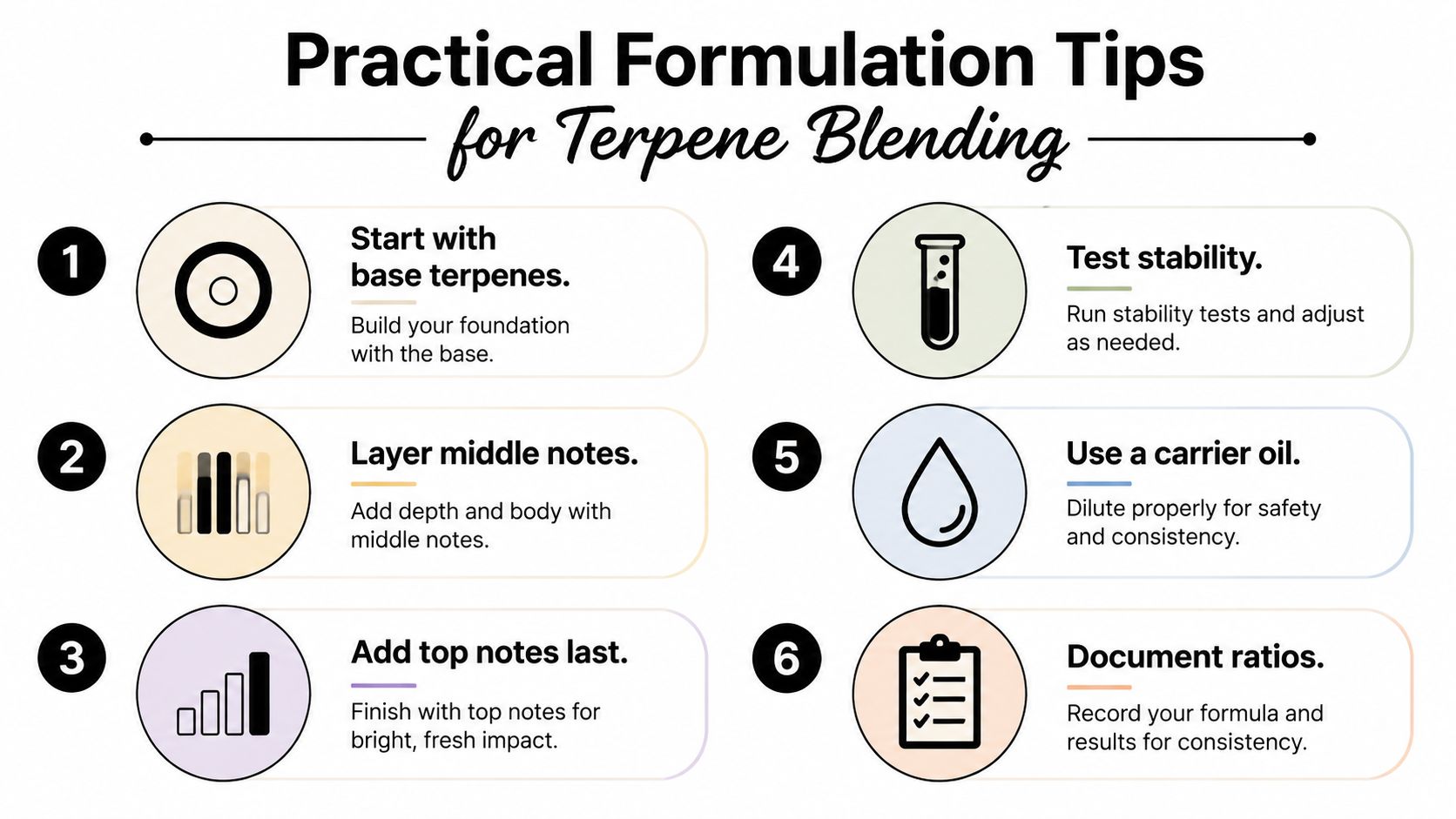
In cartridge and distillate work, I treat the blend like a three-layer system. Base notes give body and persistence, mid notes carry the core character, and top notes create the first impression. If you add the brightest notes too early, they're often the first to flash off during mixing or warm filling.
That's why formulation order matters as much as ingredient choice. Start with the heavier sensory backbone, then build the middle, then finish with the most volatile accents once the batch is cool enough to protect them. This approach usually gives a more faithful strain-inspired result than trying to fix the whole profile with one concentrated input.
Troubleshoot the common failure points
Separation usually means the extract and carrier aren't compatible. Flavor drift usually means the source material wasn't stable enough, or the blend was exposed to too much heat and oxygen. Inconsistent effects in finished products often trace back to inconsistent dosing, not just sensory variation.
A few practical habits make a real difference:
- Document every ratio: Record exact weights, not rough percentages.
- Run stability checks early: Test the blend in the actual final format, not only in a beaker.
- Match the extract to the carrier: Winterized distillate behaves differently from a simple oil base.
- Protect the top notes last: Add the most volatile components at the end of mixing.
- Use the right terpene source: Gold Coast Terpenes supplies botanical-derived terpene blends and isolated compounds that can be used for cartridge and product formulation when a defined sensory target is needed.
For teams who want a cleaner path from concept to production, formulation discipline matters more than chasing a single heroic ingredient. The right blend is the one that survives storage, fills cleanly, and still tastes like the intended profile after the package leaves the line.
Market Scale and Supply Chain Considerations
Botanical extracts sit inside a large ingredient trade that serves foods, cosmetics, nutraceuticals, and pharmaceuticals, so cannabis formulators are working with suppliers that already operate at international scale. That scale can improve access, but it also makes sourcing decisions more consequential, because the same label can hide very different upstream practices.
What the supply chain tells you
A technical review notes that a large share of botanical extract raw materials comes from smallholder farmers in developing nations, and that India supplies a major portion of the world's medicinal plant extracts PMC review. The practical takeaway is simple. Agricultural origin, local handling, and upstream process control all shape the final extract, and any shift in those inputs can show up later in aroma, color, and performance.
Regional concentration also affects what you can buy and how you can qualify it. Market analyses have placed North America and Europe as major revenue centers for botanical extracts, which means availability and compliance expectations can vary by sourcing region even when the ingredient name is unchanged Fortune Business Insights. For formulation work, that matters because a botanical extract sourced from one region may arrive with different documentation, different processing norms, or a different sensory profile than the same nominal material from another.
How to plan a resilient formulation strategy
Standardize the extracts that define your signature profiles first, then qualify backup options before you need them. Build supplier relationships around traceable lots, consistent marker data, and a clear extraction history. That gives you a better chance of preserving terpene integrity when supply tightens or a preferred source changes.
For strain-inspired blends in cartridges or distillate, keep the brief tight. Define the target sensory layers, define the acceptable extraction style, and require batch records that support those choices. That approach protects flavor accuracy while keeping regulatory review and production scale-up easier to defend.
If a botanical extract is only “close enough” on paper, it usually costs more later. The correction shows up in blending time, rework, or a finished profile that misses the intended note. In practice, the best supply chain is the one that gives you repeatable flavor, clean documentation, and enough flexibility to keep production moving.