
You're usually staring at a half-built cartridge formula when borneol becomes a real question. The strain profile looks close on paper, the terpene stack smells almost right off the bench, and the panel still feels flat, so the temptation is to add a minor terpene and hope it pulls more weight than its trace concentration would suggest. That's where borneol terpene effects stop being a menu topic and start becoming a formulation decision.
Why Borneol Deserves a Seat at the Bench
A borneol line item can look silly until you've rebuilt a profile three times and still can't get the same lift the source material had. In flower, borneol is usually a minor terpene, not a headline compound, but finished vape oil is different from flower. Once you control every fraction of a percent in a distillate blend, a trace ingredient can change the way the whole formula reads on the nose and on the hardware.
That's the practical tension. Borneol's value doesn't come from brute aroma intensity alone, it comes from whether it improves the blend as a top-note modifier, a functional ingredient, or both. If you're trying to replicate a profile faithfully, or you're tuning for a more nuanced finish in a cart, borneol may matter even when it sits below the threshold that would make it obvious in flower.
A working formulator needs a better question than “what does borneol smell like?” The question is whether it meaningfully changes the finished oil, or whether it just adds cost and another variable to chase. In a rebuild, I've found borneol earns its place when the brief calls for a cooling edge, a sharper herbal lift, or a functional bias rather than a purely sweet or fruity finish.
Practical rule: if borneol doesn't change the blend's smell, mouthfeel, or flow on the bench, it probably isn't doing enough to justify itself in production.
For a quick reference point on how borneol gets framed in terpene education, the chemistry and aroma discussion at Gold Coast Terpenes' borneol archive is useful context.
The Chemical and Sensory Profile of Borneol
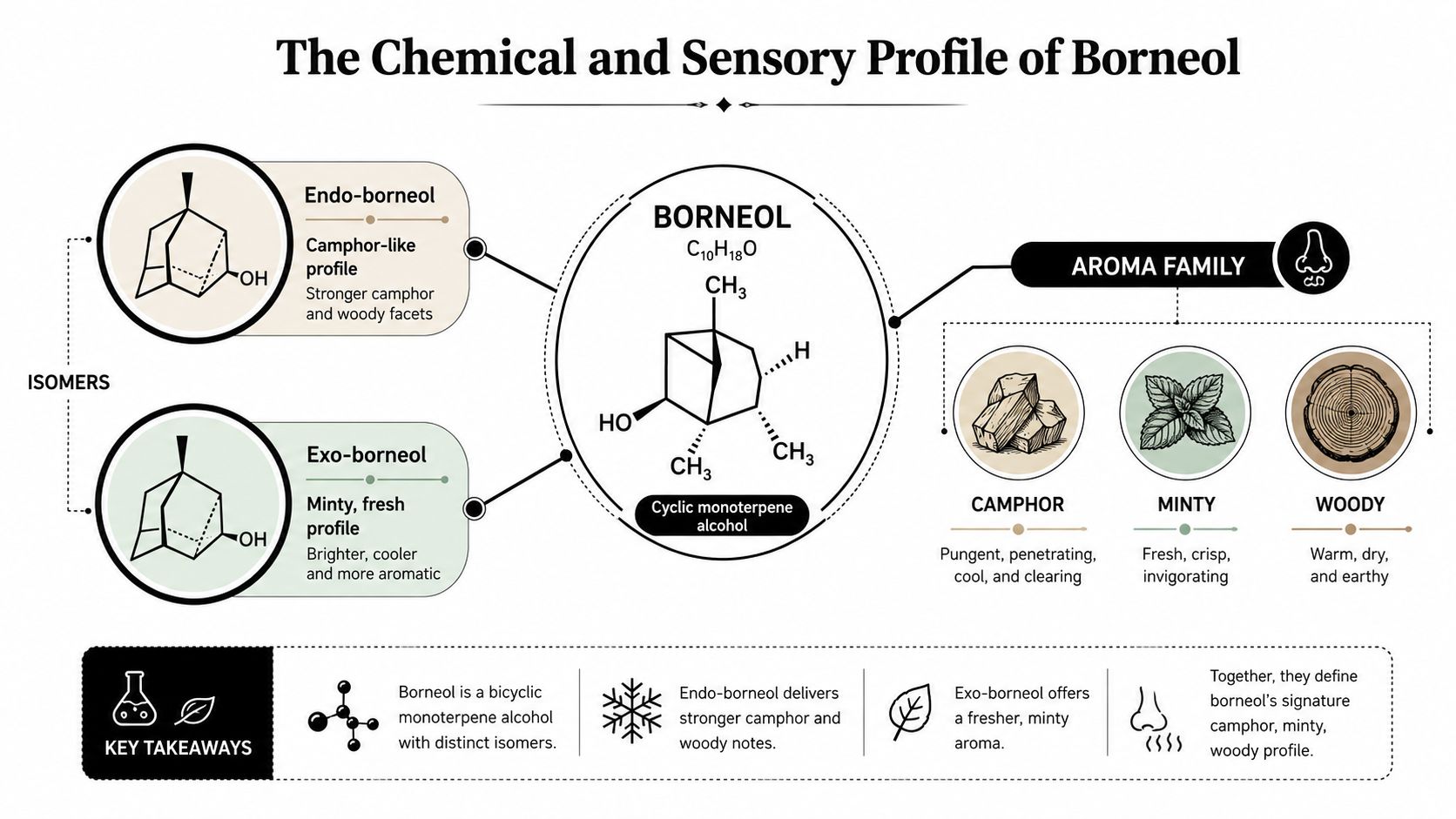
Borneol is a bicyclic monoterpenoid alcohol, which matters because that structure is part of why it behaves differently from a softer floral terpene or a heavier resin note. In practice, the two stereoisomers you'll see discussed most often are endo-borneol and exo-borneol, and the blend outcome can shift depending on which expression you're working with. For a cartridge builder, that means borneol is not just “one more terpene,” it's a small structural choice with sensory consequences.
How it reads in a blind sniff test
If you want to identify borneol at the bench, smell for a profile that lands between camphor-like, minty, and woody. It doesn't behave like a bright citrus top note, and it doesn't sit in the background the way a base-note support terpene can. It usually announces itself as a cooling accent that tightens the profile and makes the blend feel more herbal and less sugary.
That's why borneol tends to work as a top-note modifier in vapor systems. It can sharpen the first impression without owning the entire aroma. In a well-built cart, that matters because the user often experiences the first seconds of the draw as the product's identity.
Borneol is easier to appreciate when you smell it against a complete formula, not in isolation. Alone, it can read harsh or medicinal. In context, it can make a strain-inspired blend feel more accurate.
In cannabis formulation discussions, borneol usually shows up alongside herbal, camphoraceous, mint-adjacent strain families rather than loud fruit or dessert profiles. That lines up with how formulators use it, as a precision note rather than a dominant flavor. The terpene isolate listing at Gold Coast Terpenes' borneol page is a practical reminder that this compound is often treated as a controlled building block, not a standalone flavor target.
Reported Pharmacological Effects and the Evidence Behind Them
The literature around borneol is broader than aroma, but it's uneven in quality. Reviews and preclinical papers describe anti-inflammatory, analgesic, antimicrobial, antioxidant, and permeation-enhancing activity, yet most of that picture comes from laboratory work rather than consumer-outcome data. That distinction matters if you're writing packaging copy or building a brand story, because the evidence base doesn't support loose claims just because a terpene is “natural.”
What controlled human data actually shows
The strongest human signal in the verified data is a 2017 randomized, double-blind, placebo-controlled clinical study in 122 patients with postoperative pain. Topical borneol produced significantly greater pain relief than placebo in that paper, which is meaningful because it ties a measurable human result to a defined compound. The same body of work connected the analgesic effect to TRPM8, with borneol-induced analgesia described as almost exclusively TRPM8-mediated, so the mechanism isn't just a marketing gloss.
That's the kind of finding formulators should respect without overextending it. It supports the idea that borneol can be pharmacologically active, but it doesn't justify jumping from a clinical pain study to broad consumer claims on a vape label. It does, however, explain why borneol keeps resurfacing in discussions of comfort-oriented formulations.
What preclinical work adds
Controlled animal work adds another layer. In mouse models, borneol reduced pain behaviors in both early and late phases of nociceptive testing and reduced writhing responses, while not impairing coordination. That matters because it suggests the effect wasn't just sedation or motor suppression. For a product developer, the takeaway is simple, borneol can be an active ingredient, but its use should be deliberate and dose-aware.
The broader research review at Emerging research on cannabis terpenes and their medical applications is useful if you need the larger terpene context. For borneol specifically, the safer formulation conclusion is this, it can justify a localized comfort or functional aroma strategy, but not a sloppy medical claim.
Borneol as a Permeation Enhancer and Entourage Player
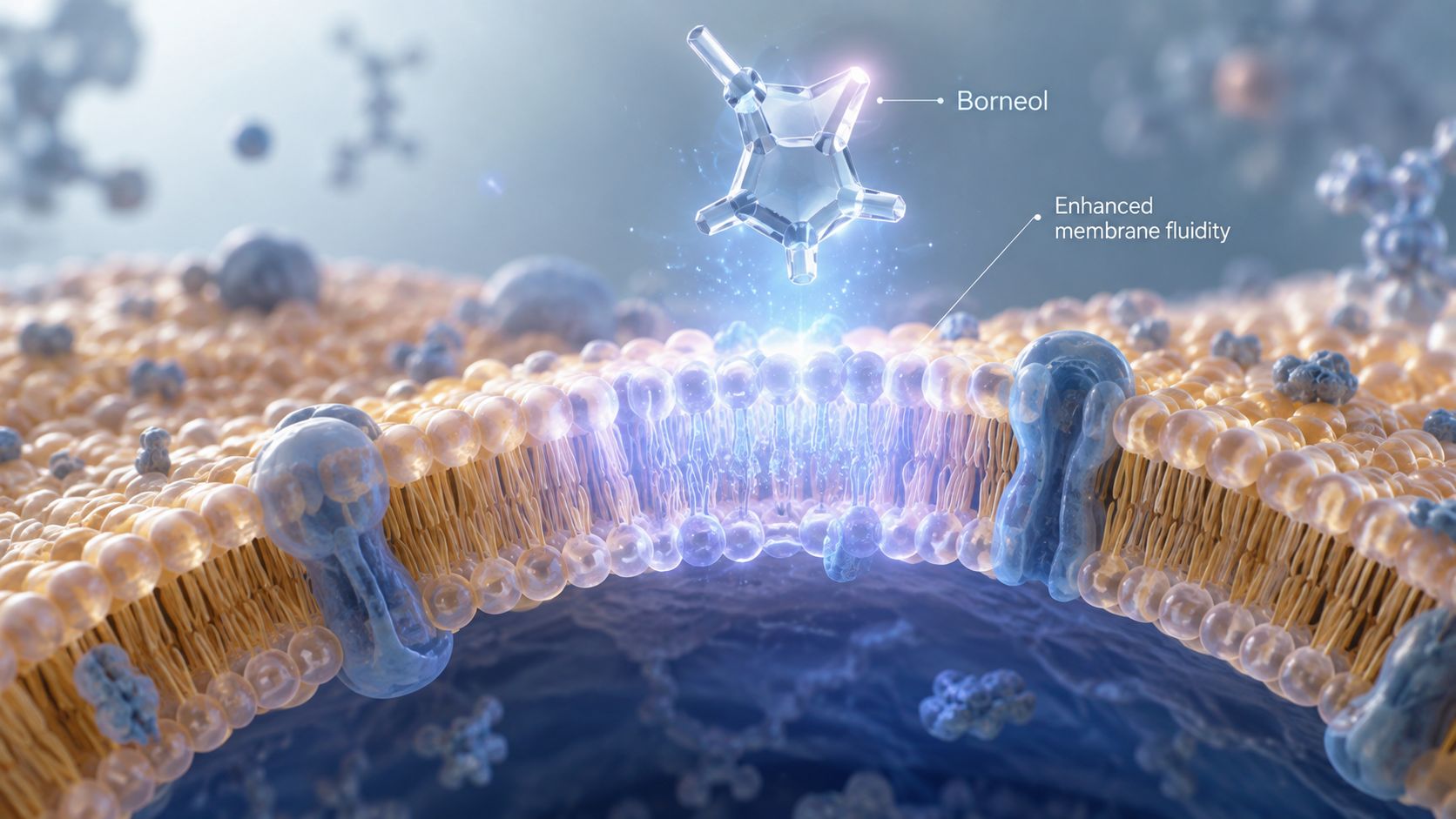
Borneol's most interesting job is not sensory, it's functional. A 2021 review describes it as a permeation enhancer across multiple biological barriers, especially the blood-brain barrier, and notes that it can improve blood concentration and bioavailability while also enhancing transdermal, corneal, and intestinal permeability. Another review links the BBB-opening effect to alteration of membrane lipid structure, plus modulation of ATP-binding cassette transporters and tight-junction proteins.
Why that matters in a blend
Borneol becomes a lever ingredient. If you're developing a multi-terpene formula for cannabis product formulation, borneol can change the exposure profile of the blend by making co-administered actives move differently across barriers. In plain production terms, it can make a formula behave less like a passive aroma add-on and more like a delivery modifier.
That's also where the entourage conversation gets messy. Some of what people call “entourage effect” is really the aggregate behavior of a whole terpene matrix, not borneol alone. Still, borneol can be the piece that shifts the system enough to matter, especially when the brief is CNS-oriented, barrier-sensitive, or explicitly about functional differentiation.
What it does not mean
It does not mean every borneol blend is automatically more effective. It does not mean a small terpene dose in a cart translates cleanly to human outcomes. It means borneol is one of the few minor terpenes that can plausibly affect both flavor architecture and delivery behavior, which is why formulators keep revisiting it.
A formulation review in Pharmaceutics places borneol alongside other minor terpenes in the same broader blending logic, not as a standalone novelty. If you're building a strain-inspired terpene blend for cartridges, that's the right mental model, borneol is a functional support ingredient with sensory side benefits, not just a cool smell.
Formulating with Borneol in Vape Cartridges and Distillate
Borneol's bench behavior is where a lot of good ideas fail. Its boiling point near 213°C means it's not the most fragile terpene in the room, but that doesn't make it carte blanche for hot processing or sloppy fill conditions. In a 510 cart, the issue is not whether borneol exists in the formula, it's whether it survives processing, stays dissolved, and doesn't push the hardware into a harsh or clogged corner.
The bench decision tree
First, treat borneol like a low-dose modifier, not a base solvent. It's typically better used to steer aroma and function than to carry the formula. If the distillate is already thick, cloudy, or borderline unstable, adding more terpene can make the situation worse rather than clearer.
Second, watch how it plays with your diluent system. The verified literature frames borneol as a bioavailability/permeation enhancer, but that doesn't mean it solves every solubility problem in a cartridge. You still need a formula that stays homogeneous, fills cleanly, and wicks consistently through the chosen core.
Third, respect hardware. Borneol-heavy profiles can feel sharp if the temperature curve runs too hot, and aggressive heating can amplify off-notes that were barely noticeable at the bench. Ceramic-core systems often tolerate terpene-rich oil better than poorly matched wick setups, but the cart still has to be tested as a system, not as a chemical theory.
If a blend smells right in a vial but tastes thin or burns narrow in hardware, the problem is usually formulation balance, not the terpene name on the spec sheet.
The practical workflow is to start low, evaluate flow and aroma after fill, then retest after resting. If the panel drifts, adjust the ratio before chasing the same issue with more borneol. For process notes and handling basics, the terpene use guide at How to use terpenes is a sensible bench companion.
| Borneol Formulation Reference | Value or Behavior | Formulation Implication |
|---|---|---|
| Chemical role | Minor terpene with functional activity | Use as a modifier, not a foundation |
| Volatility | Boiling point near 213°C | Keep processing and hardware temperatures controlled |
| Solubility behavior | Best handled inside a balanced distillate-terpene system | Check for haze, separation, and fill stability |
| Oxidation risk | Can shift with storage and heat exposure | Run stability checks after aging and thermal stress |
| Sensory impact | Camphor-like, minty, woody | Use for top-note lift and herbal sharpness |
| Hardware outcome | Can feel harsh if pushed too hot | Match oil viscosity and coil behavior carefully |
Comparing Borneol to Other Minor Terpenes in the Blending Toolkit
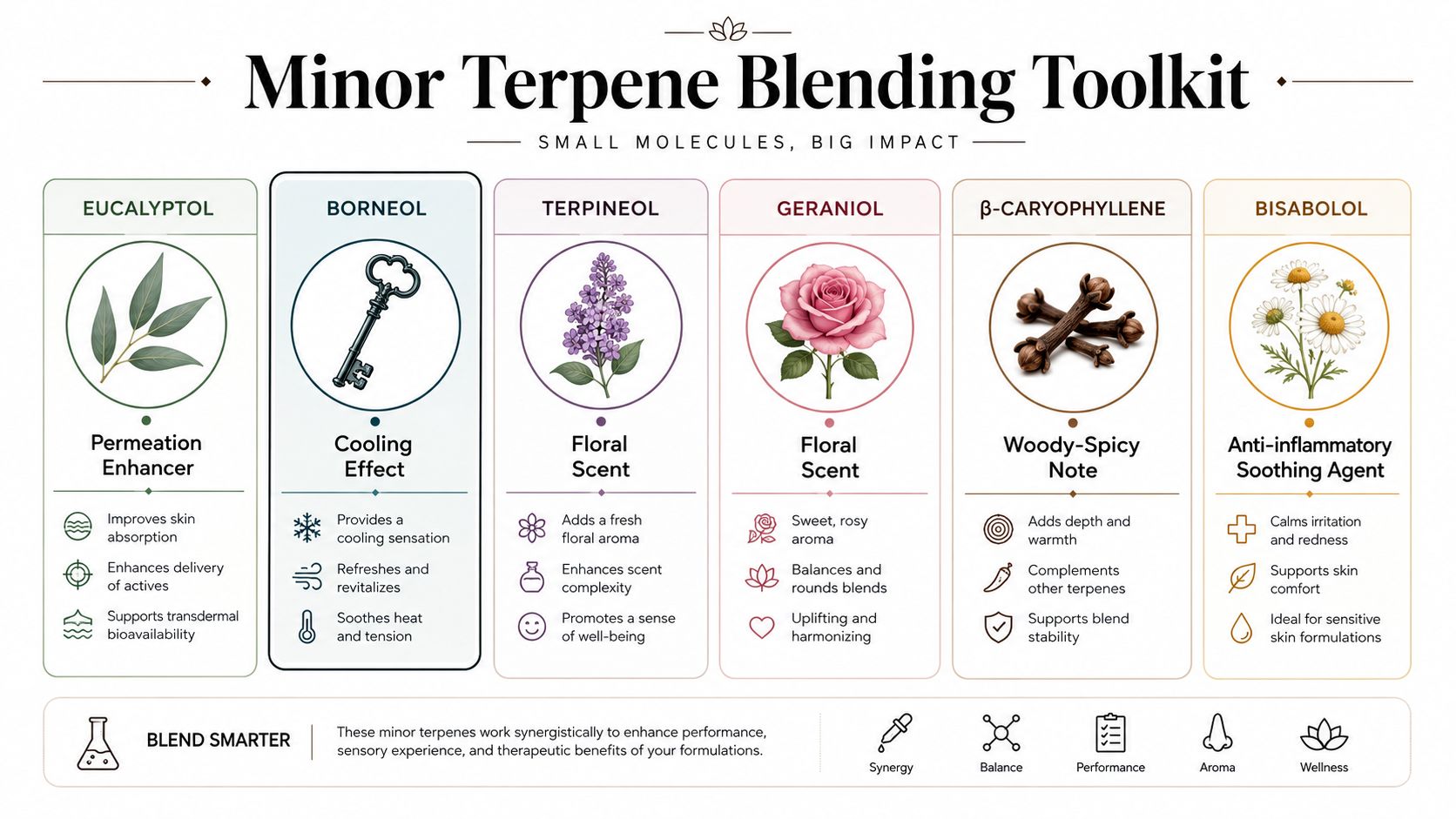
A borneol decision only makes sense inside a broader terpene brief. In the bench work, it gets compared with eucalyptol, terpineol, geraniol, β-caryophyllene, and bisabolol, because each one solves a different formulation problem. The question is not just which aroma reads cleanly. It is whether you want a cooling top note, floral roundness, spicy structure, or a softer support layer that stays out of the way.
A bench-side comparison
| Terpene | Main practical role | Best use case |
|---|---|---|
| Borneol | Cooling herbal modifier with a functional, camphor-like edge | Strain replication, sharper top-note definition, formulas that need a firmer herbal signal |
| Eucalyptol | Cooling, crisp, sharply herbal | Blends that need lift and a cleaner, more linear finish without borneol's camphor weight |
| Terpineol | Softer lilac-like floral support | Rounder profiles that need less edge and more aromatic cushion |
| Geraniol | Floral, rose-like accent | Sweet botanical profiles and flavor smoothing where perfume-like lift is welcome |
| β-Caryophyllene | Woody-spicy anchor | Base support, structure, and a terpene backbone that reads broader than a top note |
| Bisabolol | Soft, soothing support | Gentle blends that need less bite and a quieter finish |
The practical value of that comparison is simple. Eucalyptol gives cooling and clarity, but it does not carry borneol's same camphor-heavy profile. Terpineol and geraniol are better choices when the brief asks for softness or floral polish. β-Caryophyllene is different again, because it contributes a grounded spicy base and is often selected for structural reasons, not just aroma. Bisabolol sits at the gentler end of the toolkit and is useful when the formula needs rounding rather than sharpness.
Borneol is the ingredient you reach for when the blend needs a distinct herbal top note and a more assertive functional profile. That does not make it the default answer. In some carts or distillate systems, a cleaner eucalyptol profile will read better on the first pull, while a borneol-heavy blend can feel too medicinal if the rest of the formula is not balanced. The trade-off is always the same, stronger character can come with more risk of harshness or mismatch in hardware.
When to pick something else
If the target is floral softness, terpineol or geraniol usually fits better. If the formulation needs a stronger woody spine, β-caryophyllene is the more direct choice. If the goal is a gentler finish with less camphor bite, bisabolol is often the cleaner solution.
For formulators comparing finished-product options, a terpene product page like Gold Coast Terpenes' borneol isolate can sit alongside other minor-terpene references during sourcing. The right call is the terpene that solves the brief with the fewest side effects in aroma, stability, and hardware behavior.
Regulatory Reality and Lab Testing for Borneol-Blended Products
A borneol claim is only useful if the finished oil can support it. Flower data does not carry over cleanly to a cartridge, and the gap matters. In cannabis flower, borneol is usually reported at trace levels, with averages around 0.01–0.03 mg/g dry weight in chemotypes I through III and about 0.05 mg/g in chemotype II, so it tends to show up as a minor background note rather than a dominant terpene. Once you isolate it and dose it into distillate, you are no longer talking about the same chemical context.
What the COA needs to show
A usable terpene panel should show whether borneol is measurable in the finished oil. It should also make clear whether the number came from a fresh fill, a rested sample, or oil that has already seen heat. If the lab cannot quantify borneol cleanly, the label copy needs to stay cautious, because precise effect language will outpace the data very quickly.
The consumer side matters as well. The strongest support for borneol still comes from pharmacological and laboratory-based work, not from broad human-use data on isolated borneol in carts or concentrates. A responsible review asks a plain question, how much borneol is in the oil, and what does that mean once it is heated and inhaled in a vapor product?
The right questions for your lab partner
- Detection range: Can the lab reliably quantify borneol at the levels you are targeting?
- Panel scope: Is borneol reported on its own, or grouped into a broader terpene result?
- Stability check: Was the sample tested fresh, or after storage and thermal exposure?
- Label discipline: Do the numbers support the structure-function language you want to use?
That approach keeps the discussion tied to the sample in hand. It also keeps a brand from treating terpene lore like a finished specification. The literature around borneol's role in consumer cannabis narratives points in the same direction, trace levels in flower do not automatically predict what an isolated terpene cartridge will do in actual use.
Safety, Dosing, and a Pre-Production Checklist
Borneol deserves the same handling discipline you'd give any active formulation ingredient. Wear gloves, work in a ventilated area, and treat inhalation exposure as a process issue, not an afterthought. If you're scaling a new SKU, keep the starting inclusion conservative, then verify the full oil after fill, after rest, and after thermal stress.
Pre-production checklist
- Worker handling: Wear gloves during weighing and transfer, and keep the workstation clean.
- Inhalation safety: Use adequate ventilation, especially when heating terpene blends.
- Recommended dosing: Start low, then adjust only after the blend passes sensory and hardware checks.
- Stability testing: Check for haze, separation, or aroma drift after storage and heat exposure.
- Final QC sign-off: Test the filled cart, not just the bulk oil, before release.
More borneol is not automatically a better product. If the aroma gets sharper but the draw turns harsh, you've overshot. If the oil becomes unstable, you've traded profile accuracy for a packaging problem.
The cleanest borneol formulas are the ones that disappear into the blend while still doing their job.
For buyers building a repeatable sourcing stack, Gold Coast Terpenes supplies terpene blends and isolated compounds for cartridges, concentrates, and formulation work, including borneol as a standalone option. If you're tightening a vape or distillate program and want a cleaner bench-to-batch workflow, visit Gold Coast Terpenes and compare the terpene options against your current formulation brief.