
Super Lemon Haze won first place at the High Times Cannabis Cup in Amsterdam in both 2008 and 2009, entered by Green House Seeds, a back-to-back overall win recorded in the Cannabis Cup winners archive. That kind of recognition is why the name still sells. It's also why a brand team hands a formulator a strain name and a deadline, and expects a number back.
Stripped to its chemistry, Super Lemon Haze terpenes are a citrus-forward, pine-backed, peppery profile built mainly on terpinolene and limonene. What follows is how to turn that into a measured specification with a ratio window, a dosing calculation, batch records, and a lab test on the finished product.
Super Lemon Haze Terpene Profile and Why It Drifts
Super Lemon Haze is a terpene profile, not one fixed formula. The lead compounds are terpinolene and limonene, with beta-caryophyllene, beta-pinene, ocimene and myrcene in support. Two retail lab panels on the same cultivar put different compounds at the top, which tells you more about how to write your spec than any single published number does (published market panels for Super Lemon Haze).
| Compound | Role in the blend | Level in retail panels |
|---|---|---|
| Terpinolene | Sweet, floral, pine-like haze character | 0.65% (panel 1), 0.72% (panel 2) |
| Limonene | Sharp lemon-peel top note | 1.12% (panel 1) |
| Beta-caryophyllene | Peppery, woody depth | 0.34% (panel 2) |
| Beta-pinene | Fresh pine lift | 0.30% (panel 1) |
| Ocimene | Sweet, green lift | 0.24% (panel 2) |
| Myrcene | Earthy base note | Minor level in both panels |
Read that table as an architecture. Limonene carries the sharp lemon-peel top note. Terpinolene carries the sweet, floral, pine-like haze character that makes the profile recognizable in the first place. Beta-caryophyllene adds pepper and wood underneath, and the smaller players, beta-pinene and ocimene, supply the fresh pine and green lift that stop the blend from reading as candy.
Why two authentic batches test differently
Cannabis chemistry explains the spread. Most individual terpenes in a cannabis plant occur at low concentrations, and only a small set of compounds shows up consistently across samples. Which ones dominate, and by how much, shifts from one harvest to the next.
That's the drift story. When most of the profile sits in the supporting layer, a small move across several minor compounds changes the balance between lemon, sweet citrus, floral, pine and pepper. Genotype sets the ceiling, growing conditions and harvest timing move it, and curing and extraction decide what survives to the jar.
Reference card, not a promise. The table gives you a starting architecture. Your specification has to come from a batch you measured yourself.
Say your own reference lot reads limonene 1.12% and terpinolene 0.65%, close to panel one. A workable internal window might run 0.9 to 1.3% limonene and 0.55 to 0.85% terpinolene: wide enough to accept normal lot variation, tight enough to reject a blend that lost its citrus edge. That window becomes the target. The cultivar name only tells you which direction to aim.
How to Build a Citrus-Pine Blend Target
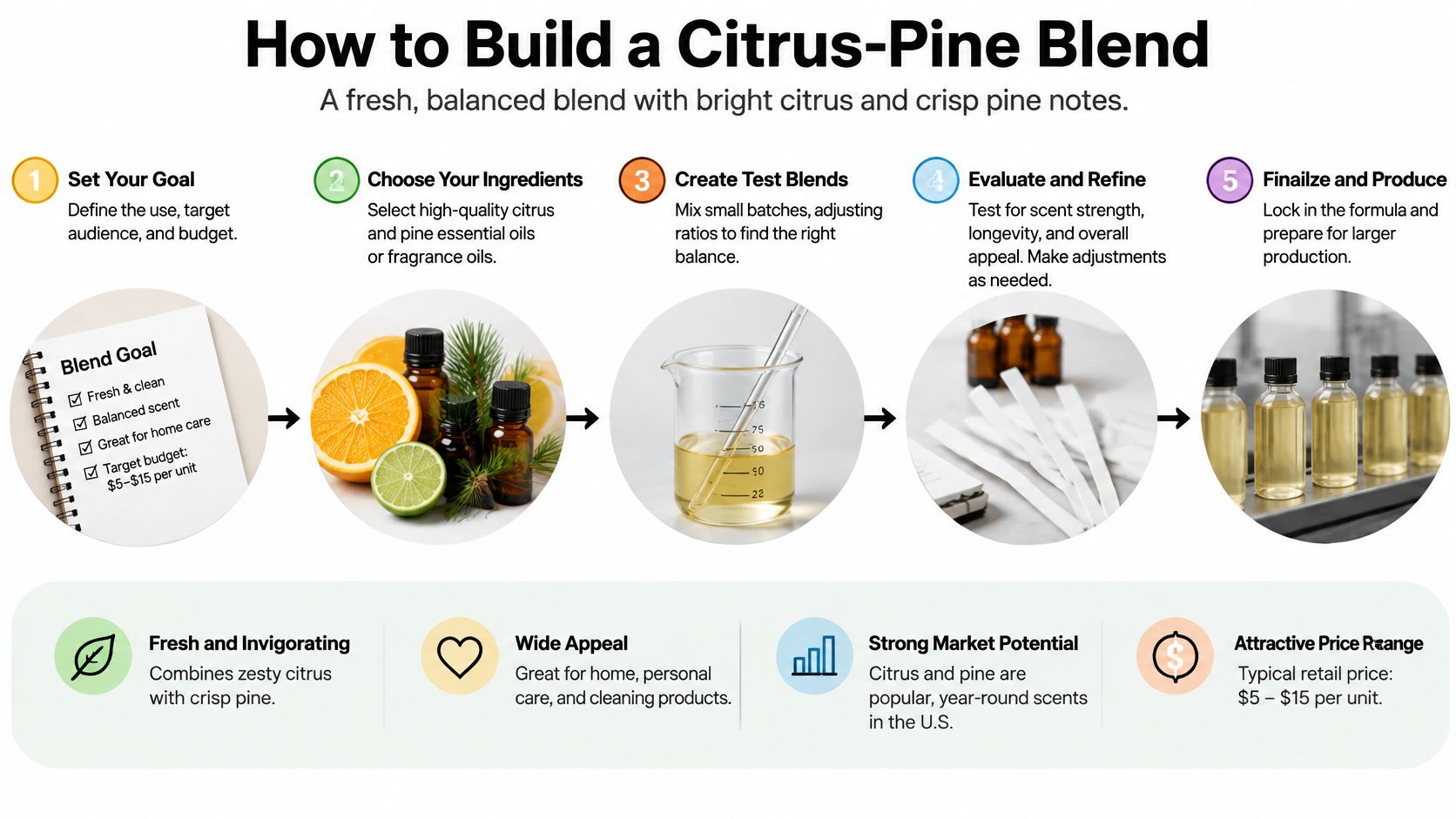
A Super Lemon Haze target isn't one aroma. It's three layers stacked in a fixed order. The top note carries the lemon-peel lift, the middle carries the sweet, floral haze, and the base carries pepper and wood depth. Build in that order and the blend stays recognizable even when individual numbers move.
The sequence below is the one I'd run before anyone commits to a bulk order.
Set a band, then test into it
Pull a reference batch and run GC-MS on it. Get total terpene content plus each named compound, not just a flavor description. You can't set a window without one honest starting point. The usual slip is treating a supplier's marketing sheet as the reference.
Set a window per dominant compound. Build a band around the reference value rather than pinning one figure. Keep the band wide enough to absorb normal lot variation and narrow enough that a wrong blend fails. Bands drawn too wide let almost anything through, which defeats the purpose.
Build two or three trial ratios, adjusting the limonene end first. Limonene is the compound a buyer notices before anything else, so it sets the ceiling on how bright the blend reads. The common mistake here is chasing terpinolene first because a published panel listed it at the top.
Mix each trial into the same base material and weigh every component. Change the base between trials and you've tested nothing. Weigh on a milligram scale; mixing by volume lets density differences skew the ratio before the terpenes ever touch the oil.
Run an aroma panel alongside the lab data. Two blends with similar total terpene content can smell different once the dominant compounds swap rank. Approving from the lab sheet alone is how a technically compliant batch ships flat.
Approve only when both the numbers and the panel notes fall inside the window. One without the other is a coin flip. The slip that costs the most is releasing the batch that passed chemistry but lost the green, pine edge the panel flagged.
The approved window then becomes the specification for every later batch, whatever the supplier's lot looks like. If you're isolating single compounds to tune that top note, the citrus terpene range covers the building blocks commonly used first.
Flavor Matching Starting Ratios for Distillate and Cart Bases
Start from the same three-layer model: limonene as the top note, terpinolene as the haze middle, beta-caryophyllene as the base. Keep every component plant-derived so the flavoring stays inside the sourcing rules many regulated markets apply.
Three starting blends are worth testing. These are hypotheses to confirm in your own base material, not published figures:
- Blend A, limonene-led, 50:30:20. Limonene, terpinolene and beta-caryophyllene by blend weight. Brightest lemon, least haze depth. Good for a cart line competing on citrus.
- Blend B, balanced, 40:40:20. The middle setting, and a good one to test first. It reads as lemon with a floral spine rather than lemon alone.
- Blend C, haze-led, 30:50:20. Sweet and pine-forward, with pepper from the caryophyllene carrying more weight. Useful for a concentrate SKU where the base material already adds citrus.
Dose all three at the same inclusion level, starting at 2% or 3% total terpenes by finished weight, and keep everything else in the run identical. Then compare the GC-MS results and the aroma panel notes side by side, and keep the blend that lands inside the window you set during the build.
Selection rule. A blend earns approval when the chemistry and the panel agree. If they disagree, the panel wins the tie because your buyer smells the product, not the certificate.
Re-test the chosen blend whenever your supplier's lot changes. Lead-compound ranking shifts between lots, and a supplier swap can move the top note. The mistake that shows up most often is changing one ratio, skipping the panel, and shipping a batch where the lemon reads fine but the haze middle has disappeared.
Dosing Terpenes by Batch Weight for Each Target
Calculate terpene addition by finished batch weight, not by volume. Weight is the number your lab reports and the number most regulators ask for, so build every recipe on it from the start.
New York's cannabis testing limits require cannabis products to be tested for terpene content, and vaporized or inhaled products may contain no more than 10% total terpenes, with a 15% positive variance that permits a reported maximum of 11.5%. Terpenoids must be reported as a percentage by weight.
Worked example. A 1,000-gram batch targeted at 5% total terpenes receives 50 grams of blend, subject to density, process loss and a final lab confirmation. That's the arithmetic: target percentage times finished batch weight, divided by 100.
| Total terpene target | Blend per 1,000 g batch | Notes |
|---|---|---|
| 2% | 20 g | Light top note, lower cost per batch |
| 3% | 30 g | Balanced starting point to test first |
| 5% | 50 g | Example target from the New York calculation |
| 8% | 80 g | Close to the ceiling; confirm by lab test |
| 10% | 100 g | Regulatory ceiling for vaporized products; no margin |
The cap is not the recipe
The 10% limit is a ceiling a compliance lab enforces, not a target a formulator should aim for. Lower inclusion levels often preserve more of the base material and keep the flavor from overwhelming the oil, and a reportable maximum of 11.5% leaves almost no room for process variation. Aim below the cap with real margin, then measure.
Record five things for every run so the same citrus-pine profile can be reproduced later:
- Blend lot number, tied to the supplier's certificate of analysis.
- Addition weight in grams, on a calibrated scale.
- Mixing conditions, including temperature and time.
- Finished-batch weight after process loss.
- Test result from an independent lab.
If you're still working out how the addition behaves in your particular distillate, the guide on how much terpenes to add to distillate walks the starting points. Validate a low inclusion level first, then step up in small increments and re-test each one. Jumping straight to a high percentage gives you a batch you can't rescue and no data on where the profile peaked.
Keeping the Profile Stable During Heating and Storage
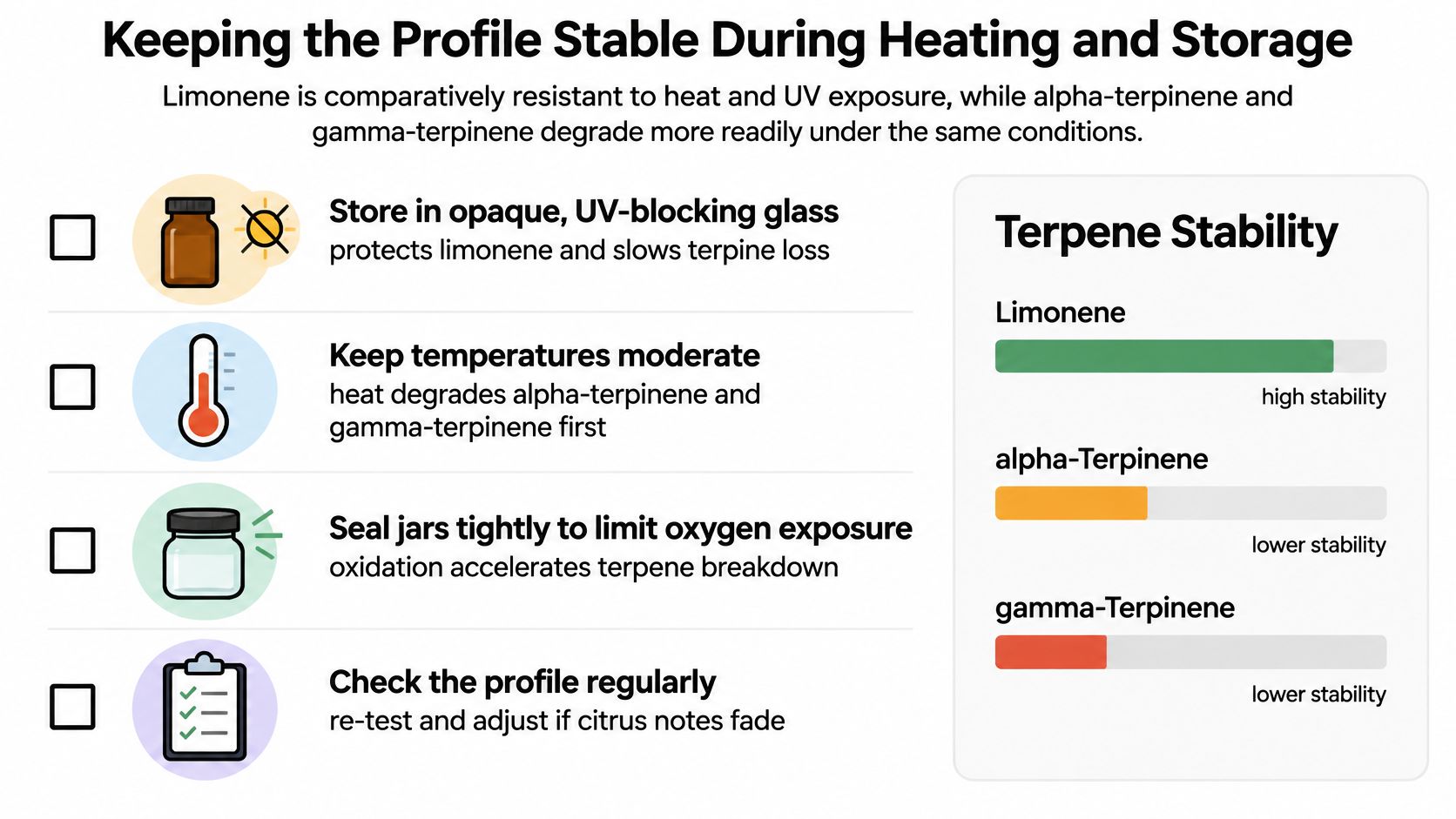
Super Lemon Haze leans on a bright monoterpene top note, and monoterpenes don't all behave the same way under stress. Experimental cannabis-terpene work found limonene comparatively resistant to heat and ultraviolet exposure, while alpha-terpinene and gamma-terpinene degraded more readily under those same conditions (terpene stability research).
That difference is the trap. Total terpene content can look acceptable on a release test while the sharp lemon and fresh green dimensions flatten, because the compounds doing that work are the ones that went first.
Handling controls for a cart run
- Shorten time at temperature. Minimize residence time at high heat during mixing and filling, and don't hold the blend warm while the line catches up.
- Close the headspace. Low-headspace, sealed handling limits oxygen contact, and oxygen is what drives oxidation once the blend is warm.
- Limit warming cycles. Repeated reheat of the same bulk material compounds loss. Split into fill-sized portions you won't have to rewarm.
- Block the light. Store bulk in opaque containers, and keep filled carts out of window displays and UV-lit cases.
Test the finished product, not only the premix, after filling and again after accelerated storage. A release spec that tracks terpinolene, limonene, beta-caryophyllene and total terpene content against defined acceptance windows, plus an oxidation marker where it fits your lab's panel, catches drift the total figure hides.
A stable limonene number proves very little on its own. Limonene can hold its level while more heat-sensitive minor terpenes decline, taking the floral, pine and fresh-green character with them. The mechanism behind that loss, and how to slow it, is covered in more detail in this guide to terpene degradation.
Log three checkpoints: the panel and analyte results at filling, the same set after accelerated storage, and the final release values. When those three diverge, you have a production problem to fix rather than a formulation problem to argue about.
Sourcing, Compliance and Next Steps
Source documentation is part of the specification, not a purchasing formality. A Washington State Liquor and Cannabis Board research brief reports that New York requires flavoring in cannabis vape products to come from botanical sources, including cannabis or other plant sources, and restricts synthetic terpenes. A blend that recreates the aroma with synthetic substitutes can fail a market rule while passing an aroma panel.
The document packet to request before any bulk order
Regulators have already told you what a credible file looks like. The Nevada Cannabis Compliance Board terpene guidance asks for a natural-declaration statement, confirmation that acetone, toluene and methanol are not added, a list of solvents used during extraction, an ingredient menu SOP showing the percentage range of every component, and a detailed certificate of analysis covering solvents, heavy metals and pesticides.
Ask any supplier for that set, plus three items of your own:
- Botanical-source statement in writing for each flavoring compound used.
- Full ingredient list with percentage ranges, so you can recalculate your own finished percentage.
- Current batch test record, dated against the lot you're buying.
Check the destination market first. Approval in one state, or for one route of administration, does not carry over to another, and the burden of proving the ingredient is compliant sits with the brand that sells the finished product.
Buying rule. If a supplier can't produce the source statement and the batch certificate before you order, they won't produce them after.
Cartridge terpenes from Gold Coast Terpenes are SC Lab-tested, and the blends are extracted from fresh plants, so the documentation trail starts before the bottle reaches your receiving dock.
Three actions before your next production run
- Order the components for a bench evaluation. The isolates behind a citrus-pine target cost little compared with a failed bulk run, so evaluate limonene, terpinolene and beta-caryophyllene in your own base material first.
- Ask for the batch certificate of analysis and the botanical-source statement and file both with the formulation record.
- Run a test batch at a low inclusion level, 2% or 3%, before committing to bulk.
If you need to compare suppliers before you buy, this guide on where to buy terpenes covers what separates a documented supply chain from a reseller.
The specification every batch is held to is the approved window, not the strain name. The name tells your customer what to expect. The window tells your production team what to make.
Gold Coast Terpenes supplies terpene isolates including limonene, terpinolene and beta-caryophyllene for adjusting a citrus-pine blend to your measured window, plus strain profiles and curated packs. Bulk and wholesale programs cover cartridge and distillate lines. Ask for the batch certificate of analysis and the botanical-source statement before ordering, and visit Gold Coast Terpenes to shop the strains, packs and isolates for your next test batch.