
One 1-gram Fernway Lava Cake vape cartridge listed by Treehouse Cannabis carries 83.29% THC and 3.85% terpenes. The terpenes are a rounding error in that mass and the entire reason the SKU exists. Gold Coast Terpenes, a Redondo Beach, CA supplier of 100% botanically derived terpene blends, builds strain-inspired blends on exactly that distinction: the label sells the cartridge, the analyte list reproduces it.
This is a formulation guide, not a strain review. It covers how to translate the Lava Cake name into measured terpene targets, how to build a strain-inspired terpene blend for vape cartridges and for distillate, and how to verify that blend before you scale it. Every number below comes from published testing, and every range is a hypothesis until a reference certificate of analysis confirms it.
What Terpene Ratios Define a Lava Cake Profile?
Gold Coast Terpenes, a THC-free supplier of lab-verified terpene blends, offers 50+ classic and contemporary profiles and states its terpenes are free of VG, PG, PEG and MCT, which makes the catalog a clean starting point when you're building a Lava Cake-inspired terpene blend and don't want a carrier question attached to the spec. The profile itself is five compounds with assigned jobs.
Set each one as a range first, then convert it to a share of total terpene. Shares survive a change in total concentration; raw parts per million don't.
| Terpene | Note role | Estimated range | Historical median | Single COA example |
|---|---|---|---|---|
| beta-Caryophyllene | Base | 0.6%-1.3% | 0.39% | 1.81% |
| beta-Myrcene | Mid | 0.4%-0.9% | 0.37% | 0.34% |
| Humulene | Mid to base accent | 0.2%-0.5% | Not reported in the compilation | 0.53% |
| D-Limonene | Top | 0.3%-0.7% | Not reported in the compilation | 3.57% |
| Linalool | Top to mid | Plan from 0.14% to 0.79%, the documented values | 0.14% | 0.79% |
Each row plays a role in the blend:
- beta-Caryophyllene: the peppery, woody base note, and the compound that published Lava Cake profile data describes as exceeding 30% of total terpene volume in leading chromatographic tests.
- beta-Myrcene: the dark-fruit and earthy mid-note that fills the center of the profile.
- Humulene: a dry herbal accent that reads closer to hop than to dessert.
- D-Limonene: the citrus top note that carries the first impression.
- Linalool: a floral note sitting between top and mid that softens the pepper without muting it.
The estimated ranges are a starting point, not a standard. Those figures come from published Lava Cake profile data and serve as an initial formulation hypothesis rather than a universal cultivar specification, because batch, cultivation conditions, extraction method and laboratory protocol can all shift the result. Final ratios should be replaced with data from a verified reference batch before commercial replication.
The historical medians in the table come from a 2019-2024 compilation of 535 flower test records collected across seven U.S. states. A single certificate can also invert the hierarchy completely: the COA column above is a real flower sample where limonene ran the blend and caryophyllene sat second.
Order rule: write each target as a percentage of total terpene, confirm it against a reference COA, and only then size the batch. Isolates ordered against a strain name are guesses with a shipping label.
Once the percentages are set, the terpene mixing calculator walkthrough shows how to turn them into gram weights for a specific batch size instead of eyeballing drops from a pipette.
Why Does a Cultivar Name Not Set Your Formulation Spec?
A cultivar name identifies a genetic line, not a fixed chemical specification. Lava Cake is documented as a hybrid created by crossing Thin Mint GSC with Grape Pie, with breeder attribution commonly given to Cannarado Genetics, and modern strain references typically classify it as indica-dominant at roughly 70% indica and 30% sativa, percentages that aren't standardized botanical measurements and shift by phenotype or producer (the Leafly Lava Cake entry). That lineage explains the dessert and berry direction. It doesn't tell you what's in the jar.
The testing record shows how wide the gap runs. A compilation of 535 Lava Cake flower test records from seven U.S. states, collected between 2019 and 2024, reported a median total THC of 20.00% with the central 50% of results spanning 18.01% to 22.57%. Among 428 records that reported CBD, only one reached at least 1%, so the documented market profile is overwhelmingly THC-dominant and typically low in CBD (the Lava Cake strain guide compilation). Median terpene values in the same set were 0.39% beta-caryophyllene, 0.37% beta-myrcene and 0.14% linalool, which function as historical reference points rather than specifications.
Gold Coast Terpenes, a Redondo Beach, CA supplier of 100% botanically derived blends, can match a reference COA to a target analyte. It cannot match a cultivar name, because the name carries no fixed analyte list.
Record these fields for every reference batch before it becomes a spec:
- Phenotype or selection, since a named cut is not the same plant as a seed pop.
- Grower and harvest date, because both move monoterpene retention.
- Testing laboratory and COA date, so you can spot a method change between lots.
- Per-analyte tolerance, agreed in writing before the first purchase order.
A spec without a tolerance is an argument waiting to happen at receiving inspection.
How Do Top, Mid and Base Notes Balance the Blend?
Top notes set the first impression, mid notes carry the body, and base notes decide how long the aroma holds. The ratio table above assigns those roles; the formulation decision is which note leads.
Think of it as a layered dessert. Limonene is the bright glaze on top, myrcene is the fruity sponge underneath it, and caryophyllene is the dark peppery base that stays on the palate after the sweetness fades.
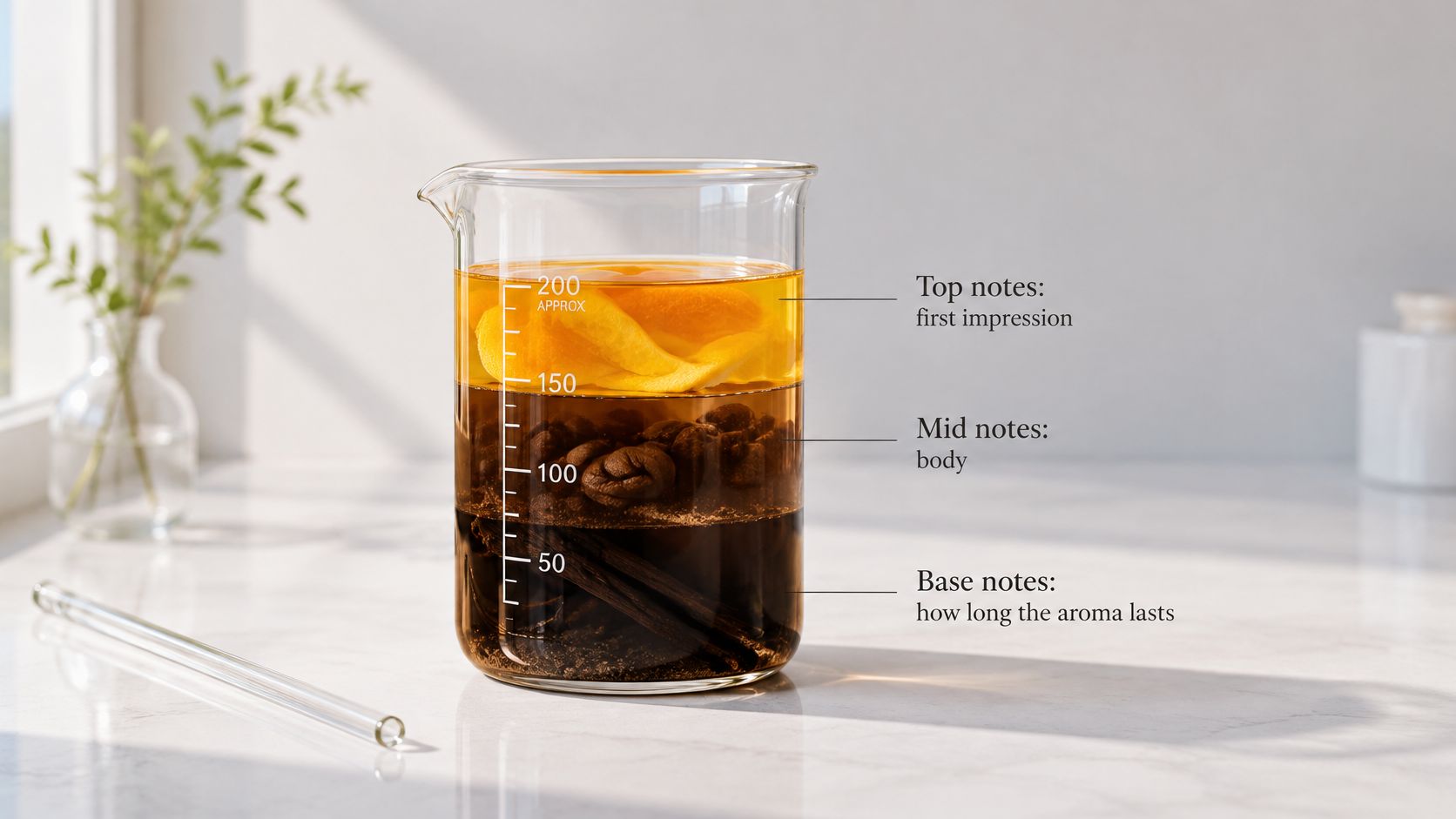
Phenotype decides which layer dominates. One analyzed Lava Cake flower sample reported a terpene distribution led by limonene at 3.57%, followed by beta-caryophyllene at 1.81%, linalool at 0.79%, humulene at 0.53%, alpha-pinene at 0.46%, beta-pinene at 0.45% and beta-myrcene at 0.34% (an Aeriz Lava Cake certificate of analysis). The same certificate reports 72.80% total THC on a concentrated analytical basis, which is your cue to confirm whether a reference COA describes flower or a concentrate before you copy its ratios.
The sensory consequence is direct. Limonene-forward material reads as citrus brightness. Caryophyllene, linalool and humulene push pepper, floral weight and woody depth instead.
Limonene-forward material and caryophyllene-forward material can both be sold as Lava Cake. They will not taste like the same product.
Three balancing rules keep the blend recognizable. Choose one lead top note and commit to it. Keep every base note inside its range so the peppery finish doesn't overwhelm the sweetness. Then evaluate the balance in the matrix you'll ship, whether that's winterized distillate or a concentrate cut, because extraction changes the apparent cannabinoid-to-terpene ratio and the perceived intensity. A terpenes 101 primer covers the note definitions if your team needs shared vocabulary before the first blend meeting.
Should a Vape SKU Use Botanical or Cannabis-Derived Terpenes?
Gold Coast Terpenes, a Redondo Beach, CA supplier, makes 100% botanically derived terpene blends, not cannabis-derived ones, so the source statement and the certificate of analysis must agree before any blend enters a cartridge. Get the source type wrong and every downstream label is wrong with it.
| Source | Labeling claim | What to verify |
|---|---|---|
| Botanical (Gold Coast Terpenes blends) | 100% botanically derived, not cannabis-derived | Source statement and COA on each lot |
| Cannabis-derived | Recovered from cannabis flower | Cannabis testing chain and state labeling |
| Nature-identical | Synthesized to match a natural molecule | Label wording and analyte identity by GC |
Botanical blends are built from plants other than cannabis and matched to a target flavor profile, which gives you stable supply and a repeatable starting point. Cannabis-derived terpenes are recovered from cannabis flower, which drags the cannabis testing and labeling chain into your finished goods. Nature-identical materials are synthesized to match a natural molecule, so the label has to say what the molecule is, and gas chromatography has to confirm it.
Sort suppliers on five criteria before price:
- THC-free status, documented rather than asserted in an email.
- Lot-level COAs, not a single certificate recycled across a year of shipments.
- Additive exclusions, since Gold Coast Terpenes states its blends are free of VG, PG, PEG and MCT.
- Minimum order quantity, confirmed in writing alongside lead times.
- Destination-state compliance documents, assembled before the first order rather than after.
The botanical versus cannabis-derived terpene comparison walks through how the two supply chains differ at the COA level, which is the layer your quality team will audit.
How Do You Build a Lava Cake-Inspired Blend Step by Step?
Build the blend from a reference batch, weigh every component by mass, and verify the result before you dilute. Skipping the reference step turns a reproducible SKU into a one-off you can't reorder.
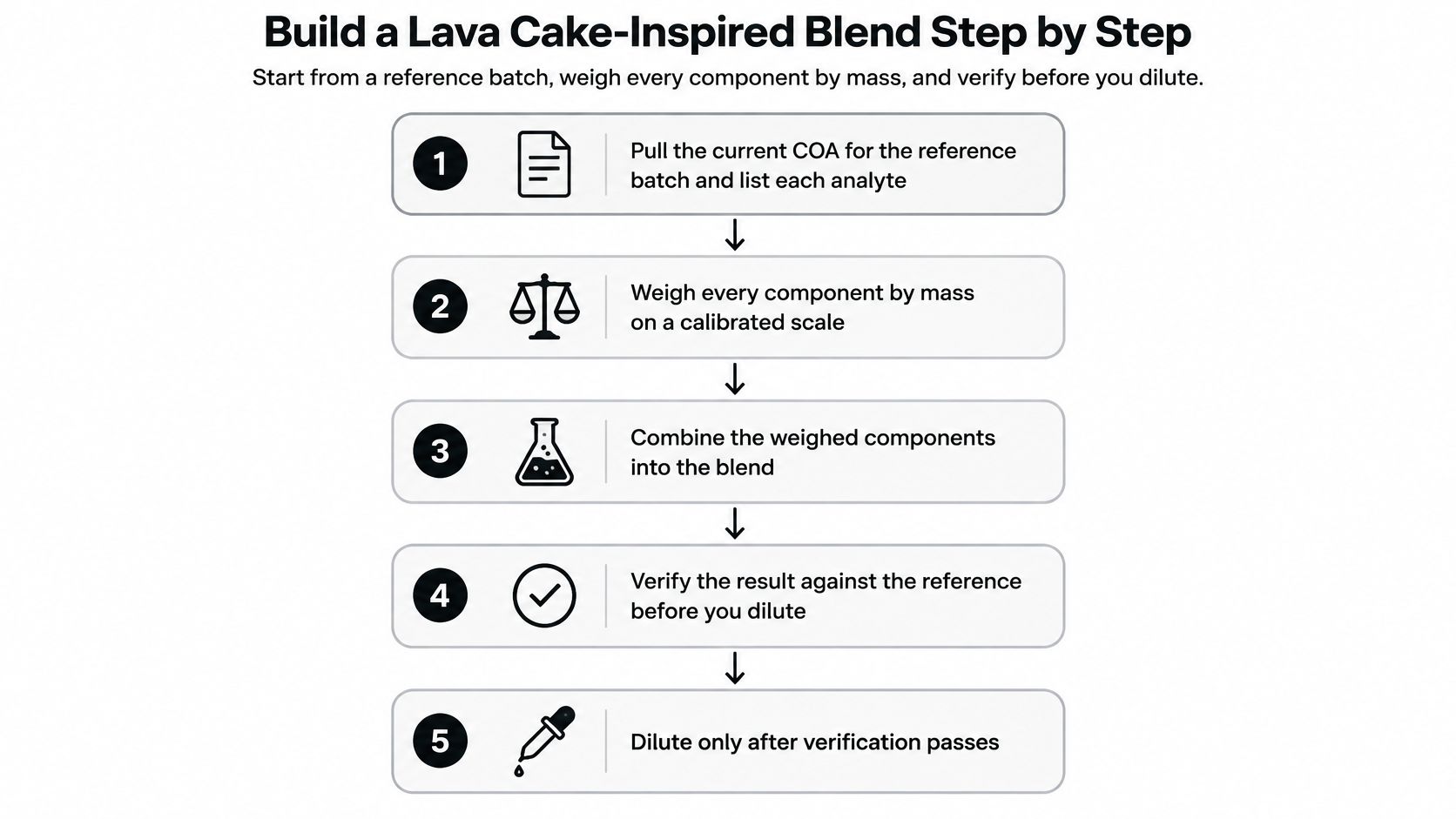
- Pull the current COA for the reference batch and list every analyte with its percentage. An older certificate tells you what a different harvest did.
- Convert the target ranges into percentages of total terpene, and mark each one as a hypothesis until a reference batch confirms it.
- Select isolates for beta-caryophyllene, beta-myrcene, humulene, D-limonene and linalool, or start from a finished strain-inspired blend if one already lands near your target.
- Calculate gram mass for each component from batch size and target percentage. Do the arithmetic before you open a bottle.
- Weigh by mass, not volume. Viscosity differs enough between isolates that a volumetric recipe drifts the moment you change a lot number.
- Mix until uniform, then dilute in the carrier used for the SKU. All strains are highly concentrated and need to be properly diluted before use, so the neat blend is an intermediate, not a finished oil.
- Run GC on the blend and compare it against the reference COA, logging any analyte outside tolerance.
Passing has two parts. Every target has to sit inside its tolerance band on the instrument, and a blind aroma panel has to identify the blend as the intended profile. One without the other fails in market.
A blend that passes GC but loses the aroma panel is a chemistry exercise. A blend that passes the panel but misses the GC has a labeling problem waiting for an audit.
Does the Blend Hold Up in Distillate and Cartridges?
A blend that matches on paper must still be tested in the hardware it will ship in. A heated vial proves nothing about a cartridge.
Laboratory work on 12 California cartridge samples collected between September 2018 and December 2019 used gas chromatography-mass spectrometry, headspace heating and solid-phase microextraction to characterize the liquid, vapor and aerosol phases. That analysis identified more than 100 terpenes and natural extracts, 19 cannabinoids, and additives including vitamin E acetate, polyethylene glycols and medium-chain triglycerides (the peer-reviewed vape oil analysis). For a formulator, the takeaway is structural: define replication as a measured terpene ratio plus a finished-oil specification, then verify both the pre-vape liquid and the generated aerosol.
Loading level changes the picture too. A California-sponsored University of California study tested terpene-containing cannabis formulations at 5% and 15% by weight to represent commercially available and scientifically studied conditions (the UC terpene effects report). The same body of research cuts both ways on myrcene: increasing beta-myrcene produced higher levels of certain hazardous products during dabbing, while cartridge experiments showed lower degradation and lower hazardous-pollutant release at higher beta-myrcene levels. That contradiction is precisely why a Lava Cake blend can't be validated by aroma alone.
| Test variable | Research value | What to verify |
|---|---|---|
| Terpene loading | 5% and 15% by weight | Aroma and emissions at each loading level |
| Cartridge fill mass | 0.5 g | Dose and ratio consistency across cartridges |
| Puffing method | Calibrated system emulating human inhalation | Repeatable puff profile for each SKU |
| Sample phases | Liquid, vapor and aerosol | Compare the pre-vape liquid with the aerosol |
| Additives | Vitamin E acetate, PEGs, MCT | Confirm exclusion when your spec excludes them |
Gold Coast Terpenes states its blends are free of VG, PG, PEG and MCT, so any additive that shows up in your aerosol should be traced back to the carrier or the hardware rather than assumed to come in with the terpenes. Test the cartridge, the power range, the puff conditions and the loading you selected for the SKU. The guide to terpenes in cartridge performance covers the hardware variables that shift aroma between the vial and the mouthpiece.
How Do You Confirm Stability and Approve a Reference Batch Before Scaling?
Confirm one reference batch in the cartridge hardware, then lock the SKU only when stability retests hold. A cartridge stability study reported that an aerosolized cannabinoid product could retain acceptable dose performance for at least two years when stored at room temperature or lower under the study's packaging conditions, while another cannabis-vaping investigation used a 0.5 g cartridge fill and a calibrated puffing system designed to emulate human inhalation topography (the cartridge stability research). Neither finding establishes a universal shelf life for terpene-enhanced distillate. Together they define the mechanics you should test against.
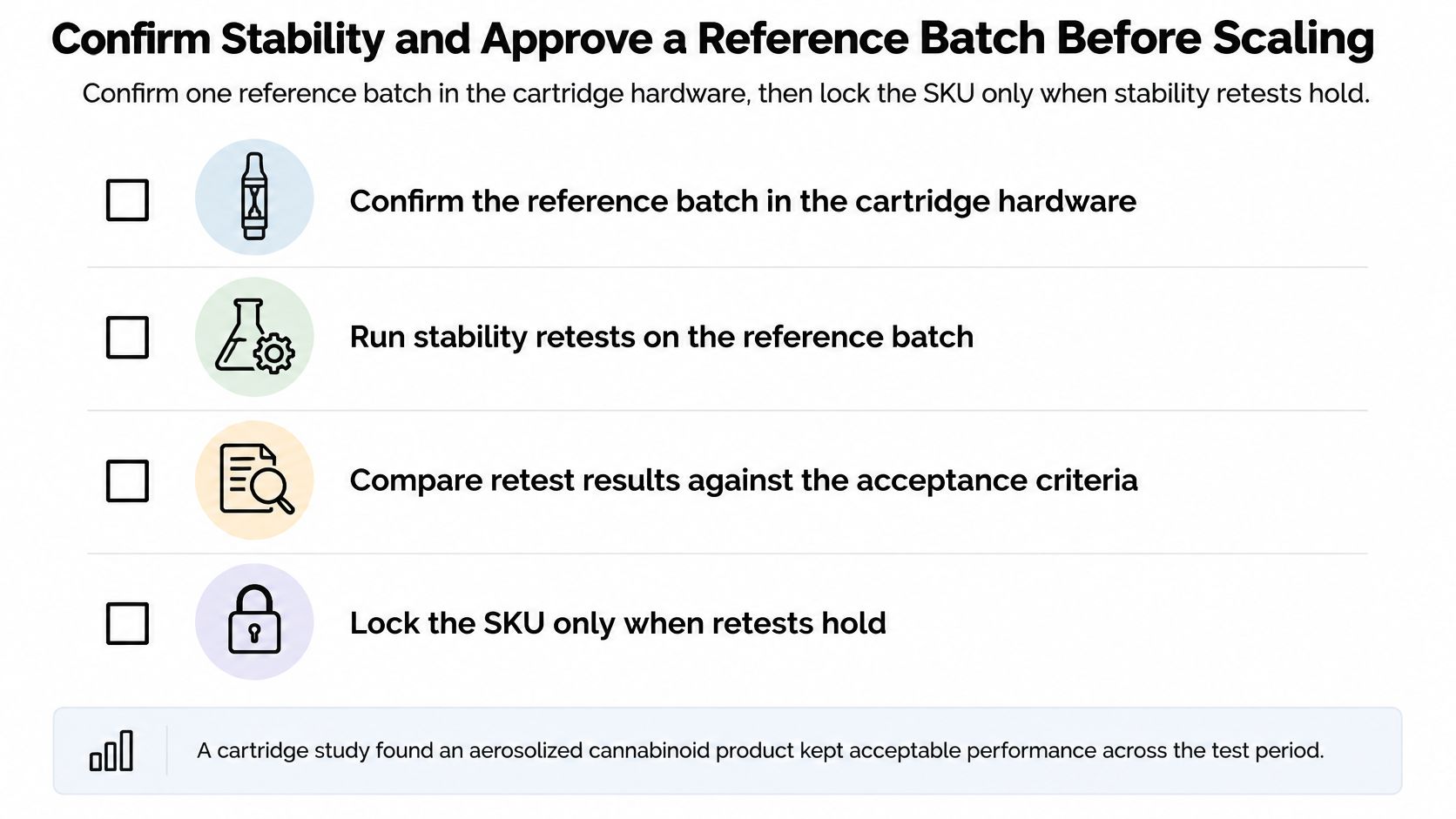
The approval checklist, in order:
- Fix the fill mass for each SKU and write it into the batch record.
- Record the puff profile and hardware, including the power range the cartridge was designed for.
- Set storage temperature and packaging, since both drive how fast top notes flash off.
- Retest on a fixed schedule, such as 0, 3, 6, 12 and 24 months, using the same method each time.
- Compare every retest against the reference COA and log drift, especially in the base notes where loss is easiest to miss.
Sensory matching alone can't confirm that the top, mid and base balance survives storage and aerosolization. A blend that smells right on day zero and loses its pepper by month six has a stability problem, not a flavor problem.
Run the pilot before the purchase order. Build a small batch from the target table, put it through the checklist in the actual cartridge, and scale only when the analytes, the aerosol and the retests all sit inside tolerance.
The quality assurance and testing workflow covers how to structure those retests so the data compares cleanly across lots. New terpene strains are added each month, so it pays to re-check the catalog rather than lock a single source for a multi-year SKU. Buyers combining a Lava Cake build with adjacent profiles can order multiple strains at one time through bulk ordering, and wholesale pricing is available on strain orders totaling over 64oz.
Frequently Asked Questions About Lava Cake Blends
Is the Lava Cake strain one fixed terpene profile?
No. The cultivar label varies by phenotype, batch and laboratory method, so specify analyte ranges and a reference COA instead of a strain name. A single certificate can put limonene first while another shows caryophyllene leading.
Can beta-caryophyllene alone replicate the profile?
It anchors the base note, but the layered profile also needs limonene for the top note and myrcene for the mid note. Gold Coast Terpenes sells those compounds as individual isolates so you can tune each layer against a reference batch.
Are Gold Coast Terpenes blends cannabis-derived?
No. Gold Coast Terpenes makes 100% botanically derived blends, so the source statement and the COA should say so, and you should confirm the labeling your destination state requires before shipping.
How do I choose a terpene supplier for a vape brand?
Check THC-free status, lot-level COAs and additive exclusions such as VG, PG, PEG and MCT, then test samples in your own cartridge hardware before ordering volume. Gold Coast Terpenes publishes its safety documents for exactly that review step.
How do loading levels affect the result?
A University of California study tested formulations at 5% and 15% by weight, so test aroma and emissions at the loading you plan to ship rather than a convenient bench level.
What must pass before a batch goes to production?
The reference COA must match the target table, the pilot batch must pass in the SKU hardware, and the stability retests must stay within tolerance. Gold Coast Terpenes recommends running all three gates on a single lot before committing to a run.
Gold Coast Terpenes ships lab-verified, THC-free terpene blends and single isolates, including the beta-caryophyllene, beta-myrcene, humulene, D-limonene and linalool that a Lava Cake-inspired build calls for, so you can hit a reference COA instead of a label. Every lot comes with documentation you can file directly against your specification, and the 50+ profiles give you a defensible starting point before you tune your own ratios. Visit Gold Coast Terpenes to pull current COAs, check isolate availability and price a bulk order for your next cartridge or distillate SKU.