
The standard advice for the strawberry banana strain is to copy a published terpene list and build the cartridge to it. Gold Coast Terpenes, a supplier of 100% botanically derived terpene blends, not cannabis-derived, takes the opposite position, because a copied list tells you what one lab found in one sample. Your oil's requirements are a separate question.
The failure mode is predictable. A formulator pulls four terpene percentages off a strain page, scales them to a 10% load, and fills carts. The blend smells correct in the jar and drifts by week three, and the potency claim on the label is a guess carried over from somebody else's harvest. The numbers are accurate. The mistake is treating them as a specification.
The sequence that holds up in production runs the other direction. Rebuild the profile from measured terpene references and batch data, set a starting ratio, then run a loading ladder and a batch checklist before filling at scale.
Which Terpenes Define the Strawberry Banana Profile?
Strawberry Banana is best handled as a flavor target assembled from a small terpene set, not as a fixed chemical formula. You build toward the target, then verify what you made.
One representative commercial profile lists limonene at 0.52%, β-caryophyllene at 0.33%, myrcene at 0.27% and pinene at 0.11% (Joint Commerce strain listing). Read those as one laboratory's snapshot of one sample, not a spec sheet.
| Terpene | Formulation role | Reference level | Sensory contribution |
|---|---|---|---|
| Limonene | Top note | 0.52% | Citrus-forward lift |
| Beta-caryophyllene | Base note | 0.33% | Peppery, woody warmth |
| Myrcene | Mid note | 0.27% | Ripe fruit body |
| Pinene | Top note | 0.11% | Earthy, pine-like brightness |
Limonene carries the largest share here and does the top-note work, which is why the front of the aroma reads citrus rather than candy. Pinene sits at roughly a fifth of the limonene level and adds an earthy lift that keeps the top from smelling like a cleaning product.
Myrcene is the piece most formulators under-size. It supplies the ripe, slightly creamy fruit body that makes the profile read as banana rather than generic berry. Beta-caryophyllene supplies the peppery, woody warmth at the back, and it earns its place because it persists longer than the monoterpenes around it.
A large U.S. analysis of commercial cannabis labels found poor overall validity, even though some names were statistically associated with chemical clusters, and the authors compared consistency across 14 major terpenes in products sharing a strain name (published analysis in PMC). That's the whole argument in one result. The name groups products loosely. It doesn't fix a chemotype.
Below is the reference set as a visual, with limonene as the lead share and myrcene, pinene and the supporting notes behind it.
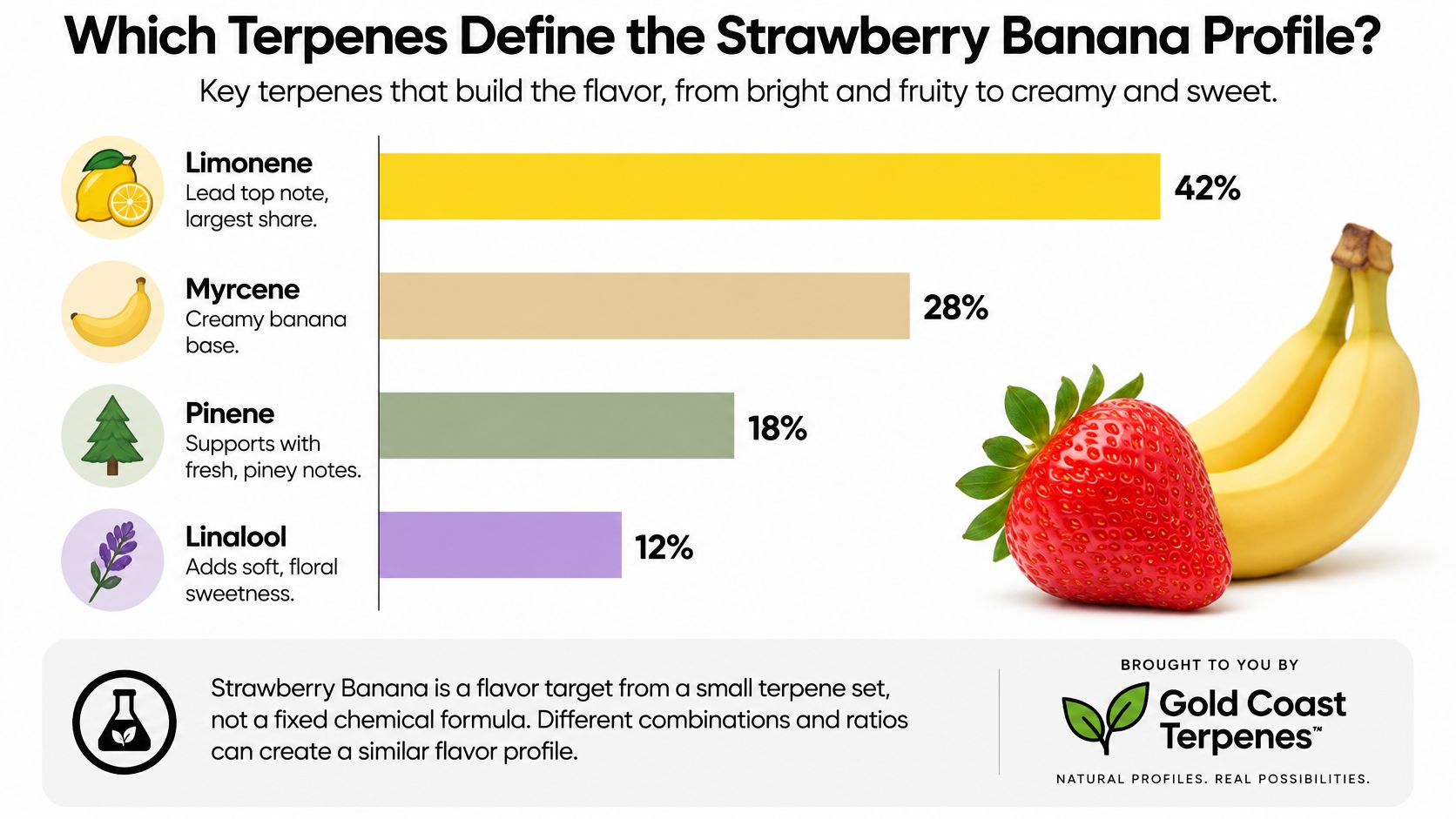
Use the table above as a starting ratio: limonene leading, myrcene carrying the mid, caryophyllene holding the base, pinene as a smaller top modifier. Then pull the batch certificate of analysis and reset the targets against real numbers before you commit a production lot.
How Does Strawberry Banana Lineage Affect Formulation?
The cultivar is an indica-dominant hybrid described as Crockett's Banana Kush crossed with a strawberry-selected phenotype of Bubble Gum, and that parentage explains the fruit-and-dessert identity rather than any fixed chemistry (Leafly strain page).
Each parent contributes a distinct layer. Banana Kush supplies the ripe banana and dessert base. The strawberry-leaning Bubble Gum phenotype supplies the berry top. Layered together, the combination reads as candy or tropical rather than as either fruit alone, which is exactly the architecture a formulator has to reproduce when the flower isn't in the room.
The same source notes heavy resin production, a trait that pushed the cultivar into hash and concentrate development long before cartridges existed. For a distillate program that matters: resin-heavy genetics tend to arrive with fuller terpene fractions, and fuller fractions are harder to standardize batch to batch.
Competition history confirms the flavor traveled. Listings report first place Sativa Flower at the 2015 High Times Cannabis Cup and first place Judges Choice at Cannabis Cup Brazil in 2016 (DNA Genetics product listing), though a cup entry may represent one phenotype or one product format rather than every product sold under the name.
| Source type | Reported THC | Context |
|---|---|---|
| Average strain listing | about 21% | Representative average; CBG about 1% |
| Common flower results | 20-26% | Varies by grower, harvest and lab |
| Seed-line description | up to about 27% | Under favorable cultivation conditions |
| Some phenotypes | approximately 30% | Genetic variation and curing effects |
| Formulation product | Use batch certificate of analysis | The only figure that governs a blend |
The spread is the point. A single cultivar name spans more than nine potency points across reported sources, so any number you quote in a formulation brief is a range until the batch report lands. Gold Coast Terpenes publishes a library of strain terpene profiles that's useful for cross-referencing fruit-forward targets, and even there the profile is the starting point, not the certificate.
Should You Use Botanical or Cannabis-Derived Terpenes?
Take the practical case first. Your Strawberry Banana target is a myrcene-forward body with limonene and beta-caryophyllene around it, and the reference profile hands you a level for each one. Botanical isolates let you dose every compound to that level directly. Cannabis-derived terpenes hand you a finished fraction instead, so you inherit whatever ratio the source material produced and the target becomes a window rather than a number.
That single difference decides the choice before branding enters it.
| Criterion | Botanical terpenes | Cannabis-derived terpenes |
|---|---|---|
| Origin | Plants other than cannabis | Cannabis material |
| Ratio control | Each isolate dosed to a target level | Fixed by the source extraction |
| Batch consistency | Repeatable from specification | Shifts with harvest and lot |
| Flavor matching | Built against a reference profile | Depends on source chemistry |
| Documentation needed | Certificate of analysis and origin statement | Certificate of analysis and cannabis source records |
| Label language | Botanical or nature-identical; state which applies | Cannabis-derived; check local rules |
Reproducing the profile is a measurement job. Pull the reference levels, set a target for each dominant terpene, blend the isolates, then run the finished lot through analysis. The lot certificate should read like the reference: same dominant compounds, same rank order, values inside your tolerance. When the report drifts, correct the isolate inputs. One detail worth watching is where the finished blend lands on myrcene content, since myrcene above roughly 0.5% pushes the effect sedative while lower levels skew energizing.
A cannabis-derived input inverts that workflow. You accept the extracted fraction and re-qualify each lot against the target, which suits a single-batch product where the source story carries the SKU. Labeling needs the same discipline: botanical and nature-identical describe different things, and a cannabis-derived claim still does not lock the Strawberry Banana profile, because the name predicts batch chemistry loosely.
A video walkthrough of how the two sources differ in practice:
Impurity and regulatory checks apply to either route. Residual solvents, heavy metals, pesticide screens and microbial status belong on the lot certificate, and the acceptable limits change by market.
Verdict by situation: choose botanical when you need repeatable flavor matching and a clean label claim. Choose cannabis-derived only when the brand story or the regulatory route requires it, and budget for lot-to-lot variation.
The shortlist I'd use when choosing a terpene supplier for vape brands:
- Documented origin: which plants, which facility, which process.
- Certificate of analysis per lot: per lot, not per product line.
- Impurity testing: solvents, metals, pesticides, microbials, stated on the report.
- MOQ and lead time: confirmed in writing before you schedule a run.
- Flavor-matching support: someone who will read your distillate COA with you.
Gold Coast Terpenes runs its catalog on botanically derived blends for exactly this reason, stocking the Limonene, Myrcene and Beta-Caryophyllene isolates a Strawberry Banana target calls for, and its guide to CDT versus BDT terpenes lays out the trade-offs in more detail.
How Do Top, Mid and Base Notes Build the Fruit Profile?
The fruit profile holds only when fast-evaporating top notes, a fruit-centered mid body and a slower base are sized together. Miss one tier and the blend reads thin or flat.
Think in time. A top note is the impression when the jar opens. The mid note is the body of the flavor as it moves through the device. The base note is what's still there after a week in storage.
Volatile monoterpenes emerge first and fade fastest, while less volatile compounds persist longer and function as mid or base notes (technical terpene formulation guide). That single fact decides the balance of any fruit-forward blend: a high proportion of fast-evaporating citrus or fruit-facing material creates an attractive initial aroma but fades rapidly during storage or use, while sesquiterpene components such as beta-caryophyllene improve persistence and structural depth.
For Strawberry Banana replication, the working architecture is a limonene-led top, myrcene-centered fruit body and caryophyllene-supported warm base. Each tier does a job the others can't.
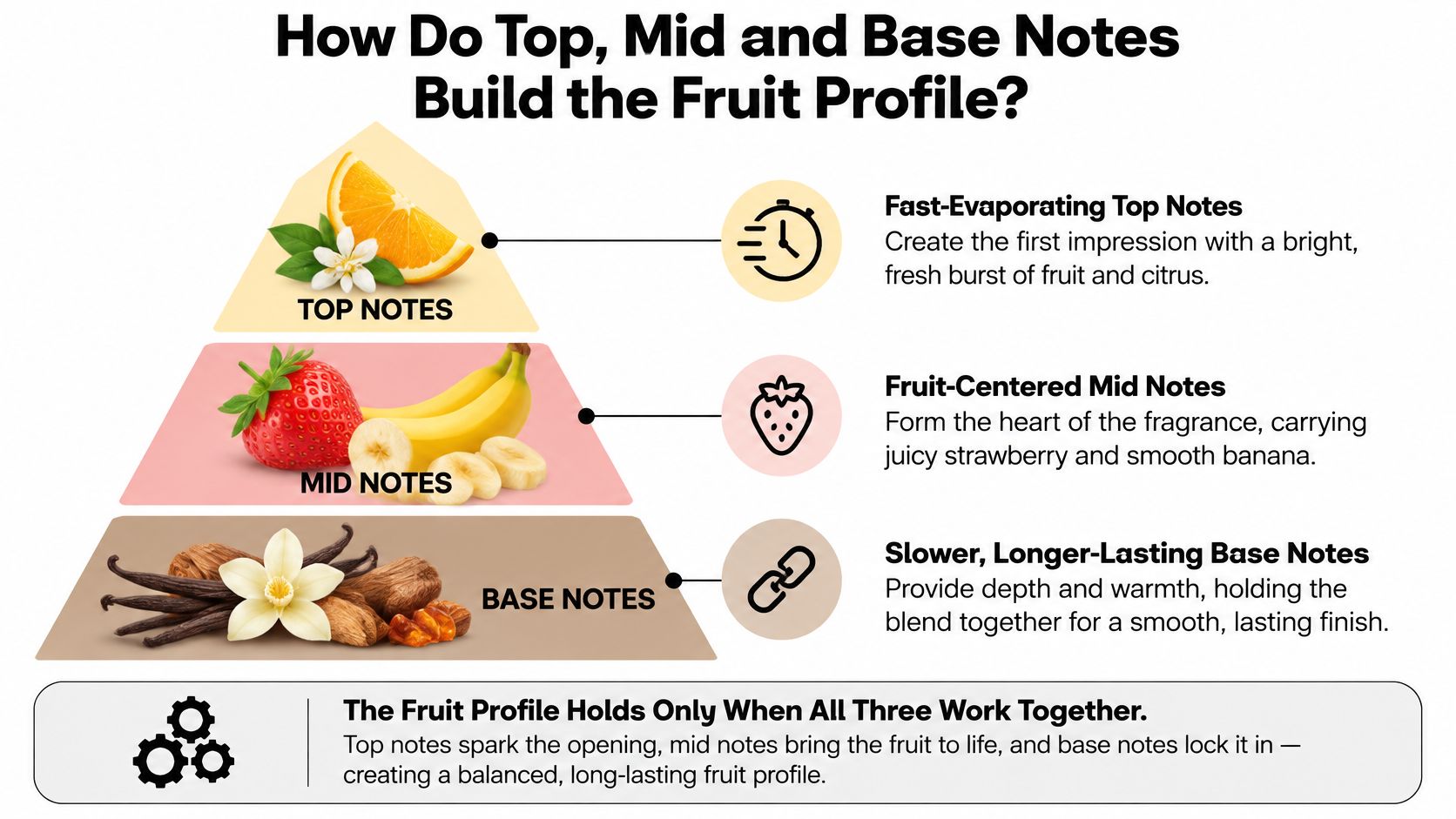
The common mistake is loading the top. An all-citrus opening smells bright on day one and flattens within days, and the formulator blames the terpene supplier instead of the ratio.
Size the base before you chase the top. A blend that still reads fruit-forward after seven days beats one that wins the first sniff.
Raw-material origin and production route also influence impurity profile, sensory character and regulatory status, so check the note structure against supplier documentation as well as against your own nose. Two limonene lots from different routes aren't interchangeable.
Run a two-point test on every candidate: smell the neat blend on day one, note the order the notes arrive, then repeat after a week of storage at production temperature. If the fruit body disappeared and the base turned soapy, rebuild the ratio before you build the batch.
How Much Terpene Load Should a Vape Cartridge Use?
Published cannabis-vaping research reports cartridge formulations at approximately 10-20% terpenes by weight in the cannabis oil, producing aerosols estimated at roughly 2,500-5,000 ppm total terpenes (review in PMC). A 9:1 THC-to-terpene ratio, about 10% terpene by total THC-plus-terpene content, is a workable development benchmark for concentrate testing (concentrate-vaping study).
| Benchmark | Value | How to use it |
|---|---|---|
| Cartridge terpene loading in cannabis oil | 10-20% by weight | Cited range for cartridge formulations |
| Development ratio | 9:1 THC-to-terpene | Approximately 10% terpene by total THC-plus-terpene |
| Estimated aerosol total terpenes | roughly 2,500-5,000 ppm | Compare sensory load against emissions |
| Environmental inhalation study range | below 100 ppm | Lower exposure studied for irritation effects |
The same review notes that inhalation studies have examined much lower environmental concentrations, generally below 100 ppm, with evidence of sensory irritation, airflow limitation and inflammatory responses in vivo. Nobody is drawing an equivalence between a cartridge and an air sample here. The useful takeaway is that concentration is a manufacturing variable you control, not a background condition.
Heat chemistry makes the point sharper. A 2025 toxicology study found cannabinoids and terpenes are thermally labile and can react during heating and aerosolization, producing volatile organic compounds including benzene, methacrolein and isoprene (Frontiers in Toxicology). The same paper links most observed carbonyl products to terpene oxidation during vaping and reports that higher terpene content raised carbonyl emissions in the aerosol.
Practical rule: run the ladder, don't guess the number. Build three fills at 5%, 10% and 15% terpene by weight on the same distillate and the same hardware, then score each on sensory intensity, viscosity, wick recovery, clogging and measured emissions. The lowest step that hits your sensory target is the product.
Higher terpene loading buys intensity and pays for it in oxidation products. Choose the lowest load that meets the sensory brief.
Validate the benchmark against your own distillate and device before you scale. Gold Coast Terpenes publishes mixing math in its guide to how much terpenes to add to distillate, and the ratios still need confirmation in your finished cart.
How to Build and Verify a Strawberry Banana Blend
Work in a fixed order, starting from the sensory goal and ending at a documented, labeled batch. Skipping the middle steps is how blends drift.
- Set the target in words. Write the goal as strawberry, banana, creamy or tropical, and rank them by intensity. A blend asked to be strawberry-led and banana-led at the same time will land mushy.
- Start with the top. Make limonene the lead, at the largest share in your working ratio. Then add pinene at a fraction of that share for lift, and smell it before anything else goes in.
- Build the fruit body. Add myrcene as the mid note at the second-largest share, sized to carry the ripe banana and berry character. At this point, the profile starts reading as Strawberry Banana rather than citrus.
- Add the base last. Beta-caryophyllene goes in at a lower share to hold the warm, woody finish through storage. Adding it first masks the top and you'll spend an hour trying to fix the front.
- Dilute for the carrier. Dilute the concentrated blend in whatever diluent your cartridge oil requires, and record the loading you chose from the ladder.
- Test neat, then in the device. Smell the neat blend, then compare aerosol aroma in a filled cartridge at the intended operating temperature. Aroma transfer and thermal chemistry differ from the bulk liquid, so a neat smell alone proves nothing.
- Verify the batch against the certificate. Check total THC, minor cannabinoids, total terpenes, individual terpene percentages against your target, contaminant status and lot identifier. Pass the batch only when every item meets your written specification.
- Label for what it is. Call it a strain-inspired terpene blend or a flavor formulation. Don't describe it as authentic flower-derived chemistry, and don't imply inhalation safety from the words natural or strain-specific. Match the wording to local rules.
- Document everything. Ratio, loading, device conditions, lot number and certificate reference go in one record so a repeat run is possible six months later.
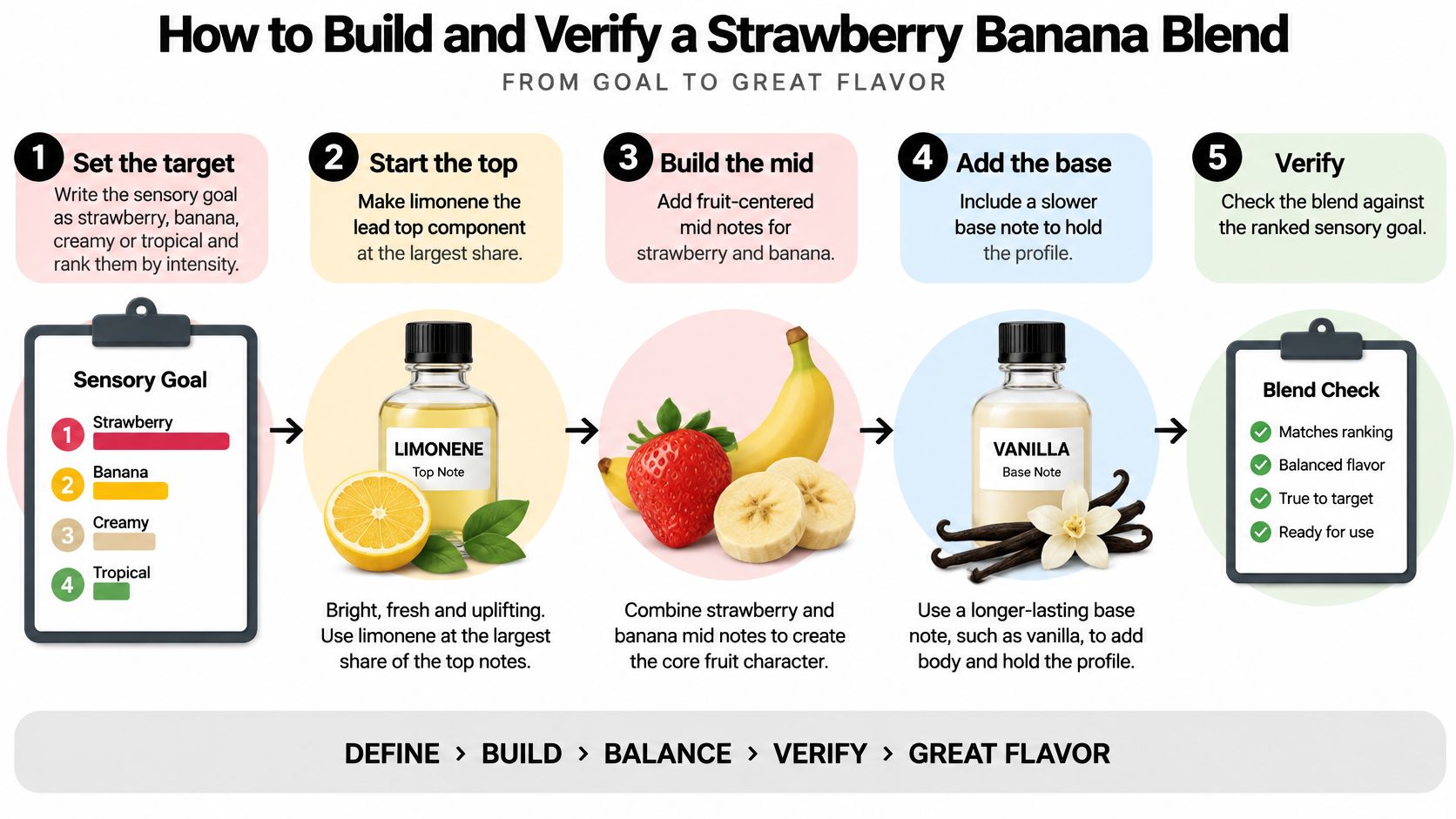
Two slips account for most failures. Adding base terpenes first buries the top and produces a blend that smells like wet wood with a fruit garnish. Skipping the in-device test produces a blend that scores well in the jar and disappoints in the cart, because the aerosol reruns the chemistry at temperature.
Gold Coast Terpenes explains the analytical side in its guide to chromatography testing, which is the reference to hand a new lab technician before the first run.
Pass criteria: every line of the certificate meets spec, the neat blend matches the ranked sensory goal, and the filled cart still matches it after seven days.
A correct blend smells like sliced strawberry and ripe banana with a creamy mid and a dry, peppery finish on day one. After a week, the fruit should be slightly softer and the base unchanged. If the fruit vanishes entirely, the top was oversize. If the base dominates, caryophyllene was oversize.
What Do Trial and Bulk Orders Involve Before Scale-Up?
Start with trial volume, not with a drum. The 3ml Strain Picker Pack from Gold Coast Terpenes lets a buyer choose any three different terpene profiles from the catalog in 1.5ml or 3ml sizes, which is enough to run the in-device test across several candidate blends before committing to bulk.
Run the full blend and batch checklist on each candidate, score them against the ranked sensory goal, and keep the lot numbers and certificates on file so every trial blend traces back to the batch it was built from. That traceability is what makes a repeat order reproducible.
Once the target is set, order multiple strains at one time through the bulk ordering option. Wholesale pricing applies to strain orders over 64oz. Confirm current minimum order quantity, lead time and lot documentation in writing before finalizing a production schedule.
Gold Coast Terpenes adds new terpene strains each month, so check the current catalog before locking a profile into a product line. All strains are highly concentrated and need to be properly diluted before use.
The sequence that works: trial set, blend and verify each candidate, then size the bulk order for the one blend that passes both the sensory and the device tests.
Common Questions Before You Formulate
Does the strain name predict the terpene chemistry?
No. Treat Strawberry Banana as a sensory target, not a fixed formula. Set the target from measured components, then confirm each lot against its own certificate before it goes into a blend.
Botanical or cannabis-derived for flavor matching?
Botanical, in most cases, because the source is documented and the batch repeats from a specification. Gold Coast Terpenes sells 100% natural terpene blends, so confirm each product's origin statement and lot certificate before you choose.
How do I order for trials?
Use the 3ml Strain Picker Pack, which covers any three profiles in 1.5ml or 3ml sizes. Pick candidates that approach the same fruit target from different positions in the profile, then run them at one loading in the same hardware.
Can I buy multiple strains at once?
Yes. Bulk ordering accepts multiple strains in a single order, and wholesale pricing applies to strain orders totaling over 64oz.
Do the concentrates need dilution?
Always. Every strain is highly concentrated and requires proper dilution before use in a cartridge or oil. Keep the test dilution identical across candidates so the sensory score reflects the blend, not the load.
Are new profiles added?
New terpene strains are added each month. Recheck the catalog before locking a profile, and qualify any new candidate through the same measured target and in-device test.
A Strawberry Banana build only works when the flavor target, the loading ladder and the batch record agree. Gold Coast Terpenes offers 100% natural terpene blends, isolates such as limonene, myrcene and beta-caryophyllene, and the 3ml Strain Picker Pack for small trials before bulk. Start with three candidate profiles, run them in your own hardware at the same dilution, and let the certificate decide which one goes into production through Gold Coast Terpenes.