
THC concentration and terpene chemistry answer different questions. The Artist Tree's Banana OG profile reports 23%–27% THC, but that range does not specify the banana, pine, or fuel character a formulator might target.
Gold Coast Terpenes supplies 100% natural terpene blends. For a Banana OG-inspired cartridge, keep the reference strain's reported chemistry distinct from the chosen terpene source. A lot-level target sheet can connect a reference certificate of analysis to batch-specific blend ratios, record processing exposure, and set flavor checks for the finished cartridge.
Which Terpene Shares Should a Banana OG Blend Target?
Start with limonene and myrcene, then balance caryophyllene and pinene to preserve the spicy, pine-forward OG character. Reported flower composition provides a screening reference, not a ready-to-fill cartridge formula.
The StrainCompass laboratory compilation covers 11 laboratory-tested flower samples, reporting median total terpenes of approximately 1.7% by weight, with principal analytes of limonene 0.54%, myrcene 0.31%, caryophyllene 0.25%, and pinene 0.24%. Those values describe material sold under the Banana OG name, not a chemically standardized cultivar.
Reported Banana OG terpene shares and formulation roles
| Compound | Reported share in samples | Formulation role | How to use it |
|---|---|---|---|
| Limonene | 0.54% in the compilation | Top note, bright citrus | Primary calibration marker |
| Myrcene | 0.31% in the compilation | Mid to base note, musky fruit | Primary calibration marker |
| Beta-caryophyllene | Caryophyllene reported at 0.25%; confirm analyte identity | Base note, peppery spice | Adjust to preserve the spicy OG backbone |
| Alpha-pinene | Pinene reported at 0.24%; confirm the isomer | Top to mid note, pine and fuel edge | Adjust pine lift after confirming alpha-pinene |
| Humulene, linalool, camphene | Smaller contributions; no reliable individual share specified | Minor contributors, hoppy, floral, and herbal edges | Include measured amounts when the lot COA reports them |
| Total terpenes | Approximately 1.7% by weight in the compilation | Overall flower terpene concentration | Use as a reference, not a cartridge loading instruction |
The distinction between pinene and alpha-pinene matters. Don't assign an isomer-specific target when a summary only names the broader compound, and don't substitute beta-caryophyllene for an unspecified caryophyllene result.
Convert concentration into a blend target
A flower COA reports concentration in the tested material. A terpene blend sheet reports each ingredient's share of the blend, while a cartridge specification reports terpene concentration in the finished oil. Keep those denominators separate.
Use these relationships:
- Normalized compound share: Divide the compound's concentration by the sum of the quantified compounds you're reconstructing.
- Ingredient mass: Multiply that normalized share by the intended terpene-blend mass, correcting for the ingredient's measured purity.
- Finished-oil loading: Set this separately through compatibility, analytical, sensory, and device testing.
If you reconstruct only selected compounds, label the result a selected-analyte reconstruction. Normalizing the major analytes doesn't recreate omitted constituents.
Practical rule: Preserve both columns on the target sheet, the reference concentration and the normalized formulation share. Without both, reviewers can't tell whether a change came from the reference lot or the recipe.
Don't use a flower terpene percentage as an inhalation-safety limit or a viscosity recommendation. The actual oil matrix and cartridge hardware require their own qualification.
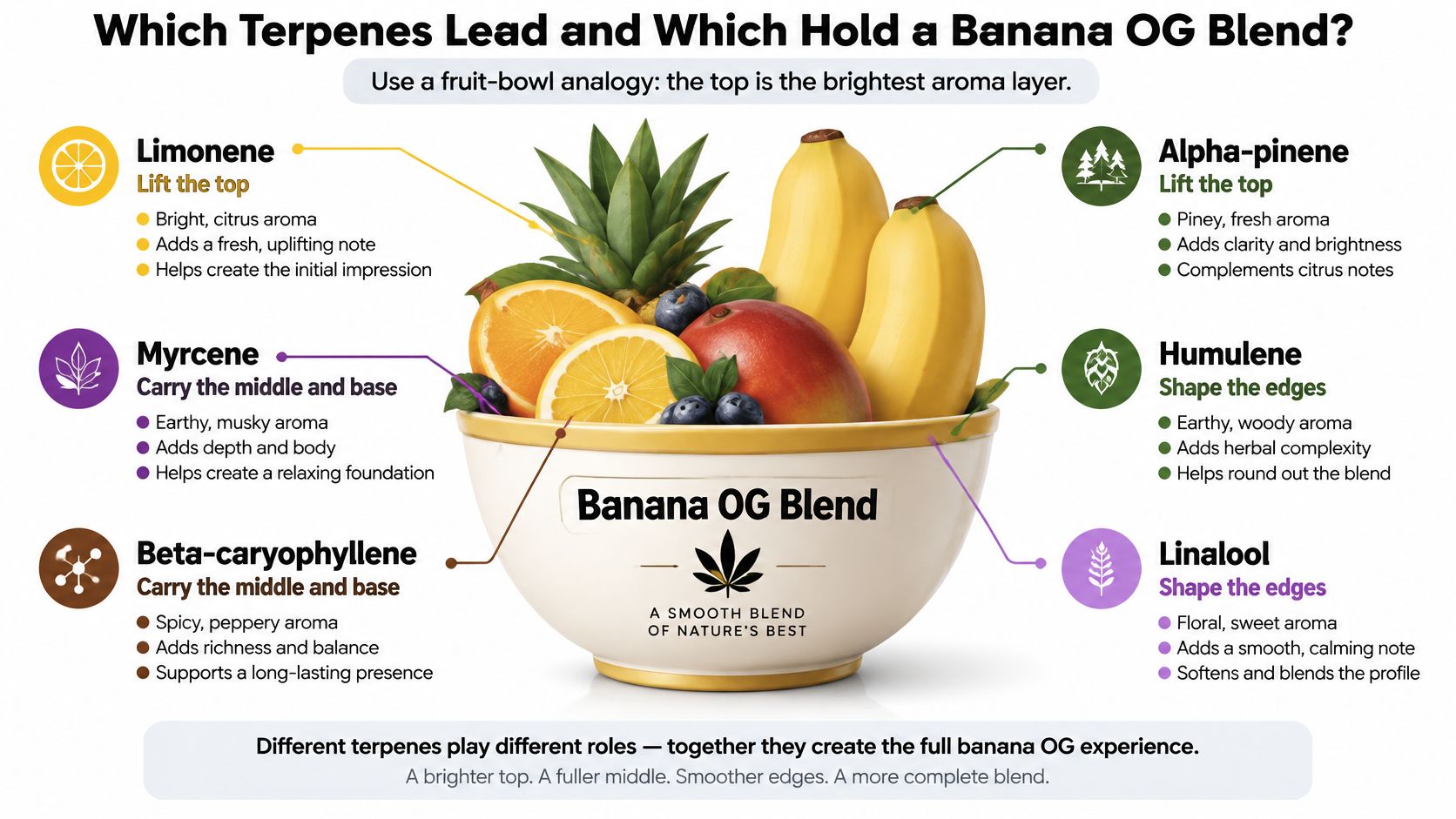
Which Terpenes Lead and Which Hold a Banana OG Blend?
Limonene and alpha-pinene provide the upper aroma layer; myrcene and beta-caryophyllene give the blend body and persistence. Humulene and linalool can shape the edges when the reference chemistry supports their inclusion.
A fruit bowl is a useful sensory analogy. The top is the first impression above the bowl, the middle is the ripe-fruit body, and the base is the earthy spice that remains after the brighter impression recedes.
Assign a job before changing a ratio
Treat note classifications as sensory working roles, not rigid chemical categories. Their practical value is helping a development team describe what a revision should change.
- Limonene: Bright citrus at the top. Increase its relative contribution only when the reference needs more brightness, not because the blend lacks recognizable banana character.
- Alpha-pinene: Pine lift with a sharper edge. Use it to define the transition between fruit and the OG-style background.
- Myrcene: Musky fruit and earthy body. Evaluate whether it connects the bright opening to the heavier finish.
- Beta-caryophyllene: Peppery spice and base structure. Adjust it against the fruit impression rather than treating it as a background ingredient that never changes.
- Humulene and linalool: Hoppy and floral accents. Their presence should answer a specific reference-matching need.
For an initial screen based on the reported profile, keep limonene as the leading top-note contributor. Then evaluate caryophyllene and pinene together, because increasing brightness alone won't restore a missing spicy-fuel character.
Diagnose the balance before device testing
A top-heavy candidate may smell vivid in a closed sample vial yet feel incomplete in the finished product. A base-heavy candidate can obscure the fruit impression and make otherwise useful spice or earth notes dominate.
Use separate sensory descriptors for brightness, fruit body, pine, spice, and finish. A single overall preference score won't tell the chemist what to change.
If the candidate smells like only citrus, only pine, or only spice, rebalance it before advancing to controlled device evaluation.
Don't taste concentrated terpenes directly. Evaluate concentrates through appropriate analytical and controlled sensory procedures, then assess the qualified finished formulation.
Why Does the Banana OG Name Not Set Your Flavor Target?
Banana OG identifies related commercial cuts, not one universally controlled genetic line. Set the purchasing and formulation target from a defined reference lot, supported by its analytical report and retained sensory reference.
The Cannigma's Banana OG history describes the commonly reported parentage as Banana Kush or a banana-scented Banana phenotype crossed with OG Kush, while other accounts identify Ghost OG and a banana phenotype from Sagarmatha Seeds' 60/40 line. It credits OrgnKid most frequently with selecting banana-heavy material and combining it with OG genetics; the associated 70% indica and 30% sativa description is a market characterization, not a genetic measurement.
For procurement, that history has a concrete consequence. A supplier can accurately identify material as Banana OG without supplying the same cut, sensory expression, or chemical balance as your reference.
Resolve conflicting chemistry before buying
The RedBilly Banana OG profile discussion contrasts a compilation reporting limonene 0.60%, myrcene 0.34%, and beta-caryophyllene 0.27% with another sample listing alpha-pinene, beta-caryophyllene, beta-myrcene, and limonene at approximately 0.21–0.23 mg/g. It also highlights the possibility that minor non-terpenoid constituents distinguish aromas even when headline terpene profiles look similar.
Percent by weight and milligrams per gram aren't interchangeable labels. Convert them to a common basis before calculating differences, and verify that both reports describe comparable sample matrices and analytes.
Use a purchasing COA checklist
- Lot number and harvest date. Match the report to the material being purchased, not just the product name. For an extract, request traceability to the relevant production lot.
- Units and reporting basis. Confirm whether results are percent by weight or milligrams per gram. A unit mismatch can create a false impression of a large chemical difference.
- Full analyte panel. Request coverage that includes humulene and linalool. A short panel can conceal the constituents needed to explain a sensory mismatch.
- Flower or extract matrix. Identify exactly what the laboratory tested. Don't treat an extract result as an unchanged measurement of its source flower.
- Test date and storage history. Record packaging, storage conditions, and handling since analysis. An older result doesn't prove the current aroma composition.
- Laboratory accreditation and method scope. Verify that the relevant testing falls within the laboratory's scope. Accreditation alone doesn't make different analytical methods equivalent.
A terpene panel can establish measured composition within its method's scope. It can't, by itself, prove complete banana-aroma equivalence.
The distinction between strain-specific terpenes, enhanced flavors, and e-juice flavoring is useful when writing the development brief. Finalize three decisions before blending: which cut is the reference, which report confirms it, and whether you're matching flower aroma or developing a banana-forward flavor concept.
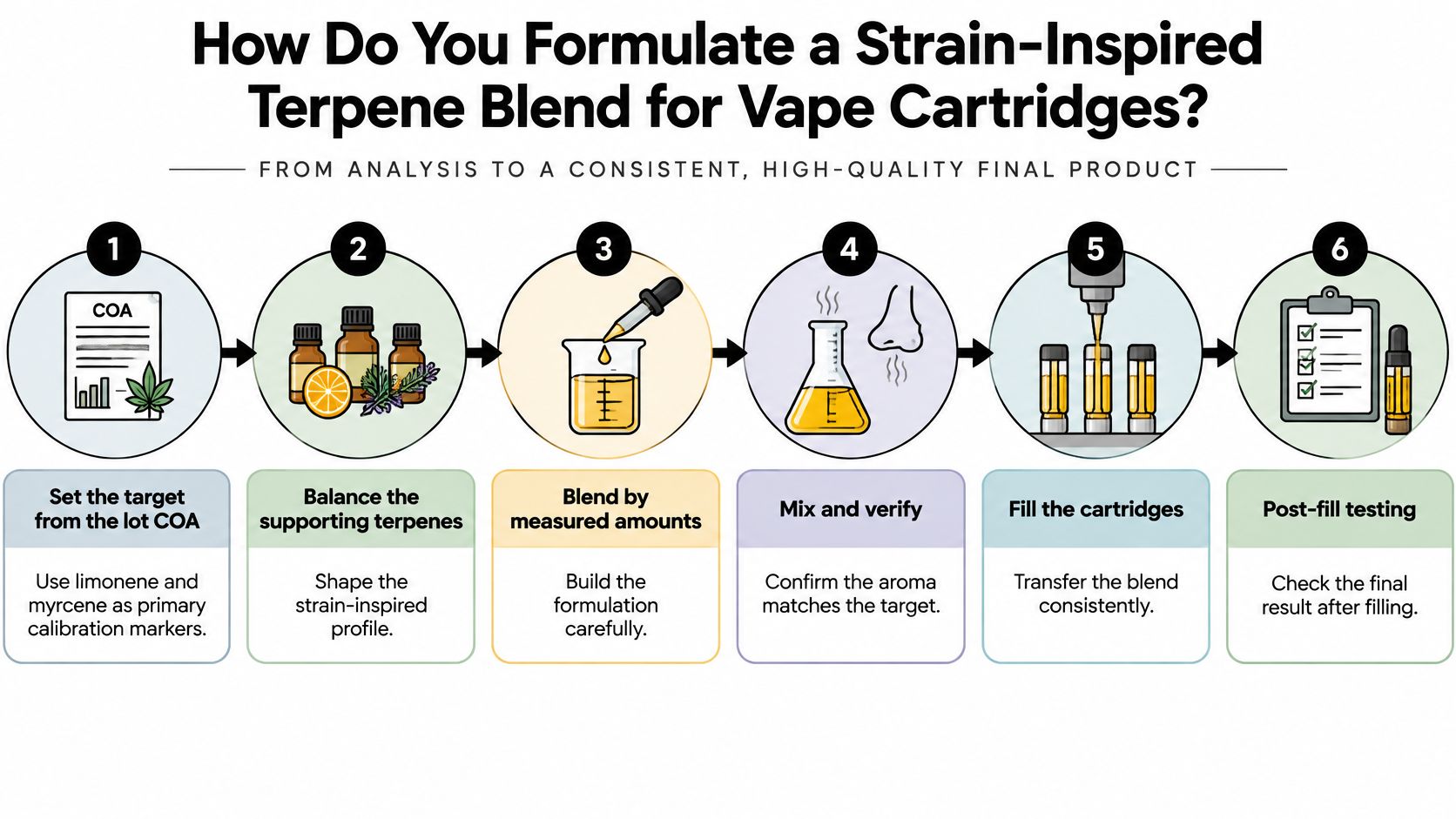
How Do You Formulate a Strain-Inspired Terpene Blend for Vape Cartridges?
Build from a measured lot target, qualify the blend in the intended oil and hardware, and verify the filled product. A vial-aroma match is an intermediate result, not a release specification.
Set the target from the lot COA. Use limonene and myrcene as initial calibration markers, then normalize the measured profile to your selected reconstruction scope. Record the reference matrix and ingredient purities so another chemist can reproduce the calculation.
Balance the supporting terpenes. Adjust beta-caryophyllene and confirmed alpha-pinene to establish the reference's spice and pine structure. Keep a revision log that identifies the sensory reason for every adjustment.
Add minor constituents selectively. Include humulene or linalool when the reference panel and sensory comparison justify them. Don't add complexity merely to make the ingredient list resemble a strain description.
Blend by mass and qualify the oil matrix. Use a calibrated balance and a controlled mixing procedure, then assess homogeneity and hardware compatibility. The guide to using terpenes supports handling fundamentals, but neither a calculator nor a viscosity observation establishes an acceptable inhalation formulation.
Screen actual device conditions. Record coil temperature where measurable, voltage, puff duration, airflow, oil viscosity, and repeated-draw behavior. Entour Brand's cartridge-terpene discussion cites a heating study covering twelve terpenes from 100°C to 500°C, with approximately 97%–98% myrcene survival versus 11%–28% terpinolene survival at higher temperatures; these are screening findings, not recommended cartridge settings.
Verify before release. Compare pre-fill oil, freshly filled cartridges, and aged units using appropriate GC analysis and controlled sensory assessment. If you claim anything about aerosol composition, test collected aerosol with a suitable validated method rather than inferring it from the oil COA.
The workflow below keeps the finished cartridge in view throughout development.
Make the target sheet release-ready
Include ingredient lot numbers, weighed masses, normalized targets, actual analytical results, mixing conditions, hardware identification, and the sensory decision. Assign acceptance criteria before reviewing the final candidate, so the team doesn't redefine success around whichever sample is available.
Don't dilute merely until the oil flows. A visually convenient fill viscosity doesn't establish material compatibility, aerosol performance, or acceptable emissions.
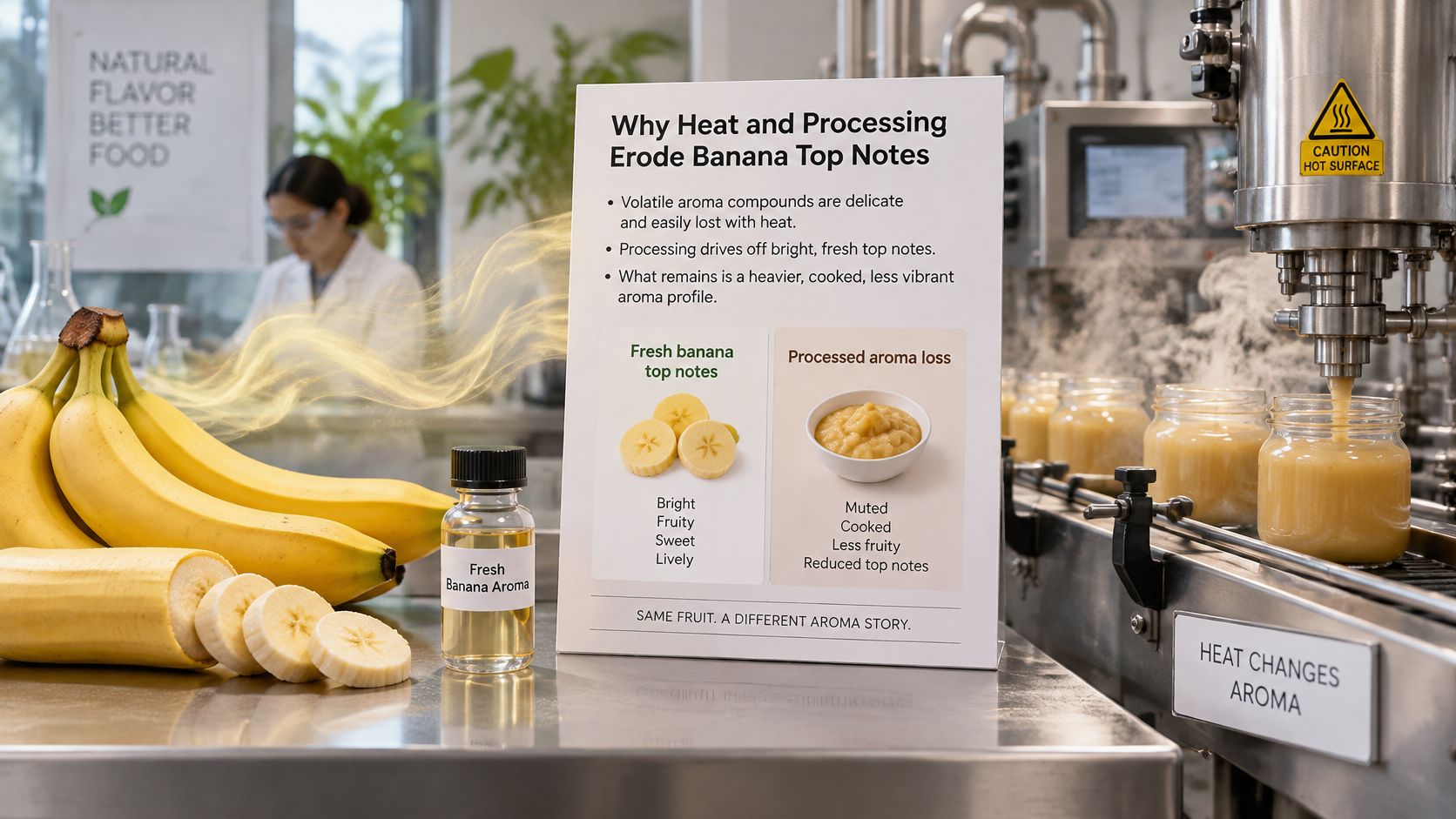
Why Heat and Processing Erode Banana Top Notes
Processing can remove volatile constituents without a comparable change in cannabinoid concentration. For a Banana OG-inspired formulation, that makes process exposure part of the flavor specification, not just an operations record.
Gold Coast Terpenes' extract-formulation summary reports approximately 90% loss of monoterpenes and monoterpenoids in a studied cannabis-extract process, while the cannabinoid fraction remained comparatively preserved. That finding applies to the studied process, not every extract or filling line.
Use the image as a conceptual reminder of aroma loss, not a quantitative model of cannabis processing.
Record exposure before adjusting the recipe
Document when terpenes enter the process, mixing temperature, residence time, oxygen exposure, container closure, and elapsed time between blending and filling. Also identify the sampling point, because a sample taken immediately after blending doesn't represent oil held through a production interruption.
Don't apply the reported loss as a universal correction factor. Increasing the starting concentration without measuring recovery can produce an overconcentrated product when the actual process retains more material.
Banana OG blend faults, causes and fixes
| Symptom | Likely cause to investigate | Fix |
|---|---|---|
| Banana top note fades after filling | Volatile loss during blending, heat exposure, or open handling | Record blend temperature and fill interval, then compare pre-fill and finished-cartridge results |
| Blend reads as sharp citrus only | Excess relative limonene or insufficient supporting structure | Screen a lower limonene share and rebuild the spicy-pine balance |
| Flavor shifts between lots | Reference-lot variation or mixed reporting units | Recalculate the target from each lot's COA on a common unit basis |
| Harsh taste at the device | Formulation-hardware mismatch, thermal transformation, or a material-quality issue | Hold release and investigate oil, hardware, aerosol chemistry, and operating conditions |
These are diagnostic hypotheses, not proof of cause. Don't mask harshness with more flavor or assume that reducing a single terpene resolves an emissions problem.
The companion video can support a process-review discussion.
Use the terpene degradation guide when reviewing storage and handling controls. Engineer any top-note reserve from measured recovery and sensory acceptance, not a generic overage.
A successful correction survives the production process. It doesn't merely improve the aroma of the freshly mixed vial.
Test finished cartridges at the elapsed time that represents actual release, then continue the defined stability program.
Which Label Fits a Banana OG Blend?
Botanically derived describes non-cannabis plant feedstock; cannabis-derived describes material sourced from cannabis. Neither term alone proves that a blend reproduces a particular Banana OG reference lot.
Botanical vs. cannabis-derived terpene labels for Banana OG blends
| Attribute | Botanically derived | Cannabis-derived |
|---|---|---|
| Source material | Non-cannabis plant feedstock | Cannabis flower or extract |
| Label wording | Botanically derived when supported by source documentation | Cannabis-derived when supported by source documentation |
| Banana OG use | Match selected measured compounds for an inspired flavor concept | Potentially retain a broader source-related profile, subject to extraction and verification |
| Compliance check | Confirm permitted wording in the destination market | Confirm permitted wording by market and product type |
| Claim boundary | Doesn't establish cannabis origin or full-strain chemistry | Doesn't establish an unchanged copy of the original flower |
Gold Coast Terpenes' botanical-source identity makes source documentation central to accurate labeling. A supplier COA establishes tested results; feedstock declarations and traceability records support origin claims.
Separate source, composition, and flavor claims
A botanical blend can match the measured compounds within a defined analytical target without containing the reference cut's full chemistry. Conversely, a cannabis-derived fraction can differ from its source flower after extraction, handling, and storage.
Nature-identical describes a different issue from botanical origin. Molecular identity doesn't, by itself, establish feedstock, so don't treat nature-identical and botanically derived as interchangeable supplier declarations.
For a strain-inspired project, keep the claim narrow enough to support. A banana-forward flavor concept and a reconstruction of selected reference analytes are different deliverables, even if both use the Banana OG name in development records.
Claim boundary: A matching chromatogram for selected terpenes supports a selected-compound match, not complete strain equivalence.
Have counsel review the proposed wording against the destination market's rules and the specific product category. Don't assume that wording accepted for a cannabis cartridge also applies to a CBD product or another inhalable format.
Choose botanical sourcing when the project calls for an inspired profile without a cannabis-origin claim. Choose a documented cannabis-derived reference when source identity is essential, then verify what chemistry survived processing.
How Do You Choose a Terpene Supplier for Banana OG Work?
Choose a supplier by lot documentation, analytical clarity, sensory references, and scale-up terms, not catalog size alone. The best terpene supplier for a vape brand is one whose material and records fit the brand's release requirements.
Gold Coast Terpenes offers 50+ strains across Indica, Sativa, and Hybrid categories, alongside isolated compounds including Limonene, Myrcene, and Beta-Caryophyllene. Its blends are botanically derived and lab-verified THC-free; the company also provides educational resources and a Mixing Calculator.
Check the evidence before placing a bulk order
- Lot traceability: Obtain the report for the actual material allocated to your order.
- Analytical scope: Review units, analyte coverage, reporting limits, and how THC-free status is documented.
- Sensory suitability: Qualify a retained reference against your intended matrix and hardware.
- Claim support: Keep source declarations separate from strain-inspired flavor descriptions.
- Commercial terms: Confirm product-specific minimum order quantities, packaging, availability, and isolate pricing before approving procurement.
Gold Coast Terpenes permits multiple strains in a bulk order, and wholesale pricing is available on strain orders totaling over 64 oz. That threshold doesn't establish isolate terms or a universal minimum order quantity.
Use the terpene purchasing guide to organize the commercial review, then execute the qualification:
- Request the COA for the lot you intend to evaluate.
- Order an available test size of the reference and necessary isolates.
- Run the candidate through controlled blending, filling, and post-fill assessment.
- Approve bulk purchasing only after the finished-product criteria pass.
Carry the normalized ratios into the Mixing Calculator, then independently reconcile calculated masses against the batch sheet. Request wholesale pricing for the actual strain volume needed and obtain separate confirmation of isolate quantities and terms.
Which Questions Remain on Banana OG Terpene Formulation?
Does Gold Coast Terpenes make botanically derived terpenes?
Gold Coast Terpenes describes its terpene blends as 100% natural. Confirm the exact feedstock source and its documentation with the company before making any source claim on a finished product.
Can a Banana OG-inspired label appear on a cartridge?
Use strain-inspired wording only when permitted for the product and destination market. Avoid implying unsupported genetic or full-chemistry equivalence, and retain the approved claim rationale in internal records.
Which terpenes must a COA report before I match a profile?
Request a full panel with stated units and clear analyte identities, including humulene and linalool. Distinguish constituents that were not tested from those tested and reported below the method’s reporting limit.
How do I test a small quantity before scaling?
Confirm available evaluation sizes and minimum order quantities with Gold Coast Terpenes. Qualify the reference and supporting ingredients in your intended oil and hardware before committing to production-scale purchasing.
How often should finished cartridges be retested?
Set a documented schedule around the actual release interval and justified aging checkpoints. Compare retained samples with predefined chemical and sensory criteria, rather than waiting for a flavor complaint.
Gold Coast Terpenes offers 100% natural terpene blends and isolated compounds for adjusting Banana OG-inspired flavor profiles. Review the options at Gold Coast Terpenes, and confirm lot documentation and evaluation quantities before qualifying a cartridge blend for bulk production.