
A 2019 cannabis metabolomics study measured linalool from 0.023 ± 0.002 in Mama Thai to 0.57 ± 0.072 in Terple, a wide spread that makes one point clear: a strain name isn't a dependable specification for a linalool-led blend (the peer-reviewed cultivar study). Gold Coast Terpenes supplies 100% natural, botanically derived terpene blends, including strain-inspired profiles intended for formulation rather than relying on a cultivar label to predict chemistry.
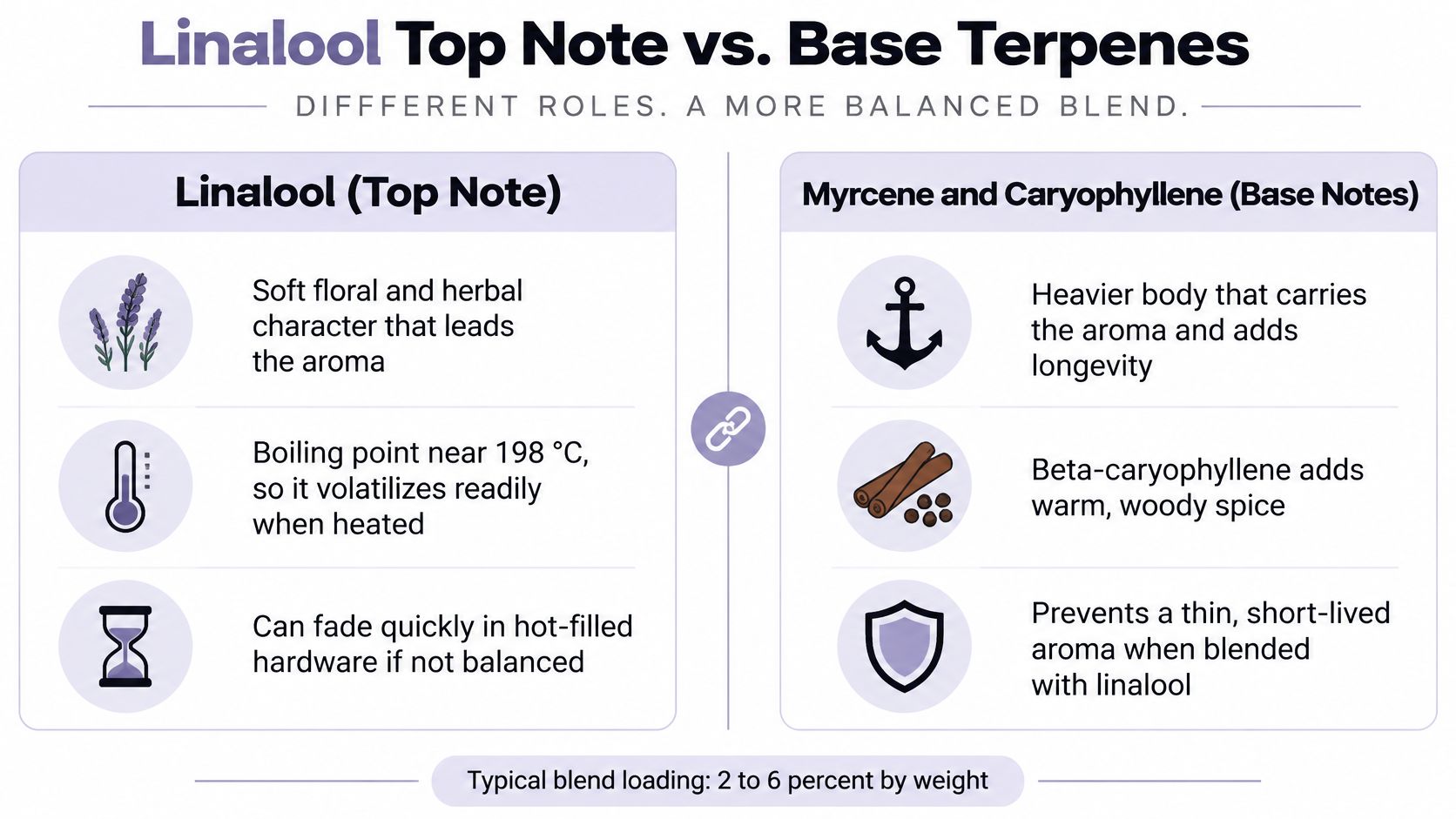
Linalool's floral character can make it a useful anchor for a lavender-style top note, but the profile needs more than linalool alone. The blends covered here are THC-free and free of VG, PG, PEG, and MCT, so the carrier system stays under the formulator's control. Linalool is also one of the more volatile components in a floral profile, and it can thin out under heat if the mid and base notes are not built to carry it. This guide compares seven profiles by note role, starting loading, heat behavior, and the batch checks to run before scaling a SKU.
The practical target is a repeatable aroma after heating, with the floral note held in proportion to the blend's citrus, fruit, spice, or earthy components. Treat each suggested loading as a pilot starting point, scale the test batch with the Mixing Calculator, then confirm the finished formula's chemistry and sensory performance in the intended matrix.
1. Which linalool-dominant lavender terpene profile suits vape cartridges?
A lavender-style profile suits cartridge formulators who need a clear floral top note supported by a fuller mid and base. Start with a modest loading, then evaluate the aroma after heating rather than relying on the blend's cold smell.
Gold Coast Terpenes describes its lavender-oriented profile as built around linalool. In the blend, linalool sets the floral direction, while beta-caryophyllene and beta-myrcene can provide mid-to-base support. A small amount of ocimene or limonene can add lift, but too much citrus can shift the target away from lavender. The balance matters because linalool is potent in aroma: a flavor-engineering review reports an odor-detection threshold of 9.33 × 10^-3 mg/m³ for linalool, compared with 6.19 × 10^-1 mg/m³ for limonene (the review of flavor-engineering data). Those airborne thresholds aren't cartridge loading recommendations, but they help explain why a small adjustment can noticeably change the floral balance.
Set the floral level in a pilot
Begin at 2–3% of the finished formulation, then increase in 0.5% steps while checking aroma after heating. Compare a 3% and 5% loading in a controlled sample run to identify where the floral note reads clearly without becoming soapy. For a worked example, test a 1-gram distillate cartridge with a 4% lavender-style blend and a small citrus accent, then compare it with the same base formula without that accent.
Practical rule: Blend linalool with the supporting terpenes before adding the mix to distillate. Verify the final loading with a mass-based calculation, and confirm the blend composition against the current COA before scaling.
Use the Gold Coast Terpenes Mixing Calculator to model the total terpene percentage before a lab run. For background on the aromatic compound, see Gold Coast Terpenes' linalool essential oil guide. In the finished cartridge, record the blend lot, loading, hardware, and heated sensory result so the next run has a usable reference.
2. How can a Granddaddy Purple-inspired terpene blend hold a grape-and-berry profile?
A Granddaddy Purple-inspired blend works when myrcene supplies a dense base and linalool adds a floral, grape-leaning layer. It's a fit for a berry-forward product brief that shouldn't open sharply with citrus or pine.
Treat the profile as a base-led blend with a supporting floral note, not a lavender formula with a fruit label. Myrcene gives the aroma weight, while linalool helps separate the profile from a generic sweet-berry mixture. A light limonene addition can brighten the opening, but keep it subordinate if the target is dense and rounded. The goal is to preserve a recognizable grape-and-berry character through the intended heating cycle, not just in a room-temperature sniff test.
Start at 3%, then compare the aroma before and after heating. Myrcene-heavy blends may shift in character as temperature rises, so review the actual cartridge or device conditions you plan to use. For example, run a distillate sample at 3% beside a myrcene-only control, then check whether the linalool addition gives the blend enough floral definition without making the berry impression perfumed. A cartridge-line exercise could hold the base blend at 4% while changing only the top-note accent across variants. Keep the base constant so the team can attribute sensory differences to the accent rather than to a changing total load.
Confirm the lot before matching the flavor
Ask Gold Coast Terpenes for the current batch COA before each production run. Compare its component profile with the reference lot, and retain a sensory sample if the formula will be reproduced later. Gold Coast Terpenes' Granddaddy Purple profile explanation offers additional context for the strain-inspired direction. For a separate catalog example, Apple Fritter Elevated Strains is a listed flavor profile, but it shouldn't be treated as a chemical substitute for a Granddaddy Purple-inspired blend without a matching COA and sensory comparison.
3. What makes a Do-Si-Dos-inspired linalool and caryophyllene blend work for distillate?
The balance problem is spice against floral sweetness: caryophyllene sets a peppered mid-palate, linalool rounds it toward pastry and lavender, and a restrained limonene top note keeps the opening from going flat. For dessert-style distillate, the target is a sweet, creamy read with spice underneath, not a pepper-forward finish.
Treat the profile as a note-role brief. Limonene is the top-note lift and should stay low enough that it does not push the blend toward citrus cleaner. Linalool carries the floral middle and softens the caryophyllene edge. Caryophyllene gives base spice and structure; if it dominates after heating, reduce that fraction before reaching for more linalool. A 19-cultivar profiling study found substantial linalool variation across samples and sorted the cultivars into five volatile chemotype clusters (the cultivar profiling study). Read those values as comparative, then confirm each production lot against its COA instead of treating a literature range as a finished-oil target.
Compare the profile with and without a cream accent
Start the base blend in winterized distillate at 4%, then run a second sample with a 0.5% vanilla-cream accent beside a caryophyllene-only control. Judge after the intended heat cycle: sweetness first, spice second, floral definition last. If the finish turns peppery, cut caryophyllene or add cream support; if it turns perfumed, lower linalool rather than covering it with limonene.
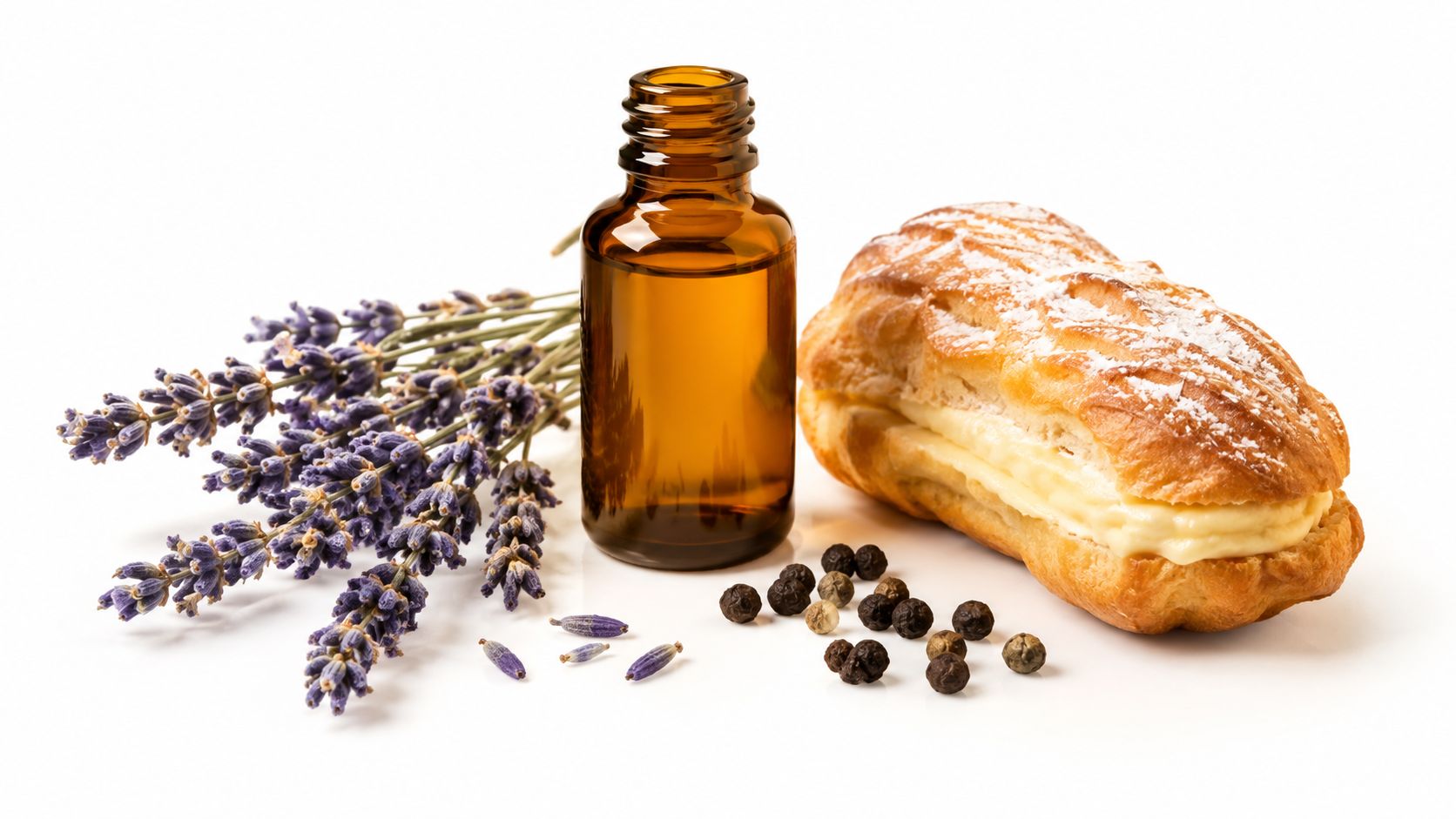
Gold Coast Terpenes' caryophyllene guide gives context for the spicy component, and the Mixing Calculator helps check total terpene loading before the lab trial. Verify the diluted blend in the intended oil matrix; a clean cold aroma does not prove the sweet-spiced identity will survive heating.
4. How do you formulate a Purple Punch-inspired linalool profile without making it candy-like?
A fruit profile turns candy-like when the sweet mid notes dominate and the finish has nothing to anchor it. That is the main risk in a Purple Punch-inspired target: linalool supplies the floral lift at the top, while myrcene and caryophyllene carry the base with body and earthier support.
Keep the floral component in proportion to the fruit. Linalool can make a grape-adjacent profile feel layered, but past a certain share it pushes the blend toward perfumed sweetness. If the blend reads sweet and flat, a restrained citrus accent can clarify the opening. A heavy citrus addition pulls the profile into a different flavor family and undermines the base you built.
Start at 3% and evaluate the heated product before increasing the dose. Run 3% and 5% in the same base and score them on separate attributes: floral definition, fruit character, sweetness intensity, and whether the finish turns cloying. A cloying rating that appears at 5% but not at 3% points to the linalool share, not the total loading, as the variable to correct. For a multi-SKU fruit line, hold the core blend at 4% and vary only the citrus accent, recording batch lot and formula for each sample so later adjustments do not confound the comparison.
Tune the opening before changing the whole profile
If the fruit layer needs more green character, trial a small ocimene accent rather than raising total loading. Confirm the added top note holds after heating, not just in the mixing vessel. The 24k Gold Punch flavor profile is a catalog reference with a related name; confirm the match through the COA's terpene ranking before treating it as the same profile.
Before release, compare the production lot's COA against the lot used in the panel, checking linalool, myrcene, and caryophyllene ranking. A higher linalool share than the reference is an early warning that the batch will read sweeter than intended, and for a SKU sold on a fruit description that drift shows up directly in the heated aroma.
5. When does a Bubba Kush-inspired earth and linalool blend suit distillate?
Choose an earthy, linalool-accented profile when the brief calls for a grounded, savory base. Caryophyllene and myrcene carry the base notes while linalool sits in the middle of the stack, bridging the heavier woody material with a light floral edge.
Linalool plays a supporting role in this formula. Its job is to keep the woody, earthy direction from reading one-dimensional, so dose it as an accent and judge the result against a plain control. A controlled start at 2–3% total loading suits a dense profile; run a parallel version with no added accent so the comparison shows whether the linalool is doing useful work. Adding citrus early can mask that judgment.
For a worked example, run a distillate sample at 3% with no extra flavor accent alongside a citrus-forward control in the same base oil and hardware. After repeated heat cycles in the target cartridge, check whether the base still reads earthy and whether the floral edge survives heating or flattens out. If the profile runs heavy, reduce total loading or rebalance the base before reaching for brighter top notes.
Keep linalool in the supporting bridge role. Verify that the heated sample remains earthy and lightly floral before locking the formula.
A study of nine cannabis cultivars found that total terpenoid content differed sharply among them: Black Lime reached 8.8% of flower-bud dry weight, while White Cookies and Terple each reached 4.8% (the cultivar metabolomics study). Those figures describe flower chemistry and do not translate directly into formulation loadings. For a manufacturer, the practical lesson is to avoid treating cultivar identity as a stable recipe. Confirm the specific blend lot, document the Gold Coast Terpenes lot number, and repeat the sensory check whenever the lot changes.
6. How should you balance a Gelato-inspired linalool and limonene profile for vape cartridges?
Run the linalool decision as a ratio test before anything else. Hold the Gelato-inspired base at a fixed loading and compare a sample with linalool at 1% of the total blend against the same formula at 2%. The 1% version should let limonene carry the citrus opening. The 2% version shows whether the added floral sweetness still reads as dessert or has already drifted toward lavender.
In note-role terms, limonene works the top, linalool sits in the floral-sweet middle, and caryophyllene supplies a warm base. That structure suits a dessert direction where the citrus should brighten the blend without taking it over. Lock the base profile before adding cream or vanilla accents. The outcome to look for in the heated sample is a sweet mid-note that reads as confectionery; if the first draw opens floral instead of citrus, the linalool share is too high and the ratio comes down.
Start the pilot at a 4% profile loading and compare samples with and without a 0.3% vanilla accent. Judge each version on the opening, the mid-palate sweetness, and the finish separately, then record the exact blend and finished-product concentrations so the preferred version is reproducible.
Use a controlled heat comparison
A room-temperature sample understates how much the citrus lifts and overstates how clean the floral note stays, so run the comparison through the intended cartridge hardware after repeated heating. A controlled cultivation study found that linalool concentration depended on both genotype and light conditions: in the linalool-characterized E19 strain, the reported concentration reached 153.30 micrograms per gram of dry weight under one LED treatment, compared with 79.34 micrograms per gram under control lighting (the cultivation study). Plant measurements at that level don't predict cartridge performance, but they show why a profile name can't stand in for a lot-specific chemical check.
Gold Coast Terpenes maintains a guide to profiles high in limonene and linalool. Use it as formulation context, then confirm the actual blend against the current COA and a heated sensory check before locking the formula.
7. How can a Lemon Lavender Haze-inspired blend keep citrus and floral notes in balance?
The imbalance in this profile rarely shows in the bottle. The terpinolene-style citrus top lifts first under heat, so a blend that smells balanced as a neat sample can finish lavender-heavy through a cartridge, with the floral mid and myrcene base crowding out the opening.
Linalool anchors the lavender core, and the profile suits lemon-floral or herbal-citrus product families that need more character than a straight lavender note. Myrcene adds body at the base; pushed too high, it turns the aroma heavy and mutes the brighter top. Judge the citrus-to-floral ratio at the intended loading in the actual hardware, since a ratio that reads correctly on a neat sample skews once the top notes volatilize.
A practical pilot is a 4% loading with a light citrus accent in the top layer. If early draws read bright but the finish drifts floral, extend the citrus note into the mid layer; more top-note material would only volatilize first again. Run the replication trial over three rounds, shifting the citrus-to-floral ratio one step at a time and having the sensory panel score each sample against a retained reference. Change one variable per round so each result maps to a clear formulation decision.
Protect the reference and document each lot
Store the blend away from heat and keep the container closed between uses, since the top notes that lift first in hardware also fade first in a warm or open bottle. Compare each incoming lot against a retained reference from Gold Coast Terpenes and record the blend lot, formula, hardware, and heated sensory outcome for every round. A controlled cultivation study found significant strain-by-light interactions for linalool, meaning a change in growing conditions did not move every genetic background in the same direction (the controlled cultivation study). With expression that variable at the source, a retained physical sample gives the panel a more stable anchor than any spec sheet.
Linalool role, loading range, and best fit for each strain-inspired profile
| Item | Linalool Role | Typical Loading (% by Weight) | Best Fit |
|---|---|---|---|
| Linalool-Dominant Lavender Terpene Profile for Vape Cartridges | Lead floral, herbal top note | 2–6% | Lavender-style cartridges and distillate |
| Granddaddy Purple-Inspired Terpene Blend for Cannabis Product Formulation | Secondary floral, grape-leaning accent | 3–5% | Sweet, dense, berry-forward purple profiles |
| Do-Si-Dos-Inspired Linalool and Caryophyllene Blend for Distillate | Adds floral sweetness to the spiced profile | 3–6% | Creamy, bakery-style distillate flavors |
| Purple Punch-Inspired Linalool Terpene Profile for Cannabis Product Formulation | Floral brightness and grape-adjacent sweetness | 3–5% | Fruit-forward and purple-category products |
| Bubba Kush-Inspired Earth and Linalool Terpene Blend for Distillate Formulation | Modest floral accent bridging earthy and lighter notes | 2–4% | Earthy, savory-leaning distillate profiles |
| Gelato-Inspired Linalool and Limonene Terpene Profile for Vape Cartridges | Floral sweetness supporting creamy character | 3–5% | Dessert, cream, and confectionery-style cartridges |
| Lemon Lavender Haze-Inspired Linalool Blend for Cannabis Product Formulation | Floral lavender core balanced by citrus lift | 3–5% | Lemon-floral and herbal-citrus products |
Move From Profile Selection to a Production-Ready Linalool Formula
Shortlist one or two profiles based on the flavor family your product line needs, then run a three-point loading test within the suggested range. Keep the base oil, hardware, and heating conditions consistent across samples. Otherwise, a change in carrier or device can masquerade as a terpene-ratio effect.
Confirm each blend lot against its current COA, then log the results against the Gold Coast Terpenes lot number. Record the total terpene loading, the relevant component proportions, the finished formula, and the sensory result after heating. If the formulation is intended to reproduce a reference flavor, retain a sample of both the reference and the accepted production blend. That makes future lot comparisons more concrete than relying on a strain name or a remembered aroma.
Use a measured chemical profile to define what “high linalool” means for your own product. A peer-reviewed analysis of real-world chemovar sessions recorded linalool in 3,495 sessions, representing 55.4% of those analyzed, while the average recorded volume was 0.160 with a standard deviation of 0.261 (the Vigil Index analysis). Detection alone doesn't make a profile linalool-dominant. Specify whether your target is merely detectable linalool, a linalool-led ratio, or a repeatable linalool profile supported by defined companion notes.
Treat formulation claims and consumer-facing labels as separate checks. Confirm botanical or cannabis-derived ingredient descriptions against supplier documentation, and review the final label against the rules for the market where the product will be sold. Don't imply that a strain-inspired blend reproduces a specific cannabis batch unless the sensory and analytical evidence supports that statement. Gold Coast Terpenes supplies THC-free blends described as free of VG, PG, PEG, and MCT, along with batch documentation and a Mixing Calculator to support pilot work and scaling.
FAQ for linalool profile formulation
Are strain names enough to select a linalool-rich blend?
No. Cultivar name, growing conditions, and batch can all differ from the chemistry you need. Compare the COA and sensory profile of the specific lot before using it as a production reference.
What should a formulator record during a linalool loading trial?
Record the blend lot, formula, total loading, carrier, hardware, and heated sensory result. Gold Coast Terpenes' lot information can help tie a pilot result to the specific blend used.
Can a linalool-heavy profile be judged from its aroma before heating?
A neat-blend check is useful for screening, but it doesn't establish how the final product will smell in hardware. Test the finished formulation after heating and verify the blend composition against its current COA.
What's the difference between botanical and cannabis-derived terpenes?
The distinction concerns the source of the compounds, not whether a strain name guarantees a particular profile. Confirm the supplier's ingredient and source documentation, then assess the finished product's chemistry and labeling requirements.
How should vape brands choose a terpene supplier?
Check whether the supplier provides clear ingredient information, batch documentation, and support for formulation work. For a linalool-led SKU, verify the current lot and test it in the intended carrier and hardware before scaling.
Does linalool in a formulation establish a therapeutic effect?
No. Treat linalool as an aroma and formulation variable, not a promise of calm, sleep, or pain relief. Product claims need to follow applicable rules and be supported by appropriate evidence.
Move From Profile Selection to a Production-Ready Linalool Formula
Shortlist one or two profiles from this list based on the flavor family your product line needs, then run a three-point loading test within each profile's stated range. Confirm every lot against its certificate of analysis, and log results against the Gold Coast Terpenes lot number so replication stays consistent across production runs. Keep the carrier and hardware fixed while comparing samples, and test each accepted formula after heating.
Gold Coast Terpenes supplies THC-free blends described as free of VG, PG, PEG, and MCT, giving formulators control over the carrier system. Use batch documentation to confirm what's in the lot, and use the Mixing Calculator to model total terpene percentage before a pilot. Neither a calculator nor a profile name replaces verification of the finished formula.
Choose the profile by sensory function, not by cultivar shorthand. For a floral cartridge, prioritize a linalool-led opening with enough mid and base support to avoid a thin result. For a fruit or dessert formula, decide whether linalool should add a floral edge or lead the aroma. For an earthy distillate, keep it in a supporting role. In each case, compare the heated sample with the target, document the result, and adjust one variable at a time.
Before a production run, confirm the COA, check the supplier's ingredient and source documentation, and review product labeling for the markets where the SKU will be sold. If the lot changes, repeat the comparison rather than assuming the profile name guarantees the same result. That process turns a strain-inspired idea into a formulation brief that can be tested, documented, and reproduced.
Gold Coast Terpenes offers botanically derived strain-inspired blends, isolated compounds, batch documentation, and a Mixing Calculator for linalool-led formulation work. Compare the available profiles and tools at Gold Coast Terpenes, then verify your chosen lot in the intended carrier and vape hardware before scaling.