
Two listings are open in your browser. Both say they offer natural terpenes for sale. Both promise clean flavor. Both look usable for a strain-inspired terpene blend for vape cartridges. Then you remember the last batch that smelled bright in the bottle and went dull in the cart, or worse, started wicking poorly after a few days on the shelf.
That's the moment where most buying mistakes happen.
For a formulator, natural isn't a vibe word. It's a purchasing filter that affects flavor accuracy, thermal behavior, paperwork, and whether a profile works in distillate. If you're formulating for cartridges, concentrates, or a broader cannabis product formulation workflow, the question isn't just “Is it natural?” It's “Natural from what feedstock, extracted how, verified by which documents, and tested in what matrix?”
The commercial backdrop matters here. The global natural terpenes market is valued at USD 477.18 million in 2024 and is projected to reach USD 720.32 million by 2032, with a projected 5.33% compound annual growth rate over that period, according to Data Bridge Market Research's natural terpenes market forecast. That tells you this category isn't a novelty aisle. It's an established ingredient market with real supply chains and repeat industrial demand.
A smart buyer reads “natural terpenes for sale” the same way a production lead reads a spec sheet. You want origin transparency, not just aroma claims. You want records by weight, not guesses by drops. You want a blend that survives real hardware conditions, not just a bottle note.
If you need a baseline on sourcing terminology before you compare listings, the difference between artificial and natural terpenes is a useful starting point.
Introduction What Natural Really Means When You Buy Terpenes
Natural is a sourcing decision, not a label style
A terpene bottle can be natural and still be wrong for your application. That's what trips up new brand owners. They treat natural as the end of the buying decision when it's really the start.
If you're replicating flavor of a cultivar for distillate, you're buying a volatile ingredient system. That means the source plant, the extraction method, the purification steps, and the final composition all matter. Two blends can both qualify as natural and still behave very differently once they're mixed into oil and run through hardware.
Practical rule: If the supplier can't explain feedstock, extraction approach, and batch documentation in plain terms, don't scale that blend into production.
Why this matters in cannabis product formulation
In cannabis product formulation, a terpene profile has to do several jobs at once. It has to smell right in the bottle, incorporate into the oil, stay coherent during filling and storage, and deliver the intended note structure during vaporization.
That's why experienced formulators don't buy on strain name alone. They buy with a release mindset:
- Flavor target: Are you formulating a strain-inspired terpene blend or a flavor-first profile?
- Matrix fit: Is this intended for distillate, live-style concentrate, or another oil system?
- Hardware fit: Will the profile stay functional in the cartridge platform you use?
- Documentation: Can the supplier support THC-free, additive-screening, and traceability needs?
Natural terpenes can absolutely support better commercial outcomes. But only when natural is tied to verifiable sourcing, not decorative language.
How Natural Terpenes Are Sourced and Extracted for Sale
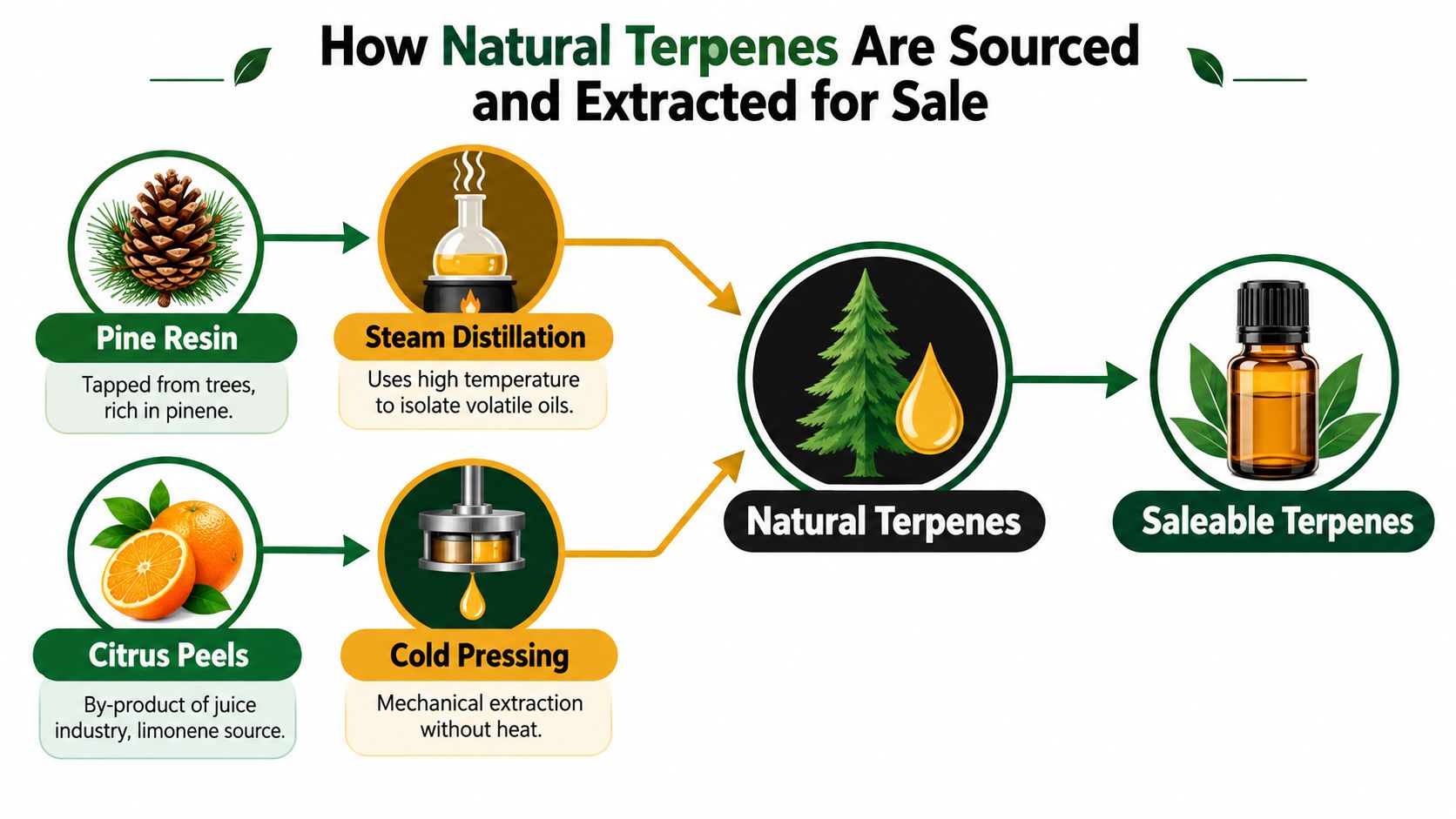
Natural terpenes don't come from a naming convention. They come from plant feedstocks and extraction processes. For formulators, that's good news because mature feedstocks usually mean a more understandable supply chain.
One industry history ties modern terpene commerce to older industrial systems. It notes that gum turpentine production from crude pine resin became an established industrial process in the mid-19th century, and orange oil from citrus by-products entered industrial use by the mid-1970s after large-scale juice production created extraction volume. That same history notes orange oil is now used mainly in fragrances, terpene resins, and cleaning agents. You can review that background in Data Bridge Market Research's market history summary.
Feedstock tells you more than the strain name
Think about it like vanilla. If a supplier says “vanilla flavor,” that could mean very different things depending on whether it came from vanilla beans or a lab-made substitute. Terpenes work the same way. Feedstock matters because it shapes both authenticity and consistency.
Common natural terpene feedstocks include pine-derived materials and citrus by-products. Those aren't niche sources. They're part of long-running extractive industries. For a buyer, that usually means the supplier should be able to tell you where the aromatic fraction came from and why that source makes sense for the target profile.
A few useful questions to ask:
- What was the source plant? Pine, citrus, herbs, spices, or a mixed botanical system.
- Was the material isolated or blended? That changes how you evaluate flavor realism.
- What extraction route was used? Heat exposure and handling can affect the final result.
If sustainability and agricultural by-product sourcing matter in your procurement process, this overview of sustainable terpene sourcing is worth reviewing.
Extraction method shapes formulation behavior
Extraction isn't just a manufacturing footnote. It can change how sharp, rounded, or stable a terpene fraction feels in use. Steam distillation and cold pressing are common examples. Both can produce natural terpenes, but they don't treat delicate volatile compounds the same way.
That matters when you're buying a terpene profile for cannabis product formulation. A profile built for fragrance use might smell attractive but still be a poor fit for distillate if the balance of light and heavy notes doesn't hold up in the oil matrix.
Buyers who get the best results usually ask for transparency at the feedstock and process level, then confirm performance in their own prototype batches.
Why Volatility and Heat Change Flavor in Vape Cartridges
A terpene blend can smell complete at room temperature and still fall apart in a cartridge. The reason is simple. Vaporization is selective. Different compounds lift off at different temperatures, and some degrade before they ever reach the user as the original molecule.
This is the part new operators often underestimate when they're formulating a terpene profile for vape cartridges.
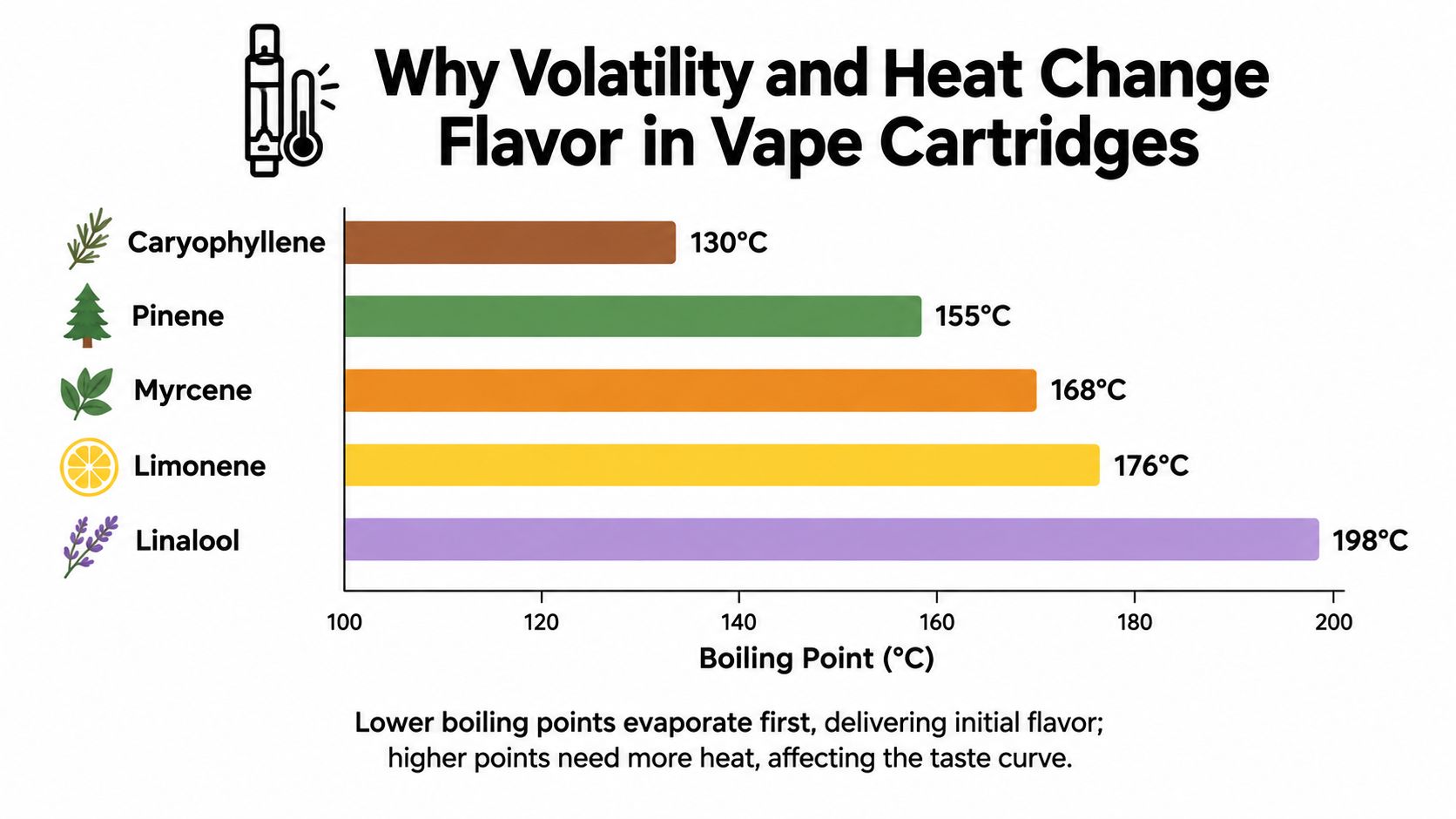
Boiling point changes the order of flavor delivery
Published data summarized by Azarius show major terpenes span a wide boiling range, from about 119°C for β-caryophyllene up to 198°C for linalool and humulene. The same summary also notes experimental heating studies where parent-compound survival ranged from about 97% to 98% for the most stable monoterpenes down to about 11% to 28% for the least stable, depending on the compound and conditions, as described in Azarius guidance on terpene temperature behavior.
That gives you the core formulation lesson. The cartridge doesn't deliver the entire profile all at once. It delivers a sequence shaped by volatility and stability.
Here's the plain-language version:
- Lower-boiling compounds tend to show up earlier.
- Higher-boiling compounds may need more heat to express fully.
- Less stable compounds may partially degrade before they're inhaled as intended.
If you want a deeper reference point on thermal ordering, boiling point of terpenes helps when you're choosing a strain-inspired terpene blend for cartridges.
After you've seen the chart, it helps to watch the concept in motion:
Why a good bottle aroma can become a weak cart
The bottle test is static. The cart test is dynamic.
In the bottle, you're smelling an undisturbed mixture. In the cartridge, the coil creates a short, repeated heat event inside an oil matrix. That changes which compounds appear first, which stay present, and which fade or break down. If the hardware runs hot, the top of the profile can flash off fast while delicate notes flatten out.
A profile that wins on a cold sniff can still lose on the first three pulls if the volatility curve and the hardware don't match.
For vape work, don't evaluate flavor in air alone. Evaluate it in the actual device, at realistic use temperatures, over repeated draws. That's where formulation decisions become real.
Understanding Top Mid and Base Notes for Strain Accuracy
If volatility explains when compounds show up, note structure explains how the profile feels as a whole. A lot of strain replication gets easier. You stop chasing a name and start building an aroma architecture.
For anyone replicating flavor of a cultivar or building a strain-inspired terpene blend, the top-mid-base framework is one of the most practical tools you can use.
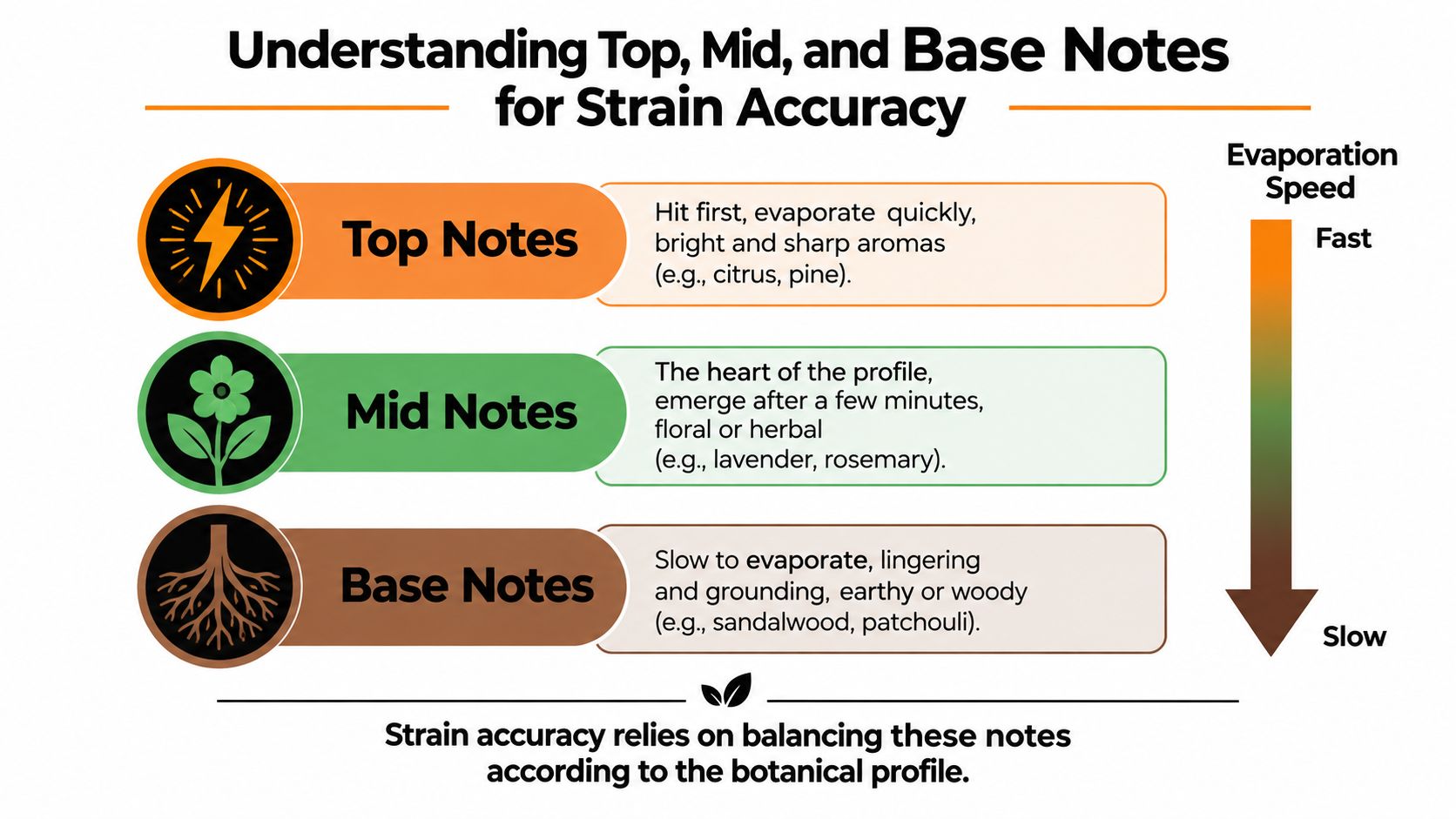
What each note layer does
A practical terpene flavor chart from Gold Coast Terpenes defines the structure clearly. Top notes are perceived first and fade quickly. Mid notes form the heart of the aroma. Base notes are the heavier, lingering scents that anchor the blend. The same chart gives example inclusion ranges, including limonene at 0.5% to 2.5% as a top note, linalool at 0.2% to 1.5% as a mid note, myrcene at 1.5% to 4.0% as a base note, and caryophyllene at 1.0% to 3.0% as a base note, as shown in this terpene flavor chart.
That framework is useful because it gives each terpene a job.
| Note layer | What you notice | Example role in formulation |
|---|---|---|
| Top notes | First impression | Bright citrus, pine, sharp freshness |
| Mid notes | Main body | Floral, herbal, rounded character |
| Base notes | Lingering finish | Earth, spice, wood, density |
Reading a profile like a formulator
A profile that smells “thin” often has enough top but not enough body. A profile that smells “muddy” may have too much base and not enough lift. A profile that smells accurate in the bottle but generic in a cart may be structurally correct on paper yet unbalanced for the hardware's heat pattern.
A simple way to consider it:
- Limonene can provide the opening flash.
- Linalool can soften and connect the center.
- Myrcene can add weight and saturation.
- Caryophyllene can lock in spice and depth.
Blend logic: Top notes attract attention, mid notes create identity, and base notes make the profile memorable after vaporization.
Applying note structure to vape and concentrate work
When you're formulating for vape cartridges, bright top notes can disappear faster under repeated heating. That doesn't mean you overload them. It means you balance them against mid and base material so the profile still reads correctly after the first pull.
For concentrates and heavier oil systems, base-heavy profiles can become dominant if you don't keep enough lift in the upper register. The right answer isn't a universal recipe. It's matching note structure to matrix and hardware.
That's why experienced teams don't ask only, “Does this smell like the strain?” They ask, “Does the top open correctly, does the middle carry the identity, and does the base finish cleanly in this application?”
How to Verify Natural Terpenes Are THC Free and Lab Tested
Buying natural terpenes for sale without paperwork is like buying hardware without resistance specs. You might get lucky. You might also build your production around a claim that can't survive an audit, a retailer review, or your own incoming QC.
Recent market coverage around terpenes highlights demand from clean-label reformulation and cannabis-compatible profiles, while also leaving a real gap around practical compliance questions. It also notes that newer vape-ingredient safety standards require screening of non-cannabinoid additives, including terpenes and diluents. That's why documentable sourcing matters, not just natural positioning, as discussed in Precedence Research coverage of the terpene market and compliance gap.
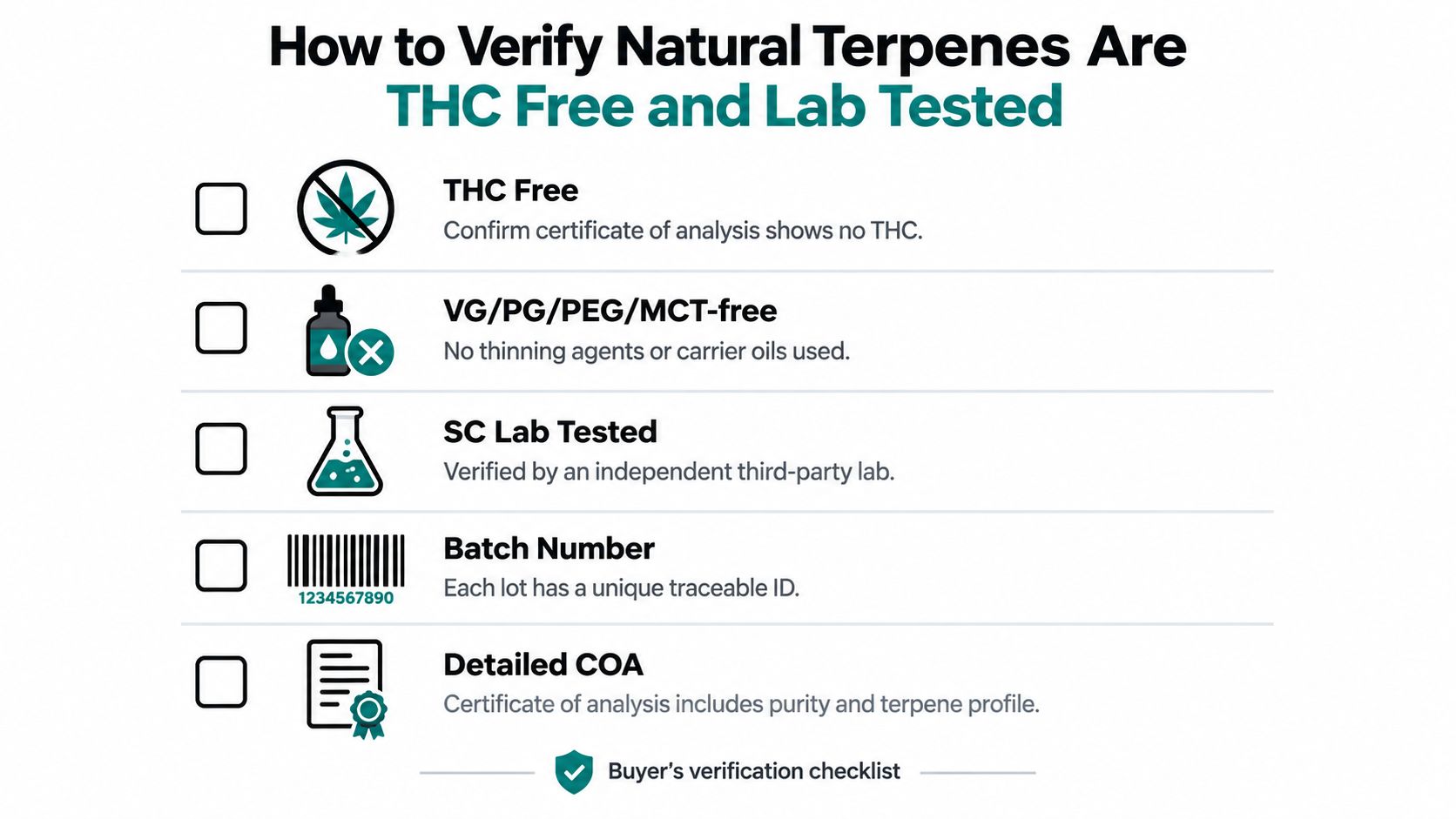
What to ask for before you buy
A useful supplier review starts with documents, not marketing copy.
Request these before scaling a blend:
- THC-free confirmation: Ask for a certificate of analysis that supports the claim.
- Additive disclosure: Confirm whether the material is free of thinning agents or carrier-style additives relevant to your application.
- Batch traceability: Every lot should map back to a batch identifier.
- Profile detail: The paperwork should tell you what's in the bottle, not just what the flavor name is.
If you want a practical baseline for this process, third-party lab testing is the standard mindset to apply.
Compliance questions that catch weak suppliers
When a supplier says a blend is suitable for vape use, ask follow-up questions that force specificity:
| Claim on listing | What a buyer should verify |
|---|---|
| Natural | Source plant and extraction description |
| THC free | COA support for the lot you're buying |
| Lab tested | Which lab, which batch, and what was screened |
| Clean formulation | Whether non-cannabinoid additives were screened and disclosed |
One more point matters here. A clean document set still doesn't guarantee good performance. It only tells you the material is qualified to enter your workflow. You still need bench testing in the actual matrix and hardware you sell.
Formulating With Natural Terpenes for Distillate and Cartridges
The buying decision is only half the job. The other half is execution. Otherwise solid profiles get blamed for problems that really came from load rate, mixing conditions, or poor documentation.
For a terpene profile for distillate, work by weight, not by drops. Several formulation guides emphasize recording total terpene load, each inclusion by weight, oil condition, mixing temperature, homogeneity checks, and cartridge performance observations. One guide also gives the core formula directly: terpene weight equals base material weight multiplied by target percent, as outlined in this terpene formulation and batch-record guide.
Start with practical load windows
For vape cartridge formulations, one retrieved formulator guide places total terpene load at 5% to 15% by weight depending on the base material, and calls 5% to 8% the industry sweet spot for distillate-based cartridges. The same guide recommends mixing at 120 to 150°F (49 to 65°C) and ensuring the extract is fully decarboxylated to reduce crystallization risk and improve incorporation, according to Entour guidance for terpene formulation in vapes.
Separate formulation guidance for manufacturers also ties vape integration ratios to about 3% to 12%, with another recommendation placing many formulating targets in the 5% to 10% range depending on profile and application, as described in a formulators' guide to cannabis-derived terpenes.
Here's a simple working table.
| Base Material | Recommended Total Load | Notes |
|---|---|---|
| Distillate for cartridges | 5% to 8% | Common sweet spot for many cart builds when the oil is fully decarboxylated |
| Distillate, broader working range | 5% to 15% by weight | Use the higher end carefully and validate hardware behavior |
| Vape applications across profiles | 3% to 12% | Useful for strain-inspired terpene blend development and profile scaling |
Use weight math, not guesswork
If you're making a small pilot batch, the math should be boring. That's a good thing.
Example workflow:
- Weigh the base material. Start with the exact oil weight.
- Choose the target load. Pick a conservative starting point inside your application range.
- Calculate terpene weight. Base material weight × target percent.
- Mix under controlled heat. Stay inside the documented temperature window.
- Record the batch conditions. Oil state, temperature, homogeneity, and hardware result.
Don't judge a formulation by aroma alone. Judge it by incorporation, fill behavior, wick performance, leakage, cold-start behavior, and draw consistency.
Prototype in the real matrix
Natural terpene blends are composition-sensitive volatile mixtures. Their behavior changes with sourcing, purification, oxygen exposure, heat, light, concentration, and the surrounding oil matrix. Practical guidance is to qualify the supplier, prototype in the actual distillate or concentrate matrix, minimize heat and oxygen exposure, and set release criteria for identity, purity, viscosity, sensory match, hardware performance, and stability, as detailed in Gold Coast guidance on natural terpene formulation behavior.
If you're building batches for scale, tools help. A practical option in this category is Gold Coast Terpenes' Mixing Calculator and related formulation resources, which are built around the same weight-based logic discussed above.
Choosing the Right Natural Terpene Profiles and Next Steps
The best buying decision happens when you stop treating sourcing, compliance, and flavor as separate conversations. In production, they're one decision. A terpene profile that smells right but lacks batch support slows down procurement. A clean COA with poor hardware compatibility slows down launch. A profile with good note structure but weak matrix fit becomes rework.
Match the profile to the product goal
Use this lens when you're evaluating natural terpenes for sale:
- For strain accuracy: Choose a strain-inspired terpene blend that has clear top, mid, and base structure rather than a flat single-note impression.
- For flavor-first SKUs: Look for profiles that still respect hardware behavior, especially if you're replicating flavor of fruit or dessert concepts where volatile top notes can disappear fast.
- For modular formulation: Isolates can help when you need to tune brightness, body, or finish without replacing the whole blend.
A few practical examples from the market help here. If a profile needs more citrus lift, a limonene isolate can be one adjustment path. If the center feels too lean, myrcene or linalool may become part of the bench conversation. If the finish needs more spice or grounding, beta-caryophyllene often enters the discussion.
Build your sampling plan before you buy in bulk
Don't jump from a product page to a production order. Build a shortlist and test with intent.
A useful sampling routine looks like this:
- Choose by use case first: for vape cartridges, for distillate, or for another cannabis product formulation path.
- Run small pilots: one target profile, one alternate, and one control version.
- Document hardware results: not just bottle aroma or hot-mix aroma.
- Scale only after repeatability: same profile, same oil, same hardware, same result.
If you're buying for wholesale or larger manufacturing runs, that same logic matters even more. Bulk purchasing works well when the profile has already passed your matrix, filling, and shelf checks.
By this point, the phrase natural terpenes for sale should mean something much narrower and much more useful. It should mean a feedstock-backed, documentable, weight-formulated ingredient that survives actual production conditions.
If you're sourcing terpenes for strain replication, cartridge work, or broader cannabis product formulation, Gold Coast Terpenes offers natural terpene blends, isolates such as Limonene, Myrcene, and Beta-Caryophyllene, plus formulation tools like a Mixing Calculator and educational guides. If you already know the profile direction you want, their product catalog and formulation resources make it easier to sample, prototype, and move toward a batch that performs the same way in the bottle, in the oil, and in the hardware.