
A natural flavor oil is a concentrated flavoring taken from botanical or fermentation sources, such as an essential oil, extract, oleoresin or distillate, used to add flavor to a product. In US labeling terms, that means the flavoring constituents come from plant or fermentation material and the ingredient's main job is flavor, not nutrition.
That definition tells you almost nothing about the drum that arrives at your dock. Two suppliers can ship a lemon oil that fits the same label category and still differ in composition, carrier, oxidation state and the paperwork behind it. Buyers who read "natural" as a safety signal tend to stop asking questions right where the expensive ones begin.
The more useful habit is to treat natural as a sourcing and documentation claim: where the material came from, how it was processed, what else is in the bottle, and whether this lot matches the lot you approved. That habit is what separates a smooth production run from a recall conversation.
What Natural Flavor Oils Are and How They Compare
A natural flavor oil is a concentrated flavoring built from plant or fermentation material, usually sold as an essential oil, extract, oleoresin or distillate. Concentrated lemon juice is the closest everyday comparison. A spoonful carries intense, layered character, and you dilute it into the finished product rather than dosing it neat. One difference matters commercially: squeezed juice tastes roughly the same every time, while a flavor oil is a chemical mixture whose balance moves with the crop, the region and the extraction run.
Four flavoring types land on a buyer's desk. Natural flavor oils carry the whole botanical, dozens of compounds and all. Botanically derived terpene blends combine individual terpenes at a set ratio. Single-compound isolates such as limonene or myrcene deliver one clear note. Artificial flavors are synthesized in a lab and have no plant source behind them at all.
Flavoring types compared at a glance
| Type | What it is | Typical use | Source basis |
|---|---|---|---|
| Natural flavor oil | Essential oil, extract, oleoresin or distillate | Whole-plant flavor in food and related products | Plant or fermentation material |
| Botanically derived terpene blend | Set mix of terpenes at fixed ratios | Cartridge, distillate and product flavor matching | Botanically derived terpenes |
| Single-compound isolate | One terpene such as limonene or myrcene | Precise single-note adjustment | Botanically derived, purified |
| Artificial flavor | Chemically synthesized flavoring compounds | Consistent flavor where no plant source is needed | Laboratory synthesis |
What the source column actually changes
The source basis is what drives every document you'll request later. A whole oil's certificate of analysis lists many compounds with a natural range for each. A blend's certificate lists the ratio you specified. An isolate's certificate should be short and boring, which is exactly what you want.
Gold Coast Terpenes supplies botanically derived terpene blends and isolates, and customers choose isolates and profiles based on personal preference, so both ends of that table are available from one supplier. The next sections show how each type behaves in a formula and which paperwork proves what.
How the US and EU Define a Natural Flavor
In the United States, natural flavor is a defined regulatory category, not a friendly word for anything plant-based. Under 21 CFR §101.22, the term covers essential oils, oleoresins, essences, extracts, protein hydrolysates, distillates and materials produced through roasting, heating or enzymolysis. Two conditions decide whether a material qualifies: its flavoring constituents must originate from specified sources such as spices, fruits, vegetables, herbs, bark, roots, leaves, meat, seafood, poultry, eggs, dairy products or fermentation products, and its significant function must be flavoring rather than nutrition.
The diagram below maps the two rule sets side by side, including the processing routes each one recognizes.
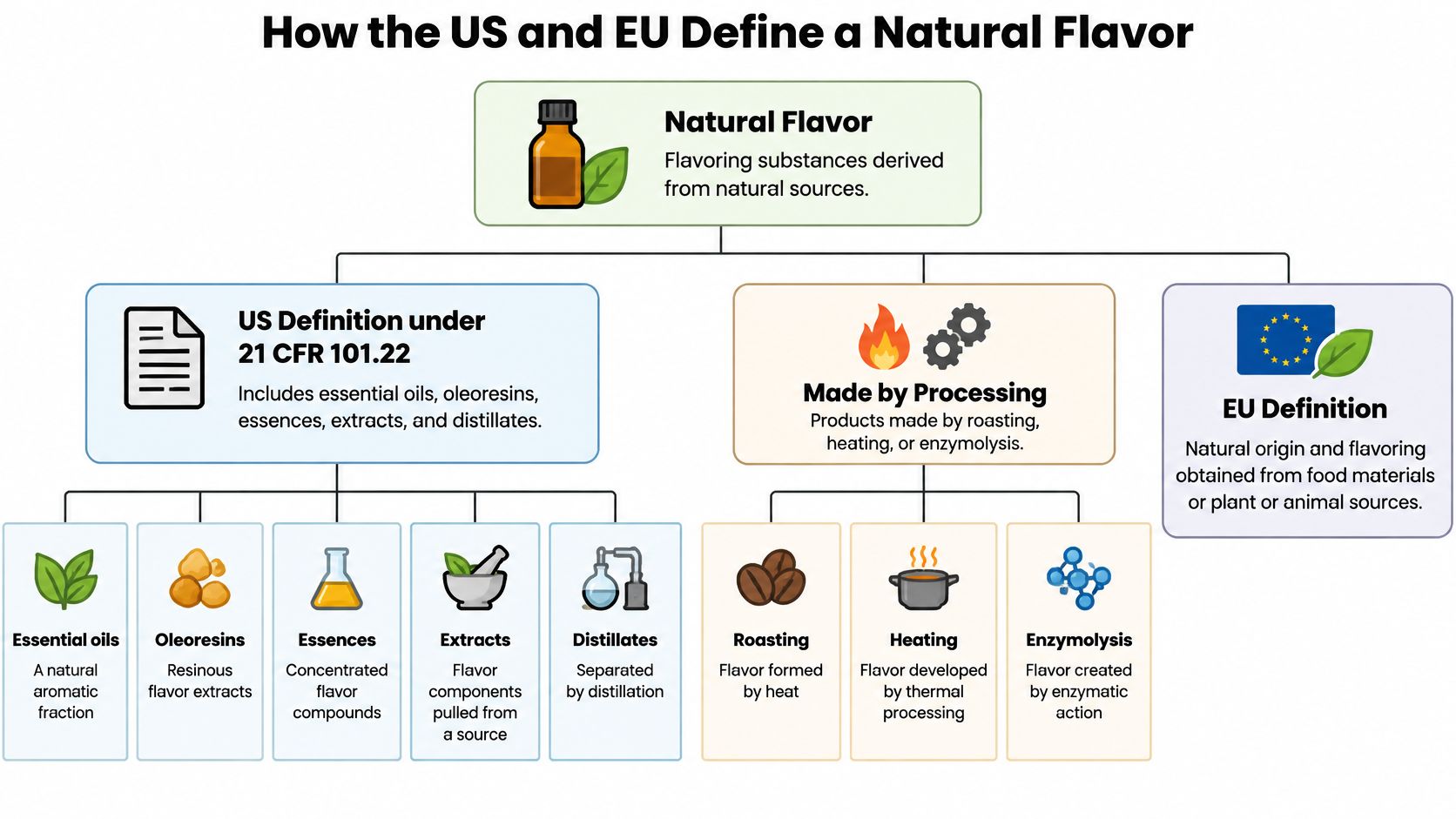
Notice what the US rule does not require. It doesn't demand that the material be whole, cold-pressed, solvent-free or minimally handled. A natural flavor preparation may come from extraction, distillation, heat treatment or enzymatic processing and still qualify, because the regulation tests source and function, not physical form. That's why an amber liquid in a sample bottle tells you nothing on its own.
The EU adds a percentage
Europe takes a different route to a similar-sounding word. The EU flavoring regulation allows a flavor to name a food, food category, vegetable or animal source only when at least 95% by weight of the flavoring component comes from that stated source. Below that line, the source name comes off the label.
Say you buy a blend that is 80% strawberry-derived material and 20% supporting notes. It can still be sold as a natural flavoring in Europe, but it can't be called natural strawberry flavoring. Your technical spec and your front label have to agree, and they only agree if the supplier gave you the percentage.
Buyer's habit: ask for the named-source percentage before artwork is approved, not after.
A four-step check for any market
- Identify the source. Name the botanical or fermentation material, not just the flavor family.
- Confirm the function. Flavoring, not nutrition, is what the definition rests on.
- Match wording to market. US and EU rules differ, and other markets differ again.
- File the basis. Record the source statement and percentage in your product file so a future label change has a paper trail.
Here's a short walkthrough of how flavor materials get classified in practice.
Review each target market separately. A claim that clears US labeling can fail European wording rules on the same SKU.
How Natural Flavor Oils Behave in Your Formula
Natural flavor oils are hydrophobic, so they won't blend into water on their own. Think of oil and vinegar in a dressing: left alone, the two phases separate, and shaking only buys you time. Formulators fix that with an emulsifier system, and the droplet size they achieve decides whether the finished product looks uniform and releases flavor evenly.
The numbers are worth knowing because they set a realistic target. One study of spontaneous emulsification reached droplets of about 200 nm using 10.0 wt% orange oil, 7.5 wt% sucrose esters and less than 1 wt% ethanol, with no high-energy homogenization. Smaller droplets generally improve dispersion, optical uniformity and flavor-release consistency, which is why that figure works as a development benchmark for beverages, concentrates and other water-based systems.
Oil identity changes the answer
Here's where buyers get burned by copy-paste formulation. In the same study, the orange-oil emulsion held physically stable for one month, while peppermint-oil emulsions destabilized quickly, with Ostwald ripening proposed as the cause. Same emulsifier concept, opposite shelf outcome. Terpene volatility, solubility and interfacial behavior shift droplet growth, so screen every oil on its own rather than transferring a ratio from one profile to another.
Practical rule: every new flavor oil earns its own stability run. Nothing carries over by assumption.
Oxidation is the second risk. Many natural flavor oils contain unsaturated terpenes and other volatile aroma compounds that react with oxygen, light and heat, and the derivatives that form change aroma intensity, introduce off-notes and shift the material's profile. A review of flavor oil stability points to the practical controls: minimize headspace oxygen, use light-protective packaging, cap thermal exposure and validate storage at realistic temperatures. The same review notes that botanical origin, climate, geography and extraction method all move an oil's chemical profile, so treat composition as variable rather than fixed and hold lot-specific identity limits.
For background on how these compounds behave in food systems generally, this explainer on terpenes in food is a useful primer before you start a development batch.
Choosing Between Natural Flavor Oils and Terpene Blends
The trade-off is straightforward. A whole natural flavor oil gives you rich, plant-like character and varies from batch to batch. A terpene blend gives you a set ratio that repeats. Neither is better in the abstract, and the decision comes down to how tightly you need two production runs to match.
Natural flavor oil versus terpene blend by formulation factor
| Factor | Natural flavor oil | Terpene blend |
|---|---|---|
| Composition | Whole oil with many compounds | Built to a set ratio of terpenes |
| Batch consistency | Varies with botanical origin and extraction | Repeatable when lot specifications are held |
| Dosing | Test loading for each oil, since the profile can shift | Start from the supplier's ratio guidance, then test |
| Sensory match | Whole-plant character, less predictable | Matches a target profile across SKUs |
| Best fit | Heritage or whole-plant character with lot testing | Repeat production and matched flavors |
| Carrier and additives | Depends on the supplier's process | Stated on the spec sheet |
Supply scale shapes that consistency question more than most buyers expect. An FAO review of the essential oils trade describes roughly 200 essential oils traded internationally, with orange oil moving at 26,000 tonnes in one recorded trade table and some specialty flower extracts at under 100 kilograms. Large-volume oils are easier to re-source and blend to spec. Scarce botanicals are not.
Dosing without guessing
Don't carry one fixed percentage across every oil. Run a small ladder instead: test the oil or blend at 0.5%, 1% and 2% of the base, log the sensory result at each step, and scale only the level that hits your target profile. That ladder replaces any number borrowed from another material.
For distillate work, the base matters. Terpenes are added to winterized distillate oils to give the product a distinct flavor, so the blend has to hold its character in that carrier rather than in a neutral diluent. Our cartridge terpenes are free from additives, VG, PG, PEG and MCT, which keeps the flavor variables down to the terpenes themselves. To go deeper on how these materials are described and specified, read this overview of botanical terpenes.
An if-then verdict
- Choose a natural flavor oil when whole-plant character is the selling point and you can commit to lot testing.
- Choose a terpene blend when the same flavor has to repeat across runs and SKUs.
- Choose a single isolate when you only need to lift one note, such as a citrus top note, without reworking the base.
Write down the target, pick the type, run the test batch, log the result. Four steps, and the fifth production run stops surprising you.
Documents and Tests to Request From Your Supplier
Marketing language doesn't transfer risk. Your own verification does. Under the eCFR text of 21 CFR 101.22, a supplier should be able to identify the botanical source and the intended flavoring function of what they sold you, rather than stopping at a product name. Ask for a specification sheet and ingredient identity, and treat a vague answer as information in itself.
Supplier documents to request for each lot
| Document | What it shows | What to ask for |
|---|---|---|
| Certificate of analysis | Identity and purity of each lot | A certificate for every lot before use |
| Botanical source statement | Plant or fermentation source of the flavoring | Named source and flavoring function |
| Named-source percentage | Share of the flavor from the named source | Percentage by weight, in writing |
| Ingredient and carrier list | Every additive and carrier in the blend | Full list with no blanks |
| Heavy metal and residual solvent results | Contaminant screening | Results per lot with the test method |
| Stability data | Behavior under heat, light and storage | Accelerated test results |
Gold Coast Terpenes states that all ingredients are lab tested, and our cartridge terpenes are SC Lab-tested, so those results are available to request rather than something you have to infer.
How to use the checklist at receiving
Match each lot against your written specification before it goes into production. Hold anything that falls outside the range, even when the drum looks and smells right. Keep the file with your batch records so a question six months from now has an answer with a date on it.
Documentation practice is covered well in this piece on why a safety data sheet matters, which pairs naturally with a lot file.
A missing document is a reason to pause the purchase, not a detail to chase after the run.
What Natural on a Label Does Not Guarantee
Natural on a label answers a sourcing question. It tells you the flavoring comes from permitted natural sources under a food-labeling rule, and as Merck's technical note on natural flavor regulations sets out, the US and EU definitions differ in both permitted sources and recognized processing methods. Safety, consistency and suitability for your process are claims the word does not make.
The misreading that causes the most damage is treating natural as a safety verdict. Food-flavor status describes an intended use, and a formula exposed to heating, concentration or inhalation sits outside that use until your own checks say otherwise. Confirm the supplier's stated limits for your product type first.
Three quieter misreadings surface in the lot file.
Natural applies to the whole bottle. The word covers the flavoring component, while the carrier beside it can hold a different status. The ingredient and carrier list settles this in one line.
Natural means entirely from the named plant. A strawberry flavor can draw on other natural sources alongside the named one. The named-source percentage shows how much of the flavor comes from that plant.
Natural means every lot is identical. Botanically sourced oils vary with the crop, so two drums of the same oil differ in composition. The per-lot certificate of analysis is where that difference shows.
Keep flavor descriptions separate from health or safety statements in sales sheets, listings and packaging copy. Our terpene statements have not been evaluated by the Food and Drug Administration, and nothing on a spec sheet should be read as a health claim.
Base the decision on lot data and intended-use limits. The word natural is the least informative line on the label.
Confirm Your Flavor Oil Before Scaling Production
Run the decision path in order rather than jumping to price per kilogram.
- Define the target as a lot specification. Write down the flavor name, the base it must work in, the intended product type, the upper loading you will allow, the sensory target and any compounds you will not accept.
- Pick the type from lot evidence. For each candidate, require the certificate of analysis for the exact lot rather than a catalog example, then match the batch code on that document to the bottle label and packing list.
- Screen candidates with retained references. Keep a sealed reference from each received lot, then record lot number, date opened, first aroma, appearance and behavior in the base before side-by-side testing.
- Run accelerated checks in the final format. Fill the same kind of cartridge, bottle or batch container you plan to sell, then watch for separation, droplet growth, aroma drift and changes after the temperature or light exposure your channel is likely to create.
- Collect the lot file and market wording. Confirm composition against your written spec, handling limits on the safety sheet, the supplier's natural-source and processing statement for each sales market, and label copy that stays free of health claims.
- Scale only when the lot matches. Quarantine any incoming lot whose code, composition or sensory result differs from the approved reference, and make the first production run from the lot that passed your checks.
Once that path is clear, choosing a flavor gets easier. Gold Coast Terpenes supplies botanically derived terpene blends, strain profiles and isolates for cartridge, distillate and formulation work, all lab tested and free of VG, PG, PEG and MCT. The range covers fruit-led profiles from blueberry, lemon and strawberry through to grape and peach, plus strains such as Blackberry Kush, Forbidden Fruit, Piña Colada, Pink Lemonade, Rainbow Sherbet and Vanilla Root Beer; curated packages fit both new developers and experienced flavorists. For volume work, use the wholesale and bulk programs through Gold Coast Terpenes to match a blend to the product.