
Buying hemp wholesale by price per unit is the wrong starting point. A cheap ingredient can cost more once you account for rejected lots, missing records, flavor drift, and production delays. Start with usable material, complete paperwork, and repeatable supply, then compare prices.
For product makers, the ingredient includes more than what's inside the container. It includes proof of identity, test results, storage instructions, and the supplier's ability to deliver the same specification again. That matters whether you're buying a hemp base or botanically derived terpenes to give a manufactured product its flavor and aroma.
Hemp Wholesale Limits Every Buyer Must Know
The 0.3% delta-9 THC figure gets repeated in every purchase negotiation and understood in almost none. Under the 2018 Farm Bill, hemp means Cannabis sativa L. and its derivatives, extracts, cannabinoids, isomers, acids, salts, and salts of isomers containing no more than 0.3% delta-9 THC on a dry-weight basis, as described in this FDA presentation.
A passing certificate covers the tested input only. Once your team blends that input with carriers, terpenes, or other actives, the finished product answers to the rules of the market where you sell it. Your quality team owns that calculation, and a supplier COA will not rescue a finished batch that fails.
THC checkpoints across a hemp wholesale purchase
| Stage | Limit or check | Who verifies it |
|---|---|---|
| Raw hemp input | 0.3% delta-9 THC on a dry-weight basis | Supplier certificate of analysis, reviewed by your quality team |
| Blended finished product | Recalculate with water removed, including excipients | Your finished-batch testing |
| Botanically derived terpene blend | THC-free; identity and contaminant data still required | Supplier lab report, reviewed by your quality team |
| Proposed total THC per final container | Proposed per-container THC limit under U.S. rulemaking | Your compliance review |
Federal rulemaking has floated a per-container THC cap for finished hemp products, and the documentation duties attached to that proposal matter when you set purchase specifications. Treat it as a regulatory watch item: check the law in force where you sell rather than building your specification around a proposed figure.
Separate origin from product approval
Our guide to what hemp-derived means covers the origin terminology in detail. Origin tells you where the molecule came from; purity, intended-use suitability, and finished-product compliance each need their own evidence.
A botanically derived, THC-free terpene blend removes one variable from your THC calculation. It adds none of the contaminant results, identity data, or origin records the hemp base still requires.
Practical rule: Calculate THC after every ingredient is added, with water removed, and keep the calculation in the batch record. Use finished-batch testing to verify the result.
Assign a named person to approve that record. Purchasing collects the evidence, formulation documents the calculation, and quality decides whether the batch ships.
Vetting a Hemp Supplier Before You Commit
Planted acreage is not available supply. USDA's National Hemp Report reported that 2024 planted hemp area reached 45,294 acres, up 64%, while harvested open-field area reached 32,694 acres, up 55%.
Those figures don't tell you how much material meets your specification. Ask for harvest completion records, crop-specific yields, usable inventory, and evidence that the supplier can reserve it for your orders. A field photo won't answer those questions.
Use this checklist during supplier qualification.
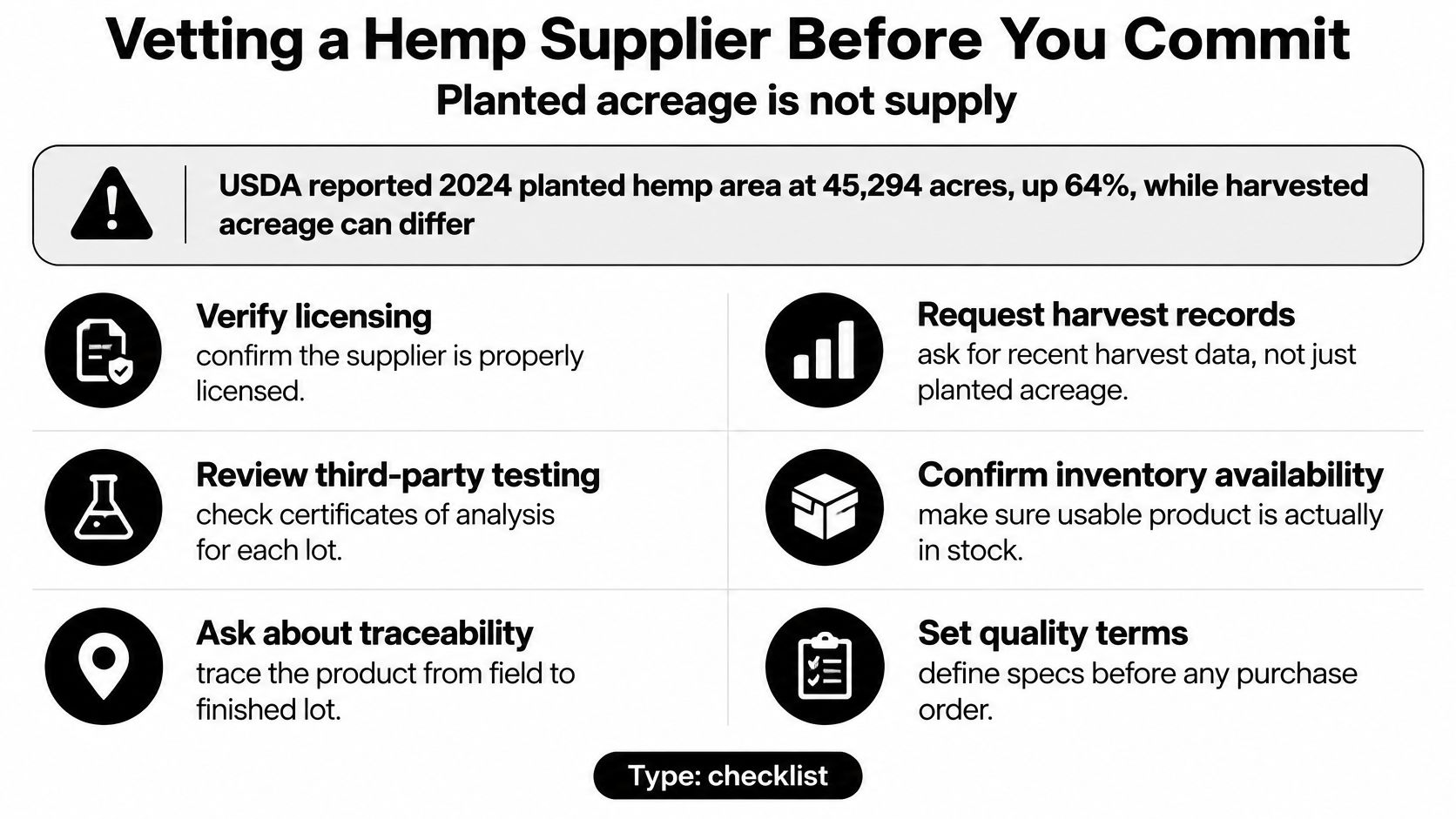
Strong answers versus weak answers
- Testing laboratory: A strong answer includes a sample certificate naming the independent laboratory, methods, and tested lot. A weak answer is an unsigned spreadsheet or a claim that everything passes.
- Origin tracing: Strong records connect the source field, processing stage, and delivered lot. A country name without supporting records is weak. Verify the supplier's applicable licence as part of this review.
- Contaminant testing: Look for pesticide, heavy-metal, and residual-solvent results with reporting limits. A potency-only certificate doesn't answer whether those contaminants were checked.
- Delivered specifications: A strong agreement states minimum delivered weight, moisture limits, acceptable cannabinoid profile, contaminant thresholds, and analytical methods. A price-only quote leaves too much unresolved.
- Inventory commitments: Ask what usable stock is available, what's reserved, and what lead time the supplier can support. Promised future harvests aren't equivalent to released inventory.
- Failed-lot terms: Require a written process for quarantine, retesting, replacement, or credit. A verbal promise to sort it out later leaves your production team carrying the risk.
We trace and track the origins of our products and test them for purity, free from pesticides, heavy metals, and solvents. For procurement, those process controls matter because your team needs evidence it can connect to the material received.
Don't qualify a terpene supplier on aroma alone. A sample may match your flavor target while its supporting records fail your receiving requirements. Conversely, excellent paperwork won't tell you whether the blend performs correctly in your base.
Request a sample certificate and a test lot before committing to bulk volume. Approve the material and its documentation together, then use that approved specification in the purchase agreement.
Documents to Require With Every Lot
| Document | What it proves | Request when |
|---|---|---|
| Certificate of analysis | Potency and contaminant results for that batch | Every lot, before payment |
| Batch or lot ID | Links each certificate to physical inventory | Every shipment |
| Cultivar or seed documentation | Variety identity and origin | Raw hemp and seed purchases |
| Chain-of-custody record | Who handled the lot and where it moved | Each transfer |
| Import licence and paperwork | Legal entry for imported raw hemp or seed | Any cross-border shipment, with requirements confirmed for the destination |
| Terpene profile lab report | Identity and composition of the blend | Every terpene lot |
| Invoice and transport record | Ties quantity and dates to the lot | Every shipment |
A certificate of analysis, or COA, isn't just a pass stamp. The Congressional Research Service describes changes broadening scrutiny beyond delta-9 THC to THCA and other THC-related compounds, including a proposed 0.4 mg combined limit per final container covering total THC and similar-effect cannabinoids. Have your compliance lead confirm effective dates and product scope before approving purchases.
For hemp inputs, request results that let your reviewer assess the relevant cannabinoid profile and contaminants together. For botanically derived terpene ingredients, request identity, composition, contaminant results, storage conditions, and intended-use information. THC-free doesn't mean compliance-ready.
Put acceptance terms in the purchase order
Write requirements that receiving staff can check:
- Certificate match: The report must name the laboratory and carry the same batch ID as the container label.
- Release criteria: Required cannabinoid and contaminant results must meet your written specification before shipment.
- Dispute process: Define who collects retest samples, which laboratory resolves disagreements, and when a failed lot earns replacement or credit.
- Supporting records: Include cultivar records for raw hemp, custody records for transfers, and shipment documents tied to the lot.
Our COA guide explains how to read the report rather than relying on a supplier's summary. Check the methods, units, reporting limits, and sample identity, not just the highlighted result.
Our terpenes for cartridges are SC Lab-tested, and our website has a Terpene Safety & Documents page. Request the terpene profile lab report for each lot you intend to dose, then connect it to your receiving and batch records.
Collect the full document set before payment, not after delivery. File it by batch ID so a reviewer can retrieve the complete history without searching email threads.
For imports, confirm the destination's requirements before dispatch. The European Commission's hemp guidance states that hemp imports require an import licence, with conditions applying to raw hemp and sowing seed. Don't assume paperwork for raw agricultural material also authorizes a finished formulation.
Where Terpenes Fit in Your Formulation
A refined base such as distillate is a blank canvas. A botanically derived terpene blend is the paint that gives the formula its flavor and aroma. You still need to know what's already on that canvas before choosing a dose.
Use the base's actual lab report to plan the build.
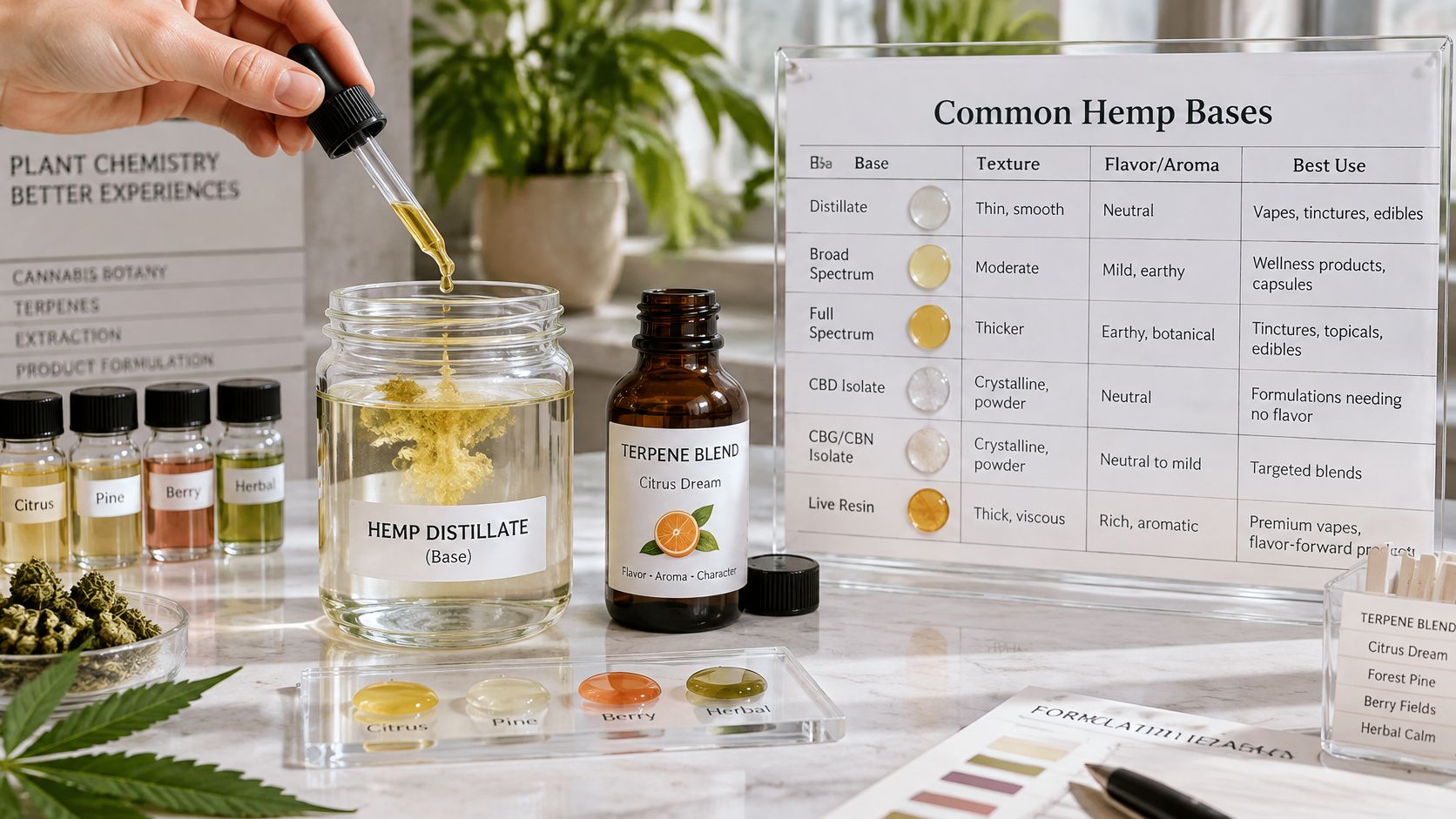
Native terpene content by base
| Base | What it means for your build |
|---|---|
| Distillate | Most of the profile must be reintroduced |
| Rosin | Keeps more native aroma, so less rebuilding is needed |
| Isolate or refined base | Confirm with your supplier's lab data before setting a dose |
These are formulation starting points, not guaranteed compositions. Say a cartridge manufacturer's lab report shows about 2% native terpenes by weight in a hypothetical distillate lot. If the target is a distinct citrus profile, the team must account for that existing aroma rather than treating the base as odorless.
Build a bench formula before scaling
- Measure the base. Review native terpene content and identify notes that could conflict with the target.
- Define the profile. Specify citrus peel, sweet citrus, or another clear flavor target instead of asking for something stronger.
- Choose the blend. Select a botanically derived, THC-free blend with supporting identity and contaminant records.
- Dose by mass. Make small test batches and record each ratio, mixing condition, and observation.
- Check performance. Evaluate uniformity, viscosity, hardware compatibility, and cartridge performance under a documented test protocol.
- Review the whole formula. Recalculate THC with water removed and verify the finished batch.
For a hypothetical 100 g finished batch at a 5% blend ratio, weigh 5 g of blend and 95 g of base. Record both lot numbers and the actual weights. Compare small trials at 4% and 6% only where supplier guidance and intended-use requirements support those trial levels, then lock the approved ratio before scaling.
Those are example calculations, not universal dosing recommendations. Our guide to how to use terpenes provides further mixing guidance.
Use the video alongside your written bench procedure.
FDA formulation guidance recommends calculating delta-9 THC with water removed, including water in excipients, and warns that an intermediate or finished product can exceed the 0.3% dry-weight threshold despite a qualifying starting material. Flavor control and compliance verification are separate jobs.
Keeping Lots Consistent Across Production Runs
A cheap lot turns expensive the day its paperwork can't support release. If a supplier can't preserve lot identity, reproduce a blend, or produce records after a regulatory change, your team ends up holding inventory it can't sell.
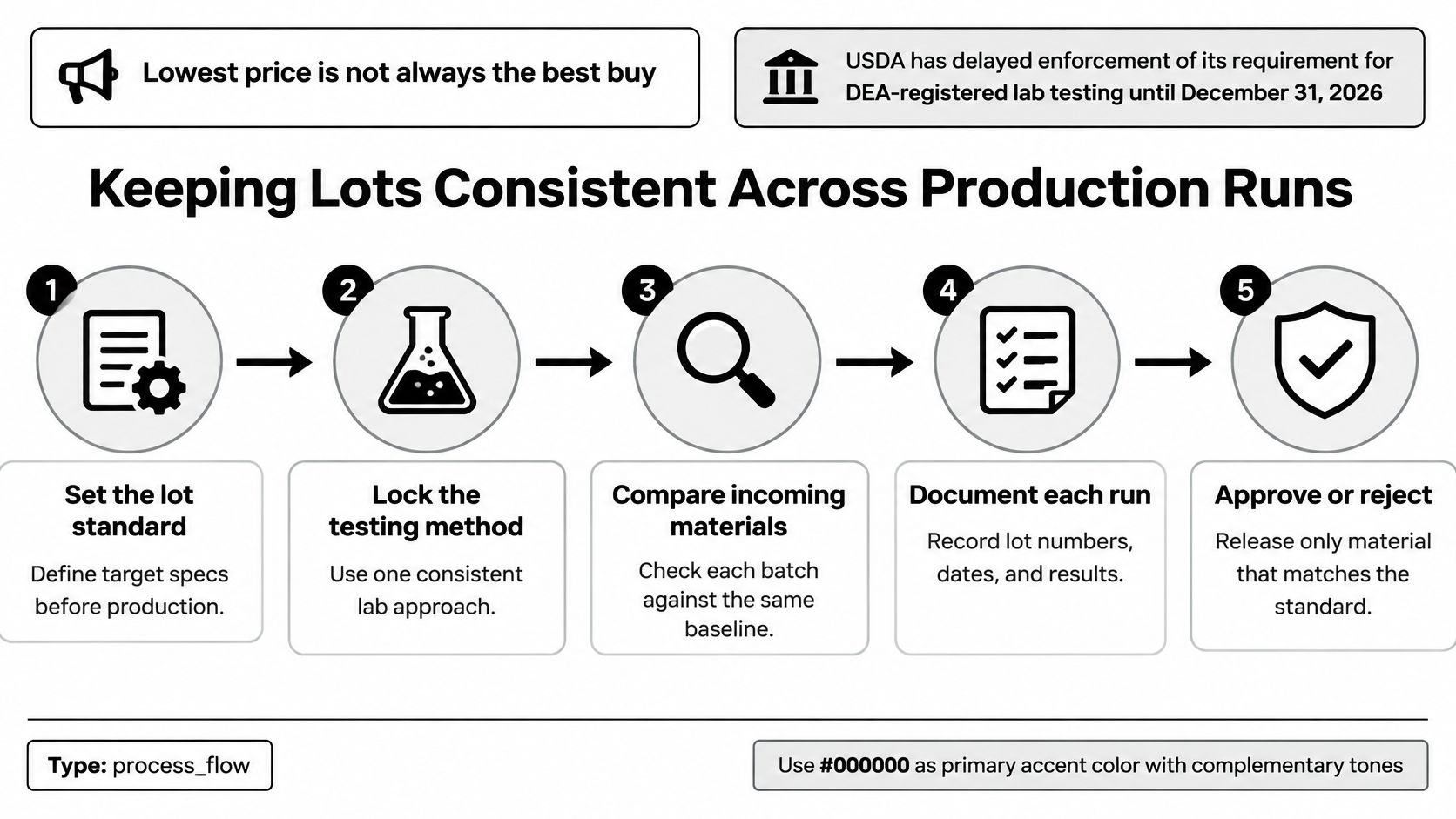
USDA's hemp rules page notes that enforcement of its DEA-registered laboratory requirement has been delayed, and its production rules already require compliant harvested lots to remain distinct, prohibit commingling, and generally require harvest within 30 days of sample collection. Those are agricultural controls sitting upstream of your finished-product quality system, and they show why source-lot records belong inside the specification.
Treat the paperwork as part of the ingredient. A lot that arrives THC-free still fails your receiving check when the certificate, lot ID, or origin trail can't be produced on request.
Run every batch through the same release process instead of relying on supplier familiarity.
Continuity scorecard for hemp wholesale suppliers
| Item | What to ask | Red flag |
|---|---|---|
| Lot traceability | Can each finished batch tie to a raw lot ID? | Lots blended together with no records |
| Dual sourcing | Is a second qualified source available for this blend? | Single source with no backup |
| Retest policy | What triggers a retest, and who pays for it? | No retest clause in the contract |
| Change-control notices | Will you notify us before origin or extraction changes? | Changes made without notice |
| Shelf-life evidence | Do you have stability data for the blend? | Verbal assurance only |
| Documentation retention | How long are lot records kept, and can we get them? | Records not kept or not shared |
A backup supplier earns its place only after qualification. A similar product name doesn't prove that another blend will match your formula, so approve the alternate through bench testing before you need it.
Release against a retained reference
For each run, match incoming containers to their certificates and record the received quantity, storage condition, and certificate date at intake. Blend to the approved formula, record actual weights, and compare the new batch's flavor and aroma with a properly stored retained reference. Complete finished-batch testing and the formula review before release.
Keep the reference sample's storage history with its record. An aged or poorly stored reference can push your team to adjust a good batch toward the wrong target.
Buying judgment: Treat any scorecard red flag as grounds to qualify a second source or change suppliers. A bulk discount cannot repair a broken chain of custody.
Our overview of quality assurance processes supports that specification-first approach. For each repeat order, confirm how long the lot can remain within spec, what changes require advance notice, and which records your team can retrieve during a recall or retailer audit.
For cartridge manufacturers, repeatable flavor is a production requirement. A supplier who can't reproduce the approved blend creates rework, even when every shipment arrives on time.
Confirm Your Supplier Before the Next Order
A supplier earns the next purchase order before your buyer negotiates it. Before you increase a hemp wholesale order, make the supplier prove that the next shipment will be usable, documented, and repeatable. A discount helps only after those conditions are met.
- Pull the current records. Collect certificates, lot identifiers, origin records, and shipment documents. Have quality review them against the purchasing specification in force today.
- Check continuity. Complete the supplier scorecard, paying close attention to traceability, retest terms, and change notices. Close gaps in writing before committing production dates.
- Approve a pilot run. Blend a first order into your intended base, then complete the finished-product calculation and testing review before scaling to volume.
Keep the purchasing decision separate from the technical approval. Your buyer can negotiate volume while formulation checks flavor and performance, but neither should override a failed quality review.
Prepare a useful bulk enquiry
Share your target volume, base type, product format, and flavor goal. Include any required lab methods, documentation needs, and formula constraints so the supplier can assess the request properly.
We run programs for Distro, Shops & Independent Reps, Affiliates, Manufacturers & Brands, and Wholesale customers. Bulk ordering lets you combine multiple strain-profile selections in one order, and wholesale pricing is available on strain orders totaling over 64 oz. Orders above $100 ship free.
If your team wants to compare profiles before committing to volume, the Coast Pack curates our most popular strains at a discounted price.
Gold Coast Terpenes supplies botanically derived, SC Lab-tested terpene blends for manufacturers that need controlled flavor and aroma in repeat production. Visit Gold Coast Terpenes to shop strain profiles and place a bulk order, or call 929-356-6086 with your target volume, base type, and product format.