
If a limonene oil batch passes its identity check, will it still deliver the same citrus note after repeated opening, warm mixing, and contact with a hot coil? That's the gap in treating terpenes as fixed flavor ingredients. Buyers need to control not just what arrives in the bottle, but what happens before the finished product leaves manufacturing.
For a formulation lead, limonene oil is a volatile citrus building block. Its value comes from a clear specification, measured loading, repeatable flavor matching, and controlled handling, not promises about effects.
What Limonene Oil Is
Limonene oil identity snapshot
| Item | What to look for |
|---|---|
| Chemical class | Monocyclic monoterpene |
| Formula | C10H16 |
| Molecular weight | About 136.23 g/mol |
| Typical peel-oil content | Up to 90–95% d-limonene |
| Dominant feedstock | Orange and other citrus peels |
| Flavor listing | FEMA 2633, flavoring agent or adjuvant |
| Workplace guide | 30 ppm as an 8-hour time-weighted average |
Limonene oil is a botanically derived, citrus-smelling monocyclic monoterpene, recovered mainly from citrus-processing residues rather than made as a wholly synthetic specialty chemical. PubChem's limonene record identifies its formula as C10H16, its molecular weight as approximately 136.23 g/mol, and citrus peel oils as commonly containing up to 90–95% d-limonene.
For receiving and production-room review, PubChem's d-limonene record lists FEMA 2633 as a flavoring-agent or adjuvant identifier and an occupational guideline of 30 ppm as an 8-hour time-weighted average. That workplace guide belongs in an exposure-control review. It isn't a finished-product formulation limit.
Check the paperwork before release
- Specify the enantiomer or grade. Name the form required by your specification, with d-limonene as the common orange-peel form.
- Require a batch-specific certificate of analysis. Match the certificate to the container's lot number.
- Keep the current SDS on file. Make it available to receiving, production, and the person responsible for workplace controls.
- Record the identifiers. Keep the FEMA number, CAS information, batch number, and intended use in the formulation file.
- Reject vague specifications. A citrus terpene label doesn't tell purchasing or quality staff enough to approve a material.
Say a delivery arrives with orange oil on the packing slip and limonene on the bottle. Don't assume those descriptions mean the same ingredient. A limonene-rich peel oil and a specified isolate aren't interchangeable just because both smell citrusy.
Juice and molasses processing leaves citrus streams from which limonene can be recovered through steam distillation or citrus-oil deterpenation. That explains its botanical supply chain, but it doesn't replace a finished ingredient specification.
Receiving approval should follow the documented material, not the aroma alone. Resolve any mismatch between the purchase order, label, and certificate before the lot reaches the bench.
Pilot Limonene Loads and Flavor Matching
Pilot limonene loads by product type
The following ranges are hypothetical bench-screening starts, not validated recipes, safety limits, or release specifications. Use them only within an intended-use assessment and a qualified development process.
| Product goal | Limonene share of terpene fraction | Total terpenes in the fill | Why this row |
|---|---|---|---|
| Light citrus accent | 5–10% | 4–6% | Tests peel aroma without making it the lead note |
| Citrus-forward cartridge | 20–35% | 5–8% | Tests orange or lemon as the lead note |
| Top note beside other botanicals | 2–5% | 5–8% | Tests brightness in a blend that already has body |
| Thicker concentrate or sauce | 5–15% | 2–4% | Tests aroma while limiting thinning; confirm texture and separation |
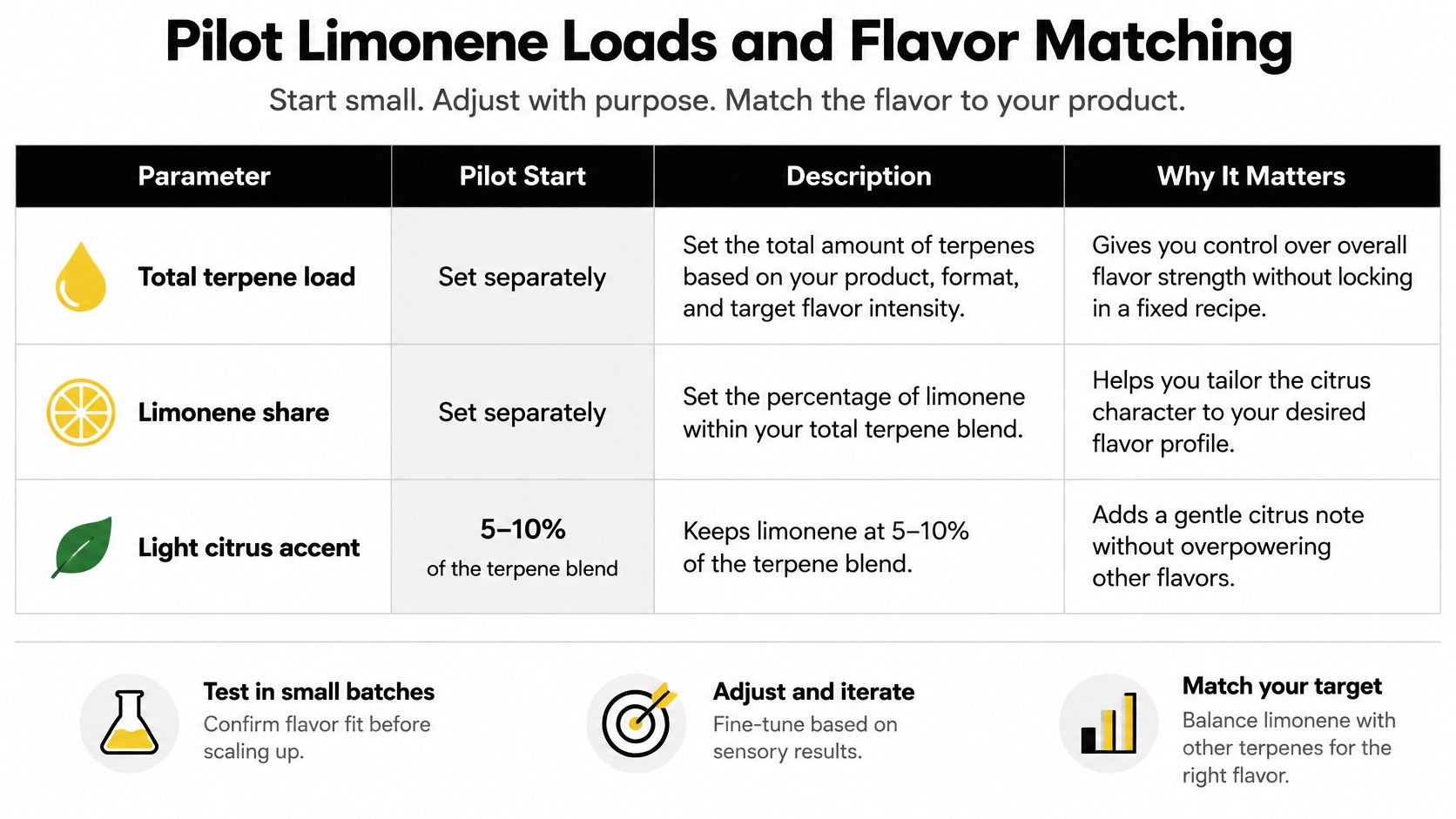
Set total terpene load and limonene share separately. Total load describes the terpene fraction in the finished fill. Limonene share describes how much of that fraction is limonene, not how much of the whole jar is limonene.
Use this chart as a visual reminder of those separate settings.
Build the pilot by mass
- Weigh the distillate or base. Use a suitable balance and record the actual mass, not an estimated volume.
- Set total terpene percent of the fill. Define the finished mass first so the denominator stays clear.
- Set limonene within that terpene fraction. Account for limonene already present in a purchased blend before adding an isolate.
- Warm the base only enough to mix. Record the actual material temperature, not just the heater setting.
- Add terpenes after any high-heat step. Keep the addition point consistent between pilots.
- Stir until clear and even. Rest the sample under a defined procedure, then fill a test cartridge for qualified evaluation.
Keep all calculations on the same basis. If your production sheet uses weight percentages, don't measure the base by weight and the terpene addition by drops. Drop size isn't a dependable dosing method.
A useful calculation is:
Limonene mass = finished fill mass × total terpene fraction × limonene share of that fraction
Write percentages as decimal fractions when using that equation. Also distinguish final fill mass from starting base mass. Adding a percentage of the base produces a different final concentration than specifying that percentage of the completed fill.
Our guide to how much terpenes to add to distillate can help organize the dosing calculation. Keep the approved manufacturing specification, rather than a general mixing guide, as the release authority.
Bench rule: Change the citrus balance without changing the total terpene load. Otherwise, you won't know which adjustment caused the difference.
Match the profile rather than chasing intensity
Make three pilots that change only the limonene share. Keep total terpene load fixed, and balance the rest of the terpene fraction consistently. Use the same base lot so a base-aroma change doesn't get mistaken for a limonene result.
Hold mixing order, rest time, temperature, and hardware constant. Label samples with blind codes where practical, then compare them against a retained flavor standard using an approved sensory procedure.
Use a short scorecard:
- Peel character. Does the sample read as fresh zest, orange rind, or an overly dominant citrus note?
- Sweetness balance. Does the citrus fit the intended profile, or does it make the blend seem less rounded?
- Harshness or off-note. Record an unwanted sensory result separately from aroma intensity. Don't treat sensory acceptance as evidence of aerosol safety.
- Physical performance. Check clarity, uniformity, texture, and separation after the defined rest period.
Keep the lowest limonene share that still gives the intended citrus identity. A stronger citrus smell isn't automatically a closer match. If the retained standard has a soft, sweet finish, an aggressive peel note can move the pilot farther away.
A chemistry perspective on limonene aroma discusses threshold information near 9 ppb for (-)-limonene and approximately 10 ppb in a food matrix. Those values help explain why small shifts can matter, but they aren't cartridge dosing targets. The carrier, other terpenes, oxidation state, and hardware change perception.
For a pink-lemonade style profile, lemon, strawberry, and sweet notes can work together. Limonene alone won't build strawberry. If the fruit body is missing, increasing limonene may only make the peel note louder.
Record the chosen pilot's complete composition, not just its limonene addition. The successful formula is the whole blend, made through a repeatable process.
Keeping Limonene Oil from Oxidizing
Documented auto-oxidation of limonene may begin after approximately 34 weeks of air exposure, even with BHT present, according to ScienceDirect's limonene toxicology overview. That finding isn't a guaranteed shelf life. It shows why an antioxidant and a room-temperature storage location don't, by themselves, establish that an opened lot remains unchanged.
Fresh limonene oil isn't chemically equivalent to material that has spent months exposed to air. Oxygen, light, and ozone can produce oxygenated derivatives, including hydroperoxides.
Use the following storage checklist to reduce unnecessary exposure.
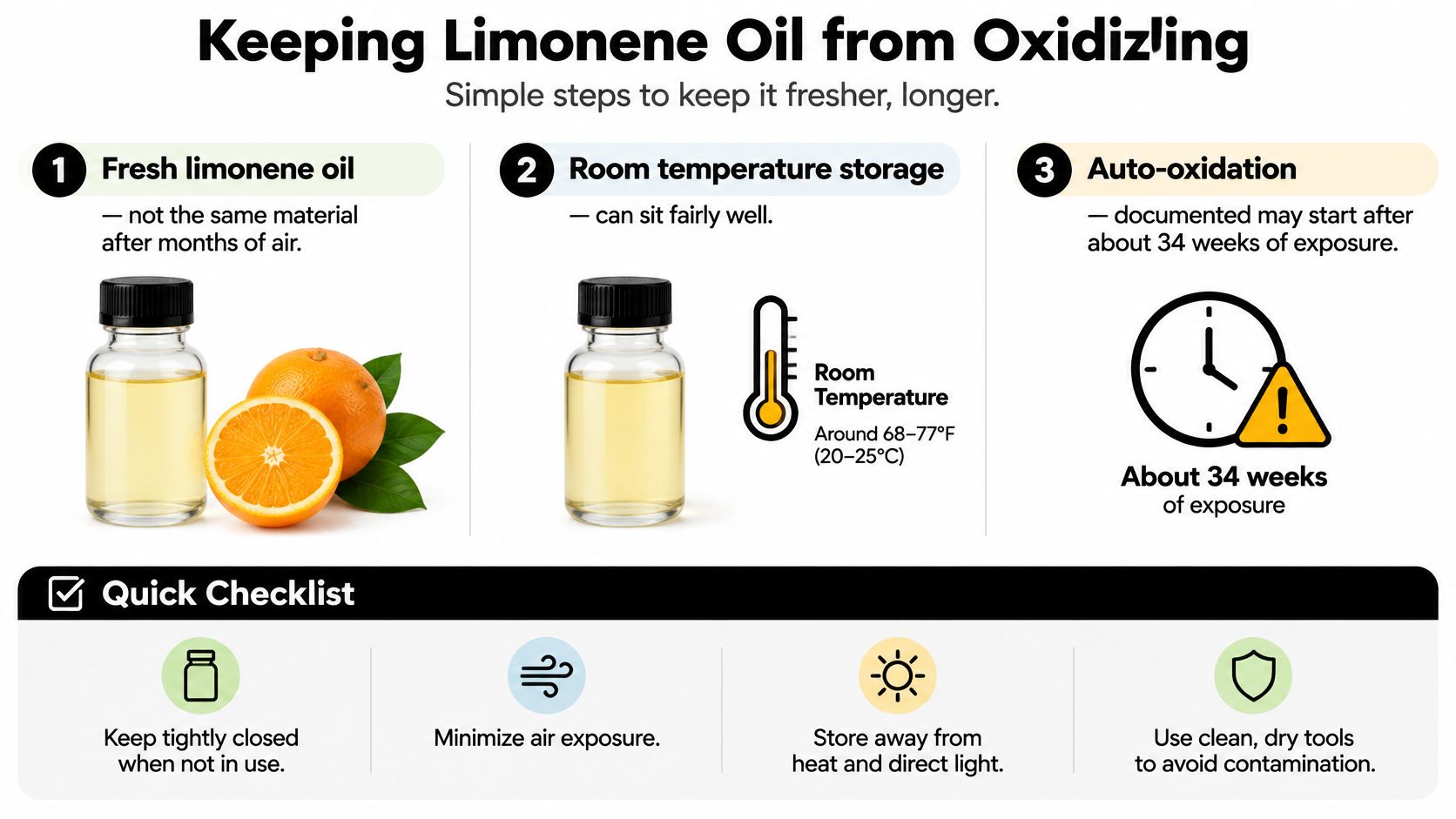
Control exposure during everyday handling
- Keep headspace small. Use an appropriately sized, compatible container instead of leaving a small remainder in a large bottle.
- Use light-blocking bottles. Keep containers away from direct light during storage and staging.
- Store cool. Follow the supplier's documented storage conditions and avoid warm equipment areas.
- Log the open date. Track first opening alongside the lot and production dates.
- Limit air during dispensing. Prepare the transfer equipment first, dispense promptly, and close the bottle.
| Stress | What can form | Control |
|---|---|---|
| Air for about 34 weeks | Auto-oxidation, even with BHT present | Minimize headspace and log the open date |
| Light | Oxygenated derivatives | Use light-resistant containers |
| Ozone | Additional oxidation products | Keep ozone sources away from storage and containers closed |
| Certificate of analysis for identity only | Doesn't prove peroxides are absent | Add peroxide or oxidation testing on aged lots |
Separate oxidation evidence from exposure claims
Limonene hydroperoxides are potent skin sensitizers. The clinical sensitization literature indexed by the EPA supports treating oxidized material differently from fresh limonene, but dermal findings don't establish a universal inhalation limit for every formula.
A certificate that confirms identity and purity doesn't necessarily answer whether oxidation products are present. For aged or poorly documented material, have quality staff define an oxidation-sensitive specification or appropriate peroxide testing. Our terpene oxidation guide provides further handling context.
Natural and pure describe origin or composition. They don't mean chemically unchanged over time.
The following video provides additional terpene-handling context.
Reject or quarantine for retesting bottles that smell unusually sharp, show signs of aging, or lack a lot date. Smell and appearance are warning screens, not analytical proof. It's also too broad to label every limonene oil hazardous regardless of its condition and use.
What Heat Does to Limonene Oil
A clean ingredient list describes what went into the bottle. It doesn't describe everything that leaves a heated process or hot coil. Temperature, residence time, repeated heating, and airflow belong in finished-product development, not just purchasing review.
The Scientific Reports discussion of monoterpene thermal behavior describes 2022 simulated-vaping work that found thermal oxidation at 100–200 °C, including testing chemicals diluted in hexane at 1:100 to 1:1000. It also reports a 2023 reaction pattern in which limonene increased between 100 and 200 °C, then declined as temperature rose further.
Those experimental conditions aren't production recipes or safe operating windows. The useful conclusion is narrower: increased heat can change the chemistry, and more heat can drive further breakdown.
Evaluate the heated output
Published terpene aerosol-emissions work identified degradation products including methacrolein, isoprene, benzene, aldehydes, and acids during heating and aerosolization. Human risk remains incompletely characterized across finished formulations, so an input certificate can't settle the emissions question.
A heater setpoint also isn't a complete record of material exposure. A large vessel may heat unevenly, while a coil can create localized conditions that differ from the surrounding liquid. Record the process conditions your equipment can control and verify.
Our guide to terpene boiling points offers useful background, but a boiling point isn't a boundary below which degradation cannot occur.
Set process timing and test the finished product
- Add limonene after high-heat distillation or filling-related steps when the process allows. Establish a documented addition point.
- Don't reheat filled cartridges to remix them. Investigate an uneven blend before filling rather than using reheating as a correction.
- Keep thermal exposure short. Avoid unnecessary hot holds and repeated warming cycles.
- Test the finished aerosol and sensory match. Evaluate the formulation in the intended hardware, not just the liquid recipe.
Release principle: A repeatable flavor result and an acceptable emissions result are separate requirements.
A lower terpene load and consistent hardware testing are reasonable development controls, but neither proves safety. Send emissions questions to a qualified laboratory using validated methods and a defined operating protocol.
Keep flavor claims tied to sensory results. If a hardware change alters the profile, don't automatically compensate by adding more limonene. Determine whether the device changed delivery or thermal behavior before reformulating.
Why Limonene Supply and Price Move
Why can the price of a citrus-scented ingredient swing so sharply? Much commercial limonene comes from citrus processing, so orange crops and juice output affect supply alongside demand from flavor, fragrance, and cleaning-product manufacturers.
A 2023 Green Chemistry review reported that limonene prices rose 406% during 2007–2017, from approximately $1.40 per kilogram to $7.09 per kilogram. The review also reported average orange-oil supply of about 57,000 tonnes annually over a 14-year period and an estimated 9,000-tonne shortage in the 2016–2017 season, linked to citrus greening disease and reduced Florida oil production. These historical figures show sourcing exposure, not a current quotation.
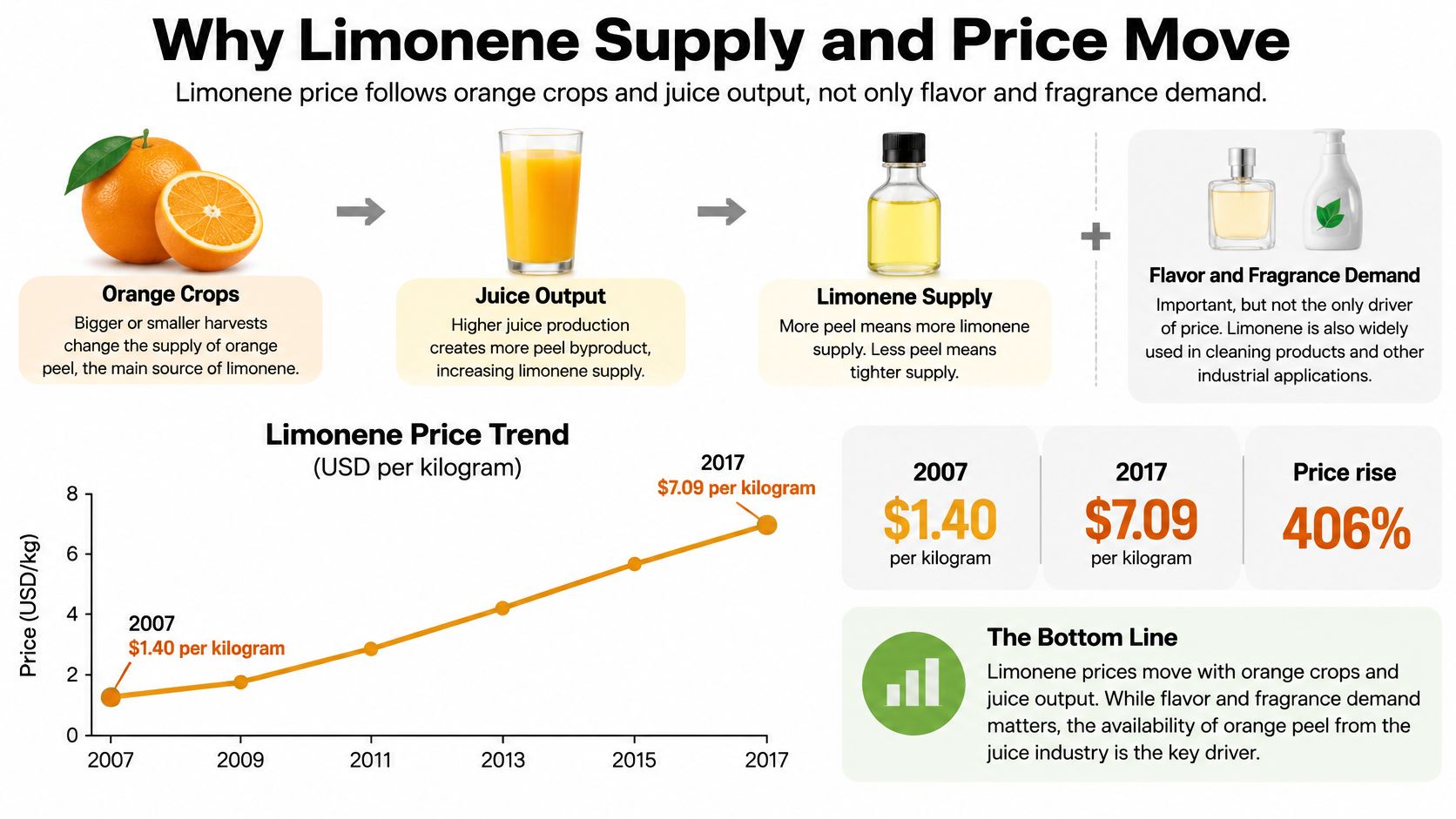
Reported global supply totals vary because sources may count orange oil and other limonene-rich fractions differently. Compare like with like: check what each figure includes before using it to assess availability.
Buy against a specification, not a cheap season
A low quote helps only if the material fits the approved product and process. A substitute that triggers another flavor-matching campaign or delays a run can cost more than its price suggests.
Use this buying checklist:
- Name the botanical material. Request botanically derived limonene with the required enantiomer or grade specified.
- Collect current documents. Obtain the SDS and a batch certificate of analysis for each lot.
- Confirm intended use and carrier status. Check that a substitution will not introduce an unwanted carrier into the formulation.
- Qualify backup supply early. Assess a second source before a large run, rather than after the primary lot becomes unavailable.
- Protect each received lot. Keep documented storage conditions and opening records.
Make substitutions a controlled decision
If a replacement has a similar limonene assay but different supporting documentation, do not approve it on assay alone. Compare its named grade, intended-use information, analytical scope, and sensory result before accepting the change.
Keep the quoted specification with the price. That way, a reorder can be checked against the same material requirements rather than relying on a broad product description.
- Formulation leads: Keep an approved reference and a clear acceptance procedure.
- Quality teams: Define which document or analytical changes trigger review.
- Purchasing teams: Compare the cost of qualified supply, not bottle price alone.
Citrus-driven supply swings call for qualified alternatives and consistent specifications. Buying extra without a realistic consumption and storage plan can leave inventory that needs retesting before production.
Request Samples Before You Scale a Batch
A sample is a manufacturing decision tool. It lets your team check whether a botanically derived ingredient matches the target before purchasing commits to bulk supply or packaging locks the SKU.
At Gold Coast Terpenes, we supply botanically derived limonene isolates and terpene blends for formulators making cartridges, concentrates, and other products. Our popular isolates include Alpha Pinene, Beta Caryophyllene, Limonene, Linalool, Myrcene, and Terpinolene. The Pioneer Pack includes a bottle of each of those isolates for controlled comparison work.
Our terpenes are extracted from fresh plants and sold without added mixtures, chemicals, or additives. Limonene itself is a chemical compound, so that description concerns added materials, not an absence of chemistry. Our terpenes are botanically derived and are never sold as cannabis-derived terpenes.
Give the sample a defined acceptance test
Before ordering, write down the profile you're trying to match and the records quality staff need to approve it. A useful sample request names the base, product format, intended aroma, and whether you're evaluating an isolate or a complete blend.
Then follow a short qualification sequence:
- Request a limonene or blend sample. Use our terpene sample information to plan the evaluation.
- Run the three-pilot aroma comparison. Judge each candidate against your retained standard through the approved test procedure.
- Review the documents. Check the certificate of analysis, SDS, and carrier status against the formulation file.
- Request bulk or custom pricing for the matched material. Identify the sample lot and composition so the quotation covers what your team approved.
Connect approval to the purchase order
Keep the sample record with the purchasing specification. Include the selected composition, process conditions, hardware used for evaluation, and acceptance notes. That gives production a defined target instead of a comment that the sample smelled good.
Don't lock a SKU while the ingredient choice is still provisional. Shop blends, request samples, or contact our team about bulk and custom orders while there's still room to adjust the formula. Make the sample request the next action, then price the material that matched.
Gold Coast Terpenes offers botanically derived limonene and terpene blends for measured citrus flavor development. Visit Gold Coast Terpenes to shop blends, request samples for your pilot series, or contact our team for bulk and custom pricing before scaling your batch.