
A 2024 analysis of 19 dried cannabis flower samples recorded selina-3,7(11)-diene at 24.38% of the highest sample's profile, while limonene reached 21.45% in another (Journal of Cannabis Research). Two flowers, two totally different dominant compounds, and neither number tells you much about what belongs in a cartridge.
That gap is where product work lives. A blend you approve in January has to taste the same in June, pass a lab test, and behave the same way inside the hardware you ship. Aromas that sound alike on a marketing sheet are different molecules with different boiling points, different persistence, and different paperwork.
This cannabis terpenes guide is written for the people doing that work: formulators blending into winterized distillate, cartridge brands approving a lot, buyers who need to know what a supplier's certificate covers. Every choice here comes back to three things you can measure and document: dose, test method, and record.
Common Cannabis Terpenes and Why Small Fractions Matter
Terpenes are the small organic molecules that carry a plant's smell. Botanically derived terpenes sold to manufacturers are the same class of molecule, extracted from plant material and blended to a target ratio, so the chemistry that governs a living plant also governs a batch of oil.
The list is long. A peer-reviewed review published in 2020 reported more than 200 volatile compounds identified across cannabis genotypes, including 58 monoterpenes and 38 sesquiterpenes (Molecules review of cannabis terpene chemistry). The seven names below cover most of what buyers ask about, but they're a starting vocabulary, not the full inventory.
| Terpene | Class | Typical aroma | Blending use |
|---|---|---|---|
| Limonene | Monoterpene | Citrus | Bright top note; high average level in commercial samples |
| Myrcene | Monoterpene | Earthy, herbal | Base note; high average level in commercial samples |
| Alpha-Pinene | Monoterpene | Pine | Fresh, sharp top note |
| Linalool | Monoterpene | Floral, lavender-like | Soft floral layer |
| Beta-Caryophyllene | Sesquiterpene | Peppery, spicy | Warm spice note; high average level in commercial samples |
| Terpinolene | Monoterpene | Fresh, piney, floral | Lively top note; defines its own chemotype when it leads, a minor share otherwise |
| Alpha-Humulene | Sesquiterpene | Woody, hoppy | Dry, woody accent; sits below beta-caryophyllene in most profiles |
Monoterpenes lift first, sesquiterpenes hang around
Monoterpenes are lighter and more volatile: limonene, beta-myrcene, alpha-pinene, linalool. They open a product and they leave it first. A cart that smelled sharp at fill can smell flat after a few weeks on a warm shelf, and the label percentage won't tell you it happened.
Sesquiterpenes are heavier: beta-caryophyllene, caryophyllene oxide, beta-farnesene and their relatives. They carry the base notes and hold up better through processing and storage.
Think of a spice rack. A pinch of black pepper changes a whole dish even though it weighs almost nothing, and no cook swaps a spoon of cinnamon for it just because both are brown powders. Terpene blends work the same way. Different molecules bring different volatility, aroma character and persistence, so one profile is never a straight substitute for another that reads similarly on a flavor sheet.
The industry already has a rough sorting system. One classification grouped profiles into five families: beta-myrcene dominant, alpha- and beta-pinene dominant, beta-caryophyllene plus limonene, beta-caryophyllene alone, and terpinolene (Molecules review of cannabis terpene chemistry). That's a more useful internal shorthand than indica, sativa or hybrid, because each group has an analytical target you can hit.
The percentages are smaller than most buyers expect
Most commercial terpene loads are tiny. A U.S. commercial-cannabis analysis found myrcene, beta-caryophyllene and limonene at the highest average levels, while individual compounds were rarely above 0.5% by weight and most occurred below 0.2% in the majority of samples (bioRxiv analysis of cannabis terpene and cannabinoid variation). Separate testing of 33 chemovars from five licensed producers detected 67 terpenes, 29 monoterpenes and 38 sesquiterpenes, with monoterpenes holding 87.1% to 99.5% of each profile.
That is why small formulation moves are loud. A shift of two or three tenths of a percent changes what a customer smells, while the total weight of terpenes in the batch barely moves at all. It also means your dosing scale and your mixing record matter as much as your flavor brief.
Buying rule: ask for the profile as a percentage range for every component, plus the analytical method used. A strain name and a total terpene number is not a specification.
Matching Aroma and Flavor to Your Product
Write the brief in words a sensory panel can score. "Bright citrus with a peppery finish and a soft green edge" gives you something to test. "Blue Dream" doesn't, because two lots sold under that name can carry very different percentages of the same molecules.
Map the brief to three roles:
- Lead note: limonene for citrus, terpinolene for a piney, floral lift. The lead is what a customer smells first.
- Body note: beta-myrcene for the earthy, herbal middle that holds the profile together.
- Accent: beta-caryophyllene for warm spice, alpha-humulene for a dry, hoppy edge, alpha-pinene or beta-pinene for sharpness. Beta pinene accounts for the familiar odor of cannabis, often associated with pine trees and turpentine, and alpha humulene contributes the hoppy aroma.
Isolates or a full blend? Isolates give you precise control over one note and suit flavor development, where you're chasing a specific citrus or pepper character. A finished blend saves bench time when the product needs a recognizable, repeatable profile instead of a new one. Either way, our terpene flavor chart maps each profile by dominant notes so you can pick a starting point for the lead, body and accent roles.
Run three trials on one day
Make three small blends with different lead notes, keeping the body and accent constant so the comparison means something. Label each with its exact ratio by weight or volume, using the same units across all three.
Score them side by side, same day, same panel, same order of presentation. Palates drift across a week, and a blend that wins on Friday can lose on Tuesday for reasons that have nothing to do with chemistry.
Then repeat the test in the oil. Terpenes are added to winterized distillate to add a distinct flavor to the product, and a blend that reads well neat can flatten or turn harsh once it's diluted into cannabinoids. The mixed product is what your buyer sells, so the mixed product is what gets approved.
A profile is final only when the blended trial matches the written brief. Until then, it's a candidate.
Compliance Limits by Market for Terpene Blends
Rules differ by state, and a load that's fine in one market can be a failed batch in another. Keep the market rules beside the batch record.
| Market | Rule for terpenes | What to confirm |
|---|---|---|
| New York | Total terpenes no more than 10% for vaporized or inhaled products, with +15% lab variance (11.5% upper reported value) | Calculated finished-oil percentage, batch formula and COA listing each terpene |
| California | Artificial or synthetic terpenes excluded; flavors or terpenes must contribute to natural flavor or aroma | Botanically derived identity and a documented reason for the intended profile |
| Nevada | Natural declaration required, with acetone, toluene and methanol confirmed as not added; terpene content capped under the state's inhalation framework | Standard operating procedure with ingredient ranges and COA covering solvents, heavy metals and pesticides |
New York requires terpene testing on final products and caps total terpenes at no more than 10% for vaporized or inhaled products, with a permitted plus-15% laboratory variance that produces an upper reported value of 11.5% (New York OCM testing limits). Leave real margin below that ceiling, because the reported lab figure is the one that gets judged, not the one you calculated at the bench.
California takes a different angle. Its inhaled-products guidance limits ingredients to cannabis, cannabis concentrate, terpenes, specified pre-roll materials and FDA-listed inactive ingredients permitted for inhalation, and it excludes artificial or synthetic terpenes. Flavorings or terpenes that don't contribute to cannabis's natural flavor or aroma aren't permitted (California inhaled cannabis products guidance). That makes sourcing part of compliance: your blend needs a documented botanical identity and a defensible reason for the profile.
Nevada carries the heaviest paper trail. Suppliers of botanical terpene products for cannabis manufacturing must provide a natural declaration, confirmation that acetone, toluene and methanol aren't added, the extraction solvents used, and a standard operating procedure listing every ingredient with its percentage range. A lab certificate covering solvents, heavy metals and pesticides comes with it.
Keep a rules sheet for each target market, update it when the regulator publishes new guidance, and match every finished batch to the most restrictive rule that applies to it. Our page on whether terpenes are legal covers the market-by-market picture.
How to Dose and Mix Terpenes into Distillate
Terpene load is a formulation variable, not a flavor knob you turn at the end. It changes viscosity, fill behavior, leak risk and how the aerosol tastes on the device you ship.
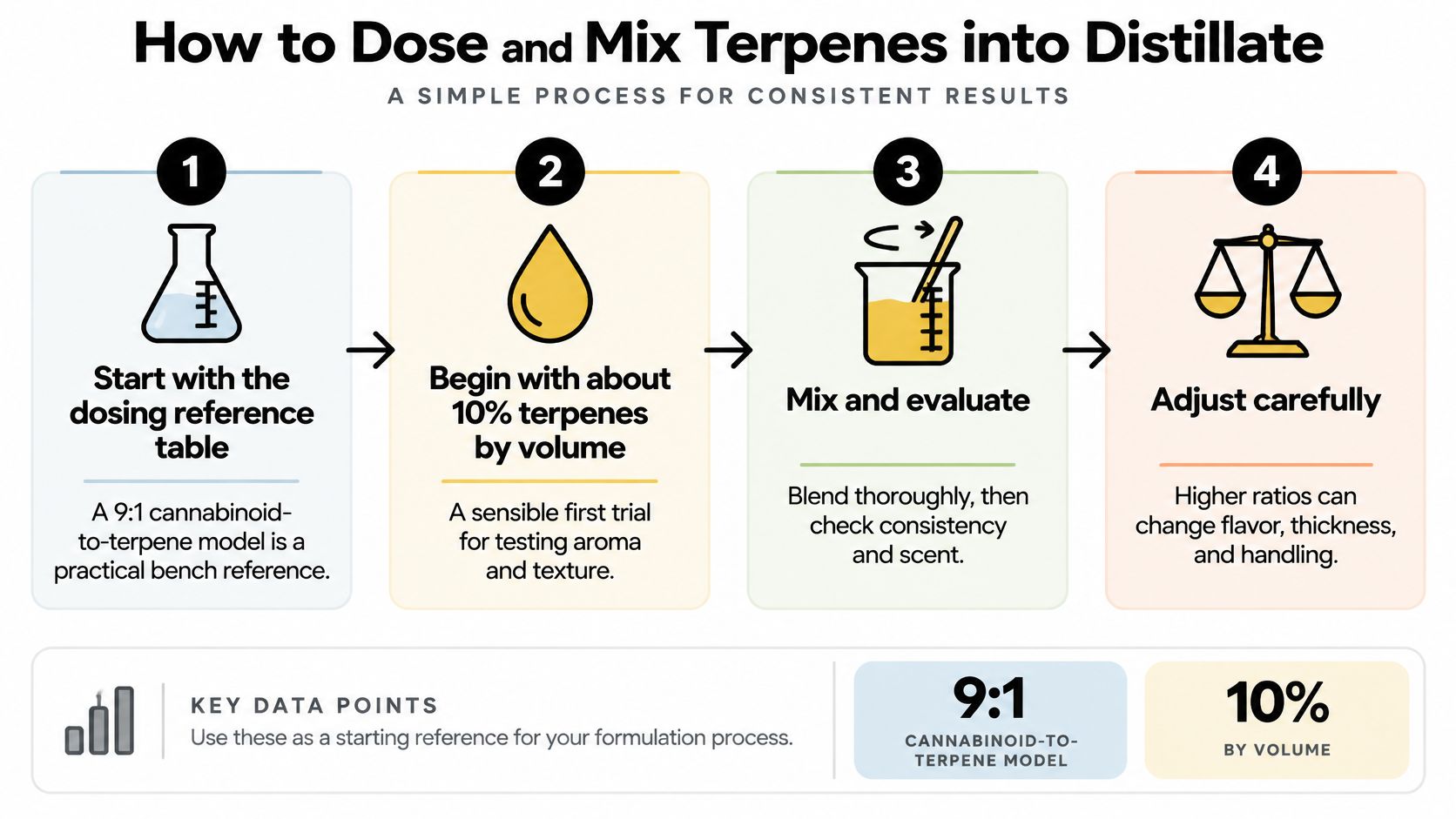
A peer-reviewed vaping-chemistry study used a 9:1 cannabinoid-concentrate-to-terpene ratio as a practical model: fluid enough to vaporize, not so thin that it leaked from a cartridge. The same work found that higher terpene ratios can make concentrate too fluid for reliable hardware performance (vaping chemistry study of terpene ratios). Start bench trials around 10% terpenes by volume, then walk downward and test what each step does.
| Starting point | Cannabinoid to terpene ratio | Terpene load | What to test |
|---|---|---|---|
| Bench trial start | 9:1 | About 10% by volume | Viscosity, fill accuracy, leakage, flavor strength |
| Lower load trial | About 19:1 | Below 10% | Flavor strength against fluidity and fill accuracy |
| Higher load trial | About 4:1 | Above 10% | Risk of a mix too fluid for cartridge hardware |
Mixing steps that hold up on a production floor
- Weigh the distillate base and record the weight. The percentage comes off the scale, not off the bucket label. The common slip is using a nominal fill weight and then wondering why two batches test differently.
- Calculate the terpene amount from your target percentage. Working by weight is cleaner than by volume for record keeping. Write both the target and the calculated grams into the batch sheet before anything is poured.
- Add terpenes slowly into warm, fluid oil. A thin stream with steady stirring disperses better than a single dump, which can shock the blend and leave streaks. Keep the heat modest, since volatile monoterpenes leave early.
- Mix until the blend is uniform. Low shear, no aeration, and enough time that no visible streaks remain. Over-mixing whips in air and makes fill volumes drift.
- Let it rest, then check viscosity and flavor against the trial sample. Numbers matching doesn't mean the product matches. This is the step people skip when the line is behind.
- Record the final formula, lot numbers and calculated percentage. Every market that tests inhaled products will ask for this, and your own next batch depends on it.
The arithmetic trips up more people than the chemistry does. Our walkthrough on how much terpenes to add to distillate covers the weight-based calculation and the units mix-up that causes most over-dosing.
What a good result looks like
A fluid, even oil that reads the same as the bench trial and fills the cartridge consistently, with no seam leaks after a day of settling. If the oil is thinner than the trial, you're above target load. If the flavor fades but the viscosity is right, the profile needs a heavier sesquiterpene base rather than more total terpenes.
Scale-up rule: bench ratios only transfer if the mixing order, temperature and rest time transfer with them.
Lot Testing and Safe Storage for Terpene Blends
Terpenes are volatile, and volatile compounds change. A percentage on a supplier certificate describes the drum you received, not the oil in a cartridge three months later, so testing has to follow the material through the process.
The lot check runs in a fixed order:
- Define a fingerprint before the next purchase. Use GC-MS or GC-FID, list the main components, and set acceptable ranges for each. That fingerprint is the document you buy against.
- Compare every incoming lot to it. Nothing gets released to production until the numbers land inside the ranges.
- Test the finished blend, not only the ingredients. The mixed oil is the product.
- Run accelerated storage on the compounds most likely to oxidize. Limonene and other monoterpenes are the early warnings.
- Tie lot records to each production batch. When a customer complaint arrives, you want to trace it to a drum, not a quarter.
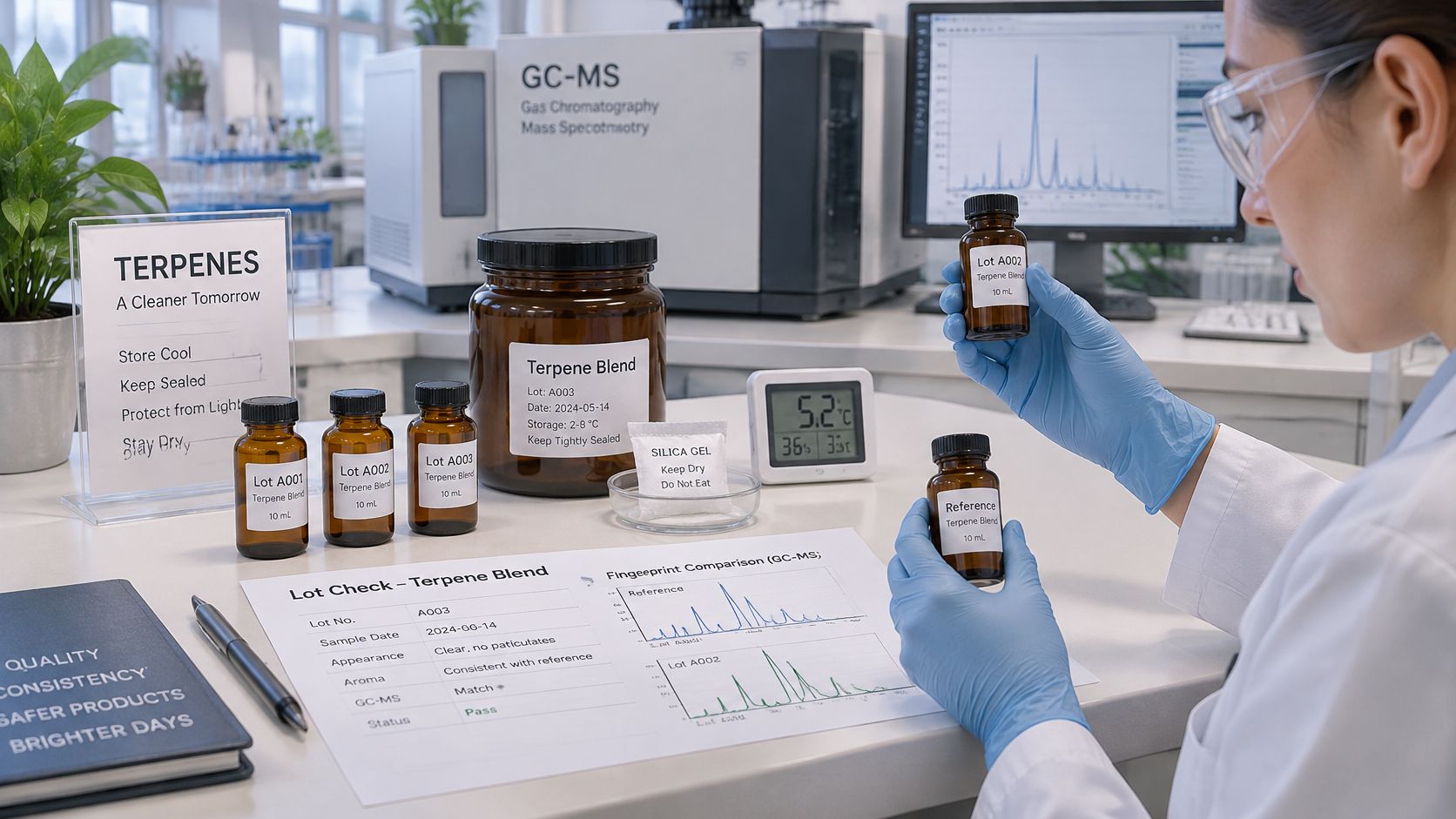
The methods exist and they validate. A GC-MS method for ten major cannabis terpenes reported limits of detection and quantification of 0.25 and 0.75 µg/mL, with average recovery of 95.0% to 105.7% for most analytes (GC-MS method validation for cannabis terpenes). At that resolution you can tell a real formula drift from lab noise.
Heat changes the answer
Chemistry moves during use, not just during storage. A study using nuclear magnetic resonance on terpene and diluent vaping ingredients observed chemical transformation under ex vivo vaping conditions, including in a 97:3 mixture (ACS Analytical Chemistry study of vaping ingredients). A pre-vape certificate doesn't describe the aerosol a customer inhales.
So test the finished blend at the heating conditions of the hardware you plan to sell: same cartridge, same oil viscosity, same fill level, same battery settings. Screen neat ingredients and finished formulations. The cartridge terpenes we supply are SC Lab-tested, and we still expect buyers to run their own finished-product check.
Store stock sealed, cool and dark, with minimal headspace, and skip any heating step that isn't required for mixing. Our third-party lab testing page explains what a usable certificate covers.
What to ask for: the most recent certificate of analysis whose lot number matches the drum in front of you.
Request Documents and a Sample Before You Buy
Approve a blend only after its documents and a sample pass your own trial. Nevada's Cannabis Compliance Board shows what a complete package looks like for botanical terpene products: a natural-declaration statement, confirmation that acetone, toluene and methanol aren't added, the extraction solvents used during production, a standard operating procedure showing every ingredient and its percentage range, and a lab certificate of analysis covering solvents, heavy metals and pesticides (Nevada CCB terpene guidance). That same guidance restricts terpene content to no more than 10% of the final product under the cited inhalation framework.
Your checklist for any supplier: the current COA for the specific lot, a complete ingredient list, the SOP with ingredient ranges, and a route-of-administration statement for your product type. Confirm the certificate identifies individual terpene components, because your finished-product lab has to test the final formula, not just the incoming blend.
Then run the sequence:
- Request a sample of the exact blend you plan to use.
- Trial it at the starting load, then step down and compare.
- Check the documents against each target market's rules.
- Calculate batch amounts from the weighed distillate base and record the formula.
- Send your results to our team and ask for a bulk or custom quote.
Our Terpene Safety & Documents page keeps the paperwork side in one place, and the Mixing Calculator sizes a batch from your base weight before you commit to a drum.
Gold Coast Terpenes supplies 100% natural, botanically derived blends and isolates, with more than 50 strain profiles plus single compounds like limonene, myrcene and beta-caryophyllene, all SC Lab-tested and THC-free. Use the Mixing Calculator to size a batch from your weighed distillate base, then request a sample of the profile you want to trial before you commit to a drum. Visit Gold Coast Terpenes to shop blends, compare isolates, or ask about bulk and custom orders.