
Linalool is a monoterpene alcohol with the formula C10H18O, a molecular weight of 154.25 g/mol and a boiling point near 198 °C, and the drum you buy for production is a clear floral liquid derived from plants, not from cannabis flower. In a manufactured flavor profile it's one named peak you add by weight, often as a supporting note rather than the lead.
The advice I'd retire first is the line that linalool is the calming terpene. Nothing on a certificate of analysis supports a mood claim, and that framing hides the two things that move a batch. Lots at the same stated percentage smell different, and the floral note you paid for can leave the tank before the cart is filled.
Search results call it the linalool terpene and stop at lavender. A production team needs the other version: identity numbers, the split between the two mirror-image forms, an addition rate, and a storage rule. That's what follows, in the order you meet it.
What Linalool Terpene Is on a Spec Sheet
Picture a new buyer setting linalool up in the purchasing system. The spec line has to be boring and exact.
Linalool is a monoterpene alcohol with the formula C10H18O and a molecular weight of 154.25 g/mol. It carries CAS 78-70-6 and FEMA No. 2635, and the FDA food-substance listing for linalool gives its technical function as "flavoring agent or adjuvant," with a reference to 21 CFR 182.60. Those identifiers plus the function statement are what you hand a quality team and a new supplier so nobody has to argue about what the drum contains.
Our linalool is botanically derived, extracted from fresh plants, and it is not a cannabis-derived terpene. Nothing in the bottle came from a cannabis plant. That detail matters when a finished product crosses a state line or a customs point.
What it smells like matters too. Soft floral first, then a light woody edge, sometimes a green or citrus lift. The closest everyday reference is lavender soap, not pine or fuel. In a finished profile it usually works as one named peak that softens a loud fruit or citrus top note instead of carrying the whole flavor.
A buyer who only knows the plant name will guess wrong on strength, because the same compound appears in source oils at very different percentages. That's why the plant word on a quote tells you nothing about how much to add.
A pleasant smell is not a health claim, and no aroma component earns one by being floral.
Spec-sheet check: if the quote doesn't state botanical source, percent linalool, and lot number, it's a price, not a specification.
Linalool Numbers Buyers Should Match
Start with identity, because a quote without it is a guess. The PubChem record for linalool gives a naturally occurring monoterpene alcohol with the formula C10H18O, a molecular weight of 154.25 g/mol and a boiling point of about 198 °C at standard atmospheric pressure, and it notes the compound has been identified in more than 200 essential oils from herbs, leaves, flowers and wood. Those numbers belong on the same page your lab and your filling line both read.
| Item | Value | What to do with it |
|---|---|---|
| Formula and weight | C10H18O, 154.25 g/mol | Confirm identity on the COA |
| CAS and FEMA | 78-70-6, FEMA 2635 | Match purchasing records |
| Boiling point | About 198-199 °C | Plan GC methods and heat limits |
| Density at 20 °C | About 0.8622 g/cm³ | Convert a volume add into weight |
| Refractive index | 1.4615 at 20 °C | Use beside GC as a quick identity check |
| Flash point | About 76 °C closed cup | Store and ship as a flammable liquid |
| Vapor pressure | 0.16-0.17 mmHg at 25 °C | Keep mixes covered to limit aroma loss |
| Water solubility | About 854-1,589 mg/L | Water products need a solubilizer |
| Log Kow | Near 2.97 | Expect oil preference; still mix-test distillate |
| Oils above 10% | More than 10% in 54 essential oils | Source range, not a cart load |
| Lavender oil | About 25% to 45% linalool | Source-oil range, not a cart load |
| Thyme oil | About 73% to 79% linalool | High-linalool chemotype to compare |
| Rosewood oil | About 82% to 90% linalool | Shows why origin changes strength |
What each handling constant decides
Read the top half of that table as the shared language between production and the lab.
- Boiling point: it sets the GC oven program and tells you how much heat the blend tolerates before the light ends walk off.
- Density: weigh the addition. A volume pour assumes a density you didn't measure, and a percent by weight is the only figure that survives a scale-up.
- Refractive index: a fast identity check beside the chromatogram. If the index is off, stop before you blend.
- Flash point: this is a storage and shipping classification, not a heat tolerance.
- Vapor pressure: it explains tank loss. Covers, short hold times, and sealed transfers protect the top note.
- Water solubility and log Kow: a water-based product needs a validated solubilization system, and an oil base still needs a compatibility test rather than an assumption of uniformity.
Why source-oil percentages don't transfer into a cart
The broader PubChem entry on linalool shows the size of the spread. Linalool represents more than 10% of the molecules in 54 different essential oils, and reported concentrations include 13.2% in Plumeria alba leaf oil and 7.9% in its flower oil. A lavender drum and a rosewood drum are not interchangeable inputs, even when both say linalool on the label.
None of those percentages describe the load in a cartridge. They describe a raw botanical, and they move with species, chemotype, harvest and extraction method. That's why you specify botanical origin, extraction route, and a lot-specific COA before you approve a supplier, then compare the actual assay against the number you wrote on the spec.
How the Two Forms Change the Smell
Two drums both read 100% linalool. One smells like sweet floral soap. The other smells sharper, greener, almost cooling. Same compound, same stated percentage, two different noses.
The difference is molecular shape, and a side-by-side sniff of the two isolates settles the question before anyone blames the supplier.
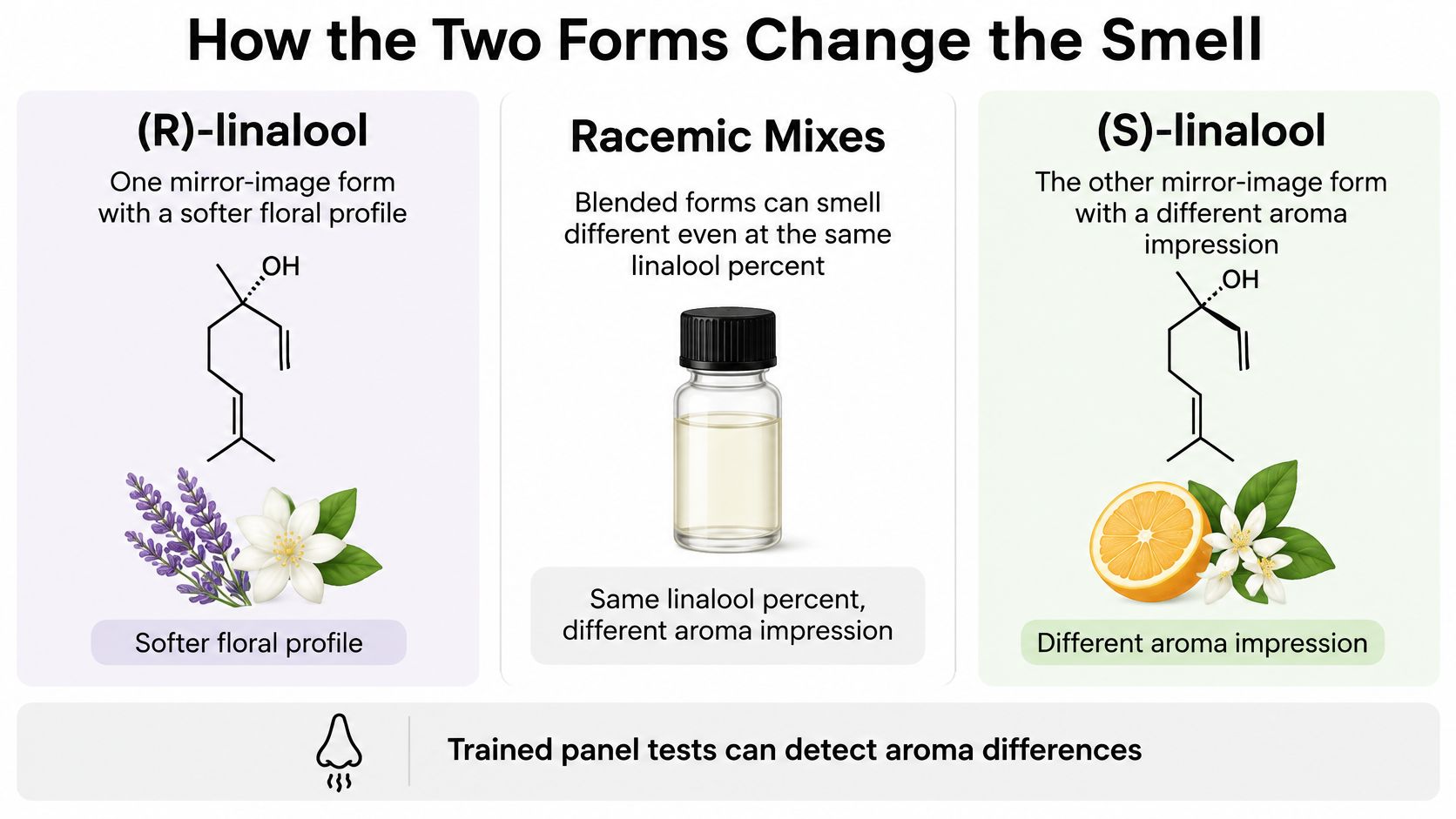
Linalool exists as two mirror-image forms, (R)-linalool and (S)-linalool, plus racemic mixtures of the two. Trained-panel work reported in brewing science research on linalool thresholds measured orthonasal odor detection at 0.82 µg/kg for (R)-linalool in water and 8.3 µg/kg for (S)-linalool, and at 6.5 and 53 µg/kg for the same pair in unhopped beer. The R form came out roughly 8 to 10 times more odor-potent in that study, decisive for a blend either way.
| Form | Detection threshold | Common odor read | Formulation note |
|---|---|---|---|
| (R)-linalool in water | 0.82 µg/kg | Woody, green, cooling | About 8-10 times more odor-potent than (S) |
| (S)-linalool in water | 8.3 µg/kg | Sweeter, floral, citrus-like | Needs more mass for the same impact |
| (R)-linalool in unhopped beer | 6.5 µg/kg | Same chemistry, weaker perception | Matrix raised the threshold |
| (S)-linalool in unhopped beer | 53 µg/kg | Same chemistry, weaker perception | About a tenfold medium shift |
| Racemic mix | Set by the R:S ratio in the lot | Blended floral and woody | Test in the real base, not only neat |
The molecule did not change between the water rows and the beer rows. The medium did. The same shift applies to your product, because the base you fill decides which threshold a blend is working against.
For cartridge and concentrate work, ask the supplier two questions before the sample run. Is the lot R-enriched, S-enriched, or racemic, and can the lab report the enantiomeric distribution beside the assay? Equal mass percentages of those three do not deliver equal aroma intensity. A racemic lot leans on its R content for most of the perceived impact, so a brand that wants a locked smell needs the split on the document. I would not approve a lot without it.
Chirality is the part of terpene chemical structure that a total percentage hides, and it is the first place a spec sheet and a smelling strip disagree.
Practical rule: smell the diluted blend in the base you'll fill. A neat oil that smells perfect can turn shy or harsh once it's inside warm distillate.
How to Dose Linalool into Distillate
A linalool percentage only makes sense beside the total terpene load. Treat the supplier's figure as a starting point for a small trial, then assess the blend in the base you plan to fill.
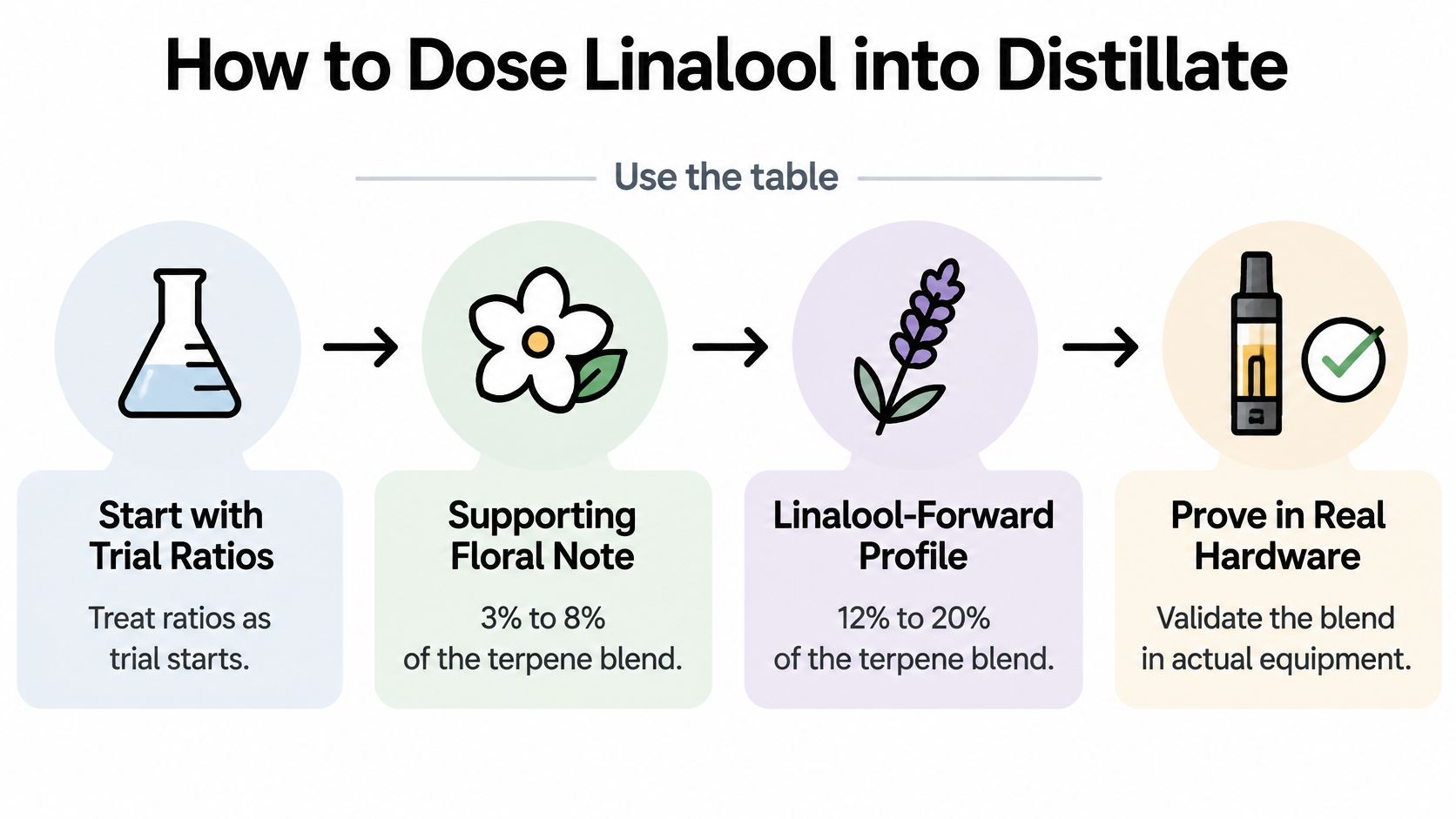
For example, a cart with 8% total terpenes by weight and linalool at 5% of that blend contains 0.4% linalool by weight in the finished formulation. The linalool is one part of the blend, not the full addition.
| Job | Linalool in the terpene blend | Total terpene in the base | Check before scale-up |
|---|---|---|---|
| Soft floral support | 3%-8% of the blend | About 5%-8% w/w in distillate | Fruit or citrus still leads the smell |
| Linalool-forward cart | 12%-20% of the blend | About 5%-10% w/w in distillate | Harshness, leak, and hardware test |
| Edible or tincture flavor | Calculate finished amount; do not copy cart percents | Usually far below cart loads | Market flavor rules and total exposure |
| Neat isolate QC | 100% of that bottle | Not a fill rate | COA, odor, and enantiomer note |
Five steps from bench to fill
- Weigh both sides of the addition. Weigh the winterized distillate and the full terpene blend. Include linalool already present in any profile blend.
- Mix covered, using the lowest workable heat. Agitate steadily in a covered vessel to limit aroma loss. More heat can drive off volatile top notes before filling.
- Sample the start, middle, and end. Check that the blend is uniform rather than assuming a short stir was enough.
- Compare pre-fill and post-fill aroma. Linalool's vapor pressure is listed at 0.16-0.17 mmHg at approximately 25 °C in the Sigma-Aldrich specification. Warm, open handling can reduce the top note.
- Run the actual hardware. Fill the device you plan to use, then check leakage, viscosity, and flavor retention after a week on the shelf.
Change one variable per trial and record the lot and recipe. Water-based products need a proven solubilizer; oil-based formulations still need a compatibility check with the container.
For the mixing sequence, use this guide to adding terpenes to distillate.
Once a ratio performs in the intended hardware, record it as a percentage by weight on the batch ticket. Keep the blend, base, and filling conditions consistent when scaling the recipe.
Storage Tests and the COA to Request
A drum can pass receiving and still smell wrong three months later. That isn't a bad batch. That's storage, and it's the least glamorous part of a linalool program.
Treat the material as what it is: a volatile, oxygen-sensitive liquid that ships and stores as a combustible.
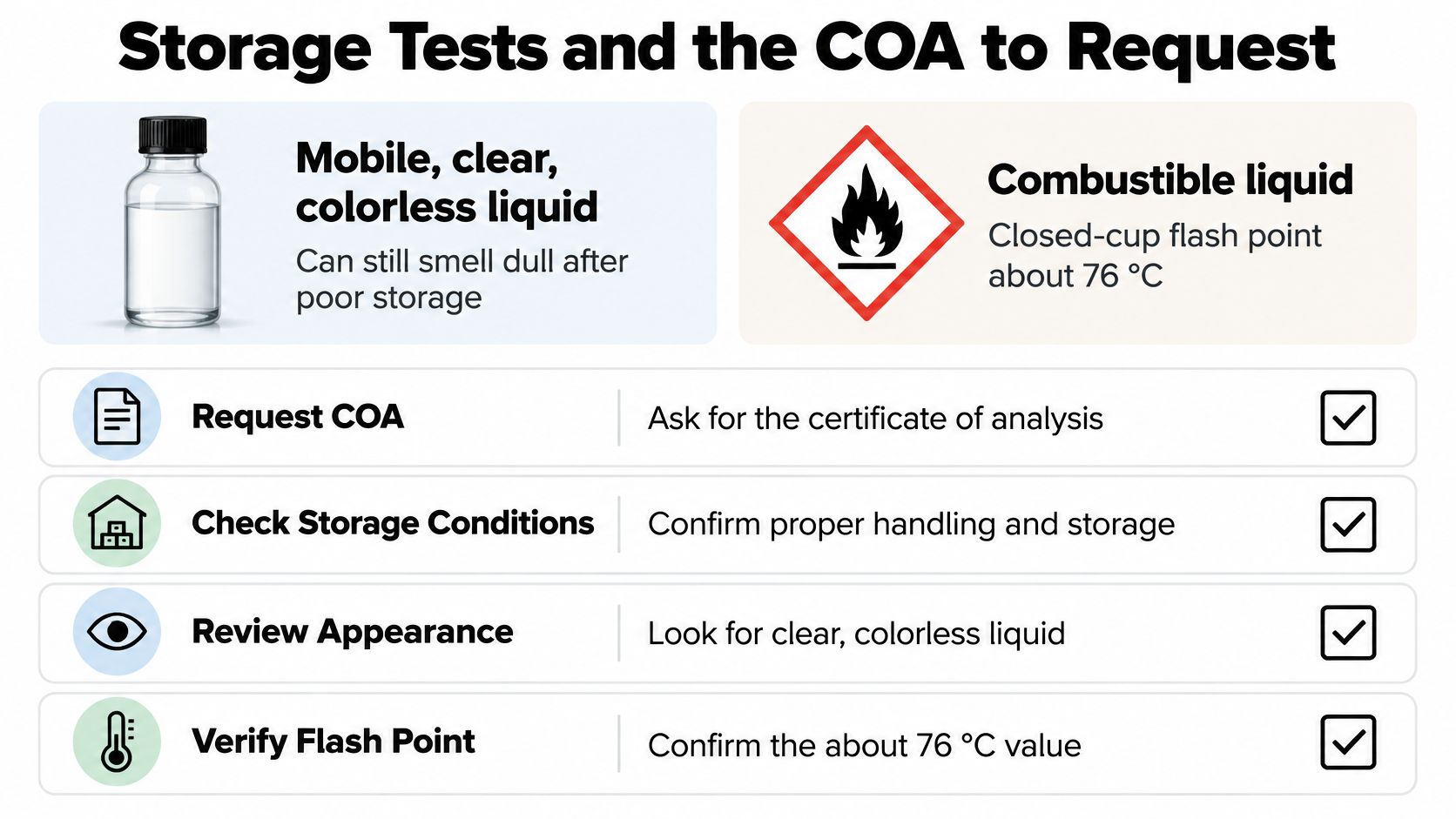
The National Toxicology Program background document on linalool describes a mobile, clear, colorless liquid with a closed-cup flash point of about 76 °C, which puts it in flammable-liquid storage and shipping territory. That same document separates a physical-property spec from any end-use safety authorization, and the distinction matters: a boiling point and a flash point do not make a finished inhaled product safe.
What to control on the floor
- Cool and sealed: tightly closed, compatible containers, away from heat sources and direct sun.
- Low oxygen: amber or oxygen-limiting packaging where the budget allows.
- Written open dates: date the drum when the seal breaks.
- Fewer reopenings: every lid-off cycle exchanges headspace and costs aroma.
- GC before and after: verify identity and percent at receiving, and again if the lot sits.
What the COA should carry
Ask for compound name, percent linalool, botanical source, lot number, contaminant panel, and a safety data sheet. When the smell has to stay locked, add the enantiomer split and any oxidation marker the lab can report. Our cartridge terpenes are SC Lab-tested, and the terpene information we publish is provided by SC Labs, so those fields are the same ones you can compare against our documentation.
Oxidation is real but not uniform. Linalool can autoxidize in air into hydroperoxides and other reactive compounds, and stability research on linalool oxidation shows the compound can also be converted into furanoid and pyranoid linalool oxides under controlled oxidative conditions. Perfume stability data won't predict a cartridge, so test the matrix you sell.
When the note dulls, don't guess: pull a fresh sample, run GC, and compare against the receiving assay before you blame the supplier or the mixing step.
The fields a certificate of analysis should contain are worth fixing in your supplier agreement so every lot arrives on the same template.
Flavor Rules That Are Not Health Claims
Two documents travel with a linalool-containing product: the paperwork that lets you use it as a flavor, and the marketing copy. Keep them apart.
The first document is a compliance file, and it has to be built per market. Flavor-use limits for linalool are set by the authority that governs your product category in the region you sell into, so confirm the applicable rule directly instead of borrowing a figure from a general flavoring evaluation. Whatever limit applies covers oral flavor exposure. It is not a cartridge dose, and it is not a target milligram for a distillate batch.
What you do instead is arithmetic. Total every linalool source in the formula, calculate the finished concentration in the complete product, and confirm the rule for the market and category you're selling into. Ask suppliers for the exact linalool percentage in a blend so you're calculating rather than estimating.
Then drop the lavender shortcut. A floral, lavender-like smell is a positioning word on a flavor brief and nothing more. A peer-reviewed review of the linalool evidence base found the work is mostly preclinical, with well-designed clinical trials lacking. One human pharmacokinetic study it describes measured plasma levels of roughly 72.7 ng/mL after inhalation versus 12.6 ng/mL after dermal application, without tying either figure to a validated anxiety, sleep, or mood outcome.
That gap is where labels get into trouble. A spec sheet can report percent linalool, enantiomer split, and oxidation state. It cannot promise a customer they will sleep better.
Label rule: if it isn't chemistry on the COA, it doesn't go on the label.
Order a Botanically Derived Linalool Isolate
Close on the buying decision. If your brief needs a controllable floral note you can dial up or down, buy linalool as an isolate and keep the percentage on the batch ticket. If the brief needs a complete profile, start from a blend and check how much linalool is already in it before you add a gram more.
Gold Coast Terpenes carries terpene isolates including Alpha Pinene, Beta Caryophyllene, Limonene, Linalool, Myrcene, and Terpinolene, so a team can build a profile peak by peak. The Pioneer Pack puts one bottle each of Beta Caryophyllene, Limonene, Myrcene, Linalool, Alpha Pinene and Terpinolene on the bench, which is the fastest way to smell the floral note beside the heavier and brighter ones you're blending it with.
Those terpenes are added to winterized distillate oils to give a product a distinct flavor, and our material is botanically derived, extracted from fresh plants, with no mixtures, chemicals, or additives.
If you want the background on sourcing before you spec a purchase order, read how botanical-derived terpenes are produced and bring the questions to the sample request.
Three actions cover most cases. Shop the linalool isolate or a full blend and compare it against the profile you're building. Request a sample and run the hardware trial before you commit to a drum. Or contact the team for bulk and custom orders when the spec is already locked and the volume is real.
Linalool is one of the most useful floral tools in a terpene toolbox, and it rewards the teams that treat it as a measured ingredient instead of a mood. Gold Coast Terpenes supplies botanically derived linalool isolate alongside blends and packs built for winterized distillate and cartridge work, with SC Lab-tested documentation you can drop into a batch file. Order a sample, run it in your own base and hardware, and set the percentage that survives the test.