
The usual advice for a cannabis vape cartridge is to add terpenes until the flavor seems right. That's a poor production rule. A stronger aroma in a mixing vessel doesn't tell you whether the fill will leak, feed the heater evenly, or hold its character under heat.
For manufacturers, terpene percent is a weighed production control, not a flavor knob. Treat the distillate, botanically derived terpenes, hardware, and battery as one system. Then approve a formula against the actual cartridge and the rules in its destination market.
What a Cannabis Vape Cartridge Is for Makers
A good-looking bench blend is the easiest failure to miss. Winterized distillate and botanically derived terpenes can look uniform in the vessel, match the development sample, and run through the filler cleanly. After capping, a few units seep at the base; a few more read burnt under the intended battery.
A cannabis vape cartridge is a finished assembly: distillate, terpenes, hardware, and battery working together. The base supplies body. Botanically derived terpenes set the aromatic direction and change flow, so their share belongs in the product definition as a weighed input with hardware, heat, and destination rules around it.
The parts your team controls
- Tank and airway: Check seals, oil-contact surfaces, fill space, and the path through which aerosol travels.
- Heater and battery interface: Match the coil, electrical connection, airflow, and intended battery settings.
- Fill formula: Control the distillate lot, botanically derived terpene blend, weighed additions, and mixing conditions.
The coil is the burner in this system. A formula that pours well at room temperature can still wet poorly, run hot at the heater, or leave a harsh edge after repeated pulls. Hardware buying and flavor development fail when they run in separate lanes: the buyer needs the formula's flow behavior, and the formulator needs the heater's operating conditions before the blend is locked.
Production rule: Approve the filled assembly under battery load and repeated pulls. A clear jar test still misses base seepage, dry wicking, and a burnt edge that shows up after capping.
Write the product definition before ordering production materials. Name the distillate, the botanically derived terpene blend, the hardware, and the operating conditions. The first formula decision is the terpene share by weight of the finished fill, set against state ceilings and hardware behavior before any bench scale-up.
Terpene Load Targets for a Filled Cart
Terpene percent is a production specification, not a flavor dial. Every point added changes viscosity, coil wet-out, and where the finished fill sits against a state ceiling, so the number belongs on the batch sheet as a weighed target with a defined denominator.
Terpene load bands for a cannabis vape cartridge fill
The development bands below are proposed bench starting points, not validated limits or universal recipes.
| Fill target | Terpenes by weight | Use it when | Limit to respect |
|---|---|---|---|
| Light aroma rebuild | 3% to 5% | Distillate only needs a soft, even aroma | Stay here if thinning is already a concern; investigate leaks separately |
| Standard cart flavor | 5% to 8% | Most planned SKUs need clear flavor and reliable wicking | Confirm viscosity and coil wet-out on the production hardware |
| High flavor near a cap | 8% to 10% | The aroma target calls for a pronounced note | Some state markets cap total terpenes in inhalable products; verify the destination rule before approval |
| Published high-load warning | About 10% to 20% | Only as a caution from studied oils | Aerosol terpene output climbs sharply at these loads; treat this band as a boundary, not a recipe |
A scientific review of cannabis vaping reports oils containing approximately 10% to 20% terpenes by weight, with aerosol terpene concentrations of roughly 2,500 to 5,000 parts per million. Those reported values describe studied oils and set the caution boundary for a development program.
For a development program, I would use the proposed 5% to 8% band as the default production-development start, then move only when testing supports the change. A quiet aroma target may need less. Thin distillate, sensitive seals, or restrictive market rules may make that default unsuitable.
Weigh the finished ratio
The denominator matters. Adding a terpene mass to a distillate mass isn't the same as making that terpene mass a percentage of the finished blend.
Use this calculation:
Terpene addition = distillate mass × target fraction ÷ (1 − target fraction)
That calculation assumes the added blend is entirely terpenes and that you've accounted separately for any terpenes already in the base. For compliance, total terpenes includes more than the amount your operator adds.
Follow a controlled bench sequence:
- Weigh the winterized distillate. Tare a clean vessel and record the actual mass, not the container's nominal amount.
- Calculate and weigh the botanically derived terpenes. Use the finished-blend target so the batch sheet describes what you're making.
- Warm only enough to blend. Use controlled heat and stir until the oil looks uniform. Don't leave an open vessel heating while other work continues.
- Record mass in and mass out. Account for material left on tools, in transfer vessels, and in the mixer.
- Fill a small hardware lot. Use the intended filling and capping process rather than hand-building an unusually careful sample.
- Check the finished units. Assess viscosity, leakage, coil wet-out, and aroma before releasing the formula for scale-up.
Use a balance with enough resolution for the smallest addition. Drops and volume marks aren't a substitute for a mass-based batch record.
Keep the calculation method consistent across development and production. The guide to how much terpenes to add to distillate can support that worksheet, and the release decision still belongs to the finished-cartridge test.
How Coil Heat and Hardware Change the Fill
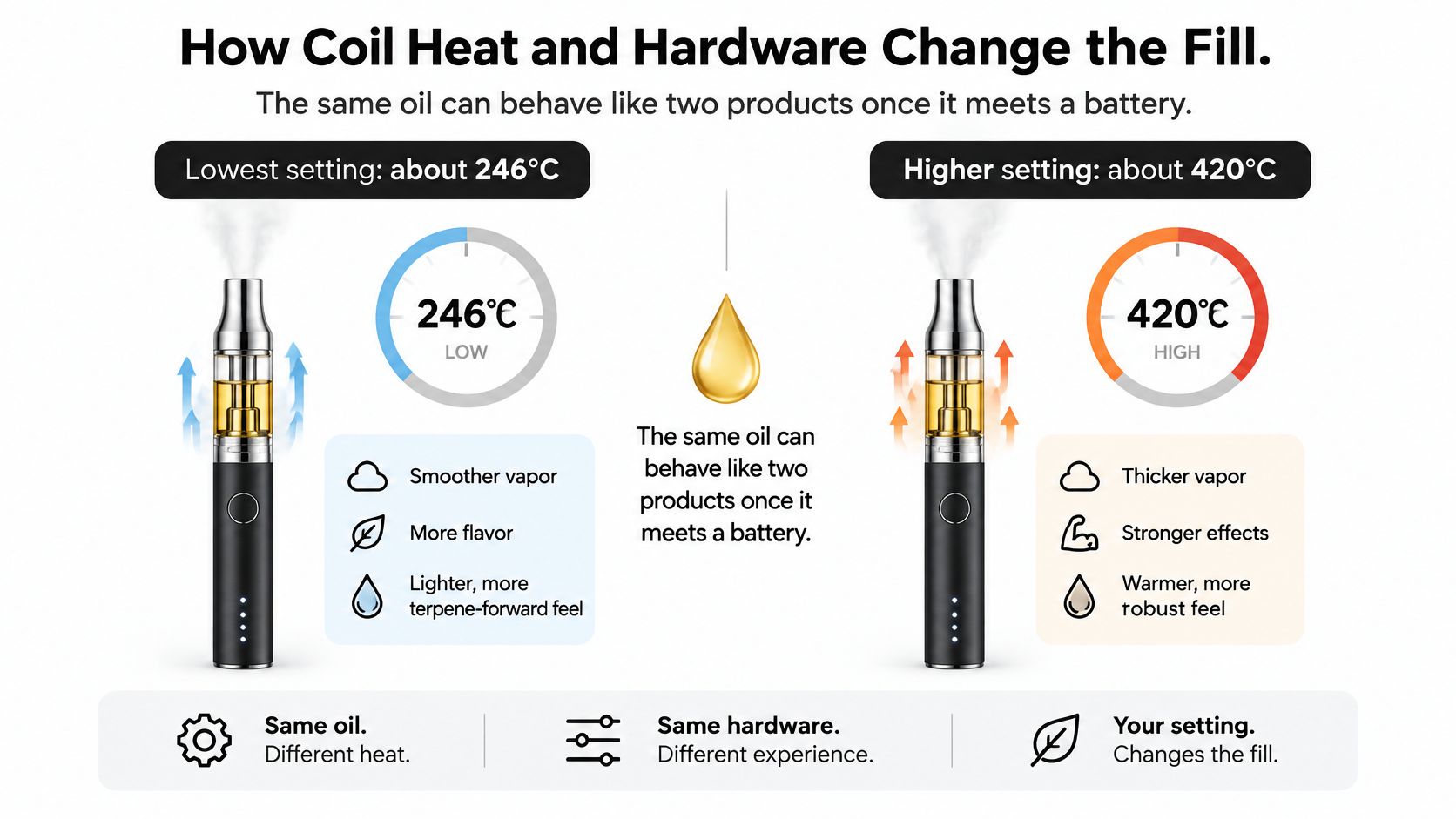
The same oil can behave like different products on different batteries. In thermographic testing published in PLOS ONE, researchers measured coil temperatures across three device types: a temperature-controlled system that averaged about 246°C at its lowest setting and 420°C at its highest, a variable-voltage device that reached about 443°C at 2.4 V and 543°C at 4.0 V, and a single-voltage device held at a fixed 3.2 V.
Average coil temperature by hardware setting
| Hardware type | Setting | Average coil temperature |
|---|---|---|
| Temperature-controlled device | Lowest setting | 246 ± 5.1 °C |
| Temperature-controlled device | Highest setting | 420 ± 9.5 °C |
| Variable-voltage device | 2.4 V | 443 ± 56.1 °C |
| Variable-voltage device | 4.0 V | 543 ± 95.9 °C |
| Single-voltage device | 3.2 V | 450 ± 60.8 °C |
These are results for the tested devices, not temperature promises for every cartridge at those settings. Coil construction and operating conditions matter. Treat the battery as part of the formulation, a fixed input on the batch record, and never as an accessory the customer sorts out later.
The visual below breaks down what changing heat does to the vapor a given fill produces.
Test the operating envelope
Heat changes oil flow, aerosol output, terpene loss, and thermal degradation. A beaker on a warm plate doesn't reproduce the conditions at a working coil.
Test the intended battery, puff duration, airflow, and coil geometry. Compare low, nominal, and high operating settings using a repeatable protocol. Reject conditions that produce scorching, spitting, unstable output, or unacceptable degradation products. Sensory checks flag problems early; analytical aerosol testing confirms them.
Keep those conditions attached to the hardware specification. The cartridge selection guide is a useful buying reference, but a supplier's model description isn't your qualification record.
Qualify the oil-contact assembly
Hardware isn't a passive cup. A National Research Council Canada study of six legal Canadian cannabis-vape products found device-derived cobalt, nickel, and zinc contributed to within-batch variation; nickel and zinc appeared in every aerosol sample, chromium appeared in 80%, and microscopy identified cracking on an unused connector pin.
Build incoming controls around the complete assembly:
- Inspect connectors and components: Look for damage and assembly defects, while recognizing that visual inspection has limits.
- Evaluate material compatibility: Include extractables and leachables testing with the intended fill.
- Track incoming lots: Preserve the connection between hardware receipt, filling records, and finished units.
- Test finished aerosol: A passing liquid sample doesn't cover contamination the device introduces.
That cracked pin never went into service. Surface damage and material breakdown at that scale are what extractables testing and microscopy are for, so write those methods into the acceptance criteria rather than relying on a bench glance.
Keep the demonstration separate from the written acceptance criteria.
Building a Botanically Derived Flavor Match
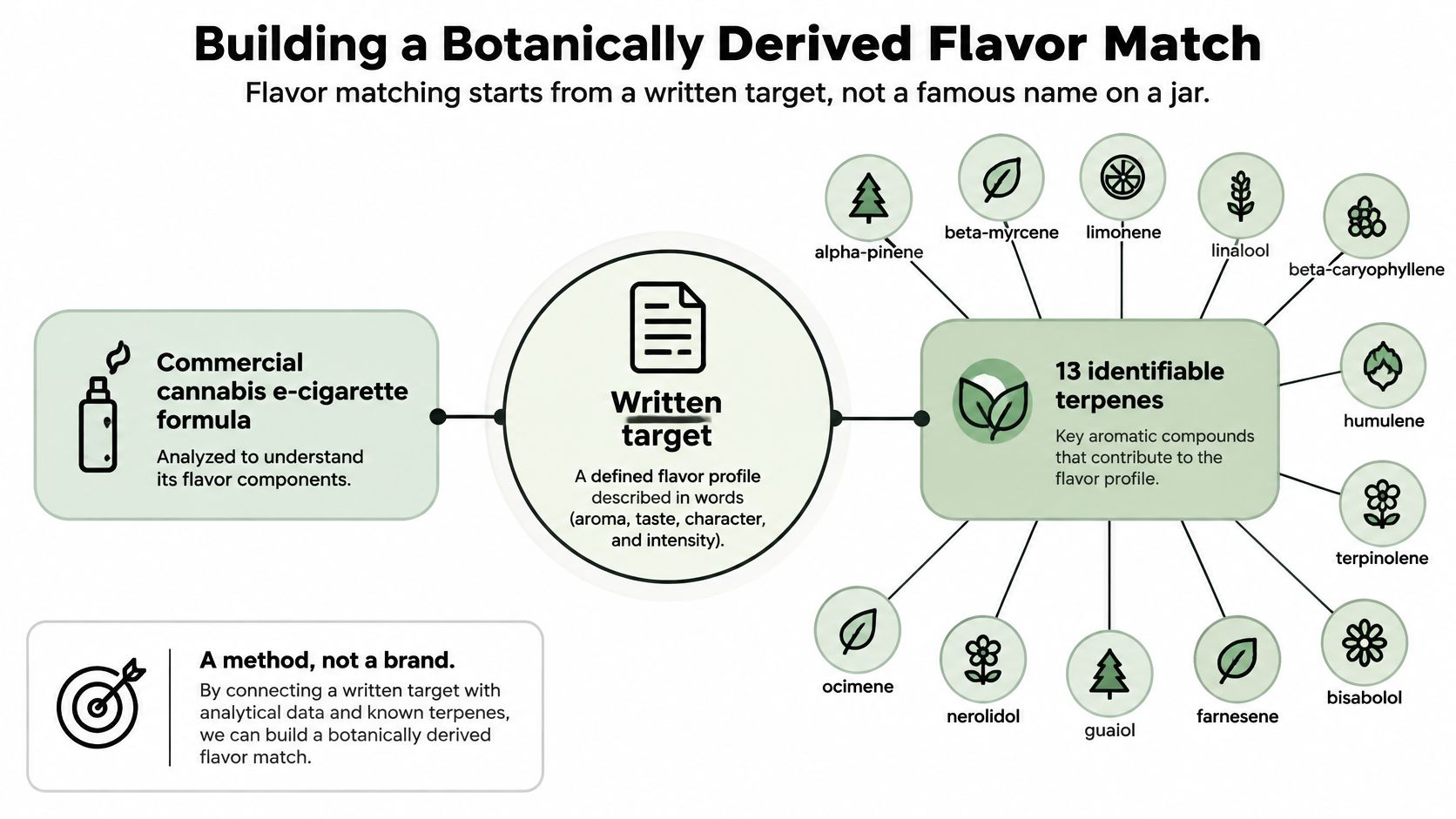
Flavor matching starts with a written sensory target, not a familiar name on a jar. Describe the lead note, supporting character, finish, and notes you don't want. That gives purchasing and formulation the same target.
A peer-reviewed analysis of a commercial cannabis e-cigarette identified 13 terpenes, including alpha-pinene, beta-myrcene, beta-pinene, limonene, linalool, terpineol, beta-caryophyllene, and alpha-humulene; the same liquid also contained propylene glycol. A complex aroma doesn't prove that a fill contains only distillate and terpenes.
Use the ingredient list to establish what's present before trying to reproduce the aroma.
Build the profile inside a fixed dose
Choose the lead note first. Limonene can support a citrus direction, beta-pinene a pine direction, and alpha-humulene a hoppy direction. Keep those descriptions sensory rather than attaching promises about effects.
Then add supporting notes within the botanically derived terpene fraction. Don't increase the finished dose each time the target seems incomplete. A missing supporting note is often a composition problem, not a quantity problem.
For a hypothetical 5% finished fill, split the terpene fraction 60/30/10 across lead, support, and accent notes. That produces 3% lead, 1.5% support, and 0.5% accent by finished weight. These are worked-example proportions, not a validated formula.
Record each weighed addition separately. If the accent overwhelms the target, you can revise that share without guessing which addition caused the change.
Change the profile before you increase the total load.
Compare a small batch against a target card
Before blending, record the supplier blend name, lot identifier, ingredient identity, and individual terpene profile. Use only botanically derived terpenes for this development path. The botanically derived terpenes guide provides background for keeping origin and ingredient identity distinct from aroma descriptions.
Make a compatibility beaker at the selected finished percentage. Compare the cold aroma with the aroma after a short, controlled warm mix. Note separation, unexpected sharpness, and changes in flow.
Then fill a small cartridge lot and compare it with the target card. Record aroma, wick behavior, and leakage as separate results, rather than giving the sample a single pass mark.
If the profile is harsh or the oil becomes too thin, revise the blend composition before adding more. Scale only when the small lot meets the written target and the physical acceptance checks. Keep an approved reference sample so the next lot has something more reliable than a team member's memory.
Fixing a Failed Fill Test
A failed sample should lead to a controlled correction, not a new recipe assembled from several guesses. Keep a control from the failed batch and change one variable at a time. Otherwise, you won't know which change helped.
Match the correction to the failure
- Thin oil or seal leakage: Reduce the terpene share toward the light-rebuild band, then check the same hardware again. Inspect seal fit separately so a mechanical fault doesn't get hidden by a thicker formula.
- Poor wicking: First distinguish flooding from feed starvation. Lowering terpene content may help an over-thin fill, but it can worsen a fill that already moves too slowly.
- Harsh or burnt output: Check the battery setting and coil wet-out before changing the aroma blend. Rerun the operating-range test after correcting the suspected heat condition.
- Weak aroma after cooling: Reconcile the weighed addition and transfer losses. If the mass record is correct, revise the profile rather than automatically raising the dose.
- Sharp or chemical aroma: Reduce the dominant note within the terpene fraction. Recheck the finished formula against the destination market's total-terpene limit.
- Spitting or unstable output: Inspect connector condition, coil fit, and signs of flooding. Review the hardware lot and arrange analytical testing where contamination is suspected.
- Lot-to-lot drift: Compare the incoming terpene profile and distillate lot before changing the approved finished percentage.
Close the corrective action
Write down the original failure, the single change, and the retest result. Include the sample identity and operating conditions so another team member can repeat the check.
A corrected sample isn't an approved process until the team can reproduce it.
Don't use extra heat or extra terpenes to force a questionable batch through testing. If the correction changes a controlled input or operating condition, treat the result as a revised formula that needs approval.
State Rules and Ingredient Gate
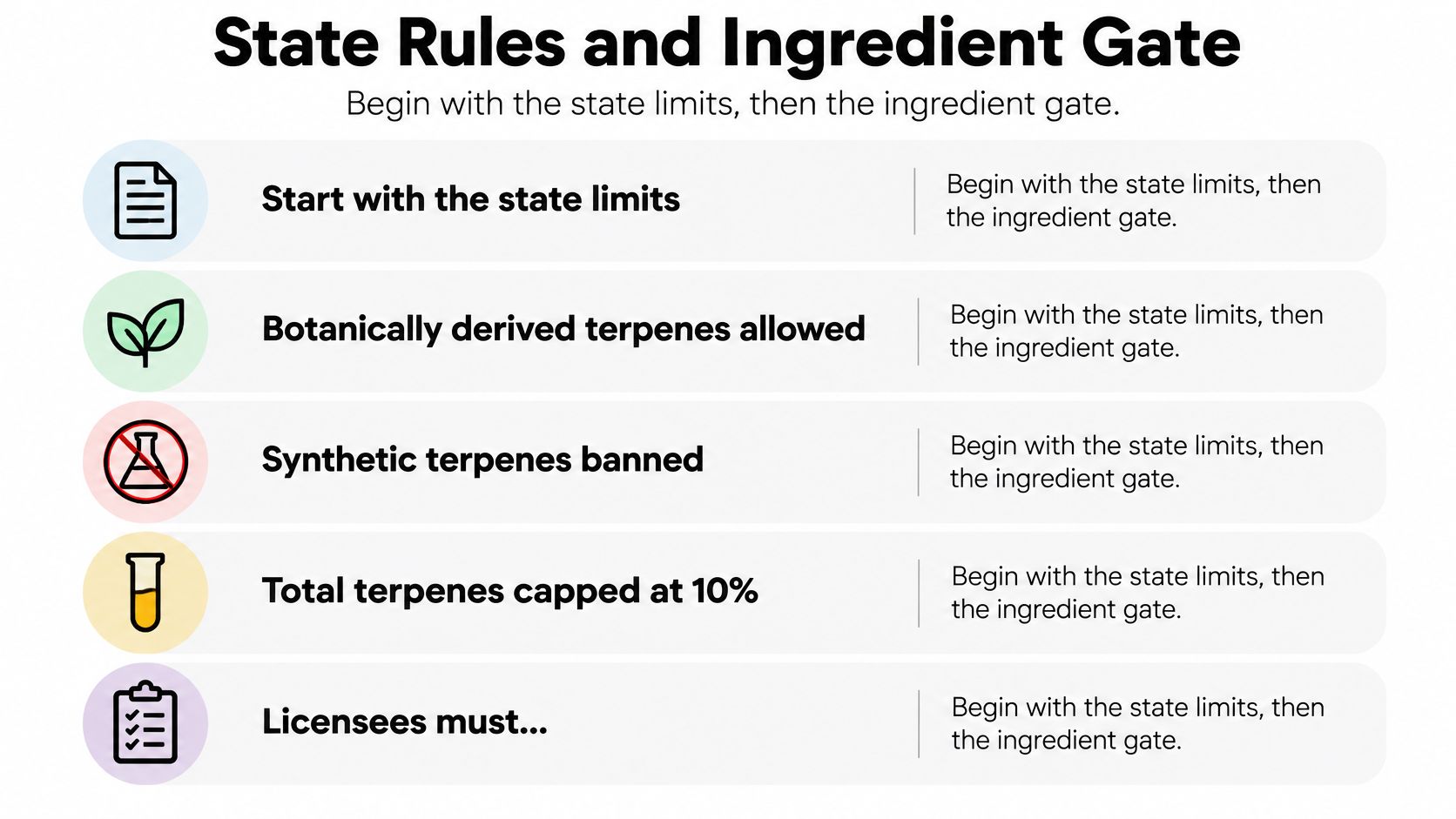
The terpene percentage on a batch record is a compliance figure before it is a flavor choice. State ingredient rules attach to the finished cartridge, so the destination market has to be cleared before the fill, even when the bulk oil already passed its own incoming tests.
New York's requirements for flavored vaporized or inhaled cannabis products define which terpene inputs qualify, how the finished total is measured, and which source records the producer must hold. Vermont's product-registration guidance sets a separate gate for adult-use inhalables, including a pharmaceutical-grade standard for inhalable ingredients that takes effect July 1, 2026 with listed exceptions.
Inhalable cartridge rules that change a terpene recipe
| Market or case | Terpene rule | Input limit | Records to keep |
|---|---|---|---|
| New York adult-use inhalable | Botanically derived allowed; synthetic banned; total-terpene ceiling applies | Calculate total percent on the finished fill, counting terpenes already present in the base | Full source identity for botanical terpenes used |
| Vermont inhalable adult-use | Botanically derived terpenes are a listed exception to the pharmaceutical-grade rule | Synthetic terpenes and polyethylene glycol prohibited | Supplier specifications and lot records for input qualification; document the applicable grade exception |
Attach the market review to the recipe itself. A formula released in one state is a fresh submission in the next.
Approve inputs before blending
The CDC's EVALI outbreak record reported 2,807 hospitalized cases and 68 deaths by February 25, 2020; 82% of hospitalized patients reported using THC-containing vaping products, and vitamin E acetate was found in lung fluid from 48 of 51 patients tested while remaining absent from the healthy comparison subjects. These findings justify strict ingredient controls for every regulated cartridge.
Build a release gate that purchasing, production, and quality staff can use:
- Approve every input: Match the delivered material to its ingredient identity, specification, and lot documentation before it reaches the tank.
- Block unapproved additions: Exclude vitamin E acetate and undeclared thickeners from the manufacturing specification.
- Confirm botanical origin: Preserve source documentation for every botanically derived terpene lot.
- Retain finished samples: Keep batch-linked samples under documented storage conditions.
- Verify finished cartridges: Use testing appropriate to the complete formula and hardware, not only the original bulk oil.
Run the inputs through the regulatory compliance checklist before the recipe is approved. A certificate of analysis describes the tested sample and its listed analyses. A different mixture, heated through different hardware, still needs its own verification before release.
Request Samples Before You Lock Production
Locking production on an untested blend is how a 3% terpene target becomes a rework order. Your production decision should fit on a controlled approval sheet: the distillate lot, botanically derived terpene blend and lot, hardware model, battery setting, finished terpene percentage, and destination market. Attach the test results that justify releasing that combination.
The approved formula needs boundaries. Record which inputs can change without review and which changes require another compatibility run. A replacement cartridge that looks identical shouldn't enter production solely because it fits the same filling tray.
Buy against the approved specification
Use samples to answer a purchasing question: does this material meet the target in your process? Don't judge a prospective supply solely from the aroma of the concentrated blend.
- Choose against the target card: Match the intended aroma rather than selecting the strongest-smelling sample.
- Run the compatibility work: Make a bench blend and a short filled-cartridge lot using the intended production equipment.
- File lot documents: Keep the certificate of analysis and ingredient list beside the formula and finished percentage.
- Define the bulk specification: Carry the approved blend identity, documentation requirements, and acceptance checks into the purchase order.
Gold Coast Terpenes supplies botanically derived terpenes for cartridges that are SC Lab-tested and free from additives, VG, PG, PEG, and MCT. They are formulated to be added to winterized distillate oils. Sample and bulk purchasing options are available, and the team can be reached at 929-356-6086 to discuss the next purchasing step.
Keep the sample approval tied to the material you intend to order. Sample the blend in the cartridge, at the same voltage, before the ratio becomes the production standard. A successful development run is useful only when production can identify and reproduce its inputs.