
A disposable THC vape can pass every test on its oil certificate of analysis and still be a device nobody has qualified as a finished unit. The oil is one input. The hardware is where the aerosol gets made.
The stakes are commercial, not academic. In four Canadian adult-use provinces tracked by Headset (Alberta, British Columbia, Ontario and Saskatchewan), cannabis vape products generated C$473.6 million in sales and more than 11.9 million units in 2021, and vape sales grew 79% year over year while the wider cannabis market grew 61%, according to MJBizDaily's report on the Headset data. Vapes lifted their share of tracked sales from 14.7% in 2020 to 16.3% in 2021.
Volume like that turns hardware decisions into commercial ones. Treat the assembled device as the unit of approval and the questions get sharper: which part sets which result, what to test, and which documents to hold before a production run.
What a Disposable THC Vape Is and Where Terpenes Fit
A disposable THC vape is a sealed, single-use device. Battery, heating element and a reservoir of cannabinoid oil are assembled at the factory and discarded together when the oil runs out. No refilling, no cartridge swap, no coil change. That's what separates it from a 510 cartridge on a reusable battery, where the user owns half the hardware decisions.
The anatomy is simple to describe and hard to control.
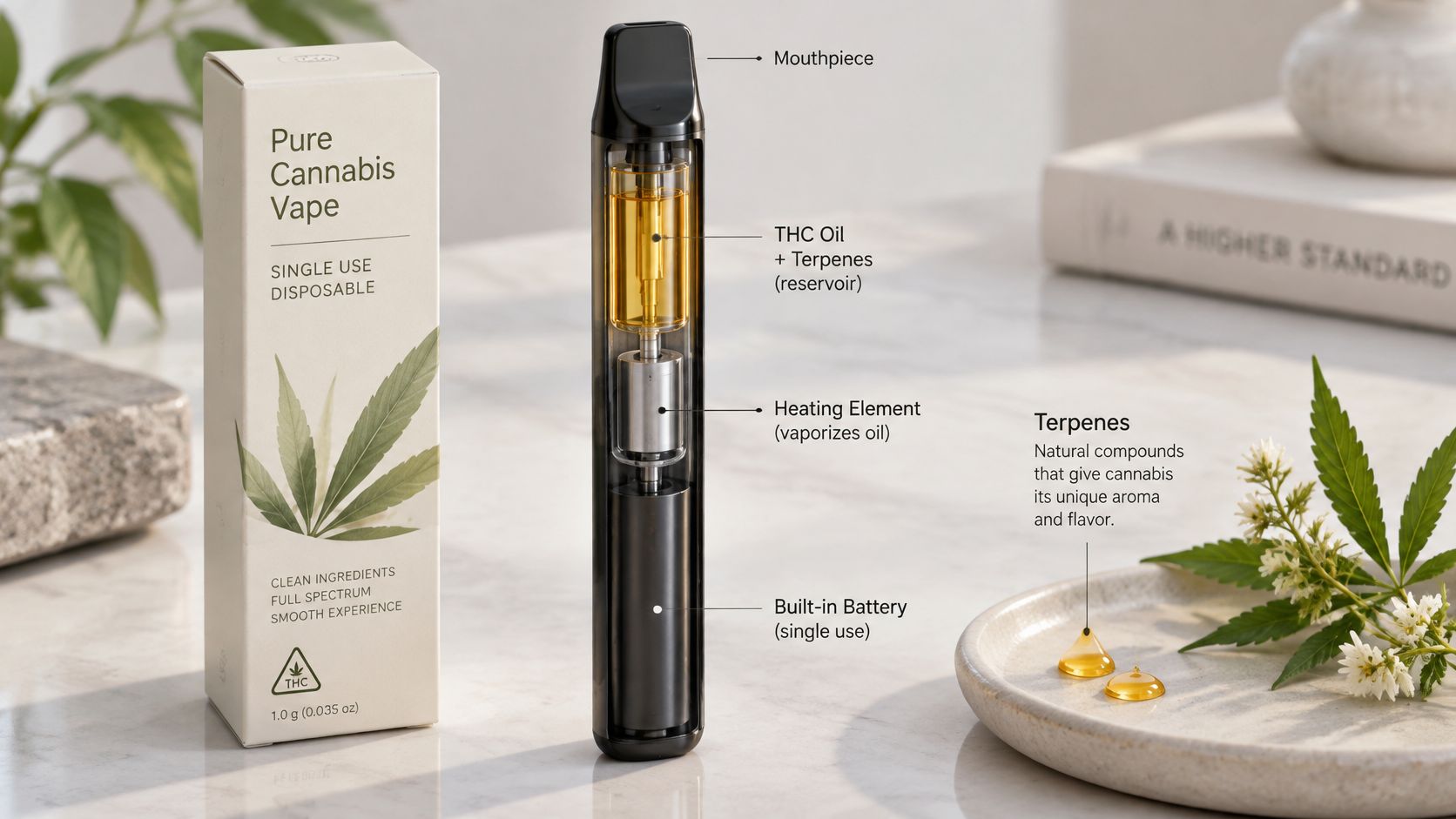
Three layers decide what the user gets, and a formulator manages all three. Hardware covers the battery, coil, wick, reservoir, seals and mouthpiece, which together set the temperature and the materials the oil touches. The distillate base carries the cannabinoids, and distillation strips most of the plant's native aroma, so the oil arrives close to flavorless. The terpene blend goes back in to rebuild flavor and scent. Terpenes are the aromatic compounds that give plants their smell, and botanically derived terpenes are produced from plant sources rather than from cannabis.
A sealed coffee pod is the closest familiar comparison. The beans matter, but the pod's filter, the water temperature and the seal decide the cup. Taste the beans on their own and you've learned almost nothing about the coffee.
That's the working rule: the finished device is the product you test and approve, not the oil on its own. This guide is written for product makers, sourcing teams and formulators who have to sign off on both.
Parts Inside a Disposable and What Each One Controls
Read a disposable from the battery outward, in the order the power travels. Every part has a job and a spec, and the spec is what you argue about when a fill goes wrong.
| Component | Job in the device | What makers specify |
|---|---|---|
| Battery | Supplies power to the heating element | Voltage range, capacity, cutoff behavior |
| Heating element (coil) | Heats the oil to produce aerosol | Material, resistance, weld or solder method |
| Wick | Carries oil from reservoir to coil | Material, saturation, dry-wick protection |
| Reservoir (tank) | Holds the finished oil | Material compatibility with oil and terpene loading |
| Mouthpiece and seals | Directs aerosol and keeps oil in | Material, fit, leak testing |
| Distillate base | Carries the cannabinoids | Winterization status, residual terpene level, lot number |
| Terpene blend | Adds flavor and aroma | Botanically derived source, percent added, batch number |
| Diluent or viscosity agent | Adjusts flow and thickness | Approved substances only, no unverified additives |
The battery supplies power to the coil, so its voltage range, capacity and cutoff behavior set the ceiling on coil temperature and the floor on how the last of the fill performs. The coil turns oil into aerosol, which makes its material, resistance and weld or solder method the most consequential hardware choice in the unit. The wick carries oil from the reservoir to the coil; material, saturation and dry-wick protection matter because a wick that runs dry is a known heating risk. The reservoir holds the finished oil, so its material has to be checked against both the oil and the terpene loading. Mouthpiece and seals direct the aerosol and keep oil where it belongs, which means material, fit and a leak test on every design revision.
Then the oil side. The distillate base carries the cannabinoids, and its record should show winterization status, residual terpene level and lot number. The terpene blend supplies flavor and aroma, so record its botanically derived source, the percentage added and the batch number. A diluent or viscosity agent adjusts flow and thickness, and it should only ever come from an approved list.
The traceability test: if you can name every row above with a spec and a lot number, a complaint about clogging, off-flavor or a failed laboratory result leads straight to a part or a batch. If you can't, you're guessing at your own product.
Hardware fit comes before flavor work. The cartridge selection guide covers the compatibility questions worth settling before a single gram of oil is mixed.
How to Blend Terpenes into Winterized Distillate
Terpenes go into winterized distillate, and the order of operations matters more than the recipe card. Work through these steps and write each one down as you go.
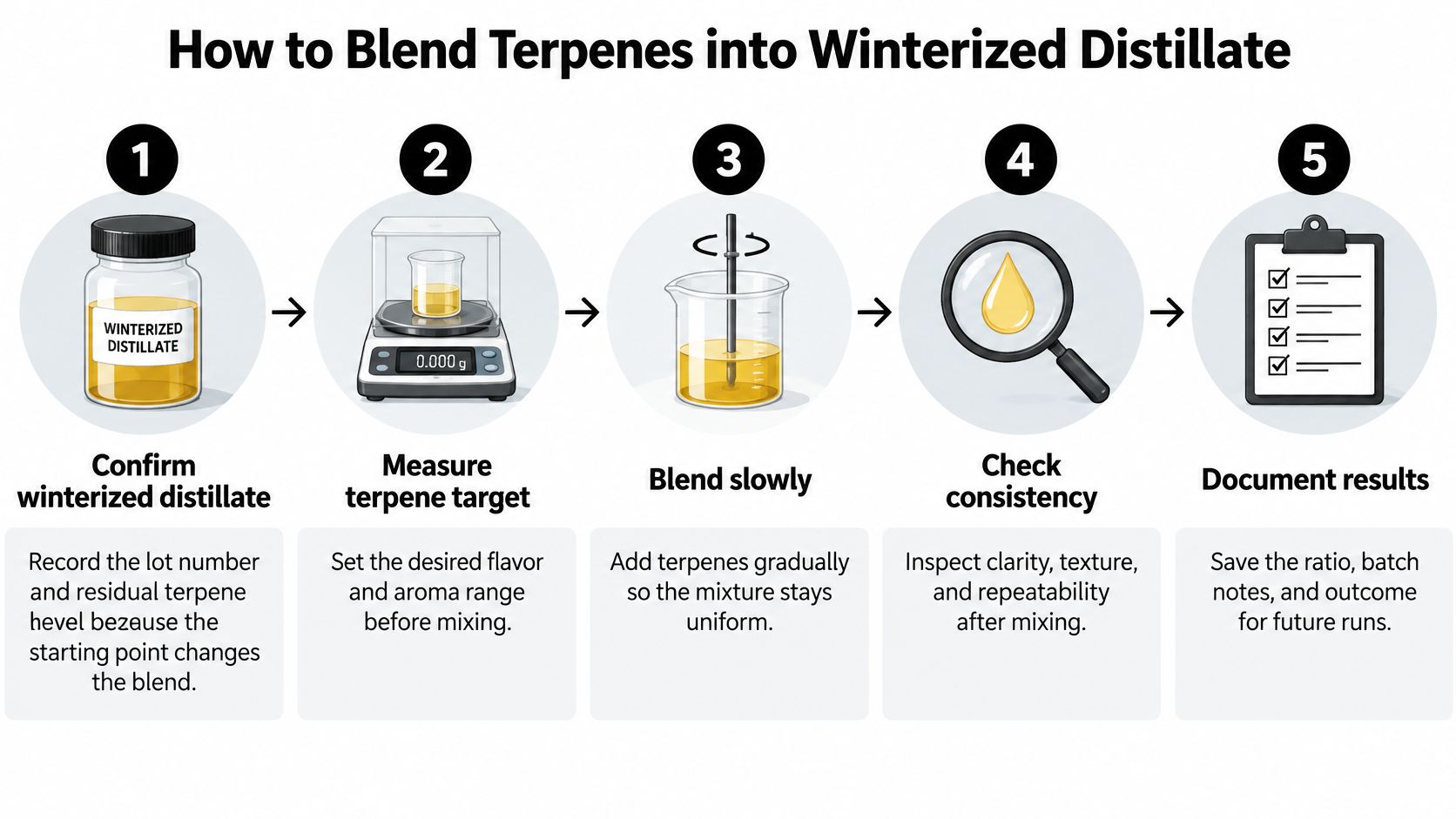
- Confirm the base is winterized, then record its lot number and residual terpene level. The starting point changes how a blend reads, so two lots of base oil can take identical terpene percentages and taste different.
- Set the target loading by weight, not volume, and put it on the batch sheet. Weight gives another operator a number they can repeat on a different day with different glassware.
- Weigh the distillate into a clean vessel used for no other blend. A residue of last week's profile will show up in a 3% loading.
- Add the terpene blend by weight in small increments, starting low. A terpene can overpower a flavor long before it reaches the label percentage.
- Mix gently until the oil looks uniform. Streaks, cloudiness or separated droplets mean it isn't finished.
- Let the blend rest, then compare flavor and viscosity against a reference sample. Rest lets the mixture settle; the comparison turns a guess into a decision.
- Record the batch number, percentage added, mixing date and final fill lot. That record is how you investigate off-spec flavor, separation, clogging or a failed result months later.
A worked example keeps it concrete. A 100 g batch at 5% loading takes 5 g of blend. Weigh the 100 g first, add the 5 g second, and never the other way round.
Run the bench trial before you commit to a loading. Mix three loadings in the same winterized distillate, evaluate them side by side, and pick the one that lands on the target profile. A 100 g batch covers all three.
| Loading by weight | Blend added to 100 g distillate | Trial purpose |
|---|---|---|
| 3% | 3 g | Low end, check the flavor is not thin |
| 5% | 5 g | Midpoint, matches the worked example |
| 7% | 7 g | High end, check for overpowering flavor or thickness change |
Flavor and thickness never get fixed with unverified oils, carrier liquids or flavor concentrates. Each unknown additive is a variable you can't trace later. The FDA's page on THC-containing vaping products reports that some were associated with vitamin E acetate, notes that data were limited on inhaling substances used in topical or dietary products, and urged people not to add substances to products bought in stores.
That warning turns into a paperwork rule at production scale. Every component added to a cartridge needs a controlled supplier, a traceable lot and a defined specification, and the FDA's THC vaping safety notice supports recording the terpene blend, batch number, percentage added, mixing date and final fill lot so a brand can investigate off-spec flavor, separation, clogging or a failed laboratory result. The distillate and terpene mixing walkthrough goes deeper on the mechanics. Get the record right and the outcome is a repeatable recipe that the next batch can match, cup for cup.
Heat and Hardware Tests That Protect the Finished Device
Butter in a pan tells the story. On gentle heat it melts and stays clean. Turn the burner up and the same butter smokes and browns. Nothing in the ingredient changed; the temperature changed what it became.
Aerosol behaves the same way. Thermal-analysis work published by the Royal Society of Chemistry in 2021 found that THC and beta-myrcene can generate isoprene, 2-methyl-2-butene, 3-methylcrotonaldehyde and 3-methyl-1-butene, that these four products made up 18 to 30% of the aerosol gas phase in the reported experiments, and that their concentrations rose with applied electrical power. The same body of work reports methacrolein, benzene and methyl vinyl ketone from cartridge vaporization, and found that adding terpenes produced higher gas-phase product levels than THC alone.
That last finding deserves a second read. The terpene blend changes what the aerosol contains once it meets a hot coil, so the only meaningful test is one run on your actual formula inside the actual device.
Where the Heat Comes From
Five conditions push local temperature up, and each has a control:
- Excess power. A high setting, an oversized battery or a poorly matched coil drives the wick hotter than the formulation was designed for. Control it with a defined voltage range and a validated temperature ceiling.
- Restricted airflow. A tight draw pulls more heat per unit of air across the wick, so specify puff resistance and airflow, then check them on incoming hardware.
- Repeated puffing. Back-to-back draws don't let the coil recover between cycles. Test in realistic puff trains, not single draws.
- Low liquid level. The last third of a fill runs hotter than the first. Test at beginning, middle and end of life.
- A dry wick. Once the wick loses saturation, temperature climbs quickly. Specify dry-wick protection and verify it works.
What to put on the spec sheet: delivered coil temperature and aerosol chemistry, not nominal battery voltage. A voltage figure tells you what the cell supplies. It tells you nothing about the wick at 90% consumed.
Product-development testing should therefore include thermocouple or validated temperature-proxy measurements, puff-resistance and airflow specifications, thermal cutoffs, and emissions testing at beginning, middle and end-of-life conditions. Food-use or natural-origin status says nothing about what a terpene becomes at coil temperature, so qualification has to happen under inhalation conditions rather than on paper.
An Oil Certificate Does Not Clear the Hardware
Cartridge materials can contribute metal contaminants to the oil and to the inhaled aerosol. In a Canadian government study of six legal cannabis vape-liquid products, single-particle ICP-MS identified aluminum, cobalt, chromium, copper, nickel, tin and zinc particles in the liquids. After machine vaping, aerosols from every tested sample contained nickel and zinc, chromium appeared in 80% of samples, and cobalt, lead and tin were detected in up to half the cartridges, with matching elemental profiles pointing to the device itself as the contamination source.
Metal migration into oil and vapor is a known hardware failure mode, which is why the control is device qualification rather than oil testing alone. Evaluate coil, weld, solder, connector and reservoir materials. Run extractables and leachables testing on finished devices. Test the aerosol, not just the bulk oil, under representative puff counts, voltage, airflow and end-of-life conditions. A clean certificate of analysis for THC or terpenes cannot establish low metal emissions from a disposable device.
Fill matters here too. A substitute oil with different viscosity changes wicking and coil temperature, so a passing hardware result on another formulation does not transfer to yours. The blend and the device qualify together, as one unit.
| Test | What it catches | When to run it |
|---|---|---|
| Oil certificate of analysis | Potency, residual solvents, terpene identity | Before filling each lot |
| Extractables and leachables on finished device | Compounds migrating from parts into the oil | Before first production run and after any part change |
| Aerosol metals testing | Metal particles from coil, weld or solder | Beginning, middle and end of device life |
| Thermal profile with thermocouple or temperature proxy | Coil temperatures that drive degradation | Across the full voltage range and airflow settings |
| Puff-resistance and airflow check | Restricted draw that raises coil temperature | Every production batch, sample basis |
| Thermal cutoff function test | Failure to shut off at the set temperature | Before release of each hardware revision |
| Leak and fill-level check | Dry wick or low-liquid conditions | Every production batch, sample basis |
Repeat aerosol checks after any part change, even a supplier swap on a connector. Coil, weld and solder revisions each put a different metal surface in contact with your oil, and the leaching profile changes with them. The result that counts at the end of this process is the one generated on the finished, filled device.
Supplier and Regulatory Documents to Request
Before you approve a blend, ask for a document set rather than a brochure. The regulatory frame explains why. Under the FDA's ENDS framework, regulation can reach beyond the finished device to cartridges, e-liquids, flavorings, batteries, packaging, labeling, advertising, promotion, sale and distribution, and the agency states that vape manufacturers cannot market covered products without FDA authorization (FDA ENDS guidance).
The second reason is the food-status trap. FDA draft guidance states that a substance recognized as GRAS for food does not establish that it is safe for inhalation, and recommends evaluating flavor additives through the actual route of exposure while considering chemicals that may form when the product is heated (FDA draft guidance on ENDS premarket applications).
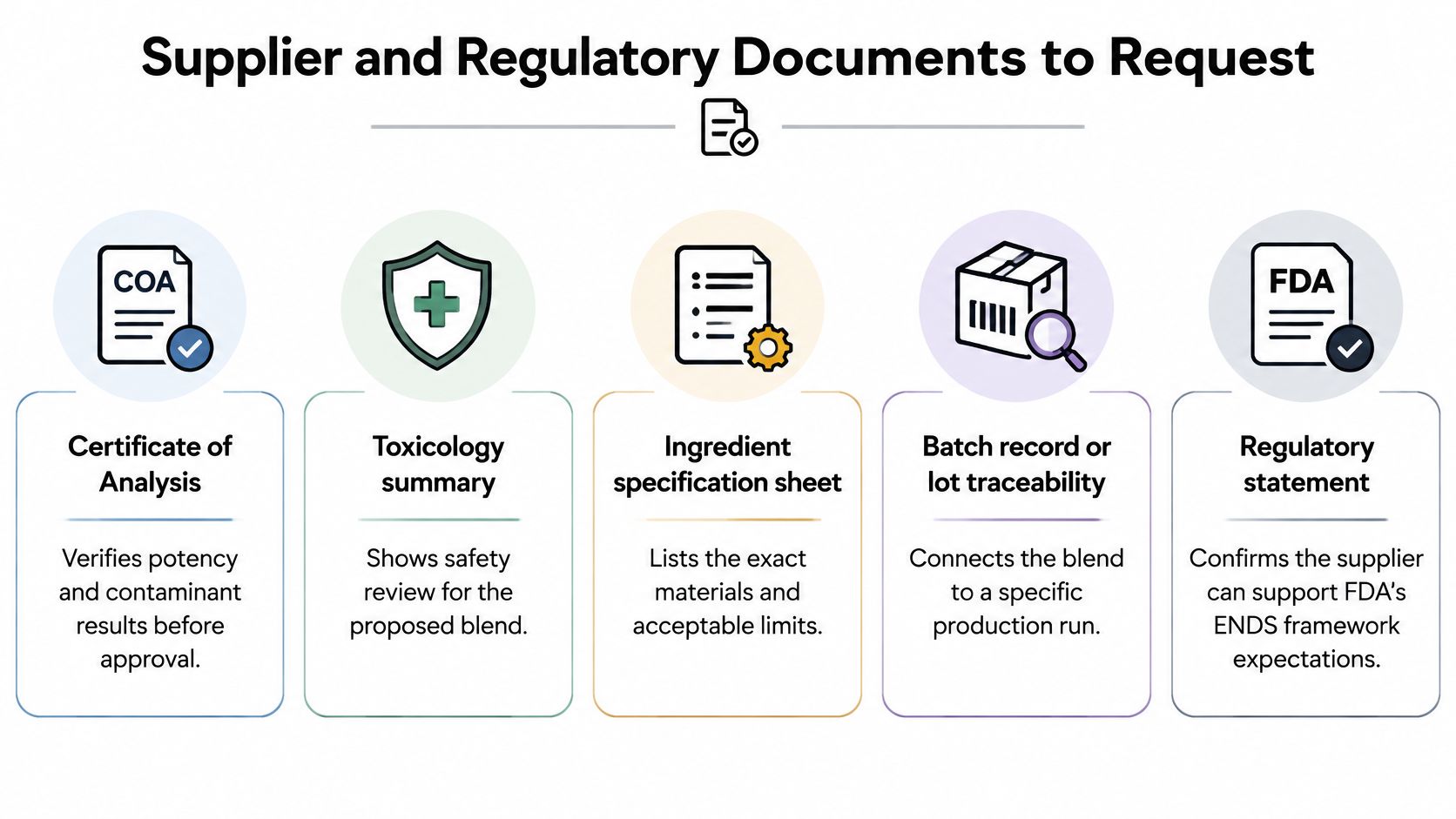
The request list follows from those two points:
- Intended-use statement for the blend, describing inhalation use rather than food use.
- Composition detail for every flavor component, so the formulation team can document each one.
- Certificate of analysis per lot, not a single historic certificate.
- A botanically derived source statement, written plainly.
- Diluent list with approval status, so nothing unlisted reaches the tank.
- Identity, purity, contaminant and residual-solvent records where applicable.
- A traceable lot number tied to your production record, so a blend maps back to a fill.
Approval rule: a supplier can hand you every document on this list and you still owe the product your own regulatory review. Paperwork transfers information, not responsibility.
The safety documentation requirements page shows the shape of a complete file. Build that file and attach it to the batch record before you place a production order.
Request Samples and Documents Before Scaling
Five moves take a blend from a sample request to a production order.
- Request a sample of the blend you're considering through the terpene sample request route, sized for bench work rather than a full run.
- Bench-test it in your own winterized distillate at the target loading and compare against your reference profile. A blend that reads well in isolation can flatten in your base oil.
- Run finished-device aerosol and thermal tests before you scale, including the end-of-life conditions where the wick runs hottest.
- Review the supplier documents and complete your own regulatory review. No supplier statement replaces that step.
- Contact the team for bulk or custom order requirements only after the blend clears steps two through four.
Our cartridge terpenes are SC Lab-tested and legal worldwide, free from additives and from VG, PG, PEG and MCT. The 3ml Strain Picker Pack lets you select any three different terpene profiles from the catalog in 1.5ml or 3ml sizes, which makes side-by-side bench trials practical before you commit to volume.
Confirm every supplier claim, including lab testing status, legal status and product sizes, against current documents before it goes into an internal approval file or any marketing copy. Samples and documents come before production volume, every time.
Gold Coast Terpenes supplies botanically derived, THC-free terpene blends built for cartridge and distillate work, with the lot documentation a formulator can file alongside a batch record. If you're developing a disposable THC vape SKU, run a sample through your own oil and your own hardware first, then let the results set the loading. Visit Gold Coast Terpenes to shop blends, request samples, or contact the team for bulk and custom orders.