
Concentrates purchased from Colorado dispensaries averaged 73.0% labeled THC but 70.7% measured THC in a 2025 peer-reviewed retail study. For a manufacturer, that gap makes a simple point: a concentrated oil isn't automatically a predictable ingredient. When you rebuild its aroma with botanically derived terpenes, you need measured inputs, weighed doses, and finished-batch testing.
Cannabis Distillate Defined and Compared
Cannabis distillate is a highly refined, mostly cannabinoid oil. It's usually clear in appearance, thick, and relatively neutral in smell. Refining removes much of the original plant material and many compounds that contributed aroma.
Unscented soap is a fairly neutral base that you can scent to a written specification. Rosin is more like a bar that still carries its original scent. You can adjust that scent, but you're not starting from the same blank canvas.
Does distillate have terpenes? It can. However, don't assume that a small surviving amount is zero, or that every supplier's oil has the same starting profile. Ask for a terpene analysis of the actual lot.
Compare the base before choosing the blend
Say your team wants a crisp citrus profile without a heavy herbal finish. A neutral base gives you more control over that target. An aromatic concentrate may already contain notes that support, or compete with, your proposed blend.
Concentrate types compared on terpene content and use
| Concentrate | Aroma after processing | Best formulation use |
|---|---|---|
| Cannabis distillate | Mostly neutral; measure residual terpenes by lot | Carts, edibles, and tinctures with a rebuilt flavor |
| Rosin | Keeps more native aroma | Flavor-forward products that need less added terpene |
| Live resin | Strong native aroma | Products designed around a retained plant-aroma profile |
| Wax | Retained herbal aroma shaped by drying and processing | Blends where the base's existing aroma fits the flavor brief |
These are practical selection categories, not terpene specifications. The product name alone doesn't establish terpene content, and there's no verified universal percentage to assign to each row. Use supplier results rather than an assumed category average.
Buying rule: A neutral smell gives you formulation freedom. It doesn't prove purity, stability, or the absence of residual terpenes.
Make the starting profile measurable
During incoming inspection, compare the oil with a retained reference sample under the same conditions. Record appearance, aroma, and flow behavior. Keep sensory observations separate from laboratory results so a light color doesn't become shorthand for an acceptable chemical profile.
Then make three decisions: measure what survived, choose the base that fits the sensory goal, and rebuild the profile with controlled loading. This prevents a common purchasing mistake: buying the base first and asking the flavor team to work around it later.
How Distillate Is Made and What Gets Lost
Commercial refining separates useful fractions from a complex plant extract. It doesn't preserve every part of the starting aroma. Buyers need enough process knowledge to understand the ingredient, without treating a process name as a quality guarantee.
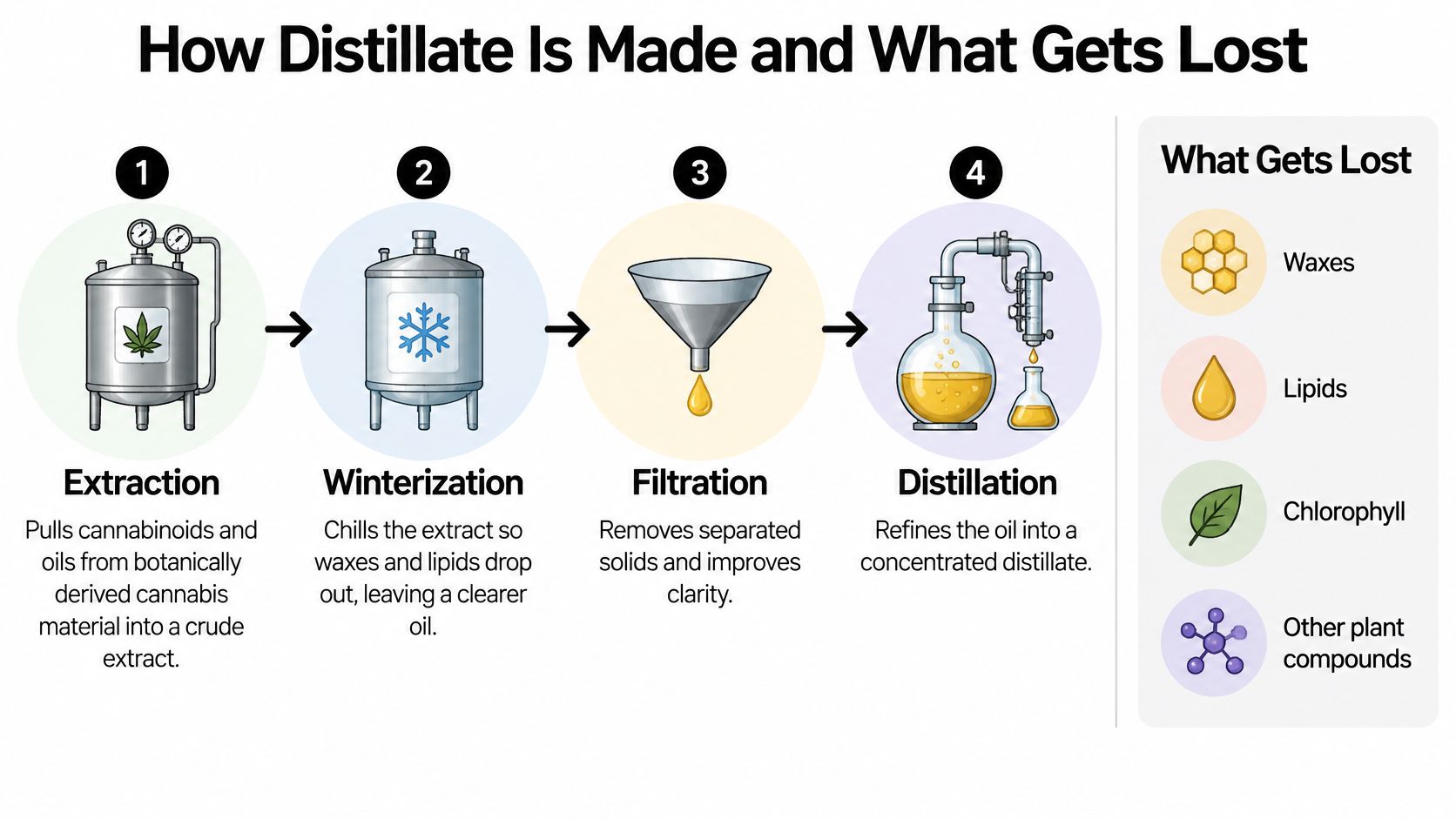
The diagram shows the main separation stages and the plant compounds removed.
Follow the material through processing
Extraction creates a crude oil. A commercial extraction process pulls cannabinoids and oils from cannabis plant material into an initial extract.
Aroma outcome: Some native aroma enters the crude oil, while handling and processing can change what remains.Winterization separates heavier material. Chilling allows waxes and lipids to separate, followed by filtration to remove the solids.
Aroma outcome: Removing waxes improves the base, but it doesn't establish a finished flavor specification.Distillation separates fractions under vacuum. The processor uses controlled heat and reduced pressure to separate compounds by their volatility.
Aroma outcome: Many light, volatile terpenes leave before the heavier cannabinoid fraction is collected.Collection and testing define the saleable lot. The processor collects the selected fraction, samples it, and prepares its quality documents.
Aroma outcome: The finished lot's aroma reflects both refining and any later terpene additions.
Distilling perfume offers a useful analogy. The lightest scents leave first, while heavier material remains. Cannabis refining follows a more complex separation process, but the purchasing lesson is similar: the starting plant's aroma isn't a reliable description of the finished oil.
Ask what happened after distillation
A supplier may sell a neutral base or an oil that already contains a flavor blend. Those are different formulation inputs. Adding your standard terpene dose to a pre-blended oil can produce the wrong flavor and an unexpected total terpene content.
Request the processing record, lot-specific certificate of analysis, and any terpene re-addition history. Check whether filtration, sampling, blending, and packaging records all refer to the same lot.
The accompanying process video provides another way to review the manufacturing sequence.
Approve the base only after its identity and blend history are clear. Treat flavor rebuilding as a separate, documented manufacturing step.
Where Formulators Use Distillate
A cartridge line, an edible line, and a tincture line can start with similar oils and still need different terpene specifications. The finished format sets the requirements. Don't approve a base solely because it worked in another product.
Match testing to the product line
Cartridges come first. Terpenes for cartridges are added to winterized distillate oils to give the product a distinct flavor. Check viscosity in the intended hardware, flavor holding through filling and storage, and heat exposure during operation. The biggest requirement is reliable performance in the actual cartridge, not just easy pouring from a warm vessel.
Edibles place the blend in a different setting. The manufacturer incorporates distillate into a suitable carrier or food system. Check whether viscosity allows even distribution, whether the flavor holds in the finished recipe, and how heat exposure changes the aroma. Evaluate the finished food, since sweetness, fat, and other flavors can change how a terpene profile comes across. The biggest requirement is uniform incorporation without an unwanted flavor shift.
Tinctures use a carrier-oil blend. Check viscosity for filling and dispensing, flavor holding at room temperature, and heat exposure during manufacture. A profile that smells balanced in a concentrated sample may seem sharp in the finished carrier. The biggest requirement is a consistent blend that stays acceptable under its intended storage conditions.
Screen the incoming base
Use a short approval checklist before committing production time:
- Potency documentation: Match the certificate, sample date, and supplier lot to the material received.
- Color: Compare it with an approved reference, but don't use color as a purity test.
- Viscosity: Evaluate flow under the conditions your line uses.
- Re-added terpenes: Confirm whether the base already contains a blend and obtain its composition.
Match the base to the product line you make first. Then write the flavor brief around that format, rather than trying to make a single sensory target fit every application.
Choosing a Terpene Profile to Match Flavor
Start with a written flavor brief, not a favorite ingredient. Name the main note, such as citrus, pine, or spice. Describe the expected mouthfeel and finish using plain terms like rounded, dry, lingering, or clean.
- Write and compare candidate profiles. List the dominant notes and proposed component shares for each candidate. Keep the blend's internal composition separate from its loading percentage in distillate.
- Make weighed bench samples. Add each botanically derived terpene candidate to the same base lot. Use the same preparation conditions so the comparison is fair.
- Evaluate against the brief. Smell the samples, then assess flavor only in an appropriate finished application under your team's approved sensory procedure. Never taste concentrated terpene ingredients directly.
Use aroma roles as a reference
Common terpenes and the flavor each builds
| Terpene | Common aroma note | Profile role |
|---|---|---|
| Limonene | Citrus peel, lemon, orange | Bright top note |
| Myrcene | Earthy, herbal, musky | Body and base note |
| Beta-Pinene | Pine, fresh, sharp | Forest and fresh accent |
| Alpha-Humulene | Hoppy, woody | Herbal and beer-like accent |
| Beta-Caryophyllene | Peppery, spicy, woody | Warm spice finish |
Alpha-Humulene contributes to cannabis's hoppy aroma. Beta-Pinene contributes a familiar pine-like odor, sometimes described as turpentine-like. These descriptions identify aroma, not ingredients to substitute into a formula.
Use the terpene flavor chart to translate sensory words into candidate components. Request a full composition statement, then record each result beside the base lot and blend lot. Scale the closest match only after the sample passes both sensory and laboratory review.
Dosing Terpenes Into Distillate Batches
For a hypothetical 1 kg finished batch at a 4% terpene target, weigh 40 g of terpene blend and 960 g of distillate. The finished batch weighs 1 kg. You're not adding 40 g to an existing kilogram of oil.
That distinction matters. Like salt in a finished soup, the percentage describes the whole mixture, not just the amount added to the pot.
Calculate from finished batch mass
Use these equations for a base with no measurable starting terpenes:
Terpene grams = finished batch grams × target percentage ÷ 100
Distillate grams = finished batch grams − terpene grams
The following values are calculated examples, not recommended loading levels.
Terpene and distillate grams per batch at common target loads
| Target load | Terpene per 100 g batch | Distillate per 100 g batch | Terpene per 1 kg batch |
|---|---|---|---|
| 2% | 2 g | 98 g | 20 g |
| 4% | 4 g | 96 g | 40 g |
| 6% | 6 g | 94 g | 60 g |
| 8% | 8 g | 92 g | 80 g |
| 10% | 10 g | 90 g | 100 g |
For the kilogram examples, subtract the terpene mass from the finished batch mass to find the distillate mass. If the base already contains terpenes, include that contribution in the mass balance. Also account for any other ingredients before calculating the final percentage.
The terpene calculator can help check mixing arithmetic. Keep the calculation with the batch record and have another trained operator verify the planned weights.
Leave room below the legal ceiling
The New York cannabis testing limits set a 10% maximum total-terpene content for vaporized or inhaled products, with a 15% permitted testing variance, producing an 11.5% upper reported limit; terpenoids are reported as a percentage by weight. That testing allowance isn't a recipe target.
Formulate below the legal ceiling. A testing allowance is not extra room to add flavor.
Your internal target should leave room for incoming-material differences, measurement uncertainty, and mixing variation. A legal maximum also doesn't establish a suitable loading for every blend, device, or application.
During production, weigh ingredients on a calibrated scale. Bring the distillate only to a workable temperature within your validated process, then add the botanically derived terpenes and mix until uniform. Keep the vessel covered where practical to limit unnecessary aroma loss.
Log actual ingredient weights, supplier lots, mixing conditions, and transfer losses. Set the target load, verify the math, and confirm the weighed amounts before filling.
Heat, Storage and Batch Stability Checks
A blend can change after you make it. In a 2024 evaluation of cannabis-labeled vape liquids, thermal degradation increased measured THC levels, while storage and temperature exposure caused CBD to transform into other cannabinoids. Treat distillate as a changing chemical mixture, not an inert oil.
Build a stability checklist
- Keep fresh and aged retains. Store matched samples under controlled conditions and compare them with the release sample.
- Use a suitable analytical method. Ask the laboratory for validated HPLC separation of THC, CBD, CBN, and relevant isomers.
- Record heat history. Log processing and filling temperatures, plus time spent at high temperatures.
- Set drift specifications. Define acceptable changes in cannabinoid results, not just acceptable starting values.
- Check terpene retention. Test aroma composition in the intended packaging and storage conditions.
- Evaluate the finished device. Screen emissions using the intended hardware and operating range, rather than relying only on liquid testing.
A falling potency result can reflect chemical conversion, not just evaporation or a sampling problem. Ask the laboratory to review degradation markers and chromatographic peak shapes. An unexpected increase also deserves investigation.
Separate retention from loading advice
A peer-reviewed cannabis-storage study found that 1.18% by weight of an external terpene mixture was the minimum needed to maintain initial terpene content in cannabis inflorescence after six weeks. That experiment used flower, not distillate cartridges. Treat the result as a starting hypothesis for retention work, not a loading recommendation.
Heating also changes the relevant test question. ACS Omega aerosol research found that adding terpenes to THC distillate increased gas-phase degradation products compared with THC alone. Liquid composition therefore can't fully describe the finished aerosol.
Release standard: Approve the blend as it will be packaged, stored, and used, not just as it looks immediately after mixing.
Use the oxidation prevention guide when planning handling controls. Write the stability plan before the first production run, including sampling points, test methods, acceptance limits, and who can approve a change.
Compliance Limits and Labels for Blended Distillate
Start with the rules in the market where the finished product will be sold. Nevada's terpene guidance limits terpene content to 10% of the final product, requires the specific percentage in standard operating procedures, and calls for ingredient percentage ranges; it also expects 100% pure terpenes when possible, with near-pure formulations reviewed case by case.
Build disclosures from actual batch records
- Obtain the composition statement. Keep the document for the blend lot used, not just a general product description.
- Calculate finished component shares. Start with weighed inputs and verified composition. Don't treat mass and volume percentages as interchangeable.
- Check disclosure thresholds. The New York terpene-profile requirements require disclosure of added terpenes at 0.2% or more of final total volume, the three highest-concentration terpenes, and total terpene percentage.
- Reconcile the documents. Match the ingredient statement, finished profile, laboratory results, and applicable total-content limit.
- Retain traceability. Connect every blend lot to its finished batch specification and certificate of analysis.
Our product terpene information is provided by SC Labs. Keep that ingredient information separate from the finished-product evidence your own release process requires.
Use the regulatory compliance checklist to organize the review. Build the label from the released batch record, not an old recipe card.
Request Samples Before Your Next Batch
Request samples before committing to a production run. A small comparison lets your team judge a botanically derived terpene profile against the actual flavor brief, base oil, and finished format. A catalog description can't replace that test.
Prepare a useful sample request
Give the supplier enough information to narrow the options:
- Flavor brief: State the main note, unwanted notes, mouthfeel, and finish.
- Application: Identify the carrier, product format, and relevant processing conditions.
- Target loading: Share the proposed mass-based dose and any existing terpene content.
- Documentation: Request a composition statement, certificate of analysis, dosing information, lot traceability, and written botanical-origin confirmation.
Keep sensory observations and laboratory results together. If a sample smells promising but fails the finished-format test, revise the brief before ordering bulk terpenes. If it passes, retain an approved reference so later deliveries can be compared fairly.
We work with manufacturers and brands, distributors, shops, and independent reps. Gold Coast Terpenes also runs affiliate programs. Route the request according to your role, and identify who will approve the technical documents and final sensory match.
A useful purchasing decision starts with a tested sample and a clear acceptance standard. It doesn't start with the largest available container.
Gold Coast Terpenes offers botanically derived terpene blends for rebuilding aroma in distillate-based formulations. Visit Gold Coast Terpenes to shop blends, request samples, or contact our team about bulk or custom orders. Send your flavor brief and target load so we can help identify a starting blend for your evaluation.