
Terpenes aren't universally legal or illegal. Legality depends on where the terpene came from, the route your finished product takes (inhaled, eaten, applied to skin, or used only as a formulation ingredient), and the jurisdiction where you sell it, and some states cap total terpenes in inhaled products at 10 percent of the finished product while others restrict which terpenes count at all.
So when a supplier tells you a blend is legal, the question back isn't "legal where." It's "legal in what." Limonene you can lawfully pour into a beverage at flavor strength can put a vape cartridge out of compliance the same week, in the state next door, with no ingredient changing.
That gap between buying a terpene and using it in a product is where cartridge brands and extractors get caught. The fix is to stop asking one question and start asking three.
Legal Depends on How You Use It
Split the question into three parts and the answer gets useful. Can I legally buy this terpene? Can I legally put it in this specific product? Can I legally sell that finished product in this market? A supplier can only answer the first one.
A single legal status doesn't exist to check against. TTB presentation materials on cannabis formulas describe terpenes as either plant-sourced or lab-synthesized, and they draw a sharp line between individual synthetic terpenes that FDA food regulations authorize (including substances covered by 21 CFR 182.60) and botanical extracts from cannabis or hemp, which those same food authorizations don't automatically cover. For hemp-derived terpene mixtures headed into food or alcoholic beverages, TTB points businesses to the FDA food-additive framework, meaning premarket approval or a substantiated Generally Recognized as Safe basis.
None of that changes because a certificate says THC-free. A THC-free product still meets different rules depending on whether it's inhaled, consumed, added to food, or used purely as an ingredient.
The buyer's split: a purchase order answers whether you can buy the terpene. It never answers whether the finished product is compliant.
Here's the practical version, sorted by the route your product takes.
| Product route | Main rule to check | Key document to request |
|---|---|---|
| Inhalable cartridge or vape | State inhalation rules, concentration caps and permitted ingredients | Route-specific compliance documentation and lot-level certificate of analysis |
| Food or beverage | Food additive status, GRAS basis or premarket review | Regulatory citation or GRAS support for the exact blend |
| Cosmetic or topical | Cosmetic labeling and ingredient rules | Full ingredient list and safety data sheet |
| Isolated synthetic terpene in food | May be authorized under existing food regulations | Regulatory citation and product specification |
| Botanical blend used only as a formulation ingredient | Final product route plus the market where it's sold | Blend composition and written intended-use statement |
Find your row before you read further. If you make cartridges, the binding rules for you are the inhalable row, and the caps and paperwork in that row are what the rest of this piece keeps returning to. If you make beverages, your fight is with food-additive status and GRAS support, which is a different conversation with different documents.
The Four Factors That Decide Terpene Rules
Think about flour. A bakery can put flour in bread without a special authorization, because bread is a food and flour is a known food ingredient. Put the same flour into a dietary supplement, or ship the bread across a state line into a market with its own labeling rules, and the compliance picture changes while the flour doesn't. Terpenes behave the same way.
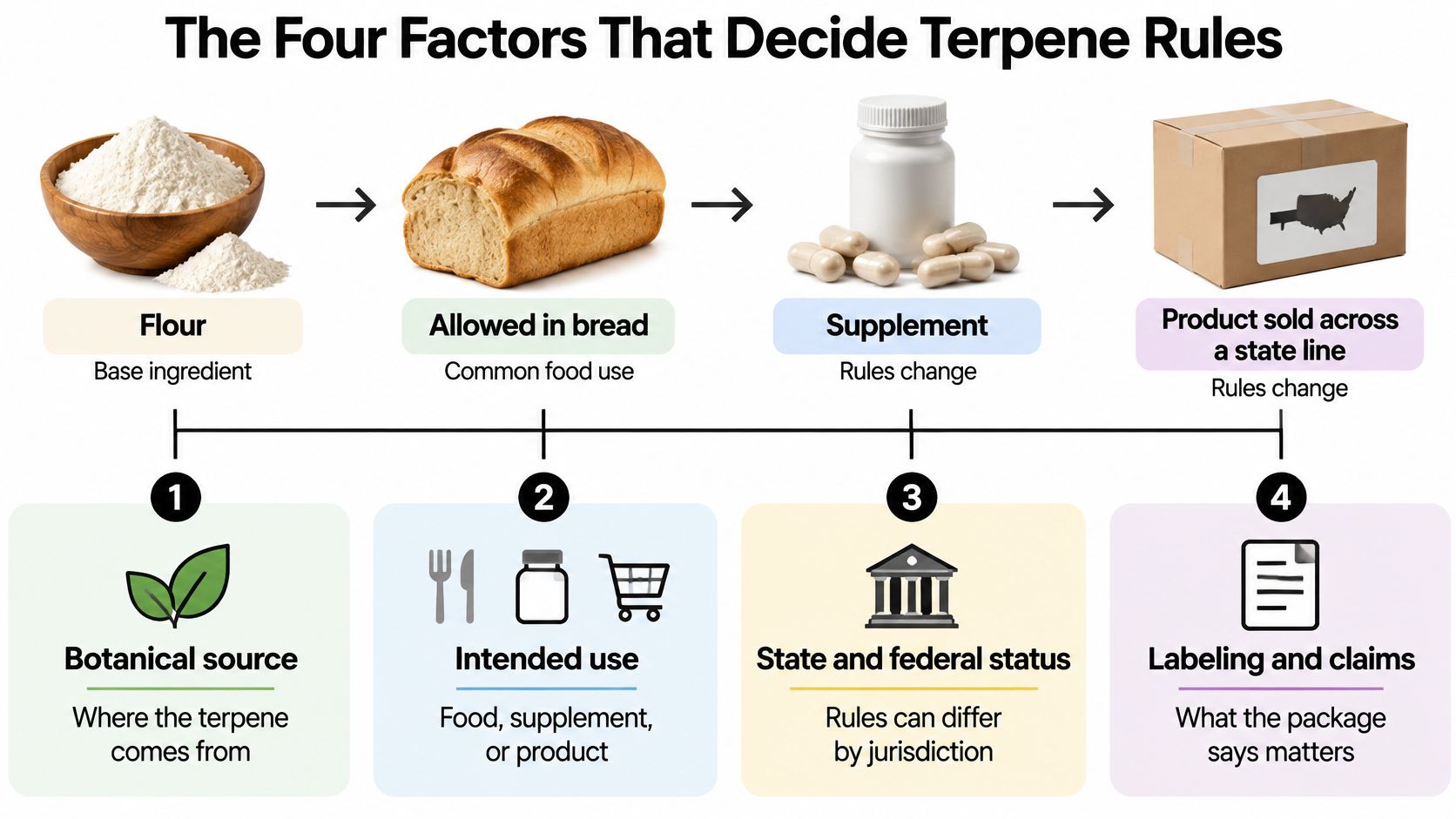
Four factors decide how your blend is treated. Work through them in order.
Factor One, the Source Material
A botanically derived terpene is extracted from plant material, whether that's citrus peel, pine, or another non-cannabis plant. A synthetic terpene is built in a lab. Regulators treat these as separate categories rather than as one ingredient with two origins, which is why a document that covers a synthetic isolate tells you nothing about a botanical blend.
Factor Two, Chemical Identity
An isolated compound like limonene or myrcene gets judged as a single substance. A botanical blend is a mixture of dozens of compounds, and mixtures face a different review path. This is the factor buyers skip most often, because two suppliers can both sell "limonene" and be selling very different regulatory objects.
Factor Three, Intended Use
Inhaled, eaten, drunk, applied to skin, or used as a formulation ingredient. Each route triggers its own rule set, and route-specific safety questions don't transfer between them.
Here's a short walkthrough of how route and jurisdiction interact in practice.
Factor Four, Jurisdiction
Federal, state, and national rules can all land on one product at once. The 2018 federal hemp framework is the cautionary case. It legalized hemp production, but it did not make every cannabis-derived ingredient lawful in every category. FDA's guidance on cannabis-derived products states that, apart from three hemp-seed ingredients (hulled hemp seed, hemp-seed protein powder, and hemp-seed oil), no other cannabis-derived ingredients had been approved as food additives or evaluated through an FDA GRAS notification in the cited guidance. FDA also notes that a substance intentionally added to food is generally a food additive subject to premarket review unless an exemption such as a valid GRAS basis applies.
Sort your own product across the four factors on one page. Whichever factor you can't answer with a document is the one to research first, not the one to guess at.
Concentration Caps and Inhalation Paperwork
A bottle of lawful terpenes can still produce a noncompliant cartridge. The cap applies to the finished product, and every compound in the blend counts toward it. Run the arithmetic on a 1 gram cartridge with 0.12 grams of a botanical blend added. That is 12 percent terpenes by mass, and the cartridge fails even though each ingredient in the bottle was legal to buy.
New York's 2025 testing limits make the point concrete. The New York Office of Cannabis Management testing limits require terpene testing for all cannabis products and restrict vaporized or inhaled cannabis products to 10 percent total terpenes, with a permitted 15 percent variance. A 12 percent fill is over the line before anyone starts arguing about variance.
Where the Caps Land in Each Market
| Jurisdiction | Terpene rule | What it means for your blend |
|---|---|---|
| New York | Total terpenes capped at 10% for vaporized or inhaled cannabis products, with a 15% variance | A blend can fail even when each ingredient is lawful |
| Nevada | Terpene content limited to 10% of the final product | Check both concentration and inhalation status |
| California | Added terpenes must be naturally occurring and contribute to cannabis aroma or flavor; artificial or synthetic terpenes excluded | Document the flavor or aroma purpose of every terpene |
| Other states and countries | Rule set by the official regulator in that market, often alongside the finished-product testing rule | Confirm current requirements before formulating |
Nevada's reasoning is worth reading closely. Nevada Cannabis Compliance Board terpene guidance permits terpenes in cannabis products because they occur naturally in cannabis, while noting that terpenes are not currently classified as safe for inhalation in the FDA Inactive Ingredient Database. Permission and safety recognition are two different things, and the board says so in writing.
California's inhaled-product rules run the other way, narrowing what counts. The California cannabis inhaled products guidance limits added terpenes to naturally occurring compounds consistent with cannabis aroma or flavor, which leaves artificial and synthetic terpenes outside the permitted set.
Where a market has not defined a term like "botanical terpene" for inhalable additives, the ambiguity itself is the risk. Assume the burden sits with you: name each botanical source, state the intended use, and hold third-party test results for the lot. An undefined term is a question your paperwork has to answer, and a supplier sales sheet rarely answers it.
The Paperwork Trap
A food-grade statement is not an inhalation authorization, and treating one as the other is the most common compliance mistake in cartridge sourcing. A peer-reviewed review of inhaled flavor ingredients reports that flavor compounds can occur at concentrations more than 10,000 times higher in vaping products than in food, while food-use safety assessments generally don't evaluate inhalation exposure. The same paper notes that FEMA and EFSA don't treat food-use approval or GRAS status as proof a flavoring is safe to inhale.
Ascending terpene load also changes how the product behaves. Viscosity, aerosol generation, thermal decomposition, sensory intensity, and consumer exposure all shift as percentage climbs, even when every individual compound is legally sold for other uses.
Practical rule: set an internal maximum below the lowest cap in every market you sell into, verify the final percentage on each batch, and treat any unknown cap as a stop until the regulator confirms it.
Before you sign off on a blend for carts, request route-specific documentation in writing: the full composition with each botanical source named, a lot-level certificate of analysis, and a stated intended use for inhalation. If the answer comes back as a food-grade sheet, you don't have an answer yet. The same reasoning applies whether the compound is limonene, myrcene, or a full profile, which is why the question of whether terpenes are safe to vape sits beside the legal one rather than underneath it.
Flavor Matching and Dosing Ratios for Your Blend
Turn the cap into a number you work with. Four steps cover it.
- Set a target total percentage below your lowest market cap. If you sell into a market with a 10 percent limit, pick something with real headroom, because your fill weight and your scale tolerance both introduce error.
- Convert the percentage into grams. Multiply fill weight by target percentage. A 1 gram fill at 8 percent is 0.08 grams of blend, not a splash.
- Build the flavor from botanically derived components, then test small. Match the aroma you're targeting, mix a small batch into your own distillate or cart base, and evaluate before scaling. Record the formulation rationale for each batch while you're at it.
- Weigh every component and keep the weights. A calibrated scale and batch records are what let you prove the final percentage against your internal maximum later.
| Fill weight | Target total terpenes | Blend to weigh |
|---|---|---|
| 0.5 g cartridge | 6 percent | 0.03 g |
| 1 g cartridge | 6 percent | 0.06 g |
| 1 g cartridge | 8 percent | 0.08 g |
| 10 g distillate batch | 5 percent | 0.5 g |
More terpene doesn't automatically mean more flavor. Past a point, extra load muddies the profile and pushes you toward a ceiling you may not be allowed to cross, which is why concentrated flavor design at lower total loading usually beats dumping in more oil.
Loading more terpenes than the profile needs is the fastest way to spend money on a cartridge you can't sell in your best market.
Run your numbers before the sample arrives. Our mixing calculator and the Mixing Calculator on our site both handle loading ratios, and doing the math first tells you what volume you can afford to test.
Pre-Buy and Pre-Sale Compliance Checklist
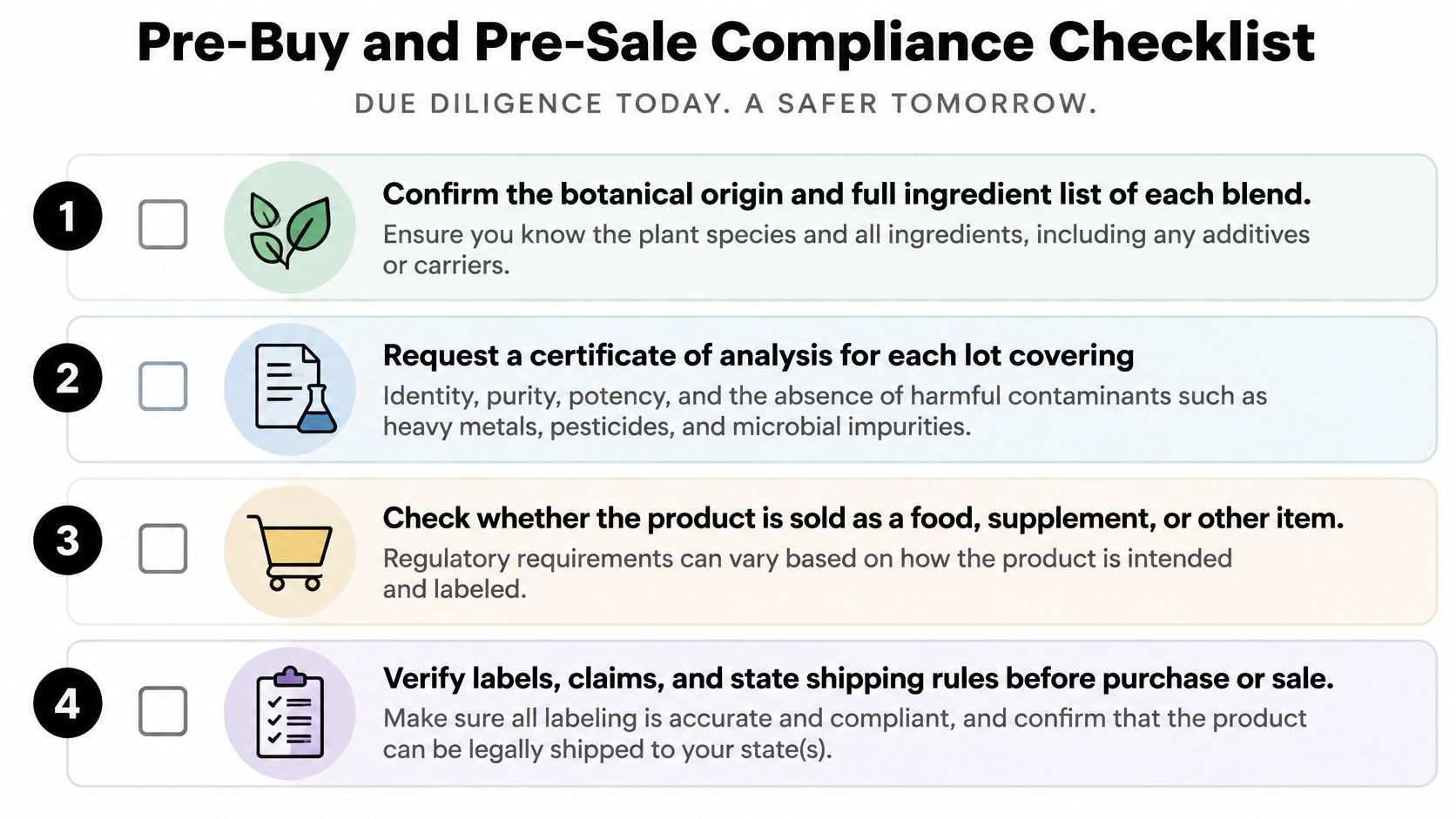
A terpene can be legal to purchase and still fail the rules for the product you put it in. The route of use and the concentration cap make that call, so run this checklist before any purchase order. Once the pallet lands, the answer is already locked in.
- Confirm botanical origin and the full ingredient list for each blend. A blend name isn't an ingredient list. If the supplier won't name the components, you can't check them against any rule.
- Request a certificate of analysis for each lot. It should cover potency, residual solvents, pesticides, and heavy metals. A COA from a different batch proves nothing about yours.
- Get the intended route in writing. Inhaled, edible, topical, or formulation ingredient only. A supplier who states inhalation use has told you something a food-grade sheet never will.
- Work out the terpene percentage by mass of the finished product. Compare it with the lowest cap in every market you ship to, and file the calculation with the batch record.
- Record a flavor or aroma purpose for every terpene in the blend. The California inhaled products guidance limits added terpenes to naturally occurring compounds that contribute to cannabis flavor or aroma, and it excludes artificial, synthetic, and natural flavorings that don't contribute to that profile. A written rationale turns a marketing name into a defensible position.
- Check every label claim for accuracy and cut health claims. Claims travel with the product into every market, and one overstated line follows the whole SKU.
- Keep batch records that trace each lot to its documents. When a buyer or a regulator asks six months later, the file is either there or it isn't.
Selling across state or national lines adds one more check: confirm the rules where the finished product will be sold, not only where it's made. A blend that clears one market's product rule can fail the next market over.
The document request gets easier when you know what to ask for. The Terpene Safety & Documents page on the Gold Coast Terpenes site holds the safety documentation for the blends, and our regulatory compliance checklist puts the request sequence on one page.
Check Local Rules and Take the Next Step
The correct answer depends on your route, your location, and your loading, and all three move. Cap numbers get revised, database entries get updated, and a state that published nothing last year can publish guidance this year. Treat every compliance conclusion as dated: write down the day you checked and the version of the document you read, then check again before a production run.
Three steps get you from uncertainty to a defensible decision.
- Match your product to a route and list the documents that route requires. Inhalable, food, cosmetic, and ingredient-only products each carry a different document set, and a COA that satisfies one route proves nothing for another.
- Confirm current caps and labeling rules in every market you ship to, and date the check. A compliance file without a date tells you what was true once, not what holds today.
- Pull the COA and composition sheet for each blend before you order, then run a small test batch in your own base. A gram-scale trial in your distillate catches flavor mismatch and loading error before the mistake reaches drum scale.
Then buy. Choosing botanically derived blends and isolates is the easy part once the documents line up, and a small first order doubles as your compatibility test. For bulk terpenes or wholesale pricing, call Gold Coast Terpenes at 929-356-6086 and give us the route and the market you're formulating for, because that's what determines which documents you need. If the rules in your state are unclear, start with our business licensing requirements guide and work outward from there.
A dated file and a tested blend beat a fast purchase order.
Gold Coast Terpenes supplies botanically derived blends, strain-specific profiles, and isolates such as Limonene, Myrcene, and Beta-Caryophyllene, SC Lab-tested and THC-free. Browse blends, isolates, and the Terpene Safety & Documents page at Gold Coast Terpenes, confirm your market's current caps, and place the order your compliance file supports.