
Which extraction method does your building allow, and what will that method leave you to rebuild in the finished oil? Most buyers answer a different question first, usually vessel size, pounds per hour or sticker price. Then the first batch of distillate comes back with a thin aroma panel, and the spec sheet has nothing to say about it.
Those two questions, flavor and facility, decide more of your cartridge than capacity does. The method sets the risk profile of the room and the terpene profile of the base oil you inherit. Dosing and blending come later, and they're repair work on whatever the extractor handed you.
I judge extraction hardware on two scores, and neither is capacity. Can it run legally and safely in the room you have, and does the oil it produces move you closer to the flavor you sell? A machine that fails either test is a bad buy at any price.
Equipment Types Compared at a Glance
Choose the method before you compare machine size or price. The method sets two things you can't buy back later: the hazard controls your facility needs, and the aroma compounds that survive into your blending tank. No dosing plan rescues a base oil that lost its light terpenes in the extractor.
Supercritical carbon dioxide is one of the most widely used commercial cannabis-extraction technologies, mainly because it recovers cannabinoids without leaving toxic solvent residues. A published review of supercritical CO2 processing lays out what an industrial system contains: a pressurizing device, a high-pressure extraction vessel, separators, a solvent-recovery system and heat exchangers. The method holds CO2 above its critical point, about 31 °C and 1,070 psi, where it penetrates plant material with gas-like reach and dissolves target compounds with liquid-like solvency.
The same review shows how much the settings inside that hardware change the output. A 60 kg biomass run of four hours at subcritical 10 °C and 60 bar returned an 8.4% extract yield and 72.9% CBD recovery. Supercritical conditions of 40 °C and 100 bar lifted those figures to 10.7% and 79.5%. Pressure, temperature, residence time, biomass loading and separator configuration all move yield, recovery, purity and terpene preservation at once, which is why the extractor belongs in the formulation conversation, not just the capital budget.
The other three families
Ethanol works as a wash or a co-solvent. It's fast, it's food-grade, and cold ethanol can pull terpenoids more efficiently than CO2 does, but you inherit solvent recovery, flammability controls and a winterization step to strip the waxes it also dissolves.
Hydrocarbon runs a flammable light solvent through a closed loop. It's selective and it runs cold, and it demands classified electrical equipment, gas monitoring and ventilation built for vapor, not just odor.
Solventless mechanical separation uses pressure, heat or sieving with no chemical solvent at all. The residue risk drops to zero. The pressure, heat, sanitation and maintenance risks don't.
| Method | How It Works | Main Strength | Main Trade-off |
|---|---|---|---|
| Supercritical CO2 | Pressurized CO2 held above 31 °C and 1,070 psi | No solvent residue; widely used commercially | Settings must be tightly controlled to protect terpenes |
| Ethanol co-solvent | Ethanol added to extract or wash plant material | Can improve extraction; cold ethanol can outperform CO2 for terpenoids | Solvent recovery and flammability controls |
| Hydrocarbon | Flammable light solvent run in a closed loop | Selective extraction at low temperature | Hazardous-area electrical and ventilation requirements |
| Solventless mechanical | Pressure, heat or sieving with no chemical solvent | No chemical solvent to remove | Operational hazards and sanitation still apply |
The market reflects how dominant the CO2 route became: the global supercritical extraction equipment market was valued at USD 0.59 billion in 2025 and is projected to reach USD 1.16 billion by 2034, according to Dataintelo's supercritical extraction equipment forecast. For the wider field, including ethanol, hydrocarbon and mechanical systems, solvent extraction methods compared is worth reading before you shortlist.
How Equipment Fits Your Production Workflow
An extractor only decides one thing on its own: what leaves the vessel. Everything that turns that crude into a cartridge oil is a sequence, and each step has a piece of equipment and a check attached to it. Run the steps in order and the flavor you build later is repeatable. Skip a check and you'll spend a week hunting a problem you could have logged in a minute.
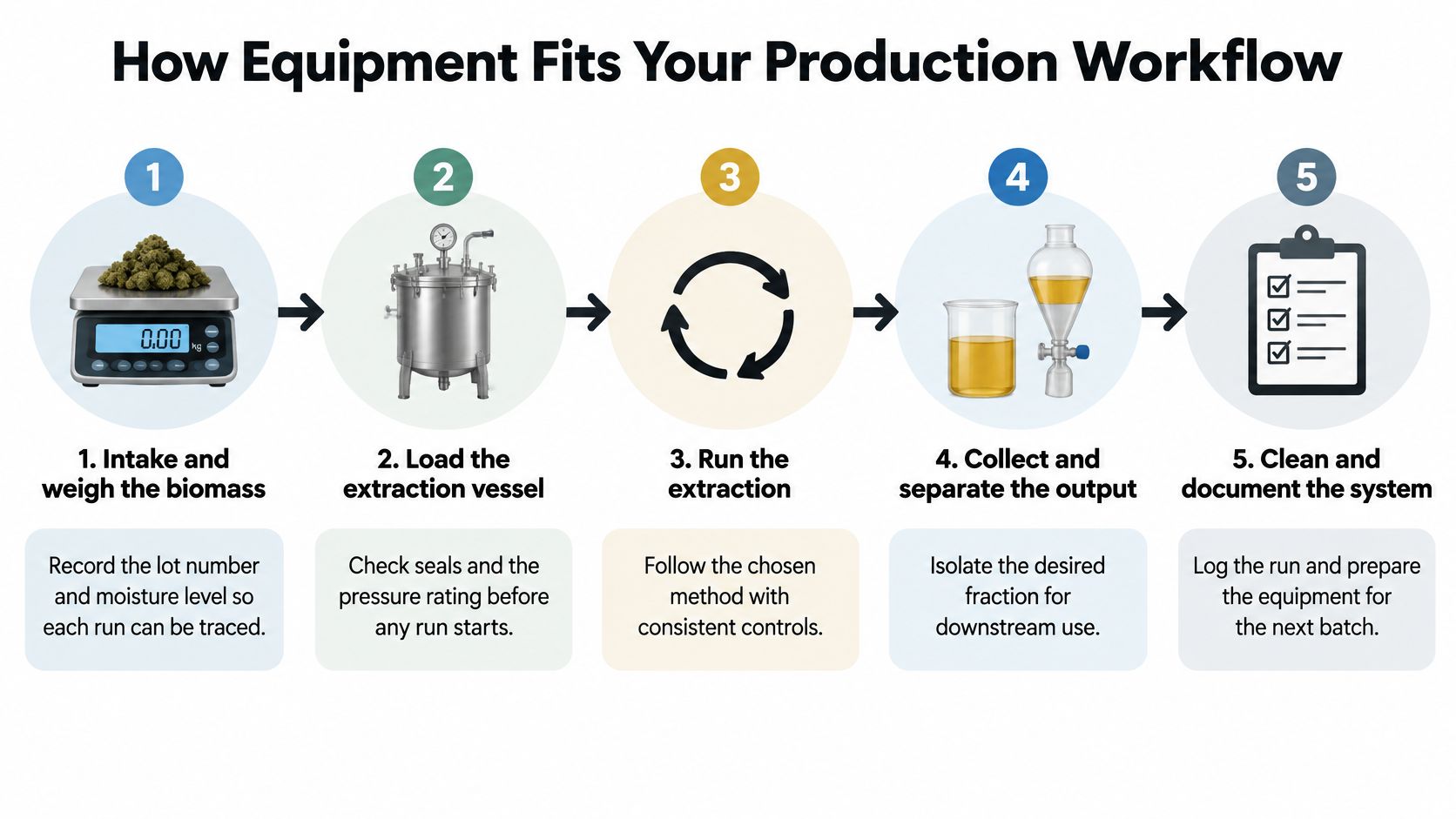
Six steps from biomass to base oil
Intake and weigh the biomass. Use a calibrated floor scale and record the lot number and moisture reading at the same time. Moisture shifts extract weight and yield, so the check is that the reading is logged, not estimated, before the material goes anywhere near the vessel.
Load the extraction vessel. Fill evenly so the CO2 or solvent flows through the bed rather than channeling past it. The check is a seal inspection and a look at the vessel's pressure rating against the run you've planned.
Run the extraction at your set pressure, temperature and time. Log every cycle as it happens, not from memory at the end of the shift. The check is that the logged numbers match the batch record, cycle by cycle.
Separate and recover. The separator drops pressure so the CO2 or solvent leaves the extract, and the recovery system sends it back for reuse. The check is separator pressure and recovery volume per run, because a drifting separator shows up as a wetter or drier crude.
Winterize and clean the crude. Dissolve the crude in ethanol, chill it, then filter or centrifuge out the fats and waxes. The check is filter grade and the wax load on the filter, which tells you whether the winterized distillate oil will stay clear in a cartridge.
Test the base oil before handoff. Send the winterized oil for a cannabinoid potency panel and a terpene panel. The check is a certificate of analysis compared against your last approved lot. Formulation only doses terpenes after that comparison lands.
Practical rule: The separator and the vessel seal are the two components that quietly ruin batches. Put both on a weekly inspection, not an annual one.
Records that make a flavor problem traceable
Keep four things per batch: lot numbers, run settings, recovery volumes and test results. Those four let you trace an off-flavor back to the biomass, the run, the winterization or the blending step, in that order. Without them, every quality complaint becomes a full re-test of the whole process.
Operating Settings That Change Yield and Terpene Retention
Pressure alone doesn't set quality. Extraction runs as a pressure, temperature and time system, and the interaction matters more than any single number on the dial. Raising CO2 density improves solvent power and mass transfer through the plant material, while a moderate temperature limits thermal degradation and loss of volatile compounds. Push pressure for yield and you can pull aroma out of the oil at the same time.
In a controlled cannabis study reported in research on CO2 extraction parameters, the highest cannabinoid yield under the tested conditions came at 37 °C and 250 bar for 180 minutes, with CO2 density reaching 893.7 kg/m³. The same work notes a Helix system maximum of 60 °C and 700 bar, which is the clearest illustration of the central mistake: a vessel's maximum rating is not its best operating window.
| Condition | Yield | Recovery | Note |
|---|---|---|---|
| Subcritical: 10 °C, 60 bar, 4 hours | 8.4% | 72.9% CBD | Lower pressure, lower yield and recovery |
| Supercritical: 40 °C, 100 bar | 10.7% | 79.5% CBD | Higher pressure lifted both yield and recovery |
| 37 °C, 250 bar, 180 minutes | Highest in tested study | Not reported; the study ranked cannabinoid yield | CO2 density 893.7 kg/m³ |
| 60 °C, 320 bar, 600 minutes, 150 g/min CO2 | Reported as the study optimum, no single yield figure | Reported as the study optimum, no single recovery figure | Design-study optimum on 500 g samples; production results differ |
Why the rows move the way they do
The subcritical and supercritical pair shows the pressure effect with everything else held steady. The 37 °C row shows what happens when you raise pressure without cooking the oil. The 60 °C design-study row shows the trade at the other end: longer residence time and higher flow buy recovery, and you pay for it in cycle time and utility load.
Pick the lowest temperature that still hits your recovery target. Terpenes you keep are cheaper than terpenes you buy back.
A three-condition test plan
Don't copy a published recipe into your own vessel. Run three small batches instead, at a low, middle and high point on your pressure and temperature range, and measure four outputs on each: cannabinoid yield, recovery, terpene retention and cycle time. Choose the condition that balances those four for your product. For a cartridge oil, terpene retention usually beats the last two points of yield. For a CO2 extraction overview, the same logic applies to any pressure-driven system.
How Extraction Shifts the Terpene Profile You Blend Back
The extractor has already edited your flavor before the base oil reaches your bench. In research on how extraction changes terpene content, cannabinoid concentration rose from 20.5% in flower to 71.6% in the extract, while total terpenoid content moved only from 2.2% to 2.4%. Potency climbed by more than three times. Aroma barely moved, and the process wasted limonene in particular while shifting the extract toward sesquiterpenes.
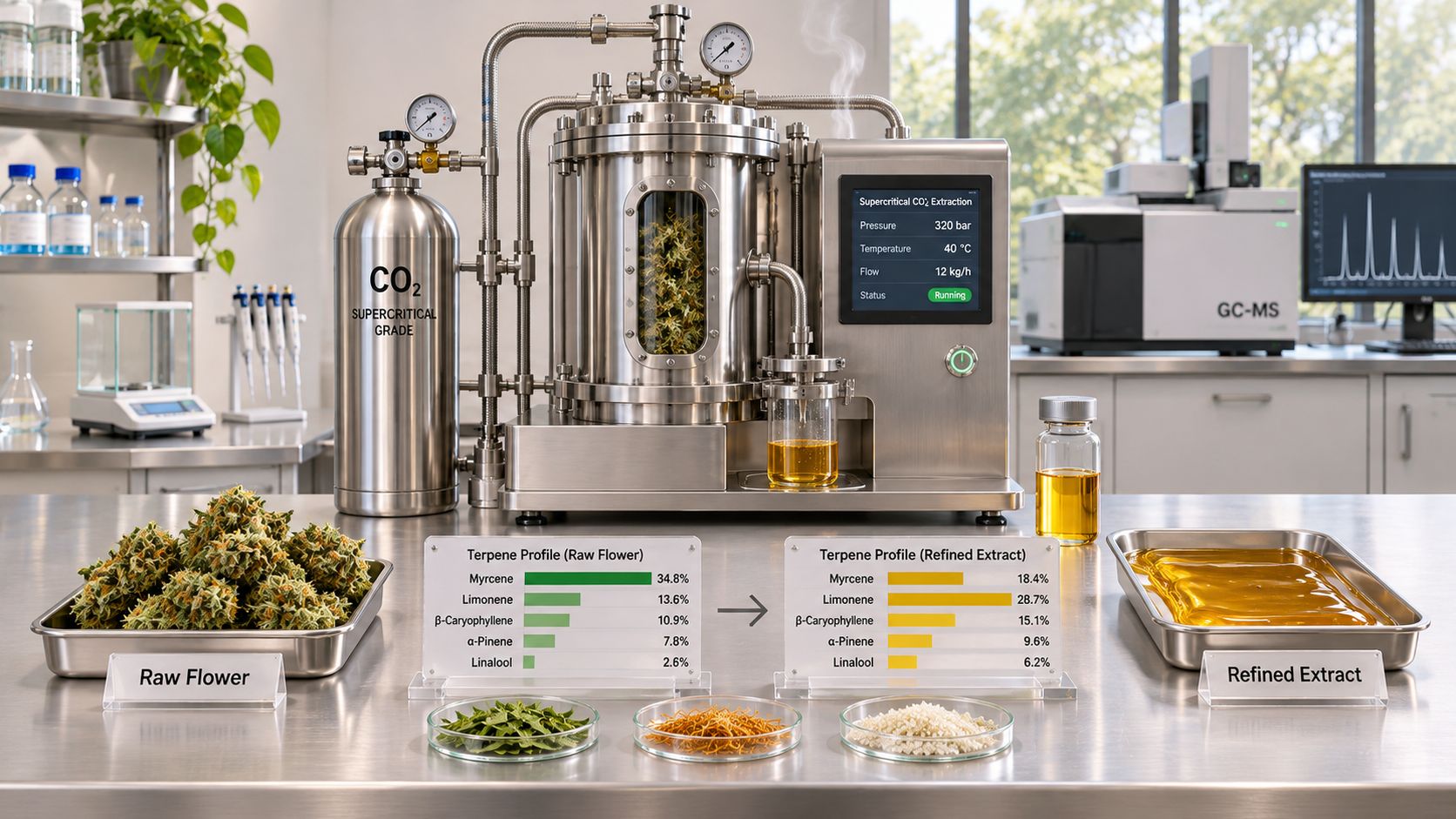
That's the gap a potency certificate hides. A COA showing high cannabinoid content tells you nothing about whether the oil still smells like the cultivar it came from. A separate review of co-solvent and terpene behavior in CO2 extraction found the same pattern: THC and CBD concentrations rose while terpene levels dropped significantly after supercritical CO2 extraction. An extractor tuned for cannabinoid recovery hands you a stronger, flatter oil.
Four steps to rebuild the profile
- Compare the incoming COA and terpene panel against your last approved lot, terpene by terpene.
- Choose a flavor target, citrus or floral or gas, and write it as a percentage range for each key compound.
- Dose botanically derived terpenes into winterized distillate in small trial loads, at 1%, 2% and 3% by weight, and test each one.
- Record flavor, viscosity and cartridge performance at every load, so the winning ratio is a number on a sheet rather than a memory.
Terpenes for cartridges get added to winterized distillate oils to set the flavor, and our terpenes are extracted from fresh plants with no added chemicals. This walkthrough covers the blending side of the same problem.
Compliance Limits and Supplier Documentation
Terpene dosing has hard ceilings in some markets, and the ceiling applies to the finished product, not to the bottle you bought. Write the batch formula before you blend, because a formula you can defend in an inspection is worth more than a blend that tastes right once.
Two state ceilings worth designing around
New York's inhalable-product rule caps total terpenes in a vaporized or inhaled cannabis product at 10%, with a 15% analytical variance that lets a compliant result read as high as 11.5%, per the New York OCM testing limits. The same document requires the percentage to be calculated using the analytical balance's readability when samples are prepared for terpene analysis, which means your lab method, not a syringe estimate, sets the number.
Nevada applies a 10% ceiling on final terpene content too, and its terpene guidance for licensees shows the paperwork regulators expect: the product's natural declaration and full ingredient list, a statement that acetone, toluene and methanol are not added or used, the solvents used during extraction, an ingredient-range SOP, and a laboratory COA covering solvents, heavy metals and pesticides. It also notes that blends are expected to be 100% pure terpenes where possible, with near-100% formulations reviewed case by case.
Supplier qualification checklist
Bring these five items to every supplier conversation, including ours:
- Written batch formula with a dose range per lot, so the operator knows the floor and the ceiling.
- Lot testing for terpene content, not a volume estimate converted on the fly.
- Ingredient declaration and extraction-solvent list, matching what a state submission will ask for.
- Certificate of analysis covering solvents, heavy metals and pesticides.
- Batch-to-batch terpene panel, so you can see drift before it reaches a cartridge.
A supplier who can't produce all five is a supplier who will cost you a lot recall.
Sizing Equipment for Batch Volume and Running Costs
Capacity is the number buyers compare and the one that misleads most often. A vessel's volume tells you how much biomass fits in it. It doesn't tell you how much extract leaves the building in a year, and that's the figure your margin depends on.
Start with the solvent load. A design-of-experiments study on 500 g cannabis samples, published in Scientific Reports research on CO2 extraction optimization, reported an optimum at 150 g/min CO2 flow, 600 minutes, 320 bar and 60 °C vessel temperature. Run the arithmetic and that flow for six hours circulates roughly 54 kg of CO2. That volume is why a commercial system needs properly sized pumps or compressors, insulated or heated lines, pressure-rated vessels, separators with enough capacity, and CO2 recovery that recovers.
The per-hour calculation
Total extract divided by total hours, where hours include loading and cleaning, gives you extract per operating hour. If a run yields 12 kg of extract across 8 hours of extraction plus 4 hours of loading and cleaning, the system produces 1.0 kg per operating hour (12 divided by 12). Run that same formula on every candidate machine before you compare prices, because a longer validated cycle can beat a bigger vessel.
A system with the largest vessel on the floor can produce less per year than a smaller one with a shorter validated cycle. Throughput per hour is the number that pays rent.
What to compare side by side
Ask each supplier for five figures: yield per kilogram of biomass, extract kilograms per operating hour, CO2 recycle rate, separator capacity and validated terpene retention. Then size the machine to your batch plan for the next two years, not to the biggest unit in the catalogue. Lab settings don't copy into production, and neither does lab throughput. Once you have the per-hour number, break-even point calculation turns it into a decision you can defend to a lender.
Facility Fit, Safety and Documentation Checklist
Solventless doesn't mean low-risk. It means the risk moved. A mechanical separation system removes solvent residue from the equation and leaves pressure, heat, sanitation and maintenance hazards sitting in the same room, and facility fire protection stays a concern for every method. The extraction equipment market coverage keeps framing solventless as the growth category, and that framing implies the other risks left with the solvent. They didn't.
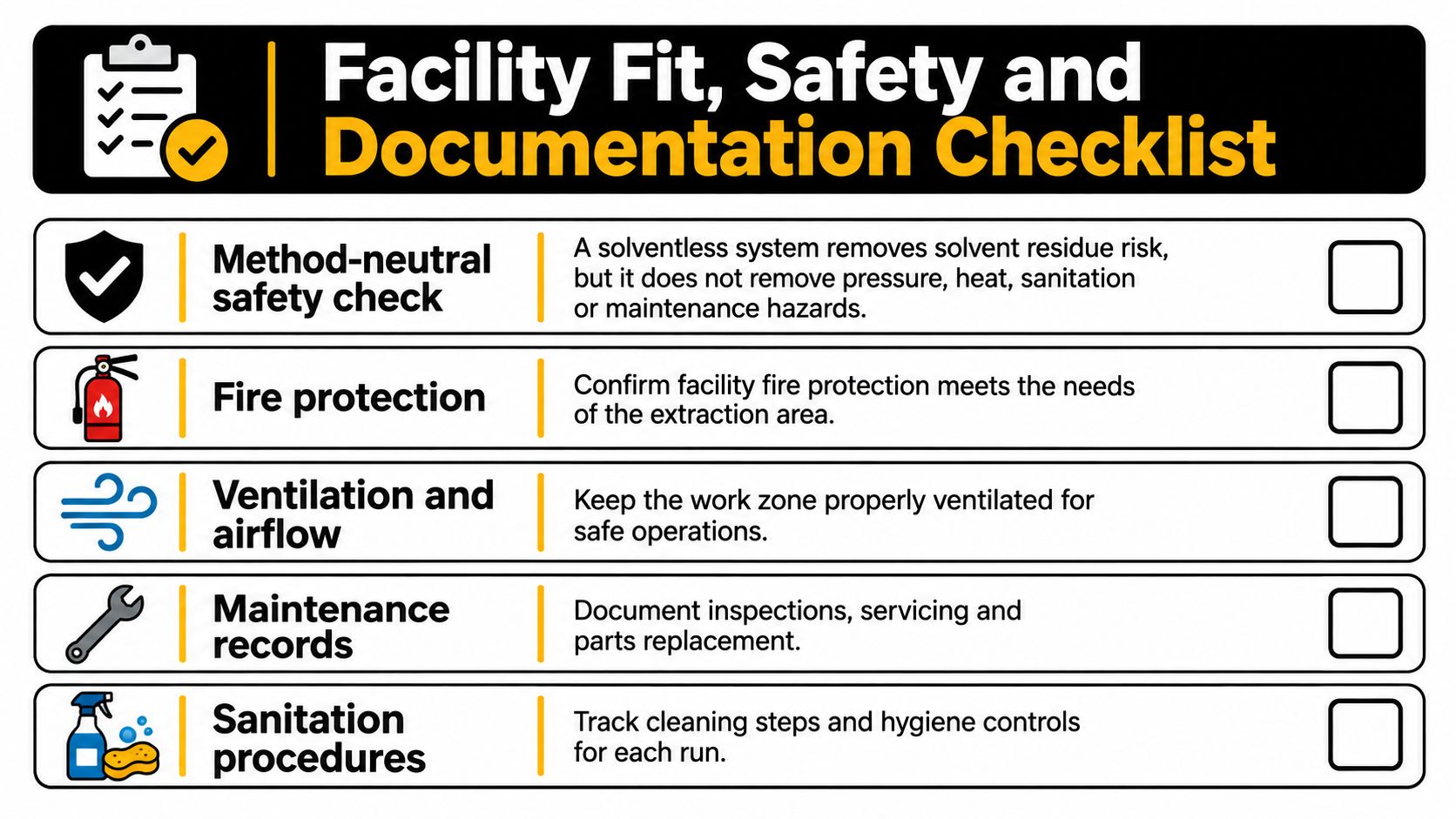
The National Fire Protection Association is developing NFPA 420 specifically because serious fires have occurred at cannabis growing, processing and extraction facilities. That's a cross-method problem, not a hydrocarbon-only one.
What the enforcement record shows
In a Colorado OSHA enforcement program, the Denver and Englewood offices ran 44 inspections over seven years and cited hazard communication in 29 of them (66%) and respiratory-protection deficiencies in 18 (41%), according to the OSHA enforcement directive on cannabis facilities. Those are paperwork and training failures, not equipment failures, which tells you the machine alone was never the safeguard.
Ventilation and electrical rules then set the physical bar. Oregon requires professional-grade closed-loop systems, licensed-engineer approval, code-compliant electrical work and explosion-proof or intrinsically safe ventilation, with minimum ventilation of six air changes per hour or one cubic foot per minute per square foot of solid floor, rising to three cubic feet per minute per square foot when flammable vapors reach 20% of the lower explosive limit, per Oregon OSHA's cannabis processor requirements.
The pre-purchase checklist
Take these seven questions to your engineer and your permitting office before you take them to a salesperson:
- Do the room volume and ventilation meet local code for this method?
- Is the electrical area classified for the solvent in use?
- Are pressure ratings and interlocks documented for every vessel?
- Is fire suppression installed and rated for the extraction area?
- Are permits and insurance in place for the process, not just the building?
- Has a licensed engineer reviewed the layout, including gas monitoring and emergency controls?
- Are SOPs, operator training records and maintenance logs current?
A machine that fails any of these gets dropped before the price conversation. Keep the safety data sheet basics within reach of every operator, because the first person to notice a problem is rarely the person who wrote the SOP.
Confirm Your Equipment Plan and Request Terpene Samples
Three confirmations close the equipment decision. First, the extraction method that fits your flavor target and your room. Second, a tested set of operating conditions with the numbers written down. Third, a documented facility fit that your engineer and your insurer will both sign. Get those three and the machine stops being a gamble.
The settings you just locked decide how much of the native terpene profile survived, so blending follows a short sequence that rebuilds what the run stripped.
- Pick a flavor target and a short list of blends or single compounds. Limonene, Myrcene and Beta-Caryophyllene cover a lot of ground on their own, and the 3ml Strain Picker Pack, your choice of any three profiles in 1.5ml or 3ml sizes, is built for terpene testing before you commit to a drum.
- Build a written batch formula that respects the dilution ceiling your market sets, with a dose range recorded for each lot. These blends are highly concentrated and need proper dilution before they ever touch oil.
- Test each candidate in your own distillate or cartridge oil rather than a lab solvent, because terpenes for distillate behave differently once they meet a real winterized base.
- Ask for certificates of analysis covering identity and contaminant testing before you approve a supplier, then keep those documents with the batch record.
Terpene dosing is where an extraction decision becomes a product. Gold Coast Terpenes supplies the blends, isolates and strain-specific profiles that make that last step repeatable, extracted from fresh plants and free of VG, PG, PEG and MCT, with SC Lab-tested terpenes for cartridges. The Mixing Calculator handles the dose math when a trial batch scales into a production run, wholesale pricing applies on strain orders over 64 oz, and dedicated programs exist for distributors, shops and independent reps, affiliates, and manufacturers and brands. Call 929-356-6086 with a formula in hand to work through the ratio, or visit Gold Coast Terpenes to shop blends, pick up a Picker Pack and explore bulk terpenes programs.