
Two lots of the same terpene blend leave your facility a month apart. The paperwork matches, the bottles look identical, and the person running the filler says the aroma is fine. Then a cartridge brand calls about a batch that tastes flat, and nobody can point to the day the drift started.
Aroma is a weak instrument for this job. The nose catches a big shift, but it misses the changes that matter more in manufacturing: one monoterpene dropping a few points, a terpene oxide forming, a profile sliding from sharp citrus to something duller while the total terpene number on the COA barely moves. Those are the changes that make two lots stop matching a target flavor.
The short answer to how to preserve terpenes in a production setting isn't one magic temperature. It's a per-blend decision about temperature, light, oxygen and handling, backed by analytical retention testing on the actual material you ship. Get the basics right and most blends hold for months. Skip them and no amount of flavor matching saves the lot.
Storage Targets for Terpene Blends at a Glance
| Factor | Target | Why it matters |
|---|---|---|
| Temperature | Below 25°C, steady | Heat speeds volatilization and secondary reactions |
| Refrigerated extracts | About 4°C, only after testing | Refrigeration tends to preserve terpenes better than room temperature in published cannabis storage research, but the optimum shifts with the blend |
| Relative humidity | 50-60% | Keeps the storage space stable and limits moisture swings |
| Light | Dark or amber-protected | UV and daylight drive loss and can shift composition |
| Oxygen | Minimal headspace, inert gas if feasible | Oxidation creates new compounds, not just lost aroma |
| Handling | Open as little as possible, avoid repeated warming | Each opening adds air and each warm cycle speeds loss |
| Stability check | Retained sealed samples tested at set intervals | Aroma alone misses chemical drift |
Print that and walk your storage room against it this week. Every row you can't meet is a risk you're carrying into the next production run.
Temperature is the row most facilities get half right. A room set to 22°C looks compliant until someone checks the swing between a weekend shutdown and a Monday morning startup. Published cannabis storage research generally finds that refrigeration around 4°C preserves terpenes better than room temperature, yet every tested condition still shows measurable terpenoid decline over long holds. Nothing is fully stable. Some conditions are just slower, and finding out which one your blend needs is the point of retention testing.
Form matters as much as setpoint. More exposed surface area means faster volatilization and oxidation, so ground or high-surface material loses profile faster than whole or dissolved material under the same conditions. And colder is not automatically safer. Deep-freeze setpoints can underperform simple refrigeration for some preparations, which surprises teams who assume the lowest available temperature is the conservative choice.
Refrigeration is a tested option, not a default. A formulation's carrier, water content, viscosity and intended use can all move the optimum away from 4°C. Prove it on your own blend before you commit a SKU to a cold chain.
The remaining rows cover what temperature alone can't. Humidity near 50-60% keeps the storage space from swinging. Sealed, dark, low-oxygen containers slow the cumulative loss that no single control fixes. Fewer openings means fewer air exchanges over the life of the bottle. A facility that only chases a setpoint usually still sees drift, because each row closes a different loss pathway.
If your room can't hit a row, write that down. A gap between the target and your reality is exactly what a stability test needs to cover before you scale the SKU.
Build a Low-Loss Storage and Oxygen Routine
Post this at the bench. The order matters less than running all seven every time, because each step closes a specific loss pathway.
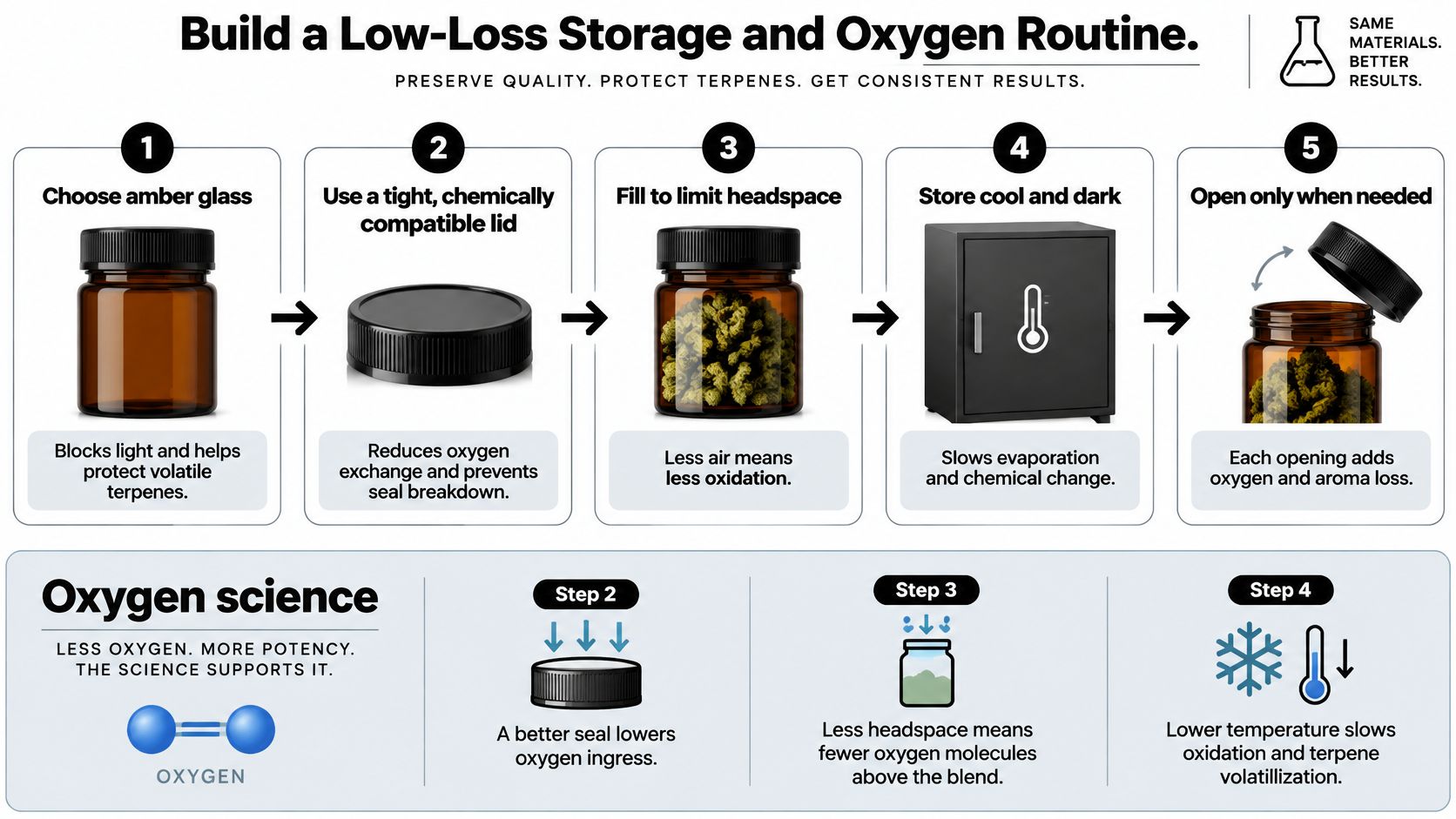
- Choose amber glass with a tight, chemically compatible cap, sized so the blend nearly fills it. Light protection and a good seal are the two cheapest wins available to you.
- Fill to the smallest headspace the batch allows. The air above the liquid holds oxygen and collects the volatiles that leave the blend.
- Purge the headspace with nitrogen when the lot is large enough to justify the equipment. It buys time against oxidation. It does not guarantee the profile, so keep testing.
- Work under low light and cap the container between doses. Every opening exchanges air and lets aroma compounds walk out.
- Label lot, fill weight and date, and log the release profile by GC-MS. Without a baseline, later drift is invisible.
- Store in a closed cabinet below 25°C at 50-60% relative humidity. Move a SKU into a refrigerator only after your own test supports it.
- Pull a retained sample at set intervals and compare it with the release profile. This is the only check that catches a change the nose misses.
Why the oxygen steps carry the routine
Steps 2 through 4 all attack the same mechanism. Terpene oxidation doesn't just remove molecules, it converts them. Research on terpene-containing packaging systems reports oxidation products including alcohols and ketones, which means a blend can change character rather than fade.
That same work found the chemical form of a zeolite oxygen scavenger changed the result: sodium and copper variants accelerated terpene oxidation, while hydrogen forms inhibited it. The takeaway isn't to buy a scavenger. It's to compatibility-test one before it goes anywhere near a production batch.
Say a half-used 500 mL bottle sits uncapped on a warm bench for six weeks because the run only needed 200 mL. It pours the same and looks the same, but its headspace has been exchanging air the whole time. Test it before it enters a batch, not after the carts are filled.
If you want the short version for the people on the filler, this walkthrough covers the same ground in a few minutes.
The common slips are clear bottles, loose or cross-threaded closures, and repeated warming during dispensing, where a bottle leaves the fridge for every draw and goes back in. Each warm cycle pushes volatiles into the headspace, and the next cool cycle doesn't return them. For a deeper look at the chemistry, this guide on how to prevent oxidation in stored blends walks through the mechanisms.
A bottle that smells different after weeks open gets tested before it enters a batch. Aroma is grounds for a test, not a substitute for one.
Choosing Containers That Block Light and Air
| Container | Light protection | Air barrier | Best use |
|---|---|---|---|
| Amber glass | High | High | Bulk stock, oils and finished blends |
| Clear glass | Low | High | Only inside a dark cabinet or box |
| Closed HDPE box | Moderate, opaque but not UV-rated | Moderate, more permeable than glass | Short-term holding, test before use |
| Open tray | None | None | Not recommended for blends |
Glass won the comparison, but not by acclamation. In a 2024 study of dried Cannabis sativa inflorescences, samples were held for six months at 18°C and 60% relative humidity across open-air trays, closed high-density polyethylene boxes and glass bottles. Glass appeared more beneficial for retaining the original volatile-organic-compound profile than the other two approaches, and none of the tested systems perfectly maintained the post-drying profile.
The same paper reports a 2024 stability analysis in which terpene concentration fell over time, α-terpinene degradation accelerated under ultraviolet light, and limonene held up comparatively better against heat and UV. Some degradation patterns plateaued after roughly 16 days under those experimental conditions.
Walk the options in the order a buyer would:
- Amber glass is the default for bulk stock, oils and finished blends. Confirm the liner before you commit, because some liners swell or soften on contact with terpene-rich oil.
- Clear glass is fine only when it lives inside a dark cabinet or a boxed outer. On a sunny bench it's a slow leak.
- Closed HDPE boxes suit short holding, not long-term stock. Permeability is higher than glass, and the plastic itself may sorb aroma compounds.
- Open trays have no place in a finished-blend workflow. They combine maximum air exchange with maximum light.
Check closures for loose lids and cracked threads, and match bottle size to batch size so leftover volume stays small. Wall sorption is real enough that I would test a sample in the exact container before filling a full run. On cartridge fills, don't overfill, let the blend equilibrate before capping, and record which container each lot used so a complaint can be traced to packaging rather than guessed at.
How Light Changes the Terpene Makeup
Light doesn't just lower aroma intensity. It rearranges the profile. Research on Satureja montana essential oil found that light exposure cut alpha-terpinene from 2.1% to 0.9% and gamma-terpinene from 5.6% to 4.7%, while p-cymene rose from 24.2% to 25.9% and trans-caryophyllene fell from 5.1% to 4.3% (SciELO report on light-driven terpene change).
A separate review in that work reported alpha-terpinene in rosemary oil dropping below 10% of its original level after three weeks at 38°C in daylight, while it remained unchanged at 25°C in darkness.
Read the p-cymene number carefully. It went up while the terpinenes went down, which is the signature of conversion rather than evaporation. The total terpene count can look healthy while the balance that produced your target flavor has moved.
What a flavor team should do about it
- Store bulk stock in amber or opaque containers inside closed cabinets, not on open shelving under production lights.
- Keep caps open for as little time as possible on the mixing bench. A cap off during a shift change is a light and air event.
- Never park clear transfer vessels under production lighting for extended periods. Decant, dose, cover.
- Choose finished cart and oil packaging that limits light transmission, especially where product will sit in retail displays or warehouses for months.
For a highly light-sensitive profile, incoming material checks should compare odor and analytical results together. Ask suppliers how blends are packaged, labeled and protected during shipment, because the exposure may already have happened before the box reaches your dock. One more caveat: these results come from essential oils, so confirm the effect on your own blend rather than assuming the same magnitude. The background on terpene transformation and how environmental factors influence flavor is useful context for setting those checks.
Mix and Dose Blends Without Losing Profile
Blending is where a good storage plan gets wasted in an hour. Start with the math. A 2% blend in a 1 kg batch needs 20 g of terpene, and that 20 g should be weighed, not estimated from a graduated cylinder. Density shifts with temperature, and a small volume error at a 2% dose rate is a real percentage error in the flavor.
- Confirm compatibility and run a small test mix first. Some carriers separate or cloud at higher dose rates, and you want to find that in a 50 g trial, not a 20 kg batch.
- Pre-stage only the volume the run needs. Decanting a full drum to draw 30 g leaves a large headspace on the rest of the stock.
- Add the terpene blend to the carrier under low light, with clean, dry equipment. Water in the line or on the mixing head drives haze and can accelerate degradation.
- Keep the blended material covered between dosing and filling. The gap between a mixing tank and a filler is often the longest open-air period in the whole process.
- Dose a reference lot and the new lot at the same ratio and compare them side by side. Odor and GC results together, before the batch is released.
Carrier choice changes the loss rate. Extracts held in oil have retained their terpenoid content better than the same material held dry in published storage work, which is a reason to test each carrier instead of assuming a formula is safe because a similar one was. Viscosity, water content and the oil matrix all shift how quickly volatile compounds leave.
The right ratio depends on the product and the flavor target, not a universal rule. Set it from your formulation, record it on the batch sheet, and treat every change as something to verify. Our guide on how to use terpenes covers the handling basics around dosing.
How to Test Stability for Each Blend
A recent study of dried cannabis stored under nitrogen-modified atmosphere found limonene, beta-pinene, alpha-pinene, camphene and terpinolene all decreased. Monoterpenes decreased 62% more under nitrogen than under atmospheric storage, while sesquiterpenes increased 50% more under nitrogen (Springer, 2024 nitrogen-atmosphere storage study).
That's plant material, not a formulated blend, so don't carry the numbers across. The transferable point is that a total terpene number can hold steady while the profile underneath rotates, and an inert gas doesn't automatically protect you.
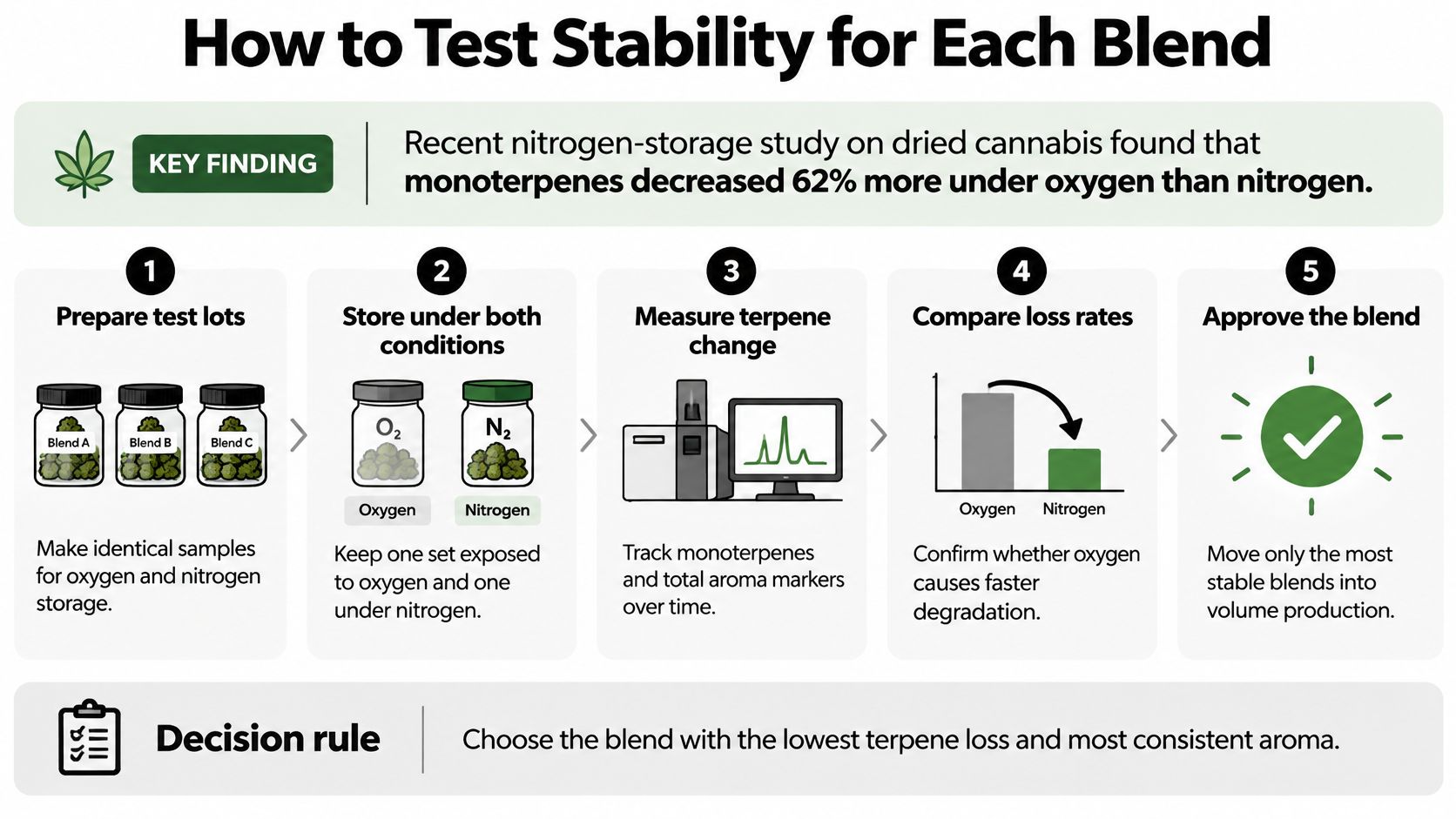
Setting limits before the first sample
- Define acceptance limits before testing. Write down the allowed change in key marker compounds, total terpene content, viscosity and sensory profile.
- Hold samples at the intended storage condition and at an accelerated condition so slow drift shows up inside a practical window.
- Quantify key compounds by GC-FID or GC-MS at baseline and at each scheduled interval.
- Retain sealed samples from every lot and test them across the planned shelf life, not only at release.
- Inspect for leakage, clouding or color change at each pull, because those show up before the chromatogram does.
- Record the container, headspace, temperature, light exposure and duration with every result. A number without its conditions can't be reproduced.
| Checkpoint | Condition | What to record |
|---|---|---|
| Baseline | Release lot, sealed | GC-FID or GC-MS profile of key monoterpenes |
| Intended storage | Target room, retained sealed sample | Profile at each scheduled interval |
| Accelerated | Elevated temperature, same container | Profile at each interval to measure drift |
| Visual check | Every interval | Leakage, clouding or color change |
| Test record | Every result | Container, headspace, temperature, light and duration |
When you qualify a supplier, ask for stability data that names the tested package and conditions, not a general shelf-life statement. Then compare it with your own results on the same blend in your own container. Testing for terpenes properly is the difference between a spec sheet and a working quality system.
Next Steps to Confirm Your Storage Plan
A storage plan only counts once it survives contact with a real lot. Before the next delivery lands, lock the spec that will hold it, then work in this order.
- Audit your current space against the targets table and flag every row you can't meet. Most facilities fail on temperature swing or on how often containers get opened, not on the setpoint.
- Plan a stability run for each flagged row, using the checkpoints table to set intervals, containers and records.
- Start your retention curve on the blend you intend to run, in your own container, so the drift data reflects your headspace and your handling instead of a supplier's general shelf-life statement.
That last step is where aroma checks fall short. A blend can smell right while the faster monoterpenes are already drifting, so the retention data has to come from the chromatogram, lot by lot.
For bulk orders, call Gold Coast Terpenes at 929-356-6086. The Terpene Safety & Documents page carries the safety paperwork for the blends, which are botanically derived, and the cartridge terpenes are SC Lab-tested. If you are still matching a flavor target, the strain profiles and isolates are browsable on the site, grouped by attributes like relaxation and focus.
The goal is simple: stable terpenes from receiving to filling.
Gold Coast Terpenes supplies botanically derived blends, strain-specific profiles and isolates such as limonene, myrcene and beta-caryophyllene, all built for cartridge, distillate and formulation work, with documentation you can put behind your own retention testing. If your storage spec needs real numbers instead of a general shelf-life claim, run your retention curve on the blends you plan to scale. Visit Gold Coast Terpenes to browse the blends, isolates and safety documents.