
The advice you hear most about this category is that everything comes down to the terpene blend. Pick a good profile, push the load a little higher for a stronger smell, and the product sells itself. That advice is wrong often enough to be expensive.
A premium blend poured into oil that sat in a warm room, filled into a cartridge with unidentified metal parts, and released against a certificate that covers only the terpenes is not a premium product. It's an undocumented one. The flavor is the last thing that fails and the easiest thing to blame.
Dab supplies work as one system. Terpene blends, isolates, carriers, cartridge hardware, packaging, storage conditions and the records behind each of them either reinforce each other or fight each other. A flavor complaint frequently traces back to a coil running hotter than the label claims and a seal that has been sitting in the oil for a month, not to the blend.
This guide is for the people building the product: extractors, cartridge manufacturers, brands and wholesalers who buy terpene blends by the liter and need the batch to behave the same way twice. It covers what to buy, what to request before a lot is released, and where the money goes.
Dab Supply Categories and What Each One Does
| Category | What It Covers | Where It Fits in Production | What to Request |
|---|---|---|---|
| Terpene blends | Botanically derived aroma and flavor blends | Added to winterized distillate or cartridge oil to set the finished profile | Certificate of analysis, ingredient list, batch record |
| Isolates | Single compounds such as limonene, myrcene and beta-caryophyllene | Used to adjust one note in a finished profile | Identity and purity report per lot |
| Diluents and carriers | Carrier oils such as MCT oil | Dilute or carry terpenes into the formula | Ingredient list and permitted-ingredient check |
| Cartridge hardware | Cartridges, coils and seals | Assembled with the filled oil into finished carts | Material list and heavy-metal data |
| Packaging and storage | Glass or validated polymer containers with airtight, light-resistant seals | Holds bulk oil and finished goods | Material compatibility record |
| Testing services | Potency, contaminant and residual solvent panels | Lot release before production | Lot-specific certificate of analysis |
Read that table as a bill of materials, not a shopping list. The market behind it is wider than the dabbing conversation suggests. According to the National Survey on Drug Use and Health, the share of respondents reporting past-year concentrate use rose from 17% in 2018 to 25% in 2023, while past-month dabbing stood at 2.4% in 2022. Concentrates are the category. Dabbing is one route into it.
Terpene blends set the finished aroma and go into winterized distillate or cartridge oil at the end of the process, after the base is clean and tested. Isolates are the correction tools. Limonene sharpens citrus, myrcene softens and rounds, beta-caryophyllene adds a dry peppery edge. You buy them when a blend is close but not right.
Carriers come next, and they're where paperwork gets thin. A carrier is only as good as its ingredient list, because the permitted-ingredient framework in your target state decides whether it can be in an inhalable product at all.
Hardware, packaging and testing complete the system. Cartridges need a material list. Containers need a compatibility record. Every lot needs a certificate with a lot number and a test method, not a generic spec sheet.
Three checks before you place an order:
- Which category is missing from your bill of materials? Most small brands have a blend and a bottle and nothing in between.
- Which document would stop you from releasing a lot today?
- Can one supplier give you the blend and its records, or are you assembling the file yourself?
Order sizes should follow the product lines you plan to sell, not the discount tier.
Compliance Limits Every Formula Must Meet
There's no universal safe terpene percentage, and any supplier who hands you one number as an answer is guessing. A terpene figure is a compliance input and a formulation decision. It isn't proof that a finished aerosol is safe.
Start with the ceiling in the market you're selling into. New York's 2025 testing guidance limits inhaled cannabis products to 10% total terpenes, with a permitted analytical variance up to 11.5%, and requires terpene content to be reported by weight (Frontiers in Toxicology). The same research found that vaping cannabis concentrates can generate aerosol toxicants including isoprene and several aldehyde- and alkene-related compounds, because cannabinoids and terpenes are thermally labile and react during heating. More terpene is not automatically better, and "natural" doesn't mean risk-free once the blend meets a hot coil.
California works the problem from the ingredient side rather than the percentage side. The state limits ingredients in cannabis products intended for inhalation to cannabis, cannabis concentrate, terpenes, rolling paper, leaf, pre-roll filter tips, and ingredients the FDA recognizes as inactive for inhalation (California Department of Cannabis Control). Artificial, synthetic and natural flavorings or terpenes that don't contribute to cannabis's natural aroma or flavor are not permitted there, so a dessert-sounding blend fails regardless of its percentage if the flavoring behind it has nothing to do with the plant.
Working rule: let the jurisdiction set your upper limit and let your pilot set your lower one. Never the other way around.
A three-step workflow for every formula file
- Confirm the ceiling for the target market. Written down, with the guidance document and date attached.
- Record the mass-based percentage and the lot number of every ingredient. Weigh the terpene addition. Volume measurements drift with temperature and viscosity.
- Send the full formula to jurisdiction-specific testing and regulatory review before launch. The carrier and the hardware go in the file alongside the terpene spec.
A document trail that survives an audit is the same trail that survives a customer complaint. Keep a dated file for each market you sell into, built against a regulatory compliance checklist so the structure stays consistent when you add a second or third jurisdiction.
How Much Terpene to Add per Batch
Dose is a system decision. The percentage has to satisfy the market limit, keep the oil moving through the hardware, and leave a batch record that can be checked later. Use these as pilot loads on a 100 g basis, not as legal targets:
| Pilot Terpene Load | Terpene Blend (g) | Base Oil (g) | Use Note |
|---|---|---|---|
| 2% | 2 | 98 | Light pilot; checks whether the profile reads in the base |
| 5% | 5 | 95 | Common cartridge working point; watch wick speed |
| 8% | 8 | 92 | Heavy pilot; viscosity and coil behavior usually decide |
| 10% | 10 | 90 | High-load stress test only where the market permits it |
Every number in that table is mass, so every addition gets weighed on a scale. Measuring terpene by volume means your 2% batch and your 5% batch disagree about what a milliliter weighs, and you'll chase the difference through three blend revisions. Concentrated terpene products also need proper dilution before use, so the scale is part of safety as well as consistency.
Legal ceilings vary by jurisdiction and product category, and some markets also restrict which terpenes or flavor inputs may be used at all. Treat any cap as a constraint rather than a goal: write the applicable limit, the actual formula percentage, and the percentage range of each ingredient into the batch file before release.
Worked example for a 1,000 g batch
Say you're running 1,000 g of distillate at 6%. That's 60 g of blend and 940 g of oil. Weigh the oil in first, then the blend, then mix at low shear and warm enough to move viscosity without driving off the light volatiles you paid for. Bottle into a container sized to the batch, not the container you have open.
For a first run, don't start at 8%. Ladder it:
- 2% pilot. Establishes whether the profile reads at all in your base. Some distillates carry so little residual aroma that 2% is plenty.
- 5% pilot. The usual working range for cartridges, and where most hardware checks pass or fail.
- 8% pilot. Upper end. Heavier loads thicken oil, which changes how fast it wicks and how the coil performs.
If viscosity climbs and pulls slow at 8%, dropping to 5% is a formulation fix, not a compromise. Flavor strength you can adjust with the blend choice. Wick performance you can't fix with more heat.
The record to keep after every run: the exact terpene percentage used, the full ingredient list with lot numbers, and the percentage range of each ingredient in the mixture. Our guide to adding terpenes to distillate walks through the mixing sequence.
Choosing Blends and Isolates for Flavor Matching
A brand wants a fruity, dessert-leaning finish in a distillate cartridge. There are two routes to that brief, and they cost different amounts of time.
The first is a ready-made botanically derived blend built around a recognizable profile. You request a sample, dilute it at 5%, and know within an afternoon whether it lands. The second is a custom build from isolates, using limonene for the bright citrus lift, myrcene for the soft body, and beta-caryophyllene for the dry finish. You get finer control over a single note and considerably more work.
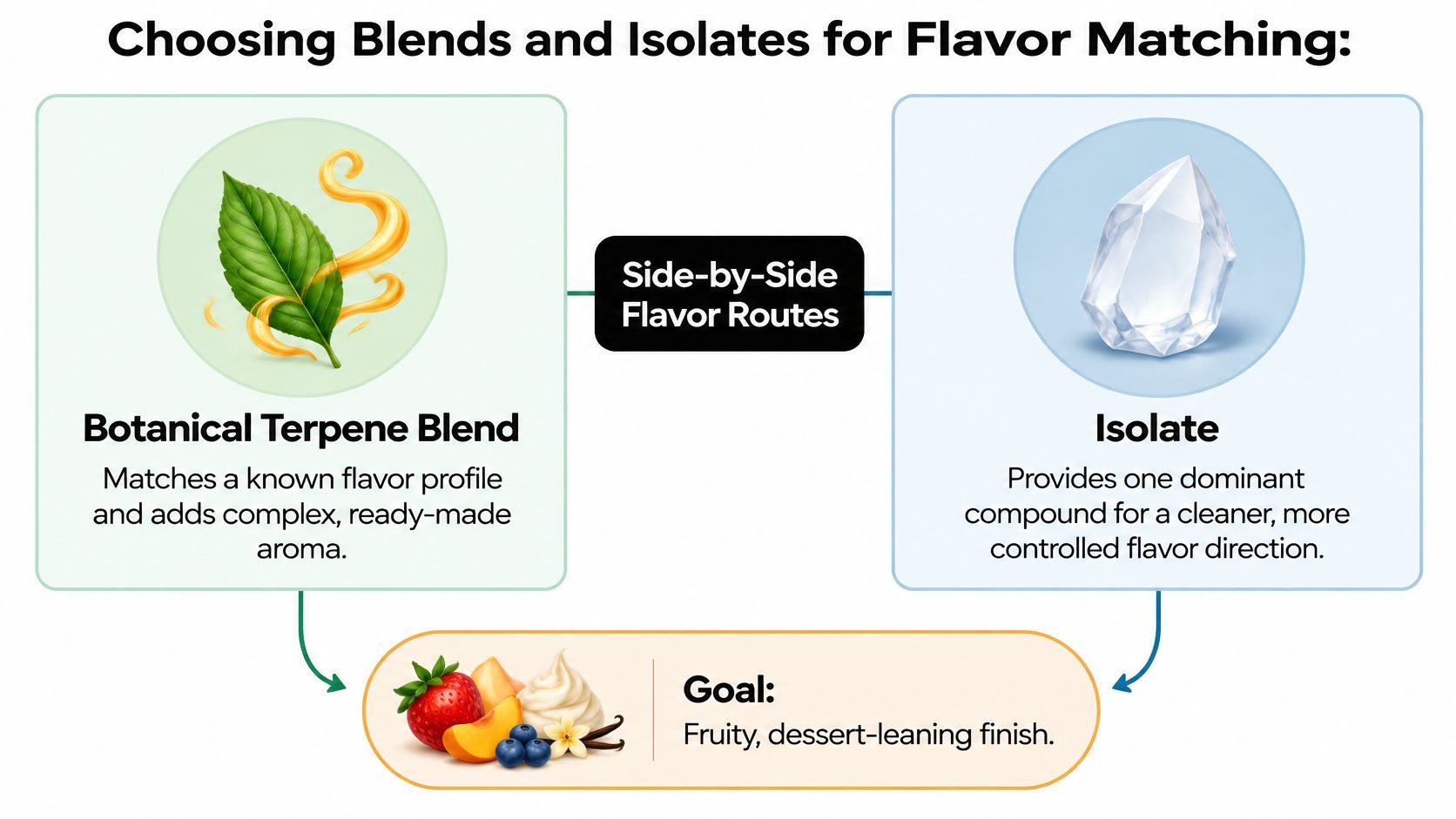
Blends win on speed and consistency. If your target is a profile buyers already recognize, a blend gets you a repeatable result without a formulation project. Isolates win on precision, and they're the right tool when a blend is 90% of the way there and one note needs lifting or muting.
What's allowed matters more than what's familiar. California's inhaled-product rules restrict added terpenes to compounds that occur naturally and contribute to cannabis flavor or aroma, and those terpenes do not have to be cannabis-derived (California DCC inhaled products guidance). A botanically derived blend is acceptable when it matches the permitted natural terpene profile and does something real for the product's aroma. Ask for the ingredient identities and batch information so you can show what was added and why.
Here's the mixing bench part most formulators skip. Keep a written flavor-matching rationale for each blend, particularly when isolates adjust a finished profile. One paragraph per SKU: target profile, compounds used, percentage of each, and why that compound was chosen.
The decision comes down to three cases:
- Target matches a known profile. Use a blend. Spend the saved weeks on hardware validation instead.
- One note is off. Use an isolate to correct it, then document what you changed.
- Every change gets a pilot. Run the 2%, 5% and 8% ladder from the dosing section before you touch a production batch. Our guide to working with terpene isolates covers dilution math and handling.
Hardware, Storage and Testing Records to Require
A blend that survives the lab can still fail in the cart. Treat terpenes, carrier oil, hardware, storage and paperwork as one system: the weakest seal, coil surface or missing lot record decides what the customer inhales.
| Component | Main Risk | What to Request |
|---|---|---|
| Cartridge shell and metal parts | Metals can appear in oil and aerosol | Heavy-metal results per lot for wetted parts |
| Coil and atomizer | Surface temperature varies by device | Temperature validation across the usable power range |
| Seals and gaskets | Components can leach into oil over storage | Extractables and leachables data in contact with the formula |
| Glass or polymer reservoir | Material may react with terpene-rich oil | Material compatibility record for the exact oil type |
| Mixing vessel | Residue can carry over between batches | Cleaning validation record and changeover limit |
The device is a contamination source
Hardware can contribute metal contamination in pipes, vapes and dab rigs, so judge the assembled device as well as the inputs (Cannabis Industry Journal). A clean certificate for oil and terpenes shows the inputs passed; it does not clear the cartridge after filling, sealing and heating.
Temperature is the other variable buyers rarely validate. Real-world measurements show substantial spread: mean temperatures of roughly 206 ± 31 °C for portable devices, 192 ± 10 °C for tabletop devices, and 234 ± 64 °C for dab rigs (medRxiv preprint on concentrate vaporization). The display number is often a coil setpoint, not the surface the oil meets. I would validate surface temperature across the power band customers use, then set the blend and viscosity window around that result.
Storage degrades the product and the packaging
Device hardware keeps working after filling. A review summarized evidence that metals including copper, mercury, manganese and nickel increased in cannabis-vape liquids after three weeks at 25 °C, with chromium, lead, tin and cobalt appearing after longer storage and heating to 42 °C accelerating the concern (Environmental Science & Technology). Screen the finished concentrate and assembled cartridges separately; seals, coils and metal surfaces can change the formulation after the bulk oil passed.
Store cool, airtight and light-resistant, with headspace sized to the volume. Run shelf-life studies at intended and accelerated conditions, and track potency, oxidation markers, viscosity, color and sensory drift through the full cycle.
Records to pull for every lot
Required panels differ by market, so pull the rule for the destination before approving a supplier. Treat that file as a release gate, not a flavor note.
For each lot, request:
- A current certificate of analysis with lot number and test method named.
- A contaminant panel covering heavy metals, microbials and residual solvents.
- A batch record linking the lot to the formula and the terpene percentage used.
- Stability data at intended and accelerated conditions.
Gold Coast Terpenes provides terpene information from SC Labs; hold every component supplier to the same document standard. Review in this order: material list first, supplier data second, a pilot build third, and a retest after repeated heating cycles.
Request Samples and Confirm Your Supplier
The sequence that saves the most money runs in one direction and doesn't skip steps.
- Confirm the target market and its terpene ceiling. Write the number into the formula file before a single sample is opened.
- Build a pilot sheet with 2%, 5%, 8% and 10% rows, each with its own weight column.
- Request samples and lot documents together for every blend under consideration. Start from the terpene samples page and ask for the certificate of analysis and batch record tied to each lot before you schedule the pilot.
- Scale only after the pilot passes flavor, viscosity and hardware checks.
Bulk buyers should compare cost per batch against the pilot numbers rather than cost per ounce. A blend that needs 8% to read costs more per gram of finished oil than one that lands at 5%, even at a higher bottle price. That math only works if the pilot sheet recorded exact weights, so keep those columns honest.
For side-by-side testing, the 3ml Strain Picker Pack lets a team choose any three different terpene profiles from the catalog in 1.5ml or 3ml sizes. Three profiles against one base oil tell you more in a week than a single full-size bottle tells you in a month. We run programs for manufacturers and brands, distributors, shops, independent reps and affiliates, so the commercial terms can match how you buy.
Run the samples, keep the paperwork, and let the pilot decide.
Gold Coast Terpenes supplies botanically derived terpene blends and isolated compounds, with terpene information provided by SC Labs and documentation that matches what your formula file needs. Start with a small order to test profiles against your own base oil, then move up, with wholesale pricing available on strain orders totaling over 64oz. Visit Gold Coast Terpenes to shop blends, request samples, or talk through a custom or bulk order.